79 résultats
18173707077Paris: Deterville 1817. Some foxing to the plates. Four volumes octavo 15 engraved plates by C.-L. Laurillard a handsome set with all four half-titles in original quarter calf over mottled papered boards gilt double spine labels in red & green. <p><p>First edition of this germinal work of natural history with three volumes by Cuvier himself and the fourth an important study of insects by his friend and colleague Latreille.</p> <p>Recognised as the father of comparative anatomy Cuvier published widely throughout his lifetime but this was his most famous and influential work and contained the results of all his previous research on the structures of living and fossil animals. It was based upon his vast knowledge of zoological anatomies and in it he applied Linnæus' system of nomenclature and classification to the whole animal kingdom in the process establishing his four great classes: vertebrate molluscous articulate and radiated.</p> <p>Cuvier's work is a benchmark for many reasons not least for the third volume present here which is actually the work of Pierre André Latreille Professor of Entomology at the Paris Museum: Latreille's contribution was not only a significant contribution to his field but he had earlier been heavily involved in characterising the insects collected on the Baudin voyage to Australia and the Pacific. In the present volume Latreille sought to update the foundation work of scholars including Fabricius within Cuvier's framework; as a result Latreille included here many Australian insects including two the 'Rhipcera' and the 'Heleus' noted for the first time.</p> <p>Cuvier born in 1769 was invited by Geoffroy Saint-Hilaire to come to Paris in 1795. He took an appointment at the newly-formed Muséum nationale d'histoire naturelle where he remained until his death from cholera in 1832. He had first publicly canvassed his new quadripartite schema of the animal kingdom in an 1812 presentation to the Academy of Sciences but it was in this work that he first detailed how this proposed division worked in practice. Here each of the classes is discussed in a separate volume with volumes I II and IV by Cuvier himself; his organizations of fish families in particular 'were so soundly based that they have become orders or suborders in present classification' DSB.</p> <p>Throughout his career Cuvier held to the premise of Le Règne Animal that the four branches were fundamentally different and that any similarities between them were due entirely to common functions rather than common ancestry. He did not believe that is that there was any evolutionary adaptation a stance which put him in open conflict with his contemporaries such as Buffon Lamarck and Geoffroy. This led to the famous debate between Cuvier and Geoffroy at the Académie Royale des Sciences in Paris in 1830.</p> <p>Cuvier's towering position in the French natural sciences should be seen in the context of a very cynical view of his ambitions towards intellectual ownership of the science on Freycinet's voyage an idea explored in correspondence between Faujas de Saint Fond and Louis de Freycinet.</p> </p> . Deterville unknown
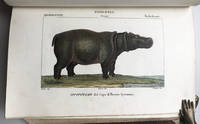
1837Flo442<p>Complete set of the plate volumes from the first Italian edition of the monumental French <em>Dictionary of Natural Sciences </em></p><p>1240 finely engraved plates with splendid hand colouring numbered 1 to 1200 but with multiple bis plates</p><p>The plates by Jean-Gabriel Prêtre worms and zoophytes shells insects and crustaceans birds mammals fish herpetology and Pierre Jean Francois Turpin botany. Newly engraved by Italian engravers Corsi Verico Cignozzi Luigi Giarre Stangli Bozza Zignoni etc.</p><p>Includes many extinct fossil species and dinosaurs as well as recently extinct species such as the Bubal Hartebeest Alcelaphus buselaphus buselaphus auroch Bos urus quagga Equus quagga quagga Cuban red macaw Ara tricolor etc.</p><p>Several critically endangered species such as the Screwhorn antelope Addax nasomaculatus and European eel Anguilla anguilla as well as endangered species including the Chinese forest musk deer Moschus berezovskii Indian rhino Rhinoceros unicornis Orang utan Pongo pygmaeus silvery gibbon Hylobates moloch polar bear Ursus maritimus white-fronted spider monkey Ateles belzebuth Green sea turtle Chelonia mydas etc.</p><p>The original published in France from 1816-1830 was the work of well-known scholars including Frédéric Georges Cuvier Antoine Laurent de Jussieu Charles Dumont de Sainte-Croix André Marie Constant Duméril Anselme Gaëtan Desmarest Hippolyte Cloquet Henri-Marie Ducrotay de Blainville etc. This Italian translation was published in Florence from 1830 to 1850.</p><p>All the plates directed by Pierre Jean Francois Turpin 1775-1840 one of the greatest botanical artists of the Napoleonic era along with Redoute and Bessa. When serving in the French army in Haiti in 1794 Turpin met botanist Pierre Antoine Poiteau and switched careers. His skill as an artist was recognized by botanists such as Poiret Humboldt Duhamel du Monceau and Candolle. Turpin provided the majority of the plates for <em>Flore Medicale.</em> Turpin drew all the botanical plates in this work along with his son who died tragically at age 18.</p><p>Jean-Gabriel Prêtre 1768-1849 was a Swiss-French natural history painter who illustrated a large number of books for Cuvier Louis Pierre Vieillot René Primevère Lesson Comte de Lacépède Richard Achille and many other French zoologists.</p><p>Half morocco spines with gilt title and volume labels in leather marble paper boards with a wood-grain pattern boards scuffed and worn. Some spotting to the index text pages at the front of each volume but most plates clean and bright on very white paper the fine stipple engravings with vivid colour. A few plates with childish colouring a few with large spots of foxing or age toning and one torn with loss of lower 3cm. Ex-libris bookplates of Periclis Staderini in all volumes. Bindings have been treated with a protective celloluse coating.</p> V. Batelli e Figli hardcover
182557403Paris: Dufour et E. D'Ocagne 1825. Third edition. Quarto 32cm. Seven volumes complete in modern half black morocco green cloth over boards titled in gilt on spines and fronts; modern marbled endpapers; vol. I: vi194340pp; vol. II part I: ivIV2371229-232pp; vol. II part 2: iv239-648pp; vol. III: iv412pp; vol. IV: iv514pp; vol. V part 1: iv4051pp; vol. V part 2: iv 5471pp; 277 engraved plates including frontispiece one plate with hand color and 2 maps 1 letterpress folding table. Straight and sound with occasional scattered browning and soil a few page corners neatly restored one plate margin trimmed close to image area but largely clean and bright: Very Good. Third edition of the work in which Cuvier demonstrated the reality of extinction through detailed examination of fossils; a cornerstone work in paleontology biology and geology. Earlier editions appeared in 1812 and 1821-24. When Cuvier began his research in the late eighteenth century it was generally believed that no species had ever gone extinct. "Taking for his field the little-known fossil quadrupeds and applying to them the principles of comparative anatomy Cuvier astonished the world by reconstructing prehistoric forms of animal life whose existence had never been suspected" Glass Temkin & Straus Forerunners of Darwin 253. He established extinction as a fact demonstrated that the age of the earth was greater than six thousand years and did much to establish the fields of comparative anatomy and paleontology. <br /> <br /> However Cuvier forcefully opposed pre-Darwinian theories of evolution. In the introduction to Ossemens Fossiles later published separately as Discours sur les révolutions de la surface du globe 1826 Cuvier argued in favor of catastrophism-the theory that violent catastrophes like the Biblical flood had caused extinction events and shaped geological features. This theory left room for contemporaries to infer a divine force that caused catastrophes and created new species; thus his research "provided a safety valve . . . between the push of geology and the drag of theology" Forerunners 255. His theories were in part disproven by Darwin and Lyell who demonstrated that both species and geological formations undergo gradual change over time; but Cuvier's ideas about catastrophism were vindicated by more recent research into mass extinction events caused by volanic eruptions and asteroids. This edition not in Ward/Carozzi. Dufour et E. D'Ocagne unknown
1812154897Paris: Chez Deterville 1812. hardcover. very good. 4 volumes. Illustrated with 154 splendid copperplates many folding and and an additional folding hand-colored geognostical map of Paris and vicinity. Each volume several parts with distinct pagination. 4to bound in early calf-backed boards with red leather labels spines are brittle and somewhat damaged at edges uncut edges. Paris: Chez Deterville 1812. First edition. Internally excellent copy with wide- margins and only faint scattered foxing.<br/> <br/> Through the method of reconstruction of what ancient mammals must have looked like on the basis of bone and other fossil remnants "Cuvier created the science of paleontology in the modern sense. At the same time he largely reformed the system of zoological classification by introducing fossil animals into it" Nordenskold. "His concept of geological revolutions which he believed to be a regular and natural part of earth's history was used to explain the mass extinction of species from previous opochs" Norman 566. "A landmark in the history of science" Horblit 20b.<br/> <br/> Chez Deterville unknown