[Botany - Hand-colored] Duke, JBiblio.com
[BOTANY BAY] ANONYMOUSBiblio.com
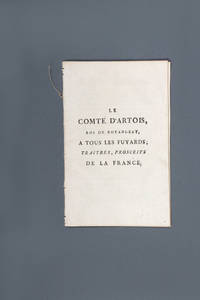
Le Comte d'Artois roi de Botani-Bay a tous les Fuyards Traitres Proscrits de la France
17904504805Paris 1790. Small hole to A4 affecting one word otherwise fine. Octavo 19 1 pp; disbound from a volume. <p><p>A very rare early "satire on French politics and English colonization" Ferguson. Likening those who fled the tumult of the French Revolution to the English convicts transported to Australia the author petitions them to join the future king of France in the newly established penal colony at Botany Bay: "le vaste continent des Terres Australes leur offre un pays nouveau asyle fait pour eux" "The vast continent of the Southern Lands offers them a new country a refuge made for them". The "count" continues that "c'est la Nation que vous etes dignes d'etentre c'est la Nation que je suis fait pour commander" "this is the nation that you deserve and that I am meant to command" and explains that in the Antipodes the laws are very different and virtue and vice are often upended.</p> <p>The satire evidently found an audience in Revolutionary France: a second edition was published in 1799. It appeared in the very first years of the English colonisation of Australia at a time when France had its own interests in the region and its own problems at home. La Pérouse commanding the Astrolabe and the Boussole arrived at Botany Bay on 24 January 1788 just as Arthur Phillip was moving the English settlement to Port Jackson. They spent six weeks in Australia before moving on.</p> <p>Toby R. Benis uses the pamplet to begin the introduction to his Romantic Diasporas: French Émigrés British Convicts and Jews 2009: "In 1799 a satirical pamphlet aimed at French émigrés and those inside the republic who sympathized with them appeared in England. Claiming to be produced in London the text was framed as an appeal from the Comte d'Artois Louis XVI's youngest brother calling on the 'cowards who fled France and to all those who have been banned from France-princes and valets traitors and bandits princesses and prostitutes' to join him in the British penal colony of Botany Bay: 'a new country made especially for them'. Styling d'Artois the "king of Botany Bay" the writer characterizes Australia as a de Sadian refuge for the worst elements of both Britain and the ancien regime bequeathed by the British government to the emigrant Prince and his circle to rule. A historical curiosity this document nonetheless points to a political and social dimension to exile in the Romantic period.". Romantic Diasporas focuses on how French emigrés Australian convicts and Britain's Jews embodied this state for Georgian society.</p> </p> . unknown
Hordern House Rare Books · Australie4 250,00 $AU≈ 2 801,18 €