Scheuchzer, JohannesBiblio.com
28 résultats
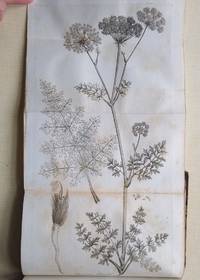
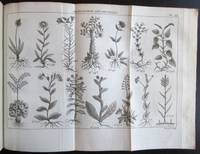
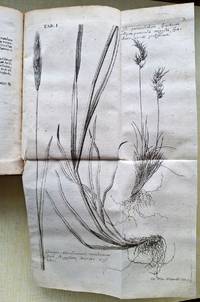
1719021143Tiguri Zurich: Typis & Sumptibus Bodmerianis 1719. First edition. With 11 single page engraved plates all on stubs and 8 folding engraved plates the title page printed in red and black and slightly loose at the lower gutter edge a little age-toned and marked pp 38 512 24 slight age-toning and marking but overall very clean and tight contemporary half-leather and paper-covered boards rather worn and a little battered worming has led to slight loss at the spine head the author's name written on the spine in a contemporary hand. Our copy has a double-sided sheet tipped-in at the front endpaper - possibly the author's brief explanation of the aims of his work I can not see this mentioned in any other copy. A highly important work in the history of grass taxonomy and with an impeccable provenance - from the library of C.E. Hubbard with his signature and stamp on the front endpaper; Hubbard was the foremost grass taxonomist of the twentieth century. . First Edition. Half-Leather. Good. Typis & Sumptibus Bodmerianis Hardcover
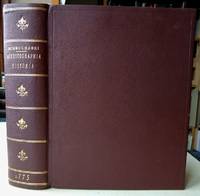
1775017855Zurich: Orell Gessner Fuessli & Socc 1775. Illustrated with 19 engraved plates of which 8 are folding large thick square octavo pp 20 512 index 24 appendices 92 a little foxing on some early and the last few pages otherwise an astounding copy - uncut edges unpressed wide margins bound in an excellent twentieth century simple brown leather in very good condition. A highly important work in the history of grass taxonomy and with an impeccable provenance - from the library of Allen Wedgewood with the Gallipoli bookplate and thence to C.E. Hubbard with his signature. RARE. Hubbard was the foremost grass taxonomist of the twentieth century. Wedwood was the son of M.L. Wedgewood with whom he collected until his death during the First World War at Gallipoli aged just 22. M.L. Wedgwood created a herbarium of British plants at Marlborough College MBH as a permanent memorial to her son. The second edition was edited by Albrecht von Haller who added the four appendices as well as descriptions of 70 new plants. Johannes Gaspar Scheuchzer 1684-1738 botanist and physician here describes over four hundred Swiss grasses. Second edition. Full Leather. Very Good. Orell, Gessner, Fuessli & Socc Hardcover
1720g5752Padua: Typis Seminarii Apud Joannem Manfre. Joints cracking. Plates clean. Binding tight. 1720. First Edition. Contemporary calf with raised bands and gilt titles. 250mm x 190mm 10" x 7". 296pp 8 23 23. 12 engraved folding Botanical plates. Heavy item - shipping supplement may apply for overseas. . Typis Seminarii, Apud Joannem Manfre hardcover
1795e7548Edinburgh: William Creech. Worn condition. Outer spine partly missing. Ex Royal College of Surgeons Ireland Library. 1795. First Edition. Grey card cover. 230mm x 140mm 9" x 6". xii 171pp. . William Creech unknown
1778e6329London: J Nourse. G : in Good condition Cover rubbed. Part of titles missing. 1778. Second Edition. Brown hardback leather cover. 220mm x 130mm 9" x 5". xxxviii 690pp. . Distributas Secundum Systema Sexuale: cum Differentiis Specierum Synonymis Auctorum Nominus Incolarum Solo Locorum Tempore Florendi Officinalibus Pharmacopæorum. Heavy item - shipping supplement may apply for overseas. . J Nourse hardcover
1785017754Canterbury London & Oxford: J. & J. Merrill; T. Cadell B. White G. & T. Wilkie; J. & J. Fletcher & D. Prince 1785. First edition 1785 complete with the three supplements of 1786 1788 & 1793. Illustrated with seven engraved plates by James Sowerby including one folding octavo pp 20 490; 40; 36; 43 endpapers marked sound internally but with some foxing and age-toning see illustration contemporary half calf and marbled boards rubbed an early rebacking has strengthened the front joint the old spine laid down the rear joint cracking a little the old spine now cracking slightly and brittle. Blanche Henrey 1256 - 1259. A work of many years scholarship including the revisions which Thomas Martyn had undertaken for his Plantae Cantabrigienses but which he ultimately gifted to Relhan. The author received much help from the amateur botanist James Dickson which contributed immensely to the value of the book as a record of the mosses fungi and algae of the county. The Thirkleby Park library copy with book label on the front endpaper and Thomas Frankland's stamped signature on the verso of all the title pages. Sir Thomas Frankland was a notable botanist. The estate was sold and the house demolished in 1927. First Edition. Half-Leather. Good. J. & J. Merrill; T. Cadell, B. White, G. & T. Wilkie; J. & J. Fletcher & D. Prince Hardcover
1761016590Paris: C.J.B. Bauche 1761. Illustrated with an engraved folding map 19 attractive engraved plates octavo half-title title page pp xviii 585 ii a little age-toning and slight staining internally a contemporary signature on the title page the occasional neat manuscript note otherwise good and sound internally twentieth century half morocco lightly scuffed raised bands to the spine. RARE. Withe bookplate of Kenneth Lazenby a founding member of the Alpine Garden Society . "The book is important because it contains an early attempt at a natural system prior to Adanson ignored by A-L de Jussieu influenced to some extent by Linnaeus's Ordines Naturales" - Stafleu & Cowan. First Edition. Half Leather. Very Good. C.J.B. Bauche Hardcover
1761017305Paris: C.J.B. Bauche 1761. Illustrated with an engraved folding map 19 attractive engraved plates octavo half-title title page pp xviii 585 ii a little age-toning and slight staining internally hinge at the front slightly weak but otherwise good and sound internally full contemporary calf worn at the corners a little rubbed generally the upper joint with slight wear lacking a small piece at the head of the spine marbled endpapers. RARE. From the library of the nurseryman Will Ingwersen with his signature on the first blank and his bookplate on the front endpaper. "The book is important because it contains an early attempt at a natural system prior to Adanson ignored by A-L de Jussieu influenced to some extent by Linnaeus's Ordines Naturales" - Stafleu & Cowan. . First Edition. Full-Leather. Good. C.J.B. Bauche Hardcover
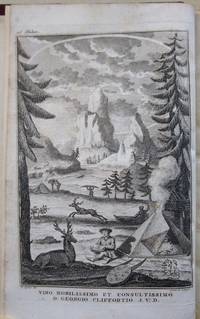
1792018826London: J. Davis for B. White et Filiorum 1792. Engraved frontispiece twelve folding plates with slight offsetting but otherwise good octavo pp l 390 16 light age-toning and occasional light foxing bound in twentieth century brown morocco with red cloth sides slight fading and very slight wear. With the bookplate of Kenneth Lazenby a founding father of the Alpine Garden Society. In the first edition of Flora Lapponica 1737 Linnaeus's ideas about nomenclature and classification were first used in a practical way making that the first proto-modern flora. This upddate by Smith cites Linnaeus as the main author and uses Linnaeus' binomial nomenclature. Second edition. Half-Leather. Very Good. J. Davis for B. White et Filiorum Hardcover
1792018827London: J. Davis for B. White et Filiorum 1792. Engraved frontispiece a little browned as is ithe title page twelve folding plates with slight offsetting and more age-toning and three with a little staining but otherwise good octavo pp l 390 16 light age-toning and occasional light foxing the hinge after the title page slightly open but absolutely no weakness quite a few interesting early neat marginal notes bound in contemporary boards a bit worn and marked a recent brown leather spine slightly scuffed. With the armorial bookplate of George Augustus Thursby; it is likely that he contributed the manuscript notes. In the first edition of Flora Lapponica 1737 Linnaeus's ideas about nomenclature and classification were first used in a practical way making that the first proto-modern flora. This upddate by Smith cites Linnaeus as the main author and uses Linnaeus' binomial nomenclature. Second edition. Quarter leather. Very Good. J. Davis for B. White et Filiorum Hardcover
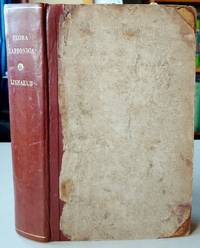
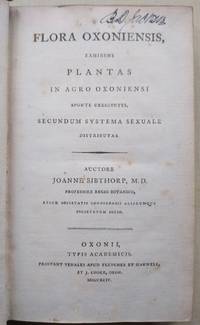
1794020746Oxford: Fletcher et Hanwell et J. Cooke 1794. First edition. Octavo pp xxiv 422 14 a little age-toning thoughout and the occasional blemish the top margin of pages 19 - 39 slightly bruised with slight tearing lacking the half-title otherwies very good internally probably contemporary half morocco and marbled boards rather rubbed and a little worn the spine head a little frayed the spine lettering faint. RARE. From the lbrary of the botanist B Daydon Jackson with his signature on the title page and the later bookplate of the nurseryman Will Ingwersen on the front endpaper. Two other earlier names on the front blank - Mary and Julia Rowley 1835 and George Rowley. Blanche Henrey 1320 - "the second book ever published on the wild plants of an English county". First Edition. Half morocco. Good. Fletcher et Hanwell et J. Cooke Hardcover
1785ST18172Turin: Michael Briolus 1785. FIRST EDITION. 410 x 270 mm. 16 1/8 x 10 5/8". Volume II with pp. 3-4 bound before pp. 1-2 but complete. Three volumes. <br/> INVENTIVE AND ELEGANT BROWN CRUSHED MOROCCO BY ANNIE BOIGE stamp-signed "A. Boige" on front pastedown and dated 1996 on rear pastedown upper covers cleverly encrusted with botanical specimens leaves or branches smooth spines with silver titling leather hinges watermarked light gray endpapers. Housed together in the original suede-lined brown cloth drop-back box suede-covered separators preventing contact between volumes. WITH engraved frontispiece portrait of the king of Sardinia in volume I engraved allegorical vignette on title pages and 92 FINE ENGRAVED PLATES ILLUSTRATING 237 BOTANICAL SPECIES. A Large Paper Copy. Cleveland Collections 557; Dunthorne 6; Sitwell "Great Flower Books" p. 67 69; Nissen BBI 18. ◆One plate with minor repair to fore-edge margin another with tiny rust hole not touching image half a dozen plates with insignificant smudges made during the printing process other trivial imperfections but A VERY FINE COPY clean fresh and wide-margined in a flawless binding.<br/> <br/> This is a major work of 18th century botany describing more than 2800 species of plants found in Italy's Piedmont region illustrating 237 previously unknown specimens and--crucially--classifying them all according to the new Linnean system becoming one of the first regional botanicals to use that taxonomy; as a bonus our copy comes in a particularly appropriate and charming binding with prominent botanical design elements. "Flora Pedemontana" was the chief work of Italian physician Carlo Allioni 1728-1804 professor of botany at the University of Turin and director of its natural history cabinet and botanical garden. The illustrations were drawn and engraved by the botanical garden's resident artist Francesco Peyroleri and his son Pietro. Our flora is also an important source of information on Alpine flowers. The modern binding is by an artisan who was proclaimed the "Grande Dame of French bookbinding" by the journal "Art & Métiers du Livre." Annie Boige trained at the Estienne School and at the Vésinet Applied Art Workshop before establishing her atelier in 1985. An art bookbinder she is noted for her monochrome color schemes and her use of beautiful leathers and vegetal materials a felicitous choice here. Michael Briolus unknown
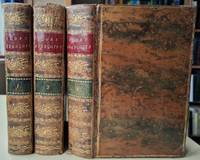
17784728Paris: IMPRIMERIE ROYALE 1778. Hardcover. Very Good. Three volume set. Contemporary mottled calf; a few repairs to binding and one to a folding table - with some loss but overall a very nice set indeed. Old bookplate of Fanny Rospigliosi <br/><br/> IMPRIMERIE ROYALE hardcover
1778021546Paris: L'Imprimerie Royale 1778. First edition. Three volumes pp cxx 132 xxix; iv 660; 654 xx i eight folding engraved plates a folding table very clean internally contemporary binding of an unusual full calf gilt-lined on the covers full gilt spines each with a red and a black label slightly rubbed and slight surface wrinkles but overall very attractive marbled endpapers marbled edges. With a stamp on the title pages of the Bibliothek Graf Spangensche an unidentified contemporary signature in the verso of the endpaper and the bookseller's label on the front paste-down endpqper of the first volume - "Cet Ouvrage se trouve ainsi que beaucoup d'autres chez La veuve Mangot Libraire sur le Hof im blauen Haus N. 312 im 3 ten Stock" "This work can be found along with many others at La veuve Mangot bookseller on the Hof im blauen Haus N. 312 im 3 ten Stock". With the bookplate in each volume of Kenneth Lazenby on of the founding members of the Alpine Garden Society. Flore française is a book by Jean-Baptiste Lamarck and Augustin Pyramus de Candolle that was published in 1815 in Paris. It is a work on botany classification and the plants of France. Lamarck designed the book to help identify plants using dichotomous keys which are classification tools that help users choose between opposing pairs of morphological characters. Lamarck was a botanist who became a prominent figure in French science after studying with de Jussieu and the publishing this work. He was mentored by Georges-Louis Leclerc Comte de Buffon a leading French scientist at the time. Lamarck's work was well-respected by scholars and helped him gain membership to the French Academy of Sciences in 1779. He later became a founding professor at the Musee National d'Histoire Naturelle where he was an expert on invertebrates. First Edition. Full-Leather. Very Good. L'Imprimerie Royale Hardcover
1791018452Turici Helvetorum Zurich: Ziegleri & Filiorum 1791. Octavo pp xvi; lxxx 526 light foxing and blemishing with some light pencil marginalia contemporary full calf rubbed and scuffed with wear at the corners marbled endpapers. Edited by the Swiss botanist Paul Usteri and published within two years of the first edition. This copy was owned by the Scottish botanist and plant collector George Don - 1798-1856 - with his signature on the first blank. The pencil notes though look to be by another hand. In this study of flowering plants Jussieu adopted a methodology based on the use of multiple characters to define groups an idea derived from naturalist Michel Adanson. This was a significant improvement over the "artificial" system of Linnaeus whose most popular work classified plants into classes and orders based on the number of stamens and pistils. Jussieu did keep Linnaeus' binomial nomenclature resulting in a work that was far-reaching in its impact; many of the present-day plant families are still attributed to Jussieu. Morton's 1981 History of Botanical Science counts 76 of Jussieu's families conserved in the ICBN versus just 11 for Linnaeus for instance. Writing of the natural system Sydney Howard Vines remarked "The glory of this crowning achievement belongs to Jussieu: he was the capable man who appeared precisely at the psychological moment and it is the men that so appear who have made and will continue to make all the great generalisations of science.". Second edition. Full-Leather. Good. Ziegleri & Filiorum Hardcover
1764015115Holmiae: Laurentii Salvii 1764. Title page printed in red and black pp xx 580 42 1 leaf of errata & emendada a little general age-toning of the pages but remarkably clean and sound internally marbled endpapers contemporary speckled calf lined in gilt dentelles in gilt a litlte worn mainly at the corners spine ornate gilt with raised bands rubbed and a bit more worn black leather title label lacking a corner joints cracking but still holding well. With the large folding portrait a bit creased which Soulsby mentions is only found in some copies. Soulsby 305. Full-Leather. Good. Laurentii Salvii Hardcover
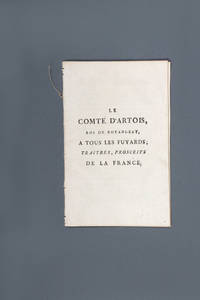
17904504805Paris 1790. Small hole to A4 affecting one word otherwise fine. Octavo 19 1 pp; disbound from a volume. <p><p>A very rare early "satire on French politics and English colonization" Ferguson. Likening those who fled the tumult of the French Revolution to the English convicts transported to Australia the author petitions them to join the future king of France in the newly established penal colony at Botany Bay: "le vaste continent des Terres Australes leur offre un pays nouveau asyle fait pour eux" "The vast continent of the Southern Lands offers them a new country a refuge made for them". The "count" continues that "c'est la Nation que vous etes dignes d'etentre c'est la Nation que je suis fait pour commander" "this is the nation that you deserve and that I am meant to command" and explains that in the Antipodes the laws are very different and virtue and vice are often upended.</p> <p>The satire evidently found an audience in Revolutionary France: a second edition was published in 1799. It appeared in the very first years of the English colonisation of Australia at a time when France had its own interests in the region and its own problems at home. La Pérouse commanding the Astrolabe and the Boussole arrived at Botany Bay on 24 January 1788 just as Arthur Phillip was moving the English settlement to Port Jackson. They spent six weeks in Australia before moving on.</p> <p>Toby R. Benis uses the pamplet to begin the introduction to his Romantic Diasporas: French Émigrés British Convicts and Jews 2009: "In 1799 a satirical pamphlet aimed at French émigrés and those inside the republic who sympathized with them appeared in England. Claiming to be produced in London the text was framed as an appeal from the Comte d'Artois Louis XVI's youngest brother calling on the 'cowards who fled France and to all those who have been banned from France-princes and valets traitors and bandits princesses and prostitutes' to join him in the British penal colony of Botany Bay: 'a new country made especially for them'. Styling d'Artois the "king of Botany Bay" the writer characterizes Australia as a de Sadian refuge for the worst elements of both Britain and the ancien regime bequeathed by the British government to the emigrant Prince and his circle to rule. A historical curiosity this document nonetheless points to a political and social dimension to exile in the Romantic period.". Romantic Diasporas focuses on how French emigrés Australian convicts and Britain's Jews embodied this state for Georgian society.</p> </p> . unknown
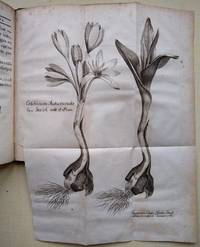
1763019038Vindobonae Vienna: Joannis Thomae Trattner 1763. "A little book which shows Colchicum autumnale Meadow Saffron root not only safe for human use but also useful for internal cures whenever diseases difficult to cure will not yield to other medicines". Small octavo illustrated with one folding engraved plate a little foxed around the margins and with a corner creased pp 96 some foxing but otherwise firm throughout the verso of the title pages has an early stamp of an Austrian library also with the perforated stamp of the John Crerar library and its tiny withdrawn stamp an early signature on the title page with the attractive bookpate of the Crerar Library on the front endpaper the free front endpaper nearly detached. red quarter morocco and marbled boards rubbed . Anton von Storck 1731 - 1803 was an Austrian physician. Storck is remembered for his clinical research of various herbs and their associated toxicity and medicinal properties. His studies are considered to be the pioneering work of experimental pharmacology and his method can be regarded as forming a blueprint for the clinical trials of modern medicine. He was convinced that plants regarded as poisonous still had medicinal applications if employed in carefully controlled quantities. Störck was particularly interested in the medical possibilities of plants such as hemlock henbane jimsonweed and autumn crocus. His experiments with these plants involved a three-step process; initially used on animals followed by a personal trial and finally given to his patients all the while maintaining a "sliding-scale" approach to determine the optimum dosage. Störck's numerous Latin medical tracts detailing his experiments into the therapeutic effects of poisonous plants excited great interest and were translated into German French English Dutch and Portuguese rapidly becoming influential medical texts throughout Europe. First Edition. Quarter leather. Good. Joannis Thomae Trattner Hardcover
1781e5854London: T Longman. Cover worn and detached. Part of outer spine missing. Text block firm. Uncut. Stamp on title page. Light scattered foxing. 1781. First Edition. Grey board cover. 240mm x 150mm 9" x 6". xvi 103pp. . T Longman unknown
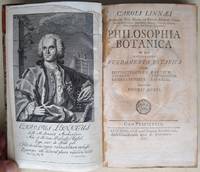
1751017563Stockholmiae & Amstelodami: Kiesewetter Godofr & Chatelain Z 1751. Latin text. Engraved frontispiece But see notes below octavo title page dedication page lectori botanico page 362 pages 9 engraved plates 2 full page engravings a little age-toning the occasional blemish or small mark the title page is a bit creased and stained in the gutter margin and there is offsetting from the frontispiece. which is chipped and with a closed tear repaired and mounted on a paper stub. Bound in possibly original marbled paper and more recent half calf slightly worn. Soulsby 437. The frontispiece is often lacking but the one we have here is not the usual frontispiece ! It is possibly a little smaller than the page size though this is not certain as it has been repaired and mounted; the offsetting to the title page which is obviously of some antiquity is definitely from the plate currently bound in. So - is it a variant or has it been added by a previous owner Interestingly I can only find one copy of this particular image online in the Wellcome Collection R. Burgess Portraits of doctors & scientists in the Wellcome Institute London 1973 no. 1778.10 ; listed as by Gustav Lundberg. It is "the first textbook of descriptive systematic botany and botanical Latin". It also contains Linnaeus's first published description of his binomial nomenclature. Philosophia Botanica represents a maturing of Linnaeus's thinking on botany and its theoretical foundations being an elaboration of ideas first published in his Fundamenta Botanica 1736 and Critica Botanica 1737 and set out in a similar way as a series of stark and uncompromising principles aphorismen. The book also establishes a basic botanical terminology. RARE. First Edition. Half Leather. Good. Kiesewetter, Godofr & Chatelain, Z Hardcover
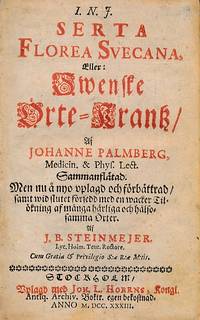
1738r2781bStockholm: Joh. L. Horrns. G : in good condition. 19th century binding. Cover rubbed with edge wear. Fep missing. Occasional foxing and darkening. 1738. Third Edition. Brown hardback half-leather cover with marbled boards. 170mm x 100mm 7" x 4". viii 282pp 62pp 118pp viii. Eighteenth century edition of Palmberg's Swedish herbal. . Joh. L. Horrns hardcover
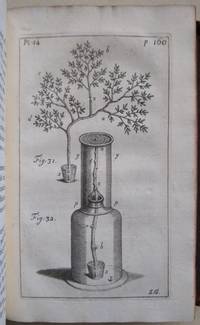
1738019442At the West-End of St Paul's London: W. Innys & R. Manby 1738. Third edition with amendments. Small octavo pp xiv 376 illustrated with 19 engraved plates small octavo pp xiv 376 slight signs of age-toning and dustiness but generall quite clean internally the front endpaper detached contemporary full calf poor the covers nearly detached. In Vegetable Staticks Hales studied transpiration - the loss of water from the leaves of plants. He estimated the surface area of the leaves of the plant and the length and surface area of the roots. This allowed Hales to compare the calculated influx of water into the plant with the amount of water leaving the plant by transpiration through the leaves. He also measured 'the force of the sap' or root pressure. Hales commented that "plants very probably draw through their leaves some part of their nourishment from the air". He prefigured the cohesion theory of water movement in plants although his ideas were not understood at the time so he did not influence the debate on water transport in plants in the 19th century. He also speculated that plants might use light as a source of energy for growth i.e. photosynthesis based on Isaac Newtons suggestion that "gross bodies and light" might be interconvertible. He also describes experiments that showed that "air freely enters plants not only with the principal fund of nourishment by the roots but also thro the surface of their trunks and leaves". While Hales work on the chemistry of air appears primitive by modern standards its importance was acknowledged by Antoine Lavoisier the discoverer of oxygen. Hales invention of the pneumatic trough to collect gases over water is also considered a major technical advance. Modified forms of the pneumatic trough were later used by William Brownrigg Henry Cavendish and Joseph Priestley in their research. Blanche Henrey 779. Full-Leather. Good. W. Innys & R. Manby Hardcover
1738015037At the West-End of St Paul's London: W. Innys & R. Manby 1738. Third edition with amendments. Small octavo pp xiv 376 illustrated with 19 engraved plates fore-edge a little thumbed but otherwise very clean and crisp internally marbled endpapers contemporary full polished calf a thin decorated gilt line around the borders a little marked and worn the spine gilt decorated with raised bands lacking the top 25mm of the spine and lacking small portions at the top of each joint the joints cracking slightly. still an attractive copy. In Vegetable Staticks Hales studied transpiration - the loss of water from the leaves of plants. He estimated the surface area of the leaves of the plant and the length and surface area of the roots. This allowed Hales to compare the calculated influx of water into the plant with the amount of water leaving the plant by transpiration through the leaves. He also measured 'the force of the sap' or root pressure. Hales commented that "plants very probably draw through their leaves some part of their nourishment from the air". He prefigured the cohesion theory of water movement in plants although his ideas were not understood at the time so he did not influence the debate on water transport in plants in the 19th century. He also speculated that plants might use light as a source of energy for growth i.e. photosynthesis based on Isaac Newtons suggestion that "gross bodies and light" might be interconvertible. He also describes experiments that showed that "air freely enters plants not only with the principal fund of nourishment by the roots but also thro the surface of their trunks and leaves". While Hales work on the chemistry of air appears primitive by modern standards its importance was acknowledged by Antoine Lavoisier the discoverer of oxygen. Hales invention of the pneumatic trough to collect gases over water is also considered a major technical advance. Modified forms of the pneumatic trough were later used by William Brownrigg Henry Cavendish and Joseph Priestley in their research. Blanche Henrey 779. Full-Leather. Good. W. Innys & R. Manby Hardcover
1769017255Vienna: Krauss 1769. Two volumes bound in one quarto illustrated with 18 folding engraved plates age-toned the final plate a littlre frayed at the fore-edge and neatly repaired at the folds two main title pages six sub-title pages to the fascicles and six dedication pages all with engraved vignettes several engraved tail-pieces pp xii 508 8 a little age-toning throughout occasional spotting and foxing but otherwise sound smartly bound in a fairly modern half-calf slightly rubbed.As usual it is the second printing of the first volume and the first edition of the second. The first title page has the blind stamp of Isaac Bayley Balfour. As well as Regius Keeper of Edinburgh Botanic Garden Balfour had the distinction at various times of being Professor of Botany at Glasgow Oxford and Edinburgh. Crantz was a botanist but primarily a physician lecturing in obstetrics. As an extremely sharp-sighted and sensible observer - and in a scientific dispute with his contemporaries Jacquin and Linnaeus - he discovered and named for example the genus Camelina and many new species such as Pedicularis rostratocapitata Veronica orchidea Veronica dillenii. Potentilla crantzii and Noccaea crantzii = Thlaspi alpestre are named for him. The six fascicules are dedicated to different botanical societies or natural historians including Saverio Manetti Albrecht von Haller and the Dane Petrus Ascanius a pupil of Linnaeus. Hunt 603; Pritzel 1954. . Half-Leather. Good. Krauss Hardcover
1724019596Londini: Gulielmi & Joannis Innys 1724. Third edition. Illustrated with 24 fine engraved plates of which two are folding small thick octavo pp 28 482 30 4-page bookseller's catalogue Blanche Henrey points out that page numbers 281-288 are repeated a printer's error a few very slight marks or paper imperfections but generally a remarkably clean bright and tight copy the front hinge is cracked but without any weakness the front free endpaper however is partially loose and may soon become completely so an armorial bookplate on the front endpaper contemporary panelled calf scuffed age-toned and worn at the corners neatly rebacked with a new calf spine a calligraphic paper title label. Blanche Henrey 323. John Ray FRS 1627 - 1705 was a Christian English naturalist widely regarded as one of the earliest of the English parson-naturalists.His classification of plants in his earlier Historia Plantarum was an important step towards modern taxonomy. Ray rejected the system of dichotomous division by which species were classified according to a pre-conceived either/or type system and instead classified plants according to similarities and differences that emerged from observation. He was among the first to attempt a biological definition for the concept of species as "a group of morphologically similar organisms arising from a common ancestor". Another significant contribution to taxonomy was his division of plants into those with two seedling leaves dicotyledons or only one monocotyledons a division used in taxonomy today. "In the Synopsis apart from the Linnean nomenclature we have a modern hand-book. The survey of species is remarkably accurate at least in flowering plants. The country has been adequately explored. The names and brief descriptions make identification easy. The classification if not scientifically perfect follows a natural sequence and is as easy to use as the modern scheme. British botany has been given a secure and intelligible foundation" - John Raven. Full Leather. Very Good. Gulielmi & Joannis Innys Hardcover