13 résultats
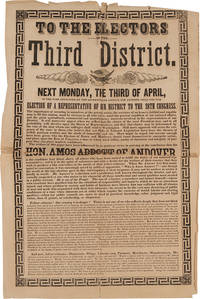
1840WRCAM28485N.p. but Andover Ma. 1840. Broadside 15 x 22 inches. Moderate wear at edges and along horizontal and vertical creases including slight closed tears where previously folded in half. Extensive editorial copy beneath bold heading and patriotic woodcut vignette. Very good. An 1840 campaign broadside on behalf of Amos Abbot distinguished Massachusetts public servant and founder of the Boston & Portland Railroad. His campaign was successful and he returned for three consecutive terms. He retired from Congress in 1849 and died in 1868. REYNOLDS p.455. unknown books
187556446Paris: G. Masson editeur. Libraire de l'Academie de Medecine 1875. 4to pp. xv 1; original tan paper wrappers illustrations including a small mounted photograph inside front wrapper; a little creased else very good. Campana's Recherches was one of the first texts to look closely at the evolution of the avian respiratory system. <br/><br/> G. Masson, editeur. Libraire de l'Academie de Medecine unknown books
18142677Hunthill House Scotland 1814. 4to 230 x 185 mm. 10 233 4 pp. Written in an italic hand in English with occasional corrections or additions in a different hand on wove paper watermarked Budgen & Wilmott / 1812. Four unnumbered pages of French text at front and four at back the latter dated 27 May 1814 in a different hand apparently the author's on different paper with no visible watermark. Very good; some occasional spotting. Contemporary red straight-grained morocco gilt edges scuffed and scraped joints strained head of spine chipped. A first-hand unpublished memoir by a French army officer of the terrible Peninsular War. The narrator was one of few survivors of the surrender of French forces after the Battle of Bailén in July 1808. The background to this event was Napoleon's attempt to complete the isolation of England from the continent by sending a French army into the Iberian Peninsula to seize the coast of Portugal and occupy Spain. Napoleon later referred to the Peninsular War characterized by appalling cruelty on both sides as the 'Spanish ulcer'; it was to be one of the primary factors in his downfall. Although written in a matter-of-fact tone the details of this memoir are searing. General Pierre Dupont de l'Étang was charged with securing French control of the major cities in Spain. Dupont's 20000 men had initial success but as they penetrated deeper into Spain they faced increasing resistance. The present diary traces the route and experiences of Dupont's army to its furthest point of penetration into Spain: Córdoba. There after a particularly bloody and cruel occupation the army was forced to withdraw and was soon overwhelmed. Dupont surrendered his army at Bailén. Originally promised safe passage most of the French were slaughtered immediately after their surrender. The start of the Peninsular War marks the commencement of the memoir written by H. de Montvaillant an officer from Montpellier who was serving in the second Corps d'Observation of the Gironde placed under the direction of General Dupont. Although the starting date of the campaign is generally accepted as March 1808 by Montvaillant's account the French had already occupied the town of Vittoria 50 miles west of Pamplona by Dec. 22 1807. By January 9 1808 French troops had advanced to south of Burgos heading toward Valladolid. At every stopover small detachments were left behind to guard the roads thereby diminishing the strength of the army as it travelled. Spanish guerrilla activity took a toll on the troops; so much so that the author records that the troops had to "redouble our vigilance and take measures the most severe ever adapted to ensure our safety" p. 58. On Feb. 16 they entered Medina del Campo on their way to Madrid. Montvaillant records his impressions of the city its palaces and inhabitants. Toledo was the next destination where he notes a visit to the palace library and the suppression of an uprising led by monks. By the end of May the French had occupied Consuegra and entered La Carolina in Andalusia. It is at this point that the narrative takes on an ominous tone. About to enter Seville Montvaillant notes a change in circumstances in the countryside and the inhabitants. The population is abandoning villages and fleeing. He records that the senior officers assumed that the army would only be harassed by small bands of "brigands" p. 84 a far cry from the massive insurgency that it encountered: "We learned that the insurgents each day gathered strength and that the Junta of Seville was determined to stop us in our march. The following days we got to the little town Baylen Bailén in whose plains two months afterwards our destiny was decided" p. 86. The French attacked and sacked the city of Córdoba: "Neither tears promises or humble supplications could arrest the thirst for pillage." p. 89; discipline was nonexistent and the drunkenness and looting continued for eight days. Soon after Montvaillant is ordered back to the village of Alcolea not far from Bailén to guard a bridge crossing. While there he discovers the slaughter of the French sick and wounded who had been left along the line of march while the main body of General Dupont's troops had taken Córdoba. The army had moved back to Andujar near Bailén and encamped. Montvaillant records that the general staff soon realized that the French were now outnumbered and that the opposition had organized itself. Dupont's army was isolated without hope of reinforcement or re-supply defending a garrison at the village of Andújar situated on a flat plain in the scorching sun. The narrative is now of troop dispositions losses tactical mistakes errors of the general staff and increasing difficulties. Dupont's surrender came on July 20 1808. The officers were segregated from the defeated army before being escorted supposedly to France. Most of the remaining army was slaughtered within days. Montvaillant records the details of his months-long "death march" southwards to the coast finally arriving at Jerez de la Frontera near Cádiz to await embarkation to France. This never occurred. The officers' captors kept them in Jerez having discovered that the ruling Junta of Seville had abrogated the surrender treaty and that the inhabitants were waiting to massacre the French on their approach to Cádiz. Montvaillant now fills his account with anecdotes of captivity and of the officers' horrendous treatment at the hands of their escorts and guards. He is unclear as to exact dates but it seems that the French captives were held at Jerez until mid-December before being hastily driven aboard ships to sail for the Balearic Islands p. 141. A severe storm intervened and they were blown off course to Africa finally coming to port at Gibraltar; several days later they were already back in Andalusia at Málaga. Then after more storms and much sailing they finally made the Balearics where they were exiled to the desert island of Cabrera. There some 4400 surviving men and officers were forced to survive as best they could p. 148. Almost 250 officers were collected from this exile after a month and taken to the capital Palma. Imprisoned there though in better conditions than previously this group of officers waited; nearly half would be massacred during a riot and assault on the prison by the inhabitants of Palma. By March 1809 only 140 of the original 250 rescued officers were alive and were returned to Cabrera where the living conditions were desperate pp. 155-165. Despite this the officers were able to conjure up distractions. There is an account of theater productions dances and the jealousy and bickering among those playing female roles in these performances. Montvaillant comments that the theatrical chronicle of Cabrera would make quite a book. Eventually the officers were placed aboard an English ship. On August 4 when they were off Cape Palos near Cartagena there were rumors of a prisoner exchange which again did not occur. After several weeks aboard the English ship Montvalliant and his companions were disembarked at Portsmouth. He continued on to Salisbury then embarked again for Leith en route to his final destination in Scotland Jedburgh where he remained in exile until the accession of Louis XVIII in 1814. The text is written in an occasionally stilted English. Eight pages of notes in French by the author are inserted four at the beginning using wax seals to insert the bifolium and four at the end dated May 27 1814. The French preface consists of a romanticized fictionalized account of the author's Scottish sojourn including a temptress fairy and concluding with the author's promise to never forget his friends in Scotland. The English text is preceded by the title-leaf and a one-page dedicatory poem introduced by a statement that these "`Recollections' in an English Garb are presented by the sincerest of Friends to the Author" and dated Hunt Hill 1 January 1814. The first of the four final pages in French provides some information about the history of the manuscript the remaining pages contain literary notes including translations into French of poems by Robert Burns and Sir Walter Scott. According to these comments the diary was originally written in French and was translated into English by the narrator's benefactors in Jedburgh. During his years of exile Montvaillant had befriended a well-off family Rutherford the owners of nearby Hunthill House to whose three young daughters he became deeply attached. Without them he claims he would not have survived the loneliness of his exile. To pay them homage and in acknowledgement of his gratitude he dedicated his memoir to them. His friends retained the original French version as a valued keepsake of their friend and an engrossing biographical narrative and presented him with this translation which he brought back to France planning to render it anew into French to share with his family and close friends. The annotations in the text appear to be the author's. He emphasizes that he plans to keep the manuscript unpublished; perhaps the memories were too painful. unknown books
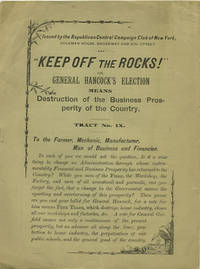
188036562New York: David H. Gildersleeve Printer 1880. First edition. Self wrappers. A very good copy faint fold. 4 pp. 16mo. Scarce Garfield campaign piece for the 1880 election. Also issued as "Why young men should vote for Gen. James A. Garfield." Argues that the Republicans have brought prosperity by limiting free trade and by returning the county to the gold standard; by 1880 the nation's money was backed by gold alone though the issue would continue to be hotly debated for years. OCLC shows three locations: Hagley Western Reserve and Rutherford Hayes Pres. Ctr.; the variant title is held at the first two locations. David H. Gildersleeve, Printer unknown books
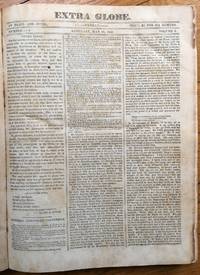
1841166Washington D.C.: Blair & Rives 1841. Good. 423pp. Volume 6 Numbers 1:27 paginated continuously. Folio. Contemporary half sheep and marbled boards. Boards detached with tape repairs. Light dampstaining at upper corner; light tanning and foxing. A complete run of this 1840 Democratic campaign newspaper published weekly as an extra to the District of Columbia periodical the Globe during political campaign seasons. This run of the Extra covers the 1840 presidential election between William Henry Harrison and Martin Van Buren. Content includes speeches and testimonials for Van Buren and against Harrison as well as editorials and other articles and party-related material that address all the principal issues of the campaign. Harrison would go on to sweep the electoral college handily but famously died in office after only four weeks as president to be succeeded by John Tyler. This is the sixth such volume the paper having started the Extra in 1834. It ran to seven volumes ending in 1841. The present volume was published from May 16 1840 to October 26 1840 with the final issue appearing post-election on January 29 1841. The whole was advertised as costing $1 for six months. The editors Francis Blair and John Rives were Jacksonian Democrats initially brought to D.C. by Jackson to be the mouth of the party. Blair & Rives unknown books
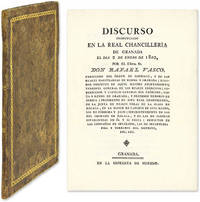
1803607371803. Granada 1803. Granada 1803. Remarks by the Recently Appointed President of the Supreme Court of Grenada Vasco del Campo Don Rafael. Discurso Pronunciado en la Real Chancilleria de Granada el Dia 2 de Enero de 1802 por El Exmo. Sr. Don Rafael Vasco Caballero del Orden de Santiago y de las Reales Maestranzas de Ronda y Granada; Regidor Perpetuo del Aquel Ilustre Ayuntamiento; Teniente General de los Reales Exercitos; Gobernador y Capitan General del Exercito Costa y Reino de Granada y Presidios Menores de Africa; Presidente de Esta Real Chancilleria De la Junta de Reales Obras de la Plaza de Malaga De la Mayor de Caminos de Este Reyno Los de Cordoba y Jaen; Superintendente de los del Obispado de Malaga Y de las de Sanidad Establecidas en el y su Costa; Inspector de las Companias de Invalidos Las de Infanteria Fixa y Torreros del Distrito Etc. Etc. Granada: En la Imprenta de Moreno 1803. iv xix pp. Quarto 8" x 5-1/2". Contemporary mottled sheep gilt frames to boards. Light rubbing to extremities with minor wear to spine ends and corners a few minor scuffs to boards tiny manuscript label to rear cover marbled endpapers crack between front free endpaper and following endleaf which is detached text notably fresh. An attractive copy. $250. First edition. This book reproduces the text of a speech given by military leader Don Rafael Vasco del Campo shortly upon his elevation by the King of Spain to the Presidency of Granada's Supreme Court of Justice. Don Vasco who distinguished himself in the service of the Spanish Crown in Mexico proclaims his humility before the office of his charge never before entrusted to a military man and invokes education as an antidote to envy hate revenge and thoughts of theft lies and deception. He also challenges the need for capital punishment and other legal injustices. During his short-lived presidency over Granada's highest court the region enjoyed peace and a flowering of the arts which ended with Napoleon's invasion of Spain and the subsequent popular uprisings against the Spanish Crown. No copies located on OCLC. Palau Manual del Librero Hispano-Americano 353024. unknown books
186331822Albany: Weed Parsons 1863. 16pp disbound caption title as issued. Very Good. <br/><br/> An attack on the Democratic Party which "has become thoroughly Vallandighamized." The document details the patriotic activities of 'War Democrats' who have left the regular Democratic Party which has deserted the Unionism of Andrew Jackson and Stephen A. Douglas and joined the Republicans in their patriotic support of the war effort. <br/>Not in Sabin. Weed, Parsons unknown books
1823WRCAM52010Washington 1823. 55-108pp. Modern blue pebbled cloth gilt label. Light tanning and foxing. Very good. The document accompanies President Monroe's Message of 1823 which consists of letters and reports concerning attacks of the Arikara Indians on General Ashley's trading party and of the Blackfoot Indians on the Missouri Fur Company's Yellowstone or Mountain Expedition. Included is correspondence from Ashley Benjamin O'Fallon William Gordon and Joshua Pilcher describing the attacks in detail. WAGNER-CAMP 22. HOWES A307. GRAFF 3071. hardcover books
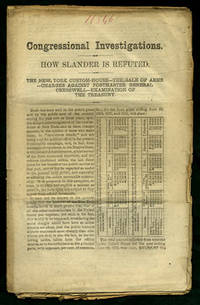
187227653n.p.: n.p. 1872. First edition. Self-wrappers. An untrimmed unopened uncut single folio leaf edges soiled fore edge with a few small tears rear leaves creased overall still about very good. 16 pp. 8vo. The Grant administration was one of the most corrupt of the 19th century with numerous investigations convened. As it prepared for the elections of 1872 and Grant's run for a second term it issued this piece of campaign literature in an attempt to refute the charges. n.p. unknown books
186031540Washington: National Democratic Executive Committee 1860. 16pp caption title as issued. Disbound title leaf detached but present lightly toned a few small spots of foxing. Else Very Good. <br/><br/> Breckinridge Buchanan's Vice President was the 1860 presidential standard-bearer of the anti-Stephen Douglas branch of the Democratic Party which had split during the 1860 nominating convention. Douglas had defied Buchanan and broken with him over the Kansas issue. This campaign piece defends Breckinridge's devotion to the Union and the Administration's record argues that slavery is-- like other forms of property-- entitled to exist anywhere in the Territories demonstrates his support in the North and attacks Douglas Popular Sovereignty and Abraham Lincoln. National Democratic Executive Committee unknown books
186031539Washington City: Issued by the National Democratic Executive Committee Colophon: Baltimore: John Murphy & Co. 1860. 8pp folded folio sheet. Tanned scattered foxing light wear. Portrait of Breckinridge on title page sketch of the Capitol on its verso with a list of Breckinridge & Lane Campaign Documents. Good. <br/><br/> Breckinridge Buchanan's Vice President was the 1860 presidential standard-bearer of the anti-Stephen Douglas branch of the Democratic Party which had split during the 1860 nominating convention. Douglas had defied Buchanan and broken with him over the Kansas issue. The Party's Southern wing seeks to prove Breckinridge's soundness as a Union man. In this speech celebrating the Union Breckinridge says "We see around us on every side the proofs of stability and improvement. The Capitol is worthy of the Republic." <br/>Sabin 7673 7671. LCP 1493. Issued by the National Democratic Executive Committee [Colophon: Baltimore: John Murphy & Co.] unknown books
1856006302Boston: John P. Jewett & Co. 1856. This was the platform for the first national Presidential election 1856 with a Republican candidate John C. Frémont. A RARE publication in its own right Rare Book Hub notes last copy appearing in a dealer catalog in 1970. This copy rendered unique and historically significant by the original owner's addition of 78 blank pages which he mostly filled with pasted in contemporaneous newspaper clippings including 7 pp. of the Democratic Party Platform of 1856. Other significant clippings are headed: The Sanford Letter Wash. Aug. 21 1848 2 pp.; Kansas Affairs-Official Instructions to Gov. Geary and Gen. Smith Wash. Sept.3 1856; Kansas Slave Code 4 pp.; Who Are the Disunionists ; 4th of July Toasts in South Carolina: The White Man Shall Be a Slave If a Laborer: Slaves Horses and other Cattle a Sale by J.B. Sproull & Co. 1855; and The Buchanan Democracy Hate Freedom. Overall approximately 40 newspaper clippings pasted in with some marginal writings and notations in ink in the handwriting of the original owner who although unnamed appears to have resided in Greene Co. OH and was most definitely a Republican ! Very Good bound in sewn brown leather 78 blank pp. with contemporary newspaper articles pasted onto most of the blank pages; the Republican Party Platform 36 pp.; Declaration and Constitution 32 PP. Whenever any other copy of the 1856 Platform comes to market it is unlikely to be as intriguing to historians and collectors as this copy. First Edition. Leather. Very Good. 24mo - over 5" - 5¾" tall. John P. Jewett & Co. Hardcover books
1808WRCAM43389Boston 1808. 20pp. Dbd. Contemporary ownership inscription on titlepage. Minor foxing and toning. Very good. A Federalist pamphlet prepared for the presidential election of 1808 in which the author recounts the grievances against the past eight years of government under the Jefferson administration. A typical New England view of Jefferson after the Embargo. In the end Jeffersonian candidate and current Vice President James Madison soundly defeated Federalist candidate Charles Cotesworth Pinckney. SHAW & SHOEMAKER 16057. unknown books