Palmer, Frances Flora Bond, artistBiblio.com

57 résultats
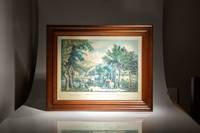
186357141New York: Currier & Ives 1863. Hand-colored lithograph approx. 30¼" x 22" by sight; fine example with strong coloring; attractively matted and in a curly maple frame. Currier & Ives New Best Fifty no. 23; Reilly Currier & Ives A Catalogue Raisonné Detroit 1984 pp. 737 758; no. 7326. Provenance: from the collection of the Minnesota railroad tycoon James J. Hill Saint Paul Minnesota. One of Currier & Ives most famous and dramatic images depicting the steamboat Princess as firewood is loaded onto the ship to power its steam engines. The artist Frances Flora Bond Palmer 1812-1876 often referred to as Fanny Palmer was an English artist who became successful in the United States as a lithographer for Currier and Ives between 1849-1868. She is credited with producing around two hundred lithographs for them during this time. Currier & Ives unknown
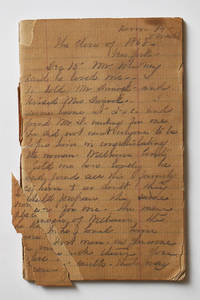
1864221802Rome 1864. 260 pp. written in ink on versos and rectos with 14 pictures engravings etc. some captioned in her hand. Included are some sheets in other hands in French and German. 1 vols. 8vo. Disbound with water damage. 260 pp. written in ink on versos and rectos with 14 pictures engravings etc. some captioned in her hand. Included are some sheets in other hands in French and German. 1 vols. 8vo. Flora Payne was a Cleveland heiress whose marriage to William Collins Whitney three years after this diary was written formed the basis of one of America's legendary families. Flora Payne herself "was an anomaly among the young ladies of her time. At eighteen she had betaken herself from Cleveland to Cambridge Massachusetts to attend the seminary for young ladies that was being conducted there by Professor Agassiz the naturalist . Flora had traveled widely abroad even to places such as North Africa with which few sophisticated New Yorkers of William Whitney's circle had firsthand acquaintance . " - Kahn JOCK p. 11. unknown
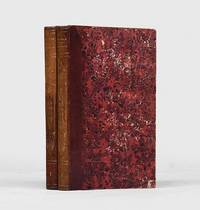
1838167701Paris: Ladvocat 1838. The most important French socialist-feminist of the 1830s and 1840s Second edition published the same year as the first of the radical philosopher's only novel vividly articulating her goal of social revolution through female emancipation. Méphis is uncommonly met with; we trace only one previous auction listing for any edition. The philosophy of Flora Tristan 1803-1844 linked the nascent socialist theories of class struggles with the contested position of women in contemporary society. Following the mixed reception of her previous political works in Méphis she employs the conventions of the novel to visualise her conception of social reform. The work centres on the titular protagonist's relationships with two aristocratic women and the tensions implicit therein - both in his proletariat origins and in the broader patriarchal conventions weighing on them. Tristan draws several "vivid evocations of feminist role models" Cross & Gray p. 2 thereby winning the novel "a secure place in French Romantic literature" Puech quoted in Cross & Gray p. 2. The work gained further notoriety due to the events surrounding its publication. In 1838 Tristan's estranged husband - a failed artist enraged by her literary success - shot her in the street in broad daylight. Miraculously she was not seriously injured and the resulting trial boosted her sales considerably. Tristan's socialist-feminist philosophy anticipates several aspects of Marx and Engels: she most notably coined the term "Workers of the world unite" a full five years before they deployed it in the Communist Manifesto. She is consequently considered "the most important French socialist-feminist of the 1830s and 1840s" Collins & Weil-Sayre p. 229. The second volume includes two of Tristan's articles on the history of western art which had formerly appeared in L'Artiste. 2 vols octavo 209 x 131 mm pp. iv vii 1 365 1; pp. iv 390 2. Wood-engraved vignette to title pages. Contemporary red quarter sheep spines lettered ruled and elaborately decorated in gilt red marbled sides marbled endpapers edges sprinkled black blue silk bookmarkers. Moderate rubbing faint sunning to spines light sporadic foxing and marginal damp staining to contents: a very good copy. Marie M. Collins and Sylvie Weil-Sayre "Flora Tristan: Forgotten Feminist and Socialist" Nineteenth-Century French Studies vol. 1 no. 4 1973; Màire Cross and Tim Gray The Feminism of Flora Tristan 1992. unknown
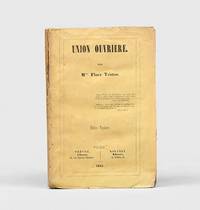
1843150437Paris: Prévot and Rouanet 1843. Coining the slogan "workers of the world unite!" five years before the Communist Manifesto First edition of the revolutionary French socialist's most famous work urging the working class to unite a call for international emancipation which appeared five years before the Communist Manifesto. Tristan is "perhaps the most celebrated of all 19th-century French feminists" Moses p. 107. Tristan's struggles as both the poverty-stricken illegitimate daughter of a Peruvian noble and as the wife of a violently abusive husband forced her to travel at various points in her life to England as a ladies' companion and Peru in the hopes of re-establishing her family ties. Upon returning to Paris in 1835 Tristan fought her husband André Chazal for custody of her two surviving children and succeeded in regards to her daughter. It was not until 1836 after Chazal shot Tristan that she was granted legal separation and the right to take back the name Tristan. Both as respite from and because of this domestic turmoil Tristan became enthusiastically involved in a number of feminist and socialist groups and activities - she published pamphlets on female immigration petitioned in favour of divorce and for the abolishment of capital punishment attended meetings of the Gazette des femmes group and engaged with the utopian socialism of the Fourierists. "In Union ouvrière Tristan rallies the French working class urging them to create a national organization that would be financed by subscriptions from the twenty-five million workers. She believed that any change among the working class must be initiated by the workers themselves: 'Now the day has come when one must act and it is up to you and only you to act in the interest of your own cause'. Despite her call to action Tristan maintained a firm stance against violence and called only for passive resistance; she believed that destructive acts would only heighten workers' problems. She tried to enlist the bourgeoisie in her plan on the basis that it would help prevent begging and theft. The second part of Tristan's crusade was her attempt to improve the position of women within the workplace and society. She argued that all classes of women should participate in the Workers' Union to lobby simultaneously for feminism and socialism. Her third chapter entitled 'Why I Mention Women' aims to establish continuity between the desires of the workers and those of women" Orlando. Unable to find a publisher willing to print the unorthodox tract she funded the book's publication herself through donations from friends acquaintances and public appeal. From these donations 14000 copies of this first edition were printed stated as "Edition populaire" which she sold for 50 centimes each. In Lyons the fundraising efforts of her working-class followers underwrote a further printing of 10000 copies. Such circulation was very high for the time: the print run of the Communist Manifesto in 1848 by contrast was 2000 copies. "Increasing scholarly attention is revealing her as a pivotal figure in the shift from early nineteenth-century utopian to Marxist economic socialism. Her insistence on the inextricability of class and gender oppression makes her a foundational socialist feminist theorist" ibid. Duodecimo. Uncut in original yellow wrappers printed in black. Housed in quarter calf chemise and slipcase. Slight split to front joint but holding wrappers and contents clean a very good well-preserved copy. Claire Goldberg Moses French Feminism in the Nineteenth Century 1984. unknown
188335676Kjøbenhavn Carl Lunds Bogtrykkeri 1883. Folio. 39x27 cm. Contemp. hcalf. Richly gilt back and gilt borders on covers. Light wear to corners and a few scratches to binding. Titlepage. 51 pp. Index Corrections and Addenda. With 171of 175 Flora Danica-plates of Scandinavian trees and bushes. All plates engraved and in fine handcolouring plates in near mint condition. <br/><br/><em>Scarce re-issue of Flora Danica in exquisite handcolouring restricted to its trees and bushes. In this work the last editor of Flora Danica Joh. Lange selected all the original copper-plates which depicted trees and bushes from the whole work - in fact 9 of the earliest plates were damaged by fire and as such not useable for a print to be taken - and made this re-issue done with the original copper-plates as a separate issue of Flora Danica. Under his auspices all the prints were carefully hand-coloured with greatest care and often surpassing the original colouring. The paper used for the re-issue is of the same quality used for the last volumes of the original issue of Flora Danica of which the last volume vol. 17 came out the same year as this extract 1883. - Carl Christensen II p.257 No 119 - Nissen BBI: 1133 - Not in BMC NH. </em> unknown
18682210931868. 1 vols. 12mo. Disbound. Wear. 1 vols. 12mo. unknown
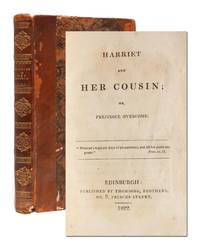
18225548Edinburgh: Thomsons Brothers 1822. First edition. Contemporary half calf over marbled boards with gilt to spine. Measuring 140 x 80mm and collating complete including frontis and publisher's catalogue to rear: vii 1 blank 199 1 errata 8 1 blank. A Near Fine copy with some scuffing to boards and joints and small chip to foot of spine. Contemporary ownership inscription to front endpaper: "Margaret Jane Palliser. Dublin 1824." A scarce work of juvenile fiction aimed at young women it is unrecorded in OCLC and Sadleir though there is mention of a later 1824 "fourth edition" and an American edition from 1827. <br /> <br /> Simple on its surface each new chapter of Harriet and Her Cousin unfolds a new layer of prejudice that all too commonly prevents young women from finding meaningful connections with each other. Raised in a rural religious household young Harriet has a spiritual awakening that leaves her soul altered. More excited about the world and the people around her and more capable of subtle observations she undertakes a journey to Edinburgh both to visit her soon-to-be-wed best friend Maria as well as to visit her grandfather and cousin Julia. On arrival Harriet is shocked by Julia's coldness and initially assumes it is prejudice against her own Christianity. Introduced to the sparkling and accomplished ladies of Julia's circle she then begins to suspect it is prejudice against her simple country nature. Only over time does Julia feel comfortable opening up to Harriet about her loneliness -- an isolation born out of the high society expectations that women reserve warm feelings and engage instead in gossip back-biting and flirtations that make them untrustworthy. As she has witnessed Harriet's refusal to conform to these behaviors Julia bonds with Harriet as an intimate friend capable of deep and meaningful conversation. Indeed Harriet learns that even with her awakened spirituality she too has much to learn about dismantling her own prejudices. Thomsons Brothers unknown
1898425944Philadelphia Pennsylvania 1898. Hardcover. Near Fine. 24mo. Measuring 5.5" x 6". Brown leather boards with beveled edges gilt decorations with the name "Flora Haedrich" embossed in gilt on the front board and lacking one metal clasp. Contains 43 ferrotype and ambrotype black and white photographs measuring between 0.5" x 0.5" and 3.5" x 2" with captions. Lightly bumped spine ends and corners with slight edgewear thus near fine album with fine photographs.<br /> <br /> Philadelphia woman Flora Haedrich's family album containing portraits of her immediate and external family members from 1865 with later pictures from 1898 and notes written in 1925. The photographs feature Flora's sisters brothers and parents and also include shots of her uncles aunts cousins and grandparents with captions including names and connections to her family written below. The photographs are professionally shot ferrotypes and ambrotypes developed by J. Fenton's photo miniature shop located on South Street in Philadelphia during the mid-19th Century. Several family members identified as business men and women are of interest. Haedrich's father Henry G. Haedrich Jr. started a company Haedrich and Sons Co. for leather working harness and saddlery for carriages in Philadelphia. According to a contemporary newspaper "Haedrich's establishment and the opinion prevailed universally has excelled by far any harness ever manufactured in this city. The whole style design finish and workmanship of this elegant set of harness are in the main original and if placed in fair competition with the finest productions of European manufacturers would undoubtedly secure the highest honors." Another member of the family Augustus Haedrich manufactured carriages and was president of the building association in Philadelphia. Lastly Emma Kirkham née Wootton is captioned as the cousin to Haedrich. Kirkham was a practicing Mormon who was active in the Young Ladies Retrenchment Association as second consular in Lehi Utah. On the last page of Haedrich's album she writes her new last name after marrying William John Bok. <br /> <br /> An aesthetically pleasing collection of professionally shot photographs of a Philadelphia family taken between 1865-1898. hardcover
19000008092LAFAYETTE INDIANA. Good. 1900. On offer is an interesting small diary/memo book written between Oct 1st 1900 and Feb 19th by Flora G Schilling an Indiana student. The memo book measures about 5 1/2 in by 2 3/4 in and was a promotional item put out by "Bert A. Drees Pharmacist" of Lafayette IN. With 30 pages it is in very good condition and 100% complete. The handwriting is quite legible. The heading of the first page note Class of 01 which would seem to confirm her status as a student. References on page 3 indicate that Schilling and her friends attended the annual Fall Carnival. The entries are sporadic in nature and some are undated. A notable entry in this little journal was: "Roosevelt came to the city. watching the Rough rider on Main Street." Oct 10 1900. This is a reference to the 1900 US Presidential election campaign where Theodore Roosevelt's was running as Vice-Presidential candidate. Most entries are of a chatty nature: "Frank and I went to dancing school Had a royal time" p10. "Preparing for examination in Astronomy." Dec 12 1900 "E. S. & I bidding V goodbye. Went downtown to to sample candy" pp15-16. "Sister M was in the room and had to study oh so hard I went to dance Monday night and had a swell time." Jan 7 1901. An interesting little notebook with an important historical reference - Wm. McKinley was in fact elected President with Roosevelt as his Vice President and less than 1 year later Roosevelt would be President following McKinley's assassination.; Manuscript; 24mo - over 5" - 5¾" tall; KEYWORDS: HISTORY OF UNITED STATES INDIANA TIPPECANOE COUNTY LAFAYETTE 19TH CENTURY 20TH CENTURY 1900S PROGRESSIVE ERA FLORA G SHILLING LAFAYETTE IN TEDDY ROOSEVELT 1900 PRESIDENTIAL ELECTION WILLIAM MCKINLEY WM. MCKINLEY ENTERTAINMENT IN EARLY 20TH CENTURY YOUNG PEOPLE AT THE TURN OF THE TWENTIETH CENTURY AMERICANA HANDWRITTEN MANUSCRIPT DOCUMENT LETTER AUTOGRAPH WRITER HAND WRITTEN DOCUMENTS SIGNED LETTERS MANUSCRIPTS DIARY DIARIES JOURNALS PERSONAL HISTORY SOCIAL HISTORY HISTORICAL HOLOGRAPH WRITERS AUTOGRAPHS PERSONAL MEMOIR MEMORIAL ANTIQUITÉ CONTRAT VÉLIN DOCUMENT MANUSCRIT PAPIER ANTIKE BRIEF PERGAMENT DOKUMENT MANUSKRIPT PAPIER OGGETTO D'ANTIQUARIATO ATTO VELINA DOCUMENTO MANOSCRITTO CARTA ANTIGÜEDAD HECHO VITELA DOCUMENTO MANUSCRITO PAPEL . unknown
186414589New York: Currier & Ives 1864. Lithograph. Lithograph. Near fine. From Currier & Ives The Old Oaken Bucket by Frances Flora Palmer published in 1864. Lithographed and published by Currier & Ives at 152 Nassau St. New York. Short closed tear along top edge archival tissue repair. Printed on wove paper. Includes 2 stanzas and 4 lines of verse by Samuel T. Woodworth. Original artwork by Frances Flora Bond Palmer. Image measures 15 15/16 x 23 3/8. Conningham 4576 In wood frame not examined outside of frame. An attractive work. "When Frances "Fanny" Flora Bond Palmer moved to New York from England in 1844 she was thirty-two and an accomplished artist and printmaker. Initially Fanny and her husband Seymour operated a small print-shop in lower Manhattan similar to one they had run in Leicester United Kingdom. In 1849 the couple moved to Brooklyn after the business closed. Nathaniel Currier recognized Palmer's talent and began to buy her drawings to use as print designs. After Currier & Ives was established in 1857 she became a staff artist. As a designer able to transfer images to lithographic stones for printing Palmer produced more than 200 prints for the firm and today is regarded as a leading woman lithographer of the period." - Met Museum 2023. <br /> Currier and Ives was a prominent American printmaking firm that operated from 1834 to 1907. They are best known for their lithographs which depicted a wide range of subjects including landscapes historical scenes portraits and everyday life in 19th-century America. Their prints were widely popular and affordable making them accessible to a broad audience. Some of the famous lithographs produced by Currier and Ives include: American Homestead Winter Clipper Ship 'Flying Cloud' The Life of a Fireman The Four Seasons of Life: Middle Age and American Railroad Scene. Currier & Ives unknown
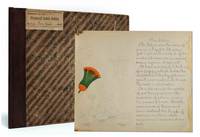
19005954Fulton Pittsburgh 1900. Faux cloth over marbled boards with ownership label to upper left corner with school district and compiler information. Measuring 9 x 11.5 inches and comprised of 22 pages of sketches herbal specimens and sample essays all recto. Firmly bound and with some dampstaining to the lower gutter not affecting text. Representing a range of exercises completed by state normal school student Flora Yagle the book presents researchers with a range of study opportunities including turn of the century pedagogical practice and curricula as well as genealogical and social history work regarding the family structure work and education of first-generation immigrants living on the East Coast. <br /> <br /> One of seven children born to German immigrants Flora Yagle b. 1886-7 clearly grew up in a family that emphasized education and upward mobility. The paper label identifies Yagle as an eighth-year student indicating that she was probably in her early teens when she completed these lessons. Census documents from around the time of her birth and childhood list her father as a foundry worker; and into her adulthood they shift to record him as the general manager of the foundry. Similar ambition was instilled in his children who are documented in census information as students or unemployed during their childhoods with work only appearing in their adulthoods. During Flora's youth she had brothers working as clerks and bookkeepers. By the time of her adulthood she has become a school clerk while her sister has obtained a position as a librarian. <br /> <br /> Part of Flora's training would have been conducted at the Fulton Elementary School located in Pittsburgh's Highland Park. A neighborhood for the rising middle class Highland Park and its schools were still in their infancy while Flora was in hers; while the residential district had been opened in 1879 the school was founded in 1894 and both intended to provide fresh air open spaces and pleasant living to skilled workers and their families who were flocking to Pittsburgh for its work opportunities. Historically Pennsylvania had been a vanguard for public and progressive education. "In his 1830 address to the state legislature Governor George Wold championed the cause of universal public education" as a scaffold for "the security and stability of the individual privileges we have inherited from our ancestors" Explore History. Before the decade was over "more than 1000 local school districts under a single statewide system of instruction" had been founded working to regularize "educational standards curriculum and instructional credentials" in tandem with the 1857 Normal School Act which founded "a network of ten state academies to prepare public school teachers" Explore History. <br /> <br /> Flora's generation was a beneficiary of these policies. Her notebook shows a range of work with creativity and visual arts central to her learning. In addition to pressed floral specimens likely from the school grounds or her home garden her book also contains a visual and textual representation of the spectrum of colors in a rainbow; illustrated lotus blossoms with a short essay on the botanical facts and cultural uses of the flower in Egypt; black and white sketches focused on perspective and shading; geometrical figures designed to be cut out and folded but here present; and figure drawings of children in Victorian clothing much like she and her classmates would wear. <br /> <br /> US Census 1890 1900 1910 1920. unknown
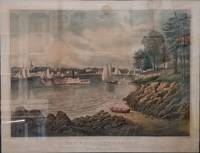
186223656New York: Currier & Ives 152 Nassau St. 1862. First printing. Print. Good overall. Attractive scene the fore shore a rocky beach with a rowboat. Looking across the water the steamboat the "Sylvan Grove" is visible as well as many masted ships. Large homes are visible on the opposite shore.<br /> <br /> Fanny Palmer designed over 200 prints of American life and captured the nation’s imagination. Today Palmer’s scenes of country living outdoor recreation national progress and newsworthy events continue to rank among the most popular lithographs produced by Currier & Ives. <br /> <br /> Lithograph original color couple of foxing spots in the sky and the top margin of the print. Somewhat tanned overall "F.F. Palmer del." printed in lower right corner. Currier & Ives, 152 Nassau St. unknown
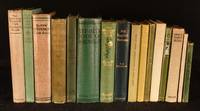
1896973Y18London: Constable and Company; George Newnes; T. Nelson and Sons et al 1896-1954. Cloth. Very Good. 7.5" by 5.5". Not Stated . A pleasing collection of cookery books and various guides to home management with authors including Lucy H. Yates and P. H. Ditchfield. This collection features sixteen volumes the majority of which are various cookery books. Interspersed are guides on hosting homely hints and gardening as well as a biographical work on Isabella Beeton by her niece Nancy Spain and a very scarce autobiography of "international hotelier" Auguste Wild. In the original cloth bindings. The entirety of this set comprises the following: Old English Customs: Extant at the Present Time by P. H. Ditchfield 1896 A Younger Sons" Cookery Book by A Younger Son"s Daughter 1896 Andrew Glendinning"s Apple Tree Cookery Book and Guide to Rational Diet Edited by Albert Broadbent 1902 Homely Hints on Food and Cooking Digestion and Indigestion 1902 The Gardener and the Cook by Lucy H. Yates 1912 More Ways of Entertaining Your Guests by Dorothy Dickinson 1913 A Handbook of Cookery for School and Home by Ada T. Pearson 1914 Easy-to-Make Confectionery and Sweets 1922 The New Butterick Cook Book Revised and Enlarged by Flora Rose 1924 Third printing American Women"s Club Cookery Book Compiled and Edited by Pearl Droste Plogsted 1928 Tit-Bits Book of Wrinkles: A Complete Library of Invaluable Hints on Every Home Subject Edited by A. C. Marshall c1930 Rural Rides by William Cobbett 1932 The Edinburgh Book of Advanced Cookery Recipes 1933 Magic in Herbs by Leonie de Sounin 1946 Fifth printing Mrs Beeton and Her Husband by Her Great Niece Nancy Spain 1948 Mixed Grill in Cairo: Experiences of an International Hotelier by Auguste Wild 1954 In the original cloth bindings. Externally smart with moderate rubbing and bumping across the set most notably to the spine of 'Younger Sons'. Damp spots and marks to the cloth of 'American Women's Club' 'Handbook' and 'Confectionery'. Fading to the spines of 'Advanced' and 'Rural Rides'. Internally firmly bound. Pages are generally bright and clean with offsetting to the endpapers and the odd spot through the majority of volumes. Ownership bookplate tipped-in to the front free endpapers. Contemporary ink inscription to the front free endpaper of 'Old English'. Very Good Constable and Company; George Newnes; T. Nelson and Sons et al hardcover
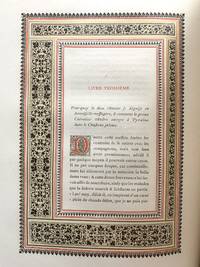
188875412Paris: R. Marchand 1888. Fine. R. Marchand Paris 1888 25.50 x 32.50 cm relié New edition. Limited to 150 copies numbered and initialed by the publisher in manuscript. Copy no. 82. All pages with Renaissance-style chromotypography borders. Initial letters and rules titles in gold. Preliminary notice by Albert de Rochas. Modern full raspberry morocco binding signed by Christiane Pesquet. Smooth spine with title along length. Boards with wide bands of fleur-de-lis paper. The same paper is found on the endpapers the second endpapers with gold paper. Spine uniformly lightened otherwise handsome copy. Copy with covers and spine preserved uncut full-margined as issued. This tale was written at the beginning of the 16th century and had several editions the last of which seems to date back to 1555. The attribution to Jeanne de Flore is not certain but probable. R. Marchand hardcover
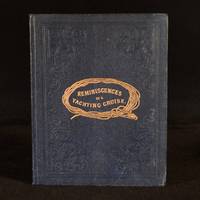
18521005Y26London: Ackerman & Co. Strand 1852. First edition. Cloth. Good. 8.5" by 6.5". T. G. Dutton; N. M. Condy . A scarce series of yachting anecdotes arranged and narrated by the wife of British maritime painter Nicholas Matthews Condy with his sketches. First edition. Scarce. The Subscribers List accounts for 149 copies only 74 of which were sold to Plymouth residents.Dedicated to the memory of the author's husband maritime painter Nicholas Matthew Condy who died the year prior to this publication. A slim volume offering a charming account of a yachting cruise including a description of a frightening thunderstorm. In the publisher's pebbled blind stamped cloth binding with gilt to front cover. With a portrait frontispiece and four lithographic plates from Condy's sketches. Collated complete. In the publisher's pebbled blind stamped cloth binding with gilt to front cover. Externally smart with mild rubbing and bumping to extremities and light damp stain to the front board upper corner. Internally generally firmly bound with front free endpaper and frontispiece working loose the latter being at risk of detaching with further handling. Pages are bright with light scattered spotting throughout. Short closed tear to margin of signature B1. Good Ackerman & Co., Strand hardcover
187847639A. L. Bancroft and Company 1878. hardback. good condition in moderately worn black cloth with some fraying at the spine ends. A. L. Bancroft and Company hardcover
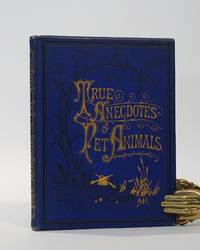
188245289Toronto: C. Blackett Robinson 1882. First Edition. Hardcover. Near Fine. Small 4to. Pp. 135 4 coloured illustrations with tissue guards 1 frontis and black and white full-page and in-text illustrations. Previous owner's name and address to the front endpaper. Publisher's royal blue cloth decorated and stamped in gold and black with gilt titles and gilt lettered spine. All edges gilt corners and spine ends with light wear. Overall an excellent copy. Scarce. C. Blackett Robinson hardcover
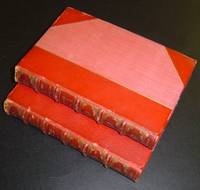
186411723London: Richard Bentley 1864. First Edition . Hardcover. Good. First Editions; 8vos in fine binding of 3/4 red leather with red linen top-edge gilt red/gold marbled endpapers. Good leather darkened and worn; edgeworn; spine heads chipped; corners bumped and worn to boards; spines darkened; edges and pages toning; vI front hinge broken ffep detached and heavily chipped and creased along bottom edge tear to spine head; vII tear to top edge of ffep. Text clean and free of foxing. 327 340 pp. <br/> <br/> Richard Bentley hardcover
1897032982North Leominster Massachusetts: Published By the Compiler Self-Published 1897. Second edition 1897. Quotations from famous authors accompanied by black and white illustrations of the authors and other pertinent views mounted on thick gray paper. Three quarter thin black leather over patterned paper covered boards 6.5" tall 144 pages. Covers heavily worn and spotted with spine covering chipped away good hinges sound text block very small chip to corner of one illustration pages slightly age-yellowed but clean no names or other markings. Hard Cover. Fair. 12mo - over 6¾" - 7¾" tall. Published By the Compiler [Self-Published] Hardcover
185850343kjöbenhavn Bianco Luno 1858. 4to. Uncut in orig. blue boards. Offprint from "Videnskabernes Selskabs Skrifter" Nat.Vid. og Math. Afd. Femte Række Bd.5". 78 pp. and 11 fine engraved plates with many figs. and 1 map. Clean and fine. <br/><br/><em>First edition. - Stafleu & Cowan: 7019. </em> hardcover
18641211140036London : R. Bentley 1864-01-01. Hardcover. Very Good. 2 volume set. 21 cm. 3/4 red Moroccan leather and marbled boards. Binding by Zaehnsdorf. 5 raised bands. Top edge gilt. Clean unmarked pages. Minor shelf wear. London : R. Bentley hardcover
1882109470Toronto: C. Blackett Robinson 1882 Book. Good. Hardcover. First Edition. Moderate to heavy age/use wear including foxing scuffs soils edge wear etc. Former music store owner's stamp on flyleaf. Late 19th century 135 page book of children's animal stories illustrated with drawings. C. Blackett Robinson hardcover
1894152801Jersey City N. J. Star Publishing Company 1894. First Edition. Hardback. Very good copy in the original gilt-blocked blind-bordered green buckram cloth. Professionally recased with the original spine laid back; very impressively finished. Remains particularly well-preserved overall; tight bright clean and strong. ; 592 pages; Description: xv 1 21-592 96 p. Incl. Illus. plates port. Col. Front. col. Pl. 22 cm. Subjects: Recitations. With the supplement. Jersey City, N. J. , Star Publishing Company hardcover
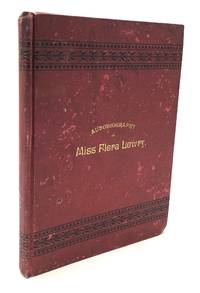
1885H23055Tyrone PA: Tyrone Herald 1885. First printing. Hardcover. Very Good. 8vo dark red decorated cloth gilt very good some general freckling to covers contents very good and clean. 150 pp. Lowery was born in 1819 in County Down Ireland parish of Killinchy town of Ballybriga. In 1849 she and her family including two brothers emigrated to the United States first to New York then to PIttsburgh Washington County where she had cousins and then things got complicated; she was split from her brothers and had hardly any money. She traveled to Indiana Wisconsin and beyond cleaned hotels and rooms did needlework and other labor and went from place to place seeking to find what happened to her brothers and also to find a way to make a decent living. She eventually circled back around to Altoona Tyrone and Birmingham PA in Huntington County. She made some money selling bootblack and then found her metier as a door-to-door salesperson for all manner of goods and sundries. Toward the end of the book she has amassed enough earnings to build a house for herself. A remarkable autobiography with lots of western Pennsylvania details. Tyrone Herald hardcover
188561652Tyrone Pa.:: Press of the Tyrone Herald 1885. First edition. publisher's blue gilt-lettered cloth. A few minor spots and light overall rubbing to cloth; tight and sound. 8vo. Press of the Tyrone Herald, hardcover