6 résultats
1926ZB701271Geneve: Comite International de la Croix-Rouge 1926. #85-96 COMPLETE ISSUES in softcover some external soiling overall very good; price is for the lot:. - If you are reading this this item is actually physically in our stock and ready for shipment once ordered. We are not bookjackers. Buyer is responsible for any additional duties taxes or fees required by recipient's country. Geneve: Comite International de la Croix-Rouge paperback
192816089Paris: The League of Red Cross Societies. 1928. Hardcover. G. Contains numberous drawings and color plates advertisements articles etc. This volume Volume 9 is a 12 month compilation of monthly reviews. Some of the contents include: Anti-Tuberculosis Work in the US The Drama of Disease at Sea Public Health and Propaganda Gustave Ador The Campaign Against Venereal Disease Some Problems in Syphilis Public Health Work in Spain The Easter Witch Earthquakes Mental Hygiene in Germany the Wreck of the Principessa Mafalda Alcohol and the Child ; Ex-Library . The League of Red Cross Societies hardcover
192715882Paris: The League of Red Cross Societies. 1927. Hardcover. G. Contains numerous drawings and color plates advertisements articles etc. This volume Volume 8 is a 12 month compilation of monthly reviews. Pictured is Victoria Eugenie of Battenberg – Queen of Spain. Some of the contents include: How the Death rate from Cancer can be Diminished; Should a Medical Exam before Marriage be obligatory Pioneer Policewomen; Red Cross in Hungary; Professor Ramon's Work on Diphterhia Cancer in Various Races A visit to Florence Nightingale from a Japanese Lady Educator The German Red Cross Flood Prevention and Red Cross Relief on the Mississippi Hydatid Disease in Iceland The Rebuilding of American Cities after Disaster etc; Ex-Library . The League of Red Cross Societies hardcover
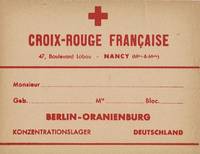
194543212Nancy France: Croix-Rouge Française 1945. ; No Date 1936-1945. Single sheet printed on one side approximately 4 x 3 inches. Unused label for packets sent via the French Red Cross based in Nancy France to inmates in Oranienburg-Sachsenhausen concentration camp.<br> “The SS established the Sachsenhausen concentration camp as the principal concentration camp for the Berlin area. Located near Oranienburg north of Berlin the Sachsenhausen camp opened on July 12 1936….<br> In the early stage of the camp's existence the SS and police incarcerated mainly political opponents….Between 1936 and 1945 however Sachsenhausen also held Jews gay men Jehovah's Witnesses ‘asocials’ among these prisoners were Roma and Sinti and later Soviet civilians. Prominent figures interned in Sachsenhausen included Pastor Martin Niemöller former Austrian chancellor Kurt von Schuschnigg Georg Elser Herschel Grynszpan and Joseph Stalin's son Yakov Dzhugashvili….<br> During the nationwide Kristallnacht ‘Night of Broken Glass’ pogrom of November 1938 Reichsführer SS SS chief and Chief of German Police Heinrich Himmler ordered the arrest of up to 30000 Jews. The SS transported those arrested to Sachsenhausen Dachau and Buchenwald concentration camps. Almost 6000 Jews arrived in Sachsenhausen in the days following the Kristallnacht riots….<br> In the spring of 1944 SS authorities began to bring thousands of Hungarian and Polish Jews from ghettos and other concentration camps to Sachsenhausen as the need for forced laborers in Sachsenhausen and its subcamps increased. Many of these new Jewish prisoners were women….<br> The guards of Sachsenhausen in the early years of the camp were men from the SS Death's Head units SS-Totenkopfverbände; later members of the Waffen-SS were transferred to the SS Death's Head Battalion and deployed as guards†USHMM.<br> For the Red Cross’ description of its attempts to support concentration camp inmates see www.icrc.org/en/document/icrc-wwii-holocaust.Toning otherwise Very Good Condition. Displayable B Holo2-163-7. Nancy (?) France: Croix-Rouge Française unknown
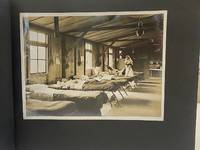
1918165841918. World War I Hospital Camp Photo Album. 1915-1918 documents the transformation of improvised military medical infrastructure in Great Britain during the mass casualty years of the First World War. Created amid the unprecedented scale of industrial warfare the album captures the rapid expansion of ad hoc hospital camps established to accommodate wounded soldiers evacuated from continental battlefields. The photographs foreground the gendered labor of wartime medicine particularly the visible presence of women serving as nurses alongside male physicians and officers and support research in military medical history women's wartime service Red Cross mobilization and the logistics of casualty care on the British home front.<br /> <br /> Nine large silver gelatin photographs 1915-1918 each approximately 7 x 9 inches mounted within an album; seven affixed with adhesive and two laid in loose; nine blank pages at rear. The images depict interior hospital wards with rows of iron cots soldiers resting under blankets and nurses in uniform attending to patients within wooden barrack structures adapted for medical use. One particularly notable image records a surgical procedure in progress with a nurse assisting four physicians wearing aprons and rolled sleeves offering rare visual documentation of operative practice in a temporary wartime facility. Additional photographs show military officers and medical staff posed formally exterior views of barracks and medical buildings stretcher transport of wounded soldiers and motorized ambulances prominently marked with large Red Cross insignia. The album as a whole presents both the institutional organization and the daily labor of care within a camp hospital environment.<br /> <br /> Produced during years when British medical services were strained by the steady influx of casualties from the Western Front and other theaters these photographs materially document the improvisational architecture of wartime healing and the integration of women into formally structured medical roles. The visual evidence of collaborative surgical teams and orderly ward arrangements underscores the professionalization of nursing and the expansion of female participation in public service during the war. As an assembled album rather than isolated prints the group preserves a contemporaneous narrative of military medicine under crisis conditions. Small tears and minor chipping at the edges of the front and rear covers; photographs clean with strong tonal range and only light handling wear; mounts secure though two prints loose as noted. Overall very good condition. A cohesive visual record of First World War hospital camp life emphasizing gendered medical labor and the material culture of emergency care. unknown
194245587London: Red Cross 1942-45. Near Fine. Quarto. cloth-binding c.480pp. b/w pls. 30 copies comprising Nos. 1-3 5-21 23-28 32-35. May 1942 to March 1945. No. 39 was last published bound in rather spotted cloth. Inc. several articles by Winston Churchill. Group photos from Camps sporting events letters from prisoners. Very scarce Red Cross hardcover