114 résultats
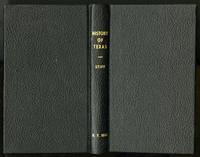
1844046060New York: Nafis & Cornish 1844. Third Edition. Hardcover. Very Good Condition. Rebound in recent black buckram front blanks retained. Old signature to endpaper occasional browning and foxing light dampstain to final 10 pages frontis trimmed to plate edge but with no loss of image"Edward Stiff" inked in on title. The frontis is the earliest view of Austin. 2 blanks frontis title vii-xxii 23-275pp. Streeter I 344 1st ed. Howes L 154 Size: Octavo 8vo. Quantity Available: 1. Shipped Weight: Under 1 kilo. Category: Americana; History. Inventory No: 046060. <br/><br/> Nafis & Cornish hardcover books
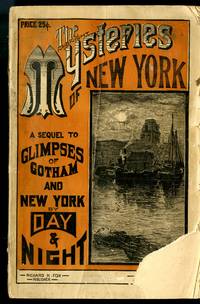
1881047104New York: Richard K. Fox Proprietor Police Gazette 1881. First Edition. Softcover. Good Condition. Browned cover and first blank lacking bottom right corner rear cover and last few pages with loss at bottom edge few bfore that with small tape repair. - minor edge chips and creasing. Scarce in libraries and commerce even though later editions claimed 95000 copies sold. 23 illustrations not including ads. 76pp with 6 pages of ads at rear.<br/><br/>A cautionary volume of sirens muggings honey pots and the myriad vagaries of street life. No doubt like many similar volumes used as a guide as well as for titillation. Size: Octavo 8vo. Quantity Available: 1. Shipped Weight: Under 1 kilo. Category: History; Inventory No: 047104. Richard K. Fox, Proprietor Police Gazette unknown books
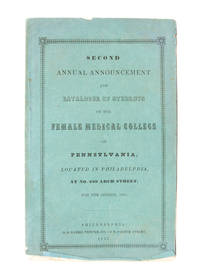
18512970Philadelphia: G.S. Harris 1851. First edition. Very Good . Original blue printed paper wraps printed to front. Some chipping and creasing to edges but overall intact and undamaged despite being quite delicate. Light scattered foxing throughout. Ownership signature of the college's original dean N.R. Mosely struck out at the top of the Faculty list on page 4; pencil ticks next to the names of several students listed in the catalogue on page 6. Exceptionally rare OCLC lists copies of this Announcement at only 2 institutions.<br/><br/>Only one year after Dr. Elizabeth Blackwell graduated valedictorian and became the first female M.D. in the U.S. the Female Medical College of Pennsylvania opened its doors. Located in Philadelphia it was the only the second school to open with the mission of training women in medicine -- having been preceded by the New England Female Medical College two years earlier in 1848. Founded by Quaker abolitionist and Underground Railroad activists who believed that women could make exceptional doctors "the college provided rare opportunities for women to teach perform research manage a medical school and with the eventual establishment of the Woman's Hospital in 1861 learn and practice in a hospital setting. It was the longest-lasting all-women medical school in the nation until it became coeducational in 1970" Mandell. The present Announcement predates these growths however showing the roots from which they emerged. One year running and the faculty remain largely male because there has yet to be an inaugural graduating class this would come in 1852; but already a female student Hannah E. Longshore is listed as a Demonstrator in Anatomy. Indeed Longshore and her sister Anna would both be part of the inaugural class of the college with the latter going on the author Discourses to Women in Medical Subjects 1897. Indeed the majority of women listed in this catalogue went on to become doctors even when it took time -- as it did for Hannah W. Ellis and Susanna H. Ellis both listed among the graduates of the 1865 class. 12 pages in all this scarce pamphlet contains Officers Corporators Faculty and Students of the school; an Announcement on the school's missions and accomplishments; information on Specialties available; Terms of enrollment; and a list of required Textbooks. It also conveys the excitement optimism and pride of those involved. "The Faculty of the Female Medical College of Pennsylvania are inspired by very different feelings from those that attended their efforts one year ago. Then they were about to enter into an untried path to engage in a great experiment.But that which was an experiment is an experiment no longer.give a woman knowledge commensurate with her natural qualifications enable her to go forth healing the sick and comforting the afflicted and she will bless the world." A rare survivor documenting that pivotal moment when women had been given the chance to prove their intellect rose to the challenge and made the future of the next female students more secure. Very Good . G.S. Harris unknown books
18882180Bloomsburg PA 1888. Very Good . Manuscript notebook composed by Ida Sylva Wagner a young woman training to become a teacher at the Bloomsburg State Normal School now Bloomsburg University of Pennsylvania between 1888-1889. Comprised of 88 pages in ink and pencil blending lecture and reading notes with what appear to be Ida's own drafts of analytic essays practice lesson plans and examination questions. Quarter cloth over marbled boards measuring 5.5 x 8.5 inches. Shelf-wear to extremities and hinges tender but holding. Text block overall tight with mild toning not affecting text. Wagner's ownership signature and school information on front paste-down; second ownership signature along with Wagner's later teaching location on rear paste-down. In Very Good condition overall considering its daily class use and apparent usage as a reference guide during Ida's later teaching career.<br/><br/>Established in 1869 the Bloomsburg State Normal School aimed to provide rigorous teacher training to ensure that regional educators could "teach the youth elements of classical education" Bloomsburg University. State census records show that she would have been 22 at the time of this class and that she later moved to Luzerne County to work as a teacher after graduation. This notebook rigorously documents her work in an advanced Practical Teaching course which provided pedagogical methodology as well as requiring students to put methods into practice by designing usable teaching materials. Ida's notebook is roughly divided into sections with blanks separating each; and they include practical notes including Introductory Consideration Foundations and Principles Length of Recitation Object Lessons and Plan of Lessons as well as sample content for lessons such as Primary Reading Primary Numbers and Rules of Grammar. In her hand Ida reflects on the importance of theory and practice noting "The powers of the child which demand the teacher's attention are the physical the intellectual the moral and the spiritual.before knowing can take place there must be something to know and the thing to be known must affect its appropriate sense." This guiding principle clearly shapes the class and Ida's notes show that she is being trained in the "something to know" for example the 15 pages of vocabulary pronunciations and definitions as well as the "affecting its appropriate sense" for example the 46 initial pages on methods for shaping appropriate lessons. <br/><br/>A dense resource with research possibilities including but not limited to the fields of history of pedagogy history of American higher education women's education and employment and gender studies. Very Good . unknown books
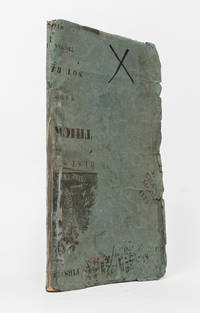
18982508N.P. 1898. Brown paper bound composition book comprised of 43 manuscript pages and 6 original crayon drawings by a young girl. First page excised. Ownership stamp of Hattie Plegge used on sheets toward the center of the book; teacher's signature Miss Sewell on nearby middle page. A fascinating and research-rich notebook in which a young girl practiced her hand in ink and pencil by copying out popular song lyrics folk ballads and poetry. <br/><br/>While the composition book of Hattie Plegge contains no overt indication of the girl's geographical location there are signs within her work that point toward the North. Poetry about General Grant and Abraham Lincoln as well as an original crayon drawing of an eagle marked "Union Forever" suggest that her community belonged to the Union during the Civil War. Additionally though she writes no date school year or age in the book her cursive and her drawings suggest that she was under the age of 12 at the time of composition. As she strives to mature her hand Hattie selects a fascinating array of works to copy out with care; and they provide valuable information about the types of music and poetry that were available to an elementary school girl. Some of the selections come from folk songs such as Billy Boy listed in the Roud Folk Song Index. Others were more widely popular tunes of the time including In the Gloaming 1877 On the Banks of the Wabash 1897 and I Guess I'll Have to Telegraph my Baby 1898. Mixed with these are also longer poems. Though Alice Cary's Suppose is listed as a recommended copybook text in Ballads for Little Folk 1874 others take a more adult political leaning as is the case with suffragist Frances Willard's work Grant is Dead copied out twice the second being more careful and Oliver Wendell Holmes' Old Ironsides. Whether the poetic works were provided by a teacher suggested by a parent or chosen by Hattie herself that give a glimpse into the social influences surrounding her. As a reminder that she is in fact a child there are 6 simple crayon drawings interspersed throughout including a Union eagle a donkey and what appears to be a schoolgirl in a cape.<br/><br/>A rich historical document with research possibilities including but not limited to paleography geography and politics in the post-Civil War era the history of education the transmission of folk songs and folk tales the history of music literature and poetry and gender studies. <br/><br/>Roud Folk Song Index 326. Ballads for Little Folk 47. unknown books
1823046784London: Benbow 1823. First Edition. Hardcover Half Leather. Very Good Condition. Early half red leather mild wear and rubbing to boards marbled endpaper loose some offsetting from frontis onto title page scattered very light foxing very clean overall bound with the half title. x 240 xvi 58pp.<br/><br/>Benbow was an interesting character a political reformer pamphleteer pirate publisher he published a well circulated edition of Queen Mab in 1812 he was in and out of trouble for most of his working career. Crimes of the Clergy is a collection of pamphlets he had written started in 1821- it was much condemned and no doubt destroyed as few copies seem to circulate. In it Benbow details a host of heinous crimes pederasty abuse drunkenness theft etc etc. Size: Octavo 8vo. Quantity Available: 1. Shipped Weight: Under 1 kilo. Category: Religion & Theology; History. Inventory No: 046784. Benbow hardcover books
18933241Wisconsin 1893. Hawthorne Composition Notebook #774 measuring 8.25 x 6.75". Comprised of 70 densely written pages largely in pencil in a single hand with penmanship maturing as pages go on across three years. Lizzie's ownership signature to the front wrap designates her as 12 years old at the start of her composition in January 5 1891. Resulting genealogy research has identified her as Elizabeth Lizzie Schuh born in Milwaukee Wisconsin in 1879. Census records show that she remained in this area through the end of her life. The present composition book is an opportunity to examine how girls were being educated at the turn of the century in the midwest and how that compares to their counterparts to either coast.<br/><br/>It is telling how little of Lizzie Schuh's preteen lessons are overtly gendered. In many notebooks of this kind from the U.K. and East Coast lessons during this age work to indoctrinate girls into an acceptable femininity even in seemingly innocuous ways. Yet here the lessons seem nearly gender neutral -- a possible sign of coeducational classrooms in her school. Throughout the notebook she writes declarative sentences works on active and passive voice practices tenses and memorizes abbreviations. She composes short essays; in the beginning these tend to focus on some piece of nature such as bees or oranges and they incorporate natural science as well as geographical information. Later essays include original short stories and reports on American figures including Daniel Boone and Andrew Jackson. As she progresses her compositions and her hand move toward adulthood becoming more confident and complex. <br/><br/>Perhaps the largest content focus is on areas of etiquette and behavior -- again a space where one might expect more overt gendering. And yet a section on How to Be Polite for example includes common-sense behavior such as "Try to be kind and unselfish" and "When anyone is writing or reading do not stand behind him or look over his shoulder." Some of the advice seems to encourage a kind of working-class or regional modesty: "Do not talk about dress" and "Do not soil your tongue with slang." Correspondence and letter-writing take up the bulk of the rear of the book. Here Lizzie begins by copying out generic letters likely providing by an instructor so she can learn the formalities both of letters and of posting them; later she imagines letters or copies out letters she herself has written and sent out. These appear to train the children for a variety of relationships including personal and familial communications the management of household and businesses and the maintenance of new acquaintances. <br/><br/>A fascinating glimpse into the language and communication development of a young Midwestern girl as she approached adulthood with research potential including but not limited to English language teaching the intersection among disciplines in elementary and middle school the history of coeducation regional education penmanship and paleography gender studies etiquette and genealogy. unknown books
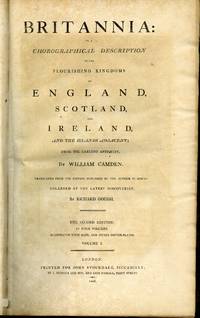
1806046466London: John Stockdale 1806. Second Edition. Hardcover Full Leather. Very Good Condition. 4 volumes in contemporary leather bindings rebacked with the spines laid back down inner joints strengthened with cloth tape. Modest browning and foxing occasional light stains and wear to page edges some offsetting but generally clean and a very good copy overall. With 104 engraved plates 57 maps mostly folding and a 1 paginated folded chart. ccvi 415 1 blank2 ; iv 518 2; iv 527 1 blank 29 1 blank; iv 570 30pp. Brunet I 1511. <br/><br/>The second edition of Gough's Britannia the first was published in 1789. "bien préférable aux précedentes" Brunet. Size: Folio. 4-volume set complete. Quantity Available: 1. Shipped Weight: Over 3 kilos. Category: History; Geography & Maps. Inventory No: 046466. John Stockdale hardcover books
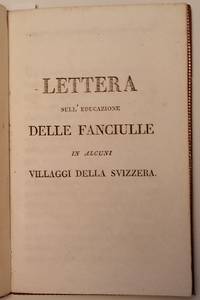
183063Bergamo: Dalla Stamperia Mazzoleni 1830. 24mo. 130 x 85 mm 5 1/8 x 3 1/4 inches. 32 24 pp. Contemporary red morocco gilt-tooled borders and spine. A lovely copy. First edition. Superb copy of this seemingly unrecorded volume designed to raise funds for the maintenance of girls' schools north of Bergamo near the Swiss border. It is published by the 'Pia opera di Santa Dorotea' an Italian movement founded in 1815 to provide education for female orphans. The volume contains two separately paginated parts each in the form of a letter. The first describes in a cheerful style the work of the schools the directors and assistants all female and the flavor of the education the girls receive; all the girls learn to read and write and educated in virtues of piety and charity. Contrasting the petulance nascent malice and puerile nature of many girls with that of those in the care of the Santa Dorotea schools the author notes that 'the education of these peasant girls is a miracle.' The author describes some of the highlights of the school year including the feast of St. Tecla 'a spectacular event'. At the end of the first part there is an advertisement for the charity's publication Pia opera di Santa Dorotea Bergamo 1830. The second part consists of a dialogue between the author of the first letter and two potential donors to the charity who after more discussion about the administration of the schools agree to make a donation. Not in cited in NUC SBN or OCLC. 63. [Dalla Stamperia Mazzoleni] unknown books
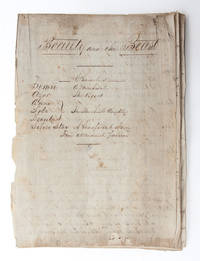
18543249N.P 1854. Complete 28 page handwritten manuscript play prompt drawn directly from Julia Corner's 1854 adaptation of Beauty and the Beast. Stitched at spine and holding though some pages are loose or delicate. Occasional staining largely confined to margins or rear blanks. Composed in one woman's hand in ink throughout with what appears to be a much younger girl's annotation in pencil to the final pages. The text throughout corresponds with Corner's book with the exception of stage directions occasionally being abbreviated or simplified. We have been unable to locate the "Miss Lacy's School" mentioned in the younger girl's note.<br/><br/>Julia Corner the daughter of a printer became a prolific children's author in her time; and her adaptation of Beauty and the Beast was hailed for "creating quite a sensation among all the middling-size children" according to Eliza Cook's Journal from that year. At a time when there was debate about the morality of performance and theater Corner was noted for "wisely sympathizing with child-natures and she declares her belief in the propriety and profit of theatrical amusement among children"; and Eliza Cook's Journal documents instances of girls in particular gravitating toward the play "settling all the characters for all available friends" and performing at home or school Cook Vol 10. Here we see first-hand evidence of this phenomenon: girls in a ladies' school taking on roles and acting them out for classmates. Further research into the school its location and its class of girls would be enlightening -- uncovering for example if there were multiple prompts for girls who could not access Corner's text whether the manuscripts were done as a handwriting exercise in addition to the performance or whether one individual simply copied this play out as a souvenir of the event. The hand used throughout is elegant and well-trained -- seemingly a grown woman whose spelling corresponds with contemporary American rather than British expectations. <br/><br/>The choice of a fairy tale like Beauty and the Beast also deserves study as it promotes particular feminine qualities -- including respect for authority filial affection and self-sacrifice and modesty -- even within the darker setting of fairies sorcery and punishment. <br/><br/>A unique opportunity for research in fields including but not limited to the trans-continental transmission of fairy tales girls' education the history of performance didactic literature and performance in schools gender studies and paleography. unknown books
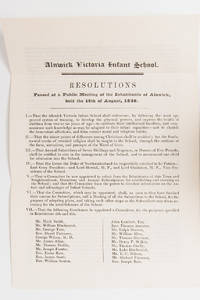
18382596Alnwick: M. Smith 1838. First edition. Fine. 3 page pamphet measuring 152 x 228mm. Trifolded with ownership signature of Wm. Dickson Esq to rear blank. Else an exceptionally clean and seemingly untouched copy of this rare pamphlet advocating for improvements in the early education of children. The only copy known on the market this title does not appear in the modern auction record or at any institutions according to OCLC.<br/><br/>A proposal and prospectus for an Infant School to serve the town of Alnwick and improve the overall level of education within the community. The pamphlet clarifies that the Duke of Northumberland is confirmed as the school's patron; and it outlines how donations and subsciptions from the town will add to the school's endowment. But more importantly it focuses on the communal benefits that will come from citizens' support for children's education regardless of their class. Touting the successes of other Infant Schools in England and abroad in providing "well-regulated nurseries for the children of the poorer classes" the committee also explains that " the most approved system of training will develop the physical powers and improve the health of children from two to six years of age -- to cultivate their intellectual faculties and communicate such knowledge as may be adapted to their infant capacities." The committee asserts that when the larger population begins sending children to school those children will be endowed with a desire to learn and "those attending will feel it as a punishment to be kept from the School" because school "is to the children what the actual business of life is to the man. Here the feelings are manifested and the character is developed" so that infants grow to intelligent and responsible members of the populace. Notably the committee also points out the short term benefits of developing an education system. "To the parents themselves many advantages will accrue from these Schools. Not only will their minds be relieved from much anxiety for the safety of their children but the mother free during the day from the necessity of watching over them will have an opportunity now denied to her of contributing by her labour to their support or of devoting more time to the promotion of their comfort at home." This acknowledgment reveals an important shift in thinking about the economic role of mothers and about women's need for time to accomplish their own work. A rare and important example of the spread of early childhood education and the arguments for its expansion. Fine. M. Smith unknown books
18223447Great Britain 1822. Comprised of 78 manuscript pages of mathematical definitions tables methods and exercises in a single hand with the ownership signature of Elizabeth Young and a running date made intermittently to the footers. Blue paper vernacular binding measuring 8 x 12 inches and stitched at spine; later tape reinforcement. Elizabeth's metric measurements and English currency reveal her to be a student somewhere in the UK. Though the commonness of her name prevents us from locating her specifically in genealogy records the manuscript she left behind reveals much about her.<br/><br/>Elizabeth's notebook is composed in a meticulous cursive hand with neat headers each dated and her name to many of the footers. Section each have a definition leading into rules and from there into word problems and calculations. Each new section progresses in complexity requiring Elizabeth to conduct longer calculations and combine a variety of arithmetical methods multiplication division addition subtraction. Some of these are generic questions about distance or weight; but others urge the student to devotion even as she works in a logical field "How many Hours Minutes and Seconds elapsed since the birth of Christ which is 1808 years ago assuming 365 days to a year". Some put Elizabeth in contact with the world of commerce and supply chain "The yearly export of Brandies from France is said to amount to 25000 tons. What is the value of this quantity at 5s6p per Gallon". Still others prepare her for the maintenance and management of a household or a business "If a servant's wages be 12.12 for 52 weeks how much is that a year" or "If 1728 Elegant wine glasses were bought for £65.2s how must they be sold per dozen or per glass to gain Ten Guineas by the sale of the whole".<br/><br/>A portion of seven pages near the center of the book offers a telling anomaly. While it continues in Elizabeth's neat hand these entries from January-February 1822 list goods purchased by community members from merchants several of whom are women. If these are a part of a school exercise they do not show the marks of it. Rather they appear to be Elizabeth making real-life notations keeping track of accounts for herself or someone else. In this sense the word problems she records and practices are being applied in her own life.<br/><br/>An exceptional document Elizabeth's notebook has research possibilities including but not limited to the history of education in the UK and trans-Atlantic comparisons the history of women's education the effects of class on girls' education mathematics approaches to teaching math to girls historical measurements women in business paleography and women's and gender studies. unknown books
18503448Great Britain 1850. Comprised of 88 manuscript pages of mathematical definitions tables methods and exercises in a single hand with the ownership signature of "Caroline Waters Age 16 yrs" to the front endpaper. Marbled paper vernacular binding measuring 8 x 12 inches and stitched at spine. Caroline's metric measurements and English currency reveal her to be a student somewhere in the UK. Though the commonness of her name and the absence of a specific date prevents us from locating her in genealogy records the manuscript she left behind reveals much about how and why girls of her age and class were being taught arithmetic.<br/><br/>Caroline's elegant practiced hand suggests that she is a member of the rising middle class and the opening of the book suggests that she is a beginning to intermediate mathematician. At the top of the first page she defines Arithmetic as "the art of computing by numbers" which "has five principal sic rules for this purpose viz. Numeration Subtraction Addition Multiplication and Division." Using this definition she divides her notebook into a section for each providing a definition for that principle plus clear-cut examples of its use in both Simple and Compound formats. Numeration Subtraction and Addition are grouped together at the front; and after these sections conclude Caroline enters in Practical Questions in Compound Addition and Subtraction. These involve word problems involving the exchange of money and the calculation of wet and dry weights cloth measurements and time. She then mirrors this with Multiplication and Division before adding sections on Decimal Fractions more Practical Questions and sections on Federal Money and Simple Interest.<br/><br/>The organization of the manuscript suggests that Caroline copied it out for continued reference where sections are easy to locate and problems clearly illustrate each of the principles. And the emphasis in sample problems on currency conversion monetary exchange and banking implies that her family in some way wanted her to be aware of these concepts.<br/><br/>An exceptional and rich document Caroline's notebook is a rich resource for study including but not limited to the history of women's education middle class education women's domestic use of mathematics women in business paleography genealogy gender studies. unknown books
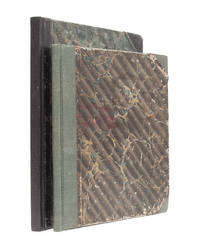
18703389United Kingdom 1870. Geography notebook of Mary Barker: Quarter black roan over marbled boards measuring 9 x 7 inches. Comprised of a calligraphic title and frontis plus 59 hand drawn-and-colored maps done by a young woman in her first three years of teacher training. Throughout Mary annotates on the margins which year and term she is in and occasionally notes that the map was drawn "From Memory"; and each map has penciled corrections and assessments. <br/><br/>with Geography notebook of Allison Jane Gillespy: Quarter cloth over marbled boards. Calligraphic title page and 35 intricately hand drawn maps from the British Empire Europe and the Middle East. <br/><br/>A pairing of beautiful and research-worthy notebooks documenting teacher training in the late nineteenth century as well as providing a look into how geographies changed across time and how British educators were being trained to perceive and educate the young about other parts of the world and how they connected to the British empire. With nearly 100 pages combined the notebooks offer scholars important comparative opportunities and means for better understanding the rising number of women educators and authors publishing works that engaged geography and international cultures during the Victorian era.<br/><br/>"The Wesleyan Methodists had a school for ministers' daughters at Trinity Hall Southport.which admitted both boarders and day girls.to educate ministers daughters and train teachers" Roach. Pupil teacher programs like the one Mary Barker was enrolled in had become a popular method of producing teachers at a time when the public's access to education expanded and the demand for instructors was at a high. Such programs functioned like an apprentice system taking a senior pupil typically thirteen years old and putting her in a five year assistantship to her own instructor. Pupil teachers typically took on responsibility for teaching lower classes observing their superiors educate the more advanced students and completing their own educations. By the 1870s these programs had become standardized to ensure proper preparation for instructors Robinson. <br/><br/>Mary's maps trace this process. As she moved from her first to her third year in this notebook the quality and care she puts into her work improves. Her handwriting and attention to detail matures. And her assessments move from Fair to Good and Very Good. Maps in the notebook include nearby locales such as Ireland Scotland and the British Isles as a whole; European nations including Sweden Norway and Prussia as well as eastern Europe and Russia. Mary also maps out "Arabia" and the "Chinese Empire" as well as "Further India" revealing a wide array of changing borders and shifting cultural attitudes. <br/><br/>While Allison does not leave any marker of her class age or school the level of intricacy in her maps suggests she was a senior student or finished instructor. These appear to be fair copies not done from memory but prepared as examples for students or as teaching aids.<br/><br/>Together the two provide a comparative opportunity to study the history and politics of mapping nineteenth century girls' education pedagogy and pedagogical training and geography. unknown books