[GUANGZHOU SCHOOL].Biblio.com
395 résultats
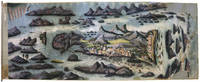
1849ABC_50166Macao 1849. Painting 350 x 150 cm. Watercolour on paper on contemporary wooden roll. A massive view of Macao from above painted in watercolours sometime in the second half of the nineteenth century during the era in which much of the trade in the area was beginning to shift from the old Portuguese colony to Hong Kong. The peninsula clearly labelled with the Mandarin toponym Àomén "Bay Gate" is very much the focus of the piece: it is depicted effectively as an island with the Chinese mainland across the isthmus abstracted away into just one of many rocks in the surrounding ocean.Macao is shown as mountainous and settled mainly on the western and southern shores with groups of white blue and yellow buildings. Many are labelled in Chinese or have yellow banners with Chinese writing on them flying above. Similarly the rocks in the surrounding waters are dotted with settlements and fortresses labelled in the same way.The seventeenth-century church of St Paul's stands in ruins at the heart of the settlement indicating that this piece was painted after 1835 when the building was gutted by a fire reducing it to its impressive frontage which remains one of the emblems of Macao to this day. Furthermore the Portas do Cerco Border Gate built in 1849 clearly appears in the northern wall across the isthmus. However none of the ships depicted are motorised suggesting that this view was still painted before the founding of the Hongkong Canton & Macao Steamboat company when steamships would have become a more common sight.The centring of Macao in what looks like a vast ocean littered with menacing rocks gives this painting an almost mythological aspect but the style is clear and realistic with the landmarks of the colonial settlement clearly depicted.Macao's strategic position on a peninsula connected to the mainland only by a narrow isthmus made it an attractive site for controlling trade in the Pearl River delta and in the region more broadly. Although initially founded as a commercial port by the Chinese in 1535 by 1557 the Portuguese had successfully negotiated a long-term lease of the island from the Ming dynasty and begun to settle there. Macao thus became the first enduring European colonial settlement in China and moreover was destined to become the last one as well being handed back to China in 1999.A beautiful monument to Macao's history in the days of its swansong as a Portuguese trading colony.Provenance: from an Italian private collection. The paper is brittle fragments have come away at the end some of these are gathered in a bag. A few larger tears down the painting however with minimal loss to contents. The painting is still clear and vivid. unknown
188429652Various places 1884-1958. Fine original condition. 73 letters from 43 correspondents including Lore Crewe Lord Curzon F. S. Kenyon Prince Louis of Battenberg Edward Lyttleton Lord Napier Lord Roseberry Sir Charles Trevelyan and others mostly pertaining to school events. unknown
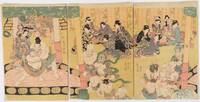
1860218670東京. Tokyo. circa1860s. Three colour woodblock prints a triptych panels loose each approx 38.5 x 25.4cms Japanese text artist's signature publisher's seal and date in the outer margin of the centre and right-hand panels and in the inner margin of the left-hand panel slivers of paper tape strengthening the top margin to the verso of each print pin-holes to the corners from previous display with loss to the lower right corners and the inner corner of the left-hand panel paper a little dusty and soiled but overall in good condition. Wonderful satirical woodblocks with muted tonings possibly from the composition for "Sumo wrestling match of Seven Lucky Gods" replacing the gods with actors as aging sumo wrestlers surrounded by onlooking geisha and fellow actors in masks and costume. <br> <br>From the collection of the late John Caiger lecturer in Asian studies ANU. . unknown
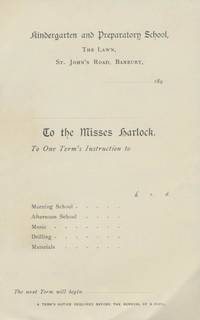
18903210273<p><em>8vo sheet 16 x 10 cm.</em></p><p>Maria and Frances Anne Harlock began their school at Banbury Oxfordshire about 1890. The Harlock's were natives of Banbury and the daughters of a local draper and former mayor who used part of the family home as a school until the death of their father in 1923 who was by then 101. As the Harlock's were Quakers good works by the family for the local area was something of a calling. Francis later served on the committee of management of the Friends' School at Sibford and it would appear that the sisters had run their own school on a break-even principle and saw education as a vocation rather than a money making enterprise.</p> The Lawn, St. John’s Road, Banbury.
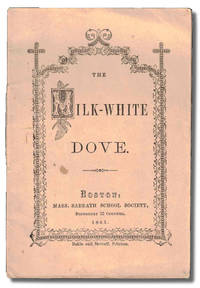
186550251Boston: Massachusetts Sabbath School Society 1865. Paperback. Good. Paperback. 5.5 by 3.75 inches. 14pp. Rubbed and darkened overall with some light foxing else a good example in publisher's stitched wraps. OCLC shows no holdings. <br/><br/> Massachusetts Sabbath School Society paperback
187029538Montgomery Alabama: John G. Stokes & Co. State Printers 1870. 7 1 blank pp. Stitched in original printed green wrappers. Light old folds wrappers lightly spotted Very Good. Contemporary inscription at head of front wrapper "Respects of G. Horton Mobile." A Bostonian who had moved to Mobile as a young man Horton was Mayor of Mobile at this time. Previously he had been an advocate of public education and had served on Mobile's school board. During the Civil War he was jailed for Unionist sympathies. During Reconstruction his advocacy of civil rights placed his life in constant danger.<br /> <br /> The Report is a chapter in Alabama's bitter Reconstruction strife. It attacks Dr. N.B. Cloud State Superintendent of Public Instruction who was regarded by unreconstructed Alabamans as a Scalawag for his support of Reconstruction and the Republican Party. The Report also attacks G.L. Putnam whom Cloud had named Mobile's superintendent of education an appointment which other Mobile educators refused to recognize. <br /> Cloud brokered a compromise-- for which he lacked authority-- by making Putnam superintendent of Emerson College known as the 'Blue School' a Negro school run by the American Missionary Association. The Report accuses Cloud and Putnam of illegally diverting public funds to the support of the Blue School.<br /> Ellison 1597. John G. Stokes & Co., State Printers unknown
187031292Montgomery 1870. 23 1 blank pp with original printed title wrappers. Text lightly dusted wrappers dirty stitched. <br /> <br /> This case is a chapter in Alabama's bitter Reconstruction history. Mobile School Commissioners claimed that George L. Putnam Superintendent of the Mobile schools had mishandled funds which were supposed to be used to support the free public schools. Putnam had been appointed Superintendent by N.B. Cloud State Superintendent of Public Instruction whom unreconstructed Alabamans considered a Scalawag. <br /> Putnam used public funds as authorized by Cloud for the support of a school for Negroes. The outcome of the case turned on whether the Commissioners were properly established under the laws and Reconstruction Constitution of Alabama. This brief reviews the history of the Mobile School System and the controversy. unknown
189331862Albany: Printed for the Ladies Union Mission School Association 1893. First Edition. Hardcover. Very good. 12mo. 1 133 pages. Frontispiece photograph. Illustrated with photographs. Brown cloth hardcover with black title on the front cover and gilt stamped title on the spine. A small dent and scuff mark on the spine. <br /> <br /> An "Association Copy." Inscription not entirely legible written on the right front flyleaf: "From Mrs. A. J. A. E. Fort Meade Feby 94." Mrs. A. J. A. is Mrs. A. J. Alexander wife of General A. J. Alexander. She is mentioned in the introduction on page 10. Mrs. A. J. Alexander played an important role in establishing a Christian mission at Sacaton Arizona Pima Reservation. Printed for the Ladies Union Mission School Association hardcover
187934705Unknown 1879. Ledger. Good. Ledger. Approx. 7.5" x 6". Marbled paper covered boards with black leather spine. Boards are shelf and edge worn. Leather is rubbed and chipped at the head and base of spine. A few pages have been torn out and one sheet torn in half. Old library label of "Perseverance S.S. Library" on the front paste down.<br /> <br /> Ledger consists of 106 lined pages used for recording student names classes teachers questions treasurer reports minutes of school meetings etc. No location of this Sunday School was provided in the records. unknown
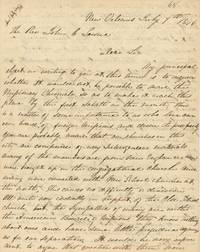
1846List2863New Orleans Louisiana 1846. Single letter three 8 x 10 inch pages. Torn at folds some tears repaired with archival tape; hole at location of seal; otherwise very good to excellent. John Holt Rice 1818–1878 was the son of a Presbyterian minister and nephew of Archibald Alexander founding professor of the Princeton Theological Seminary from which Rice graduated in 1845. When he wrote this letter he was working as a city missionary to the poor in New Orleans. Rice would spend his career ministering around the southern United States before his death from yellow fever. His correspondent is John Cameron Lowrie 1808–1900 a Scottish immigrant fellow Princeton graduate and a missionary in Colonial India. When his health became too precarious to remain abroad Lowrie returned to serve with the Board of Foreign Missions.<br /> <br /> The subject of missions boards was part of the Old School-New School controversy and schism in the Presbyterian Church particularly over whether missionary work should be primary the Old School view or secondary the New School view to the Church’s work.1 Those holding the latter view were satisfied with the work of the American Board of Commissioners for Foreign Missions ABCFM which was not a specifically Presbyterian body. Those of the former view believing that the Church’s missionary board ought to be itself Presbyterian formed the Western Foreign Missionary Society. When the Church’s second schism occurred in 1837 the Western society was <br /> renamed the Board of Foreign Missions BFM and headquartered in New York City.<br /> <br /> In this letter Rev. Rice finds himself in the delicate position of being an Old School supporter of the BFM ministering to Congregationalists and New School-raised supporters of the ABCFM. He writes to Rev. Lowrie requesting that copies of the BFM’s monthly Missionary Chronicle be sent to him in a timely manner as this was “a matter of some importance to us who love our own board of foreign missionsâ€:<br /> <br /> “You are probably aware that our churches in this city are composed of very heterogeneous materials many of the members are from New England and were brought up in the congregational church and many were connected with New School churches at the north. This causes no difficulty or division All unite very cordially in support of the Old School church but the sympathies of many are with the American Board of Missions. They know nothing about ours and have some little prejudice against us for our separation. It would be very impudent to argue that question with them now or attempt to convince them that our own board ought to be patronised by those connected with one of our churches rather than the American. But I feel certain that if they knew more of our operations they would take an interest in them.â€<br /> <br /> Rice also notes that he is an editor for the New Orleans Protestant newspaper and suggests that Lowrie send “something now and then†to excite “missionary zealâ€. Of interest to scholars of Presbyterian history especially the 19th-century Old School-New School schism.<br /> <br /> 1 Rev. Dr. Michael Parker “175 Years of Presbyterian World Mission†Presbyterian Historical Society archived November 1 2023 at https://web.archive.org/web/20231101183954/http://www.history.pcusa.org/history-online/topics-note/history-world-mission. unknown
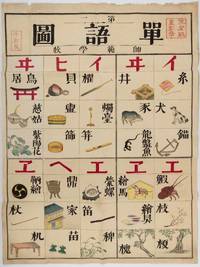
1873214113Japan. Meiji 6 1873. Four very attractive colour folded woodblock school posters 60 x 78cm each with accompanying woodblock printed textbook 32 double-folded leaves 22.5 x 15cm. Edges of posters worn with some minimal loss at margins the accompanying textbook is worn at edges with some thumb marks at lower corners but sound and generally clean. Overall good. Offers a fascinating glimpse into the beginnings of modern Japanese education. A wonderful collection of four primary school colour posters and a teacher's textbook dating to the very beginning of modern school education in Japan. The four posters contain sets of beautifully coloured and delicately printed pictures illustrating key words which children would be taught to read together with the corresponding kanji characters. The posters are divided by theme - one showing parts of the body and clothes; one showing crockery and cooking utensils; one with animals plants and tools; and one household items including a clock chair and abacus. They are particularly interesting for their combination of traditional Japanese and western items. The accompanying woodblock print text book 師範学校小学教授法 Shihan gakkō shōgaku kyōjuhō was published in Meiji 6 1873 and show how to explain each item in the classroom. <br> <br>The posters have the chops of Chikuma Prefecture current Nagano Prefecture and 1000 limited copies at the top. . hardcover
188230734Roanoke VA: Southern Methodist Publishing House 1882. First Edition. Ledger. Fair. Quarto. 134 pages. Black cloth covered boards with black leather spine. Most pages used for hand written accounts of attendance records. Form book published by the Southern Methodist Publishing House. Binding is edge worn shaken and falling apart. Hinges are broken but boards are still attached. Spine is chipped head and base. Last leave has the upper third portion torn off. Pencil notes on the end sheets. Fair only. <br /> <br /> Written on the front paste down are the two Superintendents of the school from 1883 to 1886: "J L Gresham Supt from April 1882 to Nov 16 1883 J C Hornsby Nov 16 1883 to fall of 1918." Contents contain several student names. Southern Methodist Publishing House unknown
18785956New York: Royal Baking Powder Co 1878. Stapled octavo-sized booklet 23.5 x 15cm. 32 pages. Illustrated. FIRST EDITION. Front wrapper verso with product reviews dated 1878. Includes a wood engraving showing twenty figures of diverse pans used in baking. “The recipes in this book are new and formulated by one of the most experienced Professors in the art of scientific and practical cookery especially adapted for the use of "Royal" Baking Powder and "Royal" flavoring Extracts. These preparations are incomparable in strength and purity. Substituting other articles will only end in disappointment." front wrapper blurb. Included are three hundred seventy seven recipes ranging from Bread & Rolls to Pies to Puddings to Fritters & Pancakes to Meat Pies to Icings. "The Royal Baking Powder Company was one of the largest producers of baking powder in the US. It was started by both Joseph Christoffel Hoagland & William Ziegler in 1866." Wiki. General wear & soiling to wrappers; foxing throughout; a bit musty. Good or a bit better in printed gray-green wrappers. OCLC locates four copies; Axford page 352; Bitting page 410 both for the 1882 and later editions; not in Cagle. Royal Baking Powder Co unknown
1831D19539Karlsruhe: Verlag Von Gottlieb Braun 1831. Neue Ausgabe. Hardcover. Good. Two volumes bound in one. Oblong with cloth spine and corners marbled paper boards printed label to upper board. 45 21 & 24 hand-colored lithographed maps some folding. Rubbing and wear to boards spotting throughout but hardly untypical. A rather scarce student atlas. <br/><br/> Verlag Von Gottlieb Braun hardcover
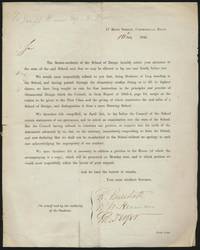
18453220094<p><em>4to printed bifolio sheet 24 x 19.5 cm some marks and folds. Addressed to Joseph Hume M.P and signed by Richard Burchet R.W. Herman and W.D. Telfer. </em></p><p>In 1845 Richard Burchett became the ringleader of students protesting to the Board of Trade about the teaching methods at the Government School of Design: this was the first attempt to improve the instruction in the principles and practice of ornamental design. The complaint became so serious that eventually a Parliamentary Committee of Enquiry was instituted in 1846 at which he and others gave evidence. Oddly by that time Burchett had already become a master at the school and so was giving evidence against his own employees to the committee.</p><p>This copy was addressed to the radical Joseph Hume M.P who was a close friend of William Williams another radical M.P. who led the charge of incompetence by the School of Design in the House of Commons. After eight committee meetings it was agreed that the School was not in good shape 'the principles of Ornaments and the practice of original design as applicable to manufactures are not efficiently taught' and 'That a knowledge of manufacturing processes so as to enable the students to unite fitness and practicability in Ornament is not communicated.' Reforms were instituted but not in time for some woefully bad designs to appear at the Great Exhibition of 1851 for all the world to see.</p> [London], 17 Bond Street, Commercial Road. 10th July
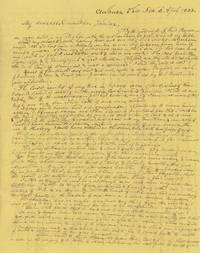
1832List3436Auburn New York 1832. Single four-page letter measuring 7 ¾ x 9 ¾ inches. Folded with very small tears at folds. Excellent to Near Fine. A letter written from the Auburn Theological Seminary in 1832 from the soon-to-be Reverend Thomas Reed Rawson 1803-1877 to his soon-to-be wife Louisa W. Dawes 1810–1849. Dawes who lived in Cummington Massachusetts was the older sister of Senator Henry Laurens Dawes best known for the 1887 Dawes Act.<br /> <br /> Rawson opens by commenting on the death of one of his students and his time spent in Oswego “visiting in the most fashionable familiesâ€; he felt this taught him a great deal about “human nature†which in Oswego is “peculiarâ€. He seems to have been particularly perplexed by the spiritual character he encountered in upstate New York a locus of the Christian revival movement now called the Second Great Awakening:<br /> <br /> “You know I expected that the spirit of the west was a more active . spirit than what was seen in the N.E. states & hoped by breathing this pure atmosphere to enjoy great spiritual health. How erroneous was the impression! How greatly have I been deceived! . I acted as though it was so – as though man was man only in certain latitudes. I acted as though face answered to face only when seen in the waters of N.E. & consequently that the heart of a N.E. man had no analogy to what beats in the bosom of one born in a more western longitude.â€<br /> <br /> Not only is Rawson nonplussed by New Yorkers’ religious qualities he is vehemently opposed to some of the new practices that arose from the religious revival there:<br /> <br /> “The state of things here I mean in all this country at the west is very peculiar. You have heard of ‘Old & New Measures’ I suppose. For myself I cannot approve of the latter. I find not a spirit in me to Fellowship them. Have been exceedingly tried by them as I have been in the midst of ‘new measures’ all winter. You can form but a faint idea of the excitement which is in this country in the religious community. In Oswego Co. the lay-men are going through the Co. holding meetings once a month in praying exhorting dispensing the duties of Clergymen &c. &c.; & it seems that the present state of things must result in a wide division in the churches. ‘A house divided against itself cannot stand.’ . As near as I can find out very sinister is the spirit that knows the new measures to that wild-pine which ran so extensively in the time of Edwards. The effects of it are seen in your town to this day.â€<br /> <br /> The “New Measures†were novel practices for American Christianity that came about during the Second Great Awakening mainly due to Presbyterian minister Charles Finney. These include very lengthy meetings public naming of sinners and public confessions of sin and were controversial with those who preferred a more orthodox and restrained service. Rawson accurately predicts that the new practices would lead to a schism; starting in 1837 the Old School-New School Controversy split the Presbyterian church along these lines. He later worries that such a division in the church would allow “Catholicism to take the advantage†and that “Satan is bringing this about as rapidly as possibleâ€. The appeal of a strong hierarchical Catholic church as opposed to a weak and divided Protestant one was a common worry among Protestants at the time.<br /> <br /> Rawson traces the “sinister spirit†of the new measures back to “the time of Edwardsâ€: Jonathan Edwards a key figure in the First Great Awakening of the 1730s and 40s. Given his reference to “your townâ€â€”Cummington Massachusetts—Rawson is probably referring to the so-called “New England theology†that arose from the First Great Awakening. Among other things New England theology proposed new views on man’s free will and responsibility; similar views would create controversy in Rawson’s time as he explains:<br /> <br /> “I see my own heart to be depraved & wicked beyond all observation but the fruits of the spirit I think I do love & hope they are sweeter & more sweet to my taste. I say taste the New measure-men are not taste-men but believe in the ‘motive scheme’ — By taste is meant the implantation of a new principle – love to God & is affected by the Holy Spirit. The ‘motive scheme’ implies that the sinner turns himself about in by motive merely.â€<br /> <br /> He is objecting to the idea that a sinner could redeem himself through an act of his own will—by his own ‘motives.’ Old School Presbyterianism holds a more orthodox Calvinist view wherein the redemption of the sinner is not up to the sinner’s will at all. Rawson makes an interesting comparison between New School views on the matter and states’ rights in the context of the then-ongoing nullification crisis:<br /> <br /> “The signs of the times declare most plainly to him who has wiped up his eyes that ‘the end has come upon the four corners of this earth’ i.e. the end of peaceful days for the present. Never was our Republic brought to a crisis like this. Nullification in the Political world is the same with Denunciation in the Religious world. This is my opinion; don’t know as have heard others say so.â€<br /> <br /> The nullification crisis arose when South Carolina declared that several import tariffs were unconstitutional and thus nullified them under the states’ rights doctrine of state nullification. Rawson seems to be drawing a parallel between the revivalists’ idea of the role of one’s motives in salvation and states’ rights advocates’ idea of the relationship between the states’ wills and the federal government’s. Of course the states’ rights issue would soon reach an apotheosis.<br /> Rawson closes with some affectionate lines for Dawes and advice about her own teaching job; the crossed text updates her on the Christian conversions within his family. Overall the letter provides detailed insights into the views of a more conservative theology student on the Presbyterian controversy that was soon to come to a head. unknown
18912092902143300143Mono fumei 1891. Soft Cover. Fine. Number of pages: 26 Size: 32cm Mono fumei paperback
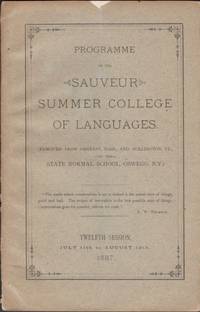
188733222Philadelphia: Press of Wm. F. Fell & Co 1887. Wraps. Fair. Wraps 8.25" x 5.5". 27 pages 9 pages of advertisements. Gray wraps with borders and title on the front cover. A list of Dr. L. Sauveur's Educational Works printed on the rear wrap. Light chips to the covers. The rear wrap is detached. Vertical crease to the contents. Illustrated with two maps: a 12" x 12" folding railroad map of the New York Central and Hudson River Railroad and Connections; and a 12" x 12" folding map of Rome Watertown and Ogdensburg Railroad and Connections. Both maps are in very good condition. The second map is attached to the rear wrap which is detached. Contents include faculty school goals testimonials school information including courses etc. From Amherst College Archives:<br /> <br /> Dr. Sauveur started the Normal School of Languages at Amherst College in 1875. In 1878 the School was first held at Amherst College. Its objective was "to familiarize instructors with the 'Natural Method' of teaching ancient and modern languages." By 1894 the Sauveur College of Languages also known as Sauveur Summer School or Normal School of Languages joined with the Amherst Summer School. The Summer School offered in addition to language courses courses in "library economy" geology physical education and other subjects. A 1901 brochure describes the Summer School of Library Economy also known as Fletcher Library School as a distinct program developed by William I. Fletcher. By 1906 the program was defunct. Press of Wm. F. Fell & Co unknown
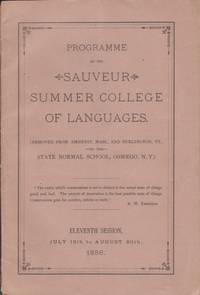
188633221Philadelphia: Press of Wm. F. Fell & Co 1886. First Edition. Wraps. Good. Wraps 8.25" x 5.5". 32 pages. Brown wraps with borders and title on the front cover. A list of Dr. L. Sauveur's Educational Works printed on the rear cover. Vertical crease to the contents. Light edge wear to some of the text. Illustrated with two maps: 9" x 7.5" folding railroad map of the New York Ontario & Western Ry; and a 12" x 12" folding map of Rome Watertown and Ogdensburg Railroad and Connections. Both maps are in good condition. Contents include faculty school goals testimonials school information including courses etc. From Amherst College Archives:<br /> <br /> Dr. Sauveur started the Normal School of Languages at Amherst College in 1875. In 1878 the School was first held at Amherst College. Its objective was "to familiarize instructors with the 'Natural Method' of teaching ancient and modern languages." By 1894 the Sauveur College of Languages also known as Sauveur Summer School or Normal School of Languages joined with the Amherst Summer School. The Summer School offered in addition to language courses courses in "library economy" geology physical education and other subjects. A 1901 brochure describes the Summer School of Library Economy also known as Fletcher Library School as a distinct program developed by William I. Fletcher. By 1906 the program was defunct. Press of Wm. F. Fell & Co unknown
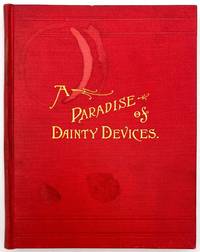
189422001239New York New York: G.H. Dickson's Sons & Co 1894. Very good. Boards rubbed with water staining. Some dust soiling upper hinge cracked end papers toned. Rare with only a single other recorded copy Brown "A Paradise of Dainty Devices" is comprised of over 100 pages of original poetry and prose by students at Mademoiselle Ruel's School in Manhattan in 1894. It was compiled by and privately printed for L.C. Baker Professor of Rhetoric and attributes each piece to the students via an index with their pseudonyms in the index: Boston Dido Vernon Van Flic Donovan Meredith Hooker and Pshaw. Subjects of the student's pieces include nature friendship school death dreaming Venice Santa Claus and more. There is also a poem about each student titled with their pseudonyms pp. 46-53 and revealing a little about each of their personalities. Overall a charming window into the lives of a small group of school girls their passions and interests.<br /> <br /> Square 8vo 7.5" by 6" pp. 105 5 in original red cloth binding stamped in gold and blind on upper cover all edges gilt patterned end papers.<br /> <br /> 1 copy on OCLC only Jan 2023. G.H. Dickson's Sons & Co unknown
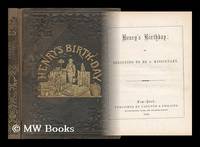
1855102999New York; Carlton & Phillips For The Sunday-School Union 200 Mulberry Street 1855. First Edition. Hardback. Very good copy in the original gilt-blocked and embossed cloth. Professionally recased with the original spine laid back; very impressively finished. Remains particularly well-preserved overall; tight bright clean and strong. ; 159 pages; Added t. P. Engraving text with borders. Form/Genre: Juvenile/Sunday school literature --New York State --New York --1861. Didactic/instructional literature. Engravings for other Sunday-School & Carlton works of this specific period are attributed to Felter after E. J. Whitney. New York; Carlton & Phillips For The Sunday-School Union, 200 Mulberry Street hardcover
183332993New York: Published by B. Waugh and T. Mason. J. Collard Printer 1833. Hardcover. Fair. 16mo. 215 pages 1. Frontispiece illustration and illustrated half title page. Marbled paper covered boards with red leather spine. Gilt title on the spine. Small chip to the leather spine. Scuffed marbled paper on the front cover. Some edge wear to the boards. Moderate toning and scattered foxing to the contents. Old pencil inscription of J H sp. Parkers Book" at the top of the right front flyleaf. Below the first inscription is a later pen inscription - "Presented to David H Aurally by Mrs. Sara Graves Reeves from the library of the Graves family at Mount Pleasant their home near Covington in Newton County Georgia 1956." On the front paste down is a yellow store label "Bailey's Shoe Shop 142 Sycamore St. Dr. 3-0172- Decatur Ga." From RootsWeb Ancestry<br /> <br /> Mt. Pleasant Georgia is named for the plantation that was built by Solomon Graves beginning in 1819. His land holdings totaled over 7500 acres at one point. The original plantation home which still exists was built in 1835. The land remained in the Graves family until the final 426 acres were sold in 1958. In the early 1980s 450 acres of the former plantation not including the 22 acres immediately surrounding the original plantation home were sold to a speculator/developer who had been assembling land at Interstate 20 interchanges east of Atlanta. By the late 1980s the land had been rezoned to a mix of industrial multi-family highway commercial and residential.<br /> <br /> See also: Perkerson Madora Field. White Columns in Georgia. New York: Rinehart & Co. Inc. 1952. Print.<br /> <br /> Covington Newton County Georgia: Mt. Pleasant Plantation - Off Hwy. 278 - 1820 plantation now a working Christmas tree farm. December 2011. Published by B. Waugh and T. Mason. J. Collard, Printer hardcover
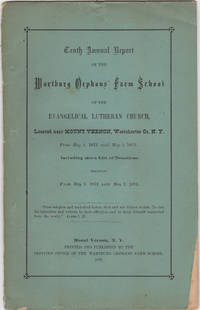
187938680Mount Vernon: Printing office of the Wartburg Orphans' Farm School 1879. First edition. Stitched paper wrappers. Overall very good copies with some chips to wrappers. Tenth report has tear along spine. 8vo. Tenth Report includes a "Compliments of G.C. Holls" card as well as a typed letter laid in loose. Thirteenth Report contains a typed letter laid in loose from the same. Holls was the Director of the Institution and on the Board of Managers. Reports cover from May 1 1875 to May 1 of each of the following years through 1879. The Wartburg Orphans' Farm School was founded in 1866 serving children who had lost parents during the Civil War. Over time the facility shifted to serving the elderly and is currently known as the Wartburg Adult Care Community. OCLC shows four locations: Huntington Trinity Yale NYHS. Printing office of the Wartburg Orphans' Farm School unknown
1845051426F.G. Fish 1845. Book. Very Good-. Hardcover. 1st Edition. In stamped brown cloth with chipping to cloth at spine ends and wear to cloth at corners. Small piece of paper with description of book glued to front pastedown. F.G. Fish Hardcover
1816271<p>New York: J. Seymour American Board of Commissioners for Foreign Missions Agents Appointed to Establish a School for Heathen Youth 1816. first edition. modern 1/4 niger morocco. Good. Inspiration for the First Mission to Hawaii. <br /><br />Rare in commerce most copies have been acquired by American institutions. Few copies have come to documented auction in the past 100 years. Of those made available about half are decommissioned library copies including a copy that sold for over $15000 at a 2006 Sotheby's auction.<br /><br />Condition: Very Good<br /><br />IMPORTANCE & BACKGROUND<br /><br />A biographical account of the lives of five Hawaiian youths who would come to form a core of initial students enrolled at the new Foreign Mission School established at Cornwall Connecticut in 1816. The vivid accounts of Captain Cook's and others explorers' voyages to the Sandwich Islands Hawaii and other Pacific islands generated interest in the U.S. to properly educative Hawaiians in both academic and Christian teachings. The school formed under the direction of the American Board of Commissioners for Foreign Missions ABCFM would serve to educate foreign students in preparation for missionary work in their native lands and elsewhere. <br /><br />A Narrative of Five Youth from the Sandwich Islands was the first of many publications intended to raise funds and stir up popular support for the new school as well as for the first Christian mission sent to the Hawaiian Islands three years later. The publications were a great success leading to the significant funding and public support critical to early efforts to fold Hawaii within the cultural and commercial influence of the United States.<br /><br />BOOK INFO<br /><br />Published in 1816 in New York by J. Seymour under the direction of ".agents appointed to establish a school for heathen youth" e.g. American Board of Commissioners for Foreign Missions. First edition first printing. Bound in modern 1/4 green niger morocco with gilt spine lettering over finely woven green cloth backed boards. Refreshed endpapers. Thin Octavo 8 1/2" x 5 1/8". Collated and complete: 3 4-44 p. <br /><br />ABOUT THE WORK & HISTORICAL CONTEXT<br /><br />By the early 1800s Hawaii had become a key aspect of America's growing trade with China. It was a critical resupply port for American ships on the trade route to China and a lucrative source for sandalwood. American merchants saw commercial possibilities that could be expanded. Protestant missionaries saw heathens in need of salvation via Christian conversion.<br /><br />This is a biographical account of and strong bit of fundraising propaganda on how five Hawaiian youths were saved from their heathen ways and savage pasts through a civilized education and Christian conversion. While the backgrounds of the youth vary - one was the son of a chief and another the survivor of brutal inter-tribal warfare for example-- the stories of these five youths share a number of common elements. All had spent time as sailors on American trade ships. Three had served at sea in the War of 1812. Most had experienced periods of extreme hardship after reaching New England. All found sponsors teachers and spiritual guides who helped them on their path to converting to Protestantism.<br /><br />CONDITION INFO<br /><br />The book is Good to Very Good by early 19th century American imprint standards.<br /><br />Binding is tight. Leather is supple. Areas of dust and light soiling to cloth. Lightly toned pages overall with light foxing. Some abrasion to paper along gutter margins of first few pages. Browning to first and last page with some brittleness and chipping. The paper used by the printer was quite thin so the text block background is darkened a bit by opposing page text on the same leaf as in all copies. No writing ex libris marks or library markings. Slight loosening at the head of the first few leaves where binding cords are exposed. A few smudges marginal paper nicks and other signs of light handling.<br /><br />.</p> J. Seymour, American Board of Commissioners for Foreign Missions (Agents Appointed to Establish a School for Heathen Youth)