102 résultats
18306526London 1830. Aquatints coloured by hand. A fine complete series of four anonymous prints of hunting scenes possibly after the Alkens.<br/> <br/>The style and naming of these prints suggests an Alken origin for the series. Siltzer records a number of series by the Alken family in which the first plate is titled "Unkennelling." This title appears to be unique to them and supports the supposition that the present series are after the Alkens. Henry Thomas Alken was born into what became an artistic dynasty. He studied under the miniature painter J. T. Barber and exhibited his first picture a miniature portrait at the Royal Academy when he was sixteen. From about 1816 onwards he "produced an unending stream of paintings drawings and engravings of every type of field and other sporting activity. He is best remembered for his hunting prints many of which he engraved himself until the late 1830s.To many sporting art is "Alken" and to describe his work or ability is quite unnecessary." Charles Lane British Racing Prints pp. 75-76<br/> <br/>Cf. Siltzer pp.57-76. unknown books
18602206161860. With Inscription and descriptive text in pencil. 1 vols. 19 x 14 inches 48.3 x 35.6 cm. Framed and glazed. Fine. With Inscription and descriptive text in pencil. 1 vols. 19 x 14 inches 48.3 x 35.6 cm. unknown books
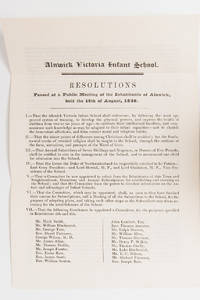
18382596Alnwick: M. Smith 1838. First edition. Fine. 3 page pamphet measuring 152 x 228mm. Trifolded with ownership signature of Wm. Dickson Esq to rear blank. Else an exceptionally clean and seemingly untouched copy of this rare pamphlet advocating for improvements in the early education of children. The only copy known on the market this title does not appear in the modern auction record or at any institutions according to OCLC.<br/><br/>A proposal and prospectus for an Infant School to serve the town of Alnwick and improve the overall level of education within the community. The pamphlet clarifies that the Duke of Northumberland is confirmed as the school's patron; and it outlines how donations and subsciptions from the town will add to the school's endowment. But more importantly it focuses on the communal benefits that will come from citizens' support for children's education regardless of their class. Touting the successes of other Infant Schools in England and abroad in providing "well-regulated nurseries for the children of the poorer classes" the committee also explains that " the most approved system of training will develop the physical powers and improve the health of children from two to six years of age -- to cultivate their intellectual faculties and communicate such knowledge as may be adapted to their infant capacities." The committee asserts that when the larger population begins sending children to school those children will be endowed with a desire to learn and "those attending will feel it as a punishment to be kept from the School" because school "is to the children what the actual business of life is to the man. Here the feelings are manifested and the character is developed" so that infants grow to intelligent and responsible members of the populace. Notably the committee also points out the short term benefits of developing an education system. "To the parents themselves many advantages will accrue from these Schools. Not only will their minds be relieved from much anxiety for the safety of their children but the mother free during the day from the necessity of watching over them will have an opportunity now denied to her of contributing by her labour to their support or of devoting more time to the promotion of their comfort at home." This acknowledgment reveals an important shift in thinking about the economic role of mothers and about women's need for time to accomplish their own work. A rare and important example of the spread of early childhood education and the arguments for its expansion. Fine. M. Smith unknown books
1895223921Paris: Gauthier-Villars et Fils 1895. First. hardcover. fine. Illustrated throughout with nicely printed portraits and other historical reproductions. 3 volumes. lxviii 519; 572; 646pp. Very thick short 4tos beautifully rebound by Stroobants in older 3/4 tan morocco over marbled boards; ornate gilt-stamped spines with burgundy leather labels; uncut edges t.e.g. original wrappers bound-in marbled board slipcase worn. Paris: Gauthier-Villars et Fils 1895-1897.<br/><br/> Fore-edges foxed and also some light foxing throughout the first volume otherwise a fine copy in a lovely binding.<br/><br/> Gauthier-Villars et Fils unknown books
188371784Paris: E. Leroux 1883. Hardcover. Fair. lv 577p. Contemporary 1/4 leather. 27cm. Covers quite scuffed. Contents reasonably sound but browned and rather brittle a few corner chips and tears. Ex lib. Title and most text in French. <br/><br/> E. Leroux hardcover books
185020700Paris 1850. Pencil pen and wash drawing with numerous sub-titles in ink signed "J. Litoux" A fascinating and beautiful architectural drawing - or 'rendu' of basic elements of house construction in cluding walls floors doorways roofs and ceilings.<br/> <br/>A fine drawing from an architectural student at the Ecole des Beaux-Arts in Paris the most influential architectural school in existence during much of the 18th century the whole of the 19th century and the first part of the 20th century. 'Students were eligible for the Ecole if they were at least fifteen years old or under thirty. They began with the seconde classe in which they competed in the concours d'émulation. These alternated between an esquisse - a rough sketch for which up to twelve hours was allowed - and a rendu - the large-scale finished drawing for which one to three months were allowed. Two to four years were usually required for a student to accumulate enough credits to enter the première classe. The same system was followed again usually for two to three years after which the student should have accumulated enough credits to compete for the Grand Prix de Rome. The winner of the Grand Prix was entitled to five years study under the auspices of the French Academy in Rome. For each of his first three years he was required to submit an analytical study of an ancient monument. For his fourth year he had to submit a complete reconstruction of a major classical work. For his fifth year he was required to submit an original work designed to a program of his own invention. In the seconde classe the student was required to attend a variety of lectures in theory history and construction and learned to prepare construction drawings. Work was done at ateliers located outside the precincts of the Ecole des Beaux-Arts. These were rented and organized by the students themselves and the students had the right to invite a teacher of their own choice to serve as their maître. The teacher himself did not have to be a member of the faculty of the Ecole nor - at least in principle - did he have to be a practicing architect.' Arthur Drexler. The Architecture of the Ecole des Beaux-Arts. New York MoMA 1977 p.8-9<br/> <br/>Arthur Drexler The Architecture of the Ecole des Beaux-Arts. New York MoMA 1977. unknown books
18508857Paris 1850. Pencil pen and wash drawing with numerous detailed measurements. A fascinating and beautiful drawing--or "rendu"--of an ancient Roman sarcophagus.<br/> <br/>A fine drawing from an architectural student at the Ecole des Beaux-Arts in Paris the most influential architectural school in existence during much of the 18th century the whole of the 19th century and the first part of the 20th century. 'Students were eligible for the Ecole if they were at least fifteen years old or under thirty. They began with the seconde classe in which they competed in the concours d'émulation. These alternated between an esquisse --a rough sketch for which up to twelve hours was allowed--and a rendu --the large-scale finished drawing for which one to three months were allowed.Two to four years were usually required for a student to accumulate enough credits to enter the première classe. The same system was followed again usually for two to three years after which the student should have accumulated enough credits to compete for the Grand Prix de Rome. The winner of the Grand Prix was entitled to five years study under the auspices of the French Academy in Rome. For each of his first three years he was required to submit an analytical study of an ancient monument. For his fourth year he had to submit a complete reconstruction of a major classical work. For his fifth year he was required to submit an original work designed to a program of his own invention. "This study of the sarcophagus of Lucius Cornelius Scipio Barbatus was part of an Ecole de Beaux Arts student's portfolio. The sarcophagus was one of many in the Scipio family tomb on the Via Appia just outside of Roma and it dates from c. 290 B.C. The obituary text reads English "Lucius Cornelius Scipio Barbatus son of Gnaeus a valiant gentleman and wise whose fine form matched his bravery very well was aedile consul and censor among you he conquered Taurasia and Cisauna in fact Samnium he overcame all the Lucanian lands and brought back hostages."<br/> <br/>Arthur Drexler The Architecture of the Ecole des Beaux-Arts. New York MoMA 1977. unknown books
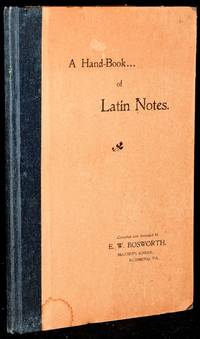
1899271407Richmond VA: Whittet & Shepperson 1899. First Edition. Hard Cover. Very Good binding. A Latin primer prepared by E. W. Bosworth of the McGuire's School in Richmond presumably for the use of the students at the school. An uncommon Richmond item. Very Good binding. Whittet & Shepperson unknown books
180427384New Haven: Printed for Simeon Jocelin. From Sidney's Press 1804. First edition. Disbound. Lacking the wrappers some light dampstaining to the top edge else about very good. 46 pp. 8vo. Simeon Jocelyn 1746-1823 was the publisher of the Chorister's Companion 1782-3 where he followed Andrew Law's approach to mix English and American and the new and the old composers. In 1787 he published A Collection of Favorite Psalm Tunes. Neither Sabin nor Shaw and Shoemaker list Jocelin as the author. Scarce. OCLC & RLIN show 10 copies. Sabin 50494. Shaw and Shoemaker 6820. Printed for Simeon Jocelin... From Sidney's Press unknown books
18712437Charterhouse School 1871. Hardcover. Very good. Dates: 1871-1877 and 1910. Small 4to. 37 ff. mostly with newspaper clippings neatly pasted in on both sides 4 ff. in manuscript "Summary of Scores" from 1871-1877 and 1910. Several leaves excised; it is possible that the present album had been re-purposed. On a few of the stubs appear fragmentary MS notations suggesting that the notebook may have once been divided alphabetically. We find on certain stubs "Ai" followed immediately by "Ao" and then several leaves later: "Her. - Hes" followed by "Io." Binding rebacked with smooth calf. In very good condition. Highly interesting homemade album of Cricket Scores available nowhere else specifically documenting the triumphs of three young members of the Blomfield family namely: E.G. Edward George C.J. Charles James and R.T. Reginald Theodore. One wonders if the present album was created in order to promote friendly competition between the brothers two of whom went to Haileybury School and one went to Charterhouse; all three went up to Oxford. There are scores and game synopsis of matches were between Haileybury Charterhouse Marylebone Cricket Club MCC Westminster Trinity College Oxon. Exeter Oxon. and more. One of the more interesting features about the album is that it provides a fascinating record of one family's love of the game:<br/><br/>¶ Edward George 1853-1885 entered Charterhouse School London in 1865 and transfer upon the School's removal to Godalming in 1872; in 1873 he went to Trinity College Oxon. where he earned a B.A. in 1877 and M.A. in 1879; thereafter he served as Curate of St. Mary's Portsea until 1883 and then Vicar of St. Mark's Woolston until his death in London in 1885.<br/><br/>¶ Charles James 1855-1928 went to Haileybury School; he underwent military training at Sandhurst and served as an army officer in India Sudan and Natal. He attained the rank of Major General before his retirement in 1917. NB: this individual is not to be confused with a noted architect of the same name b. 1862 d. 1932. <br/><br/>¶ Reginald Theodore 1856-1942 also went to Haileybury School; he earned his B.A. from Exeter Oxon. in 1880 and M.A. in 1884. He became an architect and was knighted in 1919. He is remembered mainly for his work designing British war memorials. <br/><br/>¶ The parents of the three young men were Rev. George John and his first cousin Isabella Blomfield of Bow Devonshire whose own father Charles James Blomfield was Bishop of London. <br/><br/>¶ At the end is a "Summary of Scores" for the years 1871-1877. Following this in a different hand is the year 1910; although the initial of the last name "Blomfield" remains the same the other initials belong to Reginald Thomas and his two sons Henry George and Austin. <br/><br/>¶ See Stedman Charterhouse Register 1872-1900 passim. CATALOGUER'S NOTE: We are grateful to Catherine Smith Archivist of Charterhouse School for much useful information concerning the Blomfield Family. hardcover books
189011653Andover CT: E. H. Cook printer 1890. 4to 4pp. Nice copy. A prospectus of what would become the University of Connecticut. Includes small woodcuts of the school building and the dormitory both in the process of erection. E. H. Cook printer unknown books
188033241.3Philadelphia: J. B. Lippincott & Co 1880. A later issue of the 1st edition of this important early American nursing text initially published in 1879. Cf. Cordasco 70-1507. Publisher's original green cloth binding with gilt stampd spine lettering & black stamped lettering to front board. Bevelled boards. Volume professionally recased. General wear. Feb 7th 1880 ownership isincription to a preliminary blank of one "Sarah C Robinson Bellevue Training School 426 E. 26th St. New York City.". 266 pp including Index. 8vo. 7-1/2" x 4-3/4" <br/><br/> J. B. Lippincott & Co hardcover books
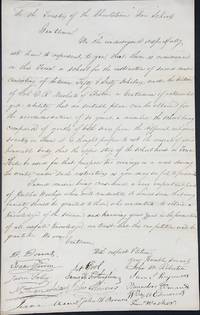
182765175Charlestown MA 1827. Single sheet folded to 30.5 x 19 cm. 4 pp. including a one page manuscript petition signed by 14 citizens two blank pages and addressed on last. An appeal to the school trustees to make available a suitable building for the instruction of 50 or 60 students composed "of youth of both sexes from the different religious societies in Town" to learn sacred music under the guidance of Col. D. R. Newhall of Boston "a gentleman of acknowledged ability." The petition acknowledges that "sacred music being considered a very important part of public worship when well conducted it would seem that every facility should be granted to those who undertake to obtain a knowledge of the science." Donald Nitz' article "The Norfolk Musical Society 1814-1820: An Episode in the History of Choral Music in New England" Journal of Research in Music Education Vol. 16 No. 4 Winter 1968 pp.319-28 discusses the transformation in American musical culture in the first few decades of the 19th century: "A group of reformers composed of clergymen immigrant European musicians and educated laymen made great efforts to bring about this change" to homophonic orthodox English idiom and away from the more "crudely-wrought but highly original and expressive fuguing tunes of William Billings Daniel Read Jacob French and many others." This transformation of the "sacred musical culture" was brought about through the propagation of musical societies and singing schools in small towns throughout New England <br/><br/> unknown books
182315369New York: D. Fanshaw Printer No. 1 Murray-Street 1823. Broadside octavo decorated borders untrimmed. Lightly foxed and dustsoiled Good. <br/><br/> A rare broadside hymn of New York's Reformed Dutch Church. OCLC records a single copy at the New York Historical Society as well as single copies of this title printed in three other years. <br/>OCLC 58786086 1- NYHS as of December 2016. Not in AI Sabin Eberstadt Decker NUC Library of Congress Broadside Catalog. D. Fanshaw, Printer, No. 1 Murray-Street unknown books
184657694Buffalo: Buffalo High School Association n.d. 1846. Oblong 8vo 67 leaves with pro-forma engraved forms on rectos without accomplishment; quarter old sheep hinges split and boards worn and nearly loose old non-original label mostly perished on front board final four leaves reappropriated as a scrapbook for local recipes the rest of the certificates generally fine. Inscribed on the front pastedown: "In Chancery 8th Circuit. In the matter of the Dissolution of the Buffalo Literary and Scientific Academy. Produced and proven before me as "Stock scrip book" "F" on hearing June 24 1846" The Buffalo High School Association later the Buffalo Literary and Scientific Academy was established in 1827 with ambitious plans for providing a "scientifick literary and military academy." It offered courses in "topography construction of maps navigation fencing ethicks natural theology evidences of Christianity and metaphysicks." Rates for attendance were high and the level of matriculation could not sustain the school. In 1863 Oliver G. Steele wrote "It was the great pet of the city. It was however too expensive for the time failing to reach the great body of our people; and changes of teachers and policy soon brought its career to a close." An act to dissolve the corporation and to provide for the just disposition of the property was passed in 1846. See "Buffalo's First High School Had its own Defense Program" by Walter McCausland Buffalo Courier-Express 1943. <br/><br/> Buffalo High School Association, n.d. hardcover books
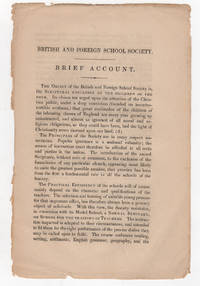
183638690London: Elizabeth Bagster widow of the late S. Bagster Jun. printer 1836. First edition. Disbound. A good copy edgewear to leaves. 4 pp. 8vo. The British and Foreign School Society was established in 1808 as a Lancasterian-based teacher training facility. This brief account provides an overview of the principles and operations of the Society's educational practices as well as its success in its international models in places such as Continental Europe and Asia the West Indies Canada Cape of Good Hope and India. OCLC locates a single holding: Trinity College. Elizabeth Bagster, (widow of the late S. Bagster, Jun.), printer unknown books
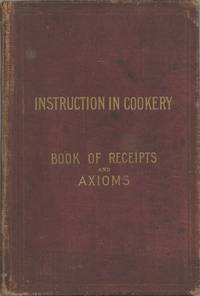
18906979London: School Board for London; Chas. Straker and Sons 1890. Small octavo 18.5 x 12.5 114 pages. Indexes. FIRST EDITION. A guide for cookery educators with syllabi and notes for instruction. Also included are instructions on using the cookbook itself in an educational setting ". but care is necessary as the girls destroy and disfigure the books sometimes. To obviate this difficulty and to help the teacher in finding out the culprits the receipts have been arranged consecutively according to the syllabuses so that the books can be strapped down with elastic bands on the pages for the lesson." Also included is the text of the author's General Axioms for Plain Cookery which had previously been printed separately as a "prize" for the girls who did not excel. Some light soiling and a few stains throughout undoubtedly those "culprits". In oxblood buckram titled in gilt on the front board. Cloth soiled and rubbed but still sound. Good. School Board for London; Chas. Straker and Sons hardcover books
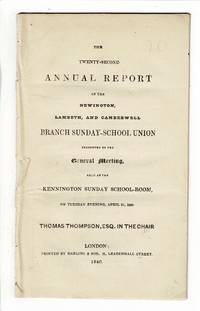
184057667London: printed by Darling & Son 31 Leadenhall Street 1840. 16mo pp. 24; removed from binding wrappers wanting; else very good. Includes a list of subscribers and 18 extracts from reports of other Sunday-Schools. Not in OCLC. <br/><br/> printed by Darling & Son, 31, Leadenhall Street unknown books
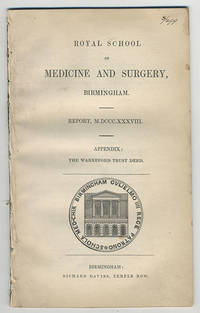
183811013Birmingham: Richard Davies 1838. 8vo. 31 1 blank pp. <br><br>Second of two parts only. The first part was "Report M.DCCC.XXXVI." With engraved device of the Birmingham Royal School of Medicine and Surgery on title-page. <br>Â Â Â Â <br>Â Â Â Â NSTC 2B34799. Removed from a nonce volume. Light watestains in top and outer margins. Inked series of numbers in one corner of title-page. Very good. Richard Davies unknown books
18471205685Philadelphia: Lindsay and Blakiston 1847. First Edition Thus. Small octavo; 214pp; ii ads; bound in full calf; black leather spine label gilt; moderate rubbing and wear; some peeling at joints; ink stamp front endpaper; owner name in fine hand; contents occasionally soiled; contents generally good with engraved frontis title vignette and seven engravings in text. Spine; black leather label gilt on brown leather. 1205685. Rockville Non-Retail Listings. Lindsay and Blakiston unknown books
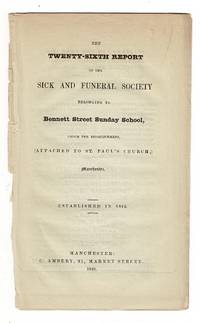
184057669Manchester: C. Ambery 91 Market Street 1840. 16mo pp. 16; removed from binding wrappers wanting stitching perished; else very good. Includes a list of donors and funerals plus other financial reports. Not in OCLC. <br/><br/> C. Ambery, 91, Market Street unknown books
1860001429Boston: Ticknor and Field 1860. Blindstamped cloth. Very Good. 8vo viii 405 pp. Later early edition. A handsome bron blindstamped copy clean and tight inside with slight cocking of the spine and light edgewear and the like. <br/><br/> Ticknor and Field hardcover books
184421438No place England: no publisher June 1844. 8vo. 24 pp. <br><br>Removed from nonce volume. Half-title detached. Page 23-24 detached. Paper age-toned. Clean copy. no publisher unknown books
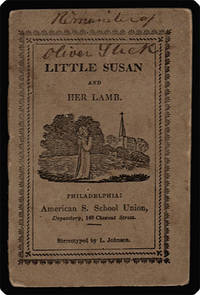
182741327Philadelphia: American Sunday-School Union between 1827 and 1853. 32mo 10.5 cm 4.125". Frontis.15 pp. <br><br>Thanks to Sunday school Susan learns to be kind to others and is able to => protectively raise a flock of lambs to provide wool for her family to sell.<br>Â Â Â Â This text was stereotyped by L. Johnson with an unsigned wood-engraved frontispiece and a wood-engraved vignette on the front wrapper. Publication date is from the American Antiquarian Society OPAC.<br>Â Â Â Â Provenance: On front cover an inscription naming "Oliver Glick. <br>Â Â Â Â <br>Â Â Â Â Shoemaker 29513. Original tan printed wrappers with inscription as above; extremities lightly rubbed small chip at lower inner corner of back wrapper. Pages foxed with one bent corner. American Sunday-School Union unknown books
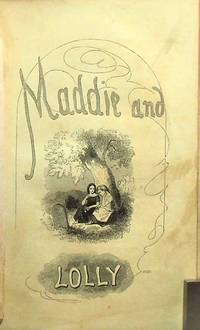
18595863Philadelphia: American Sunday-School Union 1859. First edition. Very Good. 16 cm; 36 pages. Wood-engraved frontispiece and extra title page. Bound in original patterned cloth stamped in blind; titled in gilt on spine. Very little wear or deterioration. Pages somewhat toned. American Sunday-School Union hardcover books