395 résultats
18072092902144201822Not Available 1807. Soft Cover. Fine. The book is in fine condition. Not Available paperback
1891016862New York: The Osgood Art School 1891. The rare SEVENTH EDITION with the ORIGINAL Dust Jacket. Full light green flexible cloth hardcover binding with elaborate stamped black design on the front cover and the spine previous owner's name on the front free endpaper decorative endpapers a bit age-toned edges of the book red some underlining in ink. Jacket is age tond and soiledand there is an inch chip at the top of the front panel. But considering its age still a rare find. Overall a VERY GOOD book in a VERY GOOD extremely rare dust jacket. Full Cloth. Very Good/Very Good. 12mo - over 6¾" - 7¾" tall. Hardcover. The Osgood Art School Hardcover
182315369New York: D. Fanshaw Printer No. 1 Murray-Street 1823. Broadside octavo decorated borders untrimmed. Lightly foxed and dustsoiled Good. <br /> <br /> A rare broadside hymn of New York's Reformed Dutch Church. OCLC records a single copy at the New York Historical Society as well as single copies of this title printed in three other years. <br /> OCLC 58786086 1- NYHS as of December 2016. Not in AI Sabin Eberstadt Decker NUC Library of Congress Broadside Catalog. D. Fanshaw, Printer, No. 1 Murray-Street unknown
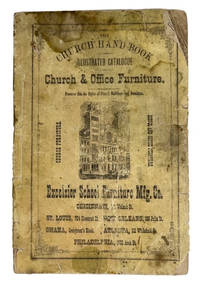
187392974Cincinnati: Excelsior School Furniture Manfactur'g Co 1873. Paperback. Fair. illustrations 62 unnumbered pages. Softcover in original wrapper. 23 cm. Lacks backstrip. Covers soiled chipped and worn. Heavily dampstained on corner of title pages. Some dog-earing and soiling along edges. Excelsior School Furniture Manfactur'g Co paperback
18692110502150902697Bunkeido other storehouse 1869. Soft Cover. Fine. Number of books: 10 Bunkeido other storehouse paperback
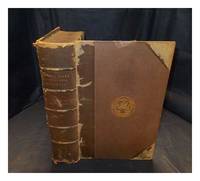
1883391251London : School Board 1883. 1st edition. Hardcover. Poor copy in the original half aniline calf over ribbed-cloth boards. Front board detached; back board lacking. Spine worn; spine bands and panel edges somewhat rubbed and bumped as with age. Text remains clear and without blemish. Physical description; 970 pp. Subjects; Great Britain. Parliament. House of Commons. London. School Board. Accounts. London : School Board hardcover
18312111902160602080Kawauchiya Mohei board 1831. Soft Cover. Fine. The book is in fine condition. Kawauchiya Mohei board paperback
188869473Majesty's 1888. Fourth Edition stated. Hardcover. Fair. COver has wear soilng bumped corners and tears to cloth. Somewhat shaken. vii 1 136 p. Includes: illustrations diagrams maps. Errata slip present! Some illustrations have color. LIV plates. This reflects the state of the art knowledge and practice in the mid to late Victorian period. From Wikipedia: "Military engineering is loosely defined as the art and practice of designing and building military works and maintaining lines of military transport and communications. This discipline of engineering is regarded as the oldest form of engineering and is also the precursor of the civil engineering discipline. While both of these disciplines of engineering are responsible for building the same types of projects their environments differ. Military engineers construct and maintain facilities that serve military servicemen on war-fronts. Military engineers are also responsible for logistics behind military tactics. Modern military engineering requires more than civil engineering techniques. In the 21st Century military engineering also includes other engineering disciplines such as mechanical and electrical engineering techniques. According to NATO "Military Engineering is that engineer activity undertaken regardless of component or service to shape the physical operating environment. ' Military Engineering incorporates support to manoeuvre and to the force as a whole including military engineering functions such as engineer support to Force Protection Counter-Improvised Explosive Devices Environmental Protection Engineer Intelligence and Military Search. Military Engineering does not encompass the activities undertaken by those 'engineers' who maintain repair and operate vehicles vessels aircraft weapon systems and equipment." Majesty's hardcover
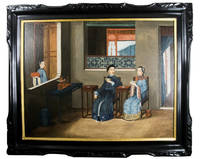
1820ABC_45805China 1820. 47 x 61 cm. picture; 61 x 74.5 cm. frame. Oil painting on canvas in a black lacquered Chinese export frame. An elegant interior scene from a Chinese Mandarins home in the early nineteenth century: a Manchu Mandarin and his consort taking tea in a domestic setting. He wears non-official semi-formal winter attire including rank badge sitting beside ahis beautiful Chinese lady surrounded by fine furniture and fittings. The whole scene reflects his good taste and social standing.Whilst tea had been the driving force of the China Trade since the early eighteenth century giving rise to export paintings illustrating its cultivation and production process the style and subject of the early export paintings was firmly rooted in traditional Chinese art and culture as in this delightful painting.l Cf. Choi Kee Il Tea and design in Chinese export painting in: The Magazine Antiques vol. 154 no. 4 October 1998. unknown
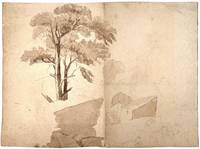
184021491840. Graphite and ink and wash in sepia and brown ink on two sheets of heavyweight wove paper 8 1/8 x 11 inches 207 x 280 mm the full sheet. With a hard horizontal crease along the top sheet edge approximately 2-inches from the top. A strip of non-archival tape along the center sheet edge where the two sheets were joined. Minor uniform toning throughout consistent with age. unknown
18972092902144200899Not Available 1897. Soft Cover. Fine. The book is in fine condition. Not Available paperback
1900127362India c.1900. Company School or Company Painting is a term that defines a hybrid Indo-European style made by Indian artists in India under British rule during the 18th and 19th centuries. The style reflects the influences of Mughal style with some European techniques such as perspective or volume made mainly for a Western clientele. Company School style went into decline with the arrival of photography towards the end of the 19th century. Original watercolour on paper. Image size: 480 x 280 mm. Framed size: 615 x 500 mm. A closed tear on the top right hand corner otherwise in very good condition. unknown
1900127361India c.1900. Company School or Company Painting is a term that defines a hybrid Indo-European style made by Indian artists in India under British rule during the 18th and 19th centuries. The style reflects the influences of Mughal style with some European techniques such as perspective or volume made mainly for a Western clientele. Company School style went into decline with the arrival of photography towards the end of the 19th century. Original watercolour on paper. Image size: 480 x 280 mm. Framed size: 615 x 500 mm. Very good condition. unknown
18722110502150904411East School Doctor's Edition 1872. Soft Cover. Fine. Number of books: 4 East School Doctor's Edition paperback
1896172368Virginia: Artillery School Press 1896. First Edition; First Printing. Hardcover. Good in decorative boards. Owner imprint on title page. Front hinge cracked rear hinge starting. Rubbing along panel edges. Artillery School Press hardcover
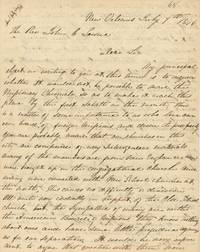
1846List2863New Orleans Louisiana 1846. Single letter three 8 x 10 inch pages. Torn at folds some tears repaired with archival tape; hole at location of seal; otherwise very good to excellent. John Holt Rice 1818–1878 was the son of a Presbyterian minister and nephew of Archibald Alexander founding professor of the Princeton Theological Seminary from which Rice graduated in 1845. When he wrote this letter he was working as a city missionary to the poor in New Orleans. Rice would spend his career ministering around the southern United States before his death from yellow fever. His correspondent is John Cameron Lowrie 1808–1900 a Scottish immigrant fellow Princeton graduate and a missionary in Colonial India. When his health became too precarious to remain abroad Lowrie returned to serve with the Board of Foreign Missions.<br /> <br /> The subject of missions boards was part of the Old School-New School controversy and schism in the Presbyterian Church particularly over whether missionary work should be primary the Old School view or secondary the New School view to the Church’s work.1 Those holding the latter view were satisfied with the work of the American Board of Commissioners for Foreign Missions ABCFM which was not a specifically Presbyterian body. Those of the former view believing that the Church’s missionary board ought to be itself Presbyterian formed the Western Foreign Missionary Society. When the Church’s second schism occurred in 1837 the Western society was <br /> renamed the Board of Foreign Missions BFM and headquartered in New York City.<br /> <br /> In this letter Rev. Rice finds himself in the delicate position of being an Old School supporter of the BFM ministering to Congregationalists and New School-raised supporters of the ABCFM. He writes to Rev. Lowrie requesting that copies of the BFM’s monthly Missionary Chronicle be sent to him in a timely manner as this was “a matter of some importance to us who love our own board of foreign missionsâ€:<br /> <br /> “You are probably aware that our churches in this city are composed of very heterogeneous materials many of the members are from New England and were brought up in the congregational church and many were connected with New School churches at the north. This causes no difficulty or division All unite very cordially in support of the Old School church but the sympathies of many are with the American Board of Missions. They know nothing about ours and have some little prejudice against us for our separation. It would be very impudent to argue that question with them now or attempt to convince them that our own board ought to be patronised by those connected with one of our churches rather than the American. But I feel certain that if they knew more of our operations they would take an interest in them.â€<br /> <br /> Rice also notes that he is an editor for the New Orleans Protestant newspaper and suggests that Lowrie send “something now and then†to excite “missionary zealâ€. Of interest to scholars of Presbyterian history especially the 19th-century Old School-New School schism.<br /> <br /> 1 Rev. Dr. Michael Parker “175 Years of Presbyterian World Mission†Presbyterian Historical Society archived November 1 2023 at https://web.archive.org/web/20231101183954/http://www.history.pcusa.org/history-online/topics-note/history-world-mission. unknown
18802091502135409800Not Available 1880. Soft Cover. Fine. Number of books: 1 Not Available paperback
18792111902160201224Kaichi School 1879. Soft Cover. Fine. Number of books: 1 Kaichi School paperback
18802111902160201225Kaichi School 1880. Soft Cover. Fine. Number of books: 1 Kaichi School paperback
18772092902141401317Tsuda Genbe version 1877. Soft Cover. Fine. Volume: 1 Tsuda Genbe version paperback
18802080502106500610Sairyu-sha 1880. Soft Cover. Fine. Volume: 1 Sairyu-sha paperback
18782082402113500130Not Available 1878. Soft Cover. Fine. The book is in fine condition. Not Available paperback
18782080502106600022Kumamoto Prefecture 1878. Soft Cover. Fine. Number of books: 2 volumes Kumamoto Prefecture paperback
18802082402113510042Not Available 1880. Soft Cover. Fine. The book is in fine condition. Not Available paperback
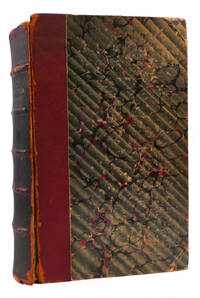
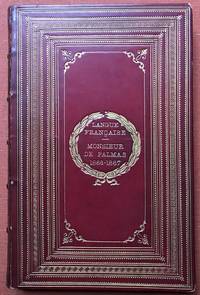
1866H3621Paris: E. Ducrocq 1866. Hardcover. Near Fine. No date probably 1866 or 1867 as it was given as first prize by the French schoolmaster Monsieur de Palmas to Ms. Mary Ingles at the school of Dr. Douglas on Great King Street Edinburgh dated July 24 1867. Tall 8vo full red calf with heavily gilt decorated covers and spine with black spine label 233 pp 10 tinted plates by Bureau. Light rubbing to corners moderate foxing throughout. E. Ducrocq hardcover