44 résultats
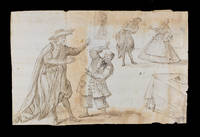
179138981791. 13 x 9 inches. Dark brown body colour on prepared paper. Inscribed "N.2.Stück" and "am 9ten Aprill 1791--nach der Natur gezeichnet von JEW" ink collector's stamp "Linel-Smlg. No." followed by pencilled number "1046" all on verso. Framed. Provenance: Linel ink collector's stamp on verso.<br/> <br/> A high quality image that clearly is drawn from life as the inscription claims. The artist's use of a dark prepared ground recalls the work of Barbara Regina Dietsch and her family. A search of Nissen's index of artists reveals one possible name: the Swiss artist Johann Emmanuel Wyss 1782-1837. However the maturity and assurance shown in the present drawing would seem to rule him out: he could have been no older than nine in April 1791. unknown
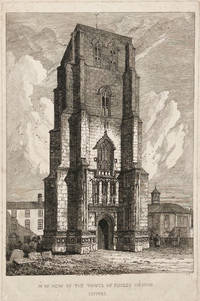
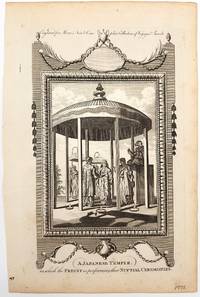
175011421750. Etching on cream wove paper 14 1/2 x 9 1/2 inches 377 x 239 mm full margins. Scattered surface soiling and handling creases consistent with age. A rare anonymous image. An impression of this work can be viewed in the permanent collection of the Fine Arts Museums of San Francisco Accession Number 1963.30.33071. unknown
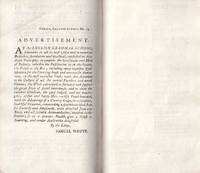
177532351AB1775. First Edition. Dublin Printed by R.Marchbank Cole's Alley Castle-Street 1775. Small-Octavo 11.2 cm wide x 17.2 cm high. Pagination: Whyte's "Modern Education." is bound to the rear of the Volume: 77 pages plus "Corrigenda" complete" / Sheridan's "Lecture on the Art of Reading - Part I" is bound at the start of the Volume: vii 1 213 pages plus 1 page "Advertisement" of Whyte's "English Grammar-School" in Dublin Grafton-Street No.75". Hardcover / Original full 18th century leather with gilt ornament and new spine-label in the style of the 18th century. In protective Mylar. Very good condition with only minor signs of wear. Extremely scarce title ! Samuel Whyte 1733-1811 Born on shipboard between Ireland and Liverpool; cousin of Francis Chamberlaine Sheridan raised by the Sheridan family in Dublin; opened his famous school at 75 Grafton St. in 1758; Whytes School became alma mater to R. B. Sheridan the Duke of Wellington and Thomas Moore - who eulogised him early with the lines hail heaven-taught votary of the Muses nine .; Donovan the Latin ussher at his school was an ardent patriot acc. Stephen Gwynn Thomas Moore 1905; ed. Shamrock or Hibernian Cresses 1772 containing poems of his protegés and later a selection of same as Poems on Various Occasions 1792; rev. 1795 heavily subscribed and twice reprinted containing verses by his pupils and others incl. Hall Hartson Thomas Moore and Thomas Dermody; provided guide to pronunciation for 1798 edition of Dr. Johnsons English Dictionary; also Miscellanea Nova Dublin 1800. ODNB DIW FDA OCIL Works: The Shamrock or Hibernian Cresses edited by Samuel Whyte Dublin 1772; Do. another edn. London: printed for S. Bladon No. 28 Pater-Noster Row MDCCLXXIII 1773 viii 272pp. 8°; Do. pirated 2nd edn. London: R. Snagg No. 29 Pater-Noster Row MDCCLXXIV 1774 2 v-viii 272pp.; and Do. reissued as A Collection of Poems the production of the kingdom of Ireland; selected from a collection pub. in that kingdom intituled The Shamrock; or Hibernian Cresses Dublin 1792-94 with add. material. ed. Poems on Various Subjects including The theatre a didactic essay; in the course of which are pointed out the rocks and shoals to which deluded adventurers are inevitably exposed. Ornamented with cuts and illustrated with notes original letters and curious incidental anecdotes 1792 printed with 705 subscriptions; Do. The second edition carefully revised and conducted through the press by Edward Athenry Whyte Dublin: printed by Robert Marchbank and sold by Exshaw Archer Jones Moore Rice Grueber Draper Mercier &c. and by the editor 1794 2 vii 1 vii 2 iv-x 1 x-lvi 2 257 7 257-343 1pp. ill. pls.: port. 8° bearing add. t.p. engraved Dublin printed for the editor Edward Athenry Whyte F.C.T.C.D. 1793; incls. list of subscribers the addenda to which are dated April 16th 1794; text continuous despite some mispagination; and Do. 3rd edn. 1796 see details; also electronic edition Eighteenth Century Reel 5001 No. 3. Miscellaneous Works: 1. ed. James Burgh The Art of Speaking: Containing I. An essay; in which are given rules for expressing properly the principal passions and humours . and II. Lessons taken from the antients and moderns . London : printed for T. Longman J. Buckland and W. Fenner in Pater-noster-Row; J. Waugh in Lombard-street; E. Dilly in the Poultry; and T. Field in Cheapside M.DCC.LXI. 1761 437319pp.; Do. 2nd edn. London 1768; Do. 4th edn. London: T. Longman & J. Buckland etc. 1775 373pp. 8°; Do. 5th edn. London 1781 8°; 6th edn. Dublin 1784 12°; Do. 7th Edn. London: printed for T. Longman and J. Buckland in Pater-noster-Row; T. Field in Leadenhall-street; and C. Dilly in the Poultry 1787 1792 373pp. see details; and Do. another edn.; so-called 7th Edn London 1792 copy held in Oxford UL. 2. English grammar-school Grafton Street Dublin Dublin c.1765 8pp.; 22 cm./8° Next to the preservation of life the education of our children is indisputably of the highest importance .; longer version of the text given in Samuel Whyte Shamrock 1772 as Thoughts on the prevailing system of school education. 3. Anonymously "Modern education; or An attempt to explain the chief causes and effects of our errours and deficiencies in that particular : with practical proposals for a reformation. In the course of which the female right to literature is asserted . and the trite witticisms usual on the question fairly stated and confuted ." Dublin: printed by R. Marchbank Coles-Alley Castle-Street MDCCLXXV. 1775 2 78pp. 12°/18 cm. 4. The Beauties of History . A new edition enlarged and carefully corrected. To which is prefixed an introductory tract on education . By Samuel Whyte Dublin: printed by R. Marchbank 1775 2 vol. 12° the author named on the titlepage of Vol. 2. 5. The theatre a didactic essay in the course of which are pointed out the rocks and shoals to which deluded adventurers are inevitably exposed by Samuel Whyte London: Printed for the editor Edward Athenry Whyte MDCCXCIII 1793 viii viii iii-x ix-xl 260 4 257-77 2 277-79 3 280-365 1 xli-lxxx 2 341-42 ill. 6pp. of pls.; port. 8°. Do. as The Theatre a didactic essay: including an idea of the character of Jane Shore as performed by a young lady in a private play &c. Dublin: printed by Zachariah Jackson for John Jones 1790 xiv 2 30 8pp. The last three leaves contain the prologue to The Sailor metamorphosed and Address &c. to Miss Whyte followed by a final advertisement leaf; ESTC T92974; also electronic copy Gale / Eighteenth Century Reel 17349 No.03. 6. An Introductory Essay on the Art of Reading and Speaking in Public Part First and Second; in which an Investigation of the Principles of Written Language is Attempted. By Samuel Whyte Principal of the English Grammar and Classic-School Dublin: printed by Robert Marchbank for the editor Edward-Athenry Whyte; where it may be had and of the booksellers 1800 vii 1 288pp. 8°. mentions Miscellanea Nova Dublin 1800 on t.p. 7. with Edward Athenry Whyte Miscellanea Nova; containing Amidst a Variety of Other Matters Curious and Interesting Remarks on Boswells Johnson . a critique on Bürgers Leonora . and an introductory essay on the art of reading and speaking in public In two parts. A new edition. By S. Whyte and his son E. - A. Whyte Dublin 1800 1801 iii-ix 280pp. 8°/20cm.; see note. Note: Samuel Johnson A Dictionary of English .; 8th edn.Dublin: printed by R. Marchbank No. 18 Chancery-Lane. 1798 - being first edition to incorporate a guide to pronunciation supplied by Samuel Whyte acc. to a note on a2v in TCD copy observed by Robin Alston. An earlier issue of this edition has Vol. 1 dated 1797 and gives Marchbanks address as Temple-Lane; texts are from same setting of type except that titlepage to Vol. 1 has been reset in this later issue. Subscribers list present a2; note at end states that as not enough subscriptions were received Marchbank had to relinquish a half share in the edition to William Gilbert and Jeremiah Sullivan. Issued in parts see nos. in signature lines: 26 in Vol.1 and 27 in Vol. 2; text in 3 columns; press figures present in Vol. 1; substantial amount of Anglo-Saxon type used in prelims. TCD Lib. cat. no. OLS L-5-186-187. Commentary: John OKeeffe Recollections London: Colburn 1826 Vol. I 304: . the children of Mr. Samuel Whytes school in Grafton Street getting up Cato at Crow Street theatre . succeeded to the delight of every feeling mind Quoted in P. Kavanagh Irish Theatre 1946 p.54. Note that OKeeffe goes on to describe how the master of a most eminent classical school in Dublin permitted and encouraged his boys to act the First Part of Shakespeares Henry IV. The schoolroom was fitted up as a theatre in very good style . &c. Quoted La Tourette Stockwell Dublin Theatres and Theatre Customs 1637-1820 NY: Benjamin Blom 1968 p.353. Thomas Moore: Moore wrote that Whyte stood at the head of his profession and that he owed to that exalted person all the instruction in English literature I have ever received Memoirs of Richard Brinsley Sheridan I p.3. Moore also speaks of Whytes theatricals Memoirs Journals and Correspondence 8 vols. 1853 Vol. I p.8. Further: In the direction of those private theatricals which were at that time so fashionable among the higher circles in Ireland he had always a leading share. Besides teaching and training young actors he took frequently a part in the dramatis personae himself and either the prologue or the epilogue were generally furnished by his Pen. Moore idem. Robert E. Ward Encycopedia of Irish Schools 1500-1800 Mellen Press 1995 remarks on Whyte as ideal teacher for Thomas Moore and author of elocution textbook The Art of Reading and Speaking in Public 1768 &c. who encouraged his students to write and recite poetry; Moores early verses were written in emulation of Whytes. Ward further quotes from Moores preface to the Poetical Works referring to the period when he was Whytes show scholar in this line Moore p.16 contributing an item called An Epilogue A Squeeze to St. Pauls to a performance of 1790 in Lady Borrowes private theatre. Ward. op. cit. p.154. Bibl. Hoover. H. Jordan Bolt Upright: The Life of Thomas Moore 2 vols. Salzburg: Salzburg Institut für Englische Sprache und Literatur 1975. Rolf Loeber & Magda Loeber A Guide to Irish Fiction 1650-1900 Dublin: Four Courts Press 2006 Intro.: Prose fiction in the English language started to replace ppoetry in the first part of the nineteenth century. Samuel Whyte anticipated this change in a poem published in Dublin in 1795: If though must write and wouldst they work disperse / Write novels sermons and any thing but verse. He was right about novels which became a popular genre of writing . p.liv. Quotations: Poetry or fiction If thou must write and wouldst thy works disperse Write novels sermons and any thing but verse. Poems on Various Subjects Dublin 1795 p.161; quoted in Rolf Loeber & Magda Loeber A Guide to Irish Fiction 1650-1900 Dublin: Four Courts Press 2006 p.lii. Source: ricorso.net hardcover
17842081402110004904Shushido Zura edition 1 volume with notes between the lines 1784. Soft Cover. Fine. Number of books: 3 Shushido Zura edition 1 volume with notes between the lines paperback
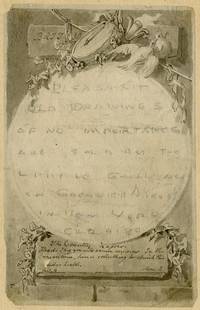
178014231780. Ink and wash on tissue thin Japon paper adhered to period cream laid paper 5 1/4 x 3 3/8 inches 132 x 84 mm the full sheet. With some handling wear and general surface soiling the matrix has some spots of light brown discoloration in the margins. A sweet composition with lovely detail. <br /> <br /> Written in ink appears "The Country illegible. Heart; I beg you will excuse illegible. In the meantime here is something to cherish this lady's health. Apr. 4 June 2." Inside the cartouche someone has written in pencil "Pleasant old drawings of no importance are sold by the illegible Gallery on Greenwich Avenue in New York CH 29184." The New York telephone exchange CH 2-9184 is the alphanumeric format for CHelsea 2-9184. unknown
180063904Tokyo & Kyoto Japan: Kano School ca. 1800-1810. One 4to. art sample design portfolio sized 12.5 x 14 in. which folds out into giant montage of six large original late-Edo-Period Kano School screen designs on durable handmade Japanese rice paper measuring 110 x 75 in. carefully pasted as montage some titled as well as featuring ink manuscript painting instructions ordered counter-clockwise: “Bamboo scene†47 x 38.5 in.; King Tang of Shang court scene 36.5 x 39 in.; 2nd Court scene 38.75 x 38.75 in.; Pine tree landscape 38.75 x 38.75 in.; Crane 28.75 x 39 in.; and Island pagoda landscape & pine trees 31 x 41.75 in six w/ original colour painting some colour painting & material instructions in Japanese all arranged to compactly fold and bound with colour woodblock illustrated cloth and old bookseller labels mounted on verso some repairs to corners to reattach the boards thumbing & minor tears a fold creases w/ a few occasional paper repairs at the first most frequently used fold minor creasing & edgewear dustsoiling to fold creases interior offset toning from sizing & paint colours still an extraordinary exemplar. This exceptional late-Edo-period original Kano School painting montage incorporates many of the elements developed by the famed multi-generational painters whom over four centuries revived and shaped Chinese idealist traditions into a uniquely vigorous Japanese art style. The Kano school painters emphasized landscapes Imperial court interior & exterior architectural elements colours uses of gold animal and botanical subjects often creating crowded panoramic scenes typically used in wall & door screens as well as triptych folding wall screens. The repeated instructions on these designs in Japanese by Sasayama Tsutsumu -- one of several Sasayama painters who took that name from the 18th- to 19th-Centuries in the Kano School beginning with Sasayama Yoi d. 1743 student of Kano Sunnobu 1636-1713 and subsequently four more generations afterwards nearly all adopted and chiefly serving the Chofu domain -- specify these designs are each one of three pieces. In addition there are ink manuscript memos appearing with directions on pigments for the final design work such as adding mica flecks or other paints & dyes and these sketches captured key features of a design so that students or other Kano artists could sufficiently enlarge recreated and fully understand the steps required for the finished decorative artwork pieces. The upper right first image presents bamboo looming in the weather emphasizing their connections to architectural features; The second and third designs capture the golden age Curt of the King of Shang in 1600 B.C. memorialized later as the Xia Dynasty; the fourth presents a rugged hillside and trees shrouded in clouds; the fourth a wonderful large crane apparently intended as part of a much larger piece; and finally the sixth lower right features distant pagoda temple shrouded mountains flower-bedecked pine tree in foreground and with delicate colouring and shading. Naganobu Kano fl. 1775-1828 and his son Osanobu Seisenin Kano 1786-1846 were of the Kobikicho family which carried on the Kano School traditions from 1730 until the Meiji Period and were instrumental in producing designs and screens for the Nishinomaru and Honmaru palaces which burned down in 1838 and again in 1844. Even though the paintings no longer exist similar original design such as these do survive in the Tokyo National Museum. Seisenin Kano was especially well known for his art adapted from his studies from ancient paintings at the end of the Edo-period. See: Kano School After the Middle of the Edo Period Art Nomura 2026; Matthew P. McKelway Rediscovering the Kano School Artforum Vol. 53 No. 5 Jan. 2015; Brief Biographies of Scholars Painters and Haiku Poets of Chofu Records of the Sasayama Family Painters of the Chofu Domain 2026. Kano School, hardcover
170198971701. 180x282mm. 7x11". España primer tercio dle siglo XVIII. Pluma tinta y aguada sepia sobre papel ocre agarbanzado verjurado. 180 x 282mm. Inscrito en el verso "64" "000.Pasteles" ". Cordón" y "P. de uno Camaron". Referencias: "Dibujo español del Renacimiento a Goya. La colección de la reina MarÃa Cristina de Borbón" Zaragoza 2008 nº 42 pp. 182 y 183 unknown
17542110502151105707Ogawa Yokuro 1754. Soft Cover. Fine. Number of books: 1 Ogawa Yokuro paperback
17862092902141800516Osaka Bookstore Matabei 1786. Soft Cover. Fine. Number of books: 1 Osaka Bookstore Matabei paperback
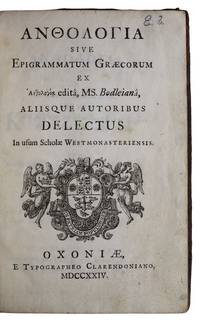
1724AQ24901Oxoniæ i.e. Oxford: E Typographeo Clarendoniano 1724. 2 99p 3. The first and sixth words of the title are transliterated from the Greek. Contemporary panelled sheep. Rubbed joints starting paper label with title in manuscript to head of spine. Contemporary inked ownership inscriptions of James Stuart to front endpapers scattered spotting. The sole recorded Oxford edition of an anthology of classical Greek satirical verse extracted from manuscripts held by the Bodleian for the use of students of Westminster School; including excerpts from the works of inter alia Anacreon Menander and Theocritus. The first London edition appeared in 1734. ESTC records copies at six locations in the British Isles BL NLS Nottingham Oxford Representative Church Body and St. Canice's Cathedral and six further worldwide California Chicago Illinois Kinder NYPL and Yale. ESTC T131082. First edition. 8vo. E Typographeo Clarendoniano unknown
1737262745London: E. Owen 1737. First edition. Double-page engraved frontispiece of Charterhouse engraved portrait of Sutton preceding Chapter I additional engraved plate of Sutton's tomb. xvi 275 1 pp. 8vo. Early 19th-century red straight-grained morocco a.e.g. Light rubbing to joints later gift inscription on ffep. First edition. Double-page engraved frontispiece of Charterhouse engraved portrait of Sutton preceding Chapter I additional engraved plate of Sutton's tomb. xvi 275 1 pp. 8vo. A life of Thomas Sutton 1532-1611 founder of the Charterhouse School in Smithfield London. E. Owen unknown
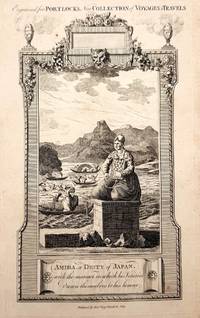
17781968London 1778. Engraving on cream laid paper 11 1/2 x 7 1/2 inches 290 x 190 mm sheet full margins. In good condition with minor age tone and an unevenly trimmed left sheet edge. Ink inscription in the left margin recto and pencil inscription in the right margin recto both well outside of the image area. unknown
180026715Canton 1800. Large 4to. 15 x 12 1/2 inches. 141 watercolours on thin paper nearly all captioned in ink in Chinese in the lower right corner each tipped to a sheet of wove paper. Mid-nineteenth century citron half morocco over marbled paper covered boards spine with raised bands in six compartments lettered in gilt in the second compartment the others with a repeat decoration in gilt marbled edges<br/> <br/> Provenance: Annie Pearson Viscountess Cowdray née Cass 1860-1932 Dunecht House Aberdeenshire.<br/> <br/> An extraordinary album of early Chinese export watercolours of the highest quality.<br/> <br/> Beginning in the late 18th century centred on the treaty port of Canton there existed a thriving trade in ethnographical watercolours executed by local Chinese artists and sold to the western merchants and travellers. The best known result of this trade is William Mason's Costume of China first published in London in 1800 which is illustrated with 60 hand-coloured aquatints adapted from a series of original watercolours by Pu-Qua of Canton. It was common for the local artists including Pu-Qua to work from a set series of models. The present album includes a number of compositions that are from the same set of models as those used by Pu-Qua but they include more detail and more of the trade-associated paraphernalia than are shown in the images as published in Mason's work. This suggests that they were not copied from Mason but were after another more detailed source or were unique compositions by the artist based on a similar series of models. Importantly these watercolours are of a uniformly higher quality than usually encountered and represent not only a wide array of occupations but also members of the highest echelon of Chinese society. The detailing on the costumes worn by these members of the royal court is breathtaking with copious use of gilt. Later collections of Chinese export watercolours were routinely executed on less expensive pith paper whereas the present watercolours are on high quality tissue and are larger in size than those typically encountered. The album represents an earlier more prestigious style of export watercolour paintings specifically meant for wealthy Europeans. These are Chinese watercolours of the highest quality designed and executed to the highest standards. The album was once owned by Annie Pearson Viscountess Cowdray Steward of Colchester and wife of Lord Weetman Dickinson Pearson 1st Viscount Cowdray.<br/> <br/> Cf. Crossman The China Trade Princeton: 1972; cf. Clunas Chinese Export Watercolours London: 1984. unknown
179016081790. Engraving with hand coloring on laid paper 5 1/8 x 6 1/2 inches 130 x 160 mm the full sheet with unevenly trimmed margins. Multiple vertical creases and with the right margin having been fully reattached with clear tape on the verso. The top left corner has also been reattached with clear tape. There is some ghost text on the verso. Coloring is fresh yet delicate and extensive. One plate from an unknown English language publication. unknown
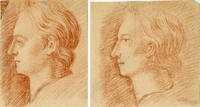
179014111790. Red crayon on cream laid paper 3 3/4 x 4 inches 95 x 102 mm ; 3 3/4 x 3 1/8 inches 95 x 80 mm. Each with scattered early repairs done with non-archival tape on the verso; the smaller of the two drawings has a repaired corner upper-right with in-drawing in red crayon. Condition issues are all consistent with age and the versos remain largely uneffected. A lovely duo. unknown
17781964London 1778. Engraving on cream laid paper 11 1/2 x 7 1/2 inches 290 x 190 mm full margins. In good condition with minor age tone and an unevenly trimmed left sheet edge. Ink inscription in the left margin recto and pencil inscription in the right margin recto both well outside of the image area. unknown
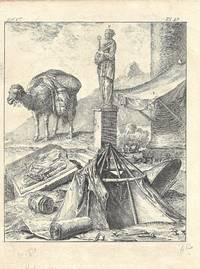
178022271780. Engraving on lightweight laid paper with an small indiscernible alphabetic watermark 9 x 7 1/2 230 x 188 mm; sheet 11 1/4 x 8 1/2 inches 284 x 215 mm wide margins. In very good condition with some light inscriptions in pencil in the lower margin outside of the image area. unknown
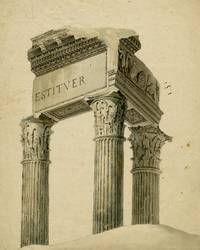
180010251800. Ink and wash in black ink with pen in black ink on watermarked C & I Honig cream laid paper 14 7/8 x 12 1/4 inches 378 x 311 mm the full sheet. In very good condition with some minor areas of light brown spotting in the right-center sheet margin. An excellent drawing with fine detail. The ruins of the Temple of Vespasian and Titus are located in the Roman Forum in Rome. The temple is a marble ruin that honors the deified emperors Vespasian and Titus. Located near the Temple of Saturn all that remain standing are three Corinthian columns that formed part of the colonnade. The temple was also dedicated to the son of Vespasiano Titus. Construction started on this temple in 79 AD. unknown
17462110502151103514Kara Bookstore Kichizaemon 1746. Soft Cover. Fine. Number of books: 2 Kara Bookstore Kichizaemon paperback