110 résultats
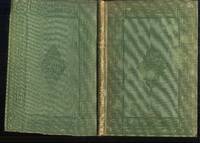
1847042349London: Wiley and Putnam 1847. First Edition. Hardcover Original Cloth. Very Good Condition. Full green publishers cloth some spotting on front board two small splits to cloth on spine lightly bumped corners. Very light scattered foxing otherwise clean. Title is a cancel from the American edition of the same year issued in wraps both in Wiley & Putnam's Library of American Books. The cloth issue is even scarcer than the US wraps issue. 71pp. Whittier's second work of prose. BAL 21753 This is the first UK edition. Size: Octavo 8vo. Quantity Available: 1. Shipped Weight: Under 1 kilo. Category: History; Antiquarian & Rare. Inventory No: 042349. <br/><br/> Wiley and Putnam hardcover books
1830044921New Haven: William Storer 1830. Early Edition. Hardcover Quarter Leather. Fair Condition. The 11th edition in 1/4 leather over boards - boards quite worn spine dry but binding sound. Stain the gutter a few marginal tears one page adhered in the gutter but no loss of text. Plates of the Battle of Trenton Bunker Hill and Saratoga. Size: Octavo 8vo. Previous owner's signature in ink. Quantity Available: 1. Shipped Weight: Under 1 kilo. Category: History; Americana. Inventory No: 044921. <br/><br/> William Storer hardcover books
189863866Raleigh NC 1898. Large format photograph 7 x 9 1/4 inches mounted on larger card stock 11 x 14 inches picturing 10 older women faculty and staff members one older man and 44 female students all posed in four rows in front of a campus building set among tall trees; verso with manuscript names for those pictured almost all with home towns. Founded in 1842 as a school for young ladies with the support of the Episcopal Church St. Mary's has operated continuously since presently as college preparatory school it included two years of college through 1998. Mount rubbed eroded in spots upper right corner broken off affecting three names on verso. 10340. <br/><br/> unknown books
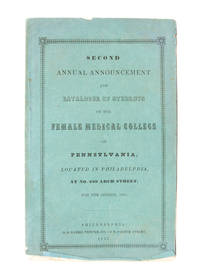
18512970Philadelphia: G.S. Harris 1851. First edition. Very Good . Original blue printed paper wraps printed to front. Some chipping and creasing to edges but overall intact and undamaged despite being quite delicate. Light scattered foxing throughout. Ownership signature of the college's original dean N.R. Mosely struck out at the top of the Faculty list on page 4; pencil ticks next to the names of several students listed in the catalogue on page 6. Exceptionally rare OCLC lists copies of this Announcement at only 2 institutions.<br/><br/>Only one year after Dr. Elizabeth Blackwell graduated valedictorian and became the first female M.D. in the U.S. the Female Medical College of Pennsylvania opened its doors. Located in Philadelphia it was the only the second school to open with the mission of training women in medicine -- having been preceded by the New England Female Medical College two years earlier in 1848. Founded by Quaker abolitionist and Underground Railroad activists who believed that women could make exceptional doctors "the college provided rare opportunities for women to teach perform research manage a medical school and with the eventual establishment of the Woman's Hospital in 1861 learn and practice in a hospital setting. It was the longest-lasting all-women medical school in the nation until it became coeducational in 1970" Mandell. The present Announcement predates these growths however showing the roots from which they emerged. One year running and the faculty remain largely male because there has yet to be an inaugural graduating class this would come in 1852; but already a female student Hannah E. Longshore is listed as a Demonstrator in Anatomy. Indeed Longshore and her sister Anna would both be part of the inaugural class of the college with the latter going on the author Discourses to Women in Medical Subjects 1897. Indeed the majority of women listed in this catalogue went on to become doctors even when it took time -- as it did for Hannah W. Ellis and Susanna H. Ellis both listed among the graduates of the 1865 class. 12 pages in all this scarce pamphlet contains Officers Corporators Faculty and Students of the school; an Announcement on the school's missions and accomplishments; information on Specialties available; Terms of enrollment; and a list of required Textbooks. It also conveys the excitement optimism and pride of those involved. "The Faculty of the Female Medical College of Pennsylvania are inspired by very different feelings from those that attended their efforts one year ago. Then they were about to enter into an untried path to engage in a great experiment.But that which was an experiment is an experiment no longer.give a woman knowledge commensurate with her natural qualifications enable her to go forth healing the sick and comforting the afflicted and she will bless the world." A rare survivor documenting that pivotal moment when women had been given the chance to prove their intellect rose to the challenge and made the future of the next female students more secure. Very Good . G.S. Harris unknown books
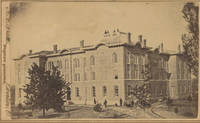
1868List1022Oberlin 1868. Albumen photographs 2 ½ x 3 ½ inches on larger mounts. Some fading to one of the photographs other image with excellent contrast near fine condition overall. Near Fine. An uncommon early pair of views of the Second Ladies' Boarding House at Oberlin College in the 1860s taken at a time when Oberlin was one of few coeducational colleges having first admitted women in 1837. Oberlin's Second Ladies Hall was built in 1861-1863 and featured Itlianate architecture and a rooftop balcony. The building was opened for student accommodations in 1865. The first floor held an assembly room a reading room a dining room parlors and stewards' quarters. The second and third floors housed 100 women. The building was destroyed by a fire in 1889. unknown books
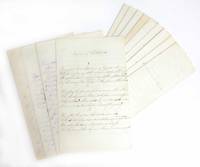
18503448Great Britain 1850. Comprised of 88 manuscript pages of mathematical definitions tables methods and exercises in a single hand with the ownership signature of "Caroline Waters Age 16 yrs" to the front endpaper. Marbled paper vernacular binding measuring 8 x 12 inches and stitched at spine. Caroline's metric measurements and English currency reveal her to be a student somewhere in the UK. Though the commonness of her name and the absence of a specific date prevents us from locating her in genealogy records the manuscript she left behind reveals much about how and why girls of her age and class were being taught arithmetic.<br/><br/>Caroline's elegant practiced hand suggests that she is a member of the rising middle class and the opening of the book suggests that she is a beginning to intermediate mathematician. At the top of the first page she defines Arithmetic as "the art of computing by numbers" which "has five principal sic rules for this purpose viz. Numeration Subtraction Addition Multiplication and Division." Using this definition she divides her notebook into a section for each providing a definition for that principle plus clear-cut examples of its use in both Simple and Compound formats. Numeration Subtraction and Addition are grouped together at the front; and after these sections conclude Caroline enters in Practical Questions in Compound Addition and Subtraction. These involve word problems involving the exchange of money and the calculation of wet and dry weights cloth measurements and time. She then mirrors this with Multiplication and Division before adding sections on Decimal Fractions more Practical Questions and sections on Federal Money and Simple Interest.<br/><br/>The organization of the manuscript suggests that Caroline copied it out for continued reference where sections are easy to locate and problems clearly illustrate each of the principles. And the emphasis in sample problems on currency conversion monetary exchange and banking implies that her family in some way wanted her to be aware of these concepts.<br/><br/>An exceptional and rich document Caroline's notebook is a rich resource for study including but not limited to the history of women's education middle class education women's domestic use of mathematics women in business paleography genealogy gender studies. unknown books
18792316Connecticut 1879. Near Fine. Archive of 13 handwritten manuscript essays composed by a Connecticut schoolgirl. Comprised of approximately 40 pages of autograph material written in ink by the same neat hand and signed "Carrie Breed." In addition to titles the majority of essays are dated and include Breed's school name and location. An exciting and interesting look into the work of a diligent young woman excited in particular about the female authors of her own time.<br/><br/>Founded in 1851 Parker Academy was a boarding school that boasted "a healthy location a tidy village an orderly community and a most beautiful valley with pleasant surroundings -- a good place for an institution of education" Historic Buildings of Connecticut. While little else is known about the school the manuscript assignments of Carrie Breed reveal a curriculum that emphasized traditional feminine skills such as polite conversation and elegant handwriting as well as more rigorous subjects including literature composition and botany. The earliest works contained in this archive are three copy exercises assigned to Carrie to practice forming her handwriting; and they speak to her own burgeoning literary interests. The first "Scenes of Childhood" is an assignment drawn from Charles Northend's The American Speaker Being a Collection of Pieces in Prose Poetry or Dialogue Designed for Exercises in School 1856. Yet the two that follow later in the academic year of 1875-76 appear to be selections chosen by Carrie herself as an instructor has added pencil notations "taken from Miss Alcott in Little Women." Published not even a decade before Alcott's novel about sisterhood and women's lives made an impact on girls across America; and here with more assertive mature penmanship Carrie copies out the long passages of "My Beth" and "In the Garrett" written by Alcott's character the aspiring author Jo. <br/><br/>The remaining essays in the archive contain Carrie's own reflections and writing as she matures as a student and thinker. Content is largely focused on moral concepts such as Influence Benevolence and Hospitality although two essays also consider the domestic work of cultivating house plants and performing house cleaning. In two essays Carrie reflects on her relationship to the seasons and to the experience of walking in the woods. The final essay as she nears the end of her time in school and likely reflects on her future as a wife and mother she writes on Filial Trust. As the months and academic years pass it is possible to see her penmanship and her thinking begin to change from those of a girl into those of a young woman with her own mind.<br/><br/>With rich research possibilities in fields including but not limited to the history of women's education paleography contemporary receptions to women's literature the history of American education and gender studies. Near Fine. unknown books
18223447Great Britain 1822. Comprised of 78 manuscript pages of mathematical definitions tables methods and exercises in a single hand with the ownership signature of Elizabeth Young and a running date made intermittently to the footers. Blue paper vernacular binding measuring 8 x 12 inches and stitched at spine; later tape reinforcement. Elizabeth's metric measurements and English currency reveal her to be a student somewhere in the UK. Though the commonness of her name prevents us from locating her specifically in genealogy records the manuscript she left behind reveals much about her.<br/><br/>Elizabeth's notebook is composed in a meticulous cursive hand with neat headers each dated and her name to many of the footers. Section each have a definition leading into rules and from there into word problems and calculations. Each new section progresses in complexity requiring Elizabeth to conduct longer calculations and combine a variety of arithmetical methods multiplication division addition subtraction. Some of these are generic questions about distance or weight; but others urge the student to devotion even as she works in a logical field "How many Hours Minutes and Seconds elapsed since the birth of Christ which is 1808 years ago assuming 365 days to a year". Some put Elizabeth in contact with the world of commerce and supply chain "The yearly export of Brandies from France is said to amount to 25000 tons. What is the value of this quantity at 5s6p per Gallon". Still others prepare her for the maintenance and management of a household or a business "If a servant's wages be 12.12 for 52 weeks how much is that a year" or "If 1728 Elegant wine glasses were bought for £65.2s how must they be sold per dozen or per glass to gain Ten Guineas by the sale of the whole".<br/><br/>A portion of seven pages near the center of the book offers a telling anomaly. While it continues in Elizabeth's neat hand these entries from January-February 1822 list goods purchased by community members from merchants several of whom are women. If these are a part of a school exercise they do not show the marks of it. Rather they appear to be Elizabeth making real-life notations keeping track of accounts for herself or someone else. In this sense the word problems she records and practices are being applied in her own life.<br/><br/>An exceptional document Elizabeth's notebook has research possibilities including but not limited to the history of education in the UK and trans-Atlantic comparisons the history of women's education the effects of class on girls' education mathematics approaches to teaching math to girls historical measurements women in business paleography and women's and gender studies. unknown books
18882180Bloomsburg PA 1888. Very Good . Manuscript notebook composed by Ida Sylva Wagner a young woman training to become a teacher at the Bloomsburg State Normal School now Bloomsburg University of Pennsylvania between 1888-1889. Comprised of 88 pages in ink and pencil blending lecture and reading notes with what appear to be Ida's own drafts of analytic essays practice lesson plans and examination questions. Quarter cloth over marbled boards measuring 5.5 x 8.5 inches. Shelf-wear to extremities and hinges tender but holding. Text block overall tight with mild toning not affecting text. Wagner's ownership signature and school information on front paste-down; second ownership signature along with Wagner's later teaching location on rear paste-down. In Very Good condition overall considering its daily class use and apparent usage as a reference guide during Ida's later teaching career.<br/><br/>Established in 1869 the Bloomsburg State Normal School aimed to provide rigorous teacher training to ensure that regional educators could "teach the youth elements of classical education" Bloomsburg University. State census records show that she would have been 22 at the time of this class and that she later moved to Luzerne County to work as a teacher after graduation. This notebook rigorously documents her work in an advanced Practical Teaching course which provided pedagogical methodology as well as requiring students to put methods into practice by designing usable teaching materials. Ida's notebook is roughly divided into sections with blanks separating each; and they include practical notes including Introductory Consideration Foundations and Principles Length of Recitation Object Lessons and Plan of Lessons as well as sample content for lessons such as Primary Reading Primary Numbers and Rules of Grammar. In her hand Ida reflects on the importance of theory and practice noting "The powers of the child which demand the teacher's attention are the physical the intellectual the moral and the spiritual.before knowing can take place there must be something to know and the thing to be known must affect its appropriate sense." This guiding principle clearly shapes the class and Ida's notes show that she is being trained in the "something to know" for example the 15 pages of vocabulary pronunciations and definitions as well as the "affecting its appropriate sense" for example the 46 initial pages on methods for shaping appropriate lessons. <br/><br/>A dense resource with research possibilities including but not limited to the fields of history of pedagogy history of American higher education women's education and employment and gender studies. Very Good . unknown books
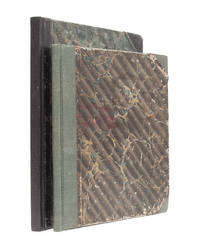
18703389United Kingdom 1870. Geography notebook of Mary Barker: Quarter black roan over marbled boards measuring 9 x 7 inches. Comprised of a calligraphic title and frontis plus 59 hand drawn-and-colored maps done by a young woman in her first three years of teacher training. Throughout Mary annotates on the margins which year and term she is in and occasionally notes that the map was drawn "From Memory"; and each map has penciled corrections and assessments. <br/><br/>with Geography notebook of Allison Jane Gillespy: Quarter cloth over marbled boards. Calligraphic title page and 35 intricately hand drawn maps from the British Empire Europe and the Middle East. <br/><br/>A pairing of beautiful and research-worthy notebooks documenting teacher training in the late nineteenth century as well as providing a look into how geographies changed across time and how British educators were being trained to perceive and educate the young about other parts of the world and how they connected to the British empire. With nearly 100 pages combined the notebooks offer scholars important comparative opportunities and means for better understanding the rising number of women educators and authors publishing works that engaged geography and international cultures during the Victorian era.<br/><br/>"The Wesleyan Methodists had a school for ministers' daughters at Trinity Hall Southport.which admitted both boarders and day girls.to educate ministers daughters and train teachers" Roach. Pupil teacher programs like the one Mary Barker was enrolled in had become a popular method of producing teachers at a time when the public's access to education expanded and the demand for instructors was at a high. Such programs functioned like an apprentice system taking a senior pupil typically thirteen years old and putting her in a five year assistantship to her own instructor. Pupil teachers typically took on responsibility for teaching lower classes observing their superiors educate the more advanced students and completing their own educations. By the 1870s these programs had become standardized to ensure proper preparation for instructors Robinson. <br/><br/>Mary's maps trace this process. As she moved from her first to her third year in this notebook the quality and care she puts into her work improves. Her handwriting and attention to detail matures. And her assessments move from Fair to Good and Very Good. Maps in the notebook include nearby locales such as Ireland Scotland and the British Isles as a whole; European nations including Sweden Norway and Prussia as well as eastern Europe and Russia. Mary also maps out "Arabia" and the "Chinese Empire" as well as "Further India" revealing a wide array of changing borders and shifting cultural attitudes. <br/><br/>While Allison does not leave any marker of her class age or school the level of intricacy in her maps suggests she was a senior student or finished instructor. These appear to be fair copies not done from memory but prepared as examples for students or as teaching aids.<br/><br/>Together the two provide a comparative opportunity to study the history and politics of mapping nineteenth century girls' education pedagogy and pedagogical training and geography. unknown books