B-R-D familyBiblio.com
23 résultats
1766PBRB024<p>The book is nearly 300 years old due to this the condition is quite bad. The spine is crumbeling and the book is very fragile the inside of the cover is stained with brown patches as well as some of the pages being folded worn and torn slightly.</p> J. Dodsley hardcover
1776CBRB638<p>This book is in good condition. Cover near the edges and spine is creased and frayed in some places. Page tanning. Some spots and marks throughout the pages. Two small tears on the cover page. No inscriptions.</p> J. Dodsley London hardcover
1715054511Oxford: John Baskett 1715. John Baskett . Hardcover. Very Good. Small 8vo. LONDON : 1715 and 1714. Bound with Sternhold & Hopkins Psalms. Hardback. Contemporary black full morocco-leather. Gilt tooled spine; gilt panelled boards. Original marbled end-papers differing petterns. Raised bands. Gilt decorated spine; gilt panels to covers. Owner name Bidulph - Ledbury. No internal markings. Text complete. Clean and tight with moderate wear; attractive binding. VERY GOOD. Will be well-packed for shipping 8vo. Rosley Books for Antiquarian books Cumberland Everyman Inklings Literature Rarities Theology and History. . <br/> <br/> John Baskett hardcover
1717053535Oxford: John Baskett 1717. John Baskett . Hardcover. Very Good. 8vo. OXFORD : 1717 and LONDON : 1716. Bound with Sternhold & Hopkins Psalms. Hardback. Contemporary black full morocco-leather. Original marbled end-papers. Raised bands. Gilt decorated spine; gilt panels to covers. Owner name dated 1804. Contemporary family details to last leaf; dates of birth; 1778 - 1865. No internal markings. Text complete. Clean and tight with moderate wear; attractive binding. VERY GOOD. Will be well-packed for shipping 8vo. Rosley Books for Antiquarian books Cumberland Everyman Inklings Literature Rarities Theology and History. . <br/> <br/> John Baskett hardcover
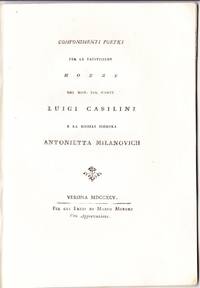
17956409Verona: per gli eredi di Marco Moroni 1795. Original edition. Fine. Octavo 20 cm; 231 blank pages. In woodblock-printed polychrome wraps in Remondini style. <br /><br />Occasional verses written and one assumes recited for the wedding of members of two of the leading political and legal families of the city of Rovigo in the province of Venice. The Casalini family effectively held political power in Rovigo from the 1400s through the nineteenth century. No copies inventoried in OCLC or in ICCU. per gli eredi di Marco Moroni paperback
175443010AB1754. Dublin J.Esdall 1754. 173 cm x 11 cm. VIII pages XVII -XXIII 268 pages. Lacking the list of Subscribers IX - XII and Start of Content-pages XIII-XVI. Later 19th century Hardcover / Half - leather with gilt lettering and ornament to spine. Good condition with only minor signs of external wear. Spine slightly damaged and broken. Bookblock tight and clean besides a faded dampstain and some lesions to outer margiuns of several pages. Needs some attention from a bookbinder. Exlibris / Bookplate of Henry J.B.Clements on pastedown Clements was landowner in County Mayo and County Galway Rosshill House connection. The book is a collection of memoirs that document the exploits of one of the most charismatic and influential families in 16th and 17th century Irish history. Chapters include for example: Richard Cromwell Baffles the Designs of Fleetwood / His advice to Richard Cromwell / Richard deposed / Lord Broghill retires to his command in Munster and is suspected by the Committee of Safety / Summoned to appear before the Commissioners in Dublin / Brings over the Army in Ireland to the King's Interest and invites the King to land at Cork / He and Sir Charles Coote declares openly for the King and secure Ireland / Taken into the Cabinet Council and made one of the Lords Justices of Ireland / etc. Eustace Budgell 19 August 1686 4 May 1737 was an English writer and politician. Born in St Thomas near Exeter Budgell was educated at Oxford University. His cousin the writer Joseph Addison took him to Ireland and got him appointed to a lucrative office. However when he lampooned the Viceroy he lost his position. Budgell assisted Addison with his magazine The Spectator writing 37 numbers signed X. In these he imitates Addison's style with some success. Between 1715 and 1727 he represented Mullingar in the Irish House of Commons. Budgell who was vain and vindictive fell on evil days; he lost a fortune in the South Sea Bubble and was accused of forging the will of Dr Matthew Tindal at the expense of his nephew Nicolas Tindal. He committed suicide by throwing himself out of a boat at London Bridge. His suicide note famously said: "What Cato did and Addison approved cannot be wrong." Wikipedia. hardcover
17298769Unpublished 1729. Half crimson morocco boards with marbled sides in good condition. Spine rubbed. Moderate bruising to corners and edges. This binding has been used to cover part of an older book which lists Acts of Parliament relating to duties to be paid on goods each page titled '49 George III. Cap.98'. The pages have been appropriated to form a new book in which the Favell Family have inlaid 11 pasted down indentures in the form of legal agreements apprenticeship contracts and documents spanning a period from 1729 until 1822. Each document is in good condition legible showing browning to edges and creasing to folds. Five documents include embossed blue revenue stamps from the reigns of George II and George III. Two documents exhibit red wax seals. Attached by tape to the rear pastedown is a birth certificate dated March 1806 Elizabeth Caroline Favell. Additional ephemera includes a printed text from the Evangelical Magazine commemorating the life of Mrs Favell who passed away December 1794. Please contact Christian White Rare Books Ltd for more information or images of this item 1729 Unpublished hardcover
176421699London: Engraved and Printed for the Author and sold by Messrs. Fletcher and Co. 1764. First edition. Ephemera. Very good condition. The coat of arms of the Hastings family published in a sumptuous format in 1764 in the "Baronagium Genealogicum; or the Pedigrees of the English Peers." The print includes the associated three text sheets of the genealogical table with vignettes also colored. Copper engraving with handsome later hand color the platemark measuring approximately 24 x 42 cm 9 1/4 x 16 1/2" on paper 30 x 48.5 cm 12 x 19 1/4". Very good condition. Plate numbers 91 92 93 94. Beautifully colored. Two small marks above shield pp 91 chip in margin of pp 94 otherwise very clean. Engraved and Printed for the Author and sold by Messrs. Fletcher and Co. unknown
176421718London: Engraved and Printed for the Author and sold by Messrs. Fletcher and Co. 1764. First edition. Ephemera. Very good condition. The coat of arms of the Augustus family published in a sumptuous format in 1764 in the "Baronagium Genealogicum; or the Pedigrees of the English Peers." Copper engraving with handsome later hand color the platemark measuring approximately 24 x 42 cm 9 1/4 x 16 1/2" on paper 30 x 48.5 cm 12 x 19 1/4". Plate number 5. Beautifully colored and very clean. Engraved and Printed for the Author and sold by Messrs. Fletcher and Co. unknown
176421689London: Engraved and Printed for the Author and sold by Messrs. Fletcher and Co. 1764. First edition. Ephemera. Very good condition. The coat of arms of the Campbell family published in a sumptuous format in 1764 in the "Baronagium Genealogicum; or the Pedigrees of the English Peers." The print includes the two associated text sheets of the genealogical table with vignettes also colored. Copper engraving with handsome later hand color the platemark measuring approximately 24 x 42 cm 9 1/4 x 16 1/2" on paper 30 x 48.5 cm 12 x 19 1/4". Plate numbers 79 80 81. Beautifully colored slt dusty at bottom margin. Engraved and Printed for the Author and sold by Messrs. Fletcher and Co. unknown
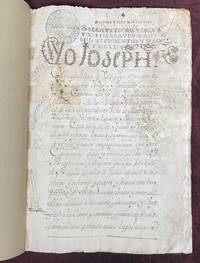
17283474Madrid 1728. Good. Manuscript on paper. Folio. 38 ff. tears and wear along fore-edges smaller tears along top and bottom of leaves persistant waterstains fol. 1 damaged with loss. Top portion of final leaf excised but the text is continuous see below. Recent sympathetic wrappers. With faults and priced correctly. EXCELLENT SPANISH GOLDEN-AGE MANUSCRIPT WHICH DOCUMENTS AN ATTEMPT TO "CERTIFY" THE NOBILITY OF A NOBLEMAN IN PROVINCIAL SPAIN WHOSE FAMILY WAS ASSOCIATED WITH THE FOUNDER OF SAN ANTONIO TEXAS.<br /> <br /> The purpose of the document is to demonstrate the nobility of Don Manuel Silbestre Joseph de Herrera y Tassis. There had been a reorganizing of the government of the town Bañares in the province of Burgos now Logroño and Herrera believed that he should be the "acalde" similar to the post of "mayor" though with greater authority than the modern mayor. However to claim the position it was necessary for some unstated reason for Herrera to prove that he was of noble birth.<br /> <br /> TEXT: The first leaves are copied from a "Book of Baptisms" the original is described as a large folio made of parchment from the Parish of San Andres in Madrid from June 5 1684 to May 23 1691 beginning at page 165. These leaves show that Manuel Herrera was born on the 31st of December 1686 making him 26 years old at the time of the events in question along with the names of his parents padrino etc. <br /> <br /> The next leaves are copied from a book titled "Twenty Three Baptisms" from the Parish of San Fines and San Luis in Madrid begun in September 12 1629 ended January 18 1630 page 109 and document the birth and baptism of Henrrique Herrera Manuel's father. Next is evidence of the fact that Manuel's older half brother Don Gregorio de Herrera y Varacaldo was granted entrance into the Orden de Santiago The Order of Saint James a military/religious order. This is a copy of a document by Don Gregorio de Tapia the king's secretary and a member of the royal cabinet.<br /> <br /> The next section lays out Manuel de Herrera's genealogy showing the claim to nobility through certain aspects of his family's history. His Grandfather Captain Don Matheo Andres de Herrera was granted membership in the Orden de Santiago by King Philip III. It is also shown that a number of Manuel's ancestors were born in Flanders obviously related to the Spanish occupation during the Eighty Years' War.<br /> <br /> Following are certifications showing that Manuel's grandfather and other ancestors had held the position of Acalde de Mesta. This means that they were in charge of the Spanish livestock sheep herders' association. Although that does not sound particularly impressive it was a position of immense power and prestige monetarily and politically and was only held at this time by members of the higher nobility. The family held this position under the authority of the Duke of Béjar the first mention in this document would have been under the 9th Duke. <br /> <br /> THE DUKES OF BÉJAR AND THE CONNECTION WITH SAN ANTONIO BEXAR COUNTY TEXAS: As we learn herein for several generations the Herrera family served under the Dukes of Béjar. Indeed Don Henrique de Herrera the father of Manuel Herrera for whom the present manuscript was written was the Governor of Sanabiza under the Duke of Béjar and a member of the Royal Council although the author claims that these records were "unavailable" as the city of Sanabiza had been taken over by the "enemy" Portuguese. The bespoke Manuel Herrera served as "Gentleman of the Chamber" under Juan Manuel López de Zúñiga y Castro later the 11th Duke of Béjar and the 10th Count of Bañares. Manuel López's uncle Baltazar de Zúñiga y Guzmánde 1658-1727 surely knew the family. He is of particular interest in the history of the Americas as he became Viceroy Governor and General Captain of New Spain President of the Royal Audience of Mexico High Majordomo of King Philip V and President of the Royal and Supreme Council of the Indies. In 1718 he established the Presidio San Antonio de Béjar; this was to become the city of San Antonio in Bexar County Texas. <br /> <br /> OTHER NOBLE FAMILY MEMBERS: Several pages describe the nobility of Manuel's older brother Gregorio who belonged to the Orden de Santiago; was a well-known noble of the Royal Court; and had been elected Acalde de Mesta over several other candidates including the Secretary of New Spain and the King's own son. Manuel's grandfather was also in the Orden de Santiago and was a member of the king's cabinet; and finally his father enjoyed noble privilege in the castle of Sanabiza. <br /> <br /> CONCLUSION: Manuel argues that he deserves to enjoy the same privileges in Bañares and he provices testimony from respected witnesses so that his "quality blood and nobility" can never again be challenged. The final section shows that the Bañares Deputation received the prepared documentation investigated its veracity confirmed the nobility of Don Manuel de Herrera y Tassis and granted him the position of Acalde de Bañares. <br /> <br /> The final leaf contains the hastily written attestation of the secretary Joseph Marttines de Vallabanes including a description of the document itself: "38 folios hand-rubricated and on the last leaf of the sello tercero paper . separated !" -- presumably referring to the missing section at the top of the last leaf. NB: the text is continuous; perhaps a decorative flourish was excised in order to validate the text of the document with another copy. <br /> <br /> SECRETARY: Written by Joseph Marttinez de Vallabanes regularly "MartÃnez"; this scribe has a habit of doubling the letters "t" and "r" a scribe in Valladolid and is "rubricado" meaning that each leaf on the recto lower interior margin has the scribe's "rúbrica"; an artistic signature that serves as a sort of notarized seal. The document was written at the order of Don Manuel Herrera y Tassis on the 10th of December 1727 as a copy of the original document written by the scribe Thomas de Silba and others in 1712.<br /> <br /> PAPER: Initial stamps at the head show the seal of King Phillip V of Spain and show that this paper is the "tercero" grade of "papel sellado" costing 68 maravidÃs approximately $7.30 today and stating the year: 1727. Papel sellado was first authorized in Spain by a decree from Felipe IV in 1636. This stamped paper primarily functioned to gather revenue for the royal treasury; documents without the official stamp were regarded as non-legal and the transactions they documented subsequently negated. Papel sellado was extended to Spain's colonies in the New World following another law in 1638 where it was mainly sold to individuals who executed legal documents such as lawyers scribes and merchants. The necessary stamps were available in four sellos the use of each dependent upon the transaction and descending in cost: Primero Segundo Tercero and Quarto with two additional categories under Sello Quarto "de oficio" for government use and "pobres" for indigents. The more prominent seals thus signaled documents of greater importance and value. Papel sellado was distributed in annual issues in Spain.<br /> <br /> WATERMARKS: <br /> 1. Filigrana Hispanicas 0023459A Ãguila bicéfala con alas abiertas y coronada. Escudo en el pecho con iniciales "MGC" en el interior = Valencia 1742. <br /> 2a. Not reproduced in Filigrana Hispanicas but possibly 0020929A Tres cÃrculos rematados en una cruz latina trebolada. En el primero una media luna en el segundo las letras PP y en el tercero un corazón.<br /> 2b. Countermark of the above Una cruz de Malta. <br /> 3. Filigrana Hispanicas 0022203A Tres cÃrculos rematados con una cruz latina trebolada. En el primero una media luna en el segundo las letras S/P/D/A y en el tercero las letras P/ GG. Debajo el número 2 = Oviedo 1738. <br /> <br /> CATALOGUER'S NOTE: We are grateful to Joseph Adams for his detailed analysis of this manuscript. unknown
1800244358vp chiefly Paris 1800. 8vo. Half calf and boards rebacked preserving most of original spine. 8vo. Sammelband of pamphlets pertaining to the Directory Council of 500 and Napoleon's rise to power.<br /> SIGNED "C. Sneyd Edgeworth / June 1817" on the half-title of the first pamphlet. Charles Sneyd Edgeworth was Maria's half-brother; his mother Elizabeth Sneyd was Mr. Edgeworth's third wife. With a list of pamphlets in Charles's hand on the first blank.<br /> An important anti-Napoleon pamphlet "Vrai Sens du Vote National" is INSCRIBED by the author Camille Jordan "par Mr Edgeworth de la part de l'autor" partially trimmed. unknown
1774WB16372Paris: Typis Barbou via Mathurinensium 1774. Hardcover. Very Good. 12mo 155 x 94mm. Pagination: xxxvj 346pp. 2 the Catalogus. Signatures: a12 b6 A-O12 P6. Three full-page plates engraved by Étienne Fessard 17141777 after Charles Nicolas Cochin 17151790 one is the frontispiece depicting a neoclassical scene of cherubs presenting the bust of Crispus Sallust to muses. Woodcut printers device of the brothers Barbou on title page two flying storks feeding each other a worm in foliated ouroboros: symbolizing fraternity typographic and engraved head- and tail pieces. Near contemporary French mottled tan calf gilt-ruled border spine gilt in six compartments one with red morocco lettering label and title SALLUS/TIUS marbled endpapers silk bookmark all edges gilt; some light edgewear and minor scuffs; few minor marginal stains throughout; overall a very good and sound copy of this scarce edition. The signature Tho. Walpole on a front flyleaf verso and the armorial bookplate with heraldry of Thomas Walpole the younger 17551840 Eton and Cambridge-educated British ambassador to Bavaria from 1783 to 1788 and the son of the British financier Thomas Walpole 17271803 also the nephew of Sir Robert Walpole 16761745 and cousin to Horace Walpole 17171797 whom he succeeded in the barony on front pastedown. Armorial crest as the bookplate of Spencer Horatio Walpole 18061898 Home Secretary and second son to that Thomas d. 1840 affixed to front marbled endpaper and his signature under that of his fathers as Spencer H. Walpole with a note written in his hand about a Roman history fragment by Granus Licinianus presented to the British Museum in Dec. 1859. Thomas Walpole the younger was 19 years old when this new edition was issued from Barbous press and he likely acquired it early on for his studies. This copy remained in the Walpole family for over 120 years. Later ex-libris of the American Arthurian scholar Nathan Comfort Starr 18961981 affixed to a front flyleaf. <br/><br/>New duodecimo edition of Roman historian Sallusts Roman history covering the Jugurthine War the Conspiracy of Catiline and with the Vita of Sallust by Stephan A. Phillippe. It was first published by Joseph Gérard Barbou fl. 17521788 in Paris in 1744 with the imprint Sumptibus Mich. Steph. David filii. Another edition was produced by Barbou in 1761 followed by this nova edition expurgate of 1774 as the new cleansed version of the text. The reading of Roman histories was incredibly important to the law-abiding and enlightened audiences of Western Europe. This copy is significant for its distinguished provenance from a branch of the Walpole family who were likely the original owners. The Walpole family were deeply entrenched in 18th century British government; it would have been crucial for Thomas and Spencer Horatio to be well-read and maintain erudite political discourse with their contemporaries. Thomass cousin the better-known Horace established the famed Strawberry Hill library and press also contributing to the learned position of the family. The year 1774 the same year of this edition saw the death of King Louis XV of France and much social and political tension in the decade prior to the French Revolution. Sallusts works became particularly popular during the Enlightenment as they encouraged a deeper reading of the mind and manners of men. The preliminary note by Spencer Horatio proves that he had great depth of knowledge about social history and scholarly works. He was a lawyer by profession but was appointed to the rank Home Secretary in 1852 before the government fell and reappointed in 1858 only to resign in 1859 interestingly the same year as this copys dated note. The Barbou press was known for their fine and ample editions of classic history works and the French engraver Charles Nicolas Cochin the Younger was well-received in his time enjoying the court patronage of Louis XV. The famous portrait engraving of Thomas Walpole the elder was made by Cochin and it is likely these history engravings appealed to the family who might have regarded him as a favorite. This copy has a wonderful Walpole ownership history and is an important Sallustian Enlightenment-era work that is rarely found. OCLC locates two institutional copies in the US at NYU and BYU. Brunet V: 87. Typis Barbou, via Mathurinensium hardcover
174179120Dordrecht:: Jacob en Hendrik Keur 1741. old full diced and blind-embossed calf over beveled wooden boards with brass corners and one of two brass clasps. . A few old genealogical notes on flyleaves. The text is age-toned; one brass clasp lacking; cracked at joints and chipped at the bottom of the spine;. Folio. Engraved illustrated title page; six folding engraved double-page maps/views and 13 engraved plates. . Jacob en Hendrik Keur, hardcover
1716216537London : Printed for J. Morphew 1716. First Edition. Hardback. Finely bound in modern aniline calf over marble boards. Raised bands with a dark morocco gilt-blocked label. An uncommonly good example - scans and additional bibliographic detail on request.; 8vo 8"" - 9"" tall; 256 pages; Physical description; folding portrait frontis 256p ; 17cm. Subject; Butler family. Ormonde James Butler Duke of 1610-1688. Ossory Thomas Butler Earl of 1634-1680. Ormonde James Butler Duke of 1665-1745. London : Printed for J. Morphew hardcover
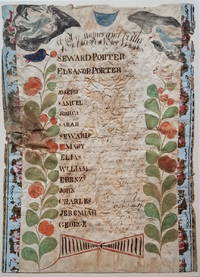
18003722<b><i>Family Register of Seward Porter circa 1800</i></b><br /><br /><br />A nicely accomplished though primitive family register of the Seward and Eleanor Porter family. Two colorful plants with birds in their top branches fill the sides of the register. At the top hover two angel-like figures one bearing an hour glass the other blowing a horn. <p>Seward and Eleanor Porter were from Weymouth Massachusetts but relocated to Falmouth in the District of Maine in about 1777 and then to Freeport in about 1782. This family register lists the names birth places and birth dates of the Porter's 13 children from 1778 to 1797. </p>Their fourth son on the list -- also named Seward Porter -- would become a prominent Maine mariner and entrepreneur. He brought the first steamboat to Maine in 1823. In 1837 he published a now-highly-prized set of charts of the Maine coast. For Seward Porter the son see:<i>Tooley's Dictionary of Mapmakers</i>: Vol 3 p. 453 and Guthorn <i>United States Coastal Charts 1783-1861</i>: p. 29. <br /><br /><b>Condition:</b> Approximately 14 x 10." Iron gall ink on wove sheet with colored decorations. The sheet is mounted on a ca. 1815 newspaper and strips of wallpaper about 1" wide have been applied along the left and right sides. The piece is in fair condition with overall cockling and some water damage. There is a small puncture on the left edge. The ink notations of the birth dates and locations are faded but legible.<br /><br />ICN 3198.
17877498<p><b><i>Original Letters Written during the Reigns of Henry VI Edward IV And Richard III. By various Persons of Rank or Consequence; Containing Many curious Anecdotes relative to that turbulent and bloody but hitherto dark Period of our History; And Elucidating not only Public matters of State but likewise the Private Manners of the Age: Digested in Chronological Order; With Notes Historical and Explanatory; And Authenticated by Engravings of Autographs Paper Marks and Seals.</i></b> <b>Edited by</b> <b>John Fenn. <br /></b></p><p><br /></p><p>Illustrated with 3 engraved hand-colored plates a large folding table and numerous engraved facsimiles of the letters seals autographs and marks. 4to. Original vellum-backed gray boards. London Printed for G.G.J. and J. Robinson 1787. First Edition. Two volumes. </p><p>The Paston Letters are a collection of letters and papers consisting of the correspondence of members of the Paston family of Norfolk and others connected with them between the years 1422 and 1509. They also include various state papers and other important documents. <br /></p><p><br /></p><p>They are arguably the most important extant primary source material concerning English life in the 15th century. In 1787 John Fenn published a selection of the letters in two volumes. In 1789 he published two additional volumes and when he died in 1794 he had prepared a fifth volume which was published in 1823 by his nephew. In 1787 Fenn presented the originals of his first two volumes to King George III and shortly afterwards received a knighthood. <br /></p><p><br /></p><p>Boards slightly scuffed; 1-inch split to top vellum joint; some minor foxing and offsetting; o/w a fine untrimmed copy in original boards with very wide margins suggestive of a large-paper copy. Scarce. <br /></p> Printed for G.G.J. and J. Robinson hardcover
1702219892NP 1702-1848 1702. First Edition. Hardback. All items are in a good to very good condition loosely gathered in a folder of vellum-covered boards probably removed from a 19th century book. The older documents are slightly edge-nicked and tanned as with age but still legible. The later documents are quite clean and bright with just some dulling around the edges. Overall this unique and rare collection of documents remains particularly well-preserved overall. Further scans images etc. and additional bibliographical material available on request.; 8vo 8"" - 9"" tall; 0 pages; A small archive of original documents relating to the Quilter family. There appears to be a connection between a number of the families mentioned in these documents and 'The Kings Candlesticks' that relate to George IV and the Julius family. Three handwritten sheets of family trees late 16th century to 1931 that feature the names of Quilter of Staple in Kent 16th century Rumball 18th-19th century Julius Quilter Palmes or Palmer Rowland and others. The original documents range from 1702 to 1848 and include ordination certificates landlord-tenant agreements articles of clerkship and wills some with their original seals. Contents include: Deacon ordination certificate awarded to George Quilter signed by the Bishop of Ely 27th September 1816. With original seal. -- Chaplain certificate: ""George Quilter to be licensed to perform the office of Chaplain of the workhouse of the Lincoln Union in the county of Lincoln"" May 29th 1837. -- Canon certificate awarded to George Quilter signed by the Bishop of Lincoln 16th Dec. 1870. -- ""Inventory of furniture and effects in the house in Malbrook belonging to Mr. Quilter 1st Jan. 1702."" -- ""Inventory and appraisemet of furniture and effects in Walbrook from Mr. Quilter to Mr. Keating 24 January 1702."" -- ""Schedule of fixtures to be appraised to Mr. Quilter from Mr. Keating 23 June 1703."" -- ""Valuation of fixtures taken in the house of Mr. Dyson by Mr. Quilter Dec. 6th 1777."" -- ""Schedule of fixtures to be appraised from Mr. Quilter to Mr. Cameron 1st October 1783."" -- Articles of clerkship between William Lee and John Rumball. 1770. With original seals. -- Articles of clerkship between James Rumball Quilter and Robert Gatty. 1st May 1779. With original seals. This document states: ""James Rumball Quilter of Walbrook in the City of London."" -- Copy of the last will and testament of Francis Russell Nixon 1803-1879 the first Bishop of Tasmania. -- Last will and testament of Julius Quilter 2nd Sept 1848. The collection also includes a 19th century handwritten personal booklet/diary of religious verse and French poetry transcribed from various works. Place names mentioned and repeated in the listed documents include: Ely Canterbury Walbrook in the City of London and Lincoln. Also included is a typed letter from C. Cary Gilson addressed to the Quilters West Chiltington Common Sussex regarding the Quilter family connections to Lord Horatio Nelson's wife. Gilson quotes Aunt Nona: ""my great grandfather owned St. Kitts. The widow Mrs. Nesbitt was a relation of his and married Lord Nelson."" Nelson and Nisbet were married at Montpelier Estate on the island of Nevis on 11 March 1787 shortly before the end of his tour of duty in the Caribbean. The marriage was registered at Fig Tree Church St John's Parish Nevis. Nelson returned to England in July with Fanny following later Sugden John 2004. Nelson: A Dream of Glory. NP, 1702-1848 hardcover
1776168426Paris : Chez la veuve Ballard & Fils Imprimeurs-Libraires du Roi 1776. First Edition. Hardback. Full contemporary tree calf very good. Professionally and period sympathetically re-backed with raised bands and the title blocked direct in gilt; very impressively finished. Generalized wear to the board extremities. Armorial motif in gilt to the frontpanel. Remains particularly well-preserved overall; tight bright clean and strong.; 8vo 8"" - 9"" tall; 472 pages; Series; Supplement de L'Histoire Genealogique et chronologique des grands officiers de la Couronne v.2. Notes: Title vignette head and tail pieces. Subjects; France - Genealogy - Military affairs - 18th century. Large folio. Paris : Chez la veuve Ballard & Fils, Imprimeurs-Libraires du Roi hardcover
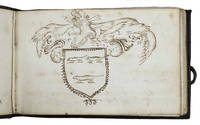
1750ABC_46340The Netherlands 1750. Oblong 8vo ca. 10.5 x 16 cm. 18th-century gold-tooled calf gold-tooled spine each board with a double-fillet frame a centrepiece and four cornerpieces gilt edges green cloth ties. Manuscript on paper written in brown and black ink in several - 17th- 18th- and 19th-century hands. With a full-page unidentified coat-of-arms showing three salamanders drawn in brown ink and a page containing 6 smaller crests of branches of the Roorda family in black ink. 1 blank 5 3 blank 20 1 blank 1 78 blank ll. Manuscript family chronicle incorporating multiple chronicles from the 17th and 18th century. The manuscript chronicles the births and deaths of four generations of the Bos Werdolen or Verdole and Roda family in Amersfoort Groningen The Hague Scheveningen IJsselstijn Tiel Deventer Kampen Zuilen and Edam. The book was probably compiled by Dirk Daniel Roda 1726-1898 a lieutenant in the infantry and later beer brewer shortly after the death of his father in 1747. It incorporates chronicles by his father Michiel Roda 1686-1747 his maternal grandfather Jacob Werdolen chronicling 1668-1686 Jacob Werdolen's father Hendrik van Werdolen a note from 1639 and a copy by Hendrik's wife Barbera Bos born 1596 of the chronicle written by her father chronicling 1577-1601.The different chronicles are interleaved with notes by Dirk Daniel Roda which supply additional biographical information. In several pages he describes the his own Roorda ancestors in the 17th century and the process by which they changed their name to Roda. Other notes chronicle the origins of the Roorda family crest of which he has drawn the known six versions. A full-page coat-of-arms containing three salamanders was possibly drawn by Barbera Bos. Although this specific crest could not be identified it probably refers to a branch other than "Bos" meaning forest or wood in her family.With the bookplate of Eltjo Aldegondus van Beresteyn 1876-1948 on the front paste-down. Also with his library label on the front board. Van Beresteyn was very interested in genealogy explaining his possession of the present family chronicle and founded the Centraal Bureau voor Genealogie CBG. A pencil inscription on the second to last leaf notes that the book was bought from H. Coffrie in 1938.Binding somewhat worn and rubbed leather on the spine somewhat cracked and with a few minor gaps paste-downs slightly browned some occasional spotting browning and soiling but overall in good condition. A fascinating family chronicle with a very interesting provenance.l For Van Beresteyn: J.A.A. Bervoets 'Beresteijn jhr. Eltjo Aldegondus van 1876-1948' in: Biografisch Woordenboek van Nederland online source. hardcover
1800LD4931c. 1800. Hardcover. Very Good. Half brown cloth and morocco gilt-stamped lettering on spine; oblong Folio; with 15 signed pencil drawings on paper about 315x485 mm each mounted on heavy cardstock with caption handwritten in French in ink in lower margin of mount. Circa 1800 with hand-lettered title-page indicating that this collection was mounted and bound in 1930. Cloth blistered; drawing paper a bit toned with some faint foxing here and there. <br/><br/>These extraordinary historical scenes by Chatillon trace the births deaths marriages and battles of the Earls of Shrewsbury from the First Earl John Talbot 1390-1453 an important English military commander during the Hundred Years War to Francis Talbot 1623-1667 the 11th Earl who met his more scandalous end in a duel with the Second Duke of Buckingham. John Talbot distinguished himself for his bravery in battle and is believed to have fought alongside Henry IV in the famous Battle of Shrewsbury 1403 in which King Henry IV defeated a rebel army led by Henry "Hotspur" Percy from Northumberland. The battle serves as the climax for William Shakespeare's "Henry IV Part One" and John Talbot appears with speaking lines in "Henry VI Part One." The Countess of Auvergne remarks of him "Is this the scourge of France / Is this the Talbot so much feared abroad / That with his name the mothers still their babes" The Battle of Shrewsbury is also the first in which English archers fought each other on English soil and archers are featured in the battle scenes illustrated here -- alongside armored horses waving flags the stern expressions of the valiant and the agonized faces of the wounded. The scope and intricacy of these drawings is difficult to capture with language -- no detail is left unrecorded from the coat of arms on a shield to the embroidery on a wedding dress the vaulted arches of a church the sinews of dog the teeth of horse gnashing its bit. A must-see please inquire for images or a complete list of captions. hardcover
17948725<p>Two volumes in one. Bound in early twentieth century half green morocco over green cloth boards. Five raised bands with gilt particulars to spine. Top edge gilt. Marbled endpapers. From the library of H. Bradley Martin with his modest bookplate to front pastedown. Includes Sotheby's lot-bookmark from the famous sale. As is common this volume lacks the title preliminaries to volume two. Complete with 101 attractive hand colored full-page plates. Plate 19-26 35-36 and 83-86 are bound out of order. Other than Bradley's plate no previous owners' names or other defacements.</p> Printed by W. Bulmer and Co. and Published for the Authority by R. Faulder hardcover
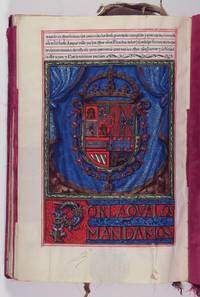
172155346Spain: Chancellary Court of Granada 1721. Original manuscript. Hardcover. Fine. Small folio 33 by 22 cm / 11-7/8 by 7-7/8 in. Illuminated manuscript on vellum. Main text in black ink masterfully penned in fine clear Gothic style ruled and bordered in red. 82 unnumbered leaves 4 blank comprising 6 full-page miniatures and 144 pages of text generally 32 lines per page. 36 richly illuminated bands with initials appear throughout the text with occasional ornate initials in black ink. The finely detailed miniatures are painted in rich colors and decorated with metallic gold and silver. The royal seal of Philip V of Spain is stamped in black ink at the bottom margin on the recto of all text leaves as well as the final three blanks; the initials of a royal notary appear at the bottom margin of each page of text. Bound in contemporary crimson velvet lightly rubbed with decorative brocade ribbon ties worn and frayed. All edges gilt; crimson silk guards bound-in to protect the miniatures and illuminated bands. Text in Spanish. Manuscript on vellum fine and clean throughout. Overall a very well-preserved bound document.<br /> <br /> Sumptuously illustrated 18th-century manuscript nobility patent carta ejecutoria de hidalguia commissioned by the De la Barra family of Castile to memorialize the recognition of its noble status in the reign of Philip V King of Spain. As depicted in the illustrated family tree and noted at the opening of the text the family traces their noble ancestry back through five generations to Don Bartholome de la Barra y Zuñiga. "During the late medieval era many individuals received the honor of hidalgo status the lowest rank of nobility but with the passage of time this noble status was not always locally recognized. If a person or family was willing to submit a documented family history to local officials of the Chamber of Hijosdalgo of the Chancellery Court of either Valladolid of Granada they could sue for formal recognition" Neary. While few succeeded in these suits those who did would often commission luxury copies of the paperwork bound with the royal seal.<br /> <br /> While customized for each family the text and images of these nobility patents follow a standardized template which must elaborate on three key themes: religious devotion; service to the crown; and purity of blood limpieza de sangre. The latter required that the family demonstrate the absence of Jewish Muslim or "heretical" ancestry. As is commonly the case the present example opens with an image of the Virgin Mary here receiving the devotion of four members of the De la Barra family depicted on their knees before a sumptuously appointed church altar. The facing image depicts the Father the Son and the Holy Spirit in the form of a dove looking down upon the infant Jesus. The other full-page miniatures depict the De la Barra family tree; their coat of arms King Philip V; and the royal coat of arms. The richly illuminated bands contain the names of De la Barra family members or introduce key sequences in the presentation and disposition of the suit. The final four pages of text comprise an official copy of the court's final decision. Penned in an ordinary scribal hand this concluding document was usually written on paper; in the present case the declaration appears on parchment at the special request of the family. The document is signed by Santiago Alcalde y Linares royal notary escribano and dated 3 July 1721.<br /> <br /> Provenance: The engraved bookplates of C. L. F. Robinson Newport Rhode Island and Mary MacMillin Norton appear on the opening blank leaf. Charles L. F. Robinson 1874-1916 described in the auction sale catalogue of his library as "a liberal and discriminating collector of rare books" who acquired many volumes from the Hoe and Huth collections was best known as a collector of rare Americana. A clipping from the auction catalogue lot 595 describing the present manuscript is laid in; a typescript of the description is tipped in at the inner margin along with another printed catalogue description possibly from another sale. Robinson served at one time as president of the Colt Patent Firearms Manufacturing Company of Hartford Connecticut. The Anderson Galleries Catalogue of Rare Books Comprising the Valuable Library of the Late Col. Charles L. F. Robinson of Hartford Conn. lot 595 p. 136; E. A. Neary "Spanish Golden Age Nobility Documents" in: Digital Collections for the Classroom. Online via Newberry Library April 13 2023. [Chancellary Court of Granada] hardcover