Renee VIVIENBiblio.com
184 résultats
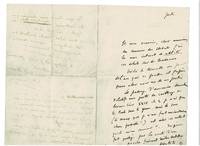
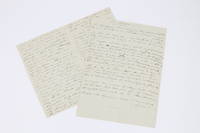
190078982s. l. Londres London 1900. Fine. s. l. Londres London Le 16 octobre 1900 11.30 x 17.50 cm 10 pages sur 2 doubles feuillets et 1 feuillet simple Very long autograph manuscript letter by Renée Vivien signed ""Ton fervent Paul"" written in black ink on two double sheets and one single sheet. Transverse creases inherent to the mailing envelope included. Moving letter recounting Renée Vivien's first encounters with suffering and death. Having returned to her family in London the Violet Muse watches over her dying cousin : ""Mon pauvre cousin va de plus en plus mal. Je crains horriblement que ce ne soit la fin. Il est la plupart du temps en proie à la fièvre et au délire. Ou bien il dort d'un mauvais sommeil de prostration et de faiblesse à la suite des piqûres de morphine. . Cela me fait mal de voir le pauvre squelette qui me sourit si faiblement ce visage est marqué déjà par la mort il y a la trace de sa serre qui ne relâche pas."" ""My poor cousin is getting worse and worse. I am horribly afraid this may be the end. He is most of the time prey to fever and delirium. Or else he sleeps a bad sleep of prostration and weakness following morphine injections. . It pains me to see the poor skeleton who smiles at me so weakly this face is already marked by death there is the trace of its grip that does not let go."" Pain is omnipresent in this letter-torrent: ""J'ai vu une chose horrible aujourd'hui à l'hôpital en allant voir mon cousin. On a apporté sur un brancard une chose épouvantable - un corps couvert d'un drap et une tête d'homme aux joues brûlées - et de cela sortait des gémissements et des hurlements et des râles. Il me semble que je ne pourrai jamais oublier l'affreuse chose inerte qui m'a frôlée de si près cette après-midi. Il paraît que c'était un ouvrier terriblement blessé par une explosion de gaz qui a eu lieu dans une fabrique à une heure cette après-midi. Ah ! la sinistre chose qu'on portait là-bas ! On entend parler d'accidents et de blessures et de mort et on n'y fait pas attention jusqu'à ce qu'on voie ce que c'est. L'horreur de tout cela m'obsède ce soir et s'ajoute à mon abattement et à ma mélancolie."" ""I saw a horrible thing today at the hospital while going to see my cousin. They brought on a stretcher a dreadful thing - a body covered with a sheet and a man's head with burned cheeks - and from this came moans and howls and death rattles. It seems to me I will never be able to forget the awful inert thing that brushed so close to me this afternoon. It appears it was a worker terribly injured by a gas explosion that occurred in a factory at one o'clock this afternoon. Ah! the sinister thing they were carrying there! One hears talk of accidents and injuries and death and pays no attention to it until one sees what it is. The horror of all this obsesses me tonight and adds to my dejection and my melancholy."" At this time Renée Vivien had not yet published anything and even devalued her verses in favor of those of the Amazon: ""Ce matin Chère la joie que m'a causée ta lettre et l'émotion profonde de ton beau sonnet - ce vers « Is there no touch beyond the touch of hands » et ces deux autres : « Is there no love that burns an unseen fire » « Beyond the finish of expressed desire » sont de toute splendeur poétique. . C'est toi qui portes au front la grande lumière c'est dans ton cur que chante la musique sublime parler de mes vers à moi Ils sont pauvres à faire pleurer."" ""This morning Dear the joy your letter caused me and the profound emotion of your beautiful sonnet - this verse 'Is there no touch beyond the touch of hands' and these two others: 'Is there no love that burns an unseen fire' 'Beyond the finish of expressed desire' are of all poetic splendor. . It is you who bears the great light on your brow it is in your heart that the sublime music sings speak of my verses me They are poor enough to make one weep."" Written in a period preceding the sentimental storms this ve unknown
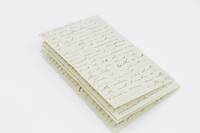
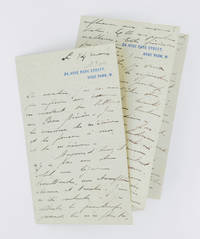
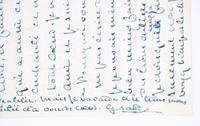
190079028s. l. Londres London 1900. Fine. s. l. Londres London Le 18 mars 1900 9.90 x 15.20 cm 14 pages sur 3 doubles feuillets et 1 feuillet simple Very long autograph letter handwritten by Renée Vivien signed Pauline written in black ink on three bifolia with letterhead from 24 Hyde Park Street and one single leaf. Horizontal folds inherent to mailing. A beautiful love letter sent from London while Renée was staying with her family: « Quand je pense qu'un télégramme va banalement et brutalement t'apprendre que je reste encore une semaine à Londres j'ai envie de pleurer. Et pourtant il ne faut pas que je pleure cela m'affaiblirait trop et j'ai besoin de toutes mes forces et de mon courage. » This painful separation is in the young womans eyes a necessary evil the promise of a radiant future: « Si je te fais ce chagrin mon amie c'est pour que nous soyons plus heureuses après. . Ne m'en veux pas de te faire attendre je souffre plus que toi ; et si je t'impose en me l'imposant moi-même cette souffrance du désappointement c'est afin de mériter mieux l'amour que tu m'accordes et le bonheur que tu me donnes par la douleur et par le sacrifice. Je serai ainsi plus digne de toi et tu m'aimeras mieux pour les larmes que j'ai offertes à notre amour. » Only a few months had passed since Renée and Natalie had begun seeing each other and one can already sense here the importance of this bond for the Muse of Violets and her insatiable need to be loved: « Tu me pardonnes dis Tu me souris toujours Je t'en prie envoie-moi ton pardon afin que je le sente comme une rosée sur mon front. Dis-moi de loin que tu m'aimes toujours et je t'entendrai à travers tout l'espace qui nous sépare. . Je t'aime à en mourir enfant chérie qui es le beau sourire blond de ma vie. Tout ce que je te dis et sic sincère. Crois-moi. Aime-moi. » Idealizing this relationship she launches into a magnificent litany: « Te faire souffrir toi qui m'as donné la joie rayonnante de mon existence ! Toi qui m'as fait aimer la vie ! - Toi qui m'as mis tant de beaux rêves dans l'âme tant de bonheur et tant de chaleur au cur ! - Toi qui es ma consolation mon espérance mon extase la merveille et le miracle de ma vie ! - Toi qui m'as donné l'amour qui me l'as révélé qui me l'as fait sentir et comprendre ! - Toi que j'aime ! » A superb letter-river imbued with the consuming passion of the Muse of Violets for her Amazon. At the end of 1899 through Violette Shillito Renée Vivienthen Pauline Tarnmet Natalie Clifford Barney cette Américaine plus souple qu'une écharpe dont l'étincelant visage brille de cheveux d'or de prunelles bleu de mer de dents implacables Colette Claudine à Paris. Natalie fresh from a summer romance with the scandalous Liane de Pougy who had introduced her to sapphism paid little heed to this new acquaintance. Renée on the other hand was utterly captivated by the young American and would recount this coup de foudre in her autobiographical novel Une Femme m'apparut: J'évoquai l'heure déjà lointaine où je la vis pour la première fois et le frisson qui me parcourut lorsque mes yeux rencontrèrent ses yeux d'acier mortel ses yeux aigus et bleus comme une lame. J'eus l'obscur prescience que cette femme m'intimait l'ordre du destin que son visage était le visage redouté de mon avenir. Je sentis près d'elle les vertiges lumineux qui montent de l'abîme et l'appel de l'eau très profonde. Le charme du péril émanait d'elle et m'attirait inexorablement. Je n'essayai point de la fuir car j'aurais échappé plus aisément à la mort. Winter 18991900. The beginnings of the idyll. One evening Vivien is invited by her new friend to the studio of Mme Barney Natalies mother 153 avenue Victor-Hugo at the corner of rue de Longchamp. Natalie dares to read aloud her own verses. When Vivien tells her she admires them she replies that it is better to love the poet. A response truly worthy of the Amazon. J.-P. Goujon Tes blessures sont plu unknown
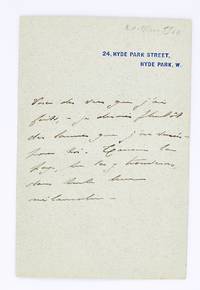
190079025s. l. Londres London 1900. Fine. s. l. Londres London Le 14 mars 1900 9.90 x 15.20 cm 8 pages sur 2 doubles feuillets Autograph letter signed ""Pauline"" by Renée Vivien written in black ink on two double sheets of letterhead paper from 24 Hyde Park Street. Transverse folds inherent to posting. A very beautiful and poetic letter written from London where the young Renée savors a sweet melancholy: ""Today there was no sun a light fog a dark and sad atmosphere. I was pleased by it I hate spring when you are no longer here and the sun and soft air hurt me. I love the sadness of the sky and the moon which goes well with my thoughts."" Despite a very busy schedule ""I am very tired this evening I return from the Alhambra where mama took me to see the military ballet and hear the patriotic songs. . I went skating in the afternoon in the morning I went to see one of my friends here who is very kind although having too much religion for my taste."" the young woman is bored in this city that she profoundly detests ""How can you be jealous you whom I adore of London which I hate I have been unhappy since I entered this city. It is dark it has a bad influence on my destiny. It brings me misfortune. It will end up killing me if I stay. I am afraid of it I want to leave to join you my darling my spring you who are the being of light and beauty my love my happiness and my consolation."" and finds comfort in the memory of her beloved of whom she thinks every moment: ""You are right to feel my thoughts around you I desperately throw my soul across space so that it finds you Your memory is in all my actions all my words it is you that I see through the things that surround me."" Natalie is everywhere even in her reading: ""I will read 'Séraphita' to find you a little in those pages of Balzac. Everything that reminds me of you everything that has some connection with you even distant is dear to me."" As Jean Chalon shows in his biography of Natalie Clifford Barney Portrait d'une séductrice Séraphita is a founding novel of the Amazon's thought and one of the first books she bought upon her arrival in Europe: ""Natalie had vainly sought this philosophical novel by Balzac in the bookstores of Washington. She would find this book in Europe and push refinement to the point of reading the angelic avatars of Séraphitus-Séraphita in that Norway which forms its setting."" From this underlined passage in her copy one notices that she retains more of its feminism than the concept of intersexuality: ""Would this not be using your rights as a man We must always please you relax you always be cheerful and have only the whims that amuse you. What must I do my friend Do you want me to sing to dance when fatigue takes away the use of my voice and legs Gentlemen even if we were dying we must still smile at you! You call this I believe reigning. Poor women! I pity them."" As evidenced by a letter addressed to her previous lover Liane de Pougy she had already introduced her to this Balzacian heroine: ""You will come to me I will go to you and we will marry our lives. That day you will read me Séraphîta. She will awaken our slumbering souls and you will lend to the sleeping words the beauty of your voice. It will be our litany of love."" It was at the end of 1899 and through Violette Shillito that Renée Vivien - then Pauline Tarn - made the acquaintance of Natalie Clifford Barney ""this American more supple than a scarf whose sparkling face shines with golden hair sea-blue pupils and implacable teeth"" Colette Claudine à Paris. Natalie who had just lived a summer idyll with the sulfurous Liane de Pougy who had initiated her into sapphism paid only discreet attention to this new acquaintance. Renée on the other hand was totally captivated by the young American and would relate this love at first sight in her autobiographical novel Une Femme m'apparut : ""I evoked the already distant hour when I saw her for the first time and t unknown
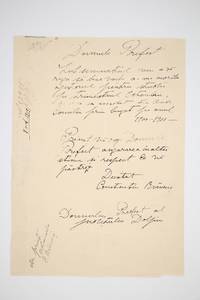
190076380Craïova Roumanie Craiova 1900. Fine. Craïova Roumanie Craiova 9 octobre 1900 14.70 x 22 cm deux feuillets rédigées au recto Two handwritten signed letters addressed to the Dolj County Prefect Craïova Romania 9 October 1900 14.7 x 22 cm & 27 x 19.5 cm two leaves written on the recto Two handwritten letters signed by Constantin Brâncui addressed to the Dolj County Prefect and written in brown and black ink one on a piece of lined paper 14.7 x 22cm and the other on larger size white paper 27 x 195 cm. The first letter is written in ink on a leaf and bears the registration number 12981 followed by the acronym pPG and is signed with the artist's full name: Constantin Brâncu. At the bottom left of the page there is a handwritten note by Brâncui: ""I received the prescription"" followed by his signature ""C. Brâncu"" and not ""Brâncusi"" or ""Brâncusi"" as he signed after his arrival in Paris. The second letter is written in ink on half a sheet of notebook paper and contains the same message the same signature and a similar inventory number. A 10 bani centimes stamp is glued to the top left. The left side below the stamp is cut out as Brâncui used to do: he removed the stamps or erased information that he did not want to keep. These two important letters document a significant chapter of the artist's biography concerning his studies financed in part by the Craiova Department.On 28 September 1898 Brâncui successfully completed his five-year schooling at the Craiova Trade School the capital of his native region and enrolled at the Bucharest School of Fine Arts. He obtained scholarships from the Madonna Dudu church in Craiova which helped him to continue his studies. He was quickly noticed by his teachers in Bucharest who awarded him prizes for making busts such as Laocoon and the antique sculpture Study based on Mars Borghese. In October 1900 Brâncui sent a request for a scholarship to the Prefect of the Dolj County the capital of which is Craiova who helped him to follow ""his studies during the October term"" and specified that this scholarship was granted to him by the County Council 1900-1901 budget. unknown
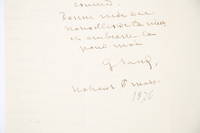
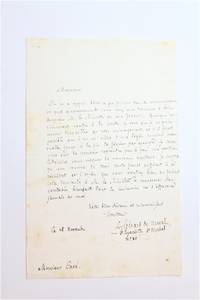
187676872Nohant Nohant-Vic 1876. Fine. Nohant Nohant-Vic 6 mars 1876 13.20 x 20.70 cm deux pages sur un feuillet remplié Autograph letter signed by George Sand addressed to Gustave Flaubert. Two pages written in black ink on a double sheet bearing at the head of the first page the sender's dry stamp. This letter was published in the complete correspondence of George Sand established by Georges Lubin. Fine letter written by George Sand a few months before her death and addressed to her lifelong friend Gustave Flaubert. The writer wishes to offer her friend a seat so he may attend the revival of her play Le Mariage de Victorine : ""Je t'écris en courant ce matin parce que je viens de recevoir de Mr Perrin avis de la 1ère représentation de la reprise du Mariage de Victorine une pièce de moi au théâtre français. Je n'ai ni le temps d'y aller ni l'envie de partir comme cela au pied levé mais j'aurais voulu y envoyer quelques amis et il ne m'offre pas une seule place. Je lui écris une lettre qu'il recevra demain et je le prie de t'envoyer au moins un orchestre."" ""I'm writing to you hurriedly this morning because I've just received notice from Mr Perrin of the first performance of the revival of Le Mariage de Victorine a play of mine at the Théâtre Français. I have neither the time to go nor the desire to leave like that at a moment's notice but I would have liked to send some friends and he doesn't offer me a single seat. I'm writing him a letter which he will receive tomorrow and I ask him to send you at least an orchestra seat."" Letters from the correspondence between George Sand and Gustave Flaubert are renowned and highly sought after. unknown
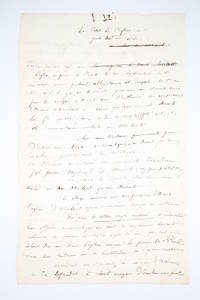
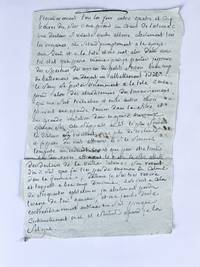
186076834s. l. 1860. Fine. s. l. s. d. ca 1860 19.60 x 31.70 cm deux pages sur un feuillet Autograph manuscript by Gustave Flaubert entitled ""De l'état de l'église en Gaule au Ve et VIe siècle"" written in black ink on both sides of a sheet. Transverse fold. Extensive manuscript notes probably written in preparation for the writing of La Légende de Saint Julien l'Hospitalier. Precious manuscript evidence of the writer's working method. unknown
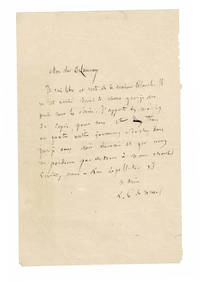
190078737s. l. 1900. Fine. s. l. 20 mars 1900 10 x 15.70 cm 2 pages sur un double feuillet Unpublished handwritten poem to Natalie Clifford Barney « à l'absente » 20 March 1900 10 x 157 cm 2 pages on a double leaf Handwritten poem entitled « à l'absente » To the absent one and addressed to Natalie Clifford Barney. Two pages written in black ink on a double leaf headed 24 Hyde Park Street. To our knowledge this three-verse octosyllabic poem is unpublished. It is preceded on the first section of this double leaf by a little handwritten message: These are the verses I have made I would rather say the tears which I have shed for you. Turn the page you will find them there in all their melancholy. Oui c'est toi mon rêve suprême Pendant ces longs ces mornes jours Où je pleure au fond de moi-même L'exil triste de mes amours! . N'as-tu pas entendu ma blonde Le bruit d'un sanglot qui revient Dans le cur de la nuit profonde C'est mon amour qui se souvient. It is at the end of 1899 and through Violette Shillito that Renée Vivien then Pauline Tarn met Natalie Clifford Barney ""this American woman softer than a scarf whose sparkling face shines with golden hair sea blue eyes never-ending teeth"" Colette Claudine à Paris. Natalie who had just experienced a summer romance with the scandalous Liane de Pougy who introduced her to sapphism paid little attention to this new acquaintance. Renée on the other hand was totally captivated by the young American woman and describes this love at first sight in her autobiographical novel Une femme m'apparut: ""I lived again the hour already well past when I saw her for the first time felt the shiver that ran through me when my eyes met the mortal steel of her look those eyes blue and piercing as a blade. I had a dim premonition that this woman would determine the pattern of my fate and that her face was the predestined face of my Future. Near her I felt the luminous dizziness which comes at the edge of an abyss or the attraction of a very deep water. She radiated the charm of danger which drew me to her inexorably."" ""Winter 1899-1900. Beginnings of the idyll. One evening Vivien is invited by her new friend to Mme Barney's studio Natalie's mother 153 avenue Victor-Hugo on the corner of the rue de Longchamp. Natalie finds the courage to read the verses of her composition. As Vivien tells her to love these verses she tells her that it is better to love the poet. A response worthy of the Amazon."" J.-P. Goujon Tes blessures sont plus douces que leurs caresses Two years of unequal happiness will follow punctuated by Natalie's recurring infidelities and Renée's sickly jealousy the letters of which oscillate between inflamed declarations and painful admissions of guilt. ""Renée Vivien is the daughter of Sappho and Baudelaire she is the 1900 flower of evil with fevers broken-up fights sad delights."" Jean Chalon Portrait d'une séductrice In 1901 a major break-up occurred which lasted almost two years; Renée despite requests from Natalie and the others she sent to win her back resisted. ""The two friends saw each other again and in August 1905 went on a pilgrimage to Lesbos which was a disappointment for Natalie Barney and was short-lived. . The spring was broken once and for all. The two former friends stopped seeing each other in 1907 and Vivien died without them seeing each other again."" J.-P. Goujon ibid. unknown
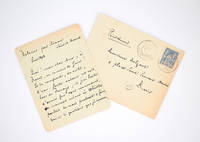
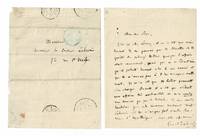
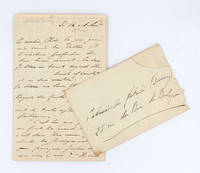
189875918Valvins 1898. Fine. Valvins 23 juin 1898 8.90 x 11.50 cm une carte recto verso - enveloppe jointe Autograph letter-card signed by Stéphane Mallarmé addressed to Alidor Delzant written in black ink on both sides. With the original envelope. Enclosed with this letter is a quatrain in Mallarmés hand: ""Tout en les éternisant / Bracquemond ici fait vivre / Les traits d'Alidor Delzant / A nous ouvert comme un livre."" Alidor Delzant was a lawyer collector and bibliophile. A friend of the Goncourt brothers he devoted a book to them and served as Edmonds secretary and testamentary executor. A delightful card in which the poëte ordinaire refers to the making of his portrait by his friend the painter Whistler: ""j'ai honte d'avoir fui dans ma verdure au moment même où Whistler parlait de mon portrait à faire"". ""On June 1st as he had promised Whistler who in his last letter with an affection verging on tenderness addressed him as mon Mallarmé he went to the painters studio on the rue Notre-Dame-des-Champs. You will see someone from the woods somewhere between the wild boar and the nightingale he had warned playfully in announcing his visit. Painter and poet ended the day dining on the rue du Bac where the all-too-ephemeral Trixie was now absent. In the half-light after dinner Whistler near a lamp seemed to resurrect in appearance the extraordinary Poe. Doubtless he then repeated to Mallarmé his intention of painting him. The next day without waiting for the Monet exhibition soon to be held at Georges Petit the Mallarmés went on to Valvins. Jean-Luc Steinmetz Stéphane Mallarmé This was most likely the execution of another portrait of Mallarmé of which no trace remains Whistler having already produced one that served as the frontispiece to Vers et Prose in 1893. He also alludes to Bracquemonds etched portrait of Delzant: ""Je comprends du reste l'eau-forte valant cet exil de Paraÿs . Redites mon affectueuse admiration toujours à Monsieur Bracquemond."" unknown
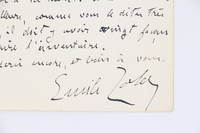
188279111Médan 1882. Fine. Médan 1er décembre 1882 13.60 x 21.40 cm 2 pages sur un double feuillet - enveloppe jointe Autograph letter signed by Emile Zola - apparently unpublished - written in black ink on a double sheet and addressed to Léon Carbonnaux department head at Bon Marché. Folds inherent to mailing. Envelope included. Only two letters from Léon Carbonnaux to Emile Zola are known: they can be consulted in the digitized preparatory file for Au bonheur des dames made available online by the Bibliothèque nationale de France. However we know from this same file which contains a long section entitled ""Notes Carbonnaux"" that this department head at Bon Marché provided Zola with a significant amount of information particularly about employee customs their remuneration and especially inventory techniques. The two men probably met when Emile Zola eager for information about the workings of department stores conducted field research in February and March 1882. Very important unpublished letter shedding new light on the pre-original publication of Au bonheur des dames. In his biography of Emile Zola Henri Mitterrand writes: ""Even before the novel was completed Zola gave an extract to Panurge in November; and on November 23 1882 Gil Blas announced its imminent publication in its columns."" Our letter discussing precisely this alleged pre-publication in Panurge attests that it was simply a joke and thus contradicts Henri Mitterrand: ""But your letter surprises and saddens me somewhat. How could you have been taken in by Panurge's stupid joke Did you not notice that the entire issue is a 'farce' Not one of the articles is authentic they are parodies and very poorly done ones at that."" Indeed reading the said extract cannot fool the assiduous reader of Zola despite the introduction that the journalists wrote: ""After Nana and Pot-Bouille those epics of elegant vice and bourgeois vice M. Emile Zola wanted to create one of honesty: Au bonheur des Dames which will appear shortly is a reassuring painting of innocence and virtue; the greatest success is assured for this new work whose characters move in the setting of a large novelty store; Parisian high commerce will not long await its observer and painter. We thank Emile Zola for having kindly cut out especially for Panurge a few pages from his still unpublished work and we are proud to give the public first an extract from this work of such high morality and such powerful interest."" Panurge no. 4 of October 22 1882 The sentences of this false Zolian text are exaggeratedly long and Panurge took the liberty of endowing the novel with a male main character Denis Mouret an amalgam of Denise the true heroine of the book to appear and Octave Mouret. One can think that it is a text composed from elements of Pot-Bouille the previous volume of Rougon Macquart where Octave - future owner of Bonheur des Dames - exercised the function of clerk before his meteoric social rise: ""For already more than two months he had been attached to the 'silks and furs' department; he arrived in the morning at seven o'clock to return home his day finished only at nine o'clock in the evening when all of Paris buzzed strangely with a feverish animation of pleasure and enjoyment and on his way back he followed gawking the great crowded boulevards where blazed the cafés full of girls and where on the asphalt at theater doors the crowd jostled with here and there in the vague rumor of trampling and pressing the roguish intonation of the cries of program vendors and ticket sellers."" Panurge In his letter of November 30 1882 Léon Carbonnaux - reading the extract from Panurge - had reproached Zola for his errors: ""Nowhere except at the Fabriques de France near Les Halles does one arrive at 7 a.m. It's at the earliest 7:30 but more often 8 a.m. and even then. There is no silk and fur counter at the Louvre. . It is so easy for you to be accurate that errors of this kind especially if t unknown
186075622s. l. Paris 1860. Fine. s. l. Paris s. d. 5 ou 12 janvier 1860 13.60 x 21 cm deux pages sur un feuillet remplié Autograph letter signed by Gustave Flaubert addressed to the archaeologist Charles-Ernest Beulé. Two pages written in black ink on a folded sheet. The recipient of this letter added nine handwritten lines a draft of his future response following Flaubert's letter. This letter has been transcribed and reproduced on the website of the Flaubert Centre at the University of Rouen. The transcriber of this missive notes: ""Are the lines written under the signature by Beulé or by Flaubert himself The handwriting resembles his. Stéphanie Dord-Crouslé suggests that Flaubert may have gone to see Beulé and written these elements under his dictation in response to the questions posed."" This hypothesis seems unlikely to us given that we know Charles-Ernest Beulé's response to this letter itself digitized by the Flaubert Centre and dated February 10 1860. This response does not seem to us to suggest a visit by Flaubert to Beulé. It seems more likely to us that Beulé inscribed under Flaubert's letter a draft of his future response of February 10 1860 which would only be an elegant reformulation of his notes. Handsome and important testimony to the colossal research that Flaubert undertook for the writing of Salammbô. ""Begun in 1857 the novel appeared in 1862 a period when Antiquity was coming back into fashion and when Carthage was 'au goût du jour' ""in vogue"" thanks to the recent excavations by Charles-Etienne Beulé at Byrsa 1859 and in the Punic ports."" Vanessa Padioleau ""Flaubert et Carthage : Salammbô roman polymorphe"" ""Flaubert and Carthage: Salammbô polymorphic novel"" in Revue Flaubert n° 9 2009 It is therefore to one of the specialists on the subject that Flaubert addresses his questions commenting on his recent reading of Ammianus Marcellinus: ""J'ai appris dans ce même Ammien que les Carthaginois ont pris Thèbes en Egypte . Qu'est-ce que cela veut dire Ce passage est je crois peu connu "" ""I learned in this same Ammianus that the Carthaginians took Thebes in Egypt . What does this mean This passage is I believe little known"" Flaubert's task is no small one: at the time nothing or almost nothing was known about the period of the Mercenary Revolt which extended over two years from 240 to 238 BC. He then begins painstaking work basing his research on the texts of the great historians of Antiquity which he reads in Latin in the original. The letter we offer shows his great mastery of it: ""J'ai appris dans ce même Ammien que les Carthaginois ont pris Thèbes en Egypte livre xvii ch. iv. 'Hanc inter exordia pandentis se late Carthaginis improviso excursu duces oppressere Poenorum'"" ""I learned in this same Ammianus that the Carthaginians took Thebes in Egypt book xvii ch. iv. 'At the time when Carthage was beginning its wide expansion the generals of the Phoenicians conquered it by a surprise attack'"". Despite this most thorough research the gate of Carthage would receive only a very brief description in the final version of Salammbô. unknown
187762711Paris 1877. Fine. Paris 9 mai 1877 13.50 x 20.50 cm 2 pages sur un feuillet remplié Autograph letter signed by Gustave Flaubert addressed to Léon Cladel. Envelope attached. Some underlinings and manuscript corrections by the author. Minor water stains. Three small restorations using adhesive on the second page as well as two fold marks inherent to the letter's folding for mailing. Amusing letter in which Gustave Flaubert whose literary renown is well established offers his support to his friend Léon Cladel who is struggling to have one of his works published. The ""master"" - this is how Léon Cladel addresses his colleague - begins this letter with enthusiasm: ""I started your book yesterday at 11 o'clock; it was finished this morning at 9!"" The ""book"" in question is L'Homme de la Croix-aux-Bufs which Flaubert had agreed to re-read for his friend on April 30; he had indeed requested the manuscript deposited with the publisher Georges Charpentier: ""Cladel wrote to me to say that he wished me to read pardon the subjunctive the novel in sheets which is with you. So send it to me or bring it to me."" Letter of May 3 1877. Léon Cladel very close to Gustave Flaubert seems to have shared with him the fears of the publisher Édouard Dentu regarding the publication of his work: ""And first of all Dentu must be mad to be afraid to publish it."" As a seasoned veteran of the ruthless world of publishing Flaubert positions himself as a professional and declares: ""Nothing in it is reprehensible either politically or morally. What he told you is a pretext"" This question of moral reprehension echoes the famous trial brought against the author of Madame Bovary. Like an enthusiastic literary critic Flaubert compliments his colleague: ""I find your book to be a real book. It is very well done very careful very masculine. & I know what I'm talking about my good man."" As a scrupulous reader he nevertheless allows himself a few remarks on Cladel's manuscript ""I have two or three small criticisms to make trivial matters - or rather advice to submit to you."" before reconsidering: ""Sometimes there are pretensions to archaism and naivety. It is an excess of good."" Flaubert's attitude here is almost paternal and in any case benevolent: aware of his friend's abilities he wishes to encourage him and see the publication of his work succeed: ""But once again be content & sleep soundly - or rather don't sleep - and often create similar works."" The benevolent writer also mentions in this letter another publisher Georges Charpentier: ""As for Charpentier to whom I will return your sheets on Friday - the day when I dine at his house I am going to give him a vigorous talking-to & in all conscience without exaggeration & without lies."" Charpentier who has been publishing Flaubert since 1874 has become a close friend of the writer with whom he maintains a rich correspondence. In this month of May 1877 he has just published Trois contes which was for Cladel the occasion for a moving celebration of his master in Letters: ""Where the devil did you get that gleaming brush with which you paint your canvases the small ones like the large ones and that sobriety that certain Latins would envy you To be at once Chateaubriand and Stendhal and moreover Flaubert."" This admiration is reciprocal and Flaubert feels for this ""true artist"" an unfeigned esteem: ""The ending is simply sublime! - & of the greatest effect."" He will reiterate a few weeks later his compliments: ""It is worked chiseled delved into. Observation in your case takes nothing away from poetry; on the contrary it brings it out."" Indeed Cladel will establish himself as the true heir to the Flaubertian style much more so than Zola who will precisely reproach him for ""working his prose relentlessly"" and ""striving to render perfect each sentence he writes."" It is finally Édouard Dentu who will publish the manuscript of L'Homme de la Croix-aux-Bufs; Cladel will moreover offer a copy enriche unknown
185976839Nohant Nohant-Vic 1859. Fine. Nohant Nohant-Vic 16 août 1859 13.50 x 20.90 cm 4 pages sur un double feuillet Autograph letter signed by George Sand addressed to Ernest Feydeau. Four pages written in blue ink on a double sheet bearing at the head of the first page the sender's blind stamp. This letter was published in the complete correspondence of George Sand established by Georges Lubin. Fine and lengthy letter discussing literature and friendship between writers. Initially a stockbroker and specialist in Antiquity Ernest Feydeau launched himself late into fiction. Anxious to occupy a literary space in which he did not feel justly appreciated he used his connections and maintained a regular epistolary relationship with illustrious correspondents such as Gustave Flaubert Sainte-Beuve and George Sand to whom he sent drafts of his novels and whose opinions he sought. This letter forms Sand's response after having just finished reading Daniel Feydeau's second novel. George Sand then at the height of her literary career describes herself thus: ""I am quite old enough to be your mother for I am 55 years old and I have good hands quite skillful but not beautiful at all. I have earned the right to no longer be coquettish I have been quite reproached for never having been so. I will tell you anything about myself that you wish."" As was her habit much solicited by her peers she delivers a very detailed critique of the text her colleague submits to her: ""I am not against sentences that jar where they need to jar but I am not for harmony being sacrificed to rhythm. Nor am I for the contrary. Understand me well I only blame what is too noticeable what reveals the technique. Do not touch the passages you speak of they are excellent. And in sum I will not insist furiously on the question of form in style seeing that if the qualities of yours should disappear with what sometimes seems to me a flaw I would be in despair at having pointed out the flaw."" Herself very close to Flaubert whom she nicknamed her ""leaden bottom"" Sand seems delighted that the two men know each other: ""I do not have time. But I will have time to receive you when you are free you must come with Flaubert who also has in me an enchanted reader and a wholehearted literary friend. I did not know he was your friend and I am pleased that he is."" The friendship goes so far that Sand soon brings the two writers together placing them on complete equal footing: ""It is no misfortune for you any more than for Flaubert to belong to the race of seers."" A form of solidarity then establishes itself in the face of critical adversity: ""All this is felt better than it can be said and that is why criticism loses its reason three-quarters of the time."" For criticism has had the misfortune of labeling Feydeau as it did with Flaubert a realist: ""People have taken it upon themselves to baptize your manner and his as realism. I do not know why; unless realism is something entirely different from what the first adherents attempted to explain to us. I suspect indeed that there is a way of envisaging the reality of things and beings which is great progress and you bring triumphant proof of it. But the name realism does not suit because art is a multiple infinite interpretation. It is the artist who creates reality within himself his own reality and not that of another. Two painters paint the portrait of the same person. Both create a work that represents the person if they are both masters. And yet the two paintings do not resemble each other. What has become of reality"" This long diatribe - a true manifesto - forms a powerful testimony to the repulsion of George Sand and Flaubert for theorists obsessed with the idea of classifying literature according to a ""system that . blinds"". unknown
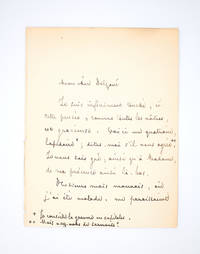
1892759251892. Fine. s. d. 15 avril 1892 12.60 x 16.40 cm 2 pages sur un double feuillet une carte et un calque Autograph letter signed by Stéphane Mallarmé to Alidor Delzant. Two pages written in black ink on a bifolium. Envelope enclosed. Also included is a signed autograph quatrain by Mallarmé on a card the one later inscribed on the mantelpiece: « Ici le feu pour renaître Tantôt durable ou charmant Comme l'amitié du maître Mêle du chêne au sarment. » Alidor Delzant was a lawyer collector and bibliophile. A friend of the Goncourt brothers he devoted a work to them and served as Edmonds secretary and executor. A fine letter in which Mallarmé evokes the composition of a quatrain to adorn Delzants mantelpiece: « Je suis infiniment touché et cette pensée comme toutes les vôtres est gracieuse. Voici un quatrain lapidaire je conseille la gravure en capitales; dites-moi s'il vous agrée. Mais usez-vous de sarments » Also included is the original tracing probably made by Mallarmé himself of the quatrain intended to decorate the lintel of Alidor Delzants library fireplace in his house at Paraÿs. Delzants reply to this letter is known: « Mon cher ami / Ces vers sont très beaux juste ce qui convenait pour glorifier la Cheminée de Paraÿs où les sarments pétillent autour des bûches des chênes. / Je demeure touché et reconnaissant. / Alidor Delzant. » unknown
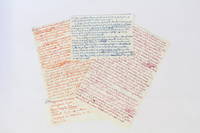
1840640991840. Fine. s. d. circa 1843 13.20 x 21.90 cm 4 feuillets Admirable set of four manuscript fragments of chapter XI of the Voyage d'Espagne which exposes behind the scenes of Gautier's writing which guided by the romantic taste for the picturesque relates his stays in Madrid and Ocaña and his passages by La Guardia and Tembleque . Gautier adopts an astonishing working format revealing the intimate / particular process of writing where flying sheets of different sizes very tight writing and corrections and inks of different colors come together. Originally intended for a publication in the press Gautier's article itself seduced by Spanish exoticism satisfies the search for picturesque then at its peak in France: "" The perpetual carousel of the fans that open close throb and flap like butterflies trying to land; the elbow movements of the women grouping themselves in their mantillas and correcting the inflection of an unsightly fold; the glances launched from one cross to the other to the people of knowledge; the pretty nod of the head and the graceful gesture which accompanies the agur by which the senhoras reply to the horsemen who salute them; the colorful crowd intertwined with Gallegos Pasiegas Valencians Manolas and water vendors "" Gautier establishes links between known references to Spain: Don Quixote and finds picaresque resonances in the adventures he saw: They were men Beyond the simple satisfaction of the public Gautier offers a glimpse of the Spanish character and bon vivant: sobriety and the patience of the Spaniards to endure fatigue is something that is prodigious. They remained Arabs on this point. One can not go further than the oblivion of material life. But these soldiers who lacked bread and shoes had a guitar. unknown
180185841Charenton 1801. Fine. ""I experience spasms a sort of shivering a lot of yawning disgust total despondency the blood rushes violently to my head then I feel dizzy spinning which makes me stumble and a thousand other things proving a great tension in the body and a great irritation in the nervous system."" Charenton 1801 15 x 22.80 cm un feuillet composé deux papiers encollés Original autograph letter by the Marquis de Sade consists of 27 lines of relatively tight handwriting. Most likely written to his wife as evidenced by the letter's origin from Sade's family. The letter is physically composed of two glued pieces of paper. On the verso the Marquis wrote 19 lines and scrupulously crossed them out - a few words and letters are still quite visible. Cited in Maurice Lever's biography 'Donatien Alphonse François marquis de Sade' Paris Fayard 1991 p. 631. On March 7 1801 Armand de Sade the Marquis's son received a letter from the Minister of Police Joseph Fouché notifying him that his father had been arrested yesterday and that handwritten pages from the novel 'La nouvelle Justine' Justine or the Misfortunes of Virtue had been found on his person: Nevertheless sensitive to your request for leniency and concerned to preserve the honor of your name I have decided to have your father transferred to the Charenton nursing home.. It should be noted that for Fouché Charenton an insane asylum was nothing more than a nursing home a prison. It should not be forgotten that a large proportion of the population of these asylums did not fit into the social and moral field and psychiatry has long had no other aim than to normalize to make them fit for social life. Contrary to what has been said Sade fits in perfectly. However as soon as he entered Charenton Sade's attitude led to his expulsion to Bicêtre the Bastille of scoundrels but his family succeeded in getting him back into the Charenton asylum. Charenton was not only the Marquis de Sade's last incarceration but also the last place he lived in where he died in 1814. The 19 lines scrupulously crossed out on the back of the leaf reveal a few words or letters; in this respect we can conjecture that it's a coded message which Sade was quite fond of for if censorship had been behind these erasures absolutely everything would have been yet the message clearly shows that almost everything has been conscientiously crossed out apart from a few words or letters. We can still make out a few of them: 'Nécessaire' 'à tous' 'ger' 'ue' 'quel' 'je trouve' 'de'. As for the letter itself it is remarkable for the homogeneity of its message. It is a lengthy complaint describing the physical ailments Sade has suffered. It is an account of the sum total of the symptoms that overwhelm the writer. In a hyperbolic style using among other figures of speech adverbs of intensity si tel très. Sade methodically spells out the violent pains his body is suffering with the whole of this violence constituting a system a structure in which all the parts are linked. In the writer's correspondence it can be said that each time he found himself incarcerated his letters mention uncontrollable physical attacks although we know of no other letter so uniform and systematic.The pain originates in the pit of the stomach radiating out to the periphery: head eyes legs all converging on vertigo loss of balance. .because that's what it's all about: Sade isn't suffering from any illness he's besieged by anguish whose ultimate meaning is vertigo the wavering of a reality from which his freedom to live as he pleases his freedom of movement and his name have been taken away. The loss of these fundamental elements of his existence sends Sade in turmoil. In addition and as regards the formation of these particular symtoms if we consider that the fulfillment of a certain sexual sadism is necessary to him the deprivation of this satisfaction turns this sadistic driv unknown
184172928Paris 1841. Fine. Paris s. d. avril 1841 13.50 x 21 cm une page sur un feuillet Autograph letter signed by Gérard de Nerval addressed to Hippolyte Delaunay written in black ink. Recipient's name in Nerval's hand on the verso of the leaf. A central fold inherent to the mailing. This letter has been transcribed in Nerval's Complete Works in the Pléiade edition. Gérard de Nerval is finally ""free and released from the Maison Blanche"" after staying there following his crisis of early spring 1841. This is not however a definitive release but probably permission granted by Doctor Blanche to his patient the latter would not be definitively released until November 1841. The handwriting difficult to read in places shows Gérard de Nerval's feverishness as he seeks to reconnect with the literary milieu: ""I bring masses of copy for you and three or four other journals."" Hippolyte Delaunay was editor-in-chief of the review L'Artiste in which Nerval published on April 11th of the same year an article entitled ""Mémoires d'un Parisien Sainte-Pélagie 1832"". unknown
184173272Paris 1841. Fine. Paris s. d. circa mars 1841 10 x 13.10 cm un feuillet et son enveloppe dépliée Very rare autograph letter signed ""Gérard Labrunie"" addressed to ""his dear papa"" Dr. Labrunie. 13 lines written in small handwriting in black ink on one page. Unfolded envelope attached showing several postal stamps restored on the back with an adhesive piece. A few transverse creases as well as some very discrete holes not touching the text and inherent to the use of a pin to seal the letter. Fine letter from Gérard Labrunie to his ""dear papa"" about a ""very complicated affair"" relating to the ""capacity as surrogate guardian"" of the writer's father. Very rare signature of Gérard de Nerval under his real patronymic name: Gérard Labrunie. unknown
188568398Dieppe 1885. Fine. Dieppe 1er septembre 1885 22.40 x 17.70 cm 4 pages sur un double feuillet Unpublished autograph letter signed Dieppe 1 September 1885 22.4 x 17.7 cm one folded sheet under custom slipcase Unpublished signed autograph letter from Edgar Degas to an unknown correspondent. 4 pages in black ink on one folded sheet. Central fold inherent to the way the letter was folded.his letter is presented in a chemise and case with paper boards decorated with abstract motifs the spine of the chemise in green morocco pastedowns and endpapers of green suede slipcase signed by Thomas Boichot. A handsome unpublished letter testimony to Degas' other great passion after dance: song.he Parisian premiere of Ernest Rayer's Wagnerian opera Sigurd took place on 12 June 1885 at the Opera de Paris. Degas overcome by the performance of the singer Rose Caron saw the piece thirty-seven times: «I still love Sigurd and I like it more and more. I have never seen Reyer except once in the street. And I made a point of telling him of the admiration it provoked in me far more immediately than in someone who being neither maid nor washerwoman was worthy of some consideration.» Degas paid homage to the beauty of Rose Caron in Sigurd by doing two drawings on fans today in private hands in the US.Properly obsessed by this «admirable work that did him so much good that he could not get over» the painter asked his famous neighbor to play him the score on the piano: «The young Jacques-Emile Blanche our neighbor plays it to me every day in place of your wife.»he letter closes with a lyrical description of Mont-Saint-Michel of which Degas had made several drawings: «Have you ever seen Mont-Saint-Michel Could we go and spend a few days there together sometime It's so pretty so charming. In one month I've been twice. The big tides at the end of September will take me back once more.» Degas' passion for opera is the subject of an exhibition for the 350th birthday of the Paris Opera open from 24 September 2019 to 19 January 2020 at the Musée d'Orsay. hardcover
190078743s. l. Londres London 1900. Fine. s. l. Londres London 24 mars 1900 10 x 15.70 cm 6 pages sur 2 doubles feuillets Handwritten signed letter addressed to Natalie Clifford Barney and enriched with a poem entitled « Le Miroir » London 24 March 1900 10 x 157 cm 6 pages on 2 double leaves Handwritten manuscript letter by Renée Vivien signed Pauline and written in black ink on a double leaf headed 24 Hyde Park Street. This letter contains a handwritten alexandrine poem entitled Le Miroir; never published on the initiative of the poet but it has been transcribed in Renée Vivien et ses masques in à l'encart April 1980: Je t'admire et ne suis que ton miroir fidèle Car je m'abîme en toi pour t'aimer un peu mieux; Je rêve ta beauté je me confonds en elle Et j'ai fait de mes yeux le miroir de tes yeux Je t'adore et mon cur est le profond miroir Où ton humeur d'avril se reflète sans cesse Tout entier il s'éclaire à tes moments d'espoir Et se meurt lentement à ta moindre tristesse Ô toujours la plus douce ô blonde entre les blondes Je t'adore et mon corps est l'amoureux miroir Où tu verras tes seins et tes hanches profondes Ces seins pâles qui sont si lumineux le soir! Penche-toi tu verras ton miroir tour à tour Pâlir ou te sourire avec tes mêmes lèvres Où trembleront encore les mêmes mots d'amour Tu le verras frémir des mêmes longues fièvres Contemple ton miroir de chair tendre et nacrée Car il s'est fait très pur afin de recevoir Le reflet immortel de la beauté sacrée Penche-toi longuement sur l'amoureux miroir! The rest of this long missive has however remained unpublished. A very beautiful letter sent from London by the Muse aux Violettes who misses her little one: Despite its slowness time passes you see and brings the hour that I await feverishly the time to meet again Natalie! Two more sad evenings and the third you will be there to rock me in your arms! . Today I was still disproportionately bored. I so need to see you again that I count the hours as they pass. I only think of you obsessed haunted taken possessed by you and by our memories. I am a poor unhappy thing far from you. Weary of society life We had the queen's dressing room how chic my darling! Lady Augustus Fitz Clarence invited us. She descends from a bastard of the King and is therefore an illegitimate relative of the sovereign! Renée lingers on the contemplation of a present from her darling: Your ring I love it so much it is a bond of our love that never leaves me. I so regretted your dagger that at the last moment I forgot to carry. Your ring you see is your memory on my finger I look at it and part of our tenderness is embodied in it. It is at the end of 1899 and through Violette Shillito that Renée Vivien then Pauline Tarn met Natalie Clifford Barney ""this American woman softer than a scarf whose sparkling face shines with golden hair sea blue eyes never-ending teeth"" Colette Claudine à Paris. Natalie who had just experienced a summer romance with the scandalous Liane de Pougy who introduced her to sapphism paid little attention to this new acquaintance. Renée on the other hand was totally captivated by the young American woman and describes this love at first sight in her autobiographical novel Une femme m'apparut: ""I lived again the hour already well past when I saw her for the first time felt the shiver that ran through me when my eyes met the mortal steel of her look those eyes blue and piercing as a blade. I had a dim premonition that this woman would determine the pattern of my fate and that her face was the predestined face of my Future. Near her I felt the luminous dizziness which comes at the edge of an abyss or the attraction of a very deep water. She radiated the charm of danger which drew me to her inexorably."" ""Winter 1899-1900. Beginnings of the idyll. One evening Vivien is invited by her new friend to Mme Barney's studio Natalie's mother 153 avenue Victor-Hugo on unknown
1861000615Chicago Illinois IL. Good. 1861. A wonderful archive of historically significant with detailed civil war content: 1 Two detailed Civil War diaries; 2 Ransom's first war letter home; 3 superb signed Ransom Civil War cartes des vistecdv; 4 Other photos: a tintype cdv gem photo and another hand colored cdv of his wife Louie Lucy Perham; 5 A book titled "Sacred Poems"; 6 Ransom's business card and property tag and lastly but of huge importance to genealogists; 7 Early name and address book of Dick Ransom mentioning many family members and Battery mates. Dick Ransom was from Chicago Illinois; enlisted on 8/7/1862 as a private. On 8/29/1862 he mustered into Chicago Mercantile Light Artillery. He was discharged for disability on 3/24/1863. Specifics: Diary #1 1861 2.5 x 3.5 inches full year January 1st through December 31st 1861 120 pages of which approx. 250 days with entries recorded dark brown period ink very legible. Great war content and a number of remarks made in great excitement; Lincoln as President; death of Col. Ellsworth and Steven Douglas. Battle excitement and the rout of the federal army at the first battle of Bull Run at Manassas. Diary #2 1862 : 3 x 5 inches entries from Aug. 7th 1862 through Mar. 6th 1863. 29 pages brown period ink very legible. Cover reads " Dick Ransom mercantile Battery Chicago Artillary 100 Washington Street Chicago". Signed in ink in Dick Ransom's hand on first page; "Dick Ransom 100 Washington Street Chicago Ill." Also included: 3 wonderful cdv/tintype of Lucy Ransom. Dick speaks of his proposal for marriage to Lucy in his 1861 diary. First is a tintype/cdv format of Lucy backmark Chicago dated Aug 19th 1866 and signed on reverse in Dick's handin brown ink "Louie Perham 1866 Dick Ransom". Secondly mounted Gem Albuman photo of Lucy on cdv mount ca. 1865. Cdv is handcolored image of Lucy dated Jan 23rd 1868. The address book includes all of Dick's friends and family and many of Mercantile Battery mates including Sinclair Willard Gunlock and Medal of Honor winner James Dunne. 3 x 5 inches many pages of entries mouse chew on cover edges. The date of 1883 can be found on the fep. Brown ink inscriptions this book is an important genealogy record and helps to identify all the people referred to in the diaries. Here are some snippets: " January 9th "my Birthday 19 years old born at South Woodstock Vermont""march 4th Abe Lincoln President of the United States"" Mar 19th " wrote a long letter to Lucy . with a proposal for marrige which I am sure will be accepted.I am in great anxiety for an answer". tintype of Lucy included "rec'd an answer alright = O.K."" April 25th -Intense excitement about . voluteers companies forming and drilling constantly all over the North"." May 2nd - douglas was received here by republicans and Democrates unanimously " May 3 - great war excitement for some time - volunteerism all over the country - great excitement". " May 5th - volunteers drilling in the streets "" May 8th - Lucy went for me to get a flag for the volunteers ."" May 9th - great war excitement companies guarding and driling". " May 24th - war message regarding the good and efficient commanders." " may 25th - Scott and President Lincoln col. Ellsworth the Zouave huro of Chicago killed in Alexandrea yesterday for tearing down a secsession flag. " June 3rd - Stephen A Douglas died at the tremont house this A.m. at 48. The city draped very very heavily mourning. col. Ellesworth funeral yeaterday at Bryan hall". " May 4th - Douglas laid in state at Bryan Hall all day." " May 5th - Douglas still in Bryan Hall ". " May 5th - Douglas still lies in state at Bryan hall is to be burried at Cottage Grove tomorrow ". "May 7th- Douglas funeral stores all shut up largest funeral ever in Chicago ". " June 10th - War excitement continues usual small battles and skirmishes but no large ones some expected soon". " June 20th - war and rumors of war some great battles expected soon in vicinity of Washington Sucession." " June 25th - Great riot in Milwakee yesterday - Dutch Mob attacks." " June 25 - all state banks in iowa Indiana and Eastern Missiouri counterfeits so plenty now". " June 30th - went out to Cottage Grove to see the camp" " July 8 - Telegraphs forbidden by the War department to transmit any war news of the intentions of the united states "." July 16 - the federal forces are beginning to move toward Richmond knowing where they will stop Gen. Scott don't tell everydody". " July 22 - At noon good news from the war high hopes night news the entire rout of the Federal army . and retreat back to Washington". referring to the first battle of Bull Run at Manassas " July 23 - News from war not encouraging - 600 killed ". " July 25- breacking accounts the battle and rout of the Union army though better than at first suspected ". " Sept. 25- think of joining T.E.G. Ransoms 11th regiment at Cairo had a letter from him wants me". referring to Gen. Ransom. " Oct 6th - another letter from T.E. G. Ransom still urges me. " " Aug 7th 1862 I enlisted in the Mercantile Battery of the Artillary of the U.S. for three years unless sooner discharges"" Aug 9th I was sworn in by capt. christopher U.S. mustering officer of Chicago". " Mr Sutter pastor presented each of the young men who had enlisted with a teatament". " Aug 11th - picked up duds to go to camp tomorrow- at 9 o'clock". "Aug 12th- at 9 o'clock at our headquarters at corner of Lake and State streets at the .Mercantile Association - marched to court house and examined by surgeon and then recieved our $ 60 ". " Aug 13th - arranged our camp as best we could not being organized . was on guard . skirmishing ." " Aug 14th -rec'd news that we were accepted by the government and were to have a full battery . powder smooth Bores . the Coffeemill . orders to fill up the company to 156 men. some photographs taken ". " Aug 25 - we elected our officers and then were visited by Adjutant General Fuller.Cooley Wilson Swan Bickford ". " Aug 29 - The Battery was mustered into service by lt. Knox ". "Sept. 1st- went to town to get more photographs". " Sept 23 - lient Wilson had a sword to be presented him ". " Oct. 3- went to camp and found that the Guns and all accoutrements and ammunition had come". . guns 2 .from riffle james cannon 2 to 8 ditto rebel guns -one made in Memphis and one in orleans which had been captured". " Oct 4th Seargents knights and Whitney Thomas and Throop drew cuts for the 4 bronze guns -knight & Thomas got the U.S. & Throop 7 Whit the rebels.". " Oct 5- had a great deal of company to look at the guns ." the Mercantile Association presented Crego with a sword . the accoutrements are being distributed and guns. today there was a sword Pistols presented to Capt. Cooley by the Mercantile Association." "Oct 15th " last evening the Asociation presented the Battery a splendid set of Colors. . to ft. Wayne.after the horses for the Battery ". " Oct 26th - we drill about 4 hours daily with our horses and guns on the prarie and five blank cartriges to break in the horses - we are almost ready mow for the field and fight". We are now likely to get our Captain Cooley to resign and have Morgan in his place. we have no guard around the camp now only on the horses guns ammunitionstores & officers tents and the boys go down town when they choose". " Dec. 25th - Vicksburg measels" "jan 2nd 1863. left Yazoo country- & Walnut Hills & c bluffs - Sherman's big retreat" . " Feb 14 - Arkansas Post- Sherman deserted - then back to Youngs Point". " Mar 6th Left Youngs Point for Hospital in Memphis on steame "City of Memphis". " April 1st 1863 - Mrs. Livermore brought me my discharge from the service- to Washington Hosptal Memphis.". " April 2 - left Memphis on Bostona -- homeward bound a free man". Remarkable archive.; Manuscript; 48mo - over 3" - 4" tall; KEYWORDS: HISTORY OF DICK RANSOM ALS CDV AMERICANA HANDWRITTEN MANUSCRIPT DOCUMENT LETTER AUTOGRAPH WRITER HAND WRITTEN DOCUMENTS SIGNED LETTERS MANUSCRIPTS HISTORICAL HOLOGRAPH WRITERS AUTOGRAPHS PERSONAL PERSONAL HISTORY MEMOIR MEMORIAL DIARY JOURNAL DIARIES JOURNALS LOG LOGS KEEPSAKE AMERICANA Civil War War Between the States VICKSBURG MANASSASS BULL RUN LINCOLN ILLINOIS MERCHANTILE ILLINOIS INFANTRY Zouave . unknown
184172914Paris 1841. Fine. Paris 18 novembre 1841 13.90 x 20.80 cm une page sur un feuillet remplié Autograph letter signed by Gérard de Nerval addressed to Auguste Cavé written in careful handwriting in black ink on the first page of a double sheet. Minor traces of folds inherent to posting and some light foxing. This letter was transcribed in Nerval's Complete Works in the Pléiade edition. After two violent nervous breakdowns Gérard de Nerval was compelled to stay at Dr. Blanche's clinic between March and November 1841. Short of money he addressed this letter to his friend Auguste Cavé then director of the Fine Arts section at the Ministry of the Interior to solicit his support with ""M. le Ministre"": ""Quoi qu'entièrement rendu à la santé je sens que je ne puis encore travailler qu'avec ménagement et s'il était possible que l'on m'aidât d'une légère somme mensuelle . je serais plus sûr de pouvoir reprendre peu à peu ma position littéraire sans risquer de nouveaux accidens"" ""Though entirely restored to health I feel that I can only work with care and if it were possible to be helped with a small monthly sum . I would be more certain of being able to gradually resume my literary position without risking new accidents"". unknown
1839803451839. Fine. s. d. ca 1839 13 x 8 cm une feuille Signed handwritten letter to Louis Desnoyers ca 1839 13 x 8 cm one leaf Handwritten letter signed by Honoré de Balzac addressed to Louis Desnoyers written on a white piece of paper in black ink. My dear Mr Desnoyers extraordinarily today I attend a diplomatic dinner of good-natured folk who want to laugh and drink and as I am in a stupor at work I have not had the courage to refuse this debauchery; I will therefore not be at home. Come early Sunday morning. / Yours / de Balzac. Louis Desnoyers plays an important role in the foundation of the Société des gens de lettres which aims to protect literary and artistic property and to create a solidarity fund. Balzac supported the creation of this Society of which Desnoyers was vice-president. Amusing letter testimony of Balzac's love of good food. unknown
1860640961860. Fine. s. d. circa 1860 20.60 x 27.60 cm un feuillet remplié DUMAS Alexandre Naïs et Chloé. Unpublished handwritten sapphic poem signed by Alexandre Dumas N. d. c. 1860 206 x 276 cm one folded leaf Autograph manuscript poem signed by Alexandre Dumas bearing the title Naïs et Chloé 84 verses in black ink on a blue folded leaf of paper. A few tiny tears without damage to the text invariably produced when a leaf of paper is folded. A very rare manuscript of a long unpublished poem depicting the love of Naïs and Chloé the writing of which is motivated by the admiration and tribute paid by Alexandre Dumas to one of the greatest figures of ancient poetry Sappho. A prolific novelist Dumas rarely tried his hand at poetry; Naïs et Chloé by its length constitutes a hapax in the literary production of this writer. The text remains unpublished to this day and is here enhanced by the elegant calligraphy of its author. The poem is made up of 21 quatrains among which stands a remarkable insertion of the most famous verse by Sappho to the beloved woman the title of which is preserved in the very body of the text. This embedding is part of the verve with which Dumas defends the poetic and evocative force of the writing of Sappho whom he elevates to the rank of the star of the world of Poetry: Il est au sein des mers s'appuyant à l'Asie Entre l'heureuse Smyrne et la sombre Lemnos Une île aux bois fleuris chers à la Poésie A qui Venus donna le doux nom de Lesbos. Quand du chantre divin la voix fut étouffée Que du nom d'Euridice elle eut frappé l'écho Le flot roula tête et la lyre d'Orphée Sur la rive où plus tard devait naître Sapho Sapho naquit la lyre en ses mains fut remise Les sons qu'elle en tira jusqu'à nous sont venus. Translated with conscientious care by the author the poem borrowed from Sappho in which that most famous verse emerges this one I say is equal to the gods is found in several places in Dumas' work particularly in the chapter entitled les vers saphiques of San Felice and in a collection of articles dedicated to the great female figures where she sits alongside Joan of Arc and Margaret of Anjou. For Dumas it is a matter of remaining faithful to the written verses and rendering their sensuality often blurred by previous translators: The translations of these two poets often appear to lack not only ancient color but are inadequate in their lesbian ardor Les étoiles du monde Galerie historique des femmes les plus célèbres de tous les temps et de tous les pays. Above and beyond this translation Dumas is imbued with the lyricism of Sappho without losing his own romantic vein and he paints the sapphic love of Naïs and Chloé in an erotic light: Oh seule palpitante échevelée et nue Une main sur ma gorge et l'autre. Oh ma Naïs Serre moi dans tes bras et sois la bien venue Car à force d'amour. tiens. tiens je te trahis Et l'on n'entendit plus alors dans la nuit sombre Que le bruit des baisers répétés par l'écho Car Nais et Cloé se taisaient et dans l'ombre Clinias s'enfuyait en maudissant Sapho. The poem testifies to the continuous interest that the authors of the late 19th century showed toward sapphism and to the personage of the reader-voyeur here embodied by Cleinias whose most famous occurrence remains Zola's Nana. Exceptional and long autograph sapphic poem by Alexandre Dumas. $ 10 000 unknown
184183639s. l. Passy Paris 1841. Fine. s. l. Passy Paris « mardi matin » 28 décembre 1841 13.50 x 21.60 cm une page sur un double feuillet enveloppe jointe Autograph letter signed by Honoré de Balzac to Jean-Baptiste Violet d'Epagny director of the Odéon theater. One page in black ink on a double sheet. Enclosed and pasted on the second page is the envelope of this letter written in Balzac's hand.""My dear director under the terms of our agreements I am ready to read I have chosen tomorrow Wednesday and I have told your stage manager the names of the actors to whom I entrust our play. I've done a bit of your job I've conquered Madame Dorval who will make you rich I'll bring her myself. Find here my dear d'Épagny a thousand regards I have given you proof of our old acquaintance by choosing you for Les Ressources de Quinola I shall expect a return in our relations and I am entitled to a great deal of zeal."" Les Ressources de Quinola is both in the spirit Les Fourberies de Scapin and Les Noces de Figaro. From the 1840s until his death Balzac's ambition was to achieve a reputation comparable to his illustrious predecessors Molière and Beaumarchais. Although this proved to be a hope as vain as it was determined Balzac never doubted failure after failure that his success was imminent. On July 15 1841 d'Épagny was appointed director of the Odéon . as any theater director would have done in his place he spent summer vacations organizing his winter programme. He asked Balzac for a play and Balzac complied choosing Les Ressources de Quinola. . We all know what a fuss was made about Balzac's play and how childishly naive the author was in filling the room with the highest Parisian society and foreign elite in order to make snobs want to join such a brilliant assembly. . Madame Dorval more astute than the author refused the role intended for her as soon as Balzac read . She did well for one never saw a more complete failure"" L'Amateur d'autographes mai 1911 Interesting letter revealing the beginnings of the creation of Les Ressources de Quinola and the author's habit of reading his play for the actors who then voted to accept or reject it. Provenance: Arthur Meyer collection then ""AGR"" stamp on letter and envelope. unknown
1865767951865. Fine. 30 mai 1865 13.70 x 21.10 cm une page sur un feuillet Autograph letter signed by Charles Baudelaire to Narcisse Ancelle written in black ink on a sheet of blue paper. Folds from mailing three minute pinholes not affecting the text. This letter was transcribed in the Complete Works volume 11 published in 1949 by L. Conard. A moving letter from Brussels addressed to the celebrated family notary who became in 1844 Charles's legal guardian charged with managing his annuity and his exponential debts. A complex relationship developed between the poet and his guardian mingling necessity and mistrust yet nonetheless bearing witness to genuine mutual respect between the two men. This correspondence devoid of the emotional quality of his letters to his mother or the circumlocutions in his exchanges with creditors constitutes one of the most precious biographical sources on the poet. Indeed Baudelaire's financial dependence constrained him to great transparency with his guardian and each of his letters to Ancelle admirably summarizes his wanderings. Thus this letter evokes the terrible mire in which the poet found himself in Belgium and his constantly postponed return to Paris. When he writes Baudelaire is still in Brussels at the Hôtel du Grand Miroir ""28 rue de la Montagne"" but one must not write the hotel's name otherwise letters do not reach him directly where he is dying of boredom illness and resentment toward a country in which he innocently believed he would find glory. This announcement of imminent departure for Paris ""Two or three days after your reply I will leave"" echoes all the similar promises the poet has made for nearly a year to his correspondents. This one will be aborted like all the others for as he confesses to Ancelle a few months earlier Paris fills him with ""a dog's fear."" It is only in August 1865 that he will make a final and brief stay in France before his fatal stroke. His return ""I am eagerly awaited in Paris and in Honfleur"" was nevertheless motivated by a compelling reason: to negotiate with a publisher through Manet's intervention the publication of his collection of reflections on his contemporaries which he had already titled My Heart Laid Bare Mon cur mis à nu and whose manuscript is partly at his mother's house in Honfleur. Another failurethe work would not appear until 1897 thirty years after Baudelaire's death. But it is undoubtedly the reference to the ""two large paintings he wishes to send to Honfleur"" that gives this letter all its significance. Baudelaire evokes his wish to repatriate paintings from his collection that he left with various lenders or restorers of which he had already sent a list to Ancelle a few months earlier. Among these which ones did he want to bring back to his mother His father's portrait the Boilly the Manet a Constantin Guys There is no mention in other letters of this art shipment and of the ""remainder"" to which the paintings were to be joined. This desire to ""send to Honfleur"" his precious belongings nonetheless testifies to the weakened poet's wish to settle permanently in his mother's ""jewel-house"" in Honfleur an island of serenity where Baudelaire dreamed of a peaceful retreat where all would once again be ""order and beauty luxury calm and voluptuousness."" He would indeed return there paralyzed and mute but for a final year of agony after his syphilitic crisis. The Hôtel du Grand Miroir would remain his last true dwelling as noted on Tuesday April 3 1866 in the register of admissions at the Saint-Jean Clinic: ""Name and first names: Baudelaire Charles. Address: France and 28 rue de la Montagne. Profession: man of letters. Illness: apoplexy."" A fine letter to the man who was both Baudelaire's persecutor and protector. He accompanied the poet until his death before becoming executor of the family estate. unknown