Renee VIVIENBiblio.com
509 résultats
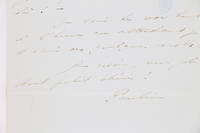
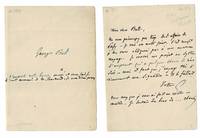
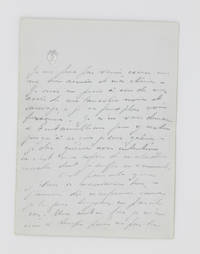
190079000s. l. Paris 1900. Fine. s. l. Paris s. d. 1er semestre 1900 12.30 x 16.70 cm 2 pages sur un double feuillet Handwritten signed letter addressed to Natalie Clifford Barney: I am in the grips of one of my bouts of black and wild melancholy - I can no longer see anyone. Paris 1st half-year 1900 12.3 x 16.7 cm 2 pages on a double leafHandwritten letter from Renée Vivien signed Paule and written in pencil on a double leaf with a silver-coloured heart with the poet's monogram at the top of the first sheet. Transverse fold from having been sent. Beautiful letter of apology after a dispute with the Amazone: Suis en proie à un de mes accès de mélancolie noire et sauvage je ne peux plus voir personne. Je m'en vais demain à Fontainebleau pour y rester jusqu'à ce que je sois guérie je dis : guérie avec intention car c'est une espèce de maladie morale dont je souffre en ce moment. C'est pour cela que j'étais si mauvaise hier j'aurais dû m'enfermer comme je le fais toujours en pareil cas. Une autre fois je m'en irai à temps pour ne pas te faire du mal si toutefois tu me permets de dire : une autre fois et si tu ne me renvoies pas à jamais de ta présence. Je n'ai qu'une excuse c'est que je souffre. Je n'ai pas été digne de l'amour que tu m'as si généreusement et si largement donné je n'ose plus te demander pardon je t'ai tant de fois offensée ! I am in the grips of one of my bouts of black and wild melancholy - I can no longer see anyone. Tomorrow I am going to go to Fontainebleau to stay there until I am healed - I say: healed with intent because it is a kind of moral illness from which I suffer at the moment. That's why I was so bad yesterday - I should have locked myself up as I always do in such a case. Another time I will go sooner so as not to cause you harm - if nevertheless you allow me to say: another time and if you do not dismiss me forever from your presence. I only have one excuse that is that I suffer. I have not been worthy of the love that you have so generously and so widely given me - I dare not ask you anymore for forgiveness - I have offended you so many times! unknown
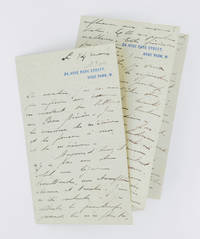
190078899s. l. Paris 1900. Fine. s. l. Paris s. d. ca. 1900 12.30 x 16.50 cm 1 page1/2 sur un double feuillet Autograph manuscript letter by Renée Vivien signed ""Pauline"" addressed to Natalie Clifford Barney and written in black ink on a double sheet with the poetess's silver monogram letterhead. A very charming letter evoking the flowers so dear to Renée ""Tout-Petit que j'aime je t'envoie des pensées toutes blanches. Garde-les dans ta chambre auprès de toi où sont mes vraies pensées tu le sais."" ""Little one I love I send you pansies all white. Keep them in your room near you where my true thoughts are you know."" as well as a gift from her ""tout petit chéri"" ""dear little one"": ""J'adore mes tablettes tu te rappelles les tablettes des deux petites joueuses de flûte - seulement elles les ont perdues et moi je ne veux pas perdre les miennes. J'ai écrit dessus en grec J'aime Natalie ! Cela m'a fait tant de plaisir ! - quelle bonne et jolie pensée tu as eue là ! -"" ""I adore my tablets do you remember the tablets of the two little flute players - only they lost them and I don't want to lose mine. I wrote on them in Greek I love Natalie! It gave me such pleasure! - what a good and lovely thought you had there! -"" Renée Vivien's Hellenist passion was born from her encounter with Eva Palmer during their stay in the United States where she accompanied Natalie Clifford Barney. This beautiful twenty-six-year-old redhead who it is said had translated all of Plato's Symposium with the Amazon gave Renée her first lessons in ancient Greek and awakened in her the passion for the poetess Sappho that never left her thereafter. It was at the end of 1899 and through Violette Shillito that Renée Vivien - then Pauline Tarn - made the acquaintance of Natalie Clifford Barney ""this American more supple than a scarf whose sparkling face shines with golden hair sea-blue eyes and implacable teeth"" Colette Claudine à Paris. Natalie who had just lived a summer idyll with the sulfurous Liane de Pougy who had initiated her into sapphism paid only discreet attention to this new acquaintance. Renée however was totally captivated by the young American and would relate this love at first sight in her autobiographical novel Une Femme m'apparut: ""I evoked the already distant hour when I saw her for the first time and the shiver that ran through me when my eyes met her eyes of mortal steel her sharp blue eyes like a blade. I had the obscure presentiment that this woman was giving me destiny's order that her face was the dreaded face of my future. I felt near her the luminous vertigo that rises from the abyss and the call of very deep water. The charm of peril emanated from her and attracted me inexorably. I did not try to flee her for I would have escaped death more easily."" ""Winter 1899-1900. Beginning of the idyll. One evening Vivien is invited by her new friend to Mme Barney's studio Natalie's mother 153 avenue Victor-Hugo at the corner of rue de Longchamp. Natalie ventures to read verses of her own composition. When Vivien tells her she loves these verses she replies that it is better to love the poet. A response quite worthy of the Amazon."" J.-P. Goujon Tes blessures sont plus douces que leurs caresses Two years of unequal happiness followed punctuated by Natalie's recurring infidelities and Renée's pathological jealousy whose letters oscillated between passionate declarations and painful mea culpa. ""Renée Vivien is the daughter of Sappho and Baudelaire she is the flower of evil 1900 with fevers broken flights sad voluptuousness."" Jean Chalon Portrait d'une séductrice In 1901 came an important rupture that would last almost two years; Renée despite Natalie's solicitations and the intermediaries she sends to win her back resists. ""The two friends saw each other again and it was in August 1905 the pilgrimage to Lesbos which constituted a disappointment for Natalie Barney and remained without consequence. . unknown
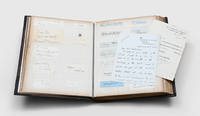
18831767411883-1916. Autograph hunting among British high society A fine assemblage of around 250 signatures of the luminaries of the Victorian and Edwardian age including a signed portrait of Ernest Shackleton the signatures of Prime Ministers Arthur Balfour and H. H. Asquith and the writers George Trevelyan John Morley and George Augustus Sala. Most of the signatures are clipped and mounted alongside their letterhead. The rest are tipped-in letters many of which are made out to Samuel Holliday 1846-1912 who worked as a superintendent for the North Eastern Railway for 48 years and consequently encountered many notable travellers - some are letters of thanks for his service. His obituary noted "he was one of the best known figures in railway circles at York and Newcastle and was held in the highest esteem by all who knew him either in his official or private capacity" North Mail Newcastle Daily Chronicle 20 August 1912. Other letters are addressed to different people and acquired elsewhere. Where dated the letters range from 1883 to 1916. Also included are loose signed photographic portraits of William Booth Liza Lehmann and Harry Lauder and a signed sketch of Harry Furniss. Provenance: Anon. Sale: Sotheby Parke Bernet & Co. London May 9 1983 Lot 356; sold to Steve Forbes chairman of Forbes Magazine and presidential candidate in the 1996 and 2000 US elections; his book label is loosely inserted. Contemporary half morocco album 283 x 229 mm brown cloth sides silk moiré endpapers cloth inner hinge supports. Together with five loose portraits of which four signed see note. Album rubbed some signatures loose contents a little toned. In very good condition. hardcover
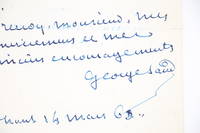
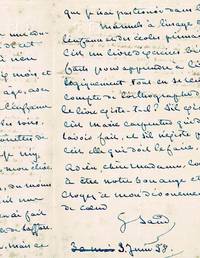
186376837Nohant Nohant-Vic 1863. Fine. Nohant Nohant-Vic 14 mars 1863 13.40 x 20.60 cm 3 pages sur un double feuillet Autograph letter signed by George Sand addressed to René Biémont. Three pages written in blue ink on a double sheet bearing at the head of the first page the blind stamp of Sand's initials. Envelope included. Folds inherent to mailing. This letter was published in the complete correspondence of George Sand established by Georges Lubin. Fine letter of congratulations addressed to René Biémont after sending his work Le Petit Fils d'Obermann: ""Your little book is very original and you show qualities of talent that will develop if you look ahead."" As an attentive reader much solicited by her young peers Sand develops her literary criticism: ""Obermann and his grandson the monk belong to the past. They are true and the timid Jean is well drawn. There is grandeur and truth in this exceptional type. But Constant d'Heurs is too passive to events. He should react against this powerless man and cure him or pity him more ."" Sententiously she thus concludes her letter: ""Do not complain of thankless work and accept it as a good thing three-quarters of life sacrificed to some duty makes the last quarter very strong and very alive. It is very good to be attached to poetry and thwarted in the possession of a beautiful dream. As soon as one can savor it without respite it fades or becomes troubled. I speak to you from experience. One is never happier and more inspired than when one believes one does not have time to be so."" Very fine testimony to the leading role that George Sand played on the literary scene of the Second Empire. unknown
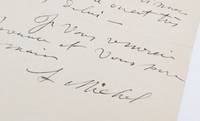
188683952s. l. Paris 1886. Fine. Letter to the Tiger: ""Before returning to the cage"" s. l. Paris 7 août 1886 13.20 x 19.20 cm 3 pages sur un bifeuillet Autograph signed letter from Louise Michel addressed to Georges Clemenceau; three pages written in black ink on a bifolium of white paper. Transverse creases inherent to posting. Fine letter from Louise Michel to Clemenceau one of her most important supporters before yet another incarceration: « Il faut avant de rentrer en cage . que je vous demande le grand service de faire entrer à l'hospice mon cousin le petit Dacheux à qui vous avez bien voulu faire avoir sa dispense d'âge. » ""Before returning to the cage . I must ask you the great favor of having my cousin little Dacheux admitted to the hospice for whom you were kind enough to obtain his age exemption."" The former communard has indeed just been sentenced to four months in prison for having given a speech in favor of the Decazeville miners alongside Jules Guesde Paul Lafargue and Étienne Susini. But for now it is the condition of her cousin Lucien Dacheux that concerns her: « Son genou étant de plus en plus malade on l'envoie en congé de deux mois mais il faut qu'il entre à l'hospice s'il ne veut pas rester estropié. De plus on n'a pu lui donner une mécanique pour son genou et en même temps le médecin lui disait que c'était indispensable - peut-être pourra-t-il en avoir une au Val de Grâce - je le recommande bien à vous et au citoyen Lafont - J'irai vous voir pour cela et une autre chose du même genre avant le 12 mais s'il était possible de faire entrer avant à l'hospice le petit Lucien Dacheux je serais bien heureuse car il sera tout à fait estropié et incapable de continuer son service où on est très content de lui. » ""His knee being increasingly ill they are sending him on two months' leave but he must be admitted to the hospice if he doesn't want to remain crippled. Moreover they couldn't give him a mechanism for his knee while at the same time the doctor told him it was indispensable - perhaps he could get one at Val de Grâce - I recommend him highly to you and to citizen Lafont - I will come to see you about this and another matter of the same kind before the 12th but if it were possible to have little Lucien Dacheux admitted to the hospice beforehand I would be very happy because he will be completely crippled and unable to continue his service where they are very pleased with him."" Louise Michel met Clemenceau in October 1870 when he was mayor of Montmartre and she was assistant schoolmistress. From their first meeting was born a strong friendship that lasted until Louise Michel's death. Clemenceau never ceased to support her particularly during her banishment to Nouméa and they maintained an extensive correspondence. A moving letter testimony to the unwavering devotion of the former communard and to the great friendship that united Louise Michel to Georges Clemenceau. unknown
190078919s. l. Paris 1900. Fine. s. l. Paris s. d. ca. 1900 12.30 x 16.50 cm 4 pages sur un double feuillet Autograph letter signed ""Pauline"" by Renée Vivien addressed to Natalie Clifford Barney and written in black ink on a double sheet with the poetess's silver monogram letterhead. Very beautiful and poetic love letter from the Muse of violets languishing for her ""dear white Lily"": ""Je n'ai pas pu te demander cet après-midi si je te verrais demain mon doux Avril mais tu as bien compris n'est-ce pas qu'il me serait aussi impossible de vivre un jour sans toi que de me priver des lumières du soleil ou des fleurs. . Avril mon doux petit Avril chaque fois que tu t'en vas tu emportes un peu de mon cur qui ne peut se détacher de toi et te suit tristement. Tu es pour moi la poésie la consolation et le rêve. Tu mets de la beauté dans ma vie et dans mon âme - quand je me réveille chaque jour et je pense à toi c'est la perpétuelle éclosion de quelque miraculeuse amour. Je vis dans un conte de fées un pays où tout est bleu et d'où la tristesse a disparu. Pense à moi ce soir avant d'aller rêver dans l'au-delà et le lointain du sommeil."" ""I could not ask you this afternoon if I would see you tomorrow my sweet April but you understood didn't you that it would be as impossible for me to live a day without you as to deprive myself of light sun or flowers. . April my sweet little April each time you leave you take with you a piece of my heart which cannot detach itself from you and follows you sadly. You are for me poetry consolation and dream. You bring beauty into my life and into my soul - when I wake each day and think of you it is the perpetual blossoming of some miraculous love. I live in a fairy tale a country where everything is blue and from which sadness has disappeared. Think of me tonight before going to dream in the beyond and the distance of sleep."" The letter then takes on a more sensual tone: ""J'aime tes cheveux blonds. Je leur envoie un long baiser. Les lys que j'ai dans ma chambre sont tristes parce que tu n'es plus là. Ils t'envoient leur âme dans un parfum. Ils t'aiment comme moi ; mais moins que moi."" ""I love your blonde hair. I send them a long kiss. The lilies I have in my room are sad because you are no longer there. They send you their soul in a fragrance. They love you like me; but less than me."" During their first night of love Renée had filled her room with lilies transforming it into a ""chapelle ardente"" N.Clifford Barney Je me souviens. Jean-Paul Goujon notes: ""The choice of lilies was very much in the taste of the period: let us remember Mucha's posters Schwabe's paintings Lorrain's poems. But Vivien who certainly remembered certain pages filled with flowers and perfumes from Zola's La Faute de l'abbé Mouret seems to have wanted to celebrate mystical nuptials coupled with a sort of perfumed death."" It was at the end of 1899 and through Violette Shillito that Renée Vivien - then Pauline Tarn - made the acquaintance of Natalie Clifford Barney ""cette Américaine plus souple qu'une écharpe dont l'étincelant visage brille de cheveux d'or de prunelles bleu de mer de dents implacables"" ""this American more supple than a scarf whose sparkling face shines with golden hair sea-blue eyes implacable teeth"" Colette Claudine à Paris. Natalie who had just lived through a summer idyll with the scandalous Liane de Pougy who initiated her into Sapphism paid only discreet attention to this new acquaintance. Renée however was totally captivated by the young American and would relate this coup de foudre in her autobiographical novel Une Femme m'apparut: ""J'évoquai l'heure déjà lointaine où je la vis pour la première fois et le frisson qui me parcourut lorsque mes yeux rencontrèrent ses yeux d'acier mortel ses yeux aigus et bleus comme une lame. J'eus l'obscur prescience que cette femme m'intimait l'ordre du destin que son visage était le visage redouté de mon avenir. Je sentis p unknown
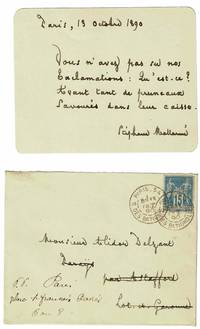
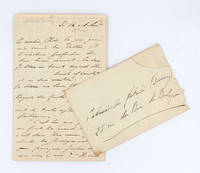
189076344Valvins 1890. Fine. Valvins 13 octobre 1890 11.40 x 8.80 cm une carte recto et une enveloppe Autograph quatrain signed by Stéphane Mallarmé addressed to Alidor Delzant written in black ink on the verso of a card. Envelope included. Alidor Delzant was a lawyer collector and bibliophile. Friend of the Goncourts he devoted a work to them and was Edmond's secretary and testamentary legatee. ""Vous n'avez pas su nos / Exclamations : Qu'est-ce / Avant tant de pruneaux / Savourés dans leur caisse"" ""You did not know our / Exclamations: What is this / Before so many prunes / Savored in their box"" Amusing stanza of thanks for the sending of prunes. unknown
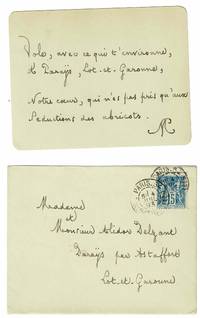
189376341Valvins 1893. Fine. Valvins 4 juillet 1893 11.40 x 8.80 cm une carte recto et une enveloppe Autograph quatrain signed by Stéphane Mallarmé addressed to Alidor Delzant written in black ink on the verso of a card. With envelope. Alidor Delzant was a lawyer collector and bibliophile. Friend of the Goncourts he devoted a work to them and was Edmond's secretary and testamentary legatee. ""Vole avec ce qui t'environne / A Paraÿs Lot-et-Garonne / Notre coeur qui n'es pas pris qu'aux / Séductions des abricots"" ""Fly with all that surrounds you / To Paraÿs Lot-et-Garonne / Our heart which is not taken only by / The seductions of apricots"" Amusing stanza of thanks for sending apricots. unknown
186735955Karlsbad (überwiegend), London u.a. bzw. ohne Ort, 1844-1867 bzw. o. J. Zus. ca. 168 S., 8° bis 4°.
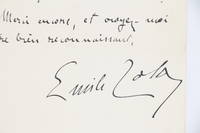
188279108Médan 1882. Fine. Médan 23 juin 1882 13.40 x 21.60 cm 1 page 1/2 sur un double feuillet - enveloppe jointe Autograph letter signed by Emile Zola - apparently unpublished - addressed to Léon Carbonnaux written in black ink on a double sheet. Folds inherent to mailing. Envelope included. Important testimony to the colossal documentation work and the capital role of Emile Zola's informants in depicting his immense natural and social fresco. This letter was sent to Léon Carbonnaux department head at Bon Marché who transmitted precious information to Emile Zola for the creation of the eleventh volume of the Rougon-Macquart series: Au Bonheur des Dames. Only two letters from Léon Carbonnaux to Emile Zola are known: they can be consulted in the digitization of the preparatory file for Bonheur des Dames made available online by the Bibliothèque nationale de France. However we know thanks to this same file which contains a long section entitled ""Notes Carbonnaux"" that this department head at Bon Marché provided a significant amount of information to Zola particularly about employee customs and their remuneration. The two men undoubtedly met when Emile Zola eager for information about the functioning of department stores conducted field research in February and March 1882. This response would therefore be the very first that the writer addressed to the department head in reply to his letter of June 19 1882. Far from imagining the keen success that this new novel would achieve Zola even seems to take it lightly: ""Je désire simplement toucher au sujet dans mon livre pour le besoin du petit drame commercial qui me sert de fable. Vos notes sont excellentes. . Enfin me voilà au travail. Le sujet est à la fois bien vaste - et bien ingrat pour un roman. On devra me tolérer un peu de fiction car il faut bien que je passionne la matière. Mais je tâche de m'en tenir le plus strictement possible à mes notes."" ""I simply wish to touch on the subject in my book for the needs of the little commercial drama that serves as my fable. Your notes are excellent. . Finally here I am at work. The subject is both very vast - and very thankless for a novel. One will have to tolerate a bit of fiction from me for I must make the material passionate. But I try to stick as strictly as possible to my notes."" It must be said that Carbonnaux takes his role as informant very much to heart and having no doubt about the book's success he writes: ""Dans le bâtiment chez nous d'ailleurs partout on attend votre livre. Les lecteurs ne vous manqueront pas. Soyez-en sûr. Vous n'en êtes plus à compter les succès celui-là s'annonce comme devant dépasser les autres."" letter of June 19 1882 For another work on the same subject has just appeared: ""J'ai lu le volume de Pierre Giffard. Il me paraît comme vous injuste et même faux dans plusieurs parties. C'est bâclé. Il aurait fallu pour un pareil ouvrage de documents purs une entière exactitude. Moi qui écris une uvre d'imagination je ne me permettrai pas de tels écarts."" ""I have read Pierre Giffard's volume. It seems to me like you unjust and even false in several parts. It is hastily done. For such a work of pure documents complete accuracy would have been necessary. I who write a work of imagination would not allow myself such deviations.""It was Carbonnaux who had pointed out the work to Zola: ""Pierre Giffard du Figaro vient de faire paraître chez Havard un vol de 300 pages intitulé « Les Grands bazars de Paris ». . On sait que le Figaro est inféodé au Louvre magasin concurrent au Bon Marché & on peut assurer que ce livre a été commandé et bâclé dès que votre intention de traiter le même sujet a été connue. . Il fallait déguiser un peu la réclame pour le Louvre."" letter of June 19 1882 We can clearly see here how much department stores fascinate and we understand the immense success that this novel by Zola describing their advent and supremacy would achieve. unknown
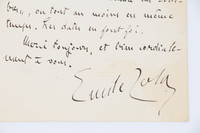
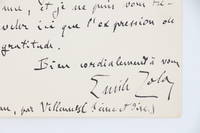
188879098Paris 1888. Fine. Paris 11 février 1888 13.20 x 20.50 cm 2 pages sur un double feuillet Autograph letter signed by Emile Zola addressed to Henry Fouquier written in black ink on a bifolium. Usual folds from mailing. This letter was transcribed in the complete correspondence of Emile Zola published by the CNRS and the Presses de l'Université de Montréal. A fine letter evoking La Terre and Tolstoy's The Power of Darkness. Henry Fouquier 1838-1900 was a literary critic and columnist for numerous newspapers. A close friend of Guy de Maupassant he supported Emile Zolas candidacy for the Académie française. This letter was written to him the day after the performance of Tolstoy's The Power of Darkness at the Théâtre-Libre. We have not found evidence of an article in which the journalist explicitly drew a parallel between the Russian drama and Zolas La Terre but Zola here addresses his thanks: « Merci mon cher Fouquier de ce que vous voulez bien dire de « la Terre » si attaquée. J'en suis touché vivement et croyez à toute ma gratitude. » It must be said that the fifteenth volume of the Rougon-Macquart cycle was harshly received unleashing passions from the moment of its serial publication in Gil Blas. On 18 August 1887 even before the conclusion of the novel was revealed to the public Le Figaro published the Manifeste des Cinq written by Paul Bonnetain J.-H. Rosny Lucien Descaves Paul Margueritte and Gustave Guiches. These young authors issued a severe verdict: « La Terre a paru. La déception a été profonde et douloureuse. Non seulement l'observation est superficielle les trucs démodés la narration commune et dépourvue de caractéristiques mais la note ordurière est exacerbée encore descendue à des saletés si basses que par instants on se croirait devant un recueil de scatologie : le Maître est descendu au fond de l'immondice. . Nous répudions ces bonshommes de rhétorique zoliste ces silhouettes énormes surhumaines et biscornues dénuées de complication jetées brutalement en masses lourdes dans des milieux aperçus au hasard des portières d'express. De cette dernière uvre du grand cerveau qui lança L'Assommoir sur le monde de cette Terre bâtarde nous nous éloignons résolument mais non sans tristesse. Il nous poigne de repousser l'homme que nous avons trop fervemment aimé. » Zola who had been developing the idea of a peasant novel for a decade was deeply affected. Though he never responded publicly to these accusations his correspondence is strewn with clarifications about the work whose sheer brutality alone seemed to occupy readers minds: « Mais vous ajoutez que notre thèse à Tolstoï et à moi est la même et peut se résumer en ceci : le travail de la terre est corrupteur. Tolstoï il me semble protesterait bien haut et quant à moi je vous affirme que je n'ai jamais voulu prouver une telle chose radicalement fausse à mon avis. Ce que je pense c'est que la petite propriété telle qu'elle existe chez nous c'est que la suite de faits sociaux qui ont abouti à notre forme sociale nous ont donné notre paysan d'aujourd'hui avec ses qualités et ses vices. Notre paysan est le prisonnier de sa terre et non l'homme libre qu'il devrait être. Comment voulez-vous qu'il n'y étouffe pas dans son ignorance et sa passion unique Labourer est très sain mais à la condition qu'on sera le maître de son champ au lieu d'en être le forçat. Je me suis exténué à faire sortir cette vérité de mon livre si l'on ne m'a pas compris la faute en est sans doute à moi. » A remarkable letter from the master of Naturalism shedding new light on one of the most brutal volumes of the Rougon-Macquart series. unknown
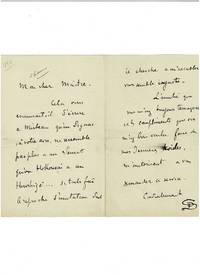
1894755111894. Fine. s. d. 23 janvier 1894 22.60 x 17.50 cm 2 pages sur un double feuillet déplié Autograph letter signed by Paul Signac addressed to Camille Pissarro written in black ink over two pages and signed with the artists monogram. This letter was transcribed in the article by Pierre Michel and Christian Limousin entitled ""Octave Mirbeau et Paul Signac - Une lettre inédite de Signac à Mirbeau"" in Cahiers Octave Mirbeau no. 16 March 2009 pp. 202-210. ""Mon cher Maître Cela vous ennuirait-il sic d'écrire à Mirbeau qu'un Signac à votre avis ne ressemble pas plus à un Seurat qu'un Hokousai à un Hiroshigé. si toutes fois sic le reproche d'imitation dont il cherche à m'accabler vous semble injuste. L'amitié que vous m'avez toujours témoignée et les compliments que vous avez bien voulu faire de mes toiles m'autorisent à vous demander ce service. Cordialement. PS"" A fine letter in which Paul Signac seeks the support of his master Camille Pissarro after a scathing critique published by Octave Mirbeau in L'Echo de Paris. In this article featured on the front page of L'Echo de Paris of 23 January 1894 Octave Mirbeau spares Signac no harshness: « M. Signac a voulu continuer Seurat. Je ne puis me faire à sa peinture. Je ne méconnais pas ses qualités mais elles disparaissent sous l'amoncellement de ses défauts. Ce qu'on admettait de Georges Seurat . on le comprend moins chez M. Signac qui n'en est que l'adepte trop complaisant et trop littéral. Et puis cette continuelle sécheresse me choque. M. Signac fait la nature immobile et figée. Jamais le vent n'a secoué la surface inerte de ses mers ni tordu les branches de ses pins ni animé l'éternelle fixité de ses nuages la raideur cartonnée de ses ciels. Il ignore le mouvement la vie l'âme qui est dans les choses. . Il serait peut-être temps pour notre joie que M. Signac voulût bien nous donner du Signac. Je crois qu'il le peut.» Why this obsession with Seurat « At the beginning of 1894 the position of Mirbeau Geffroy Pissarro and a few others was to consider that Neo-Impressionism had in fact died in 1891 with the passing of Seurat. Their retrospective view of this artistic venture led them to think that it was not a continuation of Impressionism by new scientific means but a reaction against it even a liquidation of the movement.» Cahiers Octave Mirbeau. Pissarros reply to Signac also transcribed by Michel and Limousin was not long in coming: it « l'ennuirait d'écrire ce que vous me demandez à Mirbeau et cela pour plusieurs raisons. . Premièrement parce que je suis en froid avec lui vous le savez bien. Deuxièmement parce que pour vous-même il ne sied pas de discuter l'opinion d'un critique même étant persuadé d'être dans le vrai et si vous voulez franchement ma façon de penser et que je suis heureux d'avoir l'occasion de vous exprimer je trouve que la méthode même est mauvaise. Au lieu de servir l'artiste l'ankylose et le glace. Si je vous ai fait des compliments cette année c'est parce que j'ai trouvé vos dernières toiles mieux que celles que vous aviez exposées aux Indépendants mais je suis loin de trouver que vous êtes dans la voie qui convient à votre tempérament essentiellement peintre et si jusqu'à présent je ne vous ai rien dit à ce sujet c'est parce que j'étais sûr de vous être désagréable et somme toute mes convictions peuvent ne pas être partagées par vous. Réfléchissez mûrement et voyez si le moment n'est pas venu de faire votre évolution vers un art plus de sensation plus libre et qui serait plus conforme à votre nature.» « Disheartened and deprived of the authority of a master revered by the critic Signac was left to devise himself without delay the reply to address to Mirbeau . » ibid. This response took the form of a long letter written the same day as the one offered here and now preserved at the Harry Ransom Center at the University of Austin Texas: « Je reconnais hautement que c'est Seurat qui a insta unknown
188878162Dizy Dizy-le-Gros 1888. Fine. Dizy Dizy-le-Gros samedi 15 septembre 1888 13.70 x 21.20 cm 20 pages sur 5 doubles feuillets & une enveloppe Very long autograph letter signed by Pierre Louÿs addressed to Georges Louis. Twenty pages written in blue ink on five double sheets of graph paper. Enclosed is an envelope on which is written in pencil in Pierre Louÿs's hand: ""Letter of 20 pages about my stay in Limé"" Amusing letter addressed to his brother Georges Louis with whom Pierre Louÿs maintained a very intimate relationship and whom he considered as his own father. The question of Pierre Louÿs's real father's identity still fascinates biographers today: ""His father Pierre Philippe Louis . had married in 1842 Jeanne Constance Blanchin who died ten years later after having given him two children Lucie and Georges. In 1855 he remarried Claire Céline Maldan and from this union was born in 1857 a son Paul; then in 1870 our writer who received the first names Pierre Félix. This late birth the differences in character between father and son the former's disaffection toward the latter the profound intimacy that always reigned between Louÿs and his brother Georges all this has led certain biographers and critics to suspect that the latter was in reality the writer's father. The exceptionally intimate and constant relationship that Pierre and Georges maintained between them throughout their lives could be an argument in this sense. Of course no irrefutable proof has been discovered and probably never will be. Nevertheless certain letters . are quite troubling. In 1895 for example Louÿs writes gravely to his brother that he knows the answer to 'the most poignant question' he could ask him a question he has had 'on his lips for ten years.' The following year at the height of Aphrodite's triumph he thanks Georges effusively and ends his letter with this sentence: 'Not one of my friends has a FATHER who is to him what you are to me.' Arguing from the close intimacy between Georges and Claire Céline during the year 1870 and from the jealousy that the father never ceased to show toward his younger son Claude Farrère did not hesitate to conclude in favor of Georges Louis. And what to think of this dedication by Louÿs to his brother on a deluxe copy of the first edition of Pausole: To Georges his eldest son / Pierre."" Jean-Paul Goujon Pierre Louÿs In this titillating letter bearing at the top the mention ""Papa doesn't know I'm writing you this letter"" underlined three times young Pierre Louÿs eighteen years old tells his elder about his vacation in Limé Aisne with the Glatron family. Visibly very excited he announces to his brother after some brief family news: ""And I have great news to announce to you which will decide the happiness of my life: I'm getting married. Don't look for a match for me anymore: I've found one."" In order to keep his reader in suspense he first tells him at length about his stay in Limé and paints a portrait of the Glatron family: ""Here first is the introduction to the little work I'm sending you by way of a letter and which may be very boring. It's the tableau of the Glatron family; it amused me to study them a bit while I was there. I wanted to find for each of them three or four words to paint them completely but I soon realized that I couldn't do so for any of them."" Far from being ""boring"" this very long passage allows Pierre Louÿs to deploy his talents as storyteller and caricaturist. Each member receives a colorful description ""the queen mother"" ""a nonentity"" ""a very special character"" ""petrified phlegm"" ""a repetitive Paulus"" ""the little invalid"". and Louÿs also gives pride of place to dialogues which he deliberately exaggerates: ""'I tell you that you took her by the waist! I saw you! Don't say no I saw you!'"" These humorous observations continue with the quasi-anthropological description of a village festival in Limé: ""I arrived in Limé the day before the patron saint's festival. unknown
188279109Médan 1882. Fine. Médan 16 novembre 1882 13.60 x 21.40 cm 2 pages sur un double feuillet - enveloppe jointe Autograph letter signed by Emile Zola - apparently unpublished - addressed to Léon Carbonnaux written in black ink on a double sheet. Folds inherent to mailing. Envelope included. Important testimony to the colossal documentation work and the capital role of Emile Zola's informants in depicting his immense natural and social fresco. This letter was sent to Léon Carbonnaux department head at Bon Marché who transmitted precious information to Emile Zola for the creation of the eleventh volume of the Rougon-Macquart series: Au Bonheur des Dames. Only two letters from Léon Carbonnaux to Emile Zola are known: they can be consulted in the digitization of the preparatory file for Bonheur des Dames made available online by the Bibliothèque nationale de France. However we know thanks to this same file which contains a long section entitled ""Notes Carbonnaux"" that this department head at Bon Marché provided a significant amount of information to Zola particularly about employee customs and their remuneration. The two men undoubtedly met when Emile Zola eager for information about the functioning of department stores conducted field research in February and March 1882. ""J'ai pris l'inventaire comme cadre à un de mes chapitres. D'ailleurs je n'ai spécialement besoin que du travail dans le rayon des confections et dans le rayon des soieries. Il est inutile de me renseigner sur les autres rayons."" ""I have taken the inventory as the framework for one of my chapters. Moreover I specifically only need the work in the ready-to-wear department and in the silk department. It is unnecessary to inform me about the other departments."" Thanks to this important letter we understand that it was Léon Carbonnaux who provided the essential information to Emile Zola for writing his very beautiful eleventh chapter devoted to the inventory: ""Vous avez eu l'obligeance de me donner certains détails sur l'inventaire. Vous m'avez dit qu'on choisissait le premier dimanche d'août qu'on fermait les portes et que tous les employés s'y mettaient. On vide toutes les cases n'est-ce pas on jette les marchandises sur les comptoirs ou à terre et l'inventaire n'est terminé que lorsqu'il n'y a plus absolument rien en place."" ""You were kind enough to give me certain details about the inventory. You told me that the first Sunday in August was chosen that the doors were closed and all the employees set to work. All the compartments are emptied aren't they The merchandise is thrown onto the counters or on the ground and the inventory is only finished when there is absolutely nothing left in place.""The final version of Bonheur des Dames contains all the precious information provided by the department head of Bon Marché: ""Le premier dimanche d'août on faisait l'inventaire qui devait être terminé le soir même. Dès le matin comme un jour de semaine tous les employés étaient à leur poste et la besogne avait commencé les portes closes dans les magasins vides de clientes. . Neuf heures sonnaient. . Dans le magasin inondé de soleil par les grandes baies ouvertes le personnel enfermé venait de commencer l'inventaire. On avait retiré les boutons des portes des gens s'arrêtaient sur le trottoir regardant par les glaces étonnés de cette fermeture lorsqu'on distinguait à l'intérieur une activité extraordinaire. C'était d'un bout à l'autre des galeries du haut en bas des étages un piétinement d'employés des bras en l'air des paquets volant par-dessus les têtes ; et cela au milieu d'une tempête de cris de chiffres lancés dont la confusion montait et se brisait en un tapage assourdissant. Chacun des trente-neuf rayons faisait sa besogne à part sans s'inquiéter des rayons voisins. D'ailleurs on attaquait à peine les casiers il n'y avait encore par terre que quelques pièces d'étoffe. La machine devait s'échauffer si l'on voulait finir le soir même. unknown
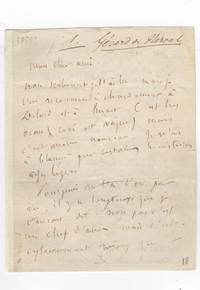
185273345Paris 1852. Fine. Paris s. d. fin 1852 10.20 x 13.20 cm quatre pages sur un feuillet remplié Autograph letter signed ""ton ami G."" addressed to the poet and playwright Armand Barthet. Nerval congratulates ""his dear friend"" on his drama Le Chemin de Corinthe: ""Non seulement je l'ai lu mais je l'ai recommandé chaudement à Delord et à Huard. C'est très beau ceci est vague mais c'est même nouveau"" ""Not only have I read it but I have warmly recommended it to Delord and to Huard. It is very beautiful this is vague but it is even new"". Folds inherent to posting. A strip of paper at the junction of the two pages and a restoration to the left inner margin. This letter has been transcribed in the correspondence published in the Pléiade edition volume 3 p. 796. The addressee has written directly following this letter a moving biographical notice concerning Gérard de Nerval: ""Nul ne savait où il demeurait - il rodait toute la nuit les poches de sa longue redingote gonflé sic de bouquins"" ""No one knew where he lived - he wandered all night the pockets of his long frock coat swollen with books"". unknown
185373273Paris 1853. Fine. Paris s. d. novembre 1853 10 x 13.60 cm un feuillet et son enveloppe dépliée Autograph letter signed ""votre G."" ""your G."" addressed to Georges Bell written in blue ink on the recto of a small sheet. Unfolded autograph envelope included containing a sentence that Nerval had not put in his letter. This letter has been transcribed in the Pléiade volume 1 letter 264. After several missed appointments and while he was at Dr. Blanche's clinic Nerval asks George Bell not to ""se préoccuper pas trop de l'affaire de Passy"" ""worry too much about the Passy affair"". Despite his confinement Nerval continues to conduct his business: ""Je conçois un projet ou système d'emprunt qui a quelques chances de réussite - mais il faut que j'engage très sérieusement ma signature."" ""I am conceiving a project or loan system that has some chances of success - but I must very seriously commit my signature."" He ends his letter with an enigmatic formula: ""Vous savez que je vous ai fait un conte ce matin. Je sortais des bras de.cherchez."" ""You know that I told you a tale this morning. I was coming from the arms of.guess."" unknown
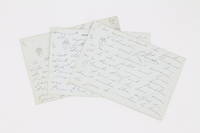
190078850s. l. 1900. Fine. s. l. Vendredi soir printemps 1900 12.50 x 8.40 cm 6 pages sur 3 cartes Handwritten letter addressed to Natalie Clifford Barney: Je t'écris ce mot dans le train tu t'en apercevras vite en observant l'irrégularité de mon écriture. I write this to you on the train you will quickly notice that by observing the irregularity of my handwriting. s.l Friday evening Spring 1900 12.5 x 8.4 cm 6 pages on 3 cards Handwritten letter from Renée Vivien written in pencil on three blue cards with the poet's monogram. This letter has been published in Renée Vivien et ses masques in A l'Encart n°2 April 1980 A very beautiful letter written on a train: Je t'écris ce mot dans le train tu t'en apercevras vite en observant l'irrégularité de mon écriture. I write this to you on the train you will quickly notice that by observing the irregularity of my handwriting. Renée had just left her cher petit amour dear little love for a short stay outside of Paris: Quelle folie de me séparer de toi même pour deux jours et comme je le regrette amèrement maintenant : - Seulement j'étais inquiète tu sais une fois rassurée j'aurai l'esprit tranquille désormais et je pensais goûter un bonheur absolu et parfait dans ton ombre tout près de toi. Comment ai-je pu être assez stupide et assez folle pour m'en aller ! Deux jours c'est si long ! C'est deux éternités de joie dont je me prive par ma bête faute ! - Vois-tu je t'aime à ne pouvoir vivre sans toi. Ne plus te voir est une souffrance accablante. Pense à moi Lys blanc - Lys blanc aime-moi car je suis triste ce soir. What madness to separate myself from you even for two days and as I bitterly regret it now: - Only I was worried you know once reassured I will have peace of mind from now on and I thought I would taste absolute and perfect happiness in your shadow very close to you. How could I be stupid enough and crazy enough to go away! Two days is so long! It is two eternities of joy that I deprive myself of by my own stupid fault! - You see I love you and cannot live without you. Not seeing you again is an overwhelming suffering. Think of me White Lilly - White Lilly love me because I am sad this evening. In this letter we encounter Vivien's obsession with flowers: J'ai reçu avant de partir l'adorable petit bouquet de violettes blanches que tu m'as si tendrement envoyé et le cher petit mot qui m'a touchée comme une plainte d'enfant triste. Before leaving I received the adorable little bouquet of white violets that you so tenderly sent and the dear little note that touched me like a sad child's complaint. It is at the end of 1899 and through Violette Shillito that Renée Vivien - then Pauline Tarn - met Natalie Clifford Barney cette Américaine plus souple qu'une écharpe dont l'étincelant visage brille de cheveux d'or de prunelles bleu de mer de dents implacables this American woman softer than a scarf whose sparkling face shines with golden hair sea blue eyes never-ending teeth Colette Claudine à Paris. Natalie who had just experienced a summer romance with the scandalous Liane de Pougy who introduced her to sapphism paid little attention to this new acquaintance. Renée on the other hand was totally captivated by the young American woman and describes this love at first sight in her autobiographical novel Une Femme m'apparut: J'évoquai l'heure déjà lointaine où je la vis pour la première fois et le frisson qui me parcourut lorsque mes yeux rencontrèrent ses yeux d'acier mortel ses yeux aigus et bleus comme une lame. J'eus l'obscur prescience que cette femme m'intimait l'ordre du destin que son visage était le visage redouté de mon avenir. Je sentis près d'elle les vertiges lumineux qui montent de l'abîme et l'appel de l'eau très profonde. Le charme du péril émanait d'elle et m'attirait inexorablement. Je n'essayai point de la fuir car j'aurais échappé plus aisément à la mort. I lived again the hour already well past when I saw unknown
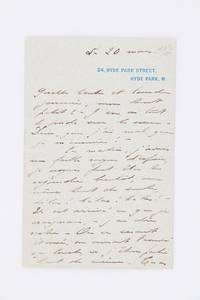
190079031s. l. Londres London 1900. Fine. s. l. Londres London Le 20 mars 1900 9.90 x 15.20 cm 4 pages sur un double feuillet Very long autograph manuscript letter from Renée Vivien signed ""Pauline"" written in black ink on a double sheet of headed paper from 24 Hyde Park Street. Transverse folds inherent to posting. Fine love letter sent from London while Renée was with her family: ""Quelle lente et lourde journée mon tout petit ! j'en ai tout le poids sur le cur Dieu que j'ai mal que je m'ennuie ! Ce matin j'avais un faible rayon d'espoir je croyais peut-être te rejoindre bientôt ou même tout de suite hélas ! hélas ! hélas ! Il est arrivé ce que je craignais j'ai dû rester On se serait étonné on aurait trouvé ça louche si j'étais partie tout de même."" ""What a slow and heavy day my little one! I have all its weight on my heart God how I hurt how I'm bored! This morning I had a faint ray of hope I thought perhaps to rejoin you soon or even right away alas! alas! alas! What I feared has happened I had to stay People would have been surprised they would have found it suspicious if I had left anyway."" This was only a few months since Renée and Natalie began seeing each other and we can read here the importance this relationship held for the Muse of violets who never ceased to flagellate herself: ""Ta pauvre lettre où chaque mot respire la mélancolie et la souffrance me brise le cur. Je souffre en la lisant tout ce que tu as souffert. Pardonne-moi Natalie ma bien-aimée ! Tes reproches sont si doux qu'ils me déchirent l'âme plus que toutes les récriminations amères qu'un autre être moins aimant m'aurait criées. J'ai eu tort cent fois tort mille fois tort de rester pourquoi donc ai-je obéi à un fantôme de Devoir à un spectre de Pitié qui je ne sais pourquoi m'obsède et vient m'ôter des heures divines que le Destin pitoyable m'accorde. La réalité c'est l'Amour il n'y a que lui rien n'est en dehors de lui et on souffre toujours de l'avoir sacrifié à quelque chose si sainte soit-elle."" ""Your poor letter where each word breathes melancholy and suffering breaks my heart. I suffer in reading it everything that you have suffered. Forgive me Natalie my beloved! Your reproaches are so sweet that they tear my soul more than all the bitter recriminations that another less loving being would have cried to me. I was wrong a hundred times wrong a thousand times wrong to stay why then did I obey a phantom of Duty a specter of Pity which I don't know why obsesses me and comes to take from me divine hours that pitiful Destiny grants me. Reality is Love there is only it nothing is outside of it and one always suffers from having sacrificed it to something however sacred it may be."" Very fine letter imbued with the devouring passion of the Muse of violets for her Amazon. It was at the end of 1899 and through the intermediary of Violette Shillito that Renée Vivien - then Pauline Tarn - made the acquaintance of Natalie Clifford Barney ""cette Américaine plus souple qu'une écharpe dont l'étincelant visage brille de cheveux d'or de prunelles bleu de mer de dents implacables"" ""this American more supple than a scarf whose sparkling face shines with golden hair sea-blue eyes implacable teeth"" Colette Claudine à Paris. Natalie who had just lived a summer idyll with the sulfurous Liane de Pougy who had initiated her to sapphism paid only discreet attention to this new acquaintance. Renée however was totally subjugated by the young American and would relate this love at first sight in her autobiographical novel Une Femme m'apparut: ""J'évoquai l'heure déjà lointaine où je la vis pour la première fois et le frisson qui me parcourut lorsque mes yeux rencontrèrent ses yeux d'acier mortel ses yeux aigus et bleus comme une lame. J'eus l'obscur prescience que cette femme m'intimait l'ordre du destin que son visage était le visage redouté de mon avenir. Je sentis près d'elle les vertig unknown
187741143Lyon u.a., 1857-1877. Zus. 72 S., 8°.
1889437356BB1889. 22,5x14 cm. (ordentlicher Zustand).
185876111Nohant Nohant-Vic 1858. Fine. Nohant Nohant-Vic 3 juin 1858 13.40 x 20.90 cm 4 pages sur un feuillet remplié Autograph letter signed by George Sand addressed to her friend Stéphanie Bourjot daughter of Étienne Geoffroy-Saint-Hilaire. Four pages written in blue ink on a folded bifolium bearing George Sands monogram. Fold marks as usual. This letter was partially published in Correspondance vol. XIV no. 7846. A beautiful and partly unpublished letter in which George Sand discusses Marie Pape-Carpantiers book and the education of her young maid Marie Caillaud: «It is an excellent book which I use to teach my young maid to read. She is extraordinarily intelligent and this book opens her mind to all sorts of sound ideas. Educating this 18-year-old childwho six months ago was only two in terms of knowledgehas been a unique experience. She now seems her age yet retains all the innocence of childhood. So every evening we read Marie Carpentiers little stories and I enjoy them just as much as my pupil does.» Marie Caillaud was only eleven years old when George Sand hired her to wash dishes and tend to the chicken coop a task that earned her the nickname Marie des poules. But the writer soon recognized the young peasant girls intelligence appointed her as housekeeper and by 1856 included her in the performances of the Nohant theatre. Her education is first mentioned in early 1858 notably in a letter from George Sand to her friend Charles Duvernet: «During my winter evenings I took on the education of little Marie the one who acted with us. From a dish washer I immediately raised her to the rank of housekeeper a role for which her excellent mind makes her perfectly suited. The greatest obstacle was that she couldn't read. That obstacle no longer exists. In thirty half-hour lessonsfifteen hours in a monthshe mastered all the difficulties of the language slowly but perfectly. This miracle is due to the admirable Laffore method which I applied with the utmost gentleness to a perfectly lucid mind.» 16 February 1858 Marie Caillaud would go on to become a notable actress at Nohant and move in the circles of George Sands illustrious guests: Delacroix Gautier Dumas Prince Jérôme Bonaparte But Marie was not George Sands first pupil. All her life Sand was deeply interested in pedagogy and taught not only her children and grandchildren but also members of her household staff and local peasants. This letter is a remarkable testament to her hands-on approach as a teacher always seeking new and effective ways to impart knowledge: «What is lackingor at least what I havent foundis a true reading method. Ive devised one for my own use never written down based on Laffores and adapted to my own ideas. But what I havent found in primers for children or public school manuals is a well-crafted exercise book that teaches reading logically while also making sense of spelling. Does such a book exist» Far from a casual activity education was central to George Sands worldview. As Georges Lubin noted her aim was not merely to teach literacy. Taught to write by her own mother at the age of five Sand understood from an early age that the only path to equality lay through intellectual emancipation: «She understood very early on that the only road to equality was intellectual emancipation. The ignorance imposed upon women was the root of their servitude. The ignorance imposed upon the working classes underpinned class inequality. Education was the key to opening locked doors.» «George Sand et l'éducation» in Nineteenth-Century French Studies 1976 A beautiful and important testimony to George Sands tireless struggle for the emancipation of women through education. unknown
187275733Nohant Nohant-Vic 1872. Fine. Nohant Nohant-Vic 19 semptembre 1872 13.20 x 20.60 cm 20 pages 1/2 sur 21 feuillets Autograph manuscript signed by George Sand written in black ink on 21 leaves of white paper. Deletions and corrections. One page of the manuscript appears to have been lost. The final version of this chronicle whose text conforms to the manuscript we offer was published in Impressions et souvenirs Paris M. Lévy 1873. George Sand would devote another article to her son's novel in Questions d'art et de littérature in 1878. The first edition of Maurice Sand's Coq aux cheveux d'or was published by Lacroix and Verboeckhoven in 1867. unknown
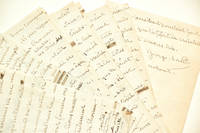
190078982s. l. Londres London 1900. Fine. s. l. Londres London Le 16 octobre 1900 11.30 x 17.50 cm 10 pages sur 2 doubles feuillets et 1 feuillet simple Very long autograph manuscript letter by Renée Vivien signed ""Ton fervent Paul"" written in black ink on two double sheets and one single sheet. Transverse creases inherent to the mailing envelope included. Moving letter recounting Renée Vivien's first encounters with suffering and death. Having returned to her family in London the Violet Muse watches over her dying cousin : ""Mon pauvre cousin va de plus en plus mal. Je crains horriblement que ce ne soit la fin. Il est la plupart du temps en proie à la fièvre et au délire. Ou bien il dort d'un mauvais sommeil de prostration et de faiblesse à la suite des piqûres de morphine. . Cela me fait mal de voir le pauvre squelette qui me sourit si faiblement ce visage est marqué déjà par la mort il y a la trace de sa serre qui ne relâche pas."" ""My poor cousin is getting worse and worse. I am horribly afraid this may be the end. He is most of the time prey to fever and delirium. Or else he sleeps a bad sleep of prostration and weakness following morphine injections. . It pains me to see the poor skeleton who smiles at me so weakly this face is already marked by death there is the trace of its grip that does not let go."" Pain is omnipresent in this letter-torrent: ""J'ai vu une chose horrible aujourd'hui à l'hôpital en allant voir mon cousin. On a apporté sur un brancard une chose épouvantable - un corps couvert d'un drap et une tête d'homme aux joues brûlées - et de cela sortait des gémissements et des hurlements et des râles. Il me semble que je ne pourrai jamais oublier l'affreuse chose inerte qui m'a frôlée de si près cette après-midi. Il paraît que c'était un ouvrier terriblement blessé par une explosion de gaz qui a eu lieu dans une fabrique à une heure cette après-midi. Ah ! la sinistre chose qu'on portait là-bas ! On entend parler d'accidents et de blessures et de mort et on n'y fait pas attention jusqu'à ce qu'on voie ce que c'est. L'horreur de tout cela m'obsède ce soir et s'ajoute à mon abattement et à ma mélancolie."" ""I saw a horrible thing today at the hospital while going to see my cousin. They brought on a stretcher a dreadful thing - a body covered with a sheet and a man's head with burned cheeks - and from this came moans and howls and death rattles. It seems to me I will never be able to forget the awful inert thing that brushed so close to me this afternoon. It appears it was a worker terribly injured by a gas explosion that occurred in a factory at one o'clock this afternoon. Ah! the sinister thing they were carrying there! One hears talk of accidents and injuries and death and pays no attention to it until one sees what it is. The horror of all this obsesses me tonight and adds to my dejection and my melancholy."" At this time Renée Vivien had not yet published anything and even devalued her verses in favor of those of the Amazon: ""Ce matin Chère la joie que m'a causée ta lettre et l'émotion profonde de ton beau sonnet - ce vers « Is there no touch beyond the touch of hands » et ces deux autres : « Is there no love that burns an unseen fire » « Beyond the finish of expressed desire » sont de toute splendeur poétique. . C'est toi qui portes au front la grande lumière c'est dans ton cur que chante la musique sublime parler de mes vers à moi Ils sont pauvres à faire pleurer."" ""This morning Dear the joy your letter caused me and the profound emotion of your beautiful sonnet - this verse 'Is there no touch beyond the touch of hands' and these two others: 'Is there no love that burns an unseen fire' 'Beyond the finish of expressed desire' are of all poetic splendor. . It is you who bears the great light on your brow it is in your heart that the sublime music sings speak of my verses me They are poor enough to make one weep."" Written in a period preceding the sentimental storms this ve unknown
190079028s. l. Londres London 1900. Fine. s. l. Londres London Le 18 mars 1900 9.90 x 15.20 cm 14 pages sur 3 doubles feuillets et 1 feuillet simple Very long autograph letter handwritten by Renée Vivien signed Pauline written in black ink on three bifolia with letterhead from 24 Hyde Park Street and one single leaf. Horizontal folds inherent to mailing. A beautiful love letter sent from London while Renée was staying with her family: « Quand je pense qu'un télégramme va banalement et brutalement t'apprendre que je reste encore une semaine à Londres j'ai envie de pleurer. Et pourtant il ne faut pas que je pleure cela m'affaiblirait trop et j'ai besoin de toutes mes forces et de mon courage. » This painful separation is in the young womans eyes a necessary evil the promise of a radiant future: « Si je te fais ce chagrin mon amie c'est pour que nous soyons plus heureuses après. . Ne m'en veux pas de te faire attendre je souffre plus que toi ; et si je t'impose en me l'imposant moi-même cette souffrance du désappointement c'est afin de mériter mieux l'amour que tu m'accordes et le bonheur que tu me donnes par la douleur et par le sacrifice. Je serai ainsi plus digne de toi et tu m'aimeras mieux pour les larmes que j'ai offertes à notre amour. » Only a few months had passed since Renée and Natalie had begun seeing each other and one can already sense here the importance of this bond for the Muse of Violets and her insatiable need to be loved: « Tu me pardonnes dis Tu me souris toujours Je t'en prie envoie-moi ton pardon afin que je le sente comme une rosée sur mon front. Dis-moi de loin que tu m'aimes toujours et je t'entendrai à travers tout l'espace qui nous sépare. . Je t'aime à en mourir enfant chérie qui es le beau sourire blond de ma vie. Tout ce que je te dis et sic sincère. Crois-moi. Aime-moi. » Idealizing this relationship she launches into a magnificent litany: « Te faire souffrir toi qui m'as donné la joie rayonnante de mon existence ! Toi qui m'as fait aimer la vie ! - Toi qui m'as mis tant de beaux rêves dans l'âme tant de bonheur et tant de chaleur au cur ! - Toi qui es ma consolation mon espérance mon extase la merveille et le miracle de ma vie ! - Toi qui m'as donné l'amour qui me l'as révélé qui me l'as fait sentir et comprendre ! - Toi que j'aime ! » A superb letter-river imbued with the consuming passion of the Muse of Violets for her Amazon. At the end of 1899 through Violette Shillito Renée Vivienthen Pauline Tarnmet Natalie Clifford Barney cette Américaine plus souple qu'une écharpe dont l'étincelant visage brille de cheveux d'or de prunelles bleu de mer de dents implacables Colette Claudine à Paris. Natalie fresh from a summer romance with the scandalous Liane de Pougy who had introduced her to sapphism paid little heed to this new acquaintance. Renée on the other hand was utterly captivated by the young American and would recount this coup de foudre in her autobiographical novel Une Femme m'apparut: J'évoquai l'heure déjà lointaine où je la vis pour la première fois et le frisson qui me parcourut lorsque mes yeux rencontrèrent ses yeux d'acier mortel ses yeux aigus et bleus comme une lame. J'eus l'obscur prescience que cette femme m'intimait l'ordre du destin que son visage était le visage redouté de mon avenir. Je sentis près d'elle les vertiges lumineux qui montent de l'abîme et l'appel de l'eau très profonde. Le charme du péril émanait d'elle et m'attirait inexorablement. Je n'essayai point de la fuir car j'aurais échappé plus aisément à la mort. Winter 18991900. The beginnings of the idyll. One evening Vivien is invited by her new friend to the studio of Mme Barney Natalies mother 153 avenue Victor-Hugo at the corner of rue de Longchamp. Natalie dares to read aloud her own verses. When Vivien tells her she admires them she replies that it is better to love the poet. A response truly worthy of the Amazon. J.-P. Goujon Tes blessures sont plu unknown
190079025s. l. Londres London 1900. Fine. s. l. Londres London Le 14 mars 1900 9.90 x 15.20 cm 8 pages sur 2 doubles feuillets Autograph letter signed ""Pauline"" by Renée Vivien written in black ink on two double sheets of letterhead paper from 24 Hyde Park Street. Transverse folds inherent to posting. A very beautiful and poetic letter written from London where the young Renée savors a sweet melancholy: ""Today there was no sun a light fog a dark and sad atmosphere. I was pleased by it I hate spring when you are no longer here and the sun and soft air hurt me. I love the sadness of the sky and the moon which goes well with my thoughts."" Despite a very busy schedule ""I am very tired this evening I return from the Alhambra where mama took me to see the military ballet and hear the patriotic songs. . I went skating in the afternoon in the morning I went to see one of my friends here who is very kind although having too much religion for my taste."" the young woman is bored in this city that she profoundly detests ""How can you be jealous you whom I adore of London which I hate I have been unhappy since I entered this city. It is dark it has a bad influence on my destiny. It brings me misfortune. It will end up killing me if I stay. I am afraid of it I want to leave to join you my darling my spring you who are the being of light and beauty my love my happiness and my consolation."" and finds comfort in the memory of her beloved of whom she thinks every moment: ""You are right to feel my thoughts around you I desperately throw my soul across space so that it finds you Your memory is in all my actions all my words it is you that I see through the things that surround me."" Natalie is everywhere even in her reading: ""I will read 'Séraphita' to find you a little in those pages of Balzac. Everything that reminds me of you everything that has some connection with you even distant is dear to me."" As Jean Chalon shows in his biography of Natalie Clifford Barney Portrait d'une séductrice Séraphita is a founding novel of the Amazon's thought and one of the first books she bought upon her arrival in Europe: ""Natalie had vainly sought this philosophical novel by Balzac in the bookstores of Washington. She would find this book in Europe and push refinement to the point of reading the angelic avatars of Séraphitus-Séraphita in that Norway which forms its setting."" From this underlined passage in her copy one notices that she retains more of its feminism than the concept of intersexuality: ""Would this not be using your rights as a man We must always please you relax you always be cheerful and have only the whims that amuse you. What must I do my friend Do you want me to sing to dance when fatigue takes away the use of my voice and legs Gentlemen even if we were dying we must still smile at you! You call this I believe reigning. Poor women! I pity them."" As evidenced by a letter addressed to her previous lover Liane de Pougy she had already introduced her to this Balzacian heroine: ""You will come to me I will go to you and we will marry our lives. That day you will read me Séraphîta. She will awaken our slumbering souls and you will lend to the sleeping words the beauty of your voice. It will be our litany of love."" It was at the end of 1899 and through Violette Shillito that Renée Vivien - then Pauline Tarn - made the acquaintance of Natalie Clifford Barney ""this American more supple than a scarf whose sparkling face shines with golden hair sea-blue pupils and implacable teeth"" Colette Claudine à Paris. Natalie who had just lived a summer idyll with the sulfurous Liane de Pougy who had initiated her into sapphism paid only discreet attention to this new acquaintance. Renée on the other hand was totally captivated by the young American and would relate this love at first sight in her autobiographical novel Une Femme m'apparut : ""I evoked the already distant hour when I saw her for the first time and t unknown