Andre MALRAUXBiblio.com
1 050 résultats
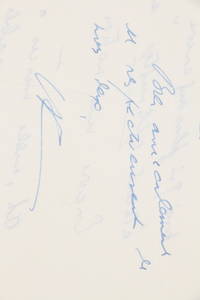
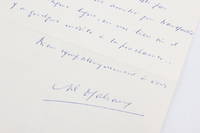
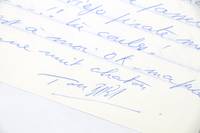
195384015Boulogne-sur-Seine Boulogne-Billancourt: S. n. 1953. Fine. S. n. Boulogne-sur-Seine Boulogne-Billancourt 5 Septembre 1953 11.50 x 18 cm une feuille une enveloppe Autograph letter dated and signed by André Malraux 14 lines in blue ballpoint pen from his Boulogne home on avenue Victor Hugo discussing his workload related to the preparation and delayed publication of the work Des bas-reliefs aux grottes sacrées for which André Parinaud is sending him documentation. André Malraux is not yet ready to send his work to the publisher: "". le livre ne parait pas cette année. Peut-être en mars 54. Et pour savoir où nous allons il faudrait que la préface au moins fût terminée. J'en ai encore pour deux mois."" "". the book is not coming out this year. Perhaps in March 54. And to know where we are going at least the preface would need to be finished. I still have two months of work ahead."" Fold mark from mailing envelope included. Resistance fighter participating in Combat André Parinaud is a journalist columnist art critic and writer. From 1959 to 1967 he held the position of editor-in-chief of the important weekly Arts bringing together the elite of French creation in all artistic fields: literature painting theater cinema. He would then conduct more than 1000 radio interviews with the greatest writers and artists including Salvador Dali Louis-Ferdinand Céline Colette Paul Léautaud André Breton Georges Simenon and André Malraux. While continuing to work at O.R.T.F. and radio he founded several festivals or artistic events such as Le Festival international du film d'art l'Académie nationale des arts de la rue. S. n. unknown
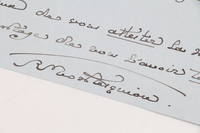
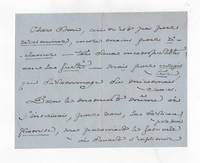
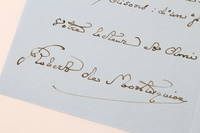
192083142s. l.: S. n. 1920. Fine. S. n. s. l. s. d. circa 1920 27 x 22 cm deux pages sur deux feuilles Autograph letter dated and signed by the dandy count 20 lines on 2 pages written in black ink about friendship and certain constraints that his correspondent seems to encounter probably his friend Henri Lapauze: ""Cher ami puisque vous souffrez c'est vous qu'il faut plaindre ; puisque je souris ce n'est pas moi qu'il faut blâmer. Votre souffrance vient de ne pas faire ce que vous voulez ; donc votre vindicte doit viser qui vous contraint. Ce que mes yeux ont vu aura comme suite conséquente ce que mes oreilles ont entendu on l'a écrit plaisamment. Il faut fournir à ces tomes là. Vous pensez bien que votre logique et votre justice ne visent qu'à établir les responsabilités. Car nous nous estimons au dessus de la louange mais pas au dessus de l'amitié. J'étais heureux de vous attester la mienne. Je le suis davantage de vous l'avoir témoignée. Votre Montesquiou."" ""Dear friend since you suffer it is you who must be pitied; since I smile it is not I who should be blamed. Your suffering comes from not doing what you want; therefore your vindication must target whoever constrains you. What my eyes have seen will have as a consequent sequel what my ears have heard it has been written pleasantly. We must provide for those volumes there. You well think that your logic and your justice aim only to establish responsibilities. For we consider ourselves above praise but not above friendship. I was happy to attest mine to you. I am even more so to have shown it to you. Yours Montesquiou."" S. n. unknown
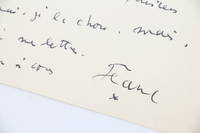
195185222Milly-la-Forêt 1951. Fine. Milly-la-Forêt 7 Février 1951 21 x 27 cm une page Autograph letter signed by Jean Cocteau addressed from his house in Milly-la-Forêt 15 lines in black ink to Olivier Quéant. Traces of folds inherent to postal mailing. ""Milly Février 1951 7 Très cher Quéant Pardonnez moi. Je traverse une crise très pénible de santé. L'opération a redéclenché les symptomes de mes supplices de la Belle et la Bête. Les médécins s'y perdent et je vais être tenu de changer de climat. Bref tout un ordre ou un désordre qui m'empêchent d'écrire surtout sur un tel sujet. Je sais que vous m'aimez bien et me comprendrez. S'il s'agissait de plusieurs mois peut-être tenterai-je la chose mais vous le voyez je forme à demi mes lettres. Tt coeur à vous. JeanC."" ""Milly February 1951 7 Very dear Quéant Forgive me. I am going through a very painful health crisis. The operation has triggered again the symptoms of my torments from Beauty and the Beast. The doctors are at a loss and I will have to change climate. In short a whole order or disorder that prevents me from writing especially on such a subject. I know that you care for me and will understand. If it were a matter of several months perhaps I would attempt the thing but as you can see I can barely form my letters. All my heart to you. JeanC."" unknown
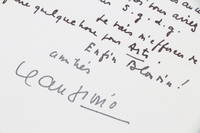
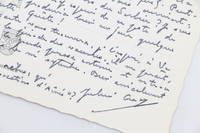
1955844221955. Fine. s. d. circa 1955 13.50 x 21 cm une feuille Autograph letter signed by Jean Giono addressed to Roger Nimier 11 lines in black ink in which he justifies his delay in responding to a request for an article submitted to him by the author of Hussard Bleu. Trace of fold inherent to envelope insertion. ""Pour Mars ça me paraît difficile. Au surplus je n'ai pas le texte et j'ai oublié mes anciennes lectures."" ""For March that seems difficult to me. Moreover I don't have the text and I have forgotten my previous readings"" but Jean Giono does not give up on all production: "". je vais m'efforcer de faire quelque chose pour Arts."" "". I will endeavor to do something for Arts."" He also rejoices at the publication of a new work by Antoine Blondin great friend of Roger Nimier probably the bookstore release of L'humeur vagabonde in 1955 or Un singe en hiver in 1959 with a thunderous: ""Enfin Blondin ! "" ""Finally Blondin!"" unknown
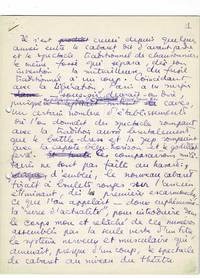
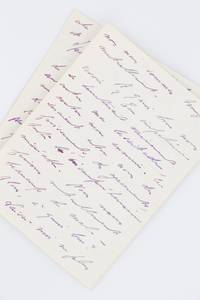
195376377Paris: s. n. 1953. Fine. s. n. Paris s. d. ca 1953 21 x 27 cm 11 feuillets rédigés au recto Manuscript partly unpublished of an article on cabaret nine pages plus two additional pages written in purple ink on perforated squared paper sheets. Numerous deletions and corrections as well as several additions. The sheets are numbered in the upper right margin from 1 to 9 then 12 and 13. The first nine sheets of this text which was never published during Boris Vian's lifetime were transcribed in Les Vies posthumes de Boris Vian by Michel Fauré 1975. The text was erroneously dated 1948 by Fauré: the mention of Samuel Beckett's En attendant Godot whose premiere took place in 1953 makes this dating impossible. An interesting text evoking cabarets and the ""troglodytes"" a fine echo to the famous Manuel de Saint-Germain-des-Prés 1951: ""Let us give back to Saint-Germain-des-Prés what rightfully belongs to it: besides a certain tonnage provided to journalists short of copy this much-decried district - by those who precisely only knew it in its journalistic aspect - is at the origin of the profound transformation of cabaret. Yes there was indeed a reason why intelligent people like Sartre Prévert Camus Merleau-Ponty etc. in short all those who today count in literature or the arts followed with such attention the great movement of the cellars despite the turbulence of the troglodytes and the incongruity of the photographer monkeys despite the muddled activity of a generation of illiterate and boorish journalists despite the vacant curiosity of the gawker and the bitter resentment of the chamber pot emptiers of rue Dauphine."" After briefly evoking jazz a subject on which he is usually dithyrambic Boris Vian devotes the greater part of his text to theater: ""Jazz on one side carved out with great trumpet blows a place in the shade on the engine room side; that is its true environment: a smoky cellar a back room a dark laboratory where the faithful gather. . The musicians finally relaxed. But for their part the actors did not remain inactive."" Visionary Vian senses ""in the air a scent of renewal"" understanding the importance that cabaret theater would assume in the years to come. Two sheets not transcribed in Fauré's work evoke the theatrical avant-garde of the early 1950s: ""And it is no accident if En attendant Godot Samuel Beckett's astonishing play is a clown entrance that lasts two hours deals with nothing in particular poses all problems wrests laughter at the moment when one should be terrified . And it is no accident if the principal interpreter of Beckett's work this pillar of avant-garde theater is a cabaret veteran."" s. n. unknown
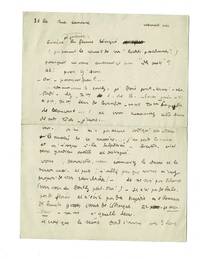
195080910s. l. Klarskovgaard 1950. Fine. s. l. Klarskovgaard 17 novembre 1950 21 x 34 cm 2 pages sur un feuillet Autograph letter signed with the initials of Louis-Ferdinand Céline addressed to his lawyer Master Thorvald Mikkelsen. Two pages written in blue ink on a large sheet of white paper; number ""568"" in Céline's hand in red pencil at the top left. Transversal folds inherent to mailing. This letter was very partially transcribed in Année Céline 2005. Early November 1950 Gaby Paul had come to visit Céline and Lucette at Klarskovgaard: ""Oh mille mercis à Mme Christensen pour son aimable repas qui réchauffé fit nos délices ! Et puis aussi gratitudes pour tout le soin qu'elle a pris de Mme Gen Paul !. Laquelle ne donne aucune nouvelle. Quelle vacherie encore . Comme c'est amusant ! Je crois qu'elle avait des projets ""journalistiques"" mais que mon attitude l'a désenchantée. """"Oh a thousand thanks to Madame Christensen for her kind meal which reheated was our delight! And also gratitude for all the care she took of Mme Gen Paul!. Who gives no news. What nastiness again. How amusing! I believe she had 'journalistic' projects but my attitude disenchanted her."" Céline also mentions the Swedish writer Ernst Bendz one of the few to defend Céline alongside Paraz: ""Une lettre amusante de Bendz ! Bendz appartient vraiment à l'aristocratie des esprits ! La preuve ! La façon qu'il ""m'estime""!!!""""An amusing letter from Bendz! Bendz truly belongs to the aristocracy of minds! The proof! The way he 'esteems me'!!!"" In 1947 Céline pursued by French justice for his collaborationist involvement was confined in Denmark. It was in May 1948 accompanied by Lucette and Bébert that he arrived at his lawyer Master Thorvald Mikkelsen's home at Klarskovgaard. The latter owned a large property by the Baltic Sea and invited the exile to stay there. On February 21 1950 as part of the épuration the writer was definitively sentenced in absentia by the civic chamber of the Paris Court of Justice for collaboration to one year of imprisonment which he had already served in Denmark. The Swedish Consul General in Paris Raoul Nordling intervened on his behalf with Gustav Rasmussen Danish Foreign Minister and managed to delay his extradition. On April 20 1951 Jean-Louis Tixier-Vignancour his lawyer since 1948 obtained Céline's amnesty under the title of ""severely disabled veteran of the Great War"" by presenting his file under the name Louis-Ferdinand Destouches without any magistrate making the connection. Céline would leave Denmark the following summer after three years spent at his lawyer's home. unknown
191480879Alger Algiers 1914. Fine. Alger Algiers s. d. ca 1914 13.70 x 18 cm 6 pages sur un double feuillet et un feuillet simple Autograph letter signed by Judith Gautier addressed to Céleste Chrétien her maid. Four pages written in black ink on a double sheet. Transverse folds inherent to mailing. Judith Gautier here evokes the visit of her friend the musician Chalmers Clifton - whom she liked to nickname Charmeur - to Dinard: ""Mr Clifton received yesterday Sunday a telegram which told him to book Villa Mitsou for August and September in the name of Ni Liao."" She also asks Celeste for additional information about a maid she recommended to her: ""Tell me again about the cleaning woman. Is she . a good cook how much does she ask for Is it only for the season"" A lover of animals she then gives some advice on how to pamper them: ""For the blackbirds you must crush the hemp seed very fine and crush in the same manner bread crust. This is the foundation of their diet but they eat almost everything bread in milk minced meat cooked or raw cherries strawberries grapes a little bit of young snail cut in pieces flies and especially mealworms and ant eggs fresh they adore them plenty of water always something to bathe in."" She also mentions one of her pets: ""My bat is still doing well. I am searching in vain for a little female for it."" ""A poor bat found itself one summer day stuck in a ""fly-catcher"" . The poor creature was struggling desperately. Judith unstuck it with cologne water put it in a small pantry and it lived there eighteen months. It lost its bat habits slept at night awake during the day it drank water from a shell lapping it like a little horse."" Anne Danclos La Vie de Judith Gautier : égérie de Victor Hugo et de Richard Wagner unknown
190885175Toulon 1908. Fine. Toulon 4 Août1908 13.50 x 21.50 cm 16 pages sur quatre doubles feuillets une enveloppe Very long autograph letter signed by Claude Farrère approximately 260 lines in blue ink 16 pages on four double sheets to his friend Pierre Louÿs. Fold marks inherent to postal dispatch envelope included. Claude Farrère mentions the letter he received from his friend and the one he has just sent him: ""I was writing to you on that same Friday a blood-colored letter. a glowing letter devoid of all composure."" He returns with humor to the quarrel between Pierre Louÿs and a certain Augusto probably Auguste Babut de Rosan for which he thought himself responsible: ""Note well dear friend that I was persuaded deep down despite your mutual denials of my personal influence in your quarrel. Human vanity never misses such opportunities. And it is with some shame that I confess to having believed myself for two good days to be the pivot of the world."" Claude Farrère castigates his own candor and lack of discernment: ""Although I am as prudent as you know me to be I am constantly caught red-handed. . the young divorced woman I once showed you at the cinema had the imprudence to arrange to meet me in deserted streets. the child's father a senior officer as befits encountered us there."" sensing that this naivety will eventually play tricks on him: "". it will end badly. I practice fencing every time I think about it."" Since he has just received his friend Pierre Louÿs's missive he continues writing his letter to respond to him and is astonished by what he has just read: ""So when four or five days later I find your first telegram 'am quarreling' with - for a reason you can guess."" I remain stupefied and rack my brain in vain. Having not guessed I suppose. I suppose wrongly. Bewilderment. I received last week seventy-five letters of which about twenty concerned you closely or distantly."" In this tangle of bruised and torn friendships Claude Farrère also describes the great dismay of another of their mutual friends a certain V who finally enlightens the writer about the misunderstanding opposing Louÿs and Babut de Rosan: ""Thereupon sudden change in V. He was more than struck. I saw him on the verge of suicide. He immediately pulls himself together regains his composure jumps on a train. And while waiting for departure time he resumes his account. and I understand."" Here Claude Farrère is almost relieved and reassured: ""Now I believe I have understood. Not quite everything. That I meddled in what did not concern me. I ask your pardon for it my friend and beg you to forget it. Your affection is so dear to me that I would be abominably unhappy to feel it cooled even by a single degree! Tell me if I must fear this and tell me so in earnest."" but still as sad for Augusto: ""Augusto is at this moment almost mad with grief because he believes your friendship lost to him. I deeply pity this poor child."" A very fine letter symbolizing the torments of the tumultuous friendships in Pierre Louÿs and Claude Farrère's circle. unknown
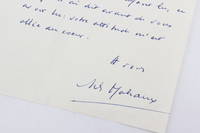
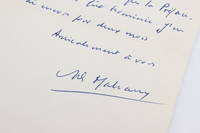
195484014Boulogne-sur-Seine Boulogne-Billancourt: S. n. 1954. Fine. S. n. Boulogne-sur-Seine Boulogne-Billancourt 17 Mars 1954 13 x 21 cm une feuille une enveloppe Autograph letter dated and signed by André Malraux 14 lines in blue ballpoint pen from his Boulogne home on avenue Victor Hugo confirming a scheduled appointment. He thanks him for his ever-benevolent friendship: ""J'ai trouvé la Parisienne à mon retour. Je vous écris vous ayant lu ce que je vous ai dit avant de vous avoir lu : votre attitude m'est allée au coeur."" ""I found la Parisienne upon my return. I am writing to you having read you what I told you before having read you: your attitude touched my heart."" Fold mark from mailing envelope included. Resistance fighter participating in Combat André Parinaud is a journalist columnist art critic and writer. From 1959 to 1967 he held the position of editor-in-chief of the important weekly Arts bringing together the elite of French creation in all artistic fields: literature painting theater cinema. He would then conduct more than 1000 radio interviews with the greatest writers and artists including Salvador Dali Louis-Ferdinand Céline Colette Paul Léautaud André Breton Georges Simenon and André Malraux. While continuing to work at O.R.T.F. and radio he founded several festivals or artistic events such as Le Festival international du film d'art l'Académie nationale des arts de la rue. S. n. unknown
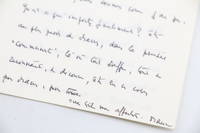
196987858s. l.: S. n. 1969. Fine. S. n. s. l. 11 Décembre 1969 10 x 7.50 cm une feuille une enveloppe Autograph card dated and signed by Maurice Blanchot to his sister Marguerite 12 lines in black ink. Manuscript envelope included. ""Cher marg voici donc des paroles comme testamentaires accueille-les non comme venant de moi mais d'une recherche qui a par hasard et sans mérite ni démérite passée par moi qui m'y suis soumis comme j'ai pu qu'est-ce qui importe finalement être au plus près de chacun dans la pensée ""communiste"" là où tout souffre tout se reconnait se découvre être en ce coeur pour chacun pour tous. Avec toute mon affection. Maurice."" Dear Marg here then are words like testamentary ones receive them not as coming from me but from a search which has by chance and without merit or demerit passed through me who submitted to it as I could what matters finally to be as close as possible to each one in ""communist"" thought where everything suffers everything recognizes itself discovers itself to be in this heart for each one for all. With all my affection. Maurice. S. n. unknown
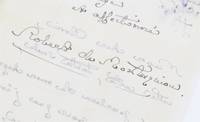
191174273s. l.: S. n. 1911. Fine. S. n. s. l. 9 Juin 1911 13.50 x 21 cm quatre pages sur deux feuilles Remarkable autograph letter dated and signed by the dandy count four pages on two large sheets 16 lines written in black ink to his ""dear friend"" Henri Lapauze denouncing his failure to keep his word and provoking the poet's epistolary ire. Henry Lapauze was to celebrate Robert de Montesquiou in a tribute book regarding the latter and to his great chagrin he forgot him thus stinging his impulsive pride: "". it is not to recriminate even less to complain - both incompatible with pride - but to record what compensates for misunderstandings."" and additional affront to the dandy-poet's pride : "". you spoke. only of Lavedan !"" while double and supreme betrayal Robert de Montesquiou honored his promise by dedicating his latest work to him: ""At the very moment when I was inscribing for you the dedication promised by me I received the fascicle where the comments promised by you were to be expressed for the book that pays tribute to me."" The poet and writer Robert de Montesquiou would be very grateful to him: "". the poet and friend who both in one thank you affectionately in advance."" Henry Lapauze 1867-1925 was a journalist art critic then in 1905 curator of the Petit Palais converted four years earlier into a museum whose collections he considerably enriched by acquiring notably the Courbet Henner Falguière collections with at the twilight of his life a marked predilection for the Decorative Arts of which he was one of the ardent promoters. S. n. unknown
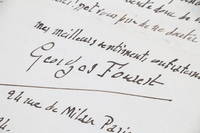
192485171Paris: S. n. 1924. Fine. S. n. Paris 14 Mai 1924 13 x 18 cm deux pages sur un double feuillet Autograph letter signed by Georges Fourest 31 lines in black ink addressed to a fellow writer. Fold mark inherent to envelope insertion marginal stains affecting some word beginnings. Georges Fourest praises the quality of his correspondent's work: ""Que les superstitieux viennent encore nous représenter le 13 comme un jour néfaste ! Pour moi je sais bien que je marque d'un caillou blanc le 13 Mai 1924 puisque le matin de ce jour-là je reçus votre exquis volume. . je pus consacrer mon après-midi à vous lire bien installé au Parc Monceaux."" Let the superstitious still tell us that the 13th is an unlucky day! For my part I know well that I mark May 13 1924 with a white stone since on the morning of that day I received your exquisite volume. . I was able to devote my afternoon to reading you comfortably installed in Parc Monceau. and compares the quality of his verse to his illustrious predecessor Clément Marot: "". quant à vos acrostiches je ne connaissais qu'un chef-d'oeuvre en ce genre celui de Clément Marot par Glatignyet voilà que vous nous en donnez sept et qui laissent de loin l'autre derrière eux."" . as for your acrostics I knew only one masterpiece in this genre that of Clément Marot by Glatigny and here you give us seven which leave the other far behind. at the risk of being considered a base flatterer: "". je ne me doutais guère qu'un poëte venait de m'exaucer et avec quelle maîtrise ! Mais si je vous disais tout ce que je pense vous me prendriez pour un flagorneur."" . I hardly suspected that a poet had just answered my prayers and with what mastery! But if I told you everything I think you would take me for a flatterer. S. n. unknown
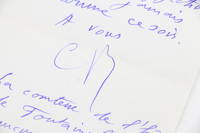
192083165s. l.: S. n. 1920. Fine. S. n. s. l. s. d. 1920 22.50 x 18 cm une page recto-verso Autograph letter signed by the dandy count 39 lines written in black ink probably addressed to his friend and bibliographer critic Henri Lapauze about the sadness that overwhelms him after the disappearance of a mutual friend. To honor his memory Robert de Montesquiou requests an editorial favor from his correspondent. Fold marks inherent to the envelope placement water damage causing two letters of the word Reuilly to blur in the upper left corner of the letter. ""Neuilly My dear friend cette carte toute seule vous parlera de mon chagrin trop grand pour que j'en puisse moi-même parler et pour que je puisse m'en taire. Vous aurez assisté au dernier éclat de ce foyer chaleureux et généreux brûlant brûlé d'intention mot illisible . Je vous demande de vous souvenir que mon pauvre ami se fit une fête d'être le premier à me mettre en relation avec votre aimable femme. Cette pensée nous sera un lien pour moi très fort. Je n'oublierai jamais non plus qu'une de ses joies finales lui vint des paroles prononcées par vous sur mon livre. C'est vous dire que l'insertion intégrale et textuelle de la note discrète dont le texte est ci-joint à la place hélas ! marquée dans la nécrologie fera de moi une fois de plus votre obligé. Robert de Montesquiou. 10 juillet."" ""this card all alone will speak to you of my grief too great for me to be able to speak of it myself and for me to remain silent about it. You will have witnessed the last brilliance of this warm and generous hearth burning burned with intention illegible word. I ask you to remember that my poor friend made it a celebration to be the first to put me in touch with your kind wife. This thought will be a very strong bond for me. I will never forget either that one of his final joys came from the words you spoke about my book. This is to tell you that the complete and textual insertion of the discreet note whose text is attached in the place alas! marked in the obituary will make me once more your obliged. Robert de Montesquiou. July 10."" S. n. unknown
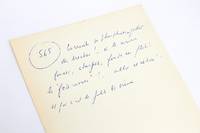
195484046Meudon 1954. Fine. Meudon 1954 20.70 x 26.80 cm une page sur un feuillet Autograph manuscript signed by Louis-Ferdinand Céline written in blue ballpoint pen on a sheet of white paper numbered 565 in the left corner. One transverse fold. Some pin holes in the upper margin evidence of the organization of Céline manuscripts in ""bundles"". « torrents de phosphore jaillir des brèches ! . et les avions foncer charger fendre ces flots ! les ""forteresses"" ! aller et retour ! et que c'est le Jules le crime » ""torrents of phosphorus gushing from the breaches! . and the planes rushing charging cleaving these waves! the ""fortresses""! back and forth! and that it's Jules who's the crime"" The passage on our sheet conforms to the published version. Published in 1954 Normance is a direct sequel to Féérie pour une autre fois which appeared two years earlier. Both parts were written during Céline's years of exile and imprisonment in Denmark. Upon his return to France in 1951 Céline undertook a work of ""polishing"" and published these two titanic texts independently originally conceived as one. ""Céline while working on it thought of this novel as a second Voyage au bout de la nuit capable twenty years later of astonishing the public as much as the 1932 novel."" Henri Godard unknown
191183347s. l.: S. n. 1911. Fine. S. n. s. l. 16 mai 1911 31 x 19.50 cm 3 feuilles Autograph letter signed by the dandy count 56 lines written in black ink on three sheets addressed to his friend and bibliographer the critic Henri Lapauze notably mentioning a work by Ingres in his possession also thanking his correspondent for his always lucid and benevolent critiques regarding him. ""16 mai 911 Cher ami merci pour le magnifique volume au sujet duquel je me félicite sans trop insister. que votre catégorique réponse de l'autre jour sur la non-participation des non-contemporains à votre index me permette de n'avoir pas à vous adresser le beau reproche que j'avais préparé non sur ""Phidias absent"" puisqu'il y est. mais sur moi-même oublié. Quand donc vous en serez à l'index en vie je suis bien sûr que dans votre équité non moins que dans votre estime méritée vous croirez justement devoir faire une part à l'homme qui a publié il y a quinze années cet essai qu'il juge mui-même aujourd'hui insuffisamment respectueux à l'heure où les jeunes gens ont trouvé ce titre pour Ingres ""un maître sans génie"". Tout de même je ne doute pas que sous l'enveloppe insuffisamment libérée du style n'oubliez pas qu'il y a quinze ans la documentation ne vous semble assez forte et le jugement assez expressif pour un temps où vous ne nous aviez pas facilité la chose avec tant de révélations qui sont votre gloire. Je le répète mon cher Lapauze le mot ne me semble pas trop fort pour l'admirable monument élevé par vous au génie des génies dans votre ouvrage si noblement animé mieux que de la ferveur d'un compatriote d'un concitoyen disons le si joli titre disons d'un ""pays"". Votre lecteur et ami Robert de Montesquiou. et voici que Jacques Blanche vient de s'y mettre - quinze ans trop tard ! Quel dommage qu'il ne m'ait pas consulté sur l'institut. Je l'aurais trouvé car mon génie à moi il ne faut pas le défier. Dominique jugé par Jacquot. "" ""16 May 911 Dear friend thank you for the magnificent volume about which I congratulate myself without insisting too much. that your categorical response the other day on the non-participation of non-contemporaries in your index allows me not to have to address to you the fine reproach I had prepared not about 'Phidias absent' since he is there. but about myself forgotten. When therefore you get to the index of the living I am quite sure that in your equity no less than in your deserved esteem you will believe justly that you should make a place for the man who published fifteen years ago this essay which he himself judges today insufficiently respectful at a time when young people have found this title for Ingres 'a master without genius'. All the same I do not doubt that under the insufficiently liberated envelope of style don't forget that it was fifteen years ago the documentation will seem strong enough to you and the judgment expressive enough for a time when you had not made things easy for us with so many revelations which are your glory. I repeat my dear Lapauze the word does not seem too strong to me for the admirable monument erected by you to the genius of geniuses in your work so nobly animated better than with the fervor of a compatriot of a fellow citizen let us say the lovely title let us say of a 'countryman'. Your reader and friend Robert de Montesquiou. and here Jacques Blanche has just started on it - fifteen years too late! What a pity he didn't consult me about the institute. I would have found it for my genius one must not defy it. Dominique judged by Jacquot."" Fold marks inherent to postal delivery. S. n. unknown
195484002Boulogne-sur-Seine Boulogne-Billancourt: S. n. 1954. Fine. S. n. Boulogne-sur-Seine Boulogne-Billancourt 28 Décembre 1954 13.50 x 21 cm une feuille Autograph letter signed and dated by André Malraux 20 lines in blue ballpoint pen from his Boulogne home on avenue Victor Hugo thanking him for his favorable review either of Des bas-reliefs aux grottes sacrées or of Le Monde chrétien both published in 1954. He apologizes for not being able to respond quickly to his laudatory article before thanking him: "". it is certain that by emphasizing both the technical aspect and the other underlined words you render the book a great service and take the animal by the right end."" he also acknowledges the clairvoyance and pertinence of his article despite the difficulty of properly apprehending the work: "". for these essays are not conceivable within traditional art criticism."" while praising the attachment that binds them: "". this attitude which is the only just one did it not necessarily imply a friendship that shows through each line in a place where there is some merit in proclaiming it."" Fold mark inherent to the mailing process. Resistance fighter and participant in Combat André Parinaud is a journalist columnist art critic and writer. From 1959 to 1967 he held the position of editor-in-chief of the important weekly Arts bringing together the elite of French creation in all artistic fields: literature painting theater cinema. He then conducted more than 1000 radio interviews with the greatest writers and artists including Salvador Dali Louis-Ferdinand Céline Colette Paul Léautaud André Breton Georges Simenon and André Malraux. While continuing to work at O.R.T.F. and radio he founded several festivals or artistic events such as The International Art Film Festival the National Academy of Street Arts. S. n. unknown
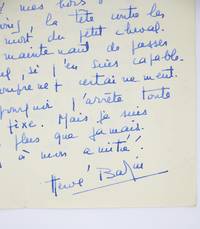
195084016Villenauxe-la-Grande Aube: S. n. 1950. Fine. S. n. Villenauxe-la-Grande Aube 1950 13.50 x 20.50 cm une feuille Autograph letter dated and signed by Hervé Bazin 49 lines in blue ink from his home in Aube La belle Angerie in Villenauxe-la-Grande in which he apologizes for his late reply: "". vous devez me trouver bien silencieux et m'en vouloir quelque peu."" ""you must find me very silent and hold it against me somewhat."" Hervé Bazin confides his apprehensions and psychological torments related to the political climate tinted with anti-communism : "" Depuis des semaines je traverse une sorte de crise assez pénible. je suis inquiet de voir se transformer peu à peu l'anti stalinisme et anti marxisme."" ""For weeks I have been going through a kind of crisis quite painful. I am worried to see the gradual transformation of anti-Stalinism and anti-Marxism."" and remains lucid about the minimal impact of his journalistic interventions : ""ma voix est mince mal assurée inefficiente."" ""my voice is thin unsteady ineffective."" preferring what his talent is recognized for : ""mieux vaut pour elle cet autre genre d'éloquence où je suis plus à l'aise : le roman."" ""better for it this other kind of eloquence where I am more at ease: the novel."" This is why he prefers to devote himself solely to writing his novels and suspends his collaboration with Georges Altmann to whom he had been providing some articles on current political events which he judges insufficient and too concise to express all that he would like to develop further: ""Pour tout vous dire je me lance dans un grand travail. qui m'oblige à quitter le forum. Il s'agit maintetant de passer à l'essentiel. C'est pourquoi j'arrête toute chronique fixe. Mais je suis avec vous plus que jamais."" ""To tell you everything I am embarking on a great work. which obliges me to leave the forum. It is now a matter of moving on to the essential. This is why I am stopping all regular chronicles. But I am with you more than ever."" Fold marks inherent to mailing. Georges Altmann began his great career as a journalist in 1922 at L'Humanité then directed by Henri Barbusse who entrusted him in 1927 with the La vie littéraire section. He was dismissed the following year from the communist daily while continuing to collaborate with Henri Barbusse on the review Monde. In 1932 he joined the Parisian editorial staff of Le Progrès de Lyon through which he made contact with the Resistance group Franc-Tireur. In March 1942 he went underground and became one of the principal editors of the review Franc-Tireur. He was arrested by the Germans in July 1944 then freed on August 18 the day before the Parisian insurrection. After the war he was involved in various journalistic and editorial activities. He then managed the press service of culture minister André Malraux. S. n. unknown
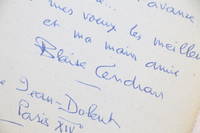
195086569Paris: S. n. 1950. Fine. S. n. Paris s. d. ca 1950 11.50 x 16 cm une page Autograph letter signed by Blaise Cendrars addressed to Luc Estang 16 lines in blue ink. Fold traces inherent to postal handling. Luc Estang has just sent his latest books to Blaise Cendrars who delights in them in advance and thanks him for this: "". je me réjouis d'avance de vous lire. "" "". I look forward with pleasure to reading you. "" S. n. unknown
194183134Paris: S. n. 1941. Fine. S. n. Paris 13 juin 1941 14 x 19.50 cm trois feuilles recto-verso Autograph letter dated June 13th Carlo Rim having specified in pencil at the head of the first leaf 1941 and signed by Raimu addressed to his great friend Carlo Rim 98 lines in black ink on three leaves recto-verso. Folds inherent to mailing. Raimu rails against the incapacity and indecision of those responsible for a film project entitled l'Arlésienne quite a symbol! of which Carlo Rim was part: ""L'arlésienne ne pourra pas se faire parce que monsieur gendre Prouvost et cie sont des couillons. Et des gens sans aucune descisions. Donc affaire morte."" ""l'Arlésienne cannot be made because monsieur son-in-law Prouvost and company are fools. And people without any decisions. So the matter is dead."" "". tous les mois il change d'idées et dieu sait s'il en a mais tout cela se termine par des idées. jamais il ne tournera pas plus le tien que celui des autres il a peut-être de l'argent mais il ne veut pas le sortir. Genre Prouvost."" "". every month he changes his mind and God knows he has ideas but all this ends with ideas. he will never shoot yours any more than those of others he may have money but he doesn't want to spend it. That's Prouvost for you."" Raimu ever so irascible does not calm down and drowns his friend's last hopes about the forthcoming realization of l'Arlésienne: ""Mon vieux Carlo à l'heure actuelle les deux pauvres studios de Nice sont pris jusqu'à fin septembre par des gens qui eux prennent les descisions et qui verse de l'argent. donc tu vois mon pauvre vieux ce sont tous des bonimenteurs Honnebelle - Prouvost. des gens plein aux as mais ils ne veulent pas les sortir."" ""My dear Carlo at present the two poor studios in Nice are booked until the end of September by people who do make decisions and who put up money. so you see my poor friend they are all smooth talkers Honnebelle - Prouvost. people loaded with money but they don't want to spend it."" "". il trouvera 100 excuses pour ne pas tourner et elles lui seront faciles."" "". he will find 100 excuses not to shoot and they will come easily to him.""and ends his epistolary diatribe with this glacial criticism:""Mon Carlo il n'y a plus rien à faire en province que de la barraque et à écarter les marchands de boniments. because que depuis la fille du puisatier je n'ai entendu que des bobards. En plus il faudrait faire des films à la noix."" ""My Carlo there is nothing left to do in the provinces but fairground shows and to ward off the peddlers of smooth talk. because since la fille du puisatier I have heard nothing but tall tales. Plus we would have to make trashy films."" Carlo Rim was a Provençal writer author notably of ""Ma belle Marseille"" a caricaturist a filmmaker: ""Justin de Marseille"" ""L'armoire volante"" ""La maison Bonnadieu"" and was notably the friend of Fernandel Raimu and Marcel Pagnol but also of Max Jacob and André Salmon whom he met in Sanary. S. n. unknown
199584395Sion-sur-l'Océan Sion-sur-l'Océan 1995. Fine. Sion-sur-l'Océan Sion-sur-l'Océan s. d. circa 1995 15 x 10.50 cm une carte postale Autograph postcard signed by Julien Gracq of 20 lines addressed to his friend and biographer Ariel Denis written in black felt-tip pen on the verso of a photograph representing the castle of la Flocellière in Vendée not far from his apartment in Sion-sur-l'Océan. Julien Gracq congratulates Ariel Denis on the accuracy of his latest article: "". I find your review excellent and particularly understanding."" although he offers a slight and humorous caveat: "". my only objection being the fashionable adjective pregnant word underlined which seems to me to be absolutely proscribed as soon as it no longer concerns pregnant women"". The author of ""Au château d'Argol"" shows confidence in his friend's future: "". Perhaps reviews of this quality will open access to a door at éditions du Sorbier for you"" while remaining cautious and modest about his own: "".I refuse to hope too much. finally some positive turn of events will occur one day in this quest! "" Finally Julien Gracq evokes the holiday period and concludes his missive with a question mocking the postcard's subtitle ""Seminary of Elder Vocations east facade"": ""this card is also a riddle: what is a seminary of Elder vocations"" unknown
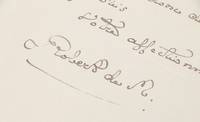
192083256s. l.: S. n. 1920. Fine. S. n. s. l. s. d. 1920 27.50 x 18 cm une page Autograph letter signed by the dandy count 18 lines written in black ink probably addressed to his friend and bibliographer the critic Henri Lapauze thanking him for his vigilance and for having corrected an error concerning one of his texts. Traces of folding inherent to mailing light creases in the left margin of the letter. ""Neuilly Dear friend thank you for your vigilant benevolence. I appreciate it all the more as the same newspaper which brought me a new flood of it represented my client to me elsewhere in the form of a very vast Perrichon! .But my Mont-Blanc described by you regains its proportions! All is in order and I am your affectionate. Robert de M. 27 Nov."" S. n. unknown
197687298Fleury-Mérogis 1976. Fine. Fleury-Mérogis 21 Septembre 1976 21 x 29.50 cm une page recto verso Autograph letter dated and signed by Jacques Mesrine dated Tuesday September 21 1976 68 lines in blue ink on one recto-verso page addressed to his lover at the time Jeanne Schneider thanks to whom the manuscript ofInstinct de mort was discreetly smuggled out of prison. A horizontal fold inherent to the envelope placement a small tear in the right margin of the letter at the fold level. Jacques Mesrine then incarcerated at Fleury-Mérogis prison arranged with his mother for her to cede upon her departure from the Paris region her Clichy apartment to Jeanne Schneider after his possible provisional release: ""J'ai eu un très agréable parloir avec maman. J'ai au moins une bonne nouvelle à t'annoncer. Pour Clichy c'est d'accord. Comme elle va vivre presque tout le temps à la montagne tu auras l'appartement pour toi. Je paierai le loyer. Elle a tout de suite dit d'accord après mon explication. . Je me doute de ta joie de savoir que tu pourras vivre à Clichy - si près de notre papy. toujours présent de par l'amour que nous avons pour lui. Je suis certain que cette petite nouvelle te remonte le moral."" I had a very pleasant visit with mama. I have at least one good piece of news to tell you. For Clichy it's agreed. Since she's going to live almost all the time in the mountains you'll have the apartment to yourself. I'll pay the rent. She immediately said yes after my explanation. . I can imagine your joy knowing that you'll be able to live in Clichy - so close to our grandpa. always present through the love we have for him. I'm certain this little news will lift your spirits. His daughter Sabrina worries him and he senses that he will have to be severe regarding her behavioral lapses: ""De Sabrina rien ! Il y a une chance pour qu'actuellement elle me prépare un ""douze"" je ne peux t'en parler sur lettre. mais j'ai l'impression que la puce me ment sur certaines choses. elle prend peut-être une route où il va me falloir la plus grande fermeté. J'ai demandé à maman de vérifier si elle va bien à l'école."" Nothing from Sabrina! There's a chance that currently she's preparing a ""twelve"" for me I can't talk about it in a letter. but I have the impression that the kid is lying to me about certain things. she's perhaps taking a path where I'll need the greatest firmness. I asked mama to check if she's doing well in school. News of his ""godson"" the famous robber Jean-Charles Willoquet with whom he organized his escape from La Santé prison where they had met makes him prouder: ""J'ai reçu la photo du plus jeune détenu de France à savoir mon filleul ""Willy Willoquet"" dans sa cour de promenade. c'est émouvant et triste à la fois !"" I received the photo of the youngest prisoner in France namely my godson ""Willy Willoquet"" in his exercise yard. It's moving and sad at the same time! The situation of his young protégé cut off from all contact with his loved ones and the people who love him reminds him of his own personal situation and the indignities of a prisoner's isolated existence: ""Je me demande comment va réagir Martine quand on va lui enlever Enfin c'est le destin qu'elle a choisi et accepté. Elle paie cher le prix de l'amour. Vous le payez toutes ""très cher""."" I wonder how Martine will react when they take him away from her Well it's the destiny she chose and accepted. She pays dearly the price of love. You all pay it ""very dearly"". In order to quickly erase this morose and implacable truth Jacques Mesrine plunges into schoolboy humor and affectionately mocks his lover's physical flaws: ""J'espère que la bonne nouvelle va te rendre ton sourire. eh ! la mémé. boutons sur la gueule. ou pas ! Je t'adore. il ne fallait pas flirter avec ""voyou"" ! C'est lui qui t'as passé cela sic nanou d'amour ton viejo pirate monte à l'abordage de tes lèvres. et. !! tu coules ! "" I hope the good news will bring back yo unknown
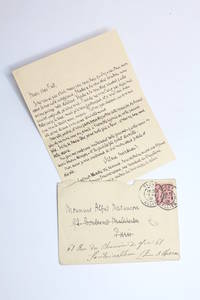
190673674Vichy 1906. Fine. Vichy 10 août 1906 11.60 x 18 cm une feuille Moving autograph letter signed by Octave Mirbeau addressed to the playwright and founder of the Revue Blanche Alfred Natanson when he had just lost his father. 18 lines in black ink on a folded sheet envelope included. ""Mon cher Fred Je ne vous ai pas écrit ; mais vous savez bien qu'il n'y a pas dans mon cur la moindre indifférence. Thadée a dû vous dire combien nous avions partagé votre douleur. Thadée a dû vous dire souvent quelle amitié profonde j'ai pour vous. Peut-être ne vous l'ai-je pas exprimée telle que je la sens mais je la sens fortement et je voudrais bien que vous la sentiez aussi un peu. C'est un gros chagrin que de ne plus être aimé de ceux qu'on aime véritablement. Vous allez partir ; et vous faîtes bien de quitter cette maison où durant plus de six mois vous avez assisté à l'horrible agonie de votre pauvre père. Tâchez de travailler pour notre joie à tous. et revenez avec une belle uvre."" ""My dear Fred I have not written to you; but you know well that there is not the slightest indifference in my heart. Thadée must have told you how much we shared your grief. Thadée must have told you often what deep friendship I have for you. Perhaps I have not expressed it to you as I feel it but I feel it strongly and I would very much like you to feel it too a little. It is a great sorrow to no longer be loved by those one truly loves. You are going to leave; and you do well to quit this house where for more than six months you witnessed the horrible agony of your poor father. Try to work for all our joy. and return with a beautiful work."". Mirbeau was particularly close to the group of the Revue Blanche since its launch in Paris in 1891. But it was since the Dreyfus affair that his intimate and lasting friendship with the Natanson brothers Thadée Alexandre and Alfred was strengthened. After aesthetic disagreements about Art Nouveau and the Nabis Mirbeau finally reunited with Thadée around 1900 in a now common inclination for the young Nabis painters of the Revue Blanche Bonnard Vallotton and Vuillard. The Revue Blanche played an essential role in France as confirmed by historian Paul-Henri Bourrelier: ""Most of the most prominent writers painters musicians politicians and intellectuals of the late 19th and early 20th centuries collaborated with it or were associated with it. Created financed and directed by the three Natanson brothers young Polish Jews with the enthusiastic complicity of their classmates from the Condorcet lycée La Revue blanche quickly became a place of debate on all subjects that stirred France. It waged political battles under the impulse of anarchists like Fénéon Mirbeau; socialists such as Blum G. Moch Péguy; Dreyfusards and founders of the League of Human Rights like Reinach and Pressensé."" unknown
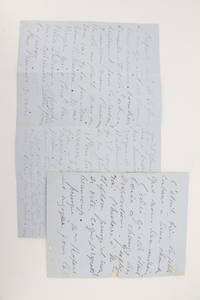
190479022Paris 1904. Fine. Paris s. d. septembre 1904 12.40 x 16.80 cm 8 pages sur 2 doubles feuillets Autograph letter signed ""Pauline"" from Renée Vivien addressed to Natalie Clifford Barney and written in purple ink on two double sheets with violet letterhead and address of 23 avenue du Bois de Boulogne. Transverse folds inherent to posting. A very beautiful and lengthy breakup letter addressed to the Amazon after her impromptu summer 1904 visit to Bayreuth to attempt to win Renée back: "". Les heures passées à Bayreuth étaient de la douceur : et c'est pourquoi je suis revenue."" ""The hours spent in Bayreuth were sweet: and that is why I returned."" The lexical field of death is omnipresent in this missive as if to better emphasize the definitive character of her decision: ""Pourquoi t'acharner à vouloir ranimer vainement les choses mortes Natalie Tu ne l'as point compris : ce que je cherchais auprès de toi c'était le souvenir et rien d'autre. On ne revit point l'autrefois. Tu dois le sentir comme moi-même. . Je souriais à mon passé. Il est doux parce qu'il est mort. Et toi tu veux galvaniser ce cadavre et le rendre odieux."" ""Why persist in trying to vainly revive dead things Natalie You have not understood: what I sought with you was memory and nothing else. One cannot relive the past. You must feel it as I do myself. . I smiled at my past. It is sweet because it is dead. And you you want to galvanize this corpse and make it odious."" The Muse of violets here reveals her suffering and disappointment pleading with Natalie twice: ""Laisse-moi ne plus revenir."" ""Let me not return again."" A veritable funeral oration for extinguished love this letter is very illuminating as to each one's way of loving: ""Nous nous sommes mal comprises. Je voulais un peu de rêve : tu m'offres la réalité."" ""We have misunderstood each other. I wanted a little dream: you offer me reality."" For this is what separates Renée - the dreamy and quasi-platonic poetess - and Natalie - the carnal and fickle lover: ""Ne sens-tu donc pas ne comprends-tu donc pas que je n'ai plus aucun désir d'amour Je suis lasse infiniment ; je ne voulais qu'un peu de douceur. Et tu m'offres la vie et les frissons que sais-je tout dont je ne me soucie point. Les joies charnelles Mais je les possède mon amie me les donne ma chair est satisfaite et au-delà. Je ne cherche point cela : je ne désire point cela. Ces choses m'excèdent venant de toi. J'espérais que assouvie de ton côté tu ne me demanderais que ce que je te demande : un peu de rêve lassé ; un peu de compréhension un peu de regret. Mais nous nous sommes trompées mutuellement. . Cherche un amour de chair chez une autre ."" ""Do you not feel do you not understand that I no longer have any desire for love I am infinitely weary; I wanted only a little sweetness. And you offer me life and thrills what do I know everything I care nothing about. Carnal joys But I possess them my friend gives them to me my flesh is satisfied and beyond. I do not seek that: I do not desire that. These things excess me coming from you. I hoped that satiated on your side you would ask of me only what I ask of you: a little weary dream; a little understanding a little regret. But we have deceived each other mutually. . Seek carnal love with another ."" It was at the end of 1899 and through the intermediary of Violette Shillito that Renée Vivien - then Pauline Tarn - made the acquaintance of Natalie Clifford Barney ""cette Américaine plus souple qu'une écharpe dont l'étincelant visage brille de cheveux d'or de prunelles bleu de mer de dents implacables"" ""this American more supple than a scarf whose sparkling face shines with golden hair sea-blue pupils implacable teeth"" Colette Claudine à Paris. Natalie who had just lived a summer idyll with the scandalous Liane de Pougy who had initiated her into sapphism paid only discrete attention to this new acquaintance. Renée however was totally capt unknown
191675947s. l. 1916. Fine. s. l. s. d. vers 1916-1918 12.40 x 17 cm 2 pages sur un feuillet remplié Autograph letter signed by Georges Auric addressed to Bolette Natanson. Two pages written in black ink on a folded sheet. Folds inherent to mailing. Beautiful poetic letter with Rimbaldian influences: ""Alchimistes Rimbaud ! Eclair ouvre le ciel de mon adolescence ! Je me sens poète et c'est bien le moment de m'arrêter !"" ""Alchemists Rimbaud! Lightning opens the sky of my adolescence! I feel like a poet and this is the right moment to stop!"" Auric mentions a concert he must give at Mme Japy de Beaucourt's who held a salon in honor of the review directed by Ricciotto Canudo Montjoie ! : ""Je dois jouer - encore ! vendredi chez Mme J. de B. non point n'est ce pas Mme Jean de B mais Mme Canudo de Beaucourt"" ""I must play - again! Friday at Mme J. de B.'s not isn't it Mme Jean de B but Mme Canudo de Beaucourt"". He adds: ""Montjoie et Canudo gras et bête italboche."" ""Montjoie and Canudo fat and stupid Italian."" Having moved in artistic circles since her earliest childhood - she was the daughter of Alexandre and niece of Thadée Natanson creators of the famous Revue Blanche - Bolette Natanson 1892-1936 became friends with Jean Cocteau Raymond Radiguet Georges Auric Jean Hugo and Colette. Passionate about fashion she left Paris for the United States with Misia Sert close friend of Coco Chanel and was hired at Goodman. With her husband Jean-Charles Moreux they created the gallery Les Cadres on boulevard Saint-Honoré in 1929 and frequented numerous artists and intellectuals. Their success was immediate and they multiplied projects: creating the fireplace for Winnaretta de Polignac decorating the château de Maulny designing Baron de Rothschild's private mansion creating frames for industrialist Bernard Reichenbach and finally creating the storefront for Colette's beauty institute in 1932. Bolette Natanson also framed works by her prestigious painter friends: Bonnard Braque Picasso Vuillard Man Ray André Dunoyer de Segonzac etc. Despite this meteoric rise she took her own life in December 1936 a few months after her father's death. unknown