10 résultats
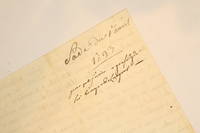
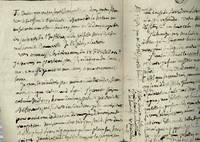
175859468Paris 1758. Fine. Paris dimanche 2 avril 1758 13.40 x 19.20 cm 2 feuillets Will of Louise-Anne de Bourbon-Condé known as Mademoiselle de Charolais copied by the hand of Jean-Baptiste-François-Joseph Count de Sade and father of the Marquis in which the latter makes her nephew Louis-François Joseph de Bourbon Prince de Conti her universal legatee. A second part concerns bequests to livery servants to chambermaids and valets to the wardrobe keeper etc. Footnote in the hand of the Marquis de Sade: ""known as Mademoiselle de Charolais"". Attached is a note sheet written in Sade's hand with a view to publishing his father's correspondence. This will was written five days before the death of Mademoiselle de Charolais whose death occurred on Friday April 7 1758 following three months of illness. The second part of the will is dated Sunday April 2 1758 while the first bears the date of Sunday April 12 1758: this is obviously an erroneous date. The entirety of this copy was written by the hand of the Count de Sade who lived with Mademoiselle de Charolais at her château of Athis-Mons from 1750 until her death. The young Count de Sade sent by his father to Paris around 1720 had as protector Louis-Henri de Bourbon Prince de Condé known as Monsieur le Duc. Upon his arrival the young man appreciated court life and ""Rare thing he pleased women without making himself hated by men: hence the number of his friends at least as high as that of his mistresses. . M. de Sade was not content with easy conquests; bourgeois women left him indifferent. Those he sought - and most often conquered - were court women not only endowed with wit and beauty but also adorned with an illustrious name credit influence or fortune capable in a word of serving his interests and putting him in good standing at court."" Lever Sade. Among his conquests figured Mademoiselle de Charolais seven years his senior sister of his protector and then royal mistress. Little desirous of marrying she preferred all her life to remain unmarried and multiplied adventures and prestigious lovers. She was notably the favorite of the Duke de Richelieu but also of Louis XV for whom she recruited numerous mistresses thus earning the sobriquet of ""royal procuress"". The carnal encounter between Mademoiselle de Charolais and the Count de Sade took place on November 24 1725 while the latter was confined to bed because of a sprain. A letter from Louise-Anne attests to this nascent adventure: ""November 24 is the most beautiful day of my life if I have regained possession of my kingdom and my sovereignty by the rights of the bed where I swore you an oath of fidelity. I count on having received yours and I now live for the prettiest king in the world."" Papiers de famille p.20. The passion was not reciprocal however and the fickle Count de Sade soon met the Duchess de la Trémoïlle. Thus distancing himself from Mademoiselle de Charolais he wrote to her by way of breaking up: ""I regarded Madam the advances you made to me as provocation of your mind and not of your heart. I did not have the honor of knowing you I owed you nothing a sprain obliged me to keep to my room I was idle there your letters were pretty they amused me I flattered myself if it were true that I had made your conquest that you might cure me of an unfortunate passion which occupies me entirely."" op. cit. p.23. In 1752 the Count de Sade was ruined by his lifestyle he had sent young Donatien to Louis-le-Grand college and lodged with his good friend Mademoiselle de Charolais at the château of Athis-Mons: ""I have retired to Mademoiselle's although it is cruel at my age to depend on someone to reduce my expenses."" Letter from the Count de Sade to his uncle the provost of L'Isle-sur-Sorgue November 11 1752. He remained with his friend accompanying her in her numerous travels across Europe until her death. The correspondence between the Count de Sade and Mademoiselle de Charolais con unknown
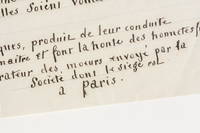
180068537Paris 1800. Fine. Paris s. d. circa 1800 23.50 x 18.30 cm une feuille Brevet d'invention Caisse d'Horloge Patent of Invention Clock Case Paris ca 1800 23.5 x 18.3 cm single sheet A curious manuscript comprising fifteen or so lines in pencil on lined paper bearing the title «Brevet d'invention Caisse d'Horloge». «A noted physiognomist tells us that women of ill repute have the mark of their behavior on their faces. In giving over their bodies to a shameful use the blood changes and becomes watery decomposition begins and colors fade. The skin grows wrinkled dark rings appear under the eyes and the blood as changed by vice has no more of a sex than the case of a clok sic. It is for this reason that an Association has been formed against the corruption of morals which leads to the degeneration of the human race. It marks the easy of virtue with a clok case sic so that they will be exposed to public vilification. They can be recognized by their unusual toilet the product of their criminal behavior and the shame of honest girls. The Repairer of Morals is dispatched by the Association whose seat is in Paris.» A very rare manuscript document. unknown
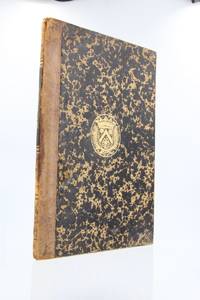
1716763501716. Fine. 1716 17 x 27 cm 6 pages reliées Autograph manuscript titled Requeste singulière de Nosseigneurs les Ducs et Pairs et de Mesdames les Duchesses au Régent - L'an 1716 ""Singular Request from My Lords the Dukes and Peers and from My Ladies the Duchesses to the Regent - The year 1716"". Six pages written in black ink without erasures or corrections. 19th-century binding in half marbled sheep smooth rubbed spine decorated with gilt and blind fillets title label along the spine paste-paper boards stamped at their center with the arms of Adélaïde Édouard Lelièvre de la Grange marquis de la Grange and de Fourilles information kindly provided by M. Jérôme-Paul Carré pebbled paper endpapers and pastedowns De Broglie-Dampmartin bookplate pasted on front pastedown. Headcaps absent. This burlesque petition was transcribed in Les Ruelles du XVIIIème siècle by Labessade in 1879. hardcover
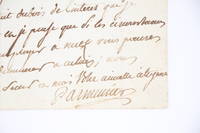
179577420Paris 1795. Fine. Paris 3ème frimaire an 4ème de la République 24 novembre 1795 17.20 x 22.70 cm une page sur un double feuillet Autograph letter signed by Antoine Augustin Parmentier addressed to citizen Chely chief pharmacist of the military hospital of Calais. Transverse folds inherent to the mailing and small paper loss due to the unsealing of the missive. ""Je suis fâché mon cher camarade que le Cen Citoyen Lavoisier m'ait envoyé un pâté sans doute dans l'intention de m'intéresser en faveur de son fils ; mais je dois vous assurer que les présents me tiédissent plutôt encore sur le compte de ceux qui m'en font au reste j'enverrais au jeune homme des livres pour la valeur du pâté ."" ""I am sorry my dear comrade that Citizen Lavoisier sent me a pâté undoubtedly with the intention of interesting me in favor of his son; but I must assure you that gifts rather cool me towards those who give them to me moreover I would send the young man books for the value of the pâté ."" An amusing letter evoking a namesake of the great physicist executed the previous year without having left any descendants. unknown
1793733941793. Fine. 1er avril 1793 15.60 x 20 cm une page sur un feuillet Unpublished autograph letter signed and dated written in black ink and addressed to a notary. On the verso probably in the hand of a secretary the inscription ""Sade du 1er avril 1793""; below this inscription a short sentence in the Marquis's hand: ""so that I may write to Gaufridy to send him money"". Some transverse folds from the original folding for posting. Lengthy letter addressed to a notary while the Marquis freed on April 2 1790 by the abolition of royal warrants is at liberty and attempting to put his affairs in order. After the Revolution his sons emigrated and he did not follow them. His name nevertheless appears on the list of persons who left France due to the revolutionary troubles: ""I hope that with all this I will manage to have my name erased from that fatal list of émigrés."" Anxious not to be considered a ci-devant Marquis in this period preceding the Terror he insists on the persecution of which he claims to be a victim despite his good will: ""It is an unparalleled atrocity that such a trick should have been played on me who have not left Paris since the revolution and who since that time have not ceased to give the most unequivocal proofs of my patriotism"". In this letter Sade also denounces the complexity of the workings of the French administration after the Revolution: ""I have just sent M. Lions the appropriate certificate of residence and I have attached a petition to the district which he tells me is . essential."" Impecunious he begs his lawyer ""to excite the zeal of those who owe him and to urge them to pay as much money as they collect immediately to M. Gauffridi sic"" and does not hesitate to show himself obliging in order to achieve his ends: ""spare no effort then I beseech you . always preserve for me your care and your friendship . I embrace and greet you with all my heart."" Sade's efforts would prove futile; in December 1793 he was imprisoned at the Madelonnettes before being admitted through the good offices of his friend Mme Quenet to the Coignard de Picpus establishment a nursing home sheltering wealthy suspects. Interesting unpublished letter showing the unfortunate Marquis at bay during one of his rare moments of freedom. unknown
1797761731797. Fine. An exceedingly rare letter from Restif: « Les événemens du 18 fructidor' m'ont rendu la vie . en affligeant mon cur » 30 fructidor 1797 An V 16 septembre 1897 18.50 x 21.30 cm 3 pages sur un double feuillet Extremely rare autograph letter signed « Restif Labretone » addressed to Citoyenne Fontaine. Three pages written in black ink on a double sheet of laid paper. Remains of a wax seal folds inherent to mailing. This letter was published with some inaccuracies in Lettres inédites de Restif de Labretone by V. Forest and É. Grimaud 1883. The Fontaine couple are merchants from Grenoble and Restif de la Bretonne began corresponding with them on March 15 1797. Important letter testifying to the completion of the publication of Restif's great autobiographical work: Monsieur Nicolas ou les Ressorts du Cur Humain dévoilé. « I will have completed the Cur humain Dévoilé within 15 days I will prepare your package immediately to have it ready. » The first eight volumes of this great autobiographical work printed by Restif himself a typesetter by trade in his residence at 11 rue de la Bûcherie were entrusted to the « dishonest » bookseller Nicolas Bonneville who did not honor his debts to the writer. Besides health issues « I exchange my illnesses and do not cure them » Restif also shares with his correspondent his literary setbacks: « The Author of Nature will preserve a sincere friend for me to compensate for the scoundrels of the Institute and the perfidious Mercier ». Indeed the previous year the author learned with bitterness that he was not admitted to the National Institute and Louis-Sébastien Mercier who had praised him in his Tableau de Paris and supported his candidacy then turned away from him. To this sum of misfortunes financial difficulties are added. Penniless and living on meager state pensions he maintains all his support for the Republic: « By what fatality do I never see the views of the rulers who welcome me; or how do they not see at once that I am attached to the Revolution to the point that I still love it even when it beats me. » Restif profoundly anti-royalist wrote several pamphlets to this effect and had just added to the end of Monsieur Nicolas an apology for the coup d'état of 18 Fructidor Year V. However this date marks the end of the allowance granted to him by Lazare Carnot after his failure at the Institute: « You know the events of 18 Fructidor; I will not speak to you about them. They have given me back my life; but by afflicting both my heart and my gratitude. » But Restif's great sorrow is the loss of his daughter Filette born from his adventure with Louise Allan whose paternity was revealed to him only late: « I am writing to you from bed weeping over my Filette who died 11 months and ten days ago . Filette was my daughter and Louise's whose soul and beauty she had. » Autograph letters signed by Restif de La Bretonne that have survived to this day are extremely rare. unknown
17700005130No place: Le chev de Berny 1770. Hardcover. Near Fine. 12mo 49pp. 3pp. of Table 3pp. with mss. borders inkspot and inked names on flyleaf flyleaf and title leaves nicked at top edge parchment-backed sprinkled boards <br/><br/>This is a UNIQUE MSS. executed by Chevalier de Berny who after a military career became the master of a writing academy in Brussels. Rather few of his works have survived. These love poems are addressed to Louise Madame Messiery M. Le Baron de H . It incoporates French masonic ideas including p. 3 "L'Amour recu Franc macon" and p. 48 in "Reflexion sur L'Amour". Le chev de Berny hardcover
179167693s. l. Londres London Paris Toulon. 1791. Fine. s. l. Londres London Paris Toulon. 1791-1832 12 000 feuillets de divers formats en feuilles Unpublished political scientific and historical archives The complete manuscript unpublished papers of Louis Chevalier de Sade 1753-1832 author of the Lexicon politique and cousin of the famous Marquis. The important geopolitical historical and scientific archives of a learned aristocrat a privileged witness of the end of the Ancien Régime the French Revolution the Consulate Empire and Restoration. A unique fund of research on the implementation of a constitutional monarchy. Exceptional collection of the Chevalier Louis de Sade's personal archives the cousin of the Marquis de Sade representing 12000 handwritten pages including several thousand unpublished and written by his hand. The Chevalier shows a thought system that he describes as «holistic» including historical political and scientific reflections. Louis Chevalier de SADE If we take the French Revolution as the birth of an experiment both secular and political the Chevalier de Sade was without doubt one of its early critics. Not only of the Revolution which had many other detractors but of its political ideology which would go on profoundly to impact the two hundred years that followed. What he calls «positive politics» is «based on reasoning and experience». «The theory did have some attractions for me; I studied it with care I savored its principles. Now I see their value only in terms of the impact of their implementation what we've seen them produce in the peoples of which history has given me knowledge. This is my method; I know that it is all in all the opposite of the methods utilized by the men who have governed us and written our constitutions to this very day without deviation. This continuous divergence between what has been done and what should never have been done increased my confidence in the path to be followed and at the same time fortified my determination to keep to the views I had adopted of judging laws by the historic consequences they entail rather than by the lyrical supposedly conclusive metaphysical arguments with which these innovators continually and still to this day assault us.» The Chevalier de Sade who saw the world in terms of his own time and place could be nothing other than a Royalist. There were practically no examples of democracy in the history known to the Chevalier apart from the Classical democracies of Greece and Rome which had been experiments only in very elitist forms of democracy. These were very well known to this political scientist whose papers contain 7000 pages dedicated to the history of the Classical world. The republic ushered in by the Revolution was more than just a political system it was the realization of a philosophical political ideal. And while most of those opposed to the new regime saw in it above all a threat to their personal situations their religious beliefs or even more simply their habits the writings of the Chevalier de Sade show no such dogmatic influence; or at least he never uses dogma to justify his arguments. Louis de Sade a gentleman without a fortune and without significant ties was conservative through philosophical and historical conviction and not out of interest. It is with this perfect intellectual honesty that he studies the essays memoirs and political or theoretical works of his contemporaries. Running counter to Enlightenment thought the Chevalier's view of society owed very little to philosophy. Though he puts together a serious theoretical history of the development of Man from the condition of «savages» to the forging of various societies he does not posit Man's ideal nature as some of his contemporaries did. Rather the Chevalier examines the gap between nature and the civilized being without passing moral or philosophical judgment as was the fashion at the time. «The political error that damned Europe in the 18th unknown
17890TP107Paris 1789. Four very warm letters from patients obviously post-operative all declaring the utmost respect and thanks to Professor Chopart. One letter is clearly signed Lalouette and the first of March 1789. Biographical Notes: SIR THOMAS PHILLIPPS 1792-1872. Born in 1792 Sir Thomas Phillipps from childhood was obsessed with the idea of obtaining virtually anything written or printed on paper including cartloads of documents from wastepaper merchants and the entire inventories of booksellers. "I wish to have one copy of every book in the world" he declared to a friend. He very nearly succeeded. His collection ultimately grew to more than 100000 books and at least 60000 manuscripts. As a result of his extravagant purchases Sir Thomas was permanently on the verge of bankruptcy and was constantly pursued by creditors. So many books arrived at his house that it was impossible to unpack his acquisitions much less keep pace with them. Visiting scholars driven to distraction would spend days hunting for an elusive text in the dusty heaps that filled every room. Because Sir Thomas has a morbid dread of fire most of his collection was housed in coffinlike boxes that could be carted away quickly. Visitors to Middle Hill were struck too by the presence of numerous logs a ploy he used to lure beetles away from his books. As Sir Thomas relentlessly pursued his passion the house itself began to crumble and its floors started to sag under the cast weight of hundreds of tons of paper. His neglect of Middle Hill was partly deliberate however. Sir Thomas's chief enemy in life James Halliwell had married his daughter against his wishes. It appears that Halliwell was in Sir Thomas' eyes the worst kind of criminal a book thief who had stolen valuable works from university libraries and even from his father-in-law. Having no sons Sir Thomas was unable to prevent Halliwell from inheriting his estate. To ensure that his detested heir would never receive anything of value Sir Thomas's solution was to allow Middle Hill to fall unto complete disrepair. He even went so far as to chop down and sell for lumber the centuries-old oak trees that lined the majestic mile-long drive to his home. In 1863 Sir Thomas decided to move - in order to accommodate his books. With the aid of 160 men 103 wagonloads of books and papers drawn by 230 horses the books were lumbered from Middle Hill top their new estate in nearby Cheltenham. It is said that for years afterwards the countryside was littered with the remains of carts that had collapsed under the sheer weight of the Phillipps collection. Sir Thomas continues to add to his library until his death in 1872. After Sir Thomas's death his immediate family had no room for his collection. So vast was the library that although individual items and large sections were sold privately or through numerous auction sales the Phillipps collection is still being sold more than a century after the death of its owner. In the course of its sales many treasures have come to light. As late as 1964 part of the long-lost and unique medieval manuscript of the Roman poet Ovid's Metamorphoses appeared and was subsequently reunited with its other half at Magdalen College Oxford. Once destined for destruction as worthless wastepaper this and many other priceless works were saved by the single-minded obsession of the greatest bibliomaniac of all time. Autograph. Manuscript. Very Fine. 8vo - over 7¾" - 9¾" tall. Paperback
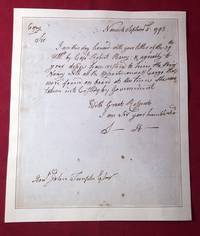
17934199Norwich CT: Original 1793. Original Letter. Very Good. 7 1/4 X 8 1/2 Inches. Autograph Letter Signed. Important letter from Samuel Huntington signer of the Declaration of Independence and Governor of Connecticut. In part: "I am this day honore'd with your letter of the 29th Ulto.by Capt. Robert Barry; & agreeably to your desire to have restored to him the Brig. Nancy with all the Appurtenances & Cargo that were found on board at the time she was taken into Custody by the Government. / With Great Respect / I am your humble Servant / S. H."<br /> <br /> This "copy" made in the hand of Samuel Huntington as Governor of Connecticut. Dated September 3 1793 this letter is an important handwritten record from the close of the Citizen Genet Affair. Huntington writes to John Temple the British Consul-General to the United States concerning the return of an English ship siezed by illegal French privateer "Petit Democrat." <br /> <br /> Tipped to another sheet. Some bleeding and a bit of toning. A nicely preserved letter ALS overall. Original unknown