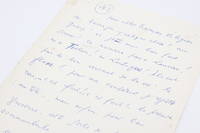
Écrits de James Ensor de 1921 à 1926
1390346870.Gpaperback. Good. Access codes and supplements are not guaranteed with used items. May be an ex-library book. paperback

Bonita · États-Unis50,47 $US≈ 42,70 €
1 815 résultats
1390096556.Ghardcover. Good. Access codes and supplements are not guaranteed with used items. May be an ex-library book. hardcover
1390346870.Gpaperback. Good. Access codes and supplements are not guaranteed with used items. May be an ex-library book. paperback
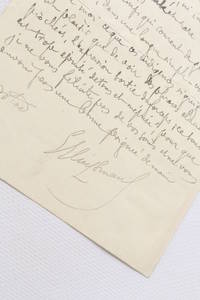
188863597Paris 1888. Fine. Paris 20 juin 1888 12.40 x 16.70 cm un feuillet Autograph letter signed addressed to Jacques Le Lorrain from Joris-Karl Huysmans 30 lines written in black ink on 2 pages. Manuscript correction by the author. Fold inherent to the letter's mailing. Remarkable letter with sometimes obscure remarks where Huysmans emphasizes the importance and rarity of the writing craft at work in the novel Nu by the cobbler-poet Jacques Le Lorrain. « In these times when people rush books in simple language - you know as well as I what these indigences mean - it is a pleasure to see elucidated sentences labored over expression delivered with forceps ». Sharp as usual Huysmans positions himself as a fierce defender of literary writing experienced as labor which contemporary production seems to be abandoning: « this concern is too exhausted by all and despised for me not to congratulate you on your care ». Accustomed to receiving works from his colleagues Huysmans endeavors to highlight the innovative particularities of each author he receives: « Many pages are truly curious. Lorgeral on the grass closing his eyes listening to the voices - it's fresh and absolutely accurate. The scene of Juliette's armpit kissing. This work so well explained of man's jealousy for the child are particular original corners of this book whose very scrupulous style has captivated me. ». The author Huysmans distinguishes himself here always attentive to the right measure necessary according to him for literary expression: « you have managed to enhance the language to make it neither powerless nor inert. And I know how difficult and rare that is! » unknown
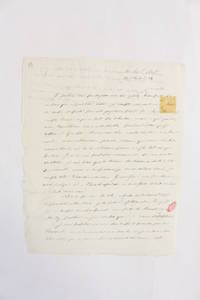
1805669741805. Fine. 10 Floréal 13 30 avril 1805 18.50 x 23.10 cm une feuille Stendhal's autograph letter addressed to his sister Pauline. 28 lines written with a fine writing in black ink. First name ""Pauline"" from the hand of the sender at the bottom of the letter. Inventory number ""36"" in ink from another hand. Two small traces of stamp and stamp a small tear restored in the bottom margin of the page. A few tiny folds inherent in the enveloping of the letter. Rare and beautiful letter of Stendhal addressed to his sister Pauline in which all the sensitivity of the young man and his love for the dramatic art shows more than twenty years before his big romantic successes. This letter comes from the correspondence between Henri Bayle here twenty-two years with his sister Pauline three years younger. This true epistolary liaison which quickly took the form of a ""diary"" - Pauline's answers were rare - is an essential milestone in the constitution of the intellectual journey of the future Stendhal. Our letter of a great lyricism testifies to the strength of the bond uniting the young writer and his sister: ""Let's shake each other my good friend. We will never find anyone who loves Pauline as Henry nor will Henry ever find a more beautiful soul than Pauline. ""The use of the third person and a lover vocabulary erects the young woman to the rank of alter ego a sister-soul and even perfect mistress. The young Henri is then precisely under the yoke of a devouring passion for the actress Melanie Guilbert whom he met during his declamation classes at Dugazon: "" I'm going to be bored perhaps by my dark sadness. I know very well that the seriousness of ardent passions is not pleasant. "" Contrasting with this passionate relationship Pauline symbolizes reason and balance a figure that Henri like a pygmalion can fashion at leisure. In good tutor he advises: ""Learn by heart roles. About declamation I will teach you a thousand things. I'm bringing you a Gil Blas and a Tracy. ""We understand here worship Stendhal devoted to the theater from his earliest years both as a player as a playwright the fund of its archives to the Grenoble Library contains nearly 700 sheets of blanks:"" I am in despair at not being able to wear you Beanies. But wait maybe someday will come . as Ulino says. ""This passion for theater Henry intends to pass it to his sister:"" We will work like hell during the time that I stay in Grenoble. ""In total opposite view with the education of women in his time he put a point of honor that Pauline is an educated person; In several letters moreover we find injunctions from the brother ordering his sister to give up needlework in favor of the reading he recommends. Truly obsessed with theater and convinced that he will become an author of successful comedies he works tirelessly: ""I am told a room where I will not be free and where I can not just declaim. Try to disturb this arrangement. ""Years before writing great novels that make her famous Stendhal already understands that loneliness is for him a source of creation and says:"" A lonely is jealous of his freedom. It is his greatest good as that of all men. "" unknown
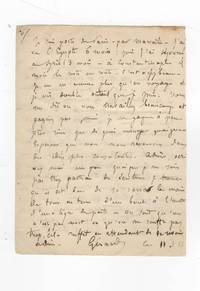
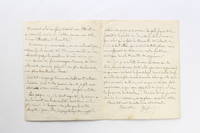
184475148Paris 1844. Fine. Paris 11 février 1844 10.40 x 13.60 cm quatre pages sur deux feuillets Three autograph letters signed by Gérard de Nerval 2 pages signed «Gérard» Théophile Gautier 1 page and a third unsigned letter 1 page penned by a certain «Robert» cf. Nerval's letter Louis Desessart Théophile Gautier's appointed publisher co-published Nervals play Léo Burckart with Barba in 1839. Following financial difficulties he was forced to take refuge «in that sad and charming city of Brussels». The three friends wrote this letter from Paris where they had reunited following Nervals long journey to the East: «I spent six months in Egypt; then three months in Syria four months in Constantinople and the rest en route. Its quite beautiful. I only enjoy myself while traveling and try to live twice as much as I can.» This journey deeply impressed Théophile Gautier who would only travel to Turkey and Egypt years later: «I am in Paris and wish I were in Cairo from where Gérard is returning.» The exoticism of distant lands starkly contrasts with the melancholy and severity of Europe: «How sad Paris is when one returns from sunlit countries.» Nerval And in Paris far from dreams of escape life means toil and melancholy: «We are like sick people who are never comfortable anywhere. I think the good times are gone and the golden hours of the past when we spoke such wise follies will never return. Whats the point of living if we must work and cannot see our friends or write to them or do anything we would like» Gautier The two writers express great compassion for their friends Belgian exile with Brussels appearing as the capital of spleen: «What! Youre still in that sad and charming city of Brussels! . Brussels is even darker poor fellow!» Nerval This joint letter was in fact initiated by «Robert»: «Isnt it true my dear friend that Im quite skilled at making you forget my faults . as a way of making it up to you Im sending you the autographs of two of your . comrades your fondest memories two men of fame who despite all their affection and friendship for you would never have written a word had I not trimmed their quills and handed them paper like sulky children and told them: write at once at once to the exile you love most.» unknown
186562589Biponti Deux-Ponts 1865. Fine. Biponti Deux-Ponts Vendredi 12 mai 1865 13.20 x 20.80 cm 1 page sur un feuillet remplié Autograph letter signed by Charles Baudelaire written in ink and addressed to his mother. A few underlinings deletions and authorial corrections. This letter was first published in Charles Baudelaire Dernières lettres inédites à sa mère in 1926. Former collection of Armand Godoy no. 197. A precious letter from Baudelaire's Brussels period during the poet's voluntary exile at the end of his life. « Il est douteux que j'habite quelque part à Paris. Je crois que j'habiterai surtout une voiture dans laquelle je ferai si je peux toutes mes courses en un ou deux jours. » Haunted by Paris the city of vice and creditors he dreads this brief return. His exile in Brussels is in his eyes a sign of failure and ever since arriving in Belgium he has delayed his return to France. Yet weary of the flat country he despises he mocks its inhabitants: « On est lent ici. » The poet like the seventeen-year-old student who once promised his mother he would get back on track now vows: « Me voici en mesure d'accomplir tous mes plans. Je ne sais comment t'exprimer ma reconnaissance ; et je crois que la meilleure manière sera d'exécuter mes promesses. » Literally obsessed with this sacred mother « who haunts his heart and his mind » the « grateful son » sees himself as incapable of fulfilling his poetic destiny without her undivided attention. unknown
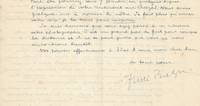
194875175Antibes 1948. Fine. Antibes 9 mars 1948 21.80 x 27 cm 2 pages sur un feuillet Unpublished autograph letter signed by André Breton addressed to Gaston Puel; two pages on one leaf written in blue ink with fine and careful handwriting numerous underlinings. Foxing and marginal adhesive traces. A very fine letter imbued with benevolence in which the Pope of Surrealism shares his numerous and time-consuming occupations with his young correspondent while reassuring him about his talent and future. Gaston Puel began corresponding with André Breton at the Liberation. They had never met at the time of this letter written four years later: « Je suis heureux que vous ayez pensé à m'adresser votre photographie. C'est un grand pas de fait pour rompre la distance et il ne se peut guère que nous ne nous rencontrions bientôt. » ""I am happy that you thought to send me your photograph. It is a great step towards breaking the distance and it can hardly be that we will not meet soon."" The two writers seem very close as evidenced by Breton's paternal and reassuring tone: « Ne parlez pas comme à regret de ceux qui avancent : vous en êtes et j'en sais bien peu qui soient si loin que vous déjà. Ce que vous m'écrivez - pas seulement cette fois - est toujours pour moi de haute importance. » ""Do not speak regretfully of those who advance: you are among them and I know very few who are already as far along as you. What you write to me - not just this time - is always of great importance to me."" A tireless worker Breton here shares his frustration and weariness with Puel: « Mais il faut continuer à vivre et pour cela se réserver une part de solitude qu'avec angoisse aussi je vois diminuer chaque jour. » ""But one must continue to live and for that reserve a share of solitude which I also see diminishing each day with anguish."" Gaston Puel then 24 years old had been participating for some time in the activities of the surrealist group around Joë Bousquet André Breton and René Char. His mentor here predicts a clear future for him: « Mon cher Ami je souhaite très vivement que vous preniez une part active à la rédaction de « Néon ». Il suffirait d'une très légère transposition de ton pour que les pages que vous m'adressez puissent y trouver place et en constituer un des éléments primordiaux. Il en va naturellement de même pour « Supérieur inconnu » si cette revue peut voir le jour. » ""My dear Friend I very much wish that you would take an active part in the editing of 'Néon'. It would only require a very slight transposition of tone for the pages you send me to find their place there and form one of its primordial elements. The same goes naturally for 'Supérieur inconnu' if this magazine can see the light of day."" This latter review meant to reconcile and unite the conservatives and innovators of surrealism would only come to light forty-eight years later under the impetus of Sarane Alexandrian. Gaston Puel would indeed join the editorial team of Néon but would eventually turn away from the surrealists - while maintaining his friendship with Breton - in 1950. unknown
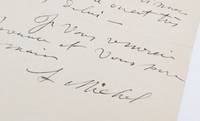
188683952s. l. Paris 1886. Fine. Letter to the Tiger: ""Before returning to the cage"" s. l. Paris 7 août 1886 13.20 x 19.20 cm 3 pages sur un bifeuillet Autograph signed letter from Louise Michel addressed to Georges Clemenceau; three pages written in black ink on a bifolium of white paper. Transverse creases inherent to posting. Fine letter from Louise Michel to Clemenceau one of her most important supporters before yet another incarceration: « Il faut avant de rentrer en cage . que je vous demande le grand service de faire entrer à l'hospice mon cousin le petit Dacheux à qui vous avez bien voulu faire avoir sa dispense d'âge. » ""Before returning to the cage . I must ask you the great favor of having my cousin little Dacheux admitted to the hospice for whom you were kind enough to obtain his age exemption."" The former communard has indeed just been sentenced to four months in prison for having given a speech in favor of the Decazeville miners alongside Jules Guesde Paul Lafargue and Étienne Susini. But for now it is the condition of her cousin Lucien Dacheux that concerns her: « Son genou étant de plus en plus malade on l'envoie en congé de deux mois mais il faut qu'il entre à l'hospice s'il ne veut pas rester estropié. De plus on n'a pu lui donner une mécanique pour son genou et en même temps le médecin lui disait que c'était indispensable - peut-être pourra-t-il en avoir une au Val de Grâce - je le recommande bien à vous et au citoyen Lafont - J'irai vous voir pour cela et une autre chose du même genre avant le 12 mais s'il était possible de faire entrer avant à l'hospice le petit Lucien Dacheux je serais bien heureuse car il sera tout à fait estropié et incapable de continuer son service où on est très content de lui. » ""His knee being increasingly ill they are sending him on two months' leave but he must be admitted to the hospice if he doesn't want to remain crippled. Moreover they couldn't give him a mechanism for his knee while at the same time the doctor told him it was indispensable - perhaps he could get one at Val de Grâce - I recommend him highly to you and to citizen Lafont - I will come to see you about this and another matter of the same kind before the 12th but if it were possible to have little Lucien Dacheux admitted to the hospice beforehand I would be very happy because he will be completely crippled and unable to continue his service where they are very pleased with him."" Louise Michel met Clemenceau in October 1870 when he was mayor of Montmartre and she was assistant schoolmistress. From their first meeting was born a strong friendship that lasted until Louise Michel's death. Clemenceau never ceased to support her particularly during her banishment to Nouméa and they maintained an extensive correspondence. A moving letter testimony to the unwavering devotion of the former communard and to the great friendship that united Louise Michel to Georges Clemenceau. unknown
189463596Paris 1894. Fine. Paris 8 février 1894 10.60 x 13.50 cm un feuillet remplié Autograph letter of Joris-Karl Huysmans signed to Camille Mauclair 44 lines written in black ink 3 pages on a folded sheet handwritten correction of the author. Two restorations using strips of paper in high and low fold of the letter the second band very slightly affects a word of the text a fold inherent in the enveloping of the letter. A long and beautiful letter in which all Huysmans' respect and interest are shown for the writings of the young Symbolist generation. Both author and literary critic Huysmans embodies a central figure for young poets like the 22-year-old Camille Mauclair who sends him one of his first poetic collections: "" The chapter on the symbol is perfect ; it is certainly the first time that we explain and with such lucidity we put things back in place. "" Heart of the symbolism and the poetic fiber of Huysmans the music of the language is particularly honored both in the lyrics and in the author's writing: "" the pieces on death on sensuality are woven into the most vivid language . and the fine writer who found the cold and ethereal absentee who wrote such sentences: ""we strive to determine our true ghost in the tumult of appearances "". "" Introduced by the mention of the myth of Narcissus Symbolist figure par excellence the letter shows the philosophical questions that underlie the movement. « Narcissus is God - It is not very beautiful to contemplate the soul . It is true that you in a melancholy return on the vanity of being have shown in a vibrant page the actors of ourselves as we are. The mystical evocations direct to Satan and more ambiguous to God echo the literary conversion of Huysmans who in 1894 prepares the writing of En Route the first part of his trilogy during direct ""black book"" that is there : ""Ah! the damn God! Really that makes me dream of a literature that feeds less his Satan as you say to a literature of humility! "" Accustomed to digressive theoretical reflections on literature Huysmans concludes his letter with: "" At bottom I am stupid to quibble over ideas because in short all the ones we express and that we will make are already in d ' other times and they are more or less new depending on whether they are more or less forgotten but what is not done before you what you own is the way to coat them. And that's where I admire you wholeheartedly because those are your sentences. "" unknown
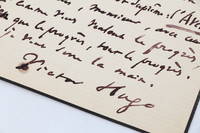
1871833181871. Fine. « So that justice finally be done for women » Mardi 7 novembre 1871 13.30 x 20.80 cm 2 pages sur un feuillet double Autograph letter signed by Victor Hugo to Léon Richer two pages in black ink on a double sheet framed in black. Crosswise folds inherent to envelope inserting. A central tear at the junction of the two sheets. Published in uvres complètes de Victor Hugo Ollendorff 1905. Manuscript housed in a blue half morocco chemise and slipcase marbled paper boards marbled paper slipcase signed Boichot. A magnificent and important letter to Léon Richer one of the first male feminist activists considered by Hubertine Auclert as the ""father of feminism"" and later regarded by Simone de Beauvoir as its ""true founder"". This deeply humanist text is a compendium of Victor Hugo's campaign for the abolition of capital punishment and the female attainment of social equality and civil rights. « Mardi 7 novembre 1871 Monsieur on m'a demandé d'urgence mon intervention pour les condamnés à mort. L'accomplissement de ce devoir a retardé ma réponse à votre excellente lettre. Vous avez raison de compter sur moi pour affirmer l'avenir de la femme. Dès 1849 dans l'Assemblée nationale je faisais éclater de rire la majorité réactionnaire en déclarant que le droit de l'homme avait pour corollaires le droit de la femme et le droit de l'enfant. En 1853 à Jersey dans l'exil j'ai fait la même déclaration sur la tombe d'une proscrite Louise Julien mais cette fois on n'a pas ri on a pleuré. Cet effort pour qu'enfin justice soit rendue à la femme je l'ai renouvelé dans les Misérables je l'ai renouvelé dans le Congrès de Lausanne et je viens de le renouveler encore dans ma lettre au Rappel que vous voulez bien me citer. J'ajoute que tout mon théâtre tend à la dignification de la femme. Mon plaidoyer pour la femme est vous le voyez ancien et persévérant et n'a pas eu de solution de continuité. L'équilibre entre le droit de l'homme et le droit de la femme est une des conditions de la stabilité sociale. Cet équilibre se fera. Vous avez donc bien fait de vous mettre sous la protection de ce mot suprême : l'Avenir. Je suis Monsieur avec ceux qui comme vous veulent le progrès rien que le progrès tout le progrès. Je vous serre la main. Victor Hugo » ""Tuesday november 7 1871 Sir I have been urgently asked to intervene on behalf of those sentenced to death. The fulfillment of this duty has delayed my reply to your excellent letter. You are right to count on me to defend the future of women. As early as 1849 in the National Assembly I made the reactionary majority burst into laughter by declaring the rights of man as natural counterparts to the rights of woman and the rights of children. In 1853 in my Jersey exile I made the same declaration on the grave of an outlaw Louise Julien but this time people didn't laugh they wept. I renewed this effort to finally do justice to women in Les Misérables I renewed it in the Congrès de Lausanne and I've just renewed it again in my letter to Le Rappel which you are kind enough to publish. I would add that every single one of my theatrical works aims to dignify women. As you can see my plea for women is long-standing and persevering and no other has ventured to continue with this endeavor. Balance between men's rights and women's rights is one of the conditions of social stability. This balance will be achieved. I commend you for placing yourself under the protection of this supreme word: the Future. I am Sir with those who like you want progress nothing but progress the whole of progress. I shake your hand. Victor H Although this letter focuses primarily on advocating for women's rights it begins with the death penalty: I have been urgently asked to intervene on behalf of those sentenced to death. The fulfillment of this duty has delayed my reply to your excellent letter. Shortly after the Paris Commune the October 1871 pages of Hugo's diary la hardcover
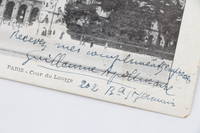
191382418Paris 1913. Fine. Paris 1913 13.30 x 21 cm une carte Unpublished autograph signed postcard by Guillaume Apollinaire addressed to the Dijon art historian Marcel Mayer. Two pages written in black ink on a photographic postcard depicting the courtyard of the Louvre. Charming letter praising the attachment to their roots of the "".fameux Flamands-Espagnols Hollandais et Bourguignons que j'admire tant"" ""famous Flemish-Spanish Dutch and Burgundians whom I admire so much"" and informing his correspondent of the writing and forthcoming publication of a ""petit livre sur Rude"" ""little book on Rude"" that Guillaume Apollinaire will not fail to send him. Fine autograph signature with the autograph address of 202 Boulevard Saint-Germain. unknown
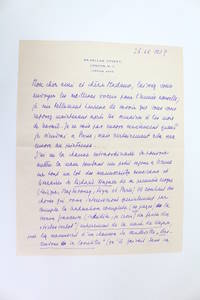
193770612Londres London 1937. Fine. Londres London 26 décembre 1937 17.90 x 22.90 cm une feuille Signed autograph letter to Alfred Cortot and his wife about Richard Wagner's manuscript collection: ""I was lucky enough to be able to acquire the entire lot one day before Bayreuth sent a trusted buyer"". London 26 December 1937 17.9x22.9cm one leaf. Autograph letter signed by Stefan Zweig to Alfred Cortot two pages on one sheet written in violet ink. An outstanding autograph letter in which the avid collector informs his friend Alfred Cortot of his acquisition of unpublished manuscripts of Wagner. Alfred Cortot himself owes his career as a conductor to his early discovery of the German composer. Cortot shared with Zweig his ""almost tyrannical bewitchment suffered with as much intoxication as fervor"" for the composer. Zweig who spoke of his collection as ""more worthy of surviving me than my own works"" The World of Yesterday: Memories of a European 1942 recounts for his friend the details of this incredible discovery of hundreds of forgotten leaflets including Wagner's intimate correspondence handwritten scores and excerpts from opera librettos including The Flying Dutchman The Sublime Fiancée or Bianca and Giuseppe Die Feen Das Liebesverbot The Ban on Love and a lost orchestral version of Rule Britannia. In December 1937 as he fled the Nazi regime and settled in London Zweig became fascinated by the archives of a time when intellectual Europe was living in perfect syncretism. The writer takes a nostalgic look at the manuscripts of Wagner who like him spent his youth travelling through the capitals of Europe: ""I was extraordinarily fortunate to be able to get my hands on a whole lot of Richard Wagner's musical and literary manuscripts from his early period Leipzig Magdeburg Riga and Paris during a short stay in Vienna"". Among these precious manuscripts is the extremely rare orchestral arrangement of the patriotic song Rule Britannia which had been missing for more than sixty years. Sharing his passion for Wagner with his friend the pianist Cortot Zweig announced his discovery with the wonder so familiar to collectors when faced with an exceptional find: "". the manuscript is the only one of its kind in the world that has been preserved. It contains things that will be of special interest to you for example the complete translation 60 pages of the French version unpublished I believe of the text of the ""Liebesverbot"" entirely in Wagner's hand as well as the manuscripts of a vaudeville song ""Descendons la Courtille"" which he performed in his darkest moments . almost thirty pieces of the highest interest and precisely from the rarest period. All this was hidden for 50 years in a private collection and I was lucky enough to be able to acquire the entire lot one day before Bayreuth sent a buyer"". The letter is a fascinating account of Zweig's parallel life which had earned him a reputation as an accomplished collector. His collection also inspired one of his most beautiful short stories The Invisible Collection die Unsichtbare Sammlung and a pioneering essay in the Deutscher Bibliophilen Kalender The Autograph Collection as an Art. His hundreds of historical musical and literary autographs from the Middle Ages to the 20th century were carefully catalogued and collected in the library-museum of his house in Kapuzinerberg: ""In this library a 'place of worship' he also exercises a real activity as an expert in autographs . . The library will attract a number of distinguished scholars sometimes accompanied by their assistants who will not hesitate to return to work there quietly for days or even weeks at a time"" Stefan Zweig le voyageur des mondes Serge Niemetz. With this acquisition Zweig sees the dream of every collector come true. After two years of exile in England Zweig returned to Vienna in time to purchase these exceptional documents from Bayreuth's emissaries who had already built up unknown
1926028728Chicago / Bishop Ca: Laird And Lee 1926. Original Manuscript . Hardcover. Very Good. Manuscript Guest Book Full Of Autographs And Greetings From Guests At The Home Of William And Aurelia Mclean Of Bishop California 1931-1939. The Mcleans Had An Outstanding Collection Of Early Native American Baskets Which Their Guests Frequently Refer To In Their Messages. <br/> <br/> Laird And Lee hardcover
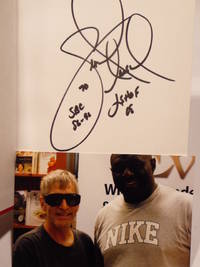
2010004324Triumph Books 2010. 1st Edition. Hardcover. Fine/Fine. Signed by Authors. 1st Printing SIGNED by Leonard Marshall! GIFT QUALITY! WITH PHOTOS OF LEONARD MARSHALL AT BOOK SIGNING!! Signed on front end paper signature only. Both book and dust jacket in Mint Condition! Dust jacket is protected in an acid-free archival quality acetate cover. SG2 Triumph Books hardcover
40654This Arizona educator and college dean wrote books about government as well; from 1937 to 1953 served that state in Congress as a Democratic representative. Two offprints from the "Congressional Record" each 1p recto and verso 8½" X 11" dated 21 January 1937 and 16 February 1937 respectively. Very good. Faint original mailing folds. These two offprints both concern President Franklin D. Roosevelt's disastrous 1937 "Judicial Procedures Reform Bill" or "court-packing plan" legislation that would have allowed him to enlarge the court in such a way that would help push through his New Deal initiatives. It proved quite controversial and ultimately failed. But only two weeks after taking his congressional seat for the first time Murdock the newbie M.C. stood up to support FDR's plan. He opens modestly professing "it is rather presumptuous of me as a new man to rise so early in the session and explain in an offhand way my attitude toward the great issues which now confront us." and concludes that he does not favor a constitutional amendment to approve FDR's plan. His second speech delivered less than one month later continues to oppose a constitutional amendment and to support Roosevelt concluding "I trust the President and cannot bring myself to give any credence to the charge that he is attempting to become a dictator." At the conclusion of each of these speeches Murdock signs large bold and in full in black ink. This choice pair is accompanied by a Typed Letter Signed rubberstamp 1p 8" X 10½" Washington DC n.y. Very good. On "Congress of the United States" letterhead the neophyte congressmen writes to "Dear Fellow Citizen" that "So large a number of my constituents have written me regarding the proposed judicial changes that I find it convenient to send copies of my speeches and this form letter because I cannot reply to each individually." He then backpeddles wildly: "Please note. that my maiden speech. was merely explaining what I thought the President meant in his first message to this Congress. This was fifteen days before his message recommending judicial changes. I had no idea that he would make any proposals nor what he would suggest if he did propose change. I feel that those of you who have written me in such grave alarm have been unduly perturbed in this matter." In other words he didn't feel FDR's court-packing plan would succeed. Ironically this form letter is signed using a rubber stamp -- even though the second-to-last paragraph of his second speech begins "I too dislike being dubbed a 'rubber stamp'"! A delightful trio -- and fortunately the original recipient future Lincoln and Civil War scholar Arnold F. Gates 1914-93 had the foresight to request that Murdock sign each of his speeches. Most unusual. unknown
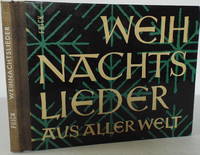
1968009199Wien: Wilhelm Frick. Signed by Maria von Trapp. Hard cover. Text in german. Published Wien: Wilhelm Frick 1968. Oblong 8vo. cloth and laminated boards xiii132pp. plus 9pp. recto printed foldout of song lyrics in English illustrations by Agathe Trapp. Signed by Maria von Trapp on flyleaf. Very good. . Very Good. Hard. 1968. Wilhelm Frick unknown
19894110bx105<p>Signed and inscribed by the author on bookplate taped to ffep Dec 1989 first printing. P/o name stamp else unmarked. 9 1/4" tall 133 pages</p> Mary Corson hardcover
1923035290Athens GA: Athens Book Co 1923. Second Edition. Pictorial Paper Covers. Very Good. 215pp; 10 plates from photographs. 7.5" x 5.5" Presentation copy inscribed on the front free-endpaper: "Presented to / Senator Peter Horbeck / by the author / Frank Attolda / Athens Ga. March 24 1924." The author served as 2nd Lieutenant in the 328th Infantry 82nd Division in World War I. Athens Book Co unknown
5589Stamped 11 Nov. 1929. Printed postcard with manuscript additions minor defects. The printed heading describes him as ""The Autograph King. Unchallenged. Owner of the largest collection of Modern Autographs in the World" lists the Exhibitions at which he has displayed his stock and adds his address and a request to the recipient to write their autograph "Request Register No. 17861". The recipient of this was Philip Yale Drew who added "Young Buffalo" to his full clear signature on the reverse. In this same year 1929 Drew had been arrested as a suspect in the the murder of tobacconist Alfred Oliver. With the original envelope in which the card was returned addressed to Bray in Drew's hand. Note: I don't yet know the connection of Bonar Law with the Company. Stamped 11 Nov. 1929. unknown
2008047080Winston-Salem N. C.: Susan Lyon Studios 2008. First Edition First Printing . Hardcover. Very Good/Very Good. 4to - over 9¾ - 12" tall. Quarto. 139 pages. Hardcover with a purple pictorial dust jacket. Moderate rubbing and wear to the jacket as well as a distinct bend to the lower edge of the front cover. The book is sound and is mostly clean but there is some brown damp staining at the lower corner of the text block at the rear of the book. Illustrated in color throughout. INSCRIBED by the author / artist to a personal friend on the front flyleaf. Susan Lyon was born in Illinois but makes her home in rural North Carolina. The subjects of her painting are not North Carolina but often feature women from different cultures as well as still life and flowers. <br/> <br/> Susan Lyon Studios hardcover
22644This liberal German statesman served briefly as chancellor during the Weimar Republic accepting the Allies' reparations terms after World War One. Unsigned envelope addressed in his hand 7" X 3½" n.p. n.d. The stamp has been removed thus no cancellation date is visible. Boldly addressed to Mr. and Mrs. Otto Wirth in East Chicago Indiana in his hand. To the left of this is written in ballpoint pen "Given to me by Dr. Wirth after Germany started WWI. unknown
19321482Washington DC: Original Letter 1932. Original Letter. Single Sheet. Near Fine. 8 X 10 1/2 Inches. November 23 1932 Typed Letter Signed TLS from US Senator Cordell Hull to "Skull and Bones" member Diplomat and Wall Street Banker Samuel Reading Bertron. Bertron was a noted Presidential advisor of several administrations. This letter is of particular interest as Tennessee Senator Cordell Hull expresses without disguise his view of America and the trouble her citizens are in. In the third year of the great depression that lastest more than a decade Hull writes:<br /> <br /> "Many large groups of American people are in a frightful condition. They are not able to pay one half of their taxes for the past year. They are in in a most ugly state of mind. Without going into details I shall hope to see you and talk out with you some of the more important and pressing phases which are uppermost in our minds."<br /> <br /> On Official United States Senate stationery. Fold-marks. A very nice remnant that clearly exhibits the concern the future Secretary of State has for his country during the height of the Great Depression. Original Letter unknown
18970200301897. Original Photographs . No Binding. Very Good. One Box Of Family Photographs Ephemera Family Letters Etc. Free To Anyone Who Can Establish A Close Family Relationship To Rudolph Forster Or A Public Archive That Will Maintain Them. <br/> <br/> unknown
195483969Meudon 1954. Fine. Meudon 1954 21.20 x 26.10 cm une page sur un feuillet Autograph manuscript signed by Louis-Ferdinand Céline written in blue ballpoint pen on a sheet of white paper numbered 243 in the left corner. Some stains as well as a central fold of no consequence. A tiny lack of paper at the lower right margin of the sheet. Some pinholes in the upper margin evidence of the organization of Céline's manuscripts in ""bundles"". ""pour aller traverser les lignes des barrages quelque chose !. au galop ! et je me suis bien fait sonner ! ça arrivera pas à Lauriac ! ni à Tartron ! ni Larengue !. Ils ont pris le bon versant de la vie : le flan !. pour ma concerne je regrette rien . c'est fait ! c'est fait ! la preuve ma tête. mais enfin pour la griserie cette sorte de bravoure somnambule j'admire les doués. je les respecte. j'arrive moi que par le stoïcisme le sang froid là ! hop !"" ""to go cross the lines barricades something!. at a gallop! and I really got myself beaten up! that won't happen to Lauriac! nor to Tartron! nor Larengue!. They took the right side of life: the flank!. as for me I regret nothing. it's done! it's done! the proof my head. but finally for the intoxication this sort of sleepwalking bravery I admire the gifted ones. I respect them. I only achieve it through stoicism cold blood there! hop!"" The passage from our sheet referring to Mauriac Sartre and Aragon conforms to the published version. Published in 1954 Normance is a direct sequel to Féérie pour une autre fois published two years earlier. The two parts were written during Céline's years of exile and imprisonment in Denmark. Upon his return to France in 1951 Céline undertook a work of ""polishing"" and published these two titanic texts independently originally conceived as one. ""Céline while working on it thought of this novel as a second Voyage au bout de la nuit capable twenty years later of astonishing the public as much as the 1932 novel."" Henri Godard unknown
18020American editor and prolific author on a variety of subjects; his books include "Mother Goose Rhymes" 1926 "Annapolis Today" 1938 "Copy: A One-Act Newspaper Play" 1910 "Bypaths in Arcady" 1915 "Flotsam" 1903 "How to Build Your Radio Receiver" 1924 "Our Army Today" 1943 and many others. Two items: First a TQS 1p 8½" X 11" n.p. n.y. Near fine. Faint original mailing folds. Brief two-stanza poem titled "Beyond" which goes as follows: "When all my little worldly tasks are done / And life is through / Shall I my love lie down in sleep at last / To dream with you / Or shall I find when you and I shall rest / In peace supreme / That death is Life but of a larger plan / And Life the dream" Boldly signed at the conclusion. Second a TNS 1p 7¼" X 10¼" New York NY 1923 February 2. Addressed to Dr. Albert Johannsen. Near fine. On "Popular Radio" letterhead listing him as editor Banning thanks this University of Chicago professor for "my unpardonable delay in responding more promptly to your flattering suggestion of over a month ago" and transmits this typed poem. Boldly signed. Johannsen authored "The House of Beadle and Adams and Its Dime and Nickel Novels" University of Oklahoma Press 1950 the definitive reference work and bibliography on the subject. His original 8½" X 11" file folder bearing a printed "Collection of Albert Johannsen" label partly filled in by Johannsen accompanies this attractive pair. unknown