Joris-Karl HUYSMANSBiblio.com
184 résultats
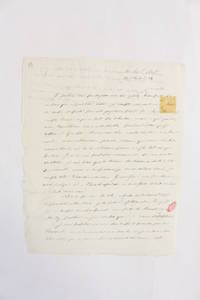
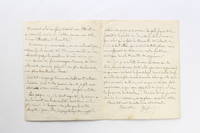
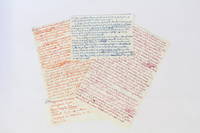
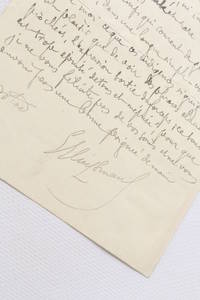
188863597Paris 1888. Fine. Paris 20 juin 1888 12.40 x 16.70 cm un feuillet Autograph letter signed addressed to Jacques Le Lorrain from Joris-Karl Huysmans 30 lines written in black ink on 2 pages. Manuscript correction by the author. Fold inherent to the letter's mailing. Remarkable letter with sometimes obscure remarks where Huysmans emphasizes the importance and rarity of the writing craft at work in the novel Nu by the cobbler-poet Jacques Le Lorrain. « In these times when people rush books in simple language - you know as well as I what these indigences mean - it is a pleasure to see elucidated sentences labored over expression delivered with forceps ». Sharp as usual Huysmans positions himself as a fierce defender of literary writing experienced as labor which contemporary production seems to be abandoning: « this concern is too exhausted by all and despised for me not to congratulate you on your care ». Accustomed to receiving works from his colleagues Huysmans endeavors to highlight the innovative particularities of each author he receives: « Many pages are truly curious. Lorgeral on the grass closing his eyes listening to the voices - it's fresh and absolutely accurate. The scene of Juliette's armpit kissing. This work so well explained of man's jealousy for the child are particular original corners of this book whose very scrupulous style has captivated me. ». The author Huysmans distinguishes himself here always attentive to the right measure necessary according to him for literary expression: « you have managed to enhance the language to make it neither powerless nor inert. And I know how difficult and rare that is! » unknown
1805669741805. Fine. 10 Floréal 13 30 avril 1805 18.50 x 23.10 cm une feuille Stendhal's autograph letter addressed to his sister Pauline. 28 lines written with a fine writing in black ink. First name ""Pauline"" from the hand of the sender at the bottom of the letter. Inventory number ""36"" in ink from another hand. Two small traces of stamp and stamp a small tear restored in the bottom margin of the page. A few tiny folds inherent in the enveloping of the letter. Rare and beautiful letter of Stendhal addressed to his sister Pauline in which all the sensitivity of the young man and his love for the dramatic art shows more than twenty years before his big romantic successes. This letter comes from the correspondence between Henri Bayle here twenty-two years with his sister Pauline three years younger. This true epistolary liaison which quickly took the form of a ""diary"" - Pauline's answers were rare - is an essential milestone in the constitution of the intellectual journey of the future Stendhal. Our letter of a great lyricism testifies to the strength of the bond uniting the young writer and his sister: ""Let's shake each other my good friend. We will never find anyone who loves Pauline as Henry nor will Henry ever find a more beautiful soul than Pauline. ""The use of the third person and a lover vocabulary erects the young woman to the rank of alter ego a sister-soul and even perfect mistress. The young Henri is then precisely under the yoke of a devouring passion for the actress Melanie Guilbert whom he met during his declamation classes at Dugazon: "" I'm going to be bored perhaps by my dark sadness. I know very well that the seriousness of ardent passions is not pleasant. "" Contrasting with this passionate relationship Pauline symbolizes reason and balance a figure that Henri like a pygmalion can fashion at leisure. In good tutor he advises: ""Learn by heart roles. About declamation I will teach you a thousand things. I'm bringing you a Gil Blas and a Tracy. ""We understand here worship Stendhal devoted to the theater from his earliest years both as a player as a playwright the fund of its archives to the Grenoble Library contains nearly 700 sheets of blanks:"" I am in despair at not being able to wear you Beanies. But wait maybe someday will come . as Ulino says. ""This passion for theater Henry intends to pass it to his sister:"" We will work like hell during the time that I stay in Grenoble. ""In total opposite view with the education of women in his time he put a point of honor that Pauline is an educated person; In several letters moreover we find injunctions from the brother ordering his sister to give up needlework in favor of the reading he recommends. Truly obsessed with theater and convinced that he will become an author of successful comedies he works tirelessly: ""I am told a room where I will not be free and where I can not just declaim. Try to disturb this arrangement. ""Years before writing great novels that make her famous Stendhal already understands that loneliness is for him a source of creation and says:"" A lonely is jealous of his freedom. It is his greatest good as that of all men. "" unknown
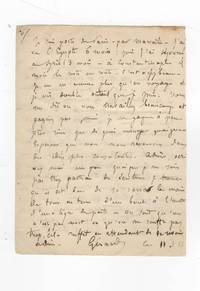
184475148Paris 1844. Fine. Paris 11 février 1844 10.40 x 13.60 cm quatre pages sur deux feuillets Three autograph letters signed by Gérard de Nerval 2 pages signed «Gérard» Théophile Gautier 1 page and a third unsigned letter 1 page penned by a certain «Robert» cf. Nerval's letter Louis Desessart Théophile Gautier's appointed publisher co-published Nervals play Léo Burckart with Barba in 1839. Following financial difficulties he was forced to take refuge «in that sad and charming city of Brussels». The three friends wrote this letter from Paris where they had reunited following Nervals long journey to the East: «I spent six months in Egypt; then three months in Syria four months in Constantinople and the rest en route. Its quite beautiful. I only enjoy myself while traveling and try to live twice as much as I can.» This journey deeply impressed Théophile Gautier who would only travel to Turkey and Egypt years later: «I am in Paris and wish I were in Cairo from where Gérard is returning.» The exoticism of distant lands starkly contrasts with the melancholy and severity of Europe: «How sad Paris is when one returns from sunlit countries.» Nerval And in Paris far from dreams of escape life means toil and melancholy: «We are like sick people who are never comfortable anywhere. I think the good times are gone and the golden hours of the past when we spoke such wise follies will never return. Whats the point of living if we must work and cannot see our friends or write to them or do anything we would like» Gautier The two writers express great compassion for their friends Belgian exile with Brussels appearing as the capital of spleen: «What! Youre still in that sad and charming city of Brussels! . Brussels is even darker poor fellow!» Nerval This joint letter was in fact initiated by «Robert»: «Isnt it true my dear friend that Im quite skilled at making you forget my faults . as a way of making it up to you Im sending you the autographs of two of your . comrades your fondest memories two men of fame who despite all their affection and friendship for you would never have written a word had I not trimmed their quills and handed them paper like sulky children and told them: write at once at once to the exile you love most.» unknown
186562589Biponti Deux-Ponts 1865. Fine. Biponti Deux-Ponts Vendredi 12 mai 1865 13.20 x 20.80 cm 1 page sur un feuillet remplié Autograph letter signed by Charles Baudelaire written in ink and addressed to his mother. A few underlinings deletions and authorial corrections. This letter was first published in Charles Baudelaire Dernières lettres inédites à sa mère in 1926. Former collection of Armand Godoy no. 197. A precious letter from Baudelaire's Brussels period during the poet's voluntary exile at the end of his life. « Il est douteux que j'habite quelque part à Paris. Je crois que j'habiterai surtout une voiture dans laquelle je ferai si je peux toutes mes courses en un ou deux jours. » Haunted by Paris the city of vice and creditors he dreads this brief return. His exile in Brussels is in his eyes a sign of failure and ever since arriving in Belgium he has delayed his return to France. Yet weary of the flat country he despises he mocks its inhabitants: « On est lent ici. » The poet like the seventeen-year-old student who once promised his mother he would get back on track now vows: « Me voici en mesure d'accomplir tous mes plans. Je ne sais comment t'exprimer ma reconnaissance ; et je crois que la meilleure manière sera d'exécuter mes promesses. » Literally obsessed with this sacred mother « who haunts his heart and his mind » the « grateful son » sees himself as incapable of fulfilling his poetic destiny without her undivided attention. unknown
188683952s. l. Paris 1886. Fine. Letter to the Tiger: ""Before returning to the cage"" s. l. Paris 7 août 1886 13.20 x 19.20 cm 3 pages sur un bifeuillet Autograph signed letter from Louise Michel addressed to Georges Clemenceau; three pages written in black ink on a bifolium of white paper. Transverse creases inherent to posting. Fine letter from Louise Michel to Clemenceau one of her most important supporters before yet another incarceration: « Il faut avant de rentrer en cage . que je vous demande le grand service de faire entrer à l'hospice mon cousin le petit Dacheux à qui vous avez bien voulu faire avoir sa dispense d'âge. » ""Before returning to the cage . I must ask you the great favor of having my cousin little Dacheux admitted to the hospice for whom you were kind enough to obtain his age exemption."" The former communard has indeed just been sentenced to four months in prison for having given a speech in favor of the Decazeville miners alongside Jules Guesde Paul Lafargue and Étienne Susini. But for now it is the condition of her cousin Lucien Dacheux that concerns her: « Son genou étant de plus en plus malade on l'envoie en congé de deux mois mais il faut qu'il entre à l'hospice s'il ne veut pas rester estropié. De plus on n'a pu lui donner une mécanique pour son genou et en même temps le médecin lui disait que c'était indispensable - peut-être pourra-t-il en avoir une au Val de Grâce - je le recommande bien à vous et au citoyen Lafont - J'irai vous voir pour cela et une autre chose du même genre avant le 12 mais s'il était possible de faire entrer avant à l'hospice le petit Lucien Dacheux je serais bien heureuse car il sera tout à fait estropié et incapable de continuer son service où on est très content de lui. » ""His knee being increasingly ill they are sending him on two months' leave but he must be admitted to the hospice if he doesn't want to remain crippled. Moreover they couldn't give him a mechanism for his knee while at the same time the doctor told him it was indispensable - perhaps he could get one at Val de Grâce - I recommend him highly to you and to citizen Lafont - I will come to see you about this and another matter of the same kind before the 12th but if it were possible to have little Lucien Dacheux admitted to the hospice beforehand I would be very happy because he will be completely crippled and unable to continue his service where they are very pleased with him."" Louise Michel met Clemenceau in October 1870 when he was mayor of Montmartre and she was assistant schoolmistress. From their first meeting was born a strong friendship that lasted until Louise Michel's death. Clemenceau never ceased to support her particularly during her banishment to Nouméa and they maintained an extensive correspondence. A moving letter testimony to the unwavering devotion of the former communard and to the great friendship that united Louise Michel to Georges Clemenceau. unknown
189463596Paris 1894. Fine. Paris 8 février 1894 10.60 x 13.50 cm un feuillet remplié Autograph letter of Joris-Karl Huysmans signed to Camille Mauclair 44 lines written in black ink 3 pages on a folded sheet handwritten correction of the author. Two restorations using strips of paper in high and low fold of the letter the second band very slightly affects a word of the text a fold inherent in the enveloping of the letter. A long and beautiful letter in which all Huysmans' respect and interest are shown for the writings of the young Symbolist generation. Both author and literary critic Huysmans embodies a central figure for young poets like the 22-year-old Camille Mauclair who sends him one of his first poetic collections: "" The chapter on the symbol is perfect ; it is certainly the first time that we explain and with such lucidity we put things back in place. "" Heart of the symbolism and the poetic fiber of Huysmans the music of the language is particularly honored both in the lyrics and in the author's writing: "" the pieces on death on sensuality are woven into the most vivid language . and the fine writer who found the cold and ethereal absentee who wrote such sentences: ""we strive to determine our true ghost in the tumult of appearances "". "" Introduced by the mention of the myth of Narcissus Symbolist figure par excellence the letter shows the philosophical questions that underlie the movement. « Narcissus is God - It is not very beautiful to contemplate the soul . It is true that you in a melancholy return on the vanity of being have shown in a vibrant page the actors of ourselves as we are. The mystical evocations direct to Satan and more ambiguous to God echo the literary conversion of Huysmans who in 1894 prepares the writing of En Route the first part of his trilogy during direct ""black book"" that is there : ""Ah! the damn God! Really that makes me dream of a literature that feeds less his Satan as you say to a literature of humility! "" Accustomed to digressive theoretical reflections on literature Huysmans concludes his letter with: "" At bottom I am stupid to quibble over ideas because in short all the ones we express and that we will make are already in d ' other times and they are more or less new depending on whether they are more or less forgotten but what is not done before you what you own is the way to coat them. And that's where I admire you wholeheartedly because those are your sentences. "" unknown
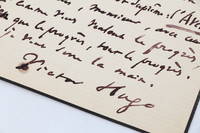
1871833181871. Fine. « So that justice finally be done for women » Mardi 7 novembre 1871 13.30 x 20.80 cm 2 pages sur un feuillet double Autograph letter signed by Victor Hugo to Léon Richer two pages in black ink on a double sheet framed in black. Crosswise folds inherent to envelope inserting. A central tear at the junction of the two sheets. Published in uvres complètes de Victor Hugo Ollendorff 1905. Manuscript housed in a blue half morocco chemise and slipcase marbled paper boards marbled paper slipcase signed Boichot. A magnificent and important letter to Léon Richer one of the first male feminist activists considered by Hubertine Auclert as the ""father of feminism"" and later regarded by Simone de Beauvoir as its ""true founder"". This deeply humanist text is a compendium of Victor Hugo's campaign for the abolition of capital punishment and the female attainment of social equality and civil rights. « Mardi 7 novembre 1871 Monsieur on m'a demandé d'urgence mon intervention pour les condamnés à mort. L'accomplissement de ce devoir a retardé ma réponse à votre excellente lettre. Vous avez raison de compter sur moi pour affirmer l'avenir de la femme. Dès 1849 dans l'Assemblée nationale je faisais éclater de rire la majorité réactionnaire en déclarant que le droit de l'homme avait pour corollaires le droit de la femme et le droit de l'enfant. En 1853 à Jersey dans l'exil j'ai fait la même déclaration sur la tombe d'une proscrite Louise Julien mais cette fois on n'a pas ri on a pleuré. Cet effort pour qu'enfin justice soit rendue à la femme je l'ai renouvelé dans les Misérables je l'ai renouvelé dans le Congrès de Lausanne et je viens de le renouveler encore dans ma lettre au Rappel que vous voulez bien me citer. J'ajoute que tout mon théâtre tend à la dignification de la femme. Mon plaidoyer pour la femme est vous le voyez ancien et persévérant et n'a pas eu de solution de continuité. L'équilibre entre le droit de l'homme et le droit de la femme est une des conditions de la stabilité sociale. Cet équilibre se fera. Vous avez donc bien fait de vous mettre sous la protection de ce mot suprême : l'Avenir. Je suis Monsieur avec ceux qui comme vous veulent le progrès rien que le progrès tout le progrès. Je vous serre la main. Victor Hugo » ""Tuesday november 7 1871 Sir I have been urgently asked to intervene on behalf of those sentenced to death. The fulfillment of this duty has delayed my reply to your excellent letter. You are right to count on me to defend the future of women. As early as 1849 in the National Assembly I made the reactionary majority burst into laughter by declaring the rights of man as natural counterparts to the rights of woman and the rights of children. In 1853 in my Jersey exile I made the same declaration on the grave of an outlaw Louise Julien but this time people didn't laugh they wept. I renewed this effort to finally do justice to women in Les Misérables I renewed it in the Congrès de Lausanne and I've just renewed it again in my letter to Le Rappel which you are kind enough to publish. I would add that every single one of my theatrical works aims to dignify women. As you can see my plea for women is long-standing and persevering and no other has ventured to continue with this endeavor. Balance between men's rights and women's rights is one of the conditions of social stability. This balance will be achieved. I commend you for placing yourself under the protection of this supreme word: the Future. I am Sir with those who like you want progress nothing but progress the whole of progress. I shake your hand. Victor H Although this letter focuses primarily on advocating for women's rights it begins with the death penalty: I have been urgently asked to intervene on behalf of those sentenced to death. The fulfillment of this duty has delayed my reply to your excellent letter. Shortly after the Paris Commune the October 1871 pages of Hugo's diary la hardcover
18970200301897. Original Photographs . No Binding. Very Good. One Box Of Family Photographs Ephemera Family Letters Etc. Free To Anyone Who Can Establish A Close Family Relationship To Rudolph Forster Or A Public Archive That Will Maintain Them. <br/> <br/> unknown
1880041949Richmond: William Ellis Jones Steam Book and Job Printer 1880. First Edition First Printing . Hardcover. Fair/No Jacket. 8vo. vi 356 pages. Hardcover bound in original brown publisher's cloth. The binding is worn and shaken and the inner hinges are cracked and holding by the cords. The book would benefit from being recased. The text is generally clean. INSCRIBED by the author on the front pastedown: "Hon. B. Johnson Barbour / With Compliments of / Rob. T. Craighill / May 23rd 1882." Contains essays on George Washington Patrick Henry Thomas Jefferson John Marshall and John Randolph of Roanoke. Rare. <br/> <br/> William Ellis Jones, Steam Book and Job Printer hardcover
1833039403St. Clairsville Ohio: Printed by Horton J. Howard 1833. First Edition. Full Calf. Good. 342pp with "Errors" at end. Bound in blind-tooled calf gilt spine rules and lettering sprinkled edges; corners scuffed front joint separated threads holding. 5.75" x 3.75" Presentation copy inscribed on the blank flyleaf: "Presented to Mrs. J.E. Breyer with Compliments of the Author / St. Clairsville O--- Feb 18th 1861." American Imprints 18967. Printed by Horton J. Howard unknown
1893044040New York: Harper And Brothers 1893. Reprint . Hardcover. Very Good. Ix 337 Pp 2 Pp Ads At Rear. Blue-Green Cloth Gilt. 1893 Printing With That Date On The Title Page. The Author Was Professor Of Rhetoric At Harvard Before All Disciplines Became Focused On Rhetoric. Ownership Signature Of Actor Hans Conried And Directly From His Library. Book With Gilt Bright But Fraying At Corners Hinges Cracked Through. <br/> <br/> Harper And Brothers hardcover
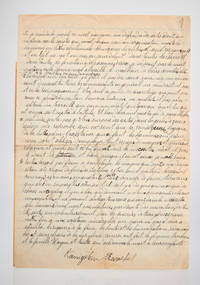
1892734381892. Fine. 1892 20 x 29.50 cm 4 pages sur un double feuillet Exceptional complete autograph manuscript of Ravachols true last testament largely unpublished unknown in this form preceding its rewriting by a third party for publication in the press. A unique testimony to the genuine thought of the anarchist icon. Four-page lined quarto manuscript entirely written in black ink and signed twice Konigstein Ravachol at the foot of each sheet. Pencil corrections within the text possibly in the hand of his lawyer. Some horizontal folds and very minor marginal tears without loss. Written in his prison cell during the second Montbrison trial that led to his death sentence this text hastily penned without punctuation or capital letters and in naïve spelling was meant to be delivered orally by Ravachol during the hearing. Ravachol was dead set on putting in his two cents for the defence not to defend himself but to explain. No luck dammit! Four words in and the judge cut him off. His statement isnt lost by Jove! Émile Pouget in Père Peinard July 310 1892. This self-styled Rocambole of anarchism was not allowed to read his statement aloud but he handed it to his lawyer Maître Lagasse and by June 23 the forbidden text appeared in the conservative newspaper Le Temps. This first publication was so faithful to the original that it preserved the author's eccentric spelling a fidelity that Émile Pouget would ironically criticise in the Père Peinard issue of July 3 1892 one week before Ravachols execution: Le Temps that opportunist bedsheet printed it as is. Like a true Jesuit it even printed it too true. Ravachol had written the thing for himself; he knew how to read it but there wasnt a word of correct spelling seeing as he knew about spelling as much as he knew about cabbage farming. Le Temps printed the thing without changing a line so its practically unreadable . Thats exactly what the bastards wanted dammit! . Im reprinting it below without changing a word just fixing the spelling. That same July 3 issue of Père Peinard included a corrected version orthographically of the statement initially published in Le Temps. This dual publication combined with Ravachols defiant bearing before the guillotine had a powerful effect on public opinion. Until then even anarchist publications had kept a certain distance from this provocative criminal suspected of using the anarchist cause for personal gain. But following his execution the testament was quickly reproduced in other newspapers and Ravachols final cry of revolt soon became a genuine anarchist anthem among libertarians worldwide. However the version circulated in the press the only known version until now the original manuscript having disappeared differs markedly from the manuscript in our possession. Indeed the style was lightly polished several turns of phrase refined and most significantly entire passages were excised including the conclusion paragraph which was fully replaced. Our manuscript with its crossings-out and revisions is likely the original version of this political testament. Written in a single burst in dense handwriting without punctuation or paragraph breaks it includes two lengthy sections expressing concerns for public health that are entirely absent from the published version. The first is a third of a page-long passage about the dangerous ingredients added to bread: no longer needing money to live thered be no fear of bakers adding dangerous ingredients to bread to make it look better or heavier since it wouldnt profit them and theyd have like everyone else and by the same means access to what they needed for their work and existence. Thered be no need to check whether the bread weighs right if the money is counterfeit or if the bill is correct. The second nearly a full page long concerns the silk-dyeing industry in which Ravachol had worked: If one reflects atten unknown
1895048006London: Wells Gardner Warton 1895. First Edition First Printing . Hardcover. Good/No Jacket. 4to - over 9¾ - 12" tall. Gordon Browne; W. H. Groome. Quarto. 310 pages. Scarce Limited Edition #127 / 150 Copies SIGNED by the author and by both artists. Hardcover in bluish-green cloth with cover designs in dark blue and lettering in gilt. The binding is rubbed and bumped. The spine is toned and has some scuff marks; the spine ends are a bit chipped. An attractive bookplate on front pastedown reads "Leonard James Shrubsall." Endpapers are foxed. There is a pencilled notation on the rear flyleaf. Text is toned has foxing throughout. <br/> <br/> Wells, Gardner, Warton hardcover
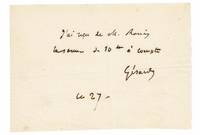
184973271s. l. 1849. Fine. s. l. 1837 ou 1849 13.40 x 9.40 cm un petit billet Autograph receipt signed ""Gérard"": ""J'ai reçu de M. Rouy la somme de 10F à compte. Gérard. Ce 27"" ""I have received from M. Rouy the sum of 10F on account. Gérard. This 27th"". Daniel Rouy was manager and cashier of the newspaper La Presse. Two transverse crease marks. This acknowledgment of debt simply dated ""ce 7"" ""this 7th"" could have been written in August 1849 if one refers to a letter to Ernesta Grisi companion of his friend Théophile Gautier in which the poet mentions such a debt: ""Je n'ai pu toucher l'argent qu'aujourd'hui mercredi. M. Rouy n'y était pas. J'y suis allé 4 fois aujourd'hui."" ""I was only able to collect the money today Wednesday. M. Rouy was not there. I went there 4 times today."" Pléiade volume 1 letter 143 of August 30 1849. However Michel Brix author of Nerval Glanes et miettes de presse and member of the Royal Academy of French Language and Literature of Belgium has very kindly pointed out to us that Nerval signed ""Gérard"" rather between 1837 and 1840 and that in 1849 he signed this kind of note ""Gérard de Nerval"". unknown
184264434Italie Italy 1842. Fine. Italie Italy circa 1842 13.50 x 20.50 cm 4 feuillets rempliés Set of four letters from Napoleon-Jerome Bonaparte to the painter Geniole two are dated August 21 and December 12 1842 6 pages in brown ink recipient address on the back of the sheets two seals of the sender in part preserved. Folds inherent in envelopes. Some tiny tasks without affecting the text. unknown
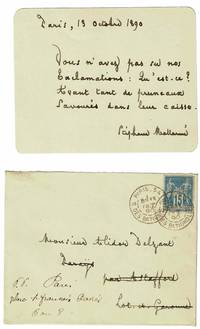
189076344Valvins 1890. Fine. Valvins 13 octobre 1890 11.40 x 8.80 cm une carte recto et une enveloppe Autograph quatrain signed by Stéphane Mallarmé addressed to Alidor Delzant written in black ink on the verso of a card. Envelope included. Alidor Delzant was a lawyer collector and bibliophile. Friend of the Goncourts he devoted a work to them and was Edmond's secretary and testamentary legatee. ""Vous n'avez pas su nos / Exclamations : Qu'est-ce / Avant tant de pruneaux / Savourés dans leur caisse"" ""You did not know our / Exclamations: What is this / Before so many prunes / Savored in their box"" Amusing stanza of thanks for the sending of prunes. unknown
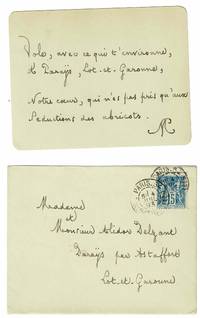
189376341Valvins 1893. Fine. Valvins 4 juillet 1893 11.40 x 8.80 cm une carte recto et une enveloppe Autograph quatrain signed by Stéphane Mallarmé addressed to Alidor Delzant written in black ink on the verso of a card. With envelope. Alidor Delzant was a lawyer collector and bibliophile. Friend of the Goncourts he devoted a work to them and was Edmond's secretary and testamentary legatee. ""Vole avec ce qui t'environne / A Paraÿs Lot-et-Garonne / Notre coeur qui n'es pas pris qu'aux / Séductions des abricots"" ""Fly with all that surrounds you / To Paraÿs Lot-et-Garonne / Our heart which is not taken only by / The seductions of apricots"" Amusing stanza of thanks for sending apricots. unknown
1892002123Boston and London: Ginn and Company. SIGNED First Edition first printing. Hard cover in original cloth. Published Boston and London: Ginn and Company 1892. 8vo. 5" x 7 1/2." v178 pages6pp. ads. Brown cloth with decorative black lettering to cover gilt lettering on spine. Inscribed "Compliments of the Author" on front fly leaf. A beautifully preserved copy in very good plus collectible condition. . Very Good Plus. Hard. 1st. 1892. Ginn and Company unknown
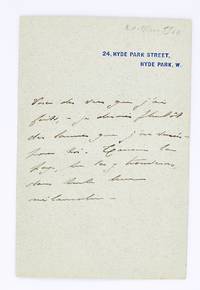
190078737s. l. 1900. Fine. s. l. 20 mars 1900 10 x 15.70 cm 2 pages sur un double feuillet Unpublished handwritten poem to Natalie Clifford Barney « à l'absente » 20 March 1900 10 x 157 cm 2 pages on a double leaf Handwritten poem entitled « à l'absente » To the absent one and addressed to Natalie Clifford Barney. Two pages written in black ink on a double leaf headed 24 Hyde Park Street. To our knowledge this three-verse octosyllabic poem is unpublished. It is preceded on the first section of this double leaf by a little handwritten message: These are the verses I have made I would rather say the tears which I have shed for you. Turn the page you will find them there in all their melancholy. Oui c'est toi mon rêve suprême Pendant ces longs ces mornes jours Où je pleure au fond de moi-même L'exil triste de mes amours! . N'as-tu pas entendu ma blonde Le bruit d'un sanglot qui revient Dans le cur de la nuit profonde C'est mon amour qui se souvient. It is at the end of 1899 and through Violette Shillito that Renée Vivien then Pauline Tarn met Natalie Clifford Barney ""this American woman softer than a scarf whose sparkling face shines with golden hair sea blue eyes never-ending teeth"" Colette Claudine à Paris. Natalie who had just experienced a summer romance with the scandalous Liane de Pougy who introduced her to sapphism paid little attention to this new acquaintance. Renée on the other hand was totally captivated by the young American woman and describes this love at first sight in her autobiographical novel Une femme m'apparut: ""I lived again the hour already well past when I saw her for the first time felt the shiver that ran through me when my eyes met the mortal steel of her look those eyes blue and piercing as a blade. I had a dim premonition that this woman would determine the pattern of my fate and that her face was the predestined face of my Future. Near her I felt the luminous dizziness which comes at the edge of an abyss or the attraction of a very deep water. She radiated the charm of danger which drew me to her inexorably."" ""Winter 1899-1900. Beginnings of the idyll. One evening Vivien is invited by her new friend to Mme Barney's studio Natalie's mother 153 avenue Victor-Hugo on the corner of the rue de Longchamp. Natalie finds the courage to read the verses of her composition. As Vivien tells her to love these verses she tells her that it is better to love the poet. A response worthy of the Amazon."" J.-P. Goujon Tes blessures sont plus douces que leurs caresses Two years of unequal happiness will follow punctuated by Natalie's recurring infidelities and Renée's sickly jealousy the letters of which oscillate between inflamed declarations and painful admissions of guilt. ""Renée Vivien is the daughter of Sappho and Baudelaire she is the 1900 flower of evil with fevers broken-up fights sad delights."" Jean Chalon Portrait d'une séductrice In 1901 a major break-up occurred which lasted almost two years; Renée despite requests from Natalie and the others she sent to win her back resisted. ""The two friends saw each other again and in August 1905 went on a pilgrimage to Lesbos which was a disappointment for Natalie Barney and was short-lived. . The spring was broken once and for all. The two former friends stopped seeing each other in 1907 and Vivien died without them seeing each other again."" J.-P. Goujon ibid. unknown
18833787bx123<p>Boston: Lee And Shepard. NY: Charles T Dillingham. Fair/ndj. 1883. First Edition. Hardcover. Brown cloth gilt. Tipped-in b/w photo frontis portrait hand-signed by the author: "Nancie A. W. Priest". With waterstain to boards and top edge of the first 200pp. Pulling at front hinge but holding.; 12mo 7" - 7½" tall; 391 pages; Signed by Author. bx133</p><p>Wikipedia: She was born at Royalston Massachusetts in 1836. She worked in a mill in New Hampshire for several years.2 Her fame rests upon the popular poem "Over the River" published in the <em>Springfield Republican</em> in 1857. According to some accounts she wrote the first draft of the poem while at work in the mill.23</p><p>In 1865 she was married to Lieut. Arlington C. Wakefield. She died at Winchendon Massachusetts in 18704 leaving behind her husband and three children one only an infant.</p><p>Her poems were published 13 years after her death by her mother Mrs. Francis D. Priest with a memoir by the Rev. Abijah Perkins Marvin Boston 1883.</p><p>Her poem entitled "Over The River" carried her name to wherever the English language was read. In the many years since publishing the poem 1857 it has been set to music by six to eight different composers and was included in Volume 111 of "The Worlds Best Poetry" 1904. Upon the death of President Lincoln she wrote a hymn that was sung to the tune of "America" by over 800 at a memorial service held in the Town Hall.<br /><br />A volume of her poems were published by her mother in 1882 entitled "Over the River and other Poems" with forward by A. P. Marvin who said "there are some specimens of poetry in this collection which bear the stamp of genius".</p> Boston: Lee And Shepard. NY: Charles T Dillingham hardcover
1893039619San Francisco 1893. Original Signed Photograph . No Binding. Fine. 7" x 5. Original Photograph Image 4 1/2" X 3 7/8" Mounted On Plain Card With Rounded Corners. Inscribed By Irving To "Sweet Charlotte" And Dated 1893. Note On Verso Explaining That It Was Obtained Backstage When She Was Taken To San Francisco By Rosa Bradbury And Her Sister. <br/> <br/> unknown
187275733Nohant Nohant-Vic 1872. Fine. Nohant Nohant-Vic 19 semptembre 1872 13.20 x 20.60 cm 20 pages 1/2 sur 21 feuillets Autograph manuscript signed by George Sand written in black ink on 21 leaves of white paper. Deletions and corrections. One page of the manuscript appears to have been lost. The final version of this chronicle whose text conforms to the manuscript we offer was published in Impressions et souvenirs Paris M. Lévy 1873. George Sand would devote another article to her son's novel in Questions d'art et de littérature in 1878. The first edition of Maurice Sand's Coq aux cheveux d'or was published by Lacroix and Verboeckhoven in 1867. unknown
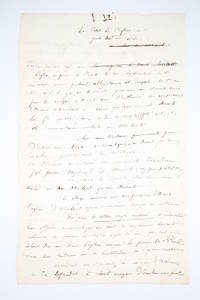
186076834s. l. 1860. Fine. s. l. s. d. ca 1860 19.60 x 31.70 cm deux pages sur un feuillet Autograph manuscript by Gustave Flaubert entitled ""De l'état de l'église en Gaule au Ve et VIe siècle"" written in black ink on both sides of a sheet. Transverse fold. Extensive manuscript notes probably written in preparation for the writing of La Légende de Saint Julien l'Hospitalier. Precious manuscript evidence of the writer's working method. unknown
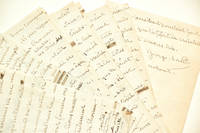
1899622111899. Fine. 1899 17.80 x 23.10 cm 2 feuillets et un quart Autograph manuscript signed by Octave Mirbeau for his article ""Au conseil municipal"" published in Le Journal on July 12 1899 90 lines in black ink on three leaves manuscript correction by the author typographical indications in blue pencil. Staining due to ink and paper. Significant of the denunciatory attitude that Mirbeau maintained in his articles this manuscript critical of the unworthy treatment of artists of genius by society is a final draft used for printing as indicated by the capital letters that delimit the paragraphs. The original leaves have been remounted on laid paper here pages from an 18th-century work Dissertatio Medica to facilitate their handling. unknown
1840640991840. Fine. s. d. circa 1843 13.20 x 21.90 cm 4 feuillets Admirable set of four manuscript fragments of chapter XI of the Voyage d'Espagne which exposes behind the scenes of Gautier's writing which guided by the romantic taste for the picturesque relates his stays in Madrid and Ocaña and his passages by La Guardia and Tembleque . Gautier adopts an astonishing working format revealing the intimate / particular process of writing where flying sheets of different sizes very tight writing and corrections and inks of different colors come together. Originally intended for a publication in the press Gautier's article itself seduced by Spanish exoticism satisfies the search for picturesque then at its peak in France: "" The perpetual carousel of the fans that open close throb and flap like butterflies trying to land; the elbow movements of the women grouping themselves in their mantillas and correcting the inflection of an unsightly fold; the glances launched from one cross to the other to the people of knowledge; the pretty nod of the head and the graceful gesture which accompanies the agur by which the senhoras reply to the horsemen who salute them; the colorful crowd intertwined with Gallegos Pasiegas Valencians Manolas and water vendors "" Gautier establishes links between known references to Spain: Don Quixote and finds picaresque resonances in the adventures he saw: They were men Beyond the simple satisfaction of the public Gautier offers a glimpse of the Spanish character and bon vivant: sobriety and the patience of the Spaniards to endure fatigue is something that is prodigious. They remained Arabs on this point. One can not go further than the oblivion of material life. But these soldiers who lacked bread and shoes had a guitar. unknown