25 résultats
1791865701791 Rome, Ecole Française de Rome (n°179), 1993, très fort volume grand in 8° broché, 966 pages ; tableaux généalogiques, figures et cartes ; couverture illustrée.
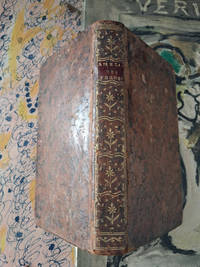
1765MP009<p><strong>Paris Chez Durand Neveu 1765.</strong> Third edition originally published in 1758. In-12vo $10.5 times 16$ cm. xii 285 pp. 3 pp. Table & Approbation.</p><p>Bound in a handsome contemporary full mottled calf binding. The spine is exceptionally well-preserved featuring five compartments intricately decorated with gilt floral motifs and a gilt-lettered burgundy morocco title label reading <em>"AMELIO DES TERRES"</em>. Covers show light rubbing and mild surface wear consistent with age but remain sturdy and highly attractive on the shelf. Marbled endpapers intact.</p><p>The title page features a beautiful decorative woodcut vignette reading: <em>"Essai sur l'Amélioration des Terres. A Paris Chez Durand Neveu. M. DCC LXV. Avec Approbation & Privilège du Roi."</em></p><p>Pages are preceded by a famous dedication address to <strong>Madame de Pompadour</strong> <em>"A Madame de Pompadour. Madame Parmi les Arts qui ont ressenti les effets de votre pro."</em>. While signed by Pattullo this introductory piece on physiocracy and the economic importance of agricultural reform was famously drafted by the Enlightenment writer Jean-François Marmontel at the request of François Quesnay.</p><p><strong>Condition Notes:</strong> Text block is secure and generally clean with light uniform age-toning and very minor spotting. Binding is worn but structurally intact and retains a very authentic period feel. <em>Note: This copy is sold as-is lacking the 3 folding plates often missing from later printings.</em> An essential mid-18th-century agronomy and political economy tract.</p> Chez Durand, Neveu, Libraire (Paris) hardcover
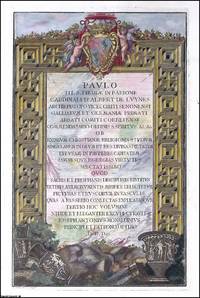
1767373395Johann Zempel Rome 1767. Unframed Print. Very Good Condition. DEDICATION LEAF ONLY. Ornately designed with allegorical putti and a heraldic escutcheon the dedication blends ecclesiastical gravitas with Enlightenment elegance. Its florid Latin extols Cardinal de Luynes Christian virtue classical erudition and patronage of antiquarian art. Printed in Rome it honours both the Cardinal and the Etruscan studies he helped bring to light. Engraving 25 x 38 cms sheet 30 x 45 cms. Later hand colouring. Text is in Latin. Category: PRINTS : Antiquarian Interest; PRINTS : Historic Interest; Printed before 1800; Latin Language; Special Features. This item may require more postage than the rates shown for delivery outside the UK. If extra postage is required we will contact you before processing your order and you will be given the details and option to decline the extra cost. Johann Zempel unknown
17934547DB(Winterthur, Steiner), 1793. 12°. 360 S., Mit handschriftlicher, von gest. Bordüren umrahmter Titel. Marmorierter Pappband mit Rückenschild (beschädigt) aus Papier.
17934547DB(Winterthur, Steiner), 1793. 12°. 360 S., Mit handschriftlicher, von gest. Bordüren umrahmter Titel. Marmorierter Pappband mit Rückenschild (beschädigt) aus Papier. + Wichtig: Für unsere Kunden in der EU erfolgt der Versand alle 14 Tage verzollt ab Deutschland / Postbank-Konto in Deutschland vorhanden +, 4547DB
1795RO80046298BARBA. 1795. In-12. Broché. Etat d'usage, Couv. légèrement passée, Dos satisfaisant, Rousseurs. 83 pages. Papier à la forme. Couverture non originale.. . . . Classification Dewey : 97.2-Dédicace, envoi
1799116633fauche 1799 Hambourg et Brunswick, chez P. F. Fauche et compagnie, 1799, 1 volume in-8 de 125x210 mm environ, XIV, 170 pages, (3) ff. (table des matières), avec 13 planches dépliantes. Envoi de l'auteur. Demi-reliure, dos long orné portant titres dorés sur pièce de cuir rouge. Exemplaire solide malgré les défauts à signaler, mors fendillés (un mors interne apparent), coiffes accidentées, coins dénudés, des rousseurs sinon intérieur en bon état.
172321208London: Printed by S. Palmer 1723. First English language edition. Hardcover. f to vg. Large quarto. XXVIII 540pp. Original gilt-stamped calf with gold lettering on spine. Raised bands. Marbled endpapers. Engraved frontispiece. Vignette on title page. Title in red and black lettering. Decorative head- tailpieces and initials. Originally published in 1696 "Apparatus biblicus" is a development of the author's "Introduction à la Lecture de l'Ecriture Sainte" 1689. In this work he calls in question the historical character of the Book of Tobias and the Book of Judith and maintains that even after the Council of Trent a difference of authority should be recognized between the proto-canonical and deutero-canonical books of the Bible. This work examines also subjects such as the history of the Hebrews and the Holy Land a description of the Tabernacle and Temple a history of the scriptures and a great many tangential matters like the plants animals minerals diseases and customs mentioned in the Bible. Illustrated with thirty striking copper plates including frontispiece with a folding map of the known world. This work is divided into three parts: 1 Of the Origin History and Antiquities of the Jews; 2 Of the Canon; 3 Of the False Gods together with an Explanation of Scriptural Names. Many of the plates are folded and some depict the following views: Map of the World; Noah's Ark; the Tower of Babel; Map of the Holy Land; Plan of the Ancient City of Jerusalem; the Ark of the Covenant; the Temple; the High Priest; the Great Sanhedrim; etc. Head and tail of spine chipped. Rubbing along edges of binding. Front hinge starting but front board still firmly attached. Minor to moderate age-toning/foxing to very first and very last pages. Minor worming and water-staining to upper margin of the last hundred pages not affecting text or plates. Binding in overall fair interior in good plates in very good condition. About the author: Bernard Lamy 1640-1715 was a French Oratorian mathematician and theologian. Printed by S. Palmer hardcover
1740007740London: Printed for the Editor 1740. Book. Very Good Plus. Full Calf. Second Edition. 8vo - over 7¾" - 9¾" tall. Frontispiece engraving of Matthew Prior by J. Parr Sculpt. viii 472 index 8 pp. Bound by J. Clarke in full calf double gilt rule border to covers spine in six compartments with red and black morocco labels and gilt rules all edges gilt marbled end pages. Very Good Plus the spine repaired in keeping although the repair leaving the end pages rubbed at gutters small period bookplate bearing a dragon the name on the bookplate obscured. covers a bit rubbed and lightly soiled. The text clean and bright. A quite nice ccopy and rather uncommon thus. Printed for the Editor Hardcover
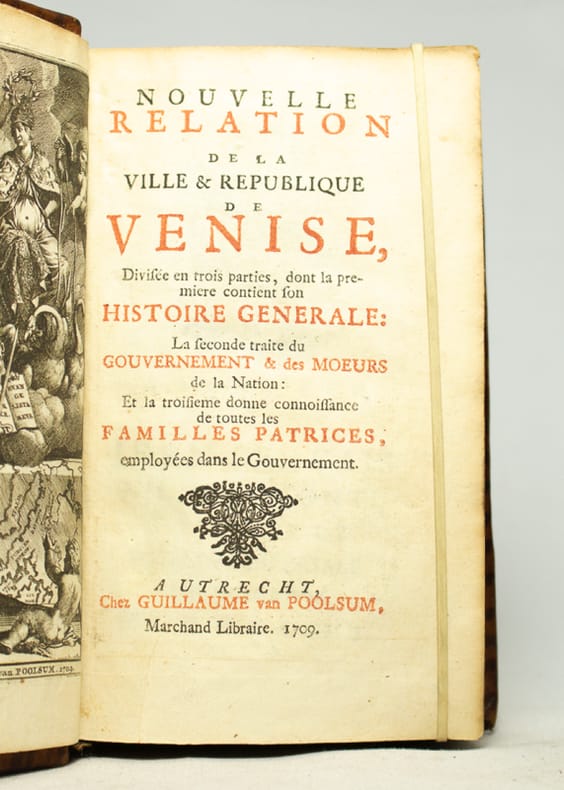
170916800Utrecht, Guillaume van Poolsum, 1709. Un volume in-12 de [22]-456-214-[14] pages, plein veau marron, dos à nerfs orné de filets et fleurons dorés, pièce de titre rouge, tranche mouchetée de rouge.
177130605Paris: Le Bas 1771. Nouvelle edition. Hardcover. Good. Four volumes 12mo. 3 130 235 85 71 leafs. Decorative paper covered boards spines worn. Remarkable narrative of Sacred History first published between 1760 and 1762. Illustrated mostly by Le Maire but also by Masquelier du Clos Gauché and many others. These volumes consist of an unascribed bilingual text Latin and French to accompany plates illustrating Biblical scenes along with short interspersed series of scenes drawn from Homer and Virgil and a gallery of Muses by way of conclusion with captions derived from Ausonius; the plates owe much to Goltzius Diepenbeeck and Le Temple des Muses and anticipate some of Le Mire-Basan's "Métamorphoses Gravées" Paris 1770. Bindings rubbed along joints and edges. Corners bumped not affecting pages throughout. Rear cover of second volume glued. Lacks the first leaf of Le Maire's dedication to the Duke of Burgundy. Otherwise this work is complete! Sporadic and very minor age toning throughout. Text in French and Latin. A good set. Le Bas hardcover
1740007740London: Printed for the Editor 1740. Frontispiece engraving of Matthew Prior by J. Parr Sculpt. viii 472 index 8 pp. Bound by J. Clarke in full calf double gilt rule border to covers spine in six compartments with red and black morocco labels and gilt rules all edges gilt marbled end pages. Very Good Plus the spine repaired in keeping although the repair leaving the end pages rubbed at gutters small period bookplate bearing a dragon the name on the bookplate obscured. covers a bit rubbed and lightly soiled. The text clean and bright. A quite nice ccopy and rather uncommon thus. . Second Edition. Full Calf. Very Good Plus/No Jacket As Issued. 8vo - over 7¾" - 9¾" tall. Printed for the Editor Hardcover books
1792RO40234592Imprimerie Nationale, Paris. 1792. In-8. En feuillets. Etat d'usage, Livré sans Couverture, Dos satisfaisant, Mouillures. 3 pages. Signature de Danton, tampon révolutionnaire rouge et annotations d'époque (certification) en dernière par. Petits manques sur les coins supérieurs du fait de la mouillure (sans altération de la lecture).. . . . Classification Dewey : 97.2-Dédicace, envoi
175343705Neapoli Naples Italy: Excudebat Joseph Raymundi. 1753. First Edition Thus. Hard Cover. Very Good. 4to; 12 335 1 errata pp pages; Mid-eighteenth century sprinkled brown calf raised bands and decorative gilt stamped decoration in spine panels with red title label edges of the text block stained red. The dedication copy of the Latin edition of Dr. John Arbuthnot's last book -- An essay concerning the effects of air on human bodies London printed for J. Tonson in the Strand 1733. With the bookplate of the dedicatee of this 1753 first Latin edition -- Niccolò Fraggianni. A full page engraved portrait of Fraggianni is included facing the text of the dedication of this edition to him. The binding displays some insect damage along portions of the outer gutter margins and at the red leather titling slip on the spine. Internally there is some minor damage which gets progressively less apparent to the front endpapers the half title and title page. At the rear there is similar damage to the endpapers but just a tiny hole in the gutter margin of the errata leaf. There is also a modest damp tide mark to the blank bottom margins of the final twenty pages. Dr. Arbuthnot was born in Scotland and in early life by training and habit of mind thought of himself as a mathematician. He came to London in 1691 the year his father a non-conforming Scottish minister had died. In London the following year Arbuthnot published 'Of the Laws of Chance' -- more or less a translation from the Latin text of Christiaan Huygens's 'De ratiociniis in ludo aleae.' This is widely thought to have been the first work on probability published in English. Arbuthnot became the tutor to a well-born son of a member of Parliament follwed his charge to Oxford where he met many eminent figures of the time -- including Isaac Newton and Samuel Pepys. Arbuthnot felt that he would benefit in life by the formal possession of an advanced degree but did not have the necessary financial backing to spend years as a student. Thus impelled by circumstances he set what I believe must be an all-time speed record for obtaining an earned doctoral degree. He returned to his native Scotland entrolled as a doctoral student in medicine at the University of St. Andrews on 11 September 1696. On that busy day Arbuthnot defended seven theses dealing with medical subjects -- and was awarded his doctorate before that same day had come to a close. Arbuthnot used this new medical degree along with what must have been a vast repertoire of conversation and helpful advice to take advantage of a chance meeting to become physician to Prince George and then to his wife Queen Anne. For ten years he moved in higher and higher circles eventually becoming a member of the Royal household. And even after Queen Anne died without arranging for the continuing support of Dr. Arbuthnot and her other inner staff he never strayed far from the various London circles of power and high achievement. Today he is probably best remembered as a founder of the "Scriblerus Club" -- with his friends Pope Gay Swift Thomas Parnell Harley and Bolingbroke. Because Arbuthnot became famous among these friends for ducking credit as author of a number of poems and satires and his numerous contributions to the works of others. Certainly few would dispute that Arbuthnot had a major influence on Swift's "Gulliver's Travels -- which he saw in various manuscript drafts -- during which he almost certainly influenced its satirical portrayal of the Royal Society the real version of which Arbuthnot had been made a member in 1704. The traditional notion is that this book was not particularly important in the history of medicine since while the idea of "fresh air" is both pleasant and beneficial -- the air could hardly manage to carry pathogens responsible for spreading major disease. When Fielding Garrison wrote his pioneering American history of medicine in 1913 he mentions Dr. John Arbuthnot in his survey of the English Eighteenth century and treats him as the creator of "John Bull" -- friend to Swift and Pope and incidentally physician to Queen Anne. And it was not until four years after Garrison's death that scientists first were able to "see" a virus using the newly developed electron microscope. Naples became a center for publication of medical books in Latin during the eighteenth century. The translator of this text into Latin Fortunatus del Felic held the chair of experimental physics and mathematics at Naples University. He expanded his Lain text on a local point of interest. Dr. Arbuthnot's 1733 English text -- Section XVII of the first chapter -- refers to the "mortiferous Stream in the Grotto del Cane near Naples." The 1753 Latin text contains 8 full double columns of notes on four pages devoted to the nature and literature of this unusual place ranging from classical times forward. Moreover since the grotto represents one of earth's most unusually concentrated exhalations of carbon dioxide into the atmosphere there is more potential interest in Dr. Arbuthnot's fascination for this location and what it might meanfor the earth and life on the planet in the twenty-first century than might have been the case a century ago when this eighteenth century book was usually dismissed by historians of medicine and science as a relatively minor work. Through this Latin translation Fortunato Bartolomeo de Felice 1723 – 1789 also known as the second Comte de Panzutt attracted the attention of Albrecht von Haller -- who influenced Felice to move to Swizerland where he eventually became one of the most important publishers of his time. More about the status of this copy as "the" dedication copy. While it sometimes occurs that the dedicatee of a book has many copies to distribute to friends and colleagues it really does appear that this copy has a unique status. We can find no other copies in library catalogues of copies in which the distinctive bookplate of Niccolò Fraggianni is reported. Moreover there is an ink inscription about the history of our copy following the death of Fraggianni in February of 1763. "Quondam / Nunc Aloysii Ranatila Scarpacci / Philosophiae et Medicinae Doctoris / 1768." . Excudebat Joseph Raymundi hardcover
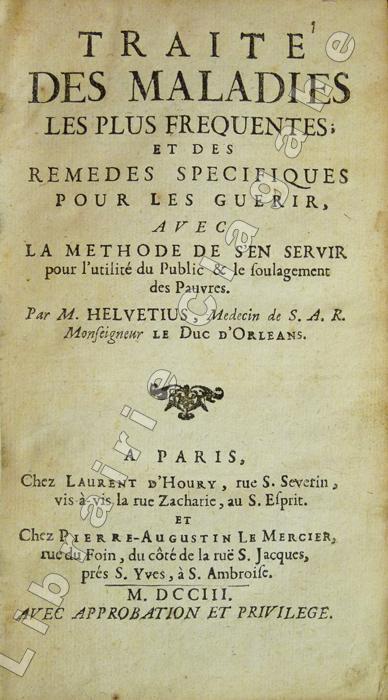
17034532Paris, Laurent d'Houry et Pierre-Augustin Le Mercier, 1703 ; in-12 ; pleine basane brune, dos à nerfs orné et doré, pièce de titre rouge, roulette décorative dorée sur les coupes (reliure de l'époque) ; (15 + 1) ff., pp. 3 - 318, (13) ff. de tables et privilège.
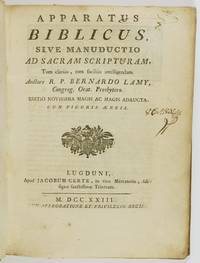
172347525Lugduni Lyon: Jacobum Certe 1723. Editio Novissima New edition. Hardcover. g- to vg. Quarto. 20 412 62 table and indices 11 plates 10 folding bound in 1 folding alphabet 11 plates at rear. Full vellum with brown lettering on spine. Title page with publisher's device. Decorative head- and endpieces historiated initials.<br /> <br /> In this work Bernard Lamy the renowned French Oratorian mathematician and theologian calls in question the historical character of the book of Tobias and book of Judith and maintains that even after the Council of Trent a difference of authority should be recognized between the proto-canonical and deutero-canonical books of the Bible. This study examines also such subjects as the history of the Hebrews and the Holy Land a description of the Tabernacle and Temple a history of the scriptures and a great many tangential matters like the plants animals minerals diseases and customs mentioned in the Bible. This book is exquisitely illustrated with 22 fine copper plate engravings ten of them folding in block one folding plate with Greek and Hebrew alphabet and eleven plates bound at rear. The eleven plates at rear depict animals and plants the others include two maps a plan of Jerusalem a detailed temple plan a priest with garments a rabbi with tefillin and 3 charts of coinage and measurements. Text in Latin. Binding with some wear few small chips slightly wavey some staining and light scuffing at spine. Some parts of book with stains at top margins due to water exposure. Binding in overall good- interior and plates in very good condition. About the author: Bernard Lamy 1640-1715 was a French Oratorian mathematician and theologian. Jacobum Certe hardcover
178516514A Paris, de l'imprimerie de Ph.-D. Pierres, 1785. In-12 de [4]-4-48-[4] et 21 pages de musique gravée, plein maroquin rouge, dos lisse orné de filets, points, étoiles et ronds dorés, pièce de titre en maroquin vert, triple filet encadrant les plats, écoinçons dorés aux angles, roulette dorée aux coupes et aux chasses, tranches dorées.
176717472Paris, Hérissant fils, 1767. Deux tomes en trois volumes in-4 de XVI-686 (numérotées 664)-[22]; [4]-560-[24]; [4]- 408 (numérotées 300-666)-CCLXXXII-[28] pages, plein veau brun havane marbré, dos à nerfs orné de fleuron et petits fers dorés, roulette fleurdelissée dorée à la pièce de tomaison, pièce de titre en maroquin camel, triple filet estampé à froid en encadrement des plats, double filet doré aux coupes.
177620735London, Printed for G. Robinson, 1776. In-8 de [27]-XXI-[1]-266 pages,plein veau marron, dos à nerfs ornés de filets dorés, pièces de titre rouge, tranches rouges.
17368673Amsterdam, J. Wetstein et G. Smith, 1736. 2 volumes in-4, frontispice, [14]-LXXV-[1]-696; [4]-848 pages, plein veau fauve, dos à nerfs ornés de filets et fleurons dorés, pièces de titre et tomaison en maroquin rouge, double filet doré sur les coupes, roulette dorée intérieure. Epidermures et petit manque de peau sur un plat, coiffe inférieure du second volume abîmée, hormis une pâle trace d'humidité aux 30 derniers feuillets du premier volume, intérieur en parfaite condition.
17846038Paris, Gueffier, 1784. 2 volumes in-8 de [4]-XVI-396p. ; [4]-474-[2]p., plein veau marbré, dos à nerfs ornés de filets et fleurons dorés, pièces de titre en maroquin rouge. Bel exemplaire en très jolie condition.
177216580Paris, Le Mire, 1772. In-4 de [3]-VII-104 pages, plein maroquin cerise à grains longs, dos à nerfs orné de filet et fleuron dorés, roulette dorée en encadrement des plats, double filet aux coupes et dentelle dorée aux chasses, tranches dorées. Séduisante reliure de l'époque joliment conservée.
177116613In Parigi, Apresso Agostino Delalain, Pietro Durand, Gio. Claudio Molini, 1771. 2 volumes grands in-4 de 331; 340 pages, plein maroquin rouge, dos à nerfs ornés de fleurons et petits fers dorés, triple filet doré en encadrement des plats, double filet aux coupes et roulette dorée aux chasses, tranches dorées.
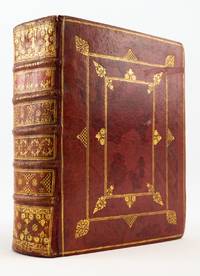
1710ST19567-052Cantabrigiae Cambridge: Cornelius Crownfield 1710. THE DEDICATION COPY ONE OF 150 ON LARGE PAPER per Mackenzie. 248 x 192 mm. 9 3/4 x 7 1/2". 4 p.l. xxiv 532 2 318 283-304 pp. 84 leaves.Edited by Rev. Joseph Wasse. <br/> FINE CONTEMPORARY RED MOROCCO GILT covers panelled with gilt fillets accented with fleuron acorn and scallop tools raised bands spine compartments densely gilt with similar tools red morocco label marbled endpapers all edges gilt probably with some very facile repairs to top and bottom of joints and spine. Front pastedown with the armorial bookplate of the dedicatee Henry Grey Duke of Kent dated 1713 and with the armorial ex-libris of Robert Offley Ashburton Crewe-Milnes Marquess of Crewe; front free endpaper with engraved armorial bookplate of Thomas Philip Earl de Grey see below for all. Dibdin II 385; Mackenzie "The Cambridge University Press 1696-1712" I 273-76. ◆Front joint with thin crack at head and tail covers with darkish splotches obvious but somehow not overly offending with antique morocco like this other very minor signs of use but the binding still extremely pleasing as a grand specimen for an important dedicatee. A MOST ATTRACTIVE COPY INTERNALLY especially clean and fresh with only negligible imperfections.<br/> <br/> This is the stately dedication copy of Wasse's monumental edition of Sallust in its original handsome unrestored binding. Described by Dibdin as "an excellent edition . . . the merits of which have long been acknowledged by the literary world" our version was prepared by Wasse after consulting nearly 80 manuscripts including "some very ancient editions." A huge undertaking it spent five years in the press. Oxford Antiquary Thomas Hearne mentioned it in his "Remarks" amazed that "Mr. Wasse . . . has so swell'd his Salust sic . . . with Notes" that "his Index will be upwards of 20 sheets"; in fact the Index consumes 84 leaves 21 quires. The text of the present volume contains the only two extant historical works of Sallust 86-34 B.C. which are his history of the conspiracy of Catiline against the senate in the year Cicero was consul and his history of the Roman war against the Numidian Algerian chieftain Jugurtha brought to its conclusion by the great soldier and populist politician Marius. As a stylist Sallust has enjoyed great fame for his artistic and epigrammatic speeches with their vividly delineated characters. A fellow of Queen's College Cambridge Joseph Wasse 1672-1738 served as chaplain to the Marquess later Duke of Kent Henry Grey 1671-1740 to whom he dedicated this work. The handsome binding is of very high quality and is decorated in the Cambridge style by an unknown binder of that city. Grey was a courtier who held a number of prominent positions: under Queen Anne he served as Lord Chamberlain of the Household and Knight of the Garter and as one of the Lords Justices Regents of the Realm upon her death; under George I he was Lord of the Bedchamber Lord Steward of the Household and Lord Keeper of the Privy Seal. Our volume was passed down in his family through the line of his granddaughter Jemima Campbell Marchioness Grey to Thomas Philip de Grey 2nd Earl de Grey 1781-1859 an amateur architect who rebuilt the family seat Wrest Park in Bedfordshire. He became the first president of the Royal Institute of British Architects. It was later in the 24000-volume library of the politician Robert Crewe-Milnes 1858-1945 Marquess of Crewe. Cornelius Crownfield unknown
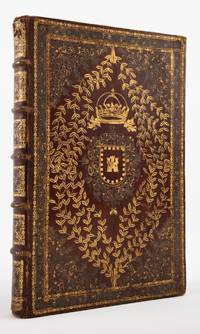
1714ST20995Naples: Bernardo-Michele Raillard 1714. 343 x 223 mm. 13 1/2 x 8 3/4". 6 p.l. CCLXIX 15 pp. <br/> IMPOSING CONTEMPORARY BROWN MOROCCO EXUBERANTLY GILT covers with painted and gilt frames of floral rolls central panel with elaborate volute cornerpieces large central lozenge formed by myriad leafy gilt vines enclosing a coat of arms containing a three-turreted castle topped by a crown held up by two putti raised bands spine compartments framed by floral roll painted and gilt daisy centerpiece tulip cornerpieces all edges gilt. The Academy's engraved device on title page and 75 ENGRAVED PLATES of scientific instruments and experiments. DSB 9:3; Dibner Herald of Science 82 first edition. Joints with modern wear one short crack at top of rear joint head of spine a bit wormed corners and extremities somewhat rubbed gilt a bit rubbed in spots difficult to tell if some of the decoration is dark because painted or is now missing gilt a couple of leaves slightly browned in the text bed occasional minor foxing more pronounced on a couple of quires other trivial imperfections but an excellent copy--quite clean and fresh internally--in a solid binding still bright with gilt.<br/> <br/> Given its binding and provenance this is a uniquely desirable copy of a significant scientific work: our stately Neapolitan edition of the "Essays on Natural Experiments" is offered here in very animated morocco bearing the arms of the man who paid for its printing and to whom the book is dedicated. That remarkable patron Caesare Michelangelo d'Avalos Marquis of Pescara and Vasto prince of Isernia and Francavilla 1667-1729 was a true Renaissance man who took Machiavelli's "The Prince" as inspiration. He was both a wily political conspirator and a generous patron of the arts and sciences. His palace at Vasto was renowned for the beauty of its furnishings for its splendid art gallery and for its impressive library overseen by the humanist scholar Alessandro Berti. The present volume was a worthy addition to that library with its glowing dedication and its regal binding extravagantly gilt but so tastefully composed that it never crosses the line into ostentatious. <br /> First printed in 1666 "Essays" was produced by the Accademia del Cimento the most significant expression of post-Galilean scientific progress in Italy. Founded in 1657 as the first organization formed for the sole purpose of making scientific experiments the Accademia occupies a singular position in the history of the development of science. Prince Leopold of Tuscany the last exceptional member of the Medici family and his brother Ferdinand who followed the Medici family tradition of patronizing the arts and sciences provided the support free-thinking direction and financial patronage for the Academy. A well-equipped laboratory and an apparently inexhaustible supply of apparatus and materials helped to make the work of the 10 scientists associated with the Academy more sustained and broader in scope than anything that had come before it. W. E. K. Middleton "The Experimenters" According to Thorndike among many other subjects the experiments described here "were concerned with air pressure and freezing; or they aimed to prove that water was incapable of compression and that there was no such thing as lightness or positive levity. Some experiments were magnetic and others electric the latter being chiefly performed with amber. Other subjects investigated were the change of colors in fluids the motion of sound and projectiles." Although no author is given by name the title page of the 1666 first edition indicated that this account was written by the secretary to the academy Lorenzo Magalotti 1637-1712. A pupil of Viviani and a friend of Boyle Magalotti was celebrated for his highly finished colorful almost dramatic descriptions of experiments. DSB notes "He has the distinction . . . of having written the best scientific prose in Italian after that of Galileo.". Bernardo-Michele Raillard unknown