Helvetius, Jean-Adrien (circa 1661 - 1727) :Livre Rare Book
29 403 résultats
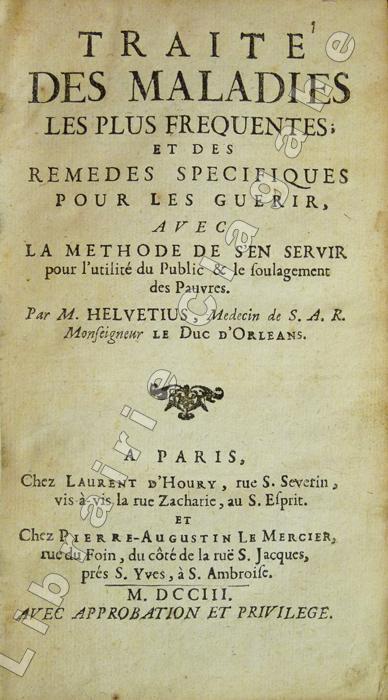
17034532Paris, Laurent d'Houry et Pierre-Augustin Le Mercier, 1703 ; in-12 ; pleine basane brune, dos à nerfs orné et doré, pièce de titre rouge, roulette décorative dorée sur les coupes (reliure de l'époque) ; (15 + 1) ff., pp. 3 - 318, (13) ff. de tables et privilège.
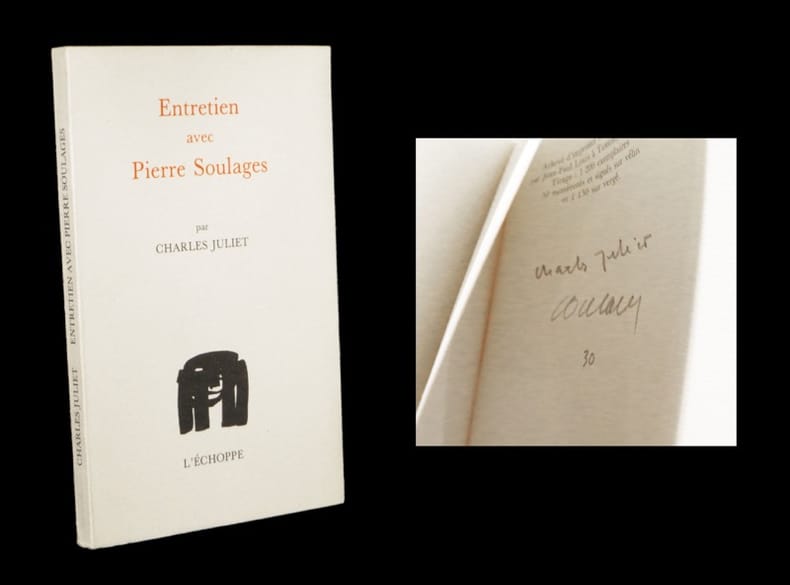
199029753(Caen), L'Echoppe, (1990). Un vol. au format pt in-12 (183 x 123 mm) de 40 pp., broché, sous couverture titrée à rabats rempliés.
52023Les Cahiers Verts.Grasset.1923.In-8 en demi-reliure à coins en maroquin blond.E.O.Dédicace de l'Auteur.Ex.CXXXIV.Portrait par Raymonde Heudebert.TBE.
1979014805Paris Gallimard NRF 1979 In-8 Broché Dédicacé par l'auteur
40964Paris, 25 mars 1957. 32,5 x 25,5 cm, 2 ff.
41318Paris, Léon Vanier, 1886. Pt. in-8° étroit, 168p. Reliure demi-chagrin noir à coins, dos à nerfs.
40193Paris, Emile-Paul Frères, 1925. In-4°, 183p. Broché, couverture illustrée rempliée.
29793Sans lieu, Les arts Terrestres, 1960. In-8°, 57p. en feuilles, sous couverture illustrée rempliée.
1934011800Paris Robert-J. Godet 1934 In-8 Demi-reliure
188055221880 Paris Maurice Dreyfous éditeur 1880 In12 bradel plein papier pièce de titre 412 pages couvertures conservées - Reliure signée (Armelle Guégant)
197724391977 Bièvres (Moulin de Vauboyen), Pierre de Tartas, 1977. 38,5 x 28,5 cm, in-folio, 1 f. bl. - 46 ff. n. ch. - 1 f. bl., 17 grandes lithographies originales en couleurs dans le texte dont 8 sur feuilles pliées en 4 (triptyques), en feuilles sous couverture de tissu bleu marine rempliée et illustrée en blanc cassé, boîtier de l'éditeur portant au premier plat la signature imprimée de Chapelain-Midy et le titre en hébreu au dos.
110845Paris, Maison Quantin, Compagnie Générale d'Impression et d'Edition, 1886, 1 volume in-8 de 235x160 mm environ, xix-294 pages, demi-reliure à coins en maroquin vert émeraude, dos à 5 nerfs portant titres dorés, orné de caissons à motifs dorés, cuir souligné d'un filet doré sur les plats, gardes marbrées, tranche de tête dorée, couvertures d'origine conservées. Ex-libris de Henri Lavedan sur le premier contreplat, avec une lettre autographe de Goncourt sur Japon adressée à Lavedan + N° 274 de : Les Hommes d'Aujourd'hui avec une caricature de Goncourt et un texte de Verlaine sur celui-ci + un envoi des auteurs à Lavedan. Illustré de 10 compositions par Jeanniot, gravées à l'eau-forte par L. Muller. Cuir légèrement décoloré sur le dos, sinon bon état
1893010081Paris Alphonse Lemerre 1893 Demi-reliure
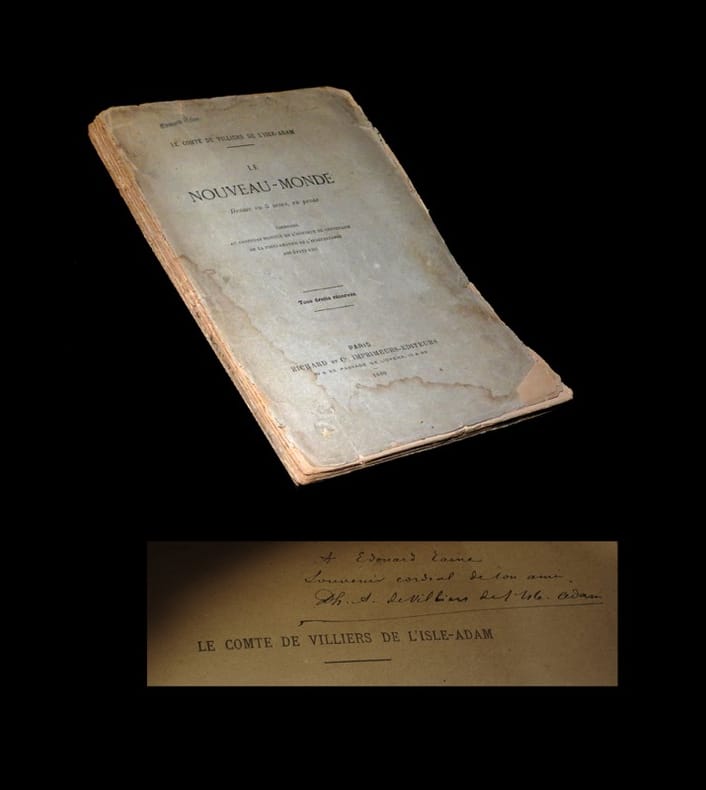
188019351Paris, Richard, 1880. Un vol. au format in-8 (252 x 168 mm) de xiv pp., 1 f. n.fol. et 190 pp., broché.
199167<p>Très rare exemplaire d' Aktfotos dédicacé signé et daté par l'auteur Jacques Alexandre grand ami de Bourboulon.</p><p>Il a écrit : " Pour un collectionneur éclairé avec toute mon amitié Jacques Alexandre Cologne 10.09.1999."</p><p>Ce qui en fait une copie presque unique on notera que l'auteur ne nomme pas le collectionneur donc la valeur est largement supérieure à une dédicace avec le nom</p><p>Beaucoup de photos de nus spécialité de l'auteur.</p><p>Le livre est proche du neuf très peu manipulé</p> Willem Knapp Verlag hardcover
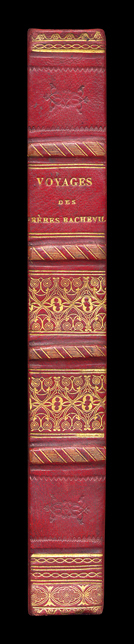
182215861Paris, Béchet Ainé et chez le Capitaine Bacheville, 1822 ; in-8 ; demi-veau glacé grenat à petits coins, dos à quatre nerfs plats décorés encadrant le titre et deux caissons décorés "à la cathédrale", palette et roulettes décoratives dorées, fleurons et roulettes à froid, tranches marbrées (reliure de l'époque) ; XII, 432, (2) pp., frontispice lithographié par G. Engelmann montrant les frères Bacheville se séparant pour toujours en Turquie d'Europe.
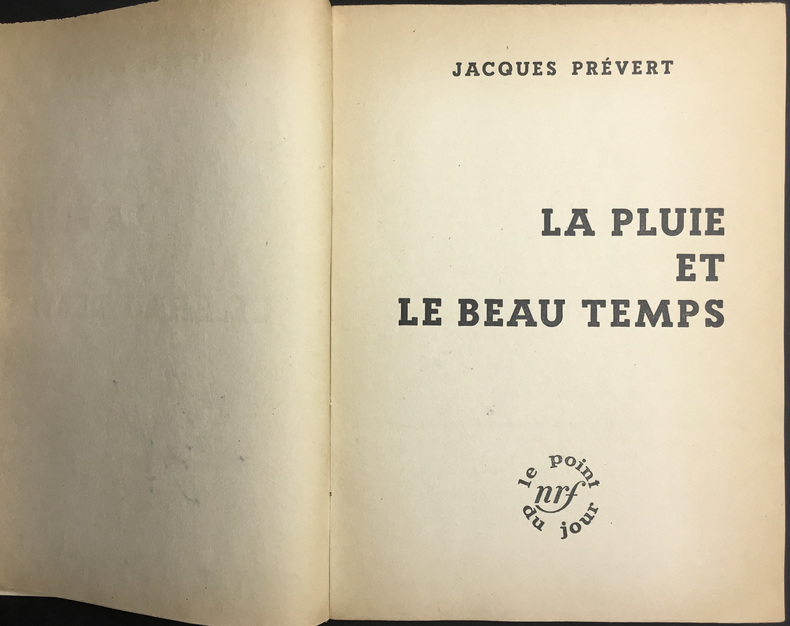
14475Paris, Gallimard, coll. "Le Point du jour", 1951 ; in-8, broché. 365 pp. Parfait état, non coupé,
194111123Paris, Emile-Paul Frères, 1941. In-12 broché de [4]-269-[7] pages, couverture rose rempliée, imprimée en deux couleurs. Dos passé, avec légers manques.
2 volumes In-4, 208-223p. Edition de luxe ornée de nombreuses illustrations coloriées et dorées par Lucy Boucher dans le style des enluminures du Moyen-åge (mise en couleurs par des procédés artistiques, artisanaux et manuels de coloriage). Tirage limité. Edition limitée à 2500 exemplaires numérotés sur vélin B.F.K. Ces 2 volumes font partie des 390 exemplaires contenant une suite en couleurs. Enrichi d'un envoi autographe signé accompagné d'un petit dessin original de l'illustratrice à la page de justification. Bords des étuis légèrement frottés, sinon très bel exemplaire.
191796522(Dresden, Petzschke & Gretschel, 1917). XIII, 383 S. Mit illustr. Titel von Erich Büttner und Illustrationen von Julius Diez. 34,5 cm. HPgt mit Kopfgoldschnitt im Orig.-Pp.-Schuber (Schuber gebräunt, angestaubt, etwas bestoßen).
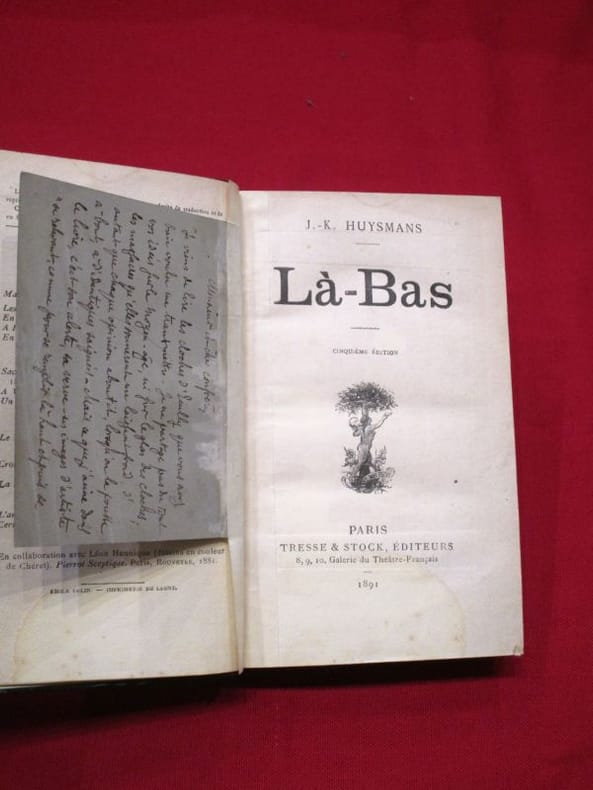
1891118347tresse & stock 1891 Paris, Tresse & Stock, 1891, 1 volume in-8, faux-titre, page de titre, 441 pages. Année de l'édition originale, mention de cinquième édition, avec une lettre autographe de Huysmans à Arthur Péricaud ("Arthur Gravillon"), magistrat, artiste sculpteur, poète né à Lyon en 1828, mort à Écully en 1899. Demi basane verte, dos à quatre nerfs, titres dorés, couvertures conservées. Dos décoloré, quelques griffures et frottements sur les plats, traces de mouillures sur les deux premiers et sur les derniers feuillets, légères taches aux pages 260-261, sinon bon état.
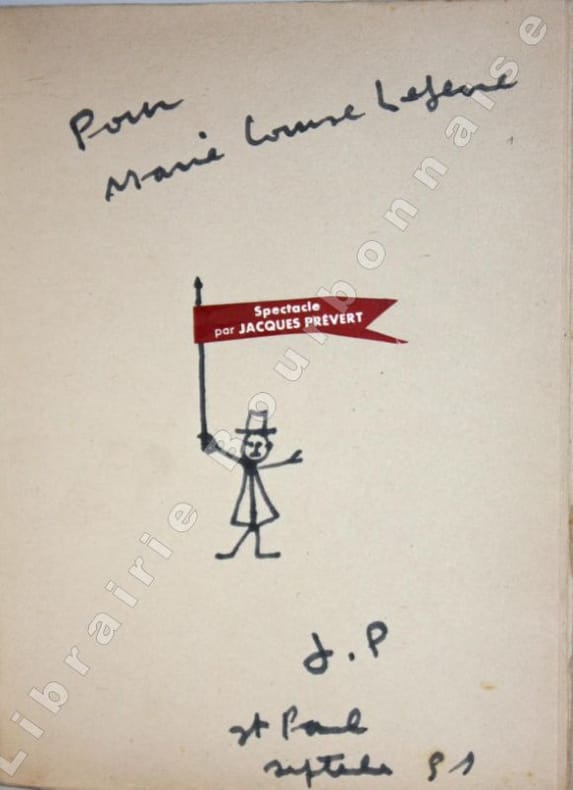
19551707Paris, Gallimard, Coll. "Le Point du jour", 1955. In-8 (193 x 143 mm) broché, couverture jaune imprimée, non rogné, 253 pages. Édition originale de cet important recueil de poèmes. Un des exemplaires du S.P. (Service de presse), celui-ci enrichi d'une jolie dédicace enluminée aux crayons de couleurs par Jacques Prévert, signée et datée "Paris Été 1955". Troisième recueil de Prévert parrainé par René Bertelé (1908-1973), éditeur ami, mais aussi critique littéraire et critique d'art.
197826231978 2 pp. in-4, 47 lignes signées de son parafe, trois ratures et corrections. On joint le livre publié (Libourne, Arts graphiques d'Aquitaine, 1978, 24 ff. n. ch., ill. noir et couleurs).
175343705Neapoli Naples Italy: Excudebat Joseph Raymundi. 1753. First Edition Thus. Hard Cover. Very Good. 4to; 12 335 1 errata pp pages; Mid-eighteenth century sprinkled brown calf raised bands and decorative gilt stamped decoration in spine panels with red title label edges of the text block stained red. The dedication copy of the Latin edition of Dr. John Arbuthnot's last book -- An essay concerning the effects of air on human bodies London printed for J. Tonson in the Strand 1733. With the bookplate of the dedicatee of this 1753 first Latin edition -- Niccolò Fraggianni. A full page engraved portrait of Fraggianni is included facing the text of the dedication of this edition to him. The binding displays some insect damage along portions of the outer gutter margins and at the red leather titling slip on the spine. Internally there is some minor damage which gets progressively less apparent to the front endpapers the half title and title page. At the rear there is similar damage to the endpapers but just a tiny hole in the gutter margin of the errata leaf. There is also a modest damp tide mark to the blank bottom margins of the final twenty pages. Dr. Arbuthnot was born in Scotland and in early life by training and habit of mind thought of himself as a mathematician. He came to London in 1691 the year his father a non-conforming Scottish minister had died. In London the following year Arbuthnot published 'Of the Laws of Chance' -- more or less a translation from the Latin text of Christiaan Huygens's 'De ratiociniis in ludo aleae.' This is widely thought to have been the first work on probability published in English. Arbuthnot became the tutor to a well-born son of a member of Parliament follwed his charge to Oxford where he met many eminent figures of the time -- including Isaac Newton and Samuel Pepys. Arbuthnot felt that he would benefit in life by the formal possession of an advanced degree but did not have the necessary financial backing to spend years as a student. Thus impelled by circumstances he set what I believe must be an all-time speed record for obtaining an earned doctoral degree. He returned to his native Scotland entrolled as a doctoral student in medicine at the University of St. Andrews on 11 September 1696. On that busy day Arbuthnot defended seven theses dealing with medical subjects -- and was awarded his doctorate before that same day had come to a close. Arbuthnot used this new medical degree along with what must have been a vast repertoire of conversation and helpful advice to take advantage of a chance meeting to become physician to Prince George and then to his wife Queen Anne. For ten years he moved in higher and higher circles eventually becoming a member of the Royal household. And even after Queen Anne died without arranging for the continuing support of Dr. Arbuthnot and her other inner staff he never strayed far from the various London circles of power and high achievement. Today he is probably best remembered as a founder of the "Scriblerus Club" -- with his friends Pope Gay Swift Thomas Parnell Harley and Bolingbroke. Because Arbuthnot became famous among these friends for ducking credit as author of a number of poems and satires and his numerous contributions to the works of others. Certainly few would dispute that Arbuthnot had a major influence on Swift's "Gulliver's Travels -- which he saw in various manuscript drafts -- during which he almost certainly influenced its satirical portrayal of the Royal Society the real version of which Arbuthnot had been made a member in 1704. The traditional notion is that this book was not particularly important in the history of medicine since while the idea of "fresh air" is both pleasant and beneficial -- the air could hardly manage to carry pathogens responsible for spreading major disease. When Fielding Garrison wrote his pioneering American history of medicine in 1913 he mentions Dr. John Arbuthnot in his survey of the English Eighteenth century and treats him as the creator of "John Bull" -- friend to Swift and Pope and incidentally physician to Queen Anne. And it was not until four years after Garrison's death that scientists first were able to "see" a virus using the newly developed electron microscope. Naples became a center for publication of medical books in Latin during the eighteenth century. The translator of this text into Latin Fortunatus del Felic held the chair of experimental physics and mathematics at Naples University. He expanded his Lain text on a local point of interest. Dr. Arbuthnot's 1733 English text -- Section XVII of the first chapter -- refers to the "mortiferous Stream in the Grotto del Cane near Naples." The 1753 Latin text contains 8 full double columns of notes on four pages devoted to the nature and literature of this unusual place ranging from classical times forward. Moreover since the grotto represents one of earth's most unusually concentrated exhalations of carbon dioxide into the atmosphere there is more potential interest in Dr. Arbuthnot's fascination for this location and what it might meanfor the earth and life on the planet in the twenty-first century than might have been the case a century ago when this eighteenth century book was usually dismissed by historians of medicine and science as a relatively minor work. Through this Latin translation Fortunato Bartolomeo de Felice 1723 – 1789 also known as the second Comte de Panzutt attracted the attention of Albrecht von Haller -- who influenced Felice to move to Swizerland where he eventually became one of the most important publishers of his time. More about the status of this copy as "the" dedication copy. While it sometimes occurs that the dedicatee of a book has many copies to distribute to friends and colleagues it really does appear that this copy has a unique status. We can find no other copies in library catalogues of copies in which the distinctive bookplate of Niccolò Fraggianni is reported. Moreover there is an ink inscription about the history of our copy following the death of Fraggianni in February of 1763. "Quondam / Nunc Aloysii Ranatila Scarpacci / Philosophiae et Medicinae Doctoris / 1768." . Excudebat Joseph Raymundi hardcover
36382Nice, Editions le Chant des Sphères, 1968. 2 volumes in-4°, 208-223p. Reliures plein maroquin rouge, dos à nerfs avec décor doré, médaillons dorés sur les premiers plats, têtes dorées, sous étuis bordés doublés de velours.