[Alletz (Edouard)]Livre Rare Book
10 résultats
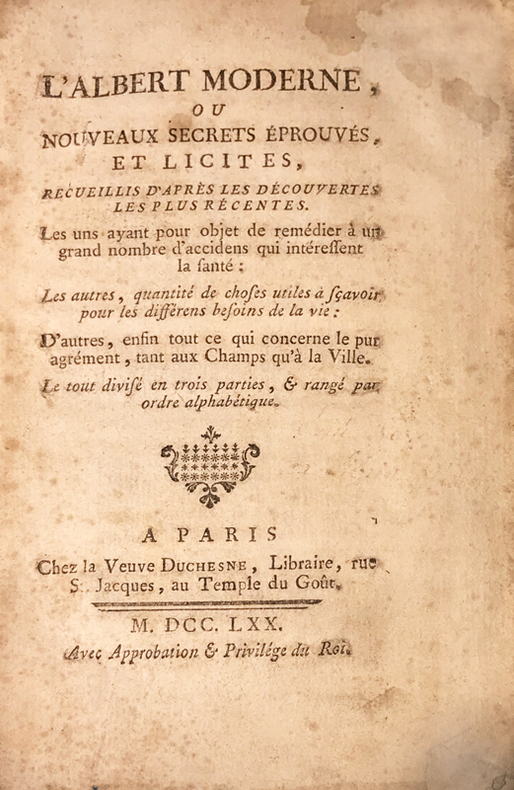
177011006Paris, Veuve Duchesne, 1770 ; in-12 ; cartonnage rigide de papier marbré bleu, étiquette manuscrite au dos, non rogné ; XXII pp. (y compris le titre), (1) f., 384 pp.
177228703Paris: Chez Debure l'aîne 1772. 1 vols. 8vo. Contemporary stained calf citron morocco label spine gilt. Some rubbing surface worming on lower cover else very good. 1 vols. 8vo. Commentary on the environmental and game laws. Chez Debure l'aîne unknown
177228703Paris: Chez Debure l'aîne 1772. 1 vols. 8vo. Contemporary stained calf citron morocco label spine gilt. Some rubbing surface worming on lower cover else very good. 1 vols. 8vo. Commentary on the environmental and game laws. Chez Debure l'aîne unknown books
171313149Montpellier 1713. Woodcut head piece of the royal arms. 1 vols. 8 1/4 x 11 1/8. Fine. Woodcut head piece of the royal arms. 1 vols. 8 1/4 x 11 1/8. French 18th Century Posting Notice. An interesting and handsome document forbidding hunting in the regions of Montredon & Saint Amans in the southwest of France. "by Order of the King.In the interest of conserving Hunting in those regions.we forbid anyone of any rank whatsoever to hunt throughout the extent of aforesaid regions.". unknown books
1713134794A Paris, Chez Michel Clousier, M. DCCXIII. Avec privilege du Roy et Chez Hilaire Foucault M. DCCXII. (1713). Two parts in one volume. (12), 167 pages and (12), 33 pages. With a lot of illustrations (cards). Leather binding. (Spine not complete. Papier partially spotted. In the second part some pages on the wrong place, but complete). 16x10 cm
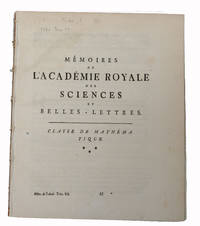
176631081(Berlin, Haude et Spener, 1766). 4to. No wrappers, as issued in ""Mémoires de l'Academie Royale des Sciences et Belles Lettres"", tome XX, pp. 91-164 (91-116"117-143"144-164). 1 engraved plate ( belonging to ""Microscope..."")
176631081Berlin Haude et Spener 1766. 4to. No wrappers as issued in "Mémoires de l'Academie Royale des Sciences et Belles Lettres" tome XX pp. 91-164 91-116;117-143;144-164. 1 engraved plate belonging to "Microscope." <br/><br/><em>3 first editions by Euler in algebra in optics and in the theory of chance - in this last paper he discusses the so-called St. Petersburg paradox the Game Pharon. </em> unknown
1794114610London: John Wallis 1794. First Edition. Hardcover. Very Good. London John Wallis 24 December 1794. Overall dimensions 520 × 663 mm dissected into 16 panels and mounted on linen comprising a hand-coloured map engraved by McIntyre printed surface 380 × 530 mm with extensive letterpress text on either side. Paper slightly tanned with a few small marks including some inkspots creases tiny chips and scattered light foxing; top right-hand corner trimmed close with the text lightly shaved; cloth a little foxed and discoloured on the verso; overall in very good condition. An attractive Georgian board game with the winner being the first player to reach London. The letterpress gives rules for playing the game and details of the history and manufactures of the 117 towns mentioned. It is not necessarily accurate; for instance Henry VI not Henry IV was captured at Northampton by the Yorkists. <p>We have traced several reissues of the game using the same plate but with some variation to the letterpress and this error appears in several of them. A spinner 'Totum' and counters were available for separate purchase and are not present in this instance. John Wallis hardcover
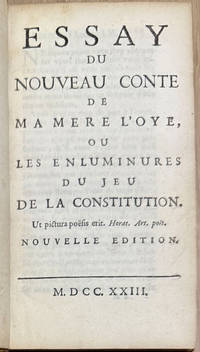
1723Debonnaire1723<p>GAME OF THE GOOSE Essay du nouveau conte de ma Mère l'Oye ou les enluminures du jeu de la Constitution by Louis Debonnaire. No imprint 1723. 8vo xiii xviii 176pp; early leather boards with original spine laid down.</p><p>Despite the claim that this is a new edition it is nonetheless an UNCOMMON IMITATION of the traditional "Game of the Goose" a rhymed pastiche as if spoken by Mother Goose written by a Jansenist priest Abbot wherein one must win the formation of a new Council here referred to as a Constitution. It introduced what became a familiar catchphrase "LIBERTY EQUALITY FRATERNITY" condemned in 1725 as anti-Rome. Barber III 880</p> No imprint hardcover
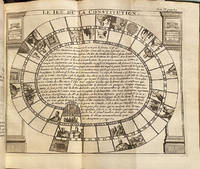
1724BB_88102Game of the Goose<br /><b><i>Poesies sur la Constitution Unigenitus</i></b>. Recueillies par le Chevalier de G. Officier de Regiment de Champagne. Villefranche i.e. Amsterdam: Chez Philalete Belhumeur 1724. Two volumes. Illustrated with duplicate frontispieces title-vignettes and many decorative woodcut head- and tail-pieces. 8vo. i i xxiv 317 pp. – i i 389 pp.; uniform polished tree-calf extra-gilt all edges gilt covers with armorial gilt stamp.<br />First edition thus greatly revised and expanded from an earlier version with essays letters poems reviews and songs with political Constitution religious Pope Clement XI and literary interest. Most important this work includes an essay titled <i>"Essai du Nouveau Conte de Ma Mere L'Oye"</i> NewTales of Mother Goose showing the influence of Perrault's tales barely twenty years after his death AND a handsome folding-out engraved board game titled <i><b>"Le Jeu de la Constitution" </b></i>designed in a race-game format.<br /><p>As a notable compilation of pro-Jansenist writings of an often satirical nature with the aforementioned board game and its five pages of rules on a folding plate. Selections include: "Les 101 propositions de la constitution Unigenitus exprimées en cent et un couplets"; "Ode pindarique sur la destruction du monastère de Port-Royal-des-Champs"; "Adieu d'une dame janséniste qui se refugie en Hollande". Brunet 4: 755. Weller 2: 88. Willaert 2: 9370. For the game see Phillippa Plock & Adrian Seville "Rothschild Collection of Printed Board Games at Waddesdon Manor" in: Of Boards and Men: Board Games Investigated Proceedings of the XIIIth Board Game Studies Colloquium Paris 14-17 April 2010 pp. 101-103: "B3 2669.2.25 Le Jeu de la Constitution - 1721/22 or to give its the full title Le Jeu / De la Constitution / Sur l'air du branle de Mets sic is <b>one of the most controversial games ever devised on the pattern of the game of Goose and perhaps may be regarded as the first polemical variant </b>Girard and Quétel 1982: 58 and 73. It dates from about 1721 but is associated with a book that appeared a year later the Essay Essai du Nouveau Conte de ma Mère l'Oye ou Les Enluminures de la Constitution. This book contains a folding plate of the game in smaller format and with some omission of text. It also contains 18 enluminures in rhymed couplets which explain the game in detail. The claimed author is given in the subtitle: 'Poesies sur la Constitution Unigenitus recuellies par le Chevalier de G. Officier du Regiment de Champagne'. The publisher is given as Philalete Belhumeur "Good Humour" Villefranche. These publication details are of course wholly fictitious as is the claimed author who in reality was the Abbe é Louis de Bonnaire 1680-1752; the book was published in Amsterdam the full-sheet game probably in Paris. De Bonnaire was a supporter of the Jansenist heresy named for Cornelius Jansen 1585-1638: this theology emphasised a particular reading of Augustine's idea of efficacious grace which stressed that only a certain portion of humanity were predestined to be saved. Though the Jansenists were strongly Catholic Jesuits and the papacy were suspicious of their beliefs which seemed to limit free will and the ability to choose to do good or evil. Despite condemnation by Pope Innocent X in 1655 the movement gained strong support in the Church. The Jansenist position as included in 101 of the propositions of Pasquier Quesnel Jansenist theologian b1634 d1719 in his Épitomé des Morales des Évangélistes of 1671 was finally condemned by Pope Clement XI's Unigenitus bull of 1713 but even this condemnation did little to diminish the enthusiasm of adherents. Indeed in 1717 four French Bishops attempted to appeal Unigenitus to a General Council a move that received considerable support from other clergy and the parlements though the majority of clergy stood by the Pope: Clement responded in the next year by excommunicating all those who had called for a General Council. Even so it was not until 1728 that the death of Jansenism was marked by the submission to the Pope's authority of Cardinal Noailles Archbishop of Paris who had originally approved Quesnel's book and was reluctant to support Unigenitus arguing that many of the 101 propositions were in fact orthodox.<br /><br />The point of the game and of De Bonnaire's book is to challenge and mock the authority of the Church and in particular that of the Pope and of his bull. For example the columns on either side are each headed by a cartoon depicting the Pope in council all present being represented by geese wearing mitres. Below the lefthand cartoon is the Latin phrase "Non ego cum Gruibus simul Anseribusque sedebo in Synodis - S. Greg. Nazianz Carm. 10" I shall not sit in Synod with cranes and geese. This refers to a dictum of Gregory of Nazianzus c329-390 Archbishop of Constantinople who compared the rowdy Council of Constantinople 381 AD to the loud cackling of a flock of geese.<br /><br />The 'good' spaces show the Apostles 'equal in number to that of the geese which they replace': there are thirteen including St Paul and they occupy the traditional spaces. The traditional hazards are likewise replaced or given special significance and others are added. The usual entry arch appears as Noah's Ark at space 1 symbolising the Church as it is tossed about on the waters of Unigenitus. The bridge of explanations at the expected space 6 shows bishops falling into the water marking their error in taking the wrong sense of the 101 propositions: it leads to space 12 acceptance where a young woman blindfolded is shown as accepting Unigenitus through ignorance. At space 15 there is the torn robe symbolising schism of the Church. The labyrinth here at space 16 symbolises error into which fall those who subscribe to the condemnation of the 101 propositions. The inn at space 19 is here the cabaret and represents the 'accommodation' accommodement or submission of the Jansenists to the bull. The Tower of Babel at space 24 represents the confusion of language into which the bull has fallen. At space 26 is the first appeal of 1717 represented by a notice on the Vatican door. At space 33 we find the avertissemens or pronouncements of the Archbishop of Soissons Jean-Joseph Languet de Gergy 1677-1753 a notorious anti-Jansenist and vehement defender of Unigenitus. He has an oboe a horn and a trumpet the three instruments symbolising 'his three avertissements and their different tones': a special rule refers to moving forward with the 'small dice' and with 'the other' when going back. Next is the prison at space 40 where the player must wait until a throw of 5 which multiplied by 3 will lead to Louis XV and deliverance. The well space 49 symbolises the body of doctrine in which the truth is hidden. At space 51 are the re-appealing Bishops the second appeal being at space 53. At space 55 is the portrait of Louis XV - enluminere XV in the book makes clear that he was seen as a force for change and re-unifying the Church. The death space at 58 shows the skeleton of Pope Clement XI sitting in an armchair wearing his papal tiara and raising his bony hand to bless an infant at his feet which represents the Unigenitus bull. Cardinal Noailles appears at the penultimate space 62 from which point 'one may only go backward'. The explanatory text in the centre of the game claims that it 'presages the day that the constitution of the Church will no longer be nothing but un Conte de ma Mère l'Oye' - a Mother Goose tale here used as a figure of speech for something unbelievable and ridiculous. The winning space at 63 shows that this result is to be achieved by a General Council in reference to that called for in 1717. De Bonnaire's book was condemned at Arras in 1726. Although his anonymity as author seems to have been effective in protecting him the publishers father and son were thrown into the Bastille. Even today the game has the power to shock by the force of its imagery.</p> Philalete Belhumeur hardcover