827 résultats
189020151France 1890. 48 playing cards on thick stock. 86 x 56 mm. Wood engraved designed with stencil color versos alike with wood engraved grid fields. Excellent condition. A fine deck of cards for the game of Aluette a trick-taking game commonly played in France. Made up of four suits—batons coins swords and cups—the deck is dealt to players clockwise and played in “tricksâ€; the highest card wins and the player who threw it take the rest of the pile. <br /> Although it is a French game Aluette uses Spanish suits indicating that the game may be older than the creation of French playing cards. It is also called “La Vache†in some circles because one of the cups cards features a cow. B.P. Grimaud was the primary producer of Aluette decks but not that offered here. However the basic imagery on the cards closely follows Grimaud’s of the mid-late 19th century. unknown
1998mon0000157544Soft Bank 4/6/1998 12:00:00 AM. jp_oversized_book. Very Good. 0.6299 in x 11.5748 in x 7.8740 in. Very minimal shelfwear near fine. Soft Bank unknown

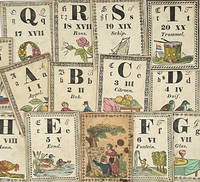
1820103149<p>No place no date but Leiden P.J. Trap c. 1820. Size: c. 6 x 8 cm. 27 cards the first one with two children reading and the other 26 contain the alphabet in various lettering types and the Roman and Arabic numbers. Each card also shows a word beginning with the letter on it and a handcoloured picture of the word. Each card with a decorative typographical border various types. card with publisher's name not present; the first card with browning and staining but all in all a lovely clean set held in a homemade green open box.</p><p>Rare Dutch alphabet cards. The first card was used for the cover of 'Kinderen lazen kinderen lezen'. c.f. Van Veen Kinderen lazen kinderen lezen #17; Buijnsters Papertoys p. 142/143.</p> P.J. Trap
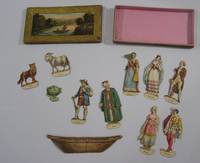
182518320French: n.p. 1825. Very good. 11 engraved cut-out figures or objects including ferryman three couples wolf goat cabbage and boat to be slotted into boat original box with engraved pictorial label colored by hand A rare children's game possibly printed by the Parisian publisher Nepveau. Contained in the box measuring 14cm x 7cm x 1cm is a complete set of figures for the two river crossing puzzles known as the 'Jealous Husbands Problem' and 'Goat Wolf and Cabbage'. The earliest account of these puzzles is in the 9th century manuscript "Propositionnes ad Acuendos Juvenes" Problems to Sharpen the Young attributed to Alcuin. In both puzzles there are only two places in the boat. In the Jealous Husbands Problem no woman can be with another man unless also accompanied by her husband. In Goat Wolf and Cabbage the wolf will eat the goat and the goat will eat the cabbage unless they are guarded by the boatman. <br /> Originally accompanied by counters and an instruction sheet now lost. The box is lightly worn else in very good condition; the figures are in fine condition except the boat which has been repaired and the cabbage which lacks the lower part of its insertion tab and one female figure lacks a hand. Rare. n.p. unknown
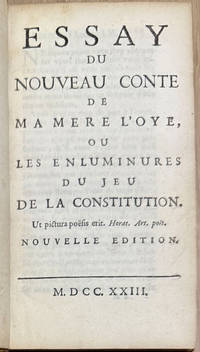
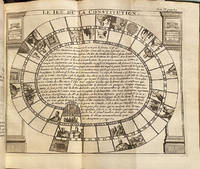
1723Debonnaire1723<p>GAME OF THE GOOSE Essay du nouveau conte de ma Mère l'Oye ou les enluminures du jeu de la Constitution by Louis Debonnaire. No imprint 1723. 8vo xiii xviii 176pp; early leather boards with original spine laid down.</p><p>Despite the claim that this is a new edition it is nonetheless an UNCOMMON IMITATION of the traditional "Game of the Goose" a rhymed pastiche as if spoken by Mother Goose written by a Jansenist priest Abbot wherein one must win the formation of a new Council here referred to as a Constitution. It introduced what became a familiar catchphrase "LIBERTY EQUALITY FRATERNITY" condemned in 1725 as anti-Rome. Barber III 880</p> No imprint hardcover
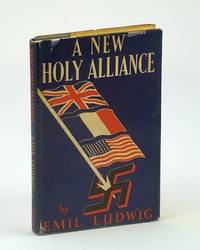
1938734G4576London: Robert Hale Limited 1938. Book. Good. Hardcover. First English Edition. 8vo - over 7¾" - 9¾" tall. 123 pages. Black and white photographic frontisplate of author. First published in German in the same year. Noteworthy for its call for a resurrection of the same two-front military alliance which was marshalled against Germany in the Great War. The following year 'Foreign Affairs Quarterly' published a review of this book endorsing this policy. - Mike King. "In July 1914 Dr. Ludwig expounded the causes and misunderstandings which led up to the Great War. The purpose of the present work is to provide a remedy for the present perilous impasse before it is too late to avert disaster." - from dust jacket. In preparing this work Ludwig confidentially sent the first 83 pages of his manuscript to Edward VIII for his corrections which were later provided by letter. Source available upon request. Bold dust jacket art depicts British/French/US spear piercing a Nazi swastika. Unmarked. Binding tight. Moderate wear to book. Somewhat above-average wear to dust jacket which is now preserved in mylar. Moderate age-toning near endpapers. Moderate foxing to edges and back half of dust jacket. A sound copy of this significant work. Robert Hale Limited Hardcover
193886240London: Robert Hale 1938. 1st edition. Nice Copy. octavo. dust jacket 123pp. frontis. A warning that the new alliance between Britain France the US & Nazi Germany will end in disaster.Very nice copy in grey boards in a very nice bright dust jacket with minimal chipping at edges. Extremely scarce especially in this condition. PHOTO available Robert Hale hardcover
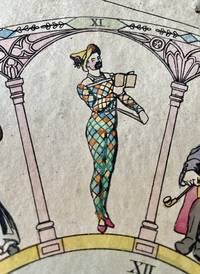
18405201<p>GAME. Arlequin und Columbine oder Arlequins Hochzeit. Nach der bekannten Pantomime gleichen Namens stellen bei diesem Spiele sämtliche Mitspieler Freier um Pantolons Tochter Columbine vor. n.p. n.p. ca 1830. </p><p> VAT in EU & UK</p><p>Lithograph broadside mounted on board 365 x 325 mm hand-coloured; board showing some staining and edges a little frayed; numbered 222 at bottom.</p><p>A well preserved board game played with two dice relating to the marriage of Harlequin and Columbine. Based on the well-known pantomime of the same name in this game all the players introduce suitors for Pantolon's daughter Columbine etc. The central circular field depicts the wedding couple surrounded by a number of acrobats. The surrounding twelve numbered arches show twelve stock male courtship figures all vying for Columbine's attention. The four corners show Commedia dell'arte figures.</p><p>Clockwise from the top the arches are numbered 2 7 5 4 10 2 8 3 6 9 2 11 while the central circle is numbered 12. The numbers thus represent all chances upon double dice with double 1 appearing three times. The rules give pay or take instructions for the various throws. The rules of the game are printed below. One participant is the 'banker' who organises the game and takes the pawns from all participants and arranges for the money to be distributed. The players throw dice andmove along according to their results.</p><p>This board game is number 222 from the fund of an unknown German publisher printed about 1840.</p><p>See Plock Phillippa and Adrian Seville "The Rothschild Collection of printed board games at Waddesdon Manor" in XIIIth Board Game Studies Colloquium Paris 14-17 April 2010; Buijnsters P.J. Papertoys. Speelprenten en papieren speelgoed in Nederland 1640-1920. Waanders Uitgevers-Zwolle 2005.</p> n.p.
189578554August 1895 - 1978. original padded leather. The album's spine is perished with light wear at edges; contents sound and fine. 8vo. Illustrated throughout. The first page is an amusing original hand-colored cartoon of a Victorian couple cowering in front of a pig initialled "A.T." Following are 175 pig drawings all signed and most dated and many with a location. Dozens are neatly filled in in black and one is flesh-colored. 117 drawings were made between 1895-1900; 26 from 1900-1910 . hardcover
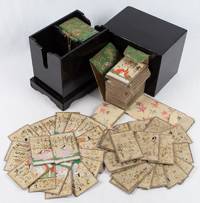
175724No date. Late Edo. Complete set of 200 delicately coloured handpainted cards flecked with gold and silver. Each card 8 × 5.4 cm. Two patterned silk cases one for the text and the other the portraits of the poets with washi paper linings are held within a black wooden lacquer box 16 ×11 ×15 cm. Some light signs of use but overall a very attractive set. This famous and much beloved Japanese card game is based on the classic anthology of 100 poems by 100 different poets. The anthology known as both Ogura Hyakunin Isshu and Hyakunin Isshu brings together waka usually now called tanka poems which were written between the 7th and 13th centuries. It was compiled by the famous 13th century critic and poet Fujiwara no Sadaie more often known as Teika. Hyakunin Isshu showcases all of the most important poets from the late Heian period in Japan. <br> <br>It is difficult to give an appropriate English language parallel to the enormous influence of the Hyakunin Isshu but possibly the closest would be the influence Shakespeare has had in the English speaking world. Many educated Japanese are able to recite many of the poems and this close association with and knowledge of these poems have to a great extent come through this card game. Playing the card game of Hyakunin Isshu is a very popular New Year holiday pastime. The first to win is the person with the largest number of cards collected. To achieve this goal you must be very familiar with the poems so that you can quickly take the card on which is written the last two lines of the poem being read out before your opponent does! A game of great knowledge and speed. . unknown
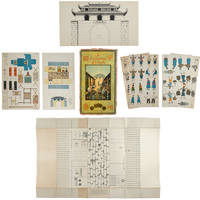
1900159678London.: Church of England Zenana Missionary Society. No date. circa1900. Nine printed sheets each printed with people or items and showing the cut lines. Original chromolithograph card box archivally repaired along seams. Some occasional light foxing on sheets card covers browned and worn in places a few other minor signs of wear but generally very good. 43 x 24cm. Rare. We have found no other copies of this game. The first two sheets show Chinese people in clothes appropriate to their age occupation etc. Those illustrated include The Opium Smoker School-master The General Shopkeeper Native Biblewoman etc. Other sheets show furniture and fittings a coloured illustration of the street a black and white image of the city gate and a much larger sheet 50 x 87.5cm which is an illustration of the street and onto which the other cut-outs when coloured and cut out are placed. . Church of England Zenana Missionary Society. hardcover
2016126133I.B.Tauris. New. 2016. Paperback. 178130047X . FREE UPGRADE to Courier/Priority Shipping Upon Request - IN STOCK AND IMMEDIATELY AVAILABLE FOR SHIPMENT - Flawless copy brand new pristine never opened -- with a bonus offer-- . I.B.Tauris paperback
200676481NMS. New. 2006. Paperback. 1901663035 . FREE UPGRADE to Courier/Priority Shipping Upon Request - IN STOCK AND IMMEDIATELY AVAILABLE FOR SHIPMENT - Flawless copy brand new pristine never opened -- 108 pp. With 138 ills. 125 col. . 20 x 21 cm. -- with a bonus offer-- . NMS paperback
1724BB_88102Game of the Goose<br /><b><i>Poesies sur la Constitution Unigenitus</i></b>. Recueillies par le Chevalier de G. Officier de Regiment de Champagne. Villefranche i.e. Amsterdam: Chez Philalete Belhumeur 1724. Two volumes. Illustrated with duplicate frontispieces title-vignettes and many decorative woodcut head- and tail-pieces. 8vo. i i xxiv 317 pp. – i i 389 pp.; uniform polished tree-calf extra-gilt all edges gilt covers with armorial gilt stamp.<br />First edition thus greatly revised and expanded from an earlier version with essays letters poems reviews and songs with political Constitution religious Pope Clement XI and literary interest. Most important this work includes an essay titled <i>"Essai du Nouveau Conte de Ma Mere L'Oye"</i> NewTales of Mother Goose showing the influence of Perrault's tales barely twenty years after his death AND a handsome folding-out engraved board game titled <i><b>"Le Jeu de la Constitution" </b></i>designed in a race-game format.<br /><p>As a notable compilation of pro-Jansenist writings of an often satirical nature with the aforementioned board game and its five pages of rules on a folding plate. Selections include: "Les 101 propositions de la constitution Unigenitus exprimées en cent et un couplets"; "Ode pindarique sur la destruction du monastère de Port-Royal-des-Champs"; "Adieu d'une dame janséniste qui se refugie en Hollande". Brunet 4: 755. Weller 2: 88. Willaert 2: 9370. For the game see Phillippa Plock & Adrian Seville "Rothschild Collection of Printed Board Games at Waddesdon Manor" in: Of Boards and Men: Board Games Investigated Proceedings of the XIIIth Board Game Studies Colloquium Paris 14-17 April 2010 pp. 101-103: "B3 2669.2.25 Le Jeu de la Constitution - 1721/22 or to give its the full title Le Jeu / De la Constitution / Sur l'air du branle de Mets sic is <b>one of the most controversial games ever devised on the pattern of the game of Goose and perhaps may be regarded as the first polemical variant </b>Girard and Quétel 1982: 58 and 73. It dates from about 1721 but is associated with a book that appeared a year later the Essay Essai du Nouveau Conte de ma Mère l'Oye ou Les Enluminures de la Constitution. This book contains a folding plate of the game in smaller format and with some omission of text. It also contains 18 enluminures in rhymed couplets which explain the game in detail. The claimed author is given in the subtitle: 'Poesies sur la Constitution Unigenitus recuellies par le Chevalier de G. Officier du Regiment de Champagne'. The publisher is given as Philalete Belhumeur "Good Humour" Villefranche. These publication details are of course wholly fictitious as is the claimed author who in reality was the Abbe é Louis de Bonnaire 1680-1752; the book was published in Amsterdam the full-sheet game probably in Paris. De Bonnaire was a supporter of the Jansenist heresy named for Cornelius Jansen 1585-1638: this theology emphasised a particular reading of Augustine's idea of efficacious grace which stressed that only a certain portion of humanity were predestined to be saved. Though the Jansenists were strongly Catholic Jesuits and the papacy were suspicious of their beliefs which seemed to limit free will and the ability to choose to do good or evil. Despite condemnation by Pope Innocent X in 1655 the movement gained strong support in the Church. The Jansenist position as included in 101 of the propositions of Pasquier Quesnel Jansenist theologian b1634 d1719 in his Épitomé des Morales des Évangélistes of 1671 was finally condemned by Pope Clement XI's Unigenitus bull of 1713 but even this condemnation did little to diminish the enthusiasm of adherents. Indeed in 1717 four French Bishops attempted to appeal Unigenitus to a General Council a move that received considerable support from other clergy and the parlements though the majority of clergy stood by the Pope: Clement responded in the next year by excommunicating all those who had called for a General Council. Even so it was not until 1728 that the death of Jansenism was marked by the submission to the Pope's authority of Cardinal Noailles Archbishop of Paris who had originally approved Quesnel's book and was reluctant to support Unigenitus arguing that many of the 101 propositions were in fact orthodox.<br /><br />The point of the game and of De Bonnaire's book is to challenge and mock the authority of the Church and in particular that of the Pope and of his bull. For example the columns on either side are each headed by a cartoon depicting the Pope in council all present being represented by geese wearing mitres. Below the lefthand cartoon is the Latin phrase "Non ego cum Gruibus simul Anseribusque sedebo in Synodis - S. Greg. Nazianz Carm. 10" I shall not sit in Synod with cranes and geese. This refers to a dictum of Gregory of Nazianzus c329-390 Archbishop of Constantinople who compared the rowdy Council of Constantinople 381 AD to the loud cackling of a flock of geese.<br /><br />The 'good' spaces show the Apostles 'equal in number to that of the geese which they replace': there are thirteen including St Paul and they occupy the traditional spaces. The traditional hazards are likewise replaced or given special significance and others are added. The usual entry arch appears as Noah's Ark at space 1 symbolising the Church as it is tossed about on the waters of Unigenitus. The bridge of explanations at the expected space 6 shows bishops falling into the water marking their error in taking the wrong sense of the 101 propositions: it leads to space 12 acceptance where a young woman blindfolded is shown as accepting Unigenitus through ignorance. At space 15 there is the torn robe symbolising schism of the Church. The labyrinth here at space 16 symbolises error into which fall those who subscribe to the condemnation of the 101 propositions. The inn at space 19 is here the cabaret and represents the 'accommodation' accommodement or submission of the Jansenists to the bull. The Tower of Babel at space 24 represents the confusion of language into which the bull has fallen. At space 26 is the first appeal of 1717 represented by a notice on the Vatican door. At space 33 we find the avertissemens or pronouncements of the Archbishop of Soissons Jean-Joseph Languet de Gergy 1677-1753 a notorious anti-Jansenist and vehement defender of Unigenitus. He has an oboe a horn and a trumpet the three instruments symbolising 'his three avertissements and their different tones': a special rule refers to moving forward with the 'small dice' and with 'the other' when going back. Next is the prison at space 40 where the player must wait until a throw of 5 which multiplied by 3 will lead to Louis XV and deliverance. The well space 49 symbolises the body of doctrine in which the truth is hidden. At space 51 are the re-appealing Bishops the second appeal being at space 53. At space 55 is the portrait of Louis XV - enluminere XV in the book makes clear that he was seen as a force for change and re-unifying the Church. The death space at 58 shows the skeleton of Pope Clement XI sitting in an armchair wearing his papal tiara and raising his bony hand to bless an infant at his feet which represents the Unigenitus bull. Cardinal Noailles appears at the penultimate space 62 from which point 'one may only go backward'. The explanatory text in the centre of the game claims that it 'presages the day that the constitution of the Church will no longer be nothing but un Conte de ma Mère l'Oye' - a Mother Goose tale here used as a figure of speech for something unbelievable and ridiculous. The winning space at 63 shows that this result is to be achieved by a General Council in reference to that called for in 1717. De Bonnaire's book was condemned at Arras in 1726. Although his anonymity as author seems to have been effective in protecting him the publishers father and son were thrown into the Bastille. Even today the game has the power to shock by the force of its imagery.</p> Philalete Belhumeur hardcover
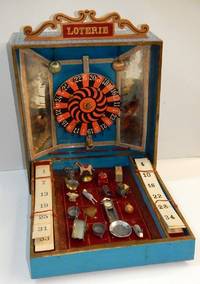
19002210013<p><i>Wooden box 32 x 26 x 8 cm with light blue patterned paper covering; the lid with a label lettered 'Loterie' and a hinged pierced wooden sign with the words 'Loterie' lettered in gilt paper on red; the lined paper interior with a central mounted wheel between mirrored sides and two hanging silk balls; the fall front where the prizes are held with two spaces left and right containing six lottery cards one from another set together with 16 toy prizes as listed below.</i></p><p>Lottery or carnival wheels games became popular at the end of the nineteenth century. Their construction was more complicated than heretofore with the addition of a rotating wheel with pins with a 'clack' mechanism sounding as the wheel is spun. The numbers on the wheel are randomly arranged from 0 through to 25 in white on alternating in black and red ground - clearly based on the 'single zero' form of roulette wheel that became the norm in Europe from the middle of the nineteenth century. The design has a second purpose as the box is hinged so that open it is given the form of a fairground entertainment with an assortment of prizes laid out in a display on squares below the wheel that each have a number too. </p><p>The idea of the game is twofold firstly as the wheel is spun and numbers called out the player who first completes a card of numbers is the winner. In the second game when the numbers 1 to 16 are called out and a player has the number on one of the cards they can then claim one of the small toy prizes. The sixteen twenty assorted of toy prizes include: a handcart wall clock bracelet scales pram wooden top bracelet fairground horse two rabbits a chicken a dish a parcel a metal top metal puzzle pair antimony jardinieres and a heart broach.</p><p>There is no makers name and the design although of a solid construction is nevertheless probably a bespoke production possibly made in order to be sold through fairgrounds and market stalls rather than the more salubrious emporia for children. The interior is lined in turquoise paper with bevelled mirrored silvered card sides and although simple the idea was glittery enough to catch any passing child's attention.</p>
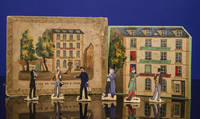
04338Paris: H. Duru 1840. A Remarkable Survival<br /> <br /> FRENCH BOARD GAME. Le Jeu Du Portier The Doorman's Game Par H. Duru. France ca. 1840. <br /> <br /> Original hand colored lithographed board depicting 'The Five Story House" 8 3/4 x 6 3/4 inches; 222 x 172 mm. with the right hand top corner beveled as issued. Six original hand colored lithographed figures each on a wooden base average size 3 1/8 x 1 1/4 inches; 80 x 32 mm. Complete in the original card box with the top showing a hand colored lithograph of "the Five Storey House". The Board and the Figures in near fine condition the box a little soiled on the top and the corners strengthened with cloth tape.<br /> <br /> The Board is lettered from top to bottom: "No. 6 "/ "No. 5 / Locart Fnt Lunetier au 3 mp" / "No. 4 / F. Sonnet M.De Dentelles" / "No.3 Clagmann Et Cie. Banquiers" / "No. 2" / "No. 1 Loge du Portier." The lid of the box is titled "Le Jeu Du Portier Par H. Duru."<br /> <br /> The six figures are titled: Le Portier The Doorman; "2 Proprietaire" Owner; "3 Banquier" Banker; <br /> "4 Marchand" Trader; "5 Fabricant" Maker and "6 Ouvrier" Worker.<br /> <br /> A remarkable survival. We have searched OCLC and can find no records of this game in any libraries and institutions worldwide - not surprising!!!<br /> <br /> H. Duru was an early to mid-nineteenth century Parisian publisher of children's books games toys and movable books. <br /> <br /> According to OCLC their other publications include:<br /> <br /> Nouvelle méthode de lecture progressive ou Lecture apprise en quarante jours <br /> 3 editions published between 1841 and 1851.<br /> Syllabaire universel en action 2 editions published between 1840 and 1857.<br /> Progressive Spelling Book illustrated in French and English published 1810<br /> Les homonymes illustrées published in 1835.<br /> Grammaire illustrée published in 1841.<br /> Quelques mots sur l'organisation du travail published in 1848.<br /> Alphabet chantant no date. Paris: H. Duru, 1840 unknown
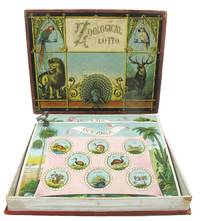
076544N: N 189-. Early English lotto game manufactured in Germany. Comprising: six coloured lithographed oblong card sheets 18.3 cm. x 23.5 cm. each incorporating eight removable pictorial disks representing the native animals of the different continents; contained within the original card box with decorative sides and pictorial title label on lid edges of box slightly rubbed and with a couple of neat repairs to corners the title label lightly soiled; a couple of small closed tears to the card beneath the Jaguar disk; n.d.c.1890s. The disks are all captioned with the name of the animal and feature a question about that animal on the verso which is answered by the brief text printed on the depression into which the disks are set on the card sheets. For example the Oceania sheet contains disks depicting a kangaroo which asks on the reverse: Who are these funny jumping creatures The answer printed below the disk is The kangaroo's with very clever features. This sheet also includes a black swan emu dingo and a Lyer-bird sic- Whose Lyer does not give one sound The lyer-birds in Australia it is found. N unknown
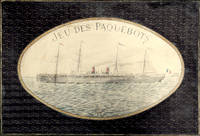
18972210164<p><i>Comprising two coloured map board 66 x 99 cm folding down to 32.5 x 49.5 cm one cloth hinge broken; 14 route cards; a barometer dial 19 x 19 cm with gilt metal spinning arrow some abrading from use; eight painted white metal playing pieces in the form of ships contained in the original small box one piece not original; 16pp booklet of instructions bound in original light green printed wrappers; all contained in the original box 35 x 52 x 5 cm; the hinged lid with a large coloured lithograph title label showing the 'Normandie' leaving port at full steam some minor abrasions but overall in good condition.</i><br /></p><p><i>Jue des Paquebots</i> was something new to games when it was published in 1897 as each player moves their boats on large maps exactly replicating the routes taken by two major French shipping lines. </p><p>The game includes two large folding boards designated 'Carte A' which illustrates the Atlantic shipping lines the other 'Carte B' with the shipping lines leaving Marseilles in the direction of the Black Sea the Indian Ocean and the Pacific. Rather pointedly the instructions state that the two maps include only the French shipping lines of the Messageries Maritimes and the Cie Générale Transatlantique the United Kingdom then the leading maritime nation is neither shown on the maps nor mentioned. </p><p>The players first decide which map they are going use and then select or bid one of the Itinerary cards 8 for map A and 6 for map B. The aim of each player is to complete the journey indicated by their itinerary and then make the return voyage; the first player to complete this double crossing wins. However the number of stopovers is not equal for each different itinerary in play. In order to equalise the chances of winning the players with the fewer ports of call have to repeat their journey a second or even a third time if necessary until the number of ports visited or passed by them in these different routes equates to the number of ports of the busiest route.</p><p>The routes all follow those which the two major French shipping companies plied. These include final destinations at Yokohama Australia New Zealand Zanzibar Odessa Buenos Ayres New York and the Antilles. </p><p>Each player places a ship playing piece at port at the beginning of their route. The first player now spins the Barometer Dial which has outer and inner instructions that allows them to advance out of port when their turn come around again the arrow is again spun and the player can read the inner line of instructions and so advance 1 2 or 3 ports along their route. However there are also stops on the Barometer Dial that include Damage - where you go back to the previous port and pay a token to the bank; Heavy Fog - where you are left stranded until the next round; Collision - this allows another turn of the dial but it the result is 50/50 chance of being sunk and thrown out of the game - you can pay for another ships so all is not lost; Call for Distress - also misses a turn; Shipwreck - something like collision although you can start out again with a new ship and no fine; Rescue - also causes the player to miss a turn; lastly and somewhat topical there is Quarantine - here the player misses a turn and also has a second spin of the arrow to determine if you can go into port or not.</p><p>The lid of the box illustrates the Cie Général Transatlantique liner La Normandie that plied the North Atlantic to New York in the summer and the south Atlantic in the winter - the ship sports a US flag on the foremast and the makers initials on the aft mast. Built in 1886 it was the largest and fastest liner of the company and was originally named 'Ville de New York.' It was also lit by electricity and could carry 1000 passengers and became the model for several sister ships built to the same plan.</p><p>The maker Charles Watilliaux succeeded the games manufacturer Coqueret in 1874 and for the next 35 years became a major publisher and manufacturer of board games and toys until their acquisition by Revenaz & Tabernat. His registered initials were 'W.X.' which is slightly modified for the flag on the box lid as C.W.X.</p> Watilliaux, éditeur.
05401France: 1900. Les Trois Chats"<br /> A Remarkable Survival of a Passé-Boules Carnival Game<br /> <br /> PASSÉ-BOULES GAME. Les Trois Chats. in the style of Louis Wain. Hand-painted 'Polychrome' Papier Maché late nineteenth century ball throwing 'Carnival' game. French ca. 1900. <br /> <br /> Three side by side polychrome cats in 'Papier Maché the structure reinforced by two wooden boards one as the base and the other at the top. The height is 24 1/2 inches 630 mm.; the width is 23 5/8 inches 600 mm.; and the depth is 5 7/8 inches 150 mm.<br /> <br /> Each of the three felines have gaping open mouths 2 1/2 inches 63 mm. the one on the center wearing an orange and blue hat with the name "Toto" in orange. At the bottom is a receptacle with three compartments which are marked "30" "50" & "20" respectively. <br /> <br /> A remarkable survival of a Passé-Boules Carnival Game.<br /> <br /> Historically passé-boule ball-toss was a very popular fairground game in France from the 19th century onwards and the masks often depict figures to be ridiculed. Any number of people may play. <br /> <br /> The object of the game is to hit the target with small white balls - similar to table tennis balls but slightly smaller. <br /> The three targets are the wide-open mouths of the three cats. Players aim to throw or bounce their ball into the open mouths for a good score.<br /> <br /> Provenance: Purchased in Paris from the family of the original owner whose Grandfather or Grandmother acquired it at the turn of the 19th/20th centuries. France: , 1900 unknown
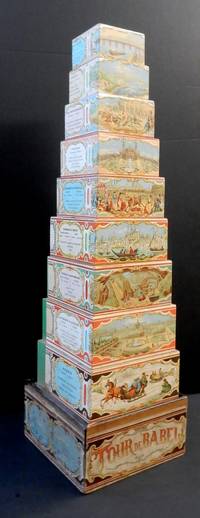
18823220299<i>A nest of nine wooden blocks ranging in size from 78 x78 x 46 mm to 182 x 182 x 60 mm each with a chromolithograph wrap-around illustration depicting European countries with statistical information; contained in the original box with a wrap around title label including four cartouche scenes printed in blue; with a sliding lid replaced.</i><br /><br />Each of the blocks is illustrated with a typical scene from European countries Russia the largest block showing a number of troikas in a winter landscape Germany & Austria with a view of Vienna Sweden and Denmark with mining for iron Turkey & Greece with a view of Istanbul etc. Also included are cartouches with basic information on the population and chief products of each country. <br /><br />The now ubiquitous graduated nested set of blocks for children was quite a late development in toy design with the earliest known patent being applied for in the US in 1881. Watilliaux's Tour of Babel was first marketed as interlocking jigsaw like pieces that could be joined together as hexagons and then stacked to form a tower that was issued at the time of the 1878 Paris Exposition here depicted as the illustration representing France. However when first American nested blocks began to appear Watilliaux evidently adapted the printed design and applied it to his own set of graduated blocks. Unfortunately this reworking did not quite fit the increased surface area of the blocks and a blank section has perforce had to be filled by a section of green glazed paper. It also necessitated the dropping the country of Switzerland and in that case the original pattern was too large to be adapted without their being some lose to the design.<br /><br />No doubt the original design had some educational value although this is somewhat lessened as there is no dexterity needed to correctly interlock the jigsaw pieces and instead only to stack and knock down the Tour de Babel.<br /><br />In 1874 Charles Watelliaux took over the publisher and manufacturer of many board games and toys Bernard Coudert and became a major producer until its sale in 1908 to Revenaz & Tabernat. Watilliaux, Editeur, Lith. J. Marie, Faub St Denis, 61.
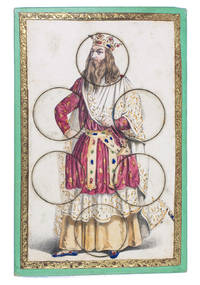
184017799Paris 1840. 19.5 x 13 cm. R. Lacouchin With 3 finely lithographed plates mounted on 3 thick green paperboard cards. The lithographs are framed with a gold-coloured ornamental border. The images on the cards are all beautifully hand coloured and the 3 cards depict respectively a crowned king in ornate robes a beautiful young lady in a green dress and a young man or possibly a court jester in an extravagant yellow and green outfit. Each card has 6 large circular movable pieces to be removed or inserted as the game demands in various circumstances. 3 puzzles. Three beautiful and complete puzzle cards with round movable pieces for example for a game of metamorphosis or lotto. While no rules are present or other specific indications given the cards with their beautiful coloured illustrations are quite intriguing by themselves.The illustration of the young man in the yellow and green outfit is signed "R. Lacouchin". Slightly foxed otherwise in very good condition. unknown
1929302295Los Angeles 1929. 100 pp of typed documents and an additional 50 album leaves mounted with approximately 50 photographs various sizes and processes and various documents. Folio. Limp leatherette with title and recipient name stamped in gilt to upper cover. Large black quarter morocco clamshell box gilt. 100 pp of typed documents and an additional 50 album leaves mounted with approximately 50 photographs various sizes and processes and various documents. Folio. "It is proposed that a COMPLETE ZOOLOGICAL GARDENS be opened to the public on a fifty cent admission basis which is to be properly laid out as an attractive Zoological and Botanical Garden with the finest and largest private collection of animals birds and reptiles to be seen anywhere on the continent."<br /> <br /> The advent of the motion picture industry in California had many wide-ranging ramifications on the business world and one was that it created a new market for firms who traditionally supplied animals to circuses and zoos both public and private owned by the likes of William Randolph Hearst. <br /> <br /> This archive is a report by the Investment Auditors of California for the Horne Corporation that was looking to expand by establishing a zoological garden in the environs of Los Angeles. The Horne Corporation was the largest and most successful of its type at the time apparently the only company in the US that could completely outfit a circus with both animals and show equipment. They were to purchase the Los Angeles Zoological Garden and Jungle Studio for $250000 and thereby sought to provide a similarly complete service to the film studios with both animals and suitable locations for film sets.<br /> <br /> The head of the company I.S. Horne for whom this report was compiled commenced trading in animals from Kansas City MO around 1914. The range of animals at the their disposal included big game birds reptiles and many of the documents concern the prospect of importing reindeer from Alaska.<br /> <br /> The material is held in a presentation album and includes the certificate of incorporation in Wilmington Delaware May 13 1929 as well as the by-laws of the corporation minutes of the first meeting the proposal for Los Angeles Zoological Garden and Jungle Studio and a balance sheet. At this stage the company had total assets of $57700 & liabilities of $625388.46; an enumeration of the various animals in inventory including wildebeest sables leopard lynx Rhodesian baboons bushbaby and a large aardvark.<br /> <br /> Of real interest are the plans for the park including artist's impressions which would be furnished with circus attractions "Monkey Island" jungle setting for motion pictures and an acknowledgment that "before the introduction of the motion picture industry the art of showmanship was not quite so highly developed as it is today." In fact one of the first pictures they supplied animals for was - appropriately enough - Trader Horn which was nominated for the 1931 Academy Award for Best Picture. <br /> <br /> On a more practical level there is a "Descriptive Classification of Principal Commercial Wild Animals" which lists 340 different animals in some details. There is also an account of hunting wild animals in East Africa as well as a section on animals that have been trained to hunt by man. Furthermore there is also much correspondence which provides much insight into the game industry its clients and the prospects for its future.<br /> <br /> Horne's venture subsequently became known as the World Jungle Compound in Thousand Oaks California eventually being acquired by 20th Century Fox studios. This archive is a record of a new phase of the entertainment industry. unknown
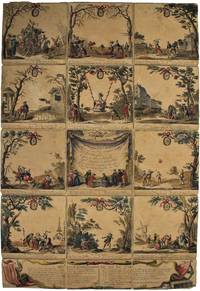
53336Paris: Crépy 1783. Original hand-coloured engraving overall 72 x 48 cm comprising 15 sections the game occupying 12 sections each 16 x 16 cm. plus 3 half-panels at the bottom for the title and rules of the Nouvelle Combinaison each 8 x 16 cm. Contemporary linen backing. Framed with museum quality glass 99% UV filter - less than 2% reflection. Easily removable from frame Joints holding although fragile wear to corners minor loss to inside margin of lower left title panel light browning a few hanging pin holes at margins. Scarce especially when coloured. Without imprint or date as normal. The 12 panels depict 12 traditional games La Main Chaude Le Balon La Crosse etc which follow the 12 months of the year. Rules for advancing around the board underneath each illustration and a second method of playing in the bottom three panels. [Paris: Crépy, 1783]. unknown
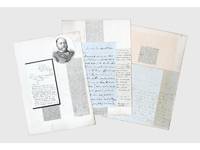
1837156409Kabul and elsewhere: 1837-41 & 1859. Correspondence chess A carefully assembled collection of material connected to players in the "great game" including Colonel Stoddart and Captain Arthur Conolly both famously beheaded at Bukhara Major Henry Rawlinson the political agent at Kandahar and Captain Sir Alexander "Bukhara" Burns. The material mounted on album leaves with accompanying newspaper clippings and other ephemera is tied together by Connolly and Stoddart's dramatic death. Sent on a mission to secure an agreement of friendship between Britain and the Emir of Bukhara in 1838 Stoddart was arrested by the emir on charges of spying and imprisoned. Conolly the intelligence agent credited with coining the term "great game" in an 1840 letter to Rawlinson arrived in Bukhara in late 1841 to negotiate his compatriot's release. Both men were killed in June 1842 and became household names back home. In the first two letters Burns writing about a year before he was killed by a mob in Kabul shares his views with Rawlinson on the latest moves in the "great game". He writes of Stoddart's short-lived release from prison and of the importance of Conolly's current intelligence-gathering in Central Asia. Shah Shuja "is surrounded by a parcel of harpies" and Burns advises caution about the use of British troops to prop up the Shah's rule: "Nothing contributes so much to lower the King's power as the employment of our troops against Afghans & I would avoid it if possible." As for Lord Auckland the governor-general "does not have great faith in the sincerity of Russia in abandoning her Khiva designs but it gives us time." The third letter from Conolly to Rawlinson discusses local news and offers a lighter-hearted window onto the life of a political agent far from home. He has swapped the diplomatic chessboard for the card table: "We miss you very much - especially at whist" the previous night's rubber being "stale and flat but not unprofitable for I won 9 rupees." This letter is mounted with a page of Stoddart's notes on taking navigational bearings which Stoddart gave to Rawlinson before departing for Central Asia in 1837. The final piece touches on the wider appeal of the Stoddart-Conolly story. Writing to the Cornish baronet Sir Hugh Molesworth almost two decades later Dr Joseph Wolff mentions his second expedition to Bokhara mounted to ascertain the fate of the two men and how the profits from the two editions of his best-selling Narrative of a mission to Bokhara 1845 were sufficient to finance a parsonage and schoolhouse in his living. a Sir Alexander Burns to Major Henry Rawlinson 21 December 1840 Kabul. ALS bifolium written across all sides. b Sir Alexander Burns to Major Henry Rawlinson 20 January 1841 Kabul. ALS bifolium written across all sides. c Captain Arthur Conolly to Major Henry Rawlinson 1840 Kabul. ALS bifolium and single sheet written across 5 sides addressed on final side remains of wax seal. d Colonel Stoddart's autograph notes on taking navigational bearings single sheet written one side. Endorsed on verso by Rawlinson "Given to me by Col. Stoddart on his departure for Bokhara in 1837. H. Rawlinson"; later note to the same effect but in a different hand below. e Revd Dr Joseph Wolff to Revd Sir Hugh H. Molesworth 31 August 1859 Taunton Somerset. ALS bifolium written across 3 sides. 4 autograph letters and single sheet of notes totalling 17 sides of manuscript tipped to or mounted on stubs to card album leaves 370 x 265 mm with laid-down material 11 newspaper clippings 2 printed illustrations sheet of manuscript later brief captions in manuscript. Letters and sheet of notes generally well preserved staining and creasing as expected stubs occasionally just touching text but no loss to sense: a very good collection. unknown
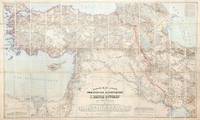
1899155664Dehra Dún India & Berlin: Photozincographed at the Office of the Trigonometrical Branch Survey of India & Dietrich Reimer 1899-1904. Remarkable assemblage of three important and superbly detailed maps A rare opportunity to acquire three exceptionally impressive and uncommon maps together forming the finest contemporary cartographic overview of the Great Game's central theatre. Spanning from the Mediterranean to Afghanistan and from the Caspian to Sir Baniyas Island they present a striking synoptic view of the region at a moment of intense strategic interest. All three share the same provenance each bearing the distinguished bookplate of the officers' mess library of the 85th Foot later part of The King's Light Infantry. Likely acquired as a group by an officer attuned to imperial affairs in the run-up to or immediate aftermath of the 1907 Anglo-Russian Convention they reflect the period's effort as Hopkirk notes to resolve regional rivalries and curb Germany's eastward ambitions. The Persia map is a landmark Survey of India production and the most comprehensive rendering of the region then available incorporating the latest British and Russian surveys and reconnoitres. Only 300 copies of this August 1904 issue were printed and institutional locations are limited to the British Library Deutsche Nationalbibliothek and Sächsische Landesbibliothek. The impressive wall map of Afghanistan June 1901 produced under Strahan and Gore and executed at the Frontier Drawing Office under Colonel R. A. Wahab is equally rare with copies recorded only at the British Library Wisconsin and the Bayerische Staatsbibliothek. Its authority rests on extensive British and Russian sources including work by Robertson Trotter Sykes Ney Elias and the Afghan Boundary Commission. These maps exemplify the Survey of India's exacting standards during the era of photozincographic production when officers were required to vet every detail under magnification. Kiepert's map of the Ottoman Empire complements the two Survey of India sheets representing the best contemporary mapping of a region Britain could not itself survey. Kiepert one of the foremost scholarly cartographers of the 19th century travelled widely in Ottoman territories producing clear and remarkably accurate maps that remain valuable records of the period. This map is comparatively well represented institutionally with around 17 holdings recorded in Europe the US and the UK. Persia: scale 1:1013760 six-sheet coloured map divided into four linen-backed quadrants each measuring approx. 976 x 963 mm when assembled measuring 1952 x 1926 mm North West North East South West South East each backed with Nonpareil pattern marbled paper each section dissected into 20; Afghanistan: scale 1:1013760 coloured map dissected into 45 sections linen backed measuring approx. 1035 x 1640 mm; Turkey: scale 1:1500000 coloured map dissected into 65 sections linen backed measuring approx. 1016 x 1700 mm; together with the "Apercu general" measuring 412 x 570 mm showing the administrative division of the same area intended to accompany the map; dissected into 10 sections linen backed. Each map housed in the original dull purple morocco-grain cloth case Stanford's printed label to front. Cases a little worn with some loss of fabric light toning to maps otherwise in excellent condition. Cases a little worn with some loss of fabric occasional light toning to maps otherwise in excellent condition. Kourosh Ahmadi Islands and International Politics in the Persian Gulf: Abu Musa and the Tunbs in Strategic Perspective 2008; Kyle J. Gardner The Frontier Complex: Geopolitics and the Making of the Indo-China Border 1846-1962 2021; Peter Hopkirk The Great Game: On Secret Service in High Asia 1992. hardcover