(ABC GAME).Biblio.com
46 résultats
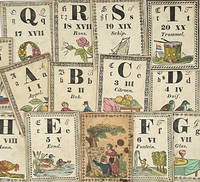
1820103149<p>No place no date but Leiden P.J. Trap c. 1820. Size: c. 6 x 8 cm. 27 cards the first one with two children reading and the other 26 contain the alphabet in various lettering types and the Roman and Arabic numbers. Each card also shows a word beginning with the letter on it and a handcoloured picture of the word. Each card with a decorative typographical border various types. card with publisher's name not present; the first card with browning and staining but all in all a lovely clean set held in a homemade green open box.</p><p>Rare Dutch alphabet cards. The first card was used for the cover of 'Kinderen lazen kinderen lezen'. c.f. Van Veen Kinderen lazen kinderen lezen #17; Buijnsters Papertoys p. 142/143.</p> P.J. Trap
1874246686London: Chapman and Hall 1874. First edition secondary binding. vi 337. 1 vols. 8vo. Green cloth spine titled in gilt. Very good minor rubbing. First edition secondary binding. vi 337. 1 vols. 8vo. Tiger hunting in Central India with notes on leopard. The author "also relates numerous stories from other sportsmen focusing on hunting bear rogue elephant and the like" Czech. Czech Asia p. 2 Chapman and Hall unknown
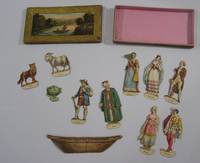
182518320French: n.p. 1825. Very good. 11 engraved cut-out figures or objects including ferryman three couples wolf goat cabbage and boat to be slotted into boat original box with engraved pictorial label colored by hand A rare children's game possibly printed by the Parisian publisher Nepveau. Contained in the box measuring 14cm x 7cm x 1cm is a complete set of figures for the two river crossing puzzles known as the 'Jealous Husbands Problem' and 'Goat Wolf and Cabbage'. The earliest account of these puzzles is in the 9th century manuscript "Propositionnes ad Acuendos Juvenes" Problems to Sharpen the Young attributed to Alcuin. In both puzzles there are only two places in the boat. In the Jealous Husbands Problem no woman can be with another man unless also accompanied by her husband. In Goat Wolf and Cabbage the wolf will eat the goat and the goat will eat the cabbage unless they are guarded by the boatman. <br /> Originally accompanied by counters and an instruction sheet now lost. The box is lightly worn else in very good condition; the figures are in fine condition except the boat which has been repaired and the cabbage which lacks the lower part of its insertion tab and one female figure lacks a hand. Rare. n.p. unknown
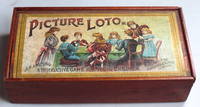
188040199London: J. Jaques & Son c.1880. Twelve cards showing 18 pictures each - a total of 216 pictures plus 207 tiles with the names of the pictures in both English and French - so lacking 9 and with some handwritten replacements included. Original wooden box with a pictorial sliding lid not fitting well but otherwise sound. Scarce. The price includes VAT in the UK. Please contact us if you are elsewhere. London: J. Jaques & Son unknown
180950306London: Publisher for the Author. by W. & T. Darton 1809. Folding game 54 x 66 cm the map portion 49 x 43 cm not including margins dissected and backed on linen. Attractive contemporary hand colouring panels either side mostly in double column containing the instructions and a list of the places featuring in the game with brief descriptions. Some minor creasing to the edge of a few sections some soiling to the reverse. Original marbled case with a printed label a little rubbed overall a well preserved example. Whitehouse p.13. London: Publisher for the Author... by W. & T. Darton unknown
187537921Paris: M.J. & Cie 1875. 10 1/4 x 10 1/4 x 5 inches. Some minor wear. 10 1/4 x 10 1/4 x 5 inches. M.J. & Cie unknown
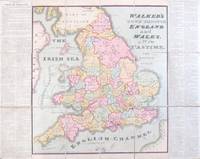
1802207728Lond. W. & T.Darton. 1802. Large folding hand-coloured map of England & Wales. 550x530cm when unfolded. Has 118 place markers on which counters can move when a totum is thrown. The counters can be purchased separately. The players commence in Maidstone no.1. and end in London No.118. Contained in a rubbed card case. Good copy. Scarce. The directions for playing s printed on the sides of the map. Lond. W. & T.Darton. unknown
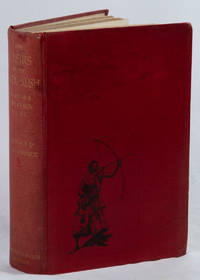
1896223413London.: Lawrence & Bullen Ltd. New Edition. 1896. Coloured folding map tipped in at rear 79 full page and text illustrations by A. D. McCormick xx 658pp original decorated polished red cloth spine gilt-lettered 24 x 15.5 cms front free endpaper browned neat inscription of a previous owner to the front pastedown manuscript short index tipped in by a previous owner at rear boards bumped and stained and spine a little sunned but a good complete copy. A distinguished soldier diplomat and Anglo-Indian administrator Sir George Scott Robertson 1852–1916 journeyed in Kafiristan in 1890-91 living for a year among the "wild" hillmen. <br>The Kafirs’ polytheistic religion and customs were rapidly disappearing by the time Robertson visited and his work served as one of the most important eyewitness accounts of the pre-Islamic cultures of the Hindu Kush and as valuable historical record of a culture that was quickly being assimilated into the broader Afghan Islamic state. It is one of the last detailed accounts of the Kafir people before they were forced into Islam or eradicated by Afghan forces. <br>Robertson’s book also provides important historical context for understanding the political dynamics of the Great Game. His observations of the Kafirs’ resistance to the Afghan Amir and his concerns about the potential spread of Islam in the region highlight the intersection of politics culture and religion in Central Asia during the 19th century. <br>The profuse illustrations are after sketches and watercolours by Arthur David McCormick who was artist on Sir Martin Conway's expedition to the Karakoram subrange of the Himalayas and in 1895 on Clinton T. Dent's expedition to the Caucasus Mountains. . Lawrence & Bullen Ltd. hardcover
189459978London: Longmans Green and Co. 1894. Two. vols. xvi 453 1; x 443 1 pp. plus 2 pp. publisher’s ads. Frontisp. both vols. illustrated title pages plates text illustrations photo illustrations throughout both vols. Pictorial brown publisher’s cloth white & black lettering front covers & spines gilt illust. on spines of lion & moose some minor soiling rubbing minor bumping to a few corners slight fraying head & foot of spines still VG- set from the library of Joseph Anderton w/ armorial bookplate on front pastedowns Non Flectimus. First editions of these volumes in The Badminton Library featuring extensive hunts in South Africa and East Africa in vol. I with chapters on elephant buffalo lion rhinoceros hippopotamus ostriches giraffes lion and musk ox; while vol. II details hunting in the Arctic the Caucasus Alps and substantial portion for hunting in India. Longmans, Green, and Co., hardcover
189764124New York: Longmans Green & Co. 1897. Tall 8vo. 8 195 1 pp. Six plates. Pictorial green publisher’s cloth cover art of moose by Decorative Designers gilt lettering front cover & spine slight rubbing & scuffing to lower right fore-edge very minor dustsoiling still VG bright copy. First American edition of this excellent work incorporating big game hunting accounts of Lions in South Africa Hippopotamus Giraffe & Zebra hunting as well as Grizzlies in the Rocky Mountains and Moose. Longmans, Green & Co., hardcover
182017762Amsterdam: Steendrukkerij van C. Goos 1820. The cards are kept in the original publisher's marbled slipcase ca. 4.8 x 7.2 cm with 2 engraved labels one with the title and imprint and one with the rules of the game. Set of 42 lithographed miniature playing cards 21 for Cloris printed in grey and 21 for Roosje printed in blue. Most charming set of miniature playing cards for use of a somewhat daring party game between young people of both sexes. The 42 cards each with an illustration of a couple and a four-line verse are either titled "Cloris" or "Roosje". The Cloris cards were divided between the boys and the Roosje cards between the girls. One of the young men would "propose" by reading the verse of one of his cards and one of the young ladies would answer by reading hers. The verses were full of love and desire but since the cards were read at random Roosje's reponse would not always be the logical answer to Cloris' proposal leading to hilarious situations.The name of the game most likely refers to De bruiloft van Kloris en Roosje which was a Dutch farce written by Dirk Buysero at the end of the 17th century. The play became incredibly popular. It was performed yearly throughout most of the 18th century and still widely known in the 19th century.The slipcase is scuffed and partly torn around the edges and corners. Otherwise in good condition.l Cat. De Koning 617; Gumuchian 3223. Steendrukkerij van C. Goos, unknown
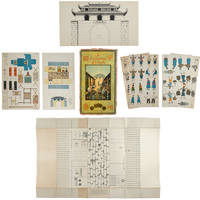
1900159678London.: Church of England Zenana Missionary Society. No date. circa1900. Nine printed sheets each printed with people or items and showing the cut lines. Original chromolithograph card box archivally repaired along seams. Some occasional light foxing on sheets card covers browned and worn in places a few other minor signs of wear but generally very good. 43 x 24cm. Rare. We have found no other copies of this game. The first two sheets show Chinese people in clothes appropriate to their age occupation etc. Those illustrated include The Opium Smoker School-master The General Shopkeeper Native Biblewoman etc. Other sheets show furniture and fittings a coloured illustration of the street a black and white image of the city gate and a much larger sheet 50 x 87.5cm which is an illustration of the street and onto which the other cut-outs when coloured and cut out are placed. . Church of England Zenana Missionary Society. hardcover
187027855France 1870. Board game. Fine. A French childrens' board game complete with the folding board 10 number disks 6 wooden pieces the instruction sheet and box. The box is papered in apricot & gold spotted paper with an image on the cover of clowns ascending a pyramide and one tumbling down. The box measures 11 x 8". All in very good condition. unknown
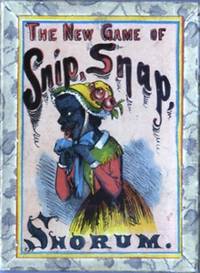
1890510171890. Deck of 20 illustrated playing cards 3 5/8 x 2 9/16 inches hand-colored with 2 card with printed game instructions. All housed in the original box with color printed label on the lid. A few cards have light soiling or foxing as does the blank paper of the box. Near fine. The game or Snip Snap Snorum has its roots in the late 18th century and was popular throughout the 19th century. It is basically a stops game in which cards are played in ascending sequence in suit. This version has five suits each containing four cards. Of these two suits depict stereotyped images of blacks with ridiculous racist names. unknown
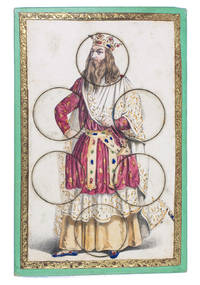
184017799Paris 1840. 19.5 x 13 cm. R. Lacouchin With 3 finely lithographed plates mounted on 3 thick green paperboard cards. The lithographs are framed with a gold-coloured ornamental border. The images on the cards are all beautifully hand coloured and the 3 cards depict respectively a crowned king in ornate robes a beautiful young lady in a green dress and a young man or possibly a court jester in an extravagant yellow and green outfit. Each card has 6 large circular movable pieces to be removed or inserted as the game demands in various circumstances. 3 puzzles. Three beautiful and complete puzzle cards with round movable pieces for example for a game of metamorphosis or lotto. While no rules are present or other specific indications given the cards with their beautiful coloured illustrations are quite intriguing by themselves.The illustration of the young man in the yellow and green outfit is signed "R. Lacouchin". Slightly foxed otherwise in very good condition. unknown
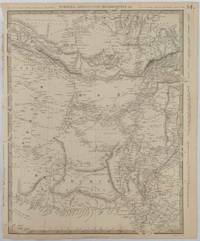
1852224152London.: Society for the Diffusion of Useful Knowledge; Charles Knight. 1852. Engraved map 39 x 30.5 cms; 41 x 34 cms sheet relief throughout shown by hachures publisher's or binder's numeric stamp 94A the margins a little browned and chipped with loss to the two keys at the inner edge marking Indian and Persian distances but the map in very good condition. A highly detailed example of political and military cartography from the height of the Victorian era capturing the Central Asian frontier at the dawn of the "Great Game". <br> <br>The map covers the expanse of Central Asia stretching from the deserts of modern-day Uzbekistan and Turkmenistan down through Afghanistan and Pakistan to the Arabian Sea. It maps out the Emirate of Bukhara in the north and the Desert of Khiva. It explicitly references the "Nomadic Tribes of Turkomans" roaming the steppes. Afghanistan is centred on the map and displays the fractured geography of the Afghan kingdom. It details the treacherous mountain passes of the Hindu Kush alongside the major strategic cities of Kabul Kandahar and Herat. Beloochistan Balochistan & Sinde Sindhanchor the southern third of the sheet it routes down toward the coastline showing the vast desert paths tribal domains and the mouth of the Indus River. . (Society for the Diffusion of Useful Knowledge); Charles Knight unknown
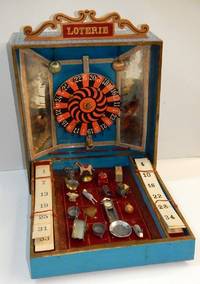
19002210013<p><i>Wooden box 32 x 26 x 8 cm with light blue patterned paper covering; the lid with a label lettered 'Loterie' and a hinged pierced wooden sign with the words 'Loterie' lettered in gilt paper on red; the lined paper interior with a central mounted wheel between mirrored sides and two hanging silk balls; the fall front where the prizes are held with two spaces left and right containing six lottery cards one from another set together with 16 toy prizes as listed below.</i></p><p>Lottery or carnival wheels games became popular at the end of the nineteenth century. Their construction was more complicated than heretofore with the addition of a rotating wheel with pins with a 'clack' mechanism sounding as the wheel is spun. The numbers on the wheel are randomly arranged from 0 through to 25 in white on alternating in black and red ground - clearly based on the 'single zero' form of roulette wheel that became the norm in Europe from the middle of the nineteenth century. The design has a second purpose as the box is hinged so that open it is given the form of a fairground entertainment with an assortment of prizes laid out in a display on squares below the wheel that each have a number too. </p><p>The idea of the game is twofold firstly as the wheel is spun and numbers called out the player who first completes a card of numbers is the winner. In the second game when the numbers 1 to 16 are called out and a player has the number on one of the cards they can then claim one of the small toy prizes. The sixteen twenty assorted of toy prizes include: a handcart wall clock bracelet scales pram wooden top bracelet fairground horse two rabbits a chicken a dish a parcel a metal top metal puzzle pair antimony jardinieres and a heart broach.</p><p>There is no makers name and the design although of a solid construction is nevertheless probably a bespoke production possibly made in order to be sold through fairgrounds and market stalls rather than the more salubrious emporia for children. The interior is lined in turquoise paper with bevelled mirrored silvered card sides and although simple the idea was glittery enough to catch any passing child's attention.</p>
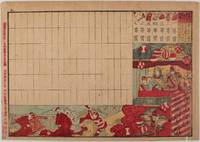
1892215726大野栄吉. Ōno Eikichi. Meiji 25 1892. Colour woodblock print 22.8 x 32.5cm evenly browned few chips in margins but overall very good. This colourful woodblock print serves as a point sheet for a horse racing board game. While the game rules are unclear the print vividly captures an exciting race scene featuring three horses and their jockeys. The race unfolds in a festive atmosphere complete with blossoms and lanterns while the spectators appear to include the Meiji Emperor and Empress along with their entourage. The Emperor is depicted in full military uniform and the Empress is shown in a traditional kimono. The print also displays the prizes for first through seventh place which include a silver cup a trophy a riding cap a scarf a shoe and a whip. Western-style horse racing began in Japan in the mid-19th century following the arrival of Westerners and became a high-class social event during the Meiji period. . 大野栄吉. [Ōno Eikichi]. unknown
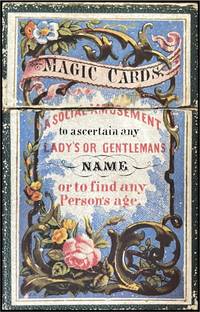
185019999England 1850. 18 cards 89 x 54 mm 9 printed on pink cardstock and 9 on yellow. Housed in original slipcover made of pebbled green paper over boards with chromolithographed label affixed to the front open at top and bottom. Light wear to edges of slipcover otherwise in excellent condition. A charming and unusual magic card game based on mathematical principles that purports to reveal anyone’s name and age. Using the pink cards for women and yellow for men the questioner holds onto the instruction and key cards and gives the player the rest of them which have lists of names and numbers and the letters A E I O U W and Y at the top. The player tells the questioner the letters corresponding to which cards have their name on them and using the key the questioner adds their corresponding numbers to get the player’s name provided it is one of the 127 names listed. The game is played the same way to determine players’ ages. The game actually works! unknown
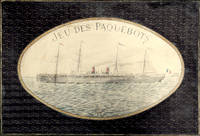
18972210164<p><i>Comprising two coloured map board 66 x 99 cm folding down to 32.5 x 49.5 cm one cloth hinge broken; 14 route cards; a barometer dial 19 x 19 cm with gilt metal spinning arrow some abrading from use; eight painted white metal playing pieces in the form of ships contained in the original small box one piece not original; 16pp booklet of instructions bound in original light green printed wrappers; all contained in the original box 35 x 52 x 5 cm; the hinged lid with a large coloured lithograph title label showing the 'Normandie' leaving port at full steam some minor abrasions but overall in good condition.</i><br /></p><p><i>Jue des Paquebots</i> was something new to games when it was published in 1897 as each player moves their boats on large maps exactly replicating the routes taken by two major French shipping lines. </p><p>The game includes two large folding boards designated 'Carte A' which illustrates the Atlantic shipping lines the other 'Carte B' with the shipping lines leaving Marseilles in the direction of the Black Sea the Indian Ocean and the Pacific. Rather pointedly the instructions state that the two maps include only the French shipping lines of the Messageries Maritimes and the Cie Générale Transatlantique the United Kingdom then the leading maritime nation is neither shown on the maps nor mentioned. </p><p>The players first decide which map they are going use and then select or bid one of the Itinerary cards 8 for map A and 6 for map B. The aim of each player is to complete the journey indicated by their itinerary and then make the return voyage; the first player to complete this double crossing wins. However the number of stopovers is not equal for each different itinerary in play. In order to equalise the chances of winning the players with the fewer ports of call have to repeat their journey a second or even a third time if necessary until the number of ports visited or passed by them in these different routes equates to the number of ports of the busiest route.</p><p>The routes all follow those which the two major French shipping companies plied. These include final destinations at Yokohama Australia New Zealand Zanzibar Odessa Buenos Ayres New York and the Antilles. </p><p>Each player places a ship playing piece at port at the beginning of their route. The first player now spins the Barometer Dial which has outer and inner instructions that allows them to advance out of port when their turn come around again the arrow is again spun and the player can read the inner line of instructions and so advance 1 2 or 3 ports along their route. However there are also stops on the Barometer Dial that include Damage - where you go back to the previous port and pay a token to the bank; Heavy Fog - where you are left stranded until the next round; Collision - this allows another turn of the dial but it the result is 50/50 chance of being sunk and thrown out of the game - you can pay for another ships so all is not lost; Call for Distress - also misses a turn; Shipwreck - something like collision although you can start out again with a new ship and no fine; Rescue - also causes the player to miss a turn; lastly and somewhat topical there is Quarantine - here the player misses a turn and also has a second spin of the arrow to determine if you can go into port or not.</p><p>The lid of the box illustrates the Cie Général Transatlantique liner La Normandie that plied the North Atlantic to New York in the summer and the south Atlantic in the winter - the ship sports a US flag on the foremast and the makers initials on the aft mast. Built in 1886 it was the largest and fastest liner of the company and was originally named 'Ville de New York.' It was also lit by electricity and could carry 1000 passengers and became the model for several sister ships built to the same plan.</p><p>The maker Charles Watilliaux succeeded the games manufacturer Coqueret in 1874 and for the next 35 years became a major publisher and manufacturer of board games and toys until their acquisition by Revenaz & Tabernat. His registered initials were 'W.X.' which is slightly modified for the flag on the box lid as C.W.X.</p> Watilliaux, éditeur.
188959410Paris: n.p. 1889. 4to. 10.5 x 10.75 in. Six individual puzzles individually postcard sized approx. 3.5 x 4.75 in. w/ colour chromolithograph image dissected onto nine wooden pieces each 1 small piece has been supplied in facsimile for upper corner of the Cairo street puzzle. All contained w/in the original deep red paper-covered wooden box raised bed w/in the box to hold the puzzles lid w/ decorative gilt title lettering minor shelfwear very minor rubbing still a VG nearly complete artifact. Very scarce original souvenir puzzle game issued for the fourth great Paris World’s Fair celebrating through pomp and events the Centennial of the French Revolution and the storming of the Bastille. The Exposition was intended to pull France out of a ruinous recession and attracted over 61000 exhibitors as well as 32 million visitors many of whom came to view the iconic Eiffel Tower. This puzzle celebrates several of the pavilions at the Exposition including Palais des Beaux-Arts designed by Joseph Brouvard filled with painting and flanking the Eiffel Tower providing visitors; the Palais de Trocadero held over from the famed 1878 Exposition celebrating the renewal of Paris following the Franco-Prussian War; as well as the Ministere de la Guerre which featured an Arms & Armour exhibition as well as displays of knightly tournaments assorted uniforms and cannon. The Maison Egyptienne and Rue au Caire would fuel the Orientalist movement and fascination with the Middle East among artists writers and the industrial arts well into the 20th Century. These boxed puzzle games were quite popular souvenirs as well as educational tools in the Belle Epoque and have become remarkably scarce. No copies in Worldcat. n.p., unknown
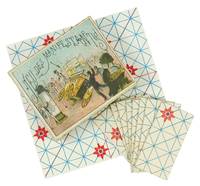
18951270431895. Paris: n.d. ca 1895. <br /> <br /> Original box 85 x 73 x 20 mm covered in gilt-patterned paper with mounted color illustrated title on outside lid and printed instructions slip on inside lid. With 8 printed rectangular card game pieces plus the rare color printed solution sheet 120 x 120 mm folded twice. Minor split to one edge of the lid a few small tears to the sheet otherwise a very good and complete example of this rare and fragile game.<br /> <br /> § A very early apparently the first issue of this French "game of protesters" in which the player takes on the part of a police officer attempting to prevent people from assembling at a demonstration. <br /> <br /> Not located in OCLC although other searches reveal copies in the Indiana Lilly Library in the Jerry Slocum Mechanical Puzzle Collection one within a "coffret de jeu" a boxed group of puzzles and games at the Musée du Jouet de Poissy and another a variant in which the game pieces are triangular at the Marseille Musée des Civilisations de l'Europe et de la Méditerranée MUCEM. Later issues with varying artwork can also sometimes appear.<br /> <br /> The Marseille museum's copy featured in a forum held on February 5 2024: "Faut-il parler des violences policières" "Should we talk about police brutality". The curator Mireille Jacotin explained: "Jeu des manifestants is a game in which you are the hero that is to say the police officer and as the accompanying instructions explicitly state you are firmly positioned on the side of the public authority responsible for maintaining order. In reality the game consists of arranging a set of cardboard pieces-printed on a right-angled triangle-shaped board-in such a way as to ensure that no two red dots end up on the same line. The underlying concept is to simplify the police's task by ensuring that they do not face a mere undifferentiated crowd-and certainly not any organized lines requiring a tactical breach such as a battlefront during wartime. The game board features no specific characters; instead it presents a simple grid-comprising lines and sectors-that serves as a framework for devising and visualizing a strategic plan atop a generic cartographic representation of public space. The red dots in this scenario represent the demonstrators. On the lid of the box however is an urban scene: an overturned double-decker bus a urinal figures stirring in the distance and a policeman in the foreground." For the original French see https://www.davduf.net/le-jeu-des-manifestants-1895. <br /> <br /> It seems likely this game was inspired by the many protests that took place in Paris throughout the 1890s including the birth of the international May Day demonstrations. unknown
182021196041820. Published by J. & E. Wallis 42 Skinner Street London and J. Wallis Junr. Marine Library Sidmouth. 1820. Original engraved sheet game circa 61 x 46cm mounted in sections on original linen folded and housed in the original buff card slipcase with publisher's onlaid engraved and handcoloured pictorial label to one side; a striking and decorative Georgian table or chase game which is composed of 53 pictorial compartments surrounding the elaborately engraved title and printed rules of the game; both game and slipcase in uncommonly fresh condition with some slight toning dusting and a few marks and some light staining to the reverse side the slipcase in unusually fresh condition; scarce in this condition; without the additional explanatory rules booklet which is frequently the case.Third edition with No 53 described in the rules as ""1820. Buonaparte on board the Bellerophon"". Later editions of the book of rules have 3 spaces added: 54. George IV. Plans of London Improvements submitted to the King; 55 William IV. Negro Slavery abolished throughout the British Dominions; 56 Victoria l. May her reign be long and happy. The game would have required a teetotum and counters but these were not supplied by the publisher Whitehouse 25. unknown
189941810Wynkoop Hallenback Crawford Co. State Printers 1899. First edition. Cloth with gilt titles stamped in blind string tied. Maps very good with small splits at corner folds colors bright in very good portfolio with small soiled spot on front and some sunning to spine. 1 colored map on 2 joined sheets 102 x 121 cm. Each map is 32 3/4 x 25 1/2 inches. Issued in portfolio 9 1/4 x 5 3/4 inches with cover title: Map of the Catskill Preserve. Engraved by J.Y. McClintock and W.L. Lawton. Over four feet if joined scale is 1 inch to 2 miles. Shows patents lots names of landowners and town boundaries subdivided into tracts. Shows street names and railroads. Compiled from "Official Maps and Field Notes on file in the State Departments at Albany N.Y. by Authority of the Fisheries Game and Forest Commission." The first meeting of the Forest Preserve Commission was held on September 23 1885 and a tabulation of the state ownership did not exist yet; in 1892 the State provided $250 the Forest Commission "for completing the public path leading to the summit of Slide mountain Ulster County included within the preserve." and in a 1893 budget bill Chapter 726 the State provided $1000 "For the expenses of examination of title and survey of lands owned by the state on Slide Mountain in Ulster County and other parts of the Catskills." which lead to the creation of this first map of the Catskill Forest Preserve. Quite detailed and in remarkably good condition. Wynkoop Hallenback Crawford Co. State Printers hardcover
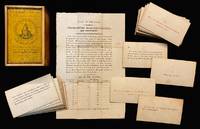
18343220027<i>24 printed cards 9.5 x 5.4 cm including 12 question cards printed in red and 12 Answer cards printed in black; a folding printed sheet of instructions; contained in the original wooden box two sides very skilfully replaced; sliding lid with printed title label depicting a seated Moses reading from the Tablets. </i><br /><br /><br />The game is intended for six players who are each provided with a piece of scrap paper called 'Contracts'. The Answer cards are dealt to the players and the Question cards retained by the dealer. The players each examine their aAswer card they have been given after which the dealer selects a question card and lays it down in front of the players and then asks each in turn until the Answer card is produced. If no answer is forthcoming then the dealer refers to a 'key' which matches questions to the correct answers. Whoever reads the wrong answer or fails to recognise they have the correct card in their hand forfeits a Contract. The player who has parted with the fewest Contracts is the winner. <br /><br />Questions include 2 'What time did God employ in forming the Creation' the Answer 'Six days: and rested on the seventh day. We are not to suppose by this expression that God was weary and required rest but that he rested from or left off creating.' 16 'Who is supposed to have arranged and published the Old Testament' Answer 'Ezra a priest of the Jews.<br /><br />Some of the answers stray into the New Testament and are also fearsomely long for children to remember:- 15 'How did the Jews forfeit the favour of God; and will they ever regain it' Answer 'They forfeited the divine favour but their obstinate rejection of the Son of God whose pure doctrine of humility and love was in direct opposition to the worldly pomp and glory which they had falsely led themselves to expect at the coming of Christ. It is predict that they will one day acknowledge Christ as the Messiah and be restored to their former privileges' One has to admit there is quite a lot of anti Jewish feeling in many of the Answer cards reinforcing contemporary prejudices - 22 'In reading the Bible what part may be passed over in order to connect the historical records' - Answer 'You may be allowed to pass over the book of Leviticus and the eight first chapters of the book of Numbers. The books of Chronicles may be read as a repetition of the book of Kings both bring you to the Babylonish Captivity; you then pursue the History of the Jews and read to the end of Esther. The writings of the Prophets as connected with the History of the Bible should be read next. The book of Job the Psalms &. are beautiful compositions and may be read as such at any time.'<br /><br />Produced by the short lived partnership of William Mason Wood a typefounder and shareholder in the Austin Letter Foundry in Aldergate and Kilelm Chandler a printer from Tewkesbury who had recently moved to London and married in 1834. The partnership in Beech street was a few hundred yards from the Austin Letter foundry and as far as we can tell lasted as a business for only a few months before it was dissolved in October 1834. Chandler was successively a printer Station Master Compositor and latterly a Fruitier. We have found no other item issued from their partnership and one feels as a product of their business the cards were a commercial failure.<br /> Wood and Chandler, Printers, 41, Beech Street, Barbican.