153 résultats
18892092902138301312Gaku yowai-kan 1889. Soft Cover. Fine. Number of pages: 84p Size: 18cm Gaku yowai-kan paperback
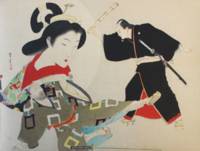
1880184811880. Japanese woodblock print 19th century depicts samurai martial practice within a domestic or staged setting providing visual evidence of sword training traditions that informed later codifications of kendo the discipline derived from earlier samurai combat techniques. The composition places a woman in formal kimono in the foreground while a samurai figure engages in training with a bamboo implement in the background his katana remaining sheathed. This pairing of civilian and martial figures situates the image within the social world of late Edo period Japan when samurai identity persisted as both a lived class structure and a cultural ideal despite the gradual decline of feudal governance prior to the Meiji Restoration.<br /> <br /> Hand colored woodblock print on thick tea paper measuring approximately 11.5 x 9 inches accompanied by a secondary tea paper sheet of similar size containing more than ten vertical columns of kanji text. The image presents detailed coloration and line work with emphasis on textile pattern posture and gesture. The samurai figure is shown in active motion with a bamboo weapon consistent with training practices while the foreground figure's kimono is rendered with attention to layered fabric and ornament. The accompanying text sheet suggests publication or descriptive context tied to the image.<br /> <br /> Produced during a period when woodblock printing functioned as a primary medium for circulating visual culture in Japan the work aligns with broader traditions of ukiyo e and related print forms that documented social roles performance and martial identity. The depiction of training rather than battlefield combat underscores the transition of sword practice into structured discipline and codified movement anticipating later formalization of kendo as both martial practice and cultural tradition. Light wear consistent with age; colors remain strong and impressions clear. Overall very good condition. unknown
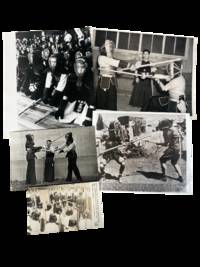
1930228001930. Kendo photo archive group of five press photographs dating from the 1930s to the 1950s documenting the practice of Japanese swordsmanship in both Japan and the United States during a period of war displacement and postwar recovery. The material captures training demonstration and competition settings providing visual evidence of how kendo was practiced across institutional and community environments. These images record both continuity and adaptation showing martial training in prewar Japan wartime or immediate postwar contexts and among Japanese American practitioners maintaining cultural traditions under changing social conditions.<br /> <br /> Five original silver gelatin photographs ranging in size from approximately 5 x 7 inches to 8 x 10 inches each with typed caption slips agency stamps and editorial markings on the verso. The images include scenes of armored kendo practitioners engaged in sparring with shinai captured mid-strike and counterstrike within dojo interiors and outdoor settings. One photograph shows rows of trainees assembled beneath banners indicating organized competition or instruction. Another depicts two fighters in a wooden-floored dojo observed by an instructor in formal attire emphasizing structured training environments. A U.S.-based image presents a group of practitioners in full armor conducting drills against a brick wall identified in captioning as Japanese American kendo activity. An outdoor scene shows two fighters engaged on uneven ground suggesting demonstration or informal practice. A postcard-format image with Japanese text shows a group of female students participating in kendo training indicating inclusion of women in organized instruction. Across the archive visual elements include protective armor bÅgu bamboo swords and regimented group formations.<br /> <br /> Produced across decades marked by militarization wartime disruption and postwar reconstruction these photographs document the persistence of kendo as a cultural and physical discipline. The archive illustrates how martial practices were maintained within Japan and transmitted within diaspora communities including Japanese Americans during periods of restriction and reestablishment. The material supports research into Japanese cultural history martial arts practice and transnational identity formation in the twentieth century. Minor edge wear and corner creasing with editorial markings on versos; overall very good condition. A concise visual record of kendo practice across shifting historical contexts. unknown
19062080502106910570Not Available 1906. Soft Cover. Fine. The book is in fine condition. Not Available paperback
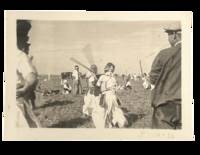
1920227341920. Unknown photographer Japanese American kendo tournament photo archive circa early 1930s documents public Japanese American martial arts practice during the interwar period when Issei and Nisei communities used cultural education sport and youth activities to sustain Japanese identity within a hostile racial climate. The strongest images show children or young adolescents in kendo armor competing outdoors before spectators preserving a rare visual record of diasporic martial arts instruction before wartime incarceration disrupted Japanese American institutions. Kendo in North America was closely tied to Japanese immigrant communities before World War II and the North American branch of the Dai Nippon Butoku Kai was approved in 1935 with an explicit goal of fostering kendo among Nisei youth placing these photographs within a broader history of cultural transmission discipline and intergenerational identity formation.<br /> <br /> Nine original silver gelatin photographs mounted on two black album leaves ranging from approximately 2½ x 3 inches to 5 x 7 inches. Four central photographs depict a large outdoor kendo match on a grassy field with child-age participants wearing full bogu armor and holding shinai bamboo swords in competitive formation. Spectators including men in Western suits and brimmed hats sit or stand along the sidelines while automobiles and period dress place the event firmly within interwar American public life. The remaining five photographs show white Americans in leisure scenes automobiles and a naval ship at dock clarifying that the kendo images were preserved within a broader travel album context rather than a single Japanese American family or dojo archive.<br /> <br /> The kendo images carry particular research value because they document Japanese cultural practice in the United States before World War II when Japanese immigrants and their American-born children negotiated public visibility under exclusion law racial restriction and assimilationist pressure. A later historical study of kendo in the United States notes that wartime conditions led to the suppression of kendo and destruction of equipment and records which heightens the evidentiary value of prewar photographs showing armored youth practice in public. Light wear and rippling from adhesive photographs clear and intact very good overall. Compact but significant Japanese American sports and cultural archive preserving interwar youth kendo community spectatorship and the public performance of diasporic identity through traditional martial art. unknown
19272111902160301569Nyorai Picture Book Publishing Society 1927. Soft Cover. Fine. Number of pages: 75 99 pages Size: B5 size Number of books: 2 Nyorai Picture Book Publishing Society paperback
19062091502135302056Hakubun-kan 1906. Soft Cover. Fine. Volume: 1 Hakubun-kan paperback
20032080202102900435Yojushorin 2003. Soft Cover. Fine. Number of books: 1 book Yojushorin paperback
19012111902152905260Hakubunkan 1901. Soft Cover. Fine. Size: paperback Hakubunkan paperback
19282111902160200066Former Zenkoji Publishing Association 1928. Soft Cover. Fine. Number of pages: 148 pages 198 pages Size: 25cmx18.3cm Number of books: 2 Former Zenkoji Publishing Association paperback
18882110502151100531Not Available 1888. Soft Cover. Fine. Number of books: 8 Not Available paperback
20032080202102600223Yojushorin 2003. Soft Cover. Fine. The book is in fine condition. Yojushorin paperback
96 pages. Features: Nice one-page ad for the Lockheed Constellation features illustration of cabin scene in-flight; Attractive color Ford ad features Green car being loaded with luggage; photo of Robert Moses of Chicago wins bubble-blowing contest; Ku Klux Klan article with photo of burning cross and shrouded members; Russian Spy - Nicolai Gregorovich Redin; New Gropings with the Atom; Cordell Hull prepares memoirs; Nice color-photo Camel cigarette ad says "More Doctors Smoke Camels"; Very nice color one-page Coke ad features spring cleaning scene; Gromyko walks out of UNO; Ad for the Town House Hilton Hotel in Los Angeles; Very cute color Schlitz beer ad features bear in nighshirt raiding fridge at night; Guns over Trieste; The Austrian Larder; Arthur Axmann - article with photo; Famine news from Europe; Possible trouble in India - with photo of Gandhi; Trouble for Jewish sports team in Vienna; Shanghai - inflation and theft; Kendo photo from Japan - it has been outlawed by the Allies; Very nice color centerfold ad for the Pennsylvania Railroad; Nice one-page color-portrait of Mr. Mervyn Le Roy in Calvert Whiskey ad; Ontario liberalizes liquor laws; Five more persons accused of Russian spying in Canada; The Capitolio Diamond Mystery; Argentina fears Yankee 'Nazi' threat; Brief obituaries for Noah Beery Sr., Charles F. Hurley, Martin L. Davey, George Washington, Field Marshal Viscount Gort; Shirley Jane Vetter regains sight after her baby is born; Oil - the big three tangle in the middle east; Color Union Pacific ad features Utah's Zion and Bryce Canyon National Parks; Yellow Bole Pipe ad; Mr. Baruch on the Extension of OPA; Billiard article and photo on Willie Mosconi; Attractive one-page color ad for the Martin 2-0-2 aircraft; Gerald Kersh lifts veil on sordid side of London; Color-photo Studebaker ad shows Don Wyman and his father grinding metal while J.F. Rogers and son Peter perform heat-treating; and more. Above-average wear and soiling. A worthy vintage copy. Book
19142091502133700687Chuoshoin 1914. Soft Cover. Fine. The book is in fine condition. Chuoshoin paperback
40 pages. Features: New flag for Canada's 98th birthday - article with photos; The Queen Mother - Her Personal Story - part 1 of 4; Jean Seberg's Return to the Top - Burned at the stake on film and in reviews, she begain again in Europe - article with photos; Photo of Miss Patricia Soulliere, "Miss Textile of the Week"; Jerry Marx Survived An Avalanche - article with photos; Fantastic colour photo centerfold ad for the Rambler line of cars; Upsurge in Canada's Track and Field Athletic Performance; Paul Anka and Diana Ayoub, the girl he left behind (and after whom his first hit song is named); Kendo battles on the Fraser River Delta dunes in Steveston - Jim Murray studies the Japanese Martial Art - article with photos; ; Back cover Esso ad with the 'Tiger in your Tank' theme; and more. Moderate wear. Unmarked. A sound copy. Book
20032091502133514006Not Available 2003. Soft Cover. Fine. Number of books: 1 Not Available paperback
19972092902138301517Chiku ma shobo 1997. Soft Cover. Fine. Number of pages: 393p Size: 15cm Number of books: 8 Chiku ma shobo paperback
19332110502150502090Nanko-sha 1933. Soft Cover. Fine. Volume: 1 Nanko-sha paperback
20032091202133201670Yojushorin 2003. Soft Cover. Fine. Volume: 1 Yojushorin paperback
1974006147Tokyo Japan: Japan Publications Inc. 1974. Second Printing . Hardcover. Near Fine/Very Good -. 4to - over 9¾" - 12" tall. 179pp.; HB grey w/gilt; slight rub w/cleantight pgs. DJ orange w/white-photo cover; rubbed w/some sun; chips on spine. "Fundamental Kendo includes all of the techniques that the beginner must study and master." photos throughout. <br/> <br/> Japan Publications, Inc. hardcover
20052081502112400411Yamakawa shuppansha 2005. Soft Cover. Fine. The book is in fine condition. Yamakawa shuppansha paperback
19652110502151100685Geisha-do 1965. Soft Cover. Fine. Number of books: 1 Geisha-do paperback
19652092902139203116Geisha-do 1965. Soft Cover. Fine. The book is in fine condition. Geisha-do paperback
19122091502135700021Hakubunkan 1912. Soft Cover. Fine. The book is in fine condition. Hakubunkan paperback
0870402269.Ghardcover. Good. Access codes and supplements are not guaranteed with used items. May be an ex-library book. hardcover