21 résultats
18822090502128300069Not Available 1882. Soft Cover. Fine. The book is in fine condition. Not Available paperback
18882110502150413629Min'yu-sha 1888. Soft Cover. Fine. Volume: 1 Min'yu-sha paperback
18732090202120414360what is not 1873. Soft Cover. Fine. Number of books: 1 what is not paperback
18812082402113510423Rairakudo 1881. Soft Cover. Fine. Volume: 1 Rairakudo paperback
1895121940Stuttgart. Verlag der J. G. Cotta'schen Buchhandlung Nachfolger. 1895. 236 Seiten. Titel- u. rückenvergoldeter, weinroter Original-Leinwand-Einband. (Einband einseitig an der vorderen Rückenkante 2,5 cm eingerissen. Kanten minimal berieben. Ansonsten gutes Exemplar). 19x13 cm
18762080502106504344Shosei shoin 1876. Soft Cover. Fine. Number of books: 3 Shosei shoin paperback
18822111902160200608Hiro-rei-sha 1882. Soft Cover. Fine. Number of pages: 114 pages Size: 18.5cmx12.5cm Number of books: 1 Hiro-rei-sha paperback
189090romanzo storico giapponse AFFICHE ORIGINALE éditée vers 1880-1890 format : 76 x 112 cm (plus un bandeau de 8 cm de haut annonçant une représentation à Turin collé en bas) Mise en scène sous forme d'opéra d'un roman du japonais TAMENAGA SHOUNSHOUI dessin de TAVIO Lithographie de E. PERINO marques de plis et d'un cachet de taxe sinon bel état de fraicheur des couleurs pas de déchirure, pas de manque pour cette très rare affiche. l'affiche n'est pas entoilée
18782090502128301145Not Available 1878. Soft Cover. Fine. The book is in fine condition. Not Available paperback
18842090502128300007Not Available 1884. Soft Cover. Fine. The book is in fine condition. Not Available paperback
18852090502128300123Not Available 1885. Soft Cover. Fine. The book is in fine condition. Not Available paperback
18822080302106807364Ryuundo Temple Osaka Prefecture 1882. Soft Cover. Fine. Number of books: 4 Ryuundo Temple, Osaka Prefecture paperback
18792090502128300510Not Available 1879. Soft Cover. Fine. Number of books: 3 Not Available paperback
18892110502150412978Not Available 1889. Soft Cover. Fine. Number of books: 3 copies Not Available paperback
18832090502126803273Hakumon Head Office Ginza Tokyo 1883. Soft Cover. Fine. Number of books: 2 Hakumon Head Office (Ginza, Tokyo) paperback
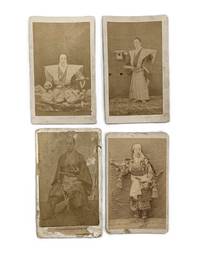
1860231401860. Meiji JapanSamuraiKabuki Theatre Samurai identity in the late 19th century photo archive documenting kabuki depictions of warrior masculinity in Japan during the early Meiji period made after the abolition of the samurai class when images of warriors continued to shape popular understandings of military tradition and masculinity in Japan. These four photographs preserve samurai imagery as presented in popular theatre at a time when Japan's military identity was changing under rapid political transformation. The archive is especially strong for showing how kabuki performance sustained martial ideals in visual form after the social foundations of hereditary warrior status had been dismantled.<br /> Photo archive of 4 albumen carte-de-visite photographs approximately 2.5 x 3.5 inches Japan circa 1860s-1880s. The images show male sitters posed in studio interiors against plain backdrops and atop patterned floor coverings each dressed as a samurai or warrior character. One figure stands in full armor with a sword at his side and a striped staff or bow-like prop in hand his costume built from lamellar armor tassels shin guards and layered protective dress that stress the ceremonial weight of warrior costume. A second sitter tentatively identified as kabuki actor Jitsukawa Enjaku appears seated frontally in voluminous robes with sharply extended shoulder forms flanked by swords and posed on a textile-covered platform in a deliberately formal composition. A third stands holding a small prop structure in one hand with a sword tucked at the waist while a fourth in a more lightly defined but heavily worn image sits in traditional dress with topknot hairstyle and blades visible at the sash. Across the group the repeated use of swords stylized posture and exaggerated makeup grounds the archive in theatrical samurai iconography rather than ordinary portraiture.<br /> These photographs belong to the decades in which photography popular prints and theater recoded samurai visuals as a national historical image rather than a living class identity. Kabuki played a central role in that process preserving warrior narratives and masculine ideals for mass audiences while early commercial photography made those images widely distributable and accessible. For institutions building Japanese photography theater or military history holdings the archive offers direct evidence of how samurai identity was presented popularized and circulated in the first generation of Japanese photography. Heavy fading staining edge wear and mount losses to several cards most notably one with substantial abrasion and corner loss; overall fair to good condition. A group exemplifying the presentation of samurai imagery in popular theatre and photography in Meiji Japan. unknown
1820305224Edo 1820. 200 woodblock illustrations of crests some light soiling to margins. 208 pp. small oblong 8vo 110 x 155 mm. blue paper wrappers worn stitched. 200 woodblock illustrations of crests some light soiling to margins. 208 pp. small oblong 8vo 110 x 155 mm. Japanese woodcut book on the crests and symbols of the Samurai families.<br /> <br /> WITH: <br /> A series of 99 small manuscript information cards on for ceremonial use for Samurai families denoting their crests and banners pen ink and colors. First half of 19th century each card 70 x 55 mm some affected by worm tracks. unknown
18603052211860. 37 pen and ink illustrations of techniques of horse breaking. On rice paper. 8vo 240 x 170 mm. Wrappers in thicker paper with title labels covers slightly soiled and occasionally affected by worm holes some spreading through the text. 37 pen and ink illustrations of techniques of horse breaking. On rice paper. 8vo 240 x 170 mm. A fine mid 19th century Samurai text on horse-riding by Hiko. The Otsubo school of samurai training originated in the 7th century and was popularized in the 12th century when the elite Samurai warriors rode into battle. By 1600 under the comparitive peace of the Toguwara Era the military practice of Military equestrianism was discouraged and often became more of a ceremonial practice amongst the Samurai clans. This late manuscript text just predates the final extinguishing of the Samurai clans by the Meiji Emperor. unknown books
1820305224Edo 1820. 200 woodblock illustrations of crests some light soiling to margins. 208 pp. small oblong 8vo 110 x 155 mm. blue paper wrappers worn stitched. 200 woodblock illustrations of crests some light soiling to margins. 208 pp. small oblong 8vo 110 x 155 mm. Japanese woodcut book on the crests and symbols of the Samurai families.<br/><br/>WITH: <br/>A series of 99 small manuscript information cards on for ceremonial use for Samurai families denoting their crests and banners pen ink and colors. First half of 19th century each card 70 x 55 mm some affected by worm tracks. unknown books
18842080302106807452Chichizando 1884. Soft Cover. Fine. The book is in fine condition. Chichizando paperback
1840122137Japan: c.1840s. A samurai's armour was a map of his spiritual power A colourful and intricately painted explanation of the complex steps samurai followed to don their famous warrior armour and required undergarments. The sequential illustrations show the fitting of a loincloth shirt and cord belt. The figure puts on trousers slippers leggings sandals greaves and thigh guards followed by the external armoured vest belt and shoulder guards. A couple of paintings show the warrior jumping and moving to test the fit of the armour and the security of the knots. Finally he straps on his swords and secures his mask helmet and arm guards completing a fearsome appearance. This manuscript was brushed on the cusp of the major changes in the status of the samurai. After the Meiji Restoration imperial decrees began to curtail their privileges and elite social standing - changes which transformed works like the present example into valuable historical documents. Quarto 267 x 197 mm ff. 15. With 30 original colour illustrations. Contemporary brown wrappers early 20th-century green thread yotsume toji stitching manuscript title label on front cover. Red ownership seal of the artist Hitomi Yuuichi Gyokuransai d.1968 on first leaf. Losses at foot of spine stitching split but still sturdy worming to wrappers and contents illustrations generally unaffected inner rear cover with old paper repair: a good example attractively illustrated. Antony Cummins & Yoshie Minami eds Samurai Arms Armour & the Tactics of Warfare: the Collected Scrolls of Natori-Ryu 2018. hardcover