58 résultats
49'De Spieghel' - Amsterdam 1931. 151pp with many b/w illus. Includes photo portraits of each artist/contributor thes photos taken by Citroen. Citroen Van Doesburg De Jong Van Der Leck Mondrian etc. Joris Minne's copy with newspaper cuttings postcard etc. Cloth boards spine little browned. 25x21cms. 'De Spieghel' - Amsterdam, 1931. hardcover
1975378732-UA13Amsterdam : Noord-Hollandsche Uitgeversmaatschappij 1975. Hardcover. Good. Originele zwarte linnen band met zilveropdruk stofomslag veel illustraties in z/w klein 4to.; Enkele lichte krassen op voor- en achterzijde stofomslag klein scheurtje in stofomslag gerepareerd met tape pagina 118 en 119 licht gevlekt. Amsterdam : Noord-Hollandsche Uitgeversmaatschappij hardcover
1975384758-UF4Amsterdam : Noord-Hollandsche Uitgeversmaatschappij 1975. Hardcover. Good. Originele zwarte linnen band met zilveropdruk stofomslag veel illustraties in z/w klein 4to.; Klein scheurtje stofomslag geplakt. Amsterdam : Noord-Hollandsche Uitgeversmaatschappij hardcover
19852092902140304503Kaze no bara 1985. Soft Cover. Fine. Number of books: 1 Kaze no bara paperback
199375430Gallery. New. 1993. Paperback. 090787939X . FREE UPGRADE to Courier/Priority Shipping Upon Request - IN STOCK AND IMMEDIATELY AVAILABLE FOR SHIPMENT - Flawless copy brand new pristine never opened -- 48 pp. With 34 ills. 8 col. . 29 x 24 cm. -- with a bonus offer-- . Gallery paperback
201299008Post Editions. New. 2012. Paperback. 9460830501 . FREE UPGRADE to Courier/Priority Shipping Upon Request - IN STOCK AND IMMEDIATELY AVAILABLE FOR SHIPMENT - Flawless copy brand new pristine never opened -- 416 pp. ; 373 illus. 231 in color. -- with a bonus offer-- . Post Editions paperback
191765739London New York Toronto Melbourne: Cassell and Company 1917. Fine. Cassell and Company London New York Toronto Melbourne 1917 13.50 x 20.50 cm reliure de l'éditeur Second issue printed in March-April 1917 one month after the first edition published in February of the same year. Publisher's red cloth. Exceptional inscribed copy signed by H.G. Wells to André Citroën: To André Citröen who has to do his share in making a new world out of a very shattered old one. From H. G. Wells. The inscription echoes the chapter of the book entitled New arms for old ones in which Wells describes the armament factory created by Citroën to remedy the French artillery weakness. Reconverted at the end of the war the factory will become the first Citroën automobile manufacturer. A superb testimony to the early friendship between the industrialist André Citroën and the writer H.G. Wells who in this very work dedicates a chapter to the new ammunition factory devised by Citroën as well as to the social progress he brings to his some thirteen thousand munitionnettes. War and the Future a work of propaganda written at the heart of the First World War brings together diverse observations on the ongoing conflict highlighting the radical change that the new armament technologies are bringing to the art of warfare. Wells states his theory of a new world scientific and technical order which already ran through his science-fiction masterpieces at the end of the last century War of the Worlds The Time Machine. As for Citroën having understood the crucial importance of the artillery in modern warfare he made a bet in 1915 to compete with the power of the Krupp armament factories. Abandoning his automobile factory project during the war he builds at his own cost an immense industrial complex on the Quai de Javel which produced 23 million shells for the allied forces. War and the Future bears the marks of Wells' admiration for Citroën whom he met the year before during his tour of Europe for the writing of this book: He is a compact active man in dark clothes and a bowler hat with a pencil and a notebook conveniently at hand. He talked to me in carefully easy French and watched my face with an intelligent eye through his pince-nez for the signs of comprehension page 141. The writer contrasted the immobility of the Front which he visited in 1916 to the incredible dynamism of the Citroën factory a veritable temple of modern industry which he describes as The busy sheds of Paris struck me as being the most living and active things in the entire war machine page 139. These few hours spent with this pioneer of military engineering had a considerable impact on the writer who saw him as an innovator speeding up the construction of the modern world. As the war ended Citroën brought an end to the production of weapons and founded the famous Citroën company making the factory his first automobile manufacturer. As with other personalities such as Joséphine Baker or Rudolph Valentino H. G. Wells became a regular customer of Citroën cars and remained a fervent admirer of the genius that was its founder. Produced at the start of the 20th century Wells' superb handwritten inscription to Citroën on the work that celebrates his visionary talents testifies to the admiration of a man who dreamed of the future for those who made it happen. Cassell and Company hardcover
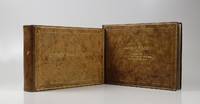
77190Paris Citroën 1915-1916. In two volumes. Oblong folio 31.5 x 43.7 cm. 71 original photographs 22.0 x 28.5-35.5 cm mounted on grey cardboard with printed captions 60; 11. Uniform full mottled calf. Boards with double gilt-rolled ornamental borders and gilt title. = A very rare set both volumes dealing with the Parisian factory founded by André-Gustave Citroën 1878-1935 renowned for its technologically advanced cars but also for its contributions to the French war industry during WWI and in particular the contributions women made as factory workers in the mass production of artillery shells. The first volume is entirely devoted to this subject showing the female munitions-workers at work. André Citroën played an essential part in French women's emancipation: once the women had left their traditional singular role as homemakers replacing the men who fought in the trenches there was no looking back and after the war their participation in the country's workforce became permanent. "World War I radically changed women's role in society as they stepped into the boots of men gone to fight for their countries. In cities across Europe women took on traditionally 'male' jobs - waiting on tables delivering the mail teaching in boys' schools or handling cash as bank clerks. 'Women rapidly became indispensable not only in the nursing and welfare services but in offices and factories and agriculture changing the whole balance of society in the process' says historian Michael Howard. As soon as war broke out in 1914 France's prime minister Rene Viviani called on women to 'replace in the workplace those who are on the battlefield'. . From 1915 onwards Europe's industry - devoted to the war effort - relied massively on the female workforce as did that of the United States from 1917. 'Without women victory will tarry' warned Britain's soon-to-be prime minister David Lloyd George in 1915. Some 400000 women were toiling in France's war factories by 1918 - a quarter of the workforce - handling some 2500 shells per exhausting 11-hour shifts" AFP. The second volume records the building and operational start of the factory itself. It shows the evolution of the works starting with a photo of the still-vacant lot save for gardens and sheds followed chronologically by views of all building developments including one with the famous Eiffel Tower in the distance. Groundwork started in March 1915 and by the 28 September the largely female workforce had already become fully active. The final photo shows the official ceremonial opening of the factory on 24 June 1916 revealing decorations given by General Gilinski on behalf of the Russian emperor. "As soon as war was declared in August 1914 André Citroën was mobilized as a lieutenant then as captain in the 2nd Grenoble Artillery Regiment. On the eastern front he was able to witness France's lack of artillery and ammunition to counter the German forces. Following the death of his brother Bernard on the front André Citroën was determined not only to do his duty but also to repel the enemy as far as possible. In January 1915 he proposed to General Louis Baquet director of artillery at the Ministry of War which was sorely lacking in ammunition to apply Fordism in a factory built in three months and capable of producing 5000 to 10000 artillery shells of Type 75 per day. Thanks to his savings those of his right-hand man Georges-Marie Haardt and especially financing from a rich diamond dealer of Armenian origin Atanik Eknayan who had already saved his fragile Mors 12 car business Citroën erected a huge ultramodern factory on 15 hectares of vacant land and vegetable gardens on the Quai de Javel. With some 13000 workers the factory produced 23 million shells at a rate of 10000 per day an unprecedented rate at the time. 'You have to produce quickly well and economically to put the products manufactured within the reach of the greatest possible number of consumers he said. The pace the factories imposed on workers was tiring and as a result André Citroën was sometimes considered a despot. Nevertheless he was one of the first manufacturers concerned about the well-being of his workers and avoided imposing repetitive tasks. André Citroën's ammunition business quickly gained a reputation and became a model of organization efficiency and social responsibility. Major personalities both civil and military visited the factory. Between 1917 and 1918 the government also charged Citroën with reorganizing supplies for the armaments industry the military postal services and with the distribution of bread ration tickets in the Paris region. When the war was over André Citroën decided to convert his factory on the Quai de Javel into a car manufacturing plan" taken from French Wikipedia. Boards a bit rubbed; a skilful repair to one joint one photograph with a brown spot in the top left corner; otherwise in an excellent state. hardcover