Abraham LincolnBiblio.com
5 résultats
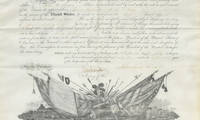
15073254115/07/1864. <blockquote><p>A real rarity the first Lincoln appointment to the Signal Corps for an officer active in Sherman’s Georgia Campaign we have seen</p></blockquote><p>On March 29 1860 the United States House of Representatives approved the Army appropriations bill for fiscal year 1861 which included the following amendment: ""For the manufacture or purchase of apparatus and equipment for field signals $2000; and that there be added to the staff of the Army one signal officer with the rank pay and allowance of a major of cavalry who shall have charge under the direction of the Secretary of War of all signal duty and all books papers and apparatus connected therewith."" The United States Senate eventually approved the appropriations bill over the objections of Jefferson Davis now Senator from Mississippi and President James Buchanan signed it into law on June 21 1860 the date now celebrated as the birthday of the modern U.S. Army Signal Corps.</p><p>Now armies on the go could report back to their civilian leadership in real time and those leaders could make decisions without waiting for a messenger on horse. This changed the face of warfare. President Lincoln himself spent significant time in the telegraph office sending and receiving war correspondence. He often walked alone from the White House to the office and chatted with the operators. As Bates later wrote “During the Civil War the President spent more of his waking hours in the War Department telegraph office than in any other place except the White House. While in the Telegraph Office he was comparatively free from official cares and therefore more apt to disclose his natural traits and disposition than elsewhere under other conditions.â€</p><p>John Quincy Adams first enlisted in 1862 with the 38th Ohio Volunteers. On October 15 of that year he was a quartermaster sergeant with the 10th Ohio Cavalry. After a stint as acting lieutenant on July 15 1864 he was appointed by the President Second Lieutenant to date from March 3 1863. Adams was actively involved in the Georgia campaign conducted by Gen. William T. Sherman. He was with left wing of the 16th Army Corps on the march to Chattanooga Tenn. In the Atlanta Campaign he participated in the battles of Resaca Dallas Kenesaw Mountain. and Jonesboro. He manned signal corps stations at Kenesaw Mt. and Allatoona.</p><p>Adams was in the engagements at Port McAllister and Rice Mill station in the campaign from Savannah through the Carolinas including battles at Columbia Bentonville and Raleigh; and at the surrender of Confederate Gen. Joseph E. Johnston to Sherman on April 26 1865. Adams was breveted 1st lieutenant for gallant and meritorious service in the Signal Corps at the battle of Allatoona; he was breveted captain for gallant and meritorious services in the Signal Corps at the capture of Fort McAllister and Savannah and throughout the war. Adams was mustered out August 22 1865. After the war he was in the 1st U. S. Cavalry and was in the Indian wars and finished his career as captain and aide to Gen. O.O. Howard in October 1884. He is listed on the roster of the U.S. Signal Corps in the Civil War.</p><p>Adams is also a protagonist in one of the most famous telegraph exchanges of the war during the battle near Allatoona. During this battle legend goes that Sherman signaled to General Corse and his men to ""hold the fort"" a phrase that inspired the later popular religious hymn entitled Hold the Fort by Chicago evangelist Philip P. Bliss which featured the chorus 'Hold the fort for I am coming’ which then became a common expression. We still use ""hold down the fort"" today. Adams was the signal officer who received that message or rather a variant as Sherman did not use that exact phrase though captured the sentiment.</p><p>This is President Lincoln’s appointment of Adams as Second Lieutenant. <strong>Document signed</strong> Washington July 15 1864 naming Adams <em>""Second Lieutenant in the Signal Corps""</em> dating from the third of March 1863.</p><p>This document is a real rarity as we have never before seen a Lincoln appointment to the Signal Corps for an officer active in Sherman’s March to the Sea. Moreover Lincoln Signal Corps appointments are themselves uncommon this being our first.</p><p>It was acquired from the Adams descendants and has never been offered for sale before.</p><p><img class=""alignnone wp-image-25018 size-post-window"" src=""https://cdn.raabcollection.com/wp-content/uploads/20231204144051/Folder-site-11-1600x1327.jpg"" alt="""" width=""1600"" height=""1327"" /></p> unknown
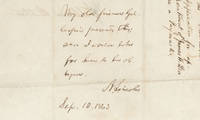
15093547615/09/1863. <blockquote><p>The letter itself was from Lamb a pallbearer after Lincoln's assassination</p></blockquote><p>Joseph Gillespie was a Whig member of the Illinois Assembly in 1840-41 and then served in the State Senate from 1847 to 1859. He joined the Republicans in 1856. Gillespie chaired the Illinois Republican State Convention in 1860 where presidential electors were selected who would vote for Abraham Lincoln and served as circuit court judge in Southern Illinois from 1861 to 1873.</p><p>From when they met in 1840 Gillespie was a key political ally lawyer and trusted and intimate friend to Abraham Lincoln. They consulted on legal cases and in political matters where they kept each other informed of political developments. Gillespie visited President-elect Lincoln at Springfield before he left for Washington. When Lincoln was president Gillespie occasionally went to Washington to see him and kept him informed about the political situation in the western states. Their correspondence shows a close personal bond.</p><p>James L. Lamb was a meatpacker industrialist and friend of Lincoln from Illinois known for his business dealings with the future President and his role as one of the pallbearers at Lincoln's funeral. In a letter addressed to President Lincoln Lamb wrote him from Springfield Ill. September 10 1863 to secure a position for a relative. “My friend and relative Mr. James H. Lea is an applicant for the position of paymaster in the army. His appointment I am sure would meet the approbation of all true friends of the Government who are acquainted with him. I have long known him as a reliable competent businessman and one whose integrity could be fully relied upon. His moral character is without blemish and the most satisfactory assurances can be given of his integrity and fitness for the position.†The docket states “Springfield Sep. 10/63 James L. Lamb to the President. Application for appointment of James H. Lea as a Paymaster.â€</p><p>This letter was not mailed by Lamb to Lincoln. Instead Lamb gave the letter to Gillespie to enlist his support and use his influence with Lincoln. Gillespie presented Lamb’s letter to Lincoln with his request that it be honored.</p><p><strong>Autograph endorsement signed</strong> Washington September 15 1863. <em>“My old friend Gillespie presents this; and I would like for him to be obliged.†</em>This is unpublished and not in Basler’s Collected Works of Abraham Lincoln. The wording of Lincoln’s endorsement saying that Gillespie presented this to Lincoln and the implication that Gillespie will need to be presenting this to the Secretary of War raises the possibility that Gillespie handed this to Lincoln in person and then took the endorsement to Stanton.</p><p>On October 10 Gillespie wrote Lincoln that the appointment had not yet been made and relating a communication with Stanton saying<em> “I would beg to call your attention to the subject of the appointment of my friend James H. Lea of Alton to the office of paymaster in the regular army. Secy. Stanton told me that he would retire one now on the list to make place for Mr Lea in a short time. I have heard nothing from him since. I would take it as a great favor if this thing could be done soon. I am aware how much you must be pressed with business of an engrossing character at this juncture but hope you may find leisure to jog the secretary’s memory.â€</em></p><p>According to papers in the Library of Congress James H. Lea was appointed an additional paymaster of volunteers to rank from February 23 1864. He signed his oath of office in April.</p><p>This is a fascinating endorsement showing how Lincoln sought to assist his old friends to the extent he appropriately could.</p><p><img class=""alignnone wp-image-25018 size-post-window"" src=""https://cdn.raabcollection.com/wp-content/uploads/20231204144051/Folder-site-11-1600x1327.jpg"" alt="""" width=""1600"" height=""1327"" /></p> unknown
15042913315/04/1865. <blockquote><p>The Assassination:<strong><br /></strong></p></blockquote><p>Abraham Lincoln continues to stand as America’s most beloved President. Of our nation’s historical icons Lincoln is the quintessential embodiment of American possibility in his mythic-like rise from rail-splitter to Chief Executive and Emancipator of the oppressed. The admiration felt by Americans for Lincoln’s humble integrity his performance in office his noble statesmanship and his keen sense of justice is enduring. Lincoln is not given the highest marks just for character but for the transformation of the nation that he left behind which was both profound and long-lasting.</p><p>Polls of historians generally show their belief that Lincoln faced the hardest job of any president. He had to define the issues inspire the people be steadfast in the face of losses win the Civil War free the slaves and lay the groundwork to reunite the nation. All that in the face of determined opposition. He accomplished all this in four years but was assassinated on April 14 1865 and his death left him unable to finish the job a job that quite likely he was the only one with a chance to get completed in a way that would truly bring the nation together.</p><p>The end of the Civil War left the nation with two overwhelming questions: what to do with and do for the millions of freed slaves; and how to reintegrate the South into the Union. On the first point Lincoln was focused on African American access to land economic prosperity and legal rights and had just approved Gen. William T. Sherman’s order distributing parcels of former slave plantations to the slaves themselves. Lincoln wanted black Union veterans to have the right to vote which was a step to ultimately embracing full suffrage for African American males. In what proved to be his final speech three evenings before his death Lincoln had become the first president ever to support black voting. Lincoln’s successor Andrew Johnson was a Southerner uninterested in fair treatment of the liberated slaves. He opposed plans designed to guarantee the civil rights of black Americans and cancelled Sherman’s order granting land to slaves. Johnson accepted the draconian post-Civil War Black Codes which limited the rights and liberties of African-Americans something Lincoln would never have done.</p><p>On the second point the readmission of the Southern states Johnson felt that once Southern states returned their loyalty to the national government they could manage their own affairs. This meant they could pass any Jim Crow laws they liked. He opposed the Republican plan for Reconstruction of the South including provisions designed to guarantee the civil rights of black Americans. The Republican Congress had no rapport with Johnson and the initial four years era of Reconstruction which was a disaster to the nation was essentially a bitter battle between a North and South that remained locked in contention presided over by a weak President Johnson and a Congress at loggerheads with him. Lincoln had enormous power and influence some of which extended into the South. He saw the end of the war as an opportunity to not simply celebrate victory but an opportunity to move the country forward. Johnson had no such feeling. Lincoln would have been much better placed to direct moderate and ease the contentions of Reconstruction.</p><p>John Wilkes Booth was a member of a famous acting family and he enjoyed a phenomenally successful stage career during the Civil War: By 1864 he earned $20000 a year at a time when the average Northern family earned around $300 annually. A Marylander by birth Booth was an open Confederate sympathizer during the war. A supporter of slavery Booth believed that Lincoln was determined to overthrow the Constitution and to destroy his beloved South. After Lincoln’s reelection in November 1864 Booth devised a plan to kidnap the president and spirit him to Richmond where he could be ransomed for some of the Confederate prisoners languishing in northern jails. That winter Booth and his conspirators plotted a pair of elaborate plans to kidnap the president; the first involved capturing Lincoln in his box at Ford’s Theater and lowering the president to the stage with ropes. Booth ultimately gave up acting to focus on these schemes. Neither of the kidnapping plans bore fruit. On the evening of April 11 the President stood on the White House balcony and delivered a speech to a small group gathered on the lawn. Two days earlier Robert E. Lee had surrendered the Army of Northern Virginia at Appomattox Court House and after four long years of struggle it had become clear that the Union cause would shortly emerge from the war victorious. Lincoln’s speech that evening outlined some of his ideas about reconstructing the nation and bringing the defeated Confederate states back into the Union. Lincoln also indicated a wish to extend the franchise to some African-Americans—at the very least those who had fought in the Union ranks during the war - and expressed a desire that the southern states would extend the vote to literate blacks as well. Booth stood in the audience for the speech and this notion seems to have amplified his rage at Lincoln. “That means nigger citizenship†he told Lewis Powell one of his band of conspirators. “Now by God I’ll put him through. That is the last speech he will ever make.â€</p><p>Three days later Booth made good on his promise. Upon learning that Lincoln and his wife intended to see the play “Our American Cousin†at Ford’s Theater Booth used his actor’s connections there to gain access to the President’s box. He shot Lincoln at about 10 pm on April 14 1865 and Lincoln died about after 7 am on the 15th.</p><p>Dr. Charles Leale was in the audience. Leale leapt over theater seats got to the president’s box and announced that he was a doctor. As he entered the President was sitting in a chair with his eyes closed and head slumped. He already looked dead Leale recalled. He felt Lincoln’s right arm for a pulse but couldn’t find one. He and some others eased Lincoln to the floor and Leale began searching for the wound. “I quickly passed the separated fingers of both hands through his blood-matted hair…and I discovered his mortal wound†Leale recalled. “The president had been shot in the back part of the head behind the left ear.†Leale stuck the little finger of his left hand into the hole in Lincoln’s skull. “I then knew it was fatal and told the bystanders†he wrote later. Leale knew he had to get Lincoln out of the theater to treat him. But he believed a carriage ride back to the White House would kill him. He and several other men lifted the president and with Leale holding Lincoln’s head they began to maneuver him outside. Across the street from the theater was the house of William Peterson and Lincoln was taken there. Lincoln was carried to a small back room stripped of his clothes and covered with blankets. His 6-foot-4-inch frame had to be placed diagonally to fit on the bed. Leale ordered the window opened and the wait began. A parade of anguished government officials and family members came and went. The President sank steadily his breathing labored and his pulse nearly undetectable. At 7:22 am on April 15 President Lincoln breathed his last. Leale smoothed the contracted muscles of Lincoln’s features placed two coins over his eyes and pulled a sheet up over his face. Famously Secretary of War Stanton saluted the fallen President and uttered “Now he belongs to the ages.†Stanton further eulogized Lincoln with the apt observation “There lies the most perfect ruler of men the world has ever seen.â€</p><p><strong>Original report</strong> on the assassination printed the very day he died</p><p>The public was hungry for information and the newspapers equally hungry to report the momentous news. One of these was the Binghamton Daily Republican and this is its issue of April 15 1865 with black mourning columns.</p><p>The front page as was routine at the time was taken up by ads. The news then began on page two. There at top left is the headline <em>“The Assassination of President Lincoln! A Nation in Mourning!!!â€</em> It begins <em>“We feel too unfitted by this awful event to allude to the calamity in terms becoming its solemnity and importance! LINCOLN IS DEAD! Struck down by the hands of a brutal assassin in the midst of the triumphs which were commemorating his salvation of the country. A great man indeed has fallen! The foremost man of his time is no more…We dare not contemplate what may follow this sad and inscrutable providence.â€</em> This was followed by a proclamation of the governor of New York. On page three were dispatches from 12:30 AM to noon to 3:00. An early dispatch reports that<em> “the President was shot… and is not expected to liveâ€</em> and told of the events of the assassination then available in detail. It mentioned <em>“The screams of Mrs. Lincoln first disclosed the fact to the audience that the President had been shot.â€</em> Later it reported of Lincoln <em>“At midnight the Cabinet…a few personal friends with Surg. Gen. Barnes and his immediate assistants were beside his bedside…The parting of his family with the dying president is too sad for description.â€</em></p><p>At noon the newspaper had more news and reported <em>“Later concerning the President. He died this morning at 7:20. Two villains engaged in the horrible crime. The murder planned before March 4th.â€</em> At the bottom of the column is a report on the progress of the army of General William T. Sherman saying that in response to Grant’s hope Sherman would pursue the remaining Confederates Sherman said <em>“I think we’ll do it.â€</em> At 3:00 the paper printed the latest from Washington. It contained <em>“Full particulars of the Death of Abraham Lincolnâ€</em> plus <em>“Inauguration of President Johnsonâ€</em> and Johnson’s statement on taking office.</p><p>Original newspapers reporting Lincoln’s assassination have become very scarce this being our first in over a decade. This one is comprehensive and with its black borders and large headlines is evocative of the moment and would be perfect for display.</p><p><img class=""alignnone wp-image-25018 size-post-window"" src=""https://cdn.raabcollection.com/wp-content/uploads/20231204144051/Folder-site-11-1600x1327.jpg"" alt="""" width=""1600"" height=""1327"" /></p> hardcover
1512mon0000003126Lincoln 1/1/2015 12:00:00 AM. paperback. Very Good. in x in x in. A Represenative Photo May Be Used Actual Photos Available Upon Request Read The Description For Actual Items Included. Comes With Owners Manual Quick Start Guide Warranty Guide With Case. Lincoln paperback
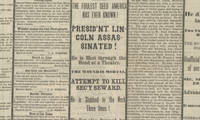
1518100999Newspaper disbound 23" x 16" 8 pp. Probably removed dbd minor staining and browning a little creasing and fading; otherwise very good.This is an early report under the heading "Important Assassination of President Lincoln." This is the second morning edition with the 3 a.m. update from Edward Stanton the Secretary of War which indicates Lincoln was still alive but in very bad shape. The article describes John Wilkes Booth "the actor" as the alleged assassin of the president. It describes how Booth entered Lincoln's box and after shooting him stating "Sic semper tyranis" before he leaped on to the stage. This report gives considerable detail about the how Washington reacted to the news and the scene at Lincoln's deathbed. There is also a good deal of coverage of the assassination attempt on Secretary of State William Seward. This paper represents an important piece of American history. books