777 résultats
19042550New York: King Memorial Committee of The Century Association by G.P. Putnam's Sons 1904. First Edition. Leather bound. Near fine. Letter from Secretary of State John Hay to General James Grant Wilson regarding a lock of President Lincoln's hair. Octavo. vii 429pp. Three quarter green morocco title in gilt on spine decorative compartments. Frontispiece portrait with issue cover. Marbled endpapers. Bookplate affixed to front endpaper. Top edge gilt. Letter affixed to front endpaper from Secretary of State John Hay to Gen. James Wilson Grant dated November 8 1902 in response to an inquiry over whether he still possessed a lock of Lincoln's deathbed hair. Includes envelope. Letter notes that he "greatly regrets that I am not the possessor of a lock of Lincoln's hair. I had a little of it for a year or two after his death but in some unaccountable way it was lost." John Hay's search for locks of Lincoln's hair would be a lifelong passion for the friend of the slain president. In 1893 Hay wrote to Doctor Charles Sabin Taft a bystander physician who attended to President Lincoln after being shot at Ford's Theater asking if the doctor had any strands of hair in his possession. Doctor Taft declined to barter for his memento but in 1905 his son found the original letter and contacted Hay. In a hurry the hair was purchased by Hay and promptly encased in a yellow ring. This yellow ring was sent to President Theodore Roosevelt on the occasion of his inauguration. He wore the ring to his inauguration and it remains in the Theodore Roosevelt collection at Sagamore Hill. Mearns 1959. King Memorial Committee of The Century Association by G.P. Putnam's Sons unknown books
186125613<p>An unusual and possibly unique Lincoln portrait above patriotic banners and a quotation from his first inaugural address.</p> <b>ABRAHAM LINCOLN. GABRIEL KAEHRLE.</b>Print. "Abraham Lincoln" with excerpt from First Inaugural Address ca. 1861-1864. 9¾ x 12 in.<p><b><br /></b></p><p><b>Complete Transcript</b></p><p> <i>ABRAHAM LINCOLN</i></p><p><i> SIXTEENTH PRESIDENT OF THE UNITED STATES</i></p><p><i>"In your hands my dissatisfied fellow-countrymen and not in mine is the momentous issue of Civil War. You have no oath registered in heaven to destroy the Government while I have the most solemn one to 'preserve protect and defend it.' The mystic chords of memory stretching from every battle-field and patriot-grave to every living heart in this broad land will swell the chorus of the Union when again touched as surely they will be by the better angels of our nature."</i></p><p><i>Extract from the closing paragraph of Lincoln's Inaugural Message March 4 1861.</i></p><p>A lithograph of this same Lincoln image retaining Kaehrle's signature was used in a jugate 1864 campaign illustration of Lincoln and Andrew Johnson published by H. H. Lloyd & Co. in New York.</p><p><b>Gabriel Kaehrle</b> is listed in an 1857 New York directory as an engraver and he illustrated books which were published in New York in 1860 and 1862.</p><p>Very rare and possibly unique. None in OCLC and no other examples traced.</p><p><b>Condition</b></p><p>Staining to edges shadow of former matting; professionally conserved.<br /></p> books
183723104.01<p>Lincoln and John Todd Stuart cousin of Lincoln's future wife Mary Todd had served together in the Illinois House of Representatives from 1834-1836. They formed Stuart & Lincoln on April 12 1837.</p> <b>ABRAHAM LINCOLN.</b>Newspaper. <i>Sangamo Journal</i> Springfield Ill. December 23 1837. 4 pp. 18 x 24¾ in. Double matted and framed with glass on both sides to display pages one and four. Slightly chipped 26 x 33 in. frame.<p>In the upper portion of the first column of the first page appears this five line advertisement: <i>"STUART & LINCOLN / ATTORNEYS and Counsellors at Law will practice / conjointly in the Courts of this Judicial Circuit. – / Office No. 4 Hoffman's Row up stairs. / Springfield april 12 1837."</i> Two ads directly above: <i>"NINIAN W. EDWARDS / ATTORNEY & COUNSELLOR AT LAW / Springfield – Illinois."</i></p><p>Lincoln had moved from New Salem Illinois to Springfield in 1836. He had first met fellow attorney Ninian W. Edwards when both were members of the Illinois State House of Representatives. Edwards married Elizabeth Todd in 1832 and Lincoln met Elizabeth's sister Mary Todd at the Edwards home where Mary had moved in 1839. On November 4 1842 Lincoln and Mary Todd were married in the Edwards mansion.</p><p>The <i>Sangamo Journal </i>started publishing in 1831 shortly after a young Lincoln settled in New Salem. The newspaper faithfully supported Abraham Lincoln and the Whig Party throughout many name changes: the <i>Illinois Journal</i> 1847 shortly after Lincoln left for Congress then the <i>Illinois State Journal</i>1855. As the Whig party broke up the newspaper supported the newly-formed Republican Party and Abraham Lincoln's rising political star.</p><p><b> Condition</b></p><p>Very fine with no visible tears.</p> books
4951BENJAMIN LINCOLN 1733-1810. Lincoln was a Revolutionary War general and the Secretary of War from 1781 to 1783. SURRENDER OF CHARLESTON SOUTH CAROLINA. On April 2 1780 10000 British soldiers under the command of General Henry Clinton sieged 3000 Continental Army soldiers at Charleston. On May 12 the over-matched forces surrendered marking the largest Continental Army capitulation of the American Revolution. General Cornwallis was left in charge of British forces and Lincoln was eventually traded for a British general. After the Charleston surrender a guerilla war broke out in South Carolina. When the British surrendered at Yorktown Benjamin Lincoln was there to accept Cornwallis’s sword. D. 2pg. 8†x 10â€. 1780. Charleston South Carolina. A contemporary draft of General Lincoln’s articles of capitulation for Charleston: “Article of Capitulation proposed by Major General Lincoln – Art. 1 that all acts of hostilities and Work…Between the Besiegers and Besieged Until…of Capitulation shall be Agreed on signed…Executed or be collectively Rejected. Art. 2. The town and fortifications shall…be surrendered to the Commander in Chief of the…Forces such as they now stand. Art. 3. The Continental Troops and Sailors – with their baggage shall be Conducted to a Place to be Agreed on – where they will Remain Prisoners of War – until Exchanged – White Prisoners they shall be supplied with Good and Wholesome Provisions in such quantity as is Served out to the Troops of his Britanic sic Majesty. Art. 4. The militia now in garrison shall be permitted to return to their respectives homes and…be secured in their persons and property. Art. 5. The sick and Wounded shall…be continued under the care…Art. 6. The Garrison shall at an hour appointed march out with shouldered arms Drums beating and Colours Flying to a place to be agreed on where they will pile their arms. Art 7. That the French Consul his house papers and other movable property shall be protected and untouched and a proper time granted to him for retiring to…that may afterwards be agreed upon between…Commander in Chief of the British forces. Art. 8. That the citizens shall be protected in their persons and Property. Art. 10. That a twelve months time be allowed all such as do not choose to continue under the British Government to dispose of their Effects real and personal in the State with out any molestation or to remove such part thereof as they choose as well as themselves and families and that during that time they or any of them may have it as their option to reside occasionally in town or country. Art 11. That the same protection to their persons and properties and the same time for the removal of their Effects be given to the subjects of France and Spain as required for the citizens in the previous articles. Art 12. That a vessel be permitted to go to Philadelphia with the General’s dispatches which are not to be opened. Signed May 8th 1780 B Lincolnâ€. This likely is an early draft since Article 6 is not included; that stated “The officers of the army and navy shall keep their horses swords pistols and baggage which shall not be searched and retain their servants.†It is in an unknown hand and is not in the writing of Lincoln’s aide-de-camp Hodijah Baylies. The document just underwent a professional restoration to remove silking and improve the overall condition although I would still rate the document’s state as fair. There are paper losses that affect some words but the legibility has improved considerably. unknown books
1907876081907. Photograph signed and dated "Gutzon Borglum 1907." The photograph taken by Borglum shows his marble bust of Abraham Lincoln. On February 6 1908 the President's son Robert Todd Lincoln wrote to Borglum regarding the bust as "the most extraordinarily good portrait of my father I have ever seen." The sculpture is on display in the Crypt of the U.S. Capitol Building. A<i> </i>typed Lincoln quotation pasted to mount at lower left. In very good condition. Double matted and framed. The entire piece measures 15 inches by 17.5 inches. Sculptor Gutzon Borglum designed and oversaw the execution of the Mount Rushmore National Memorial from 1927 to 1941 with the assistance of his son Lincoln Borglum. Conceived by South Dakota historian Doane Robinson the 60-foot sculpture was initially intended to promote tourism in the Black Hills Region of South Dakota. unknown books
13623LINCOLN Abraham. Stereograph photo published by Keystone View Company. The original 1865 image was long attributed Mathew Brady and a handwritten note in pencil on verso mentions that attribution but the image was actually taken by Lewis Emory Walker a government photographer about February 1865 and published for him by the E. & H. T. Anthony Co. This rare stereograph O-104 was Published by Keystone. It is said that the short haircut was suggested by Lincoln's barber to facilitate the taking of his life mask by Clark Mills. Lincoln's eyes are deep and sorrowful; The civil war had taken its toll on him. One pen notation: "No 92" below the image Keystone bio of Lincoln on verso with their copyright. unknown books
1865863261865. BROADSIDE - Lithograph LINCOLN Abraham. EMANCIPATIONS PROKLAMATION. Davenport Iowa: W.H. Pratt 1865. August Hageboeck lithographer. This is the second German-language version of the Emancipation Proclamation. It is printed in cursive within an oval border. The weight of the individual letters is varied so that when viewed from a distance a portrait of Lincoln emerges from the text. Originally printed on a rectangular sheet but here trimmed to an oval that surrounds the image the sheet is 37 x 29.5 cm. The image is 32 x 23 cm. The paper is browned and dampstained at the bottom center at the copyright information. It is matted and housed in a custom archival portfolio. A rare print. unknown books
18641403210Wright & Potter 1864. 5th or later Edition. Soft cover. Very Good. Boston. 1864. 88110pp. plus folding map. Original printed paper wrappers. Internally clean back cover not attached anymore water stain at top of spine and around it. Very good. Devoted almost entirely to the Massachusetts war effort published early in January 1864. The folding map shows the Soldier's National Cemetery at Gettysburg dedicated November 19 1863 with the long speech of Edward Everett of Massachusetts and the short "Dedicatory Speech by President Lincoln" better known as the Gettysburg Address. Also printed is the "Programme of Arrangements" of that day a list of Massachusetts soldiers killed at Gettysburg and buried there and details of the cemetery. Monaghan notes this as an early printing of the Gettysburg Address. MONAGHAN LINCOLN BIBLIOGRAPHY I:48. This historically significant and very early book publication of the Gettysburg Address which may be the most important and certainly best known speech in US history is extremely uncommon and almost only found rebound or with the covers missing. This version intact and in its original condition is a coveted artifact of Americana. Comes in a custom-made slipcase. Wright & Potter unknown books
186085724Chicago: Charles Leib 1860. Very Good. Four-page newspaper. A couple of small holes various brown spots and other bits of minor wear A campaign newspaper for Abraham Lincoln in the Presidential Campaign of 1860. We note a half-column story on the front page of this issue that accuses Senator Douglas of being a Roman Catholic -- a charge based partly on the fact that Mrs. Douglas was a Catholic as were their children -- probably an effective charge in largely Protestant mid-19th century America. Our brief research suggests that Douglas was not a Catholic or a formal member of any other organized religious group. The purpose of another half-column story on the front page was to make it clear that Lincoln had publicly condemned the actions of John Brown and did not object to Brown's execution. Charles Leib the editor was a political operative with a murky background who had previously edited a Democratic campaign newspaper on behalf of the Buchanan campaign in 1856. Leib served briefly as an Assistant Quartermaster in the Union Army before heading to new Mexico probably in 1863 and died there in 1865 at the age of 38. <br/><br/> Charles Leib unknown books
186125965<p><b>ABRAHAM LINCOLN.</b>Chromolithograph. <i>Presidents of the United States</i> Philadelphia: Published by F. Bouclet lithographed by A. Feusier. Sheet size: 21 in. x 27 in. Image size: 24½ in. x 18¾ in. </p><br />A large patriotic chromolithograph issued around the time of Abraham Lincoln's first inauguration. The central image is the goddess Columbia wearing a draped American flag flanked by bald eagle and Union shield. Behind her is a steam ship and the artist's rendition of what the then-uncompleted Capitol building was expected to look like. Surrounding Columbia is an ornate frame made up of portraits of the presidents of the United States from 1789-1861—including a beardless Abraham Lincoln: George Washington John Adams Thomas Jefferson James Madison James Monroe John Quincy Adams Andrew Jackson Martin Van Buren William H. Harrison John Tyler James K. Polk Zachary Taylor Millard Fillmore Franklin Pierce James Buchanan and Abraham Lincoln.<p><b>Historical Background</b></p><p>Erin Mast curator of "My Abraham Lincoln" a 2009 exhibition at President Lincoln's Cottage Museum noted that the print "both commemorates Lincoln's election and recognizes the challenges and opportunities facing the 16th president. The 16 presidential portraits encircle symbols of the republic at a time when a divided nation faced secession and civil war. In the center Columbia holds a shield and liberty cap the latter being a symbol both of revolution and of freed slaves. A bald eagle grasps arrows and an olive branch and carries a ribbon with the motto 'E Pluribus Unum.' The Capitol dome shown completed at a time when it was still unfinished symbolizes the founding of the democratic republic while a steamship symbolizes development and progress. The allegorical images relate to concepts that Lincoln expressed in his first inaugural address; that seceding and breaking the Constitution would be a step backward not forward and violates the very principles of the Union a Union which is 'older than the Constitution.' By commemorating Lincoln's election and illustrating the troubled and complex scene he faced this chromolithograph encapsulates the spirit of Lincoln's presidency."</p><p><b>Provenance</b></p><p>From the Estate of Malcolm S. Forbes.</p><p><b>Condition</b></p><p>Damp stains at top two corners light mat burn but generally a very fine example.</p> books
184822094.01 -.02<p>Lincoln's spot resolution and speech condemns the pretexts for starting the war with Mexico. He requests proof from President Polk that American blood was shed on American soil and that the enemy provoked the Americans and he asks if those Americans present were ordered there by the United States Army.</p> <b>ABRAHAM LINCOLN.</b>Newspaper. <i>National Intelligencer</i> Thursday December 23 1847. Washington: Gales & Seaton . 4 pp. Offered with another issue of the <i>National Intelligencer</i> January 20 1848. 4 pp.<p><b><br /></b></p><p><b>Excerpts:</b></p><p><b>December 23 1847 issue</b></p><p>Page 2 bottom of first column to second column</p><p><i>Mr. LINCOLN moved the following preamble and resolutions which were read and laid over under the rule:</i></p><p><i> Whereas the President of the United States in his message of May 11 1846 has declared that "the Mexican Government not only refused to receive him the envoy of the United States or listen to his propositions but after a long-continued series of menaces have at last invaded </i>our territory<i> and shed the blood of our fellow citizens on</i> our own soil<i>."</i></p><p><i> And again in his message of December 8 1846 that "we had ample cause of war against Mexico long before the breaking out of hostilities; but even we forbore to take redress into our own hands until Mexico herself became the aggressor by invading </i>our soil <i>in hostile array and shedding the blood of our citizens."</i></p><p><i> And yet again in his message of December 7 1847.</i></p><p> Resolved by the House of Representatives<i> that the President of the United States be respectfully requested to inform this House—</i></p><p><i> 1st. Whether the spot on which the blood of our citizens was shed as in his messages declared was or was not within the territory of Spain at least after the treaty of 1819 until the Mexican Revolution.</i></p><p><i> 2d. Whether that spot is or is not within the territory which was wrested from Spain by the revolutionary Government of Mexico. </i></p><p><i> 3d. Whether that spot is or is not within a settlement of people which settlement has existed ever since long before the Texas revolution and until its inhabitants fled before the approach of the United States army.</i></p><p> <i>4th. Whether that settlement is or is not isolated from any and all other settlements by the Gulf and the Rio Grande on the south and west and by wide uninhabited regions on the north and east.</i></p><p><i> 5th. Whether the people of that settlement or a majority of them have ever submitted themselves to the government or laws of Texas or of the United States by consent or by compulsion either by accepting office or voting at elections or paying tax or serving on juries or having process served upon them or in any other way.</i></p><p><i> 6th . Whether the people of that settlement did or did not flee from the approach of the United States army leaving unprotected their homes and their growing crops </i>before<i> the blood was shed as in the messages stated; and whether the first blood so shed was or was not shed within the enclosure of one of the people who had thus fled from it. </i></p><p><i> 7th. Whether our </i>citizens<i> whose blood was shed as in his messages declared were or were not at that time armed officers and soldiers sent into that settlement by the military order of the President through the Secretary of War.</i></p><p><i> 8th. Whether the military force of the United States was or was not so sent into that settlement after Gen. Taylor had more than once intimated to the War Department that in his opinion no such movement was necessary to the defense or protection of Texas. </i></p><p><i> Several resolutions of inquiry were here offered my Messrs. GEORGE S. HOUSTON W.P. HALL PHELPS GREEN McCLELLAND and KAUFMAN which are omitted for want of room.</i></p><p><b>January 20 1848 issue: </b></p><p>Page 2 bottom of 3rd column thru 6th column. In this lengthy address Lincoln questions President Polk's judgment regarding the aims and prosecution of the war in Mexico putting it in the context of the American Revolution: <i>"Texas revolutionized against Mexico and became the owner of something…if she got it in any way she got it by revolution; one of the most sacred of rights—the right which he believed was yet to emancipate the world; the right of a people if they have a government they do not like to rise and shake it off…He talked like an insane man. He did not propose to give Mexico any credit at all for the country we had already conquered; he proposed to take more than he asked for last fall…"</i></p><p>Additional news: page 2 middle of 4th column prints a lively senatorial debate involving Jefferson Davis. Page 3 bottom of 2nd column <i>"Mr. LINCOLN from the same committee reported a bill for the relief of William Fuller and Orlando Saltmarsh. Read and committed." </i>Page 4 middle of 3rd column <i>"By Mr. LINCOLN: A bill to amend an act entitled 'An Act to raise for a limited time an additional military force and for other purposes' approved February 11 1847."</i> This act gave the president permission to raise one regiment of dragoons and nine regiments of infantry to be used in the war with Mexico. In addition the act dealt with the logistics of each regiment such as raising the pay for field surgeons or adding a quartermaster to each regiment.</p> books
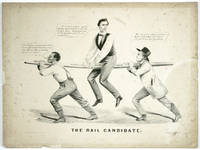
1860WRCAM37633New York: Currier & Ives 1860. Lithograph 13 1/2 x 18 inches. Moderate age-toning foxing and soiling. Moderate browning in margins. Small closed tears and chips in margins one moderate-size closed tear in left margin. A fair copy. A lithographic political cartoon published by Currier & Ives commenting upon the anti- slavery plank of the 1860 Republican platform. "The 'essential' anti-Lincoln cartoon of 1860" - Holzer et al. Abraham Lincoln is shown being carried uncomfortably in the middle of a split wooden rail an allusion to both the platform and to Lincoln's backwoods origins. Supporting the left end of the rail is a black man in simple working clothes who states "Dis N asterisks ours strong and willin' but its awful hard work to carry Old Massa Abe on nothing but dis ere rail!!" Holding the right end of the rail is well-dressed newspaper editor and strong Lincoln supporter Horace Greeley identified by a copy of his NEW YORK TRIBUNE in his coat pocket. Greeley tells Lincoln "We can prove that you have split rails & that will ensure your election to the Presidency." Lincoln replies "It is true I have split rails but I begin to feel as if this rail would split me it's the hardest stick I ever straddled." Lincoln is depicted - visually and thematically - as a straddler at best while the images of Greeley and the African American supporting the rail are derisive. <br> <br> A finely drawn and insightful political cartoon from the 1860 election. REILLY AMERICAN POLITICAL PRINTS 1860-31. WEITENKAMPF p.123. CURRIER & IVES: CATALOGUE RAISONNÉ 5478. Harold Holzer Gabor Borritt & Mark Neely THE LINCOLN IMAGE p.38 figure 18. Currier & Ives hardcover books
41587Oblong double-folio 13 x 17 inches seal affixed; docketed on verso. Several small breaks at corner folds corner torn away just touching the docketing. A very good copy. In this document Jonathan Tucker was appointed second lieutenant of a company in the 5th Regiment of Militia in Worcester County. In the following month Lincoln was named Major General of all the Massachusetts state militia; he was given command of the southern department in 1778 and after his capture and exchange was with Washington at Yorktown where he was chosen to receive Cornwallis's sword. Other members of the council who signed this document include Perez Morton James Otis Benjamin Greenleaf Caleb Cushing John Winthrop Joseph Gerrish John Whetcomb Elias Taylor Michael Farley Joseph Palmer Moses Gill Samuel Holton B. White Charles Chauncey and John Taylor. <br/><br/> unknown books
186136386Philadelphia: Published by F. Bouclet 1861. Rare beautifully colored 20" x 25-3/4" lithograph printed on wove paper titled "Presidents of the United States". Displays all the Presidents through a beardless Lincoln surrounding a vignette of Lady Liberty the American eagle a steamboat and the Capitol the dome complete as anticipated though still under construction. Published by F. Bouclet and lithographed by A. Feusier. In superb condition with just a hint of toning from previous framing. Fine.<br/><br/> "A large patriotic print probably issued around the time of Abraham Lincoln's inauguration. Columbia stands before the U.S. Capitol holding a shield and a staff with a liberty cap. On her brow she wears a laurel wreath with a single star. Beside her is an eagle holding a streamer with the motto "E Pluribus Unum." A steamship is visible in the background left. The central scene is framed by oval portraits of the first sixteen presidents of the United States with George Washington at the top and a beardless Abraham Lincoln at the bottom" Reilly.<br/> The print "commemorates Lincoln's election and recognizes the challenges and opportunities facing the 16th president. In this image a portrait of Lincoln completes an unbroken ring of portraits depicting the 15 presidents who preceded him. The illustration calls to mind a quote from Lincoln's first inaugural 'Perpetuity is implied if not expressed in the fundamental law of all national governments'. By commemorating Lincoln's election and illustrating the troubled and complex scene he faced this chromolithograph encapsulates the spirit of Lincoln's presidency" Mast 'A Closer Look at Presidents of the United States 4 President Lincoln's Cottage page 2 2009. <br/>Reilly 1861-13. OCLC 41119329 2- Lib. Cong. MN Public School District as of November 2019. The print is also included in the Jay Last Collection at the Huntington. Published by F. Bouclet unknown books
186095830c. 1860. Rare original painting of the 16th President of the United States Abraham Lincoln. After a photograph by Civil War photographer Alexander Gardner. Scottish photographer Alexander Gardner immigrated to the United States in 1856 where he became best known for his photographs of the American Civil War President Abraham Lincoln and the execution of the conspirators to Lincoln's assassination. In near fine condition. In a period frame. The entire piece measures 20.75 by 16.75 inches. Rare and desirable. Abraham Lincoln served as the 16th President of the United States from March 1861 until his assassination in April 1865. He led the United States through its Civil War and in doing so preserved the Union of the United States of America abolished slavery and strengthened the federal government. Lincoln began constructing his cabinet on election night and sought to create a cabinet that would unite the Republican party. His eventual cabinet would include his primary rivals for the Republican nomination and although his appointees held differing views on economic issues all were opposed to the expansion of slavery into the territories of the United States. The most senior cabinet post of Secretary of State was appointed to William Seward who had recently failed to win the 1860 Republican presidential nomination and Lincoln's choice for Secretary of the Treasury was Ohio Senator Salmon P. Chase Seward's primary political rival and the leader of a radical faction of the Republican party that sought the immediate abolition of slavery. unknown books
18642547081864. very good-. This historic and rare black printed broadside presents the platforms of both parties the Republicans having convened in Baltimore in June and nominated Abraham Lincoln for President and Andrew Johnson for Vice President and the Democrats having convened in Chicago in August and nominated George B. McClellan for President and George H. Pendleton for Vice President. This copy measures 29 x 23 cm is double columned and with the imprint "For sale by all News Agents. Price $1 per 100." Very light foxing at the bottom margin more visible on the verso. Fraying at the margins as usual. Sabin 63348 Exceedingly scarce.<br/><br/> unknown books
18593483New York: Charles Scribner 1859. First edition. Near Fine. Original publisher's cloth binding stamped in gilt and blind. Faint spotting to boards and gentle fraying to extremities mostly concentrated to the crown of the spine and upper front corner. Binding tight and square. Buff endpapers. Collating xxix 1 blank 31-363 1 blank: complete. Some staining to pages 312-313 and small marginal stains to pages 349-363 else a surprisingly fresh and clean copy without the typical foxing of the era. Inscribed on the front endpaper by the author in the year of publication: "To one of my earliest pupils Mrs. Martha White Gilbert with ever affectionate remembrance of Almira H. L. Phelps. Baltimore MD Oct. 10 1859." A scarce book institutionally and in trade it does not appear in the modern auction record and is the only copy currently on the market. A testament to Phelps' lifelong dedication to women's education the present copy was given to one of the first girls she ever taught. A meaningful association.<br/><br/>A pioneer in American women's education Almira Phelps began her career tutoring students of the all-male Middlebury College in science mathematics and philosophy. "This experience illustrated the disparity between education available for men and for women and Almira spent the rest of her life fighting for more educational opportunities for females" History of American Women. Joining forces with her sister Emma Willard the founder of the Troy Female Seminary in New York Phelps began to teach rigorous humanities and science courses in addition to lecturing publicly on behalf of women's rights for equal education. Phelps established herself as a frontrunner in the field publishing ten books on the education of women. The present Hours with my Pupils came after decades of experience as she reached the pinnacle of her career. "In 1841 Phelps received an invitation.to take charge of the Patapsco Female Institute in Ellicott's Mills Maryland. Phelps became principal and her husband was the business manager of the Institute which soon attained a great reputation due to its high academic standards. Ever a proponent for the betterment of the education of young girls Phelps focused on creating a curriculum.designed in particular to train highly qualified teachers" Dictionary of Early American Philosophers. Retiring in 1855 and settling in Baltimore Phelps continued her work by publishing activist pieces in national periodicals and books like this. A collection of educational addresses from throughout her career Phelps expresses optimism about what her work can still accomplish: "Go then ye written thoughts speed your way to the hearts of the women of my country.teach them the worth of their own souls!" <br/><br/>Ogilvie's Women in Science 147. History of American Women. Near Fine. Charles Scribner unknown books
1681H0011a2-a6b-b7c-c7d-2315 pages. Small square octavo 7 ¾" x 6 ¼" bound in full leather. Second edition. Thomas Barlow 1607-1691 was an English academic and clergyman who became Provost of The Queen's College Oxford and Bishop of Lincoln. He was considered in his own times and by Edmund Venables writing in the Dictionary of National Biography to have been a trimmer a reputation mixed in with his academic and other writings on casuistry. His views were in fact Calvinist and strongly anti-Catholic and he was one of the last English bishops to identify the Pope as the Antichrist He worked in the 1660s for the 'comprehension' of nonconformists but supported the crackdown of the mid-1680s; and declared loyalty to James II of England on his accession having strongly supported the Exclusion Bill which would have denied the Catholic James the succession. Pope Pius V's response to Queen Elizabeth I of England assuming governance of the Church of England included support of the imprisoned Mary Queen of Scots and her supporters in their attempts to take over England "ex turpissima muliebris libidinis servitute". A brief English Catholic uprising the Rising of the North had just failed. Pius then issued a bull Regnans in Excelsis dated April 27 1570 that declared Elizabeth I a heretic and released her subjects from their allegiance to her. In response Elizabeth who had thus far tolerated Catholic worship in private now actively started persecuting them. Condition: Original bards with new period spine and red label with gilt lettering to spine corners rubbed and bumped else a good to very good copy. Printed by S Roycroft for Robert Clavel at the Peacock hardcover books
1862WRCAM54585Washington D.C.: War Department Adjutant General's Office 1862. Three volumes with over 300 individual imprints. 12mo. Uniformly bound in contemporary three- quarter roan and marbled boards gilt leather labels. Wear to leather and edges boards somewhat rubbed front hinges tender. Contemporary ownership inscriptions and binder's tickets on front endpapers of second and third volumes; later bookplate on front pastedown of first volume. Light toning in places otherwise internally clean. Very good. A uniformly-bound set of General Orders issued by the Adjutant General's Office of the War Department in Washington D.C. previously owned by Brig. Gen. John Pope Cook. The orders cover 1861 and 1862 and comprise a nearly complete run of orders for the Union Army during the first two years of the Civil War. Undoubtedly the most significant General Order in this collection is a preliminary printing of the Emancipation Proclamation. <br> <br> A handful of the orders are signed in ink by the various adjutant generals. The Emancipation Proclamation bound in the third volume is as follows: <br> <br> GENERAL ORDERS No. 139. THE FOLLOWING PROCLAMATION BY THE PRESIDENT IS PUBLISHED FOR THE INFORMATION AND GOVERNMENT OF THE ARMY AND ALL CONCERNED: BY THE PRESIDENT OF THE UNITED STATES OF AMERICA A PROCLAMATION caption title. Washington D.C.: War Department Adjutant General's Office ca. September 24 1862. 3pp. This work is one of the earliest printings of the Preliminary Emancipation Proclamation issued to regimental commanders in the field during the Civil War in the week after President Lincoln's official manuscript version was finished. Here the third paragraph rings out with Lincoln's timeless words: "That on the first day of January in the year of our Lord one thousand eight hundred and sixty- three all persons held as slaves within any State or designated area of a State the people whereof shall then be in rebellion against the United States shall be then thenceforward and forever free." <br> <br> Following the Seven Days Battle and Gen. McClellan's retreat from the Peninsula at the end of June 1862 President Lincoln realized that there would be no early end to the war and found himself "as inconsolable as it was possible for a human to be and yet live." Anxious for news from the army and needing to escape the constant interruptions at the White House he frequently visited the telegraph office in the War Department building to await dispatches. It was during one such visit early in July that he asked the chief of the telegraph staff Maj. Thomas Thompson Eckert for some paper to "write something special" and began the first draft of the Emancipation Proclamation completing it in a few weeks. <br> <br> Lincoln had long hoped to resolve the slavery issue through a congressional act of emancipation compensating slave owners for their loss of "property" but that approach was roundly rejected by representatives from the border states leaving the President who had decided upon the necessity of emancipation with a presidential proclamation as the only option. The extraordinary document he conceived would announce the liberation on January 1 1863 of all slaves in those states still in rebellion against the Union and promised compensation to slave owners in those states that returned to the fold before that time if they adopted "immediate or gradual abolishment of slavery." This proclamation would be followed by a final proclamation issued on the 1st of January identifying those states still in rebellion and confirming the liberation of all slaves therein. <br> <br> On Tuesday July 22 Lincoln presented his draft to the Cabinet telling them that he had resolved firmly upon the course of action it specified and asking them not for advice but suggestions. The only observation he had not anticipated came from Secretary of State Seward who proposed that it might be best to wait for a military victory before issuing the Proclamation as it could otherwise seem like "the last measure of an exhausted government." Immediately recognizing the wisdom of the suggestion Lincoln held back. On September 17 after an anxious wait of nearly two months he received the victory he needed at the bloody Battle of Antietam. Completing his final draft Lincoln presented it to his cabinet for refinement on September 22. Following the meeting Seward took the amended draft with him to the State Department where a formal manuscript copy was made then signed by Lincoln and Seward. <br> <br> The first edition of the Preliminary Emancipation Proclamation Eberstadt #1 a small three-page circular intended for distribution within the government and to the local press was likely printed on September 22. At the time that Charles Eberstadt published his study of the Proclamation 1950 he was able to locate only one copy which he himself owned and as nearly as we have been able to determine no other copies have come to light since then. <br> <br> Eberstadt #2 is a supposed second edition no copy of which Charles Eberstadt was able to locate whose existence he inferred from the standard State Department practice of printing a folio edition consisting solely of the text of the proclamation followed by another printing consisting of the text of a letter of transmittal from the Secretary of State as well as the text of the proclamation. While there may be a copy of Eberstadt #2 in the National Archives as he speculated it is not recorded in their online catalogue nor have we been able to find a copy in any other online catalogue including OCLC the Library of Congress and the Abraham Lincoln Library. <br> <br> Eberstadt's third printing of the Preliminary Emancipation Proclamation is without a doubt the earliest obtainable printing. It consists of Secretary of State Seward's one-page letter of transmittal addressed "To the Diplomatic and Consular Officers of the United States in foreign countries" and the text of the proclamation. Eberstadt located a total of only five copies in institutions at the Library of Congress the National Archives Yale the Clements Library and Brown. OCLC does not record any additional copies nor is it recorded in Monaghan. This firm sold a copy several years ago. <br> <br> The present copy of GENERAL ORDERS No. 139 is Eberstadt's fourth printing of the Preliminary Emancipation Proclamation dated in print on September 24. Charles Eberstadt surmises that this field order printing could have been accomplished as late as September 29 or 30 and produced in as many as 15000 copies. It is however rather uncommon in the market and this is the first copy of this printing of the Preliminary Emancipation Proclamation offered by this firm. <br> <br> "From the first days of the Civil War slaves had acted to secure their own liberty. The Emancipation Proclamation confirmed their insistence that the war for the Union must become a war for freedom. It added moral force to the Union cause and strengthened the Union both militarily and politically. As a milestone along the road to slavery's final destruction the Emancipation Proclamation has assumed a place among the great documents of human freedom" - National Archives. "The proclamation has been called by responsible persons one of the three great documents of world history ranking with Magna Carta and the Declaration of Independence" - Eberstadt. <br> <br> Besides including about 300 orders on all manner of Union military activity at the outset of the Civil War the present collection also contains the 1861 printing of REGULATIONS FOR THE UNIFORM AND DRESS FOR THE ARMY OF THE UNITED STATES. Set out in GENERAL ORDERS No. 6 this twenty-four-page printing of the Army dress regulations was the first to set out uniform requirements for the Union during the conflict. The first sentence of the first section requires officers to "wear a frock coat of dark blue cloth." Thus the Blue and the Gray begins. <br> <br> This set was collected and bound by John Pope Cook who began the Civil War as a colonel in command of the 7th Illinois Volunteer Regiment. He was promoted to brigadier general after his troops played a key role in the Union victory at Fort Donelson early in 1862. After his promotion he was transferred to a command in the Department of Iowa and Dakota Territory where he remained until early 1863 conducting campaigns against the Sioux from his base in Sioux City Iowa. These orders must have been bound near the end of this period since contemporary labels note the binder one William F. Kiter as being from relatively close by Council Bluffs. <br> <br> A very early printing of one of the most important political acts in the Civil War and indeed in American history contained in a set of General Orders contemporaneously assembled by a significant Union Army commander. EBERSTADT LINCOLN'S EMANCIPATION PROCLAMATION 4. War Department, Adjutant General's Office hardcover books
1864D16155Baltimore: Cushings & Bailey 1864. First Edition. First and only edition extra-illustrated with approximately 65 inserted portraits. Full red pebbled morocco gilt dated 1882 on the spine rebacked with the original spine laid down the covers panelled in gilt the spine tooled and lettered in gilt with the initials "W.H.W." at the foot. 10 x 8 inches 25.5 x 21 cm; with lithographed title and approximately 65 mostly engraved or lithographed portraits inserted three are original drawings including one of Julia Ward Howe xi lithographed contents 200 pp. lithographed fascsimiles of the handwriting of the authors. Intermittent foxing the inserted portraits have offset to the text leaves opposite rebacked as noted and lightly rubbed. <br/><br/>This volume produced at the time of the 1864 Baltimore Sanitary Fair contains what is considered the first reproduction of the Gettysburg Address in Lincoln's hand. The facsimile was made from what is now known as the "Bliss Copy" of the address the fifth and final manuscript copy of the address that Lincoln executed at the request of the editors of this volume. Other authors represented here include Emerson Poe Melville Hawthorne and many other notables of the period. Cushings & Bailey unknown books
1916319056New York: Privately Printed 1916. First edition. 10 plates including map and frontispiece. 32pp. 1 vols. 12mo. Later blue cloth. Bookplate of Samuel B. Webb. First edition. 10 plates including map and frontispiece. 32pp. 1 vols. 12mo. Lincon Ellsworth 1880-1951 polar explorer and benefactor of the American Museum of Natural History produced a small private edition of his first-hand account of this hunt in the Bitterroot Mountains of Montana in 1911. The last large herd of buffalo in the U.S. had grazed in the Flathead Reservation and had been sold to the Canadian government four years before. After the round-up several outlaw bulls were still at large in the rugged terrain. Ellsworth describes a three-week hunt in which he finally stalked and shot a large bull.<br/>With outstanding provenance from the library of Samuel B. Webb a descendant of the Vanderbilt and Havemeyer families. Phillips p. 112; Streeter Sale 4131; Litchfield 76; Heller 1:95; OCLC 16140977 Privately Printed unknown books
18846914Boston: Roberts Brothers 1884. Octavo 19 x 13 cm. 536 7 pages. Additional blanks. Advertisements; fifty illustrations in the text. General index table of contents and alphabetical index. WITH: Cabinet photograph 16.6 x 10.75 cm. by Stein Photographer of Milwaukee Wisc. of the author in three quarter view. The verso has a manuscript annotation in an anonymous hand "Author of the Boston Cook Book. Head of Boston Cooking School" and inscribed by the subject "With the compliments of Mary J. Lincoln". Very slight soil otherwise fine. ~ The book: FIRST EDITION SECOND PRINTING same year as the first with sixteen advertisements on seven pages rather than six on four pages. Both issues copyright 1883 but title page stating "1884". Except for the advertisements the contents and pagination of the '84 '85 '86 and '87 printings are identical. The milestone cookbook from the first principal of the Boston Cooking School and a student of Maria Parloa. According to the preface the work was "undertaken at the urgent request of the pupils of the Boston Cooking School who have desired that the receipts and lessons given during the last four years in that institution should be arranged in a permanent form." Considered one of the first American cookbooks to provide scientific information about cooking and nutrition. It helped set the pattern of rational organization for cookbooks to come. Both famous and important "this book marked a change in culinary literature. Having directed the Boston Cooking School est. 1879 she Lincoln was able to arrange her material in an orderly plan and to set it forth in plain sensible language that housewives could understand. While it instantly became the standard kitchen companion it had still greater effect in shaping the course of early work in domestic science in grade and normal schools. Fanny Farmer's Cook Book is a direct outgrowth from this. The New York book stores currently display the sixth complete revision which states on the jacket that it is the 63rd printing and that 2286000 copies have been sold to date 1947." Number 86 of the Grolier Club One hundred influential American books printed before 1900. With twenty-one additional recipes in manuscript at the rear including a few medicinal recipes but mostly culinary receipts such as Fig Filling for Cake Cornucopias Vinegar Cookies and Miss Kingsbury's Pineapple Cream. The interior variously soiled throughout and with wear to some fore edges; edge of dedication page trimmed; amateur repair to one leaf pages 304/5. In half black calf over pebbled black cloth; spine gilt-titled and -compartmented. Hinges worn but holding; rubbing to corner. in a custom clamshell box. Altogether a complete sound and not altogether unattractive copy of a rare book in either issue of the first printing. Grolier Club One Hundred Influential American Books Printed in Before 1900 page 116-117; Bitting page 288 1896 ed. Cagle 478 the first printing; Streeter 4206 first issue; Sotheby's Crahan Sale. October 1984 earning $2300. Roberts Brothers hardcover books
15849LINCOLN Abraham. The Lincoln And Douglas Debates. A Political Debates between Hon. Abraham Lincoln and Hon. Stephen A. Douglas. In the Celebrated Campaign of 1858 in Illinois. Published by Columbus Follett Foster and Company 1860. First edition third issue as identified by a number 2 on page 13 and publishers ad. Publisher's original olive green textured cloth with blind-stamped borders. Slight chipping to headband. Spine lettered in gilt. 268 pages.<br/><br/>As the Republican nominee for the Senate Lincoln delivered his famous convention speech declaring 'A house divided against itself cannot stand.' He challenged his opponent Stephen Douglas to seven debates highlighting the inconsistency in favoring popular sovereignty and the Dred Scott decision. Lincoln further stressed the moral iniquity of slavery. Gilt and boards faded chipping to upper some damp stain minor foxing and toning as usual. Overall a good copy. Although Douglas won the election Lincoln's thoughtful and clear ideation enhanced his fame and led him to winning the Presidency in 1860. unknown books
187724759<p>"<i>she bore her accumulated miseries with a serene resignation an intrepid fortitude a true heroism of soul of which the history of the world does not afford a brighter example.</i>"</p> <b>MARY LINCOLN.</b>Signed Book. "<i>Mary Lincoln. / 1878</i>" in her copy of Charles Duke Yonge <i>The Life of Marie Antoinette Queen of France</i> 2d rev. ed. London: Hurst and Blackett 1877 xvi 432 pp. 8vo. bound in tooled purple cloth boards with titled spine. A carte-de-visite portrait of Mary Lincoln has been affixed to the front free endpaper.<br /><p><b>Historical Background</b></p><p>Mary Lincoln likely identified with the guillotined French queen's plight. Their words whether truly said or not and their intentions were frequent targets of abuse in the press. The press of their respective days viewed both as spendthrifts and harshly questioned their motives attacking Marie Antoinette's commitment to the welfare of the French people "let them eat cake" and Mary Lincoln's loyalty to the Union in light of her southern familial ties.</p><p>Perhaps Mary Lincoln drew comfort and inspiration from Yonge's closing tribute to his royal subject quoted above. An incredible association copy acquired and inscribed by Mary Lincoln while she was living in France.</p><p><b>Mary Lincoln</b> 1818-1882 was born into the prominent Todd family in Lexington Kentucky. Educated at female academies and boarding schools she learned to speak French fluently and also studied literature dance drama and music. She was very well-educated for her time place and gender. In November 1842 she married Abraham Lincoln in Springfield Illinois and they had four sons. She supported her husband's political ambitions becoming First Lady in 1861. Because she was from a border state with several of her relatives supporting the Confederacy Mary Lincoln was the object of suspicion in the press. Although she was responsible for hosting many social functions her extensive spending to renovate the White House also drew complaints from a nation at war and from her husband. However she also visited wounded soldiers in Washington hospitals taking them fruit and flowers and writing letters home for them. Prone to severe headaches and depression she suffered the loss of three of her four sons and was present when Abraham Lincoln was assassinated at Ford's Theatre.</p><p>After leaving the White House she lived in Chicago where her son briefly had her committed to a sanitarium in 1875. After being declared competent to manage her own affairs in 1876 she spent the next four years traveling in Europe and living in Pau France. She later returned to Springfield where she died in her sister's home.</p><p><b>Marie Antoinette</b> 1755-1793 was born in Vienna Austria the daughter of Francis I Holy Roman Emperor. She married the future French king Louis XVI 1754-1793 in 1770 when she was just fifteen years old. They had four children between 1778 and 1786. When her husband ascended to the throne in 1774 she became the Queen of France. The young royals came to symbolize all of the excesses of the reviled French monarchy and she became the target of a great deal of vicious gossip. After the outbreak of the French Revolution in 1789 the government placed the royal family under house arrest in the Tuileries Palace. After the abolition of the monarchy in September 1792 the Convention found the former king guilty of undermining the French Republic and executed him in January 1793. The Revolutionary Tribunal tried Marie Antoinette in October and found her guilty of depleting the treasury conspiracy against the Republic and treason. She was sent to the guillotine on October 16 1793.</p><p><b>Charles Duke Yonge</b> 1812-1891 was born in Eton and attended Eton College Cambridge University Oxford University and Keble College. From 1866 to his death he held a chair of English Literature at Queen's College Belfast. He authored a dozen books of history and biography. He translated six works by Cicero and prepared an English-Latin dictionary and an English-Greek lexicon.</p><p><b>Condition</b></p><p>Spine cracked with some minor losses and some rubbing at top and bottom some wear to boards pages overall clean with a few bearing some marginal loss that has been repaired else very good.</p> Hurst and Blackett hardcover books
186222179<p>"<i>We cannot escape history… In giving freedom to the slave we assure freedom to the free… We shall nobly save or meanly lose the last best hope of earth.</i>"</p><p>One month before signing the Emancipation Proclamation the president proposes colonization and his plan for compensated emancipation discusses foreign affairs reports on progress of the Pacific Railroad the war and finance. This rare "<i>Sentinel Extra</i>" broadsheet apparently unrecorded in OCLC has other news of the day on the verso including a fantastic article quoting General Meagher's reaction to the resignation of several officers after McClellan was removed.</p> <b>ABRAHAM LINCOLN.</b>Broadsheet <i>"Sentinel Extra"</i> place unknown ca. December 2 1862 9⅛ x 24 in. 2 pp.<p><b><br /></b></p><p><b>Excerpt:</b></p><p>"<i>The suspension of specie payments by the banks… made large issues of United States notes unavoidable. In no other way could the payment of the troops and the satisfaction of other just demands be so economically or so well provided for… A return to specie payments however at the earliest period … should ever be kept in view. Fluctuations in the value of currency are always injurious… Convertibility prompt and certain convertibility into coin is generally acknowledged to be the best and surest safeguard against them; and it is extremely doubtful whether a circulation of United States notes payable in coin and sufficiently large for the wants of the people can be permanently usefully and safely maintained…</i></p><p><i>There is no line straight or crooked suitable for a national boundary upon which to divide…Among the friends of the Union there is great diversity of sentiment and of policy in regard to slavery and the African race amongst us… emancipation will be unsatisfactory to the advocates of perpetual slavery but the length of time 37 years in Lincoln's compensated emancipation proposal should greatly mitigate their dissatisfaction. The time spares both races from the evils of sudden derangement… while most of those whose habitual course of thought will be disturbed by the measure will have passed away before its consummation. They will never see it. Another class will hail the prospect of emancipation but will deprecate the length of time. They will feel that it gives too little to the now living slaves. But it really gives them much. It saves them from the vagrant destitution which must largely attend immediate emancipation in localities where their numbers are very great and it gives the inspiring assurance that their posterity shall be free forever… Let us ascertain the sum we have expended in the war since compensated emancipation was proposed last March and consider whether if that measure had been promptly accepted by even some of the slave States the same sum would not have done more to close the war than has been otherwise done…</i></p><p><i><b>Fellow-citizens we cannot escape history.</b> We of this Congress and this administration will be remembered in spite of ourselves. No personal significance or insignificance can spare one or another of us. <b>The fiery trial through which we pass will light us down in honor or dishonor to the latest generation. We say we are for the Union. The world will not forget that we say this. We know how to save the Union. The world knows we do know how to save it. We—even we here—hold the power and bear the responsibility. In giving freedom to the slave we assure freedom to the free—honorable alike in what we give and what we preserve. We shall nobly save or meanly lose the last best hope of earth.</b></i>"</p><p><b>Additional Content Below Lincoln's State of the Union</b></p><p>Three news items cover the bottom half of the third column verso.</p><p>The first discusses the three top western cities as grain shippers Chicago Milwaukee and Toledo. The numerical measurements of the grain are counted in bushels. Chicago tallied a total export of <i>Wheat Corn Oats Rye and Barely</i> which amounted to <i>55526816</i> bushels. Milwaukee totaled <i>14869625</i> bushels. Toledo totaled <i>18667817</i> bushels.</p><p>The second re-prints news from <i>Liverpool Journal of Commerce</i> published on November 11th regarding the British government's adherence to neutrality policies.</p><p>The third reports on Gen. Thomas Meagher's reaction to the resignation of some of his officers after Gen. McClellan was removed from his command of the Army of the Potomac:</p><p>"<i>Commanding a brigade composed principally of Irish soldiers the Brigadier-General considers it not out of place to remind them that the great error of the Irish people in their struggle for an independent national existence has been their passionate and blind adherence to an individual instead of to a principle of cause. Thus for generations their heroic efforts in the right direction have been feverish and spasmodic when they should have been continuous equable and consistent.</i>"</p><p><b>Thomas Francis Meagher</b> 1823-1867 was an Irish nationalist and leader of the Young Irelanders in the Rebellion of 1848. After being convicted of sedition he was first sentenced to death but received transportation for life to Van Diemen's Land in Australia. In 1852 he escaped and made his way to the United States where he settled in New York City. At the beginning of the American Civil War Meagher joined the U.S. Army and rose to the rank of brigadier general. He was most notable for recruiting and leading the Irish Brigade U.S. 69th Infantry Regiment New York State Volunteers and encouraging support among Irish immigrants for the Union. He had one surviving son from his first wife.</p><p>Following the Civil War Meagher was appointed acting governor of the Montana Territory. In 1867 Meagher drowned in the swift-running Missouri River after falling accidentally from a steamboat at Fort Benton.</p> books