28 résultats
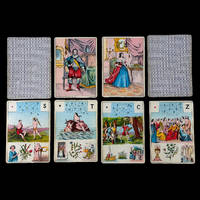
1845121<p>Original complete divination card deck</p><p><em>Grand Jeu de Mlle Le Normand</em></p><p>The most used divination deck beside Tarots</p><p>Card Deck<em>. </em><em>Grand Jeu de Mlle Le Normand</em>. Paris B.P. Grimaud c.a. 1845.</p><p>Complete deck 128 x 9 cm 54 chromolithographic cards printed on thick cardboard with French suit-marks. Each card except for the Querent cards includes a variety of zodiacal classical and modern images. In addition there is a miniature playing card illustration in the top left corner and a letter of the alphabet in the top right. The two Querent cards representing a man and a woman depict figures dressed in 17th-century clothing. The backs of the cards are adorned with violet geometric designs with rounded corners.</p><p>The <em>Grand Jeu de Mlle Lenormand </em>takes its name from the famous French bookseller necromancer fortune-teller and cartomancer Marie Anne Lenormand although there is no definitive evidence that these cards were used by Lenormand herself.</p><p>Her deck was later reprinted in English-speaking countries under the name: <em>Grand Jeu Lenormand Astro Mythological Cards</em>.</p><p><em>The Grand Jeu de Mlle Lenormand </em>is known for its intricate and intellectual iconography featuring complex scenes based on Greek mythology. Each card includes multiple layers of symbolism including references to astrology alchemy and divination.</p><p>Each card features:</p><p><!-- if !supportLists-->· <!--endif-->A playing card reference</p><p><!-- if !supportLists-->· <!--endif-->An astrological reference/constellation</p><p><!-- if !supportLists-->· <!--endif-->A letter of the alphabet</p><p><!-- if !supportLists-->· <!--endif-->A central image which is a particular scene from Greek mythology</p><p><!-- if !supportLists-->· <!--endif-->Two further smaller scenes depicted on the bottom left and bottom right of the card</p><p><!-- if !supportLists-->· <!--endif-->A particular flower bottom centre.</p><p>The primary elements for divination are the central image and the two smaller scenes at the bottom with the other symbols providing additional context and meaning.</p><p>The 52 all but the Querent cards cards can be divided in 5 categories :</p><p><!-- if !supportLists-->· The Conquest of the Golden Fleece which represents Business 6 cards</p><p><!-- if !supportLists-->· <!--endif-->The Trojan War representing the Right of the Strong over the Weak 9 cards</p><p><!-- if !supportLists-->· <!--endif-->Hermetic Knowledge based on alchemy which represents Marriage and more generally relations between people. 7 cards</p><p><!-- if !supportLists-->· <!--endif-->The Zodiac Cards representing an amount of Time. 12 cards</p><p><!-- if !supportLists-->· <!--endif-->The Unexpected. 18 cards.</p><p>Marie Anne Adelaide Lenormand 1772–1843 also known as Marie Anne Le Normand was a renowned French bookseller necromancer fortune-teller and cartomancer especially famous during the Napoleonic era. It is said that notable figures such as Marat Robespierre and Saint-Just sought her counsel and received ominous predictions of their deaths. She is also reputed to have had connections with Empress Joséphine and Napoleon Bonaparte as well as Talleyrand the French minister who navigated France through the Congress of Vienna. Lenormand is widely regarded in France as the greatest cartomancer of all time instrumental in the rise of French cartomancy that began in the late 18th century.</p><p>An identical deck can be found in the collection of the Bibliothèque Nationale de France BNF: <u>https://gallica.bnf.fr/ark:/12148/btv1b10510163j/f7.item</u>;</p><p>Conditions: Light marks of use overall in excellent condition.</p><p>References: Catherine Perry Hargrave <em>A History of playing cards</em> Dover publications 2021; Peter Endebrock 2021; Henry Rene D'Allemagne <em>Les cartes à jouer du XIV au XX siècle </em>Paris : Librairie Hachette 1906; W. GURNEY BENHAM History of the Pack and Explanations of Its Many Secrets Read Books 2019;</p> B.P. Grimaud
1900136<p>CARDS TO PREDICT "THE PAST THE PRESENT AND THE FUTURE"<br />A COMPLETE DECK BELONGING TO AUSTRIAN TAROCK PATTERN TYPE C</p><p>THE MOST BEAUTIFUL OF THE "WORK AND PLAY" TAROTS PRODUCED IN EUROPE.</p><p><em>Austrian Tarock Pattern Type C</em><em> </em>Wien Ferdinand Piatnik & Söhne 1900-1920.</p><p>54/54 tarot cards 114 x 62 mm chromolithography backs of the cards enriched by a double-ended neoclassical decoration round corners French suits. Tax stamp and printer's device with "Ferd. Piatnik & Söhne Ag – Wien – Registrirte Schutzmarke" on the Ace of Hearts "Ferd. Piatnik & Söhne Ag" on the Jacks of Diamonds.</p><p>The deck belongs to the pattern called Austrian Tarock pattern Type c. Four suits of 8 cards each King Queen Knight Jack and Hearts and Diamonds Ace–4 and Spades and Clubs 7–10 plus twenty-two trump cards. The trump cards depict scenes of outdoor life in various countries. The trumps and court cards are double-ended and the trumps display a different scene at each end. They are numbered with Roman numerals. Trump number II invariably has at one end the picture of a crowned eagle sword in claw perched on a rock inscribed with "Industrie Und Glück" Trump No. I the Fool is always portrayed as a stage musician.</p><p>Provenance: Tax stamp known as <em>Kartenstempel</em> named after the inscription on the upper part of the stamp which is commonly found <em>on antique decks of playing cards particularly in Austria and the</em> territories of the Austrian Empire. The stamp guaranteed that the deck had been legally produced and that taxes had been paid. The type of stamp present on this deck was in use between 1900 and 1920 and the value of 60 Heller indicated "a deck of more than 36 cards not lacquered not washable." Endebrock 2000.</p><p>REFERENCE: KATHLEEN WOWK Playing Cards of The World Lutterworth Press 1983 pp. 137-140; Peter Endebrock Playing-card Pages website 2000; SYLVIA MANN Collecting Playing cards Arco Publications 1966 pp. 105-108</p> Ferdinand Piatnik & Söhne
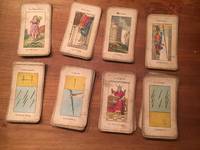
1880Biblioni17Jeu de tarot divinatoire dit "Grand Etteilla " ou " tarot égyptien. Pussey Paris. N.d. circa 1880. Complete deck of 73 cards; the set does not have an introductory leaflet. The cards are somewhat dust soiled. Around 12 cards carry some sparse annotations. . <br /><p>"Etteilla" the pseudonym of Jean-Baptiste Alliette 1 March 1738 – 12 December 1791 was the French occultist who was the first to popularise tarot divination to a wide audience 1785 and therefore the first professional tarot occultist known to history who made his living by card divination. Etteilla published his ideas of the correspondences between the tarot astrology and the four classical elements and four humors and was the first to issue a revised tarot deck specifically designed for occult purposes.</p><br /><br /><br /><br /><br /><br /><br /><br /> Pussey