4 résultats
175324336A Paris Chez Pissot Libraire Quai De Conti a La Defcente Du Pont-neuf 1753. HARDBAck NODustJacket ISSUED 1st Edition MDCC LIII 1753 EARLY Printing VG/GOOD AS-IS NOJACKET Small Full Brown mottled tan calf LEATHER With Raised Spine Bands & Burgundy Label with Tears Wear chips with Gold Gilt Rubbed 446 Pgs Cover Rub wear & tiny Chips Tears Edges Extremities Interior Nice Tight very light Wrinkling FOX Wear Cover small separation at Bottom spine & light Cracking along Edge but Still Tight small 8vo with Ribbon Bookmark. First Edition. Hard Cover. A Paris Chez Pissot, Libraire, Quai De Conti, a La Defcente Du Pont-neuf hardcover
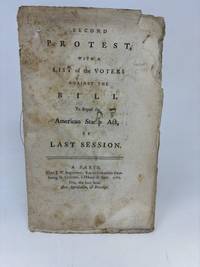
176683817Paris: Chez J.W. Imprimeur Rue du Colombiere Fauxbourg St. Germain a l'Hotel de Saxe 1766. Stitched Pamphlet. Fair. Octavo. 9 in. x 5 1/2 in. Good thick laid bond. Nibbling to top quarter outer edge of first several pages with no text loss. Soiling smudging wrinkling and two small raisin-size holes to front cover. Speakers on this issue were: 1 Against the Repeal of The Stamp Act: Lord Lyttelton Earl of Bute Earl Gower. 2 For the Repeal: Duke of Newcastle. The 15-page pamphlet concludes with a three- page LIST of the ".LORDS who Voted and Protested against the Repeal of the American Stamp Act March 11 1766"<br /> <br /> Denounces "the growing mischiefs" in America.<br /> <br /> This important legislative record last sold at auction in 1957. Chez J.W. Imprimeur, Rue du Colombiere Fauxbourg St. Germain, a l'Hotel de Saxe unknown
17651173761765. First Edition. AMERICAN REVOLUTION STAMP ACT ELIOT Andrew. A Sermon Preached Before His Excellency Francis Bernard Esq And the Honorable House of Representatives Of the Province of the Massachusetts-Bay in New England May 29th 1765. Being the Anniversary for the Election of His Majesty's Council for the Province. Boston: Green and Russell 1765. Slim octavo period-style full speckled calf gilt black morocco spine label uncut; pp. 3-5 6-59 1. $3800.First edition of the influential Boston pastor's most famous and most controversial work his May 29 1765 Election Day Sermon delivered two months after passage of the incendiary Stamp Actboldly proclaiming ""when tyranny is abroad 'submission is a crime'""one of only 700 copies published.Macaulay wrote that the Stamp Act of 1765 will be remembered ""as long as the globe lasts."" It marked a sharp break from the past as ""the first direct internal tax ever to be laid on the colonies by Parliament; indeed the first tax of any sort other than customs duties"" Morison 185. ""In the summer of 1765 as colonists waited for the stamp tax to go into effect voices of protest grew louder and drew support from many ministers"" Stout New England Soul 270. In particular the sermons of pastors such as Jonathan Mayhew and Andrew Eliot ""took on new vigor new relevance and meaning."" In Eliot's May 29 1765 Election Day sermon published the same year his words were infused with ""direct power for to proclaim from the pulpit in the year of the Stamp Act and before the assembled magistrates of Massachusetts that when tyranny is abroad 'submission is a crime' was an act of political defiance"" Bailyn Ideological Origins 6. Mindful of his audience which included Britain's powerful Massachusetts-Bay Governor Francis Bernard Eliot here underscores the colonists' objections by invoking their rights as Englishmen and the tradition of common law. ""Our fathers dearly bought the privileges we enjoy"" he declares: ""It is evident when they left their native land they thought the rights of Englishmen would follow them."" Yet throughout even as he might couch his language there remains his ""unexpectedly fierce insistence"" that submission to the perversion and misuse of power is not simply a crime: it is ""an offence against the state an offence against mankind an offence against God.'""Eliot's sermon distinctly offered a ""fine articulation of a tradition of thought familiar to every New Englander if not to every American exemplifying at the outset of the Revolutionary era a substratum of belief that underlay the developing rebellion."" Soon his correspondence ""initiated by the publication of the election sermon expresses with unique clarity the transformation of election-sermon platitudes into revolutionary imperatives. It is probably the most vivid expression of this transforming or triggering process in the entire literature of the Revolution"" Bailyn Faces of Revolution 111-13. In 1768 confronted with the arrival of a British warship and four regiments of troops Eliot would write to Harvard benefactor Thomas Hollis: ""'To have a standing army! Good God! What can be worse to a people who have tasted the sweets of liberty!' He was convinced he wrote that if the English government 'had not had their hands full at home they would have crushed the colonies"" Bailyn Ideological 114. ""Eliot weathered the Revolutionary War in Boston and at the request of General Washington made the official thanksgiving sermon on March 28 1776. He died on September 13 1778"" Harvard University. First edition: title page found with ""Price two shillings"" or without this copy no priority established. Published by the printers to the House of Representatives who were paid ""in July of 1765 for about 700 copies"" Adams Independence 12a. Without half title. Adams Controversy 65-8a. Newberry Library American Revolutionary War Pamphlets 187. Evans 9964. Sabin 22124. Text fresh last few leaves with expert paper repair to upper gutter's edge. unknown
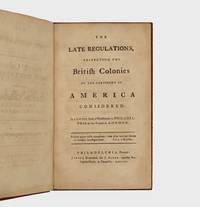
1766376944London: J. Almon 1766. First English edition. 62pp. Without the terminal ad leaf. 8vo. Modern full speckled calf spine gilt red morocco label. First English edition. 62pp. Without the terminal ad leaf. 8vo. The scarce first British edition after the first edition printed in Philadelphia in December 1765 of Dickinson's first work an important tract against the Stamp Act. Here Dickinson argued against stricter trade regulations that drained the colonies of currency and warned that taxing the colonies without their consent was a step toward slavery. "Considered only as an essay in economic theory the pamphlet is notable for its discussion of paper money of flows of trade and of the mechanisms and effects of taxation are sophisticated for the time.But the essay is more than a technical treatise. Stylistically it has the vivid phraseology the dramatic exclamatory italicization and paragraphing and the aptness of illustration that would soon make Dickinson the most widely read pamphleteer in the colonies" Bailyn. <br /> <br /> This can be exemplified by the culminating section of this work in which Dickinson writes: "Late measures have indeed excited an universal and unexampled grief and indignation throughout the colonies. What man who wishes the welfare of America can view without pity without passion her restricted and almost stagnated trade with its numerous train of evils-taxes torn from her without her consent-Her legislative assemblies the principal pillars of her liberty crushed into insignificance-A formidable force established in the midst of peace to bleed her into obedience-The sacred right of trial by jury violated by the erection of arbitrary and unconstitutional jurisdictions-and general poverty discontent and despondence stretching themselves over his unoffending country"<br /> <br /> Indeed it was in the wake of the dissent following the Stamp Act that Dickinson emerged as arguably the first hero of the Revolution an important spokeman against British tyranny. His Letters from a Farmer in Pennsylvania published in 1768 would put him at the forefront of the Patriot movement and the philosophical underpinnings of that work can be found in his Late Regulations. It is widely believed that Benjamin Franklin then in London as the colonial agent for Pennsylvania arranged for the work's publication there timed with his famous testimony before the House of Commons protesting the Stamp Act.<br /> <br /> Both the Philadelphia and London first editions of Dickinson's Late Regulations are considerably more scarce than his Letters from a Farmer with only a single example of either edition appearing in the auction records in the last quarter century. American Controversy 65-5b; Howes D238; Sabin 20043; Bailyn Pamphlets of the Revolution 14 J. Almon unknown