FAIZANT JACQUESMareMagnum

15 593 résultats
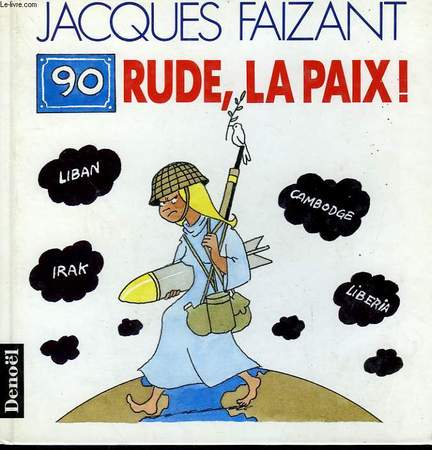
ISBN : 2207237885. Denoël. 1990. In-8 Carré. Relié. Bon état. Couv. convenable. Dos satisfaisant. Intérieur frais. 141 pages. Illustré de nombreux dessins en noir et blanc. Dessins humoristiques.
R150026431DENOËL .. 1990.. In-8. Relié. Bon état, Couv. convenable, Dos satisfaisant, Intérieur frais. 141 pages. 1ère de couverture illustrée en noir et blanc. Nombreux dessins en noir et blanc, dans le texte.. . . . Classification Dewey : 847-Satire, humour
ISBN : 2207237885. DENOËL .. 1990.. In-8 Carré. Relié. Bon état. Couv. convenable. Dos satisfaisant. Intérieur frais. 141 pages. 1ère de couverture illustrée en noir et blanc. Nombreux dessins en noir et blanc, dans le texte.
1972100046579Les cahiers de Paris 1972 in8. 1972. Broché. illustrations en noir et blanc
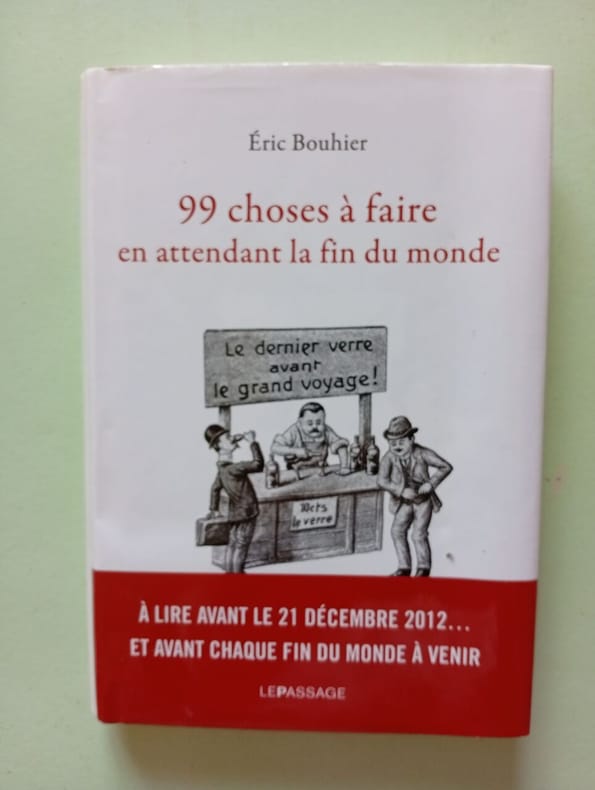
2012500310282LE PASSAGE 2012 146 pages 12 2x1 8x17cm. 2012. Broché. 146 pages. Un essai humoristique et philosophique qui propose 99 idées et activités à expérimenter dans l'ordre ou le désordre pour mener une vie riche et apaisée face aux annonces récurrentes de fin du monde. L'auteur s'appuie sur l'exemple de la prophétie du 21 décembre 2012 pour railler notre fascination pour l'apocalypse
51702Zurich, Editions Diogenes 1955, grand in-8 cartonnage illustré de l'éditeur, 92 p. (usure sans gravité à la coiffe supérieure, sinon très bon état) Un des grands dessinateurs d'humour de sa génération, à redécouvrir.
2009100065025Points 2009 144 pages 13x18x1cm. 2009. Poche. 2 volume(s). 144 pages.
New English Paperback. Oblong large 8vo. (16 x 21 cm). In English and Turkish. 232 p., ills. 9th International Tourism Cartoon Competition Book, 2017.= 9. Uluslararasi Turizm Karikatürleri Yarismasi Albümü, 2017. 800 copies were printed.
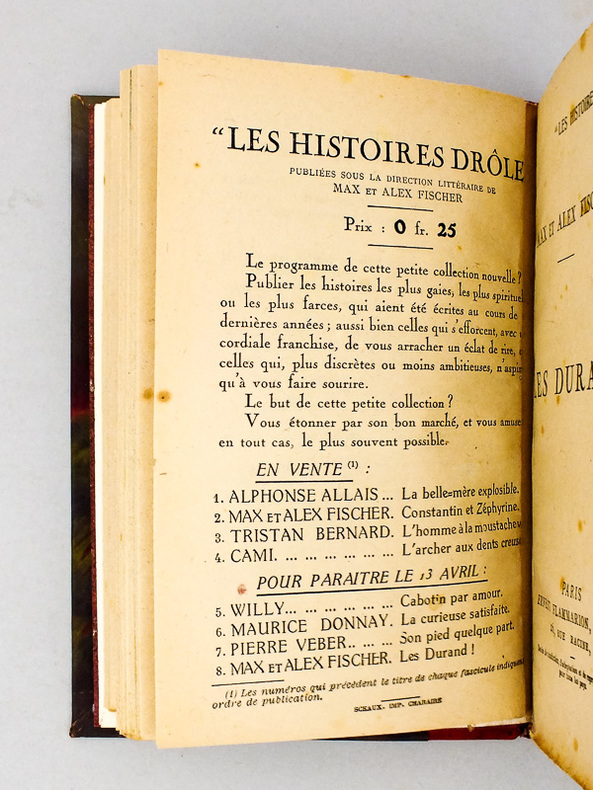
1925521361 vol. in-12 rel. moderne demi-basane rouge, dos à trois nerfs, avec 4 num. de la coll. Les Histoires drôles, Ernest Flammarion éditeur, Paris, s.d. (circa 1925), 31 pp. par num. i.e. 124 pp. au total.
1 vol. in-12 rel. moderne demi-basane rouge, dos à trois nerfs, avec 4 num. de la coll. Les Histoires drôles, Ernest Flammarion éditeur, Paris, s.d. (circa 1925), 31 pp. par num. i.e. 124 pp. au total. Bon état pour cette compilation de quatre petits ouvrages humoristiques, parus sous la direction littéraire des frères Maxime Fischer (1880-1957) et Alex Fischer (1881-1935). Ces deux frères, d'origine suisse, co-écrivaient des histoires drôles et furent directeurs de collections et directeurs littéraires chez Ernest Flammarion, de l'avant-guerre à 1928. Français
1964542382 vol. à savoir : 1 vol. in-8 br., Presses de la Cité, Paris, 1964 et 1 vol. in-12 cartonnage éditeur, Bibliothèque Verte, Hachette, 1964
2 vol. à savoir : 1 vol. in-8 br., Presses de la Cité, Paris, 1964 et 1 vol. in-12 cartonnage éditeur, Bibliothèque Verte, Hachette, 1964 Bon ensemble réunissant deux ouvrages du célèbre "Jean-Charles", dédicacés par leur auteur, dont cette très belle dédicace : "A Marc Soriano, Bon pour une visite à l'Ecole des Malins, où je me suis permis de le citer, le Proviseur reconnaissant" ! Bon état (couv. lég. frottées) Français
1963692633 vol. dont 2 vol in-8 br. et 1 vol. in-4 br., grandes ill. couleurs, éditions Le Bélier, Paris, s.d., 1963 et 1964., env. 30 pp. par livre.
6 fasc. in-4 br., Les éditions Jean Picot, Paris, s.d. (circa 1960), env. 10 pp. par fasc. Bon état. Prix pour l'ensemble. Français
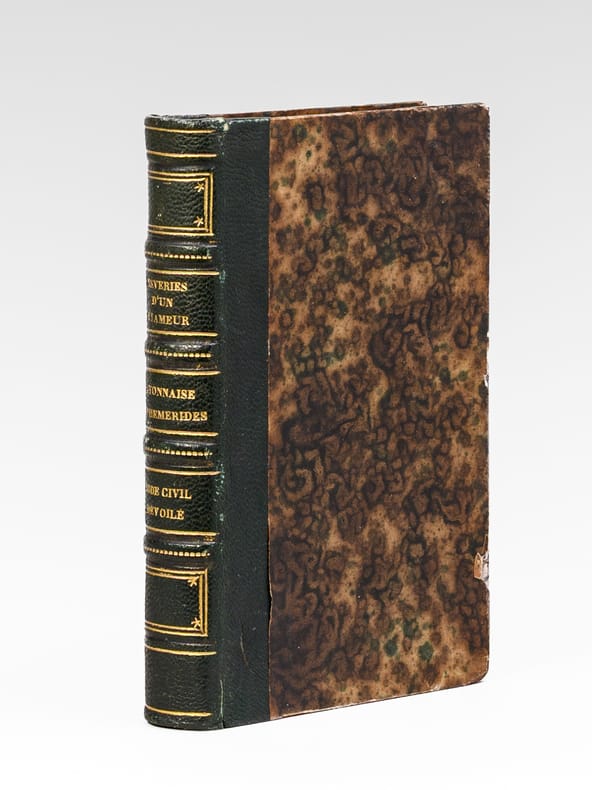
1854705141 vol. in-18 reliure de l'époque demi-chagrin vert, dos à 4 nerfs dorés orné : Rêveries d'un Etameur pour faire suite aux Pensées de Blaise Pascal,par Commerson & E. Furpille, Chez Martinon, 1854, 144 pp. [ Suivi de : ] Mayonnaise d'Ephémérides et de Dictionnaire assaisonnée par Joseph Citrouillard et retournée par les deux hommes d'Etat du Tintamarre. Ouvrage dédié à l'âge mûr et à l'impubère, Chez Martinon, s.d., XIV-129 pp. [ Suivi de : ] Le Code civil dévoilé, dédié aux Emballeurs, aux Réfugiés polonais et aux Gardes nationaux sans ouvrage et notamment aux licenciés de l'Ecole de Droit pour Cause d'Incapacité Notoire par Commerson et H. Maxance Jurisconsultes du Tintamarre, Chez Martinon, 1854, 143 pp.
Fine English Paperback. Pbo. Oblong 8vo. 187, [5] p. Texts in Turkish and English. Color caricatures. [24. International Nasreddin Hodja cartoon contest.]= 24. Uluslararasi Nasreddin Hoca karikatür yarismasi.
Very Good Persian Paperback. 12mo. (16,5 x 11,5 cm). In Persian. 160 p. [AZIZ NESIN IN PERSIAN] Tabq muqarrat (Majmua-ye Dâsitân). [= Gidi gidi]. Translated from Turkish to Persian by Reza Hamrah. Nesin was a Turkish writer, humorist and the author of more than 100 books. Aziz Nesin was a political activist. After the 1980 military coup led by Kenan Evren, the intelligentsia was oppressed. Aziz Nesin led a number of intellectuals to rebel against the military government, by issuing the Petition of Intellectuals (Turkish: Aydinlar Dilekçesi). He was the President of the Türkiye Yazarlar Sendikasi (Turkish Writers' Union). Reza Hemrah who translated Aziz Nesin's "Bir Ölünün Hatiralari", "Saçkiran", "Kimliksiz Adam", "Gidigidi" and many other works into Persian has an important position in reputation of Aziz Nesin in Iran. Nearly half of works of Aziz Nesin translated into Persian belongs to Reza Hemrah. Hemrah translation attracted considerable attention by 1960s and 1970s. Persian media has some doubts about whether Reza Hemrah's translations are authentic or not. According to criticisms, when the books of Hemrah were banned by government of that time, writer published his own books in the name of Aziz Nesin. To another criticism, Hemrah compiled Aziz Nesin's works by reading his books or asking for his friends to read them and published again. (Yesim Isik). First and Only Persian Edition. This the second translation of Aziz Nesin to Persian language and in Persian literature. "Tabq muqarrat" means in Persian "According to the rules". First one was in 1965 by Samad Bahrangi. Not in OCLC.; Mushar 3414. Extremely rare.
6664Paris, Fayard, 1970. In-8, broché, couverture à rabats.
Very Good Turkish, Ottoman (1500-1928) Contemporary half leather and quarter bdg. Two volumes. Five raised bands to the spine. Gilt lettering on compartments. Wear on the spine of the first volume. A label on the second's spine. Occasionally slight stains on thin papers. Overall very good volumes. 4to. (27 x 19 cm). In Ottoman script (Old Turkish with Arabic letters). Extremely rare 29 issues of the second and third years in two volumes of this rare Hamidian period (1876-1908) Ottoman periodical, devoted to the circulation of contemporary prose and poetry, as well as criticism, Mekteb was edited by Ismail Hakki from 1891 to 1894, followed by Ebülfeyyaz Hakki from 1894-1898. The magazine was a particularly important voice for the Servet-i Fünun [i.e. The Wealth of the Sciences] generation of writers. Weekly; 26 Temmuz 1307 [8 August 1891] - 30 Kanun-i Sanî 1313 [12 February 1898]. This periodical was published by Ottoman-Armenian bookseller, publisher, and printer Karabet Kesisyan Efendi (Garabed Keshishian, 1850-1911), who is a prominent Armenian figure in the history of Ottoman printing. As a prolific and enterprising figure, he was one of the most famous printers of the Hamidian Era (1876-1909). His contributions in this field reflect the sociocultural changes that occurred gradually in the Ottoman Empire in the nineteenth century. His printing house published mostly Turkish language textbooks and became the sole provider for the Turkish military and civil schools from 1889 until the beginning of the twentieth century. Duman 1331.
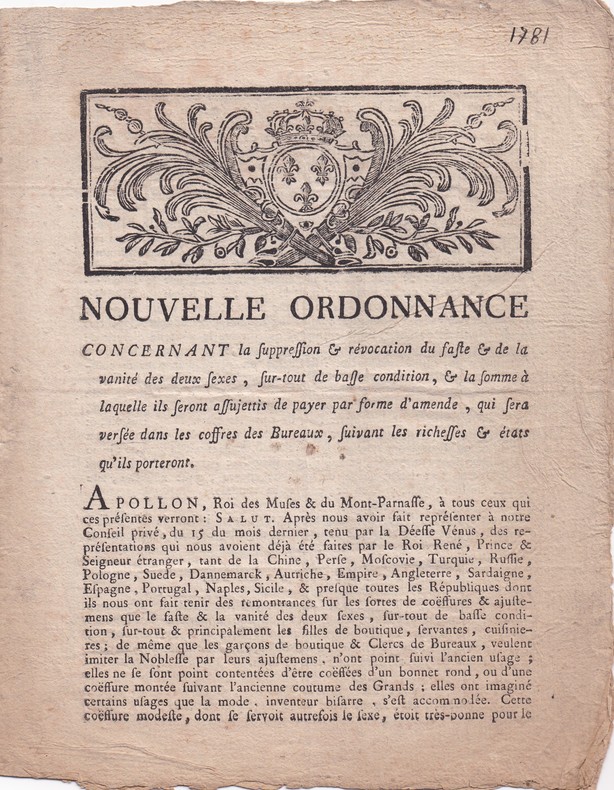
011037[Humour, Satire, Coiffure], Nouvelle ordonnance concernant la suppression & révocation du faste & de la vanité des deux sexes, surtout de basse condition. Paris, Lenoir, 3 avril 1781. In-4, 4p. Amusante satire contre les coiffures à la mode, écrite au nom d'Appolon, bien qu'ayant les armes de France en tête. Elle propose notamment la création d'une taxe sur le luxe, à travers les coiffures. Et elle se finit par une amusante chanons. Quelques citations du document: «Les maris excitent leurs femmes à se coëffer à la mode & même à enchérir au-dessus de ceux qui les surpassent par la naissance & la condition». «De cet exemple, il en résulte que le pauvre veut imiter la noblesse, quoiqu'il ne gagne guere». «le luxe est l'avant-coureur de la ruine des Etats». Extraits de la chanson: «Celles qui porteront de gros chignons, Paieront de grosses contributions, Elles seront soumises à l'Ordonnance Que nous publions dans la France. [...] Quand le vent s'enfile là-dedans, Vous avez peur à tout moment, Qu'il n'emporte vos coëffures A cent lieues par-delà Namur. Les Dames de grande condition, Se coeffent d'honnête façon, D'une belle dentelle de Malines, La plus chère & la plus fine. Les gens du commun pour 30 sous, Se coëffent dans le dernier goût, Faiseuses de modes & femmes-de-chambre Croient avoir l'air bien élégantes.» Rare curiosité. [187-2] 100
Very Good Persian Original wrappers. Folio. (33 x 25 cm) and some different sizes. In Persian with bilingual titles in English and Persian. A lot including 124 issues, published between July 30, 1991, to 1999. A lot including 124 issues of this rare Iranian satyric magazine "Gol Agha", which was the first such publication in post-revolutionary Iran, maintaining its dominance for more than two decades after its debut, adding monthly and annual editions as well as producing new generation of satirists and cartoonists. Kioumars Saberi Foumani, (1941-2004), also known by his pen name Gol-Agha, was an Iranian satirist, writer, and teacher. Saberi was born during the Second World War in Souma'eh Sara a city in Gilan Province. His father, originally from Rasht, worked for the Ministry of Economic Affairs and Finance. He was transferred to Souma'eh Sara in 1938 and then to Fuman in 1942 where he died a few months later. His mother, who was the daughter of a respected cleric and one of the few educated women in the city, taught the Quran after the death of her husband. His brother, who was 14 years older, had to leave school at the age of 15 to work to help with the family expenses. Education for Saberi was hard because of his family's poverty and he had to start working in a tailor shop after finishing his elementary education. He also worked in his brother's bicycle repair shop during elementary school and high school. He started high school education at his mother's insistence. At the age of 16, he gained entry to Sari's Agriculture teacher's college which only accepted one student from Fuman each year. He continued his college education and graduated in 1959. He worked as a teacher from 1959-1961. At the age of 20, he took his high school exams and received his high school diploma. He continued his education at the University of Tehran while working as a teacher. He achieved his bachelor of science degree in political science in 1965. He spent most of the 1970s reading and teaching and in 1978 he obtained his master's degree in comparative literature from the University of Tehran. Saberi got married in 1966 and he had a daughter and a son. His son died in a car accident in 1985 but this sad incident did not stop him from reaching his goal, which was to make people smile. Kioumars Saberi Foumani died on April 30, 2004. During his first year at university, Saberi was arrested for participating in student demonstrations and started to write political satire in Towfigh magazine. Towfigh magazine was Iran's most respected pro-democracy political satire magazine, with the highest circulation in Iranian history. Its editor-in-chief was Hossein Towfigh who, along with his brothers Hassan and Abbas, turned Towfigh magazine into the most influential journal in Iranian history. Saberi became one of the many staff writers of Towfigh magazine. After the Iranian Revolution, he became the cultural advisor for Mohammad Ali Rajai. One of his other political posts was as the counselor to the minister of Housing and Urban Development of Iran. Following the Revolution, Saberi worked in different political positions before deciding to leave politics. He was in charge of Roshde-Adabe-Farsi magazine and sometimes he wrote for the Ettelaat newspaper. He started a column called "Do-Kalame-Harfe-Hesab" in Ettelaat in 1984 which was a starting point for political satires after the revolution. He continued writing for this column for six years until he started his own magazine called Gol-Agha in 1990. His courageous and powerful writings were appreciated by many famous authors such as Mohammad Ali Jamalzadeh. Saberi received first prize in the press exhibitions of 1992 and 1994 and second prize in 1993. He stopped writing for Ettelaat in 1993. The main characters in his writings are Gol-Agha, Shagholam, Mamasadegh, Kamineh, The wife of Mamasadegh), Mash-Rajab, and Ghazanfar. In 2003 in his last editorial in Gol-Agha, Saberi announced that publishing Gol-Agha will be stop
Very Good Turkish Original artwork in watercolor, Indian ink, and dry paint. 11,5x9,5 cm. This rare original artwork of Mary and Jesus comes along an exceptional provenance of Turkish cartoonist Semih Balcioglu (1928-2006), with his handwritten note on verso "Cemal Nadir'in bir kompozisyonudur" [i.e. It's composed by Cemal Nadir]. Signed on right lower as "C. N". Unpublished work. Cemal Nadir was a Turkish cartoonist. He was born in Bursa, Ottoman Empire on 13 July 1902. His father Sevket was a calligrapher (Turkish: Hattat) employed in courts. After finishing high school, he began working as a sign painter in Bursa. He also created cartoons, and his first cartoon appeared in Diken (literally: "The Thorn") periodical. Although he moved to Istanbul and tried to be a full-time cartoonist, he could not make it and he returned to Bursa. The Alphabet reform of 1929 gave Cemal Nadir a second chance to show his talent. When Turkey adopted the Latin alphabet replacing the Ottoman Turkish alphabet in Arabic script, all sign boards were necessarily changed, and he worked hard to meet the demand. The same year, he moved once more to Istanbul to work for the daily Aksam. Later, he also drew for the newspaper Son Posta, as well as for satirical magazines such as Akbaba. He also contributed to Yedigün. During this period, he published the satirical magazine Amcabey. During World War II, he drew anti-Nazism cartoons in the daily Cumhuriyet. In 1946, Republican People's Party (CHP) invited him to run for a seat in the parliament. However, he refused the invitation, he said that with political affiliation he would not be able to create cartoons.
18993184Paris Fayard frères 1899 in-8 demi-reliure Paris, Fayard frères, sd [ca 1899-1905]. 9 titres reliés en 2 volumes in-8, 23 x 14 cm (R), 166 (1), 144, 144, 166 (1) pp. - 166 (1), 72, 166 (1), 142 (1), 70 (1) pp., nombreuses gravures en noir dans le texte, demi-toile avec pièces de titre et monogramme P.P. en queue, couvertures non conservées.
112629rabaut perlet 1797 1798 5 volumes in-12 de 85 x 135 mm environ comprenant les Aventures de Sir Williams Pickle, A Paris, De l'Imprimerie de RABAUT le jeune, An VII [1798-1799]. Pour chaque tome : 1 faux-titre, 1 frontispice, page de titre, puis 251 - 252 - 237- 243 - 248 - 223 pages. [suivi des] Aventures de Roderick Random, A Paris, Au bureau du Journal de Perlet, Et chez Ouvrier, 1797. Pour chaque tome : page de titre puis 247 - 252 - 223 - 239 pages. Reliures postérieures, demi-basane chagrinée rouge framboise, dos à cinq nerfs portant titres et tomaisons dorés, gardes marbrées. Coiffes frottées, coins émoussés, traces d'étiquettes papier sur les plats, quelques rousseurs, des déchirures sans manque, des traces de mouillures pages 120 à 180 du tome 3 de Roderick Random, bon état général.
Very Good Turkish, Ottoman (1500-1928) Handsome fine contemporary brown half-leather bindings. Six raised bands to spine, title, and issue numbers gilt lettered, floral decorations in compartments. 4to. (30 x 24 cm). In Ottoman script (Old Turkish with Arabic letters) and French. All pages with illustrations in text or full-page illustrations, all numbers with an Islamic numbering system, reversed collation, with two title pages: Ottoman recto and in French verso, numbers 35, 41, 44, 45 with title pages in color. Rare poster is coming with the set inside the volumes as a supplement to the magazine. Extremely rare togetherness of the complete set of 130 issues of the Ottoman Turkish-French satirical magazine "Kalem", richly illustrated with thousands of attractive illustrations and cartoons, started its publication life with the end of Sultan Abdulhamid II's repression regime in 1908. The collection provides an invaluable resource, reflecting the changes in society after the Second Constitutional Revolution in New Ottoman State. The magazine was published weekly in 130 numbers between 21 August 1324 (3 September 1908) and 16 June 1327 (29 June 1911), starting immediately after the Second Ottoman Constitutional Revolution. The magazine was a mixture of satire and a saloon magazine, focusing on politics, social life, and revolution. The only continuously running part of the magazine was Haftalik Dedikodu (Weekly Gossip). The founders of the magazine were Salah (Selah) Cimcoz (1875-1947), a Turkish politician, lawyer, and owner of Kalem Newspaper, and Celal Esat Arseven (1876-1971) a Turkish painter, writer, and parliamentarian. He was the first to introduce the history of art and urbanistic architecture to Turkey. Duman 1080.; Only one complete copy survive in institutions worldwide in OCLC 472569754 (Bibliothèque nationale de France, BnF). (Source: References: Tobias Heinzelmann, Die Balkankrise in der osmanischen Karikatur).