Ludovico AriostoBiblio.com
10 résultats
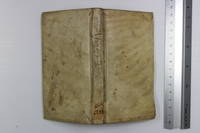
1613013158Venice: part of title page torn away 1613 Book. Fair. Hardcover. In Venetia 1613 remainder of title page torn away. 83 numbered leaves. Title page damaged where the foot of the page has been torn away with the loss of the publisher's details. Replaced with blank paper. Old vellum binding which is browned and soiled. Titled in faint ink to the spine. Old paper label to the foot of the spine which is starting to peel off. Light browning and some staining to pages. Paper repair to one of the rear free end papers. Worming to the rear board and holes to the final rear free end paper. Ink owner's name to the front free end paper a small ink flower drawn on the front pastedown and an ink inscription to the title page more or less illegible and partly scribbled through. [ part of title page torn away ] hardcover
163827683Venetia Apresso Lorenzo Griffo 1638 In-12 carré 373 ppavec la table finale, petit manque de cuir en coiffe, la reliure est postérieure d'au moins un siècle à l'impression et l'impression est plus dans l'esprit des livres du XVI ème siècle avec un bois gravé in-texte pour chaque Chant. Cours de Marge en tête. Belle étiquette d'un Libraire d'Arras du XVIIIIème siècle - menus défauts sans gravité
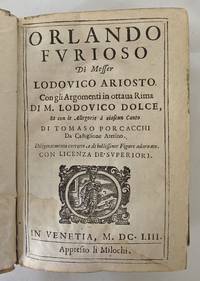
165324368Venetia Venice: Appresso li Milochi 1653. Octavo 277 pp. 16 cm paper-covered boards with vellum spine. Printed in double columns with 51 allegorical woodcut vignettes one at the beginning of each of the 46 cantos plus five with the appended "Cinque Canti" which has its own title page additional woodcut ornaments.Small section 1.5 cm clipped from top margin of A2 with loss of one line of text dampstain visible to varying degrees throughout see images. Bookseller label of Libreria Cecchi Firenze on front pastedown. An uncommon small-format edition intended for popular consumption that demonstrates the ongoing popularity of this work well over a century after its initial publication 1516. Appresso li Milochi unknown
1603004548Venice: F. Valgrisi and N. Moretti 1603. Early Printing. Hardcover. Some of the impressions are weak but most are quite presentable. Trimmed at the top close to the text and plate lines affecting one line of text in the dedication; other margins quite adequate. Vellum soiled. Very Good or better. Large octavo 7" x 10" bound in early full vellum 16 654 32 pages. The complete and corrected ORLANDO FURIOSO with Ruscelli's dedication to the Duke of Ferrara dated 1556 and an account of the life of Ariosto by Battista Pigna. Illustrated with an engraved title page 51 full-page woodcuts ornamental headpieces and initial letters. The woodcuts within decorative borders are after the designs of Dossa Dossi the Ferrarese painter and are printed from the blocks of the first Valgrisi quarto editon of 1556. <br/><br/>First published in 1516 this classic Italian romantic epic influenced many later works including Spenser's THE FAERIE QUEENE and Shakespeare's MUCH ADO ABOUT NOTHING. The action takes place against the background of the war between Charlemagne and his Christian paladins and the Saracen army which is attempting to invade Europe. However Ariosto has little concern for historical or geographical accuracy and the poem wanders at will from Japan to the Hebrides as well as including many fantastical and magical elements such as a trip to the moon and an array of fantastical creatures including a gigantic sea monster called the orc and the hippogriff. The poem grew in popularity as well in size after Ariosto's death increasing from 40 to 46 cantos in 1532 and finally to the finished form of 51 cantos. F. Valgrisi and N. Moretti hardcover
1603247181603 En Vénétie, Appresso Felice Valgrisi, 1603, in-4 (25 x 18 x 4 cm.), vélin, pièce de titre en maroquin rouge sur le dos, tranches mouchetées.
16171807030002In Genoua : Appresso Giuseppe Pauoni 1617. Hardcover. Good. 3 parts in one volume. Folio 31 cm. Bound in 18th century mottled calf. Gilt ruled gilt fleurons spines engraved in gilt. Front hinge cracked with chipping to joint. Internally clean and unmarked. 20 full-page engraved plates by Camillo Cungio after Bernardo Castello. Text printed in double columns. Woodcut head- and tail-pieces initials. Two portraits of Tasso and Carlo Emanuele I Duke of Savoy. Historiated initials. 16 255 1 71 1 36 4 p. The "third and grandest Tasso series". See Unglaub Poussin and the Poetics of Painting: Pictorial Narrative and the Legacy of Tasso p. 235. The illustrations differ significantly from Castello's in the Pavoni editions of 1590 and 1604. Brunet V.666; ABPC 1977; Cicognara 1:1113 In Genoua : Appresso Giuseppe Pauoni hardcover
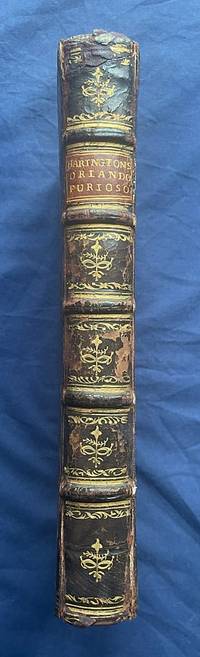
1634V64647London: Miller for Parker 1634. Very Good/None. copperplates 46 full-page said to be engraved under direction of Harrington & exalting legendary Roger d'Este. Sm.4to 278x185mm contemporary ruled calf with contrasting gilt lettered label and 5 raised bands compartment nicely gilt. Blindstamp initials H.H.to covers tips worn/ some splitting to foot of spine/some scuffed and scored and some leather surface laminating. All edges speckled red. 9423pgs9 Titlepage for Epigrams dated 1633 43pp SIGNATURES of Robert Kirk 1705 to margin of Titlepage & another very fancy but faint to foot of Titlepage in the margin. Third edition of Harington's 1591 translation. The engraved title with architectural border includes portraits of Ariosto and Harrington as well as a portrait of Harington's dog Bungy in the lower left corner. Strange EPS made of sheets from a bible with bookplate of James Marquis of Carnarvon and another coat of arms bookplate to rear EP. A fine wide margined copy with well printed well inked plates and unusually thick strong paper. Crisp and clean. Referenced by: STC 2nd ed. 748 and ESTC S106834. Miller for Parker hardcover
163469070London: Printed by G. Miller for J. Parker 1634. HARRINGTON John. . Orlando Furioso. in English Heroical Verse by Sir John Harrington of Bath Knight. Now thirdly revised and amended with the Addition of the Author's Epigrams. London: Printed by G. Miller for J. Parker 1634.<br> <br> Full Description:<br> <br> ARIOSTO Lodovico. HARRINGTON John translator. Orlando Furioso in English Heroical Verse by Sir John Harrington of Bath Knight. Now thirdly revised and amended with the Addition of the Author's Epigrams. London: Printed by G. Miller for J. Parker 1634.<br> <br> Third edition of Harrington's 1591 translation which was the first English edition and remained the only English translation of many years. This third edition is further expanded by the addition of the "Author's Epigrams." Two works in one small folio in sixes 10 5/8 x 7 1/4 inches; 270 x 185 mm. 16 1 Ads 1 plate 423 9 table 1 Title 1 blank 43 1 blank pp. With engraved title-page for the first work and 46 full-page engravings included in the pagination accompanying each Canto. Separate title-page for "Epigrams" with an engraved vignette. Epigrams have a separate title but continuous register. Elaborate engraved head and tail pieces and initials.<br> <br> Contemporary full calf rebacked to style. Spine with red morocco spine label lettered in gilt. Spine stamped in gilt. All edges speckled red. Newer endpapers Fore-edge margins are trimmed close a few times just touching printed marginal notes. Closed tear to bottom margin of S1 barley touching a few letters. T6 with a tear to fore-edge margin with a bit of loss to marginal note. Some various dampstains and other soiling throughout. Some minor occasional offsetting from plates. Overall a very good copy.<br> <br> "Lodovico Ariosto represented the sentiments the passions and the vices and virtues of 16th-century Italians in his epic poem L'Orlando Furioso The Crazy Orlando. This Renaissance classic based on romances popular at the time furnished the framework for the chivalric narrative in Edmund Spenser's The Faerie Queene. Orlando Furioso is a tale of knights dames and courtesies when the Moors invaded France to avenge the death of their king's father. In the story Orlando Roland Charlemagne's nephew and most famous knight falls madly in love with Angelica who is also pursued by many other Christian and Moorish knights. She flees these attentions only to bestow her love in the end on a poor man without rank. Ariosto's view of life reflected throughout the poem is one of ironic disillusionment-love is madness. John Harington 1561-1612 was a witty courtier and godson of Queen Elizabeth. He is also the acknowledged inventor of the flush toilet. According to lore Harington first translated the racy tale of Jocundo from Canto XXVIII and circulated it among the ladies of the Court. The Queen feigned to be shocked by some passages and reprimanded her godson for endangering the morals of her maids of honor. Elizabeth sentenced Harington to stay away from the Court until he had translated the whole of Ariosto's poem. Harington completed the translation by 1591. Harington's Orlando Furioso is one of the major translations of the age freely executed but faithful to the spirit and style of the original. At 33000 lines in length and nearly 6000 lines shorter than the original the translation is seldom exactly what Ariosto wrote shorter in places and expanded elsewhere-with moral truisms added. Each of the forty-six cantos of the poem is preceded by a full-page illustration including the especially risqué one for Canto XXVIII. All are copied strictly or with slight variation from the plates used by Girolamo Porro in a Venice edition printed in 1584. The engravings are unsigned purportedly the work of several engravers including possibly Jodocus Hondius. Clark Library UCLA Chrzanowski 1607a : Regarding the 1607 Second edition.<br> <br> STC 748. Pforzheimer 447.<br> <br> HBS 69070.<br> <br> $3000. Printed by G. Miller for J. Parker unknown
160318663Venetia: Vencenzo Valgrifi 1603. A very early printing of the complete and corrected ORLANDO FURIOSO also with the Life of Ariosto by Battista Pigna. Letters tables and scholarly critical works by Ruscelli and others. Magnificently illustrated with 51 full-page woodcut engravings within ornate borders using the blocks from the first Valgrisi quarto edition of 1556 46 in the ORLANDO 5 additional in the appended “Cinque Canti†also with engraved architectural titlepage imprint set in type in a cartouche in the lower part of the border type ornament with the title medallion portrait of Ariosto from the Giolito portrait of 1542 from the profile by Titian devices of Ariosto and Valgrisi’s serpent device half titles and beautifully engraved decorated large head and tail pieces and large historiated and arabesqe capital initials printed in double column Italic. 4to full antique Italian vellum over stiff boards spine with terra-cotta morocco label lettered and decorated in gilt. 8 A - Z8; Aa - Vv8; ie xvi 654 32. A very handsome copy in proper period binding. The paper just likely mellowed and toned by time very occasionally headlines slightly shaved first gathering cropped a bit the vellum very well preserved sturdy and handsome. RARE AND EARLY ILLUSTRATED PRINTING OF ONE OF THE FOUR CORNERSTONES OF ITALIAN LITERATURE. Ariosto’s great cantos inspired by the crusades are considered his crowning achievement. Though first published in 1516 Ariosto considered this edition incomplete and imperfect. He continued to work on correcting and enlarging it throughout the remainder of his life thus the first “complete†ORLANDO FURIOSO was not produced till 1532 the year prior to the author’s death by consumption.<br> The extraordinary merits of this work cast into oblivion the numberless romantic poetry which inundated Italy during this period. This flawless work powerful elegant and cultivated. In description and narrative he excites the reader’s deepest feelings and displays a vivacity of fancy with which no other poet can vie.<br> ‘The ORLANDO blocks were cut for Valgrisi’s first quarto edition of 1556 and follow Niccolo Zoppino’s idea of providing one illustration to each canto but going far beyond the Zoppino blocks in skill of design and cutting. They are the first full-page illustrations for Ariosto. They were placed in the instructive tradition of the Marcolini Dante the illustration is mentioned on the title-page and at the beginning of Ruscelli’s 1556 dedication to Alfonso d’Este Duke of Ferrara. Ruscelli explains to the reader the application of the rules of perspective to the multiple scenes in these cuts. The upper part of the block often becomes a map offering as Philip Hofer notes a tour of the canto by hippogryph. Valgrisi’s artist often varied from Giolito’s in his choice of the principal scene for illustration and relegated the Giolito subjects to his background. Valgrisi’s blocks are printed within borders with figures and grotesques. He was able to use the same blocks without borders in an octavo of 1556 for the popular market. There are two different border designs for the illustrations and two smaller cherub borders for the “argomento†to each canto.’ Vencenzo Valgrifi hardcover
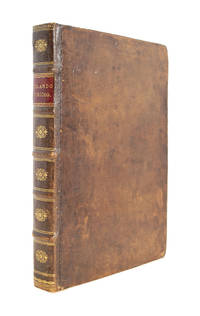
1634001525London: Printed by G. Miller for J. Parker 1634 1634. THIRD EDITION AND THE FIRST ENGLISH LANGUAGE EDITION. 1 vol. folio 10-1/2" x 7-3/4" ix423pp.xxvii engraved title-page with vignette portraits of Ariosto and Harington and 46 full-page engraved illustrations complete a few leaves at beginning including 2 plates not affecting the image with fore-edge repair slight loss to side-notes of 3 leaves a couple of short tears minor worming to several pages Ownership inscription on front blank endpaper "Elizabeth Tyringham Her Booke Aprill ye 5 1668." bound in contemporary full calf over cords head and foot of spine renewed at some early date worming to rear cover hinges fine internally generally clean and bright no water staining overall a VERY GOOD copy STC 748 The plates were first used in the 1591 edition and derive from Girolamo Porro's illustrations of the 1584 Venetian edition. London: Printed by G. Miller for J. Parker, 1634 unknown