Voltaire, Francois Marie ArouetBiblio.com

80 résultats
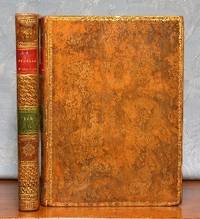
1759752Genève Geneva: Cramer 1759. First Edition. 3 vols. in one 12mo 164 x 100mm pp. 2 291 1; 133 1 35 1. First printing of the great 18th century philosophical narrative with all the points correct. Including the 3 usual cancels the right title page ornament repeated pages 193 and 266 the misprints of “que ce ce fut†page 103 line 4 and “précisément†page 125 line 4 the correction removing a paragraph break page 31 the rewritten lines about the Lisbon earthquake page 41 etc. Contemporary full calf red calf label rebacked with the original spine saved and laid down recornered marbled endpapers gilt rubbed inner paper hinges strengthened old ink signatures on the endpaper and front blank tiny signature on the title page one tissue strengthened tear at the bottom of A2 touching the last 3 lines of text without any loss otherwise internally quite nice clean and very good. Bound without N7 a blank and N8 a notice to the binder as is usual agreeing in all respects to what you would have received if you had purchased a copy in sheets on publication day then bought the sequels and then handed them over to the most local Swiss bindery. Ref: PMM 204. There were 18 editions of Candide in 1759. It took 221 years for a clear and convincing bibliography to first sort them out and then got accepted and once accepted our real 1st edition was confirmed as rare. In the last 15 years however that bibliographical data has been more widely circulated and several 1st editions that weren’t on the original 22–copy census have come into market. It is still scarce more so in a contemporary binding.<br /> <br /> Candide bides as the epitomic philosophical fable of the French Enlightenment and the genotype of irony without exaggeration and though it’s laced with more salt than the postwar streets of Carthage it repeatedly tolls a reminder that light hearts live long. Most importantly Candide remains remarkably relevant when examined through contemporary frameworks functioning as an incisive proto-postcolonial text that anticipates modern discourse on global inequality systems of oppression and the limitations of Enlightenment rationality. The novel's scathing portrayal of slavery conquest and religious persecution resonates with intersectional analyses that recognize how power structures interlock across racial gender and economic dimensions. The savage irony throughout the text dismantles not just philosophical optimism but also European exceptionalism exposing the hypocrisy of colonial enterprises and religious institutions alike. The narrative's episodic structure—with its global movements between Europe South America and the Ottoman Empire—invites discussions of transnationalism and diasporic experience while Candide's concluding retreat to cultivate his garden has been reinterpreted by ecocritical scholars as both an acknowledgment of environmental interdependence and a potentially problematic withdrawal from systems-level political engagement.<br /> <br /> “Do you believe†said Candide “that men have always massacred each other as they do to-day that they have always been liars cheats traitors ingrates brigands idiots thieves scoundrels gluttons drunkards misers envious ambitious bloody–minded calumniators debauchees fanatics hypocrites and fools†“Do you believe†said Martin “that hawks have always eaten pigeons when they have found them†<br /> –Voltaire Candide. Cramer unknown
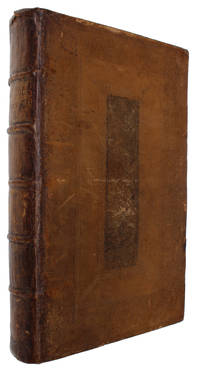
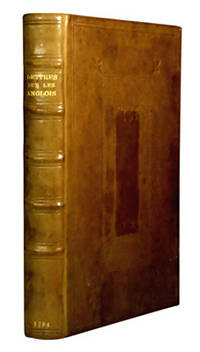
173360085London C. Davis and A. Lyon 1733. 8vo. Lovely contemporary full Cambridge-style binding with five raised bands to spine and blindstamped ornamental borders to boards. . Double gilt line-borders to boards. All edges of boards with gilt borders. Gilt title to spine. Hinges neatly and professionally re-inforced. Internally very nice clean and fresh. A lovely crisp and large copy with good margins printed on heavy fine paper. 16 -including preface contents advertisements 253 1 18 -Index pp. <br/><br/><em>The important actual first edition of this highly celebrated key work of the Enlightenment in which the anecdote of how Newton discovered gravity the story about Newton and the falling apple appeared for the first time together with the description of the difference between the physical world view of the English and the French the "plenum" and the "vacuum". This seminal work in which Voltaire famously depicts British philosophy science society and culture in comparison to French can be viewed as the Enlightenment equivalent to Tocqueville's "Democracy in America". This series of essays which is based on Voltaire's experiences when living in England was actually written by Voltaire mostly in English which he mastered to perfection. It has often been presumed that the first edition of the work was that published in French in 1734 but actually the present English edition constitutes the actual first appearance of the work as well as the version that is closest to Voltaire's intention as the French language version is the re-written one and the English version the original. Curiously almost all modern English versions are translations into English of the French edition instead of the original English version making this edition of the utmost importance.After the original English edition of 1733 two French editions soon followed the first in 1734. Unlike the British the French resented the book and already in 1734 the French Parliament issued an order for the author's arrest and condemned the work causing the impact of it in France to be delayed. The book was burned for being "dangerous to religion and civil order". At the same time the work became a bestseller in Britain and as much as 14 editions of the work were published in the eighteenth century. "Inspired by Voltaire's two-year stay in England 1726-8 this is one of the key works of the Enlightenment. Exactly contemporary with Gulliver's Travels and The Beggar's Opera Voltaire's controversial pronouncements on politics philosophy religion and literature have placed the Letters among the great Augustan satires. Voltaire wrote most of the book in English in which he was fluent and witty and it fast became a bestseller in Britain. He re-wrote it in French as the Lettres philosophiques and current editions in English translate his French." Nicholas Cronk Introduction to the Oxford's Classics edition from 1999.The great French philosopher Voltaire was greatly impressed by the philosophical and scientific achievements of the English especially those of Newton Locke and Bacon. As a disseminator of scientific knowledge Voltaire came to play a great rôle in the popularization of Newtonian science and its discoveries the present work being a prime example. Although the work was condemned by the French authorities it still came to play a great rôle in the spreading of Newtonian ideas in France. The present work generally came to play a dominant rôle in Enlightenment accounts of the history of science and philosophy. The work focuses on British science and thought and uses the accounts of these to emphasize what is lacking in French society and French thought. The work is generally very critical towards the French "ancient régime" and when Voltaire here discusses the emergence of empiricism it is viewed as an English tradition that stands in opposition to the French rationalist tradition with Descartes as the prime example. This view is taken over by the following Enlightenment historians of science and philosophy e.g. d'Alembert see for instance his "Preliminary Discourse" of 1751. Some of the most influential passages of the work are probably those on Bacon who Voltaire sees as the founder of modern experimental science Newton and Descartes. Letters XIV on Descartes and Newton XV on attraction and XVI on Newton's Optics from 1704 are among the most influential essays of the work. In XVI Voltaire reflects upon Newton's "Optics" and the way that he rejected Descartes' theory and set out his own account of the properties of light. In XV he presents the first account of Newton and the falling apple: "As he was walking one Day in his Garden and saw some Fruits fall from a Tree he fell into profound Meditation on that Gravity the Cause of which had so long been sought but in vain by all the Philosophers whilst the Vulgar think there is nothing mysterious in it. He said to himself that from what height soever in our Hemisphere those Bodies might descend their Fall wou'd certainly be in the Progression discover'd by Galileo; and the Spaces they run thro' would be as the Square of the Times. Why may not this Power which causes heavy Bodies to descend and is the fame without any sensible Diminution at the remotest Distance from the Center of the Earth or on the Summits of the highest Mountains; Why said Sir Isaac may not this Power extend as high as the Moon." pp. 127-28.But perhaps the most famous passage in the volume is the opening of Letter XIV: "A Frenchman who arrives in London will find Philosophy like every Thing else very much chang'd there. He had left the World a "plenum" and he now finds it a "vacuum". At Paris the Universe is seen compos'd of Vortices of subtile Matter; but nothing like it is seen in London. In France 'tis the Pressure of the Moon that causes the Tides; but in England 'tis the Sea that gravitates towards the Moon; so that when you think that the Moon should make it Flood with us those Gentlemen fancy it should be Ebb which very unluckily cannot be prov'd." pp. 109-10. </em> hardcover
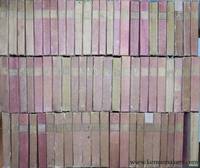
1789000012023Paris: La Société Littéraire-Typographique 1789. First edition. Hardcover. Very Good. 70 vol. 8vo. Please inquire if you require any pagination information. Contemporary full calf spines in six and a half compartments each with a red and a green morocco label lettered in gilt; several edges decoratively stained yellow. With 104 of the 122 recorded plates Cohen-DeRicci calls for 122 plates volume one is missing the tableau the folding plate and the dedication plate. Due to the vagaries of hand-press-era binding and to the large size of the set it is difficult to determine which of the other 16 plates are the ones missing. The plates present depict Voltaire scenes from his plays and several fascinating figures from European History including of course Enlightenment-era figures. All other half-titles present see condition statement. Bengesco 2142. Brunet 681. Cohen-DeRicci 1042-1047. This edition is the set most lauded for its completeness and beautiful typography. Baskerville's type was purchased to produce this sizeable set of Voltaire's writings. The later editions of Voltaire's works are said to be based on this edition. Voltaire's career was nothing short of prolific as demonstrated by these 70 volumes. With a biting wit and a clever pen the philosophe lampooned Leibniz wrote countless plays and historical dramas and corresponded with his fellow Enlightenment-era intellectuals. He walked the line of philosopher and literary figure and made great contributions to science in his translation of Newton's writings into French. He was a champion not only of the natural sciences but of liberty and of personal pleasure. Voltaire dreamed that European society would and could move forward away from tyrannical monarchies towards a more sophisticated and benevolent system of governance. He stands out as one of the most popular and influential figures of the Enlightenment era. Volume 37 lacks its free front endpaper a few leaves in the volumes have an occasional dampspot volume 43 lacks leaf CC8 and its half-title. La Société Littéraire-Typographique hardcover
1795ILTPVOLT95Paris: Didot Le Jeune L'An Troisième 1795. 1795. 2 Volumes. 4to. pp. 211; 212. with half-titles. engraved frontis. portrait of Jeanne d'Arc by Gaucher & 21 engraved plates by engraved by A very tall fine crisp copy on thick paper deckle edge visible on some leaves bound in contemporary tree calf gilt backs all edges gilt some surface scarring to covers but still a very nice copy. First Edition with these Illustrations the frontispiece portrait of Jeanne d'Arc by Gaucher and the other twenty-one plates engraved by Bacquoy Choffard Delignon Delvaux Duhamel Dupréel Lemire Lingée Malbeste Patas Pauquet Ponce and Romanet after designs by Lebarbier Marillier Monnet and Monsiau. "Très belle édition." Cohen-De Ricci Cohen-De Ricci 1034. Brunet V 1362. Bengesco 513. F. Hardcover. Paris: Didot Le Jeune, L'An Troisième [1795]. Hardcover
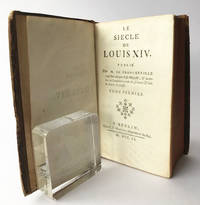
17512359The first edition of Voltaire's brilliant historical study of the age of King Louis XIV. Begun as early as 1732 Voltaire sent a manuscript version to Frederic II who was enthusiastic and encouraged its publication. In 1739 Voltaire published a 'Plan Raisonné' of the project including two finished chapters but this was condemned by the court and seized. In 1750 Voltaire left France for Frederic's court at Berlin where he set himself to complete the work. Failing to obtain the 'privilège royal' or even the non-written 'permission tacite' he decided to go ahead and publish the work in Berlin at his own expence. Voltaire continued to add to the work in subsequent editions most notably in the 1753 Berlin edition where he added a supplement in which he refuted the attacks made by La Beaumelle.<br /><br /><i>Two volumes in one 12mo 144 x 85mm pp. xiv 488 1 errata; ii 466 2 errata with the half-title to the first volume in contemporary calf rather worn spine gilt in compartments foot of spine chipped wormhole to the head of spine wanting the front endpaper red edges.</i><br /><br />BN Voltaire Catalogue 3361-3363. C.F. Henning
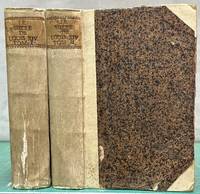
175116247Berlin: C F Henning. Very Good- with no dust jacket. 1751. First Edition; First Printing. Hardcover. Vellum darkened and with some surface cracking light extremity wear; light foxing. No half-title pages. Errata page for both volumes bound at end of Vol I. Two custom owners' bookplates in first volume. Solid hardcovers. ; French language. Half vellum binding with marbled boards. Two of two volumes complete. Bengesco I 1178. This work was the most researched and carefully prepared of Voltaire's works. He began work on this project in 1734 while at the Chateau Cirey put it aside in 1738 and resumed work on it in 1750. First Edition First Printing of Voltaire's pioneering historical study of the age of King Louis XIV published while Voltaire was resident at the court of King Frederick II of Prussia.; xii 488 2 errata; ii 466 in 2v pages . C F Henning hardcover
1775044596Genève et Paris: Cramer et Bardin 1775. Edition encadrée" Complete set of all 40 volumes with the engraved frontispieces where issued all pages printed within the wood-engraved frames octavo format. Uniformly bound in mottled calf with gilt spine trim and lettering; some leather chipping mostly at the head of some spines. all edges marbled. Contents: t. 1 La Henriade divers autres poëmes et toutes les piéces relatives à l'épopée. t. 2-10 Ouvrages dramatiques précédés et suivis de toutes les piéce qui leur sont relatifs. t. 11 La Pucelle d'Orléans poëme suivie du Temple de Gout &c. t. 12-13 Mélanges de poësies &c. t. 14-17 Essai sur les moeurs et l'esprit des nations; et sur les principaux faits de l'histoire depuis Charlemagne jusqu'à Louis XIII. t. 18-20 Siècle de Louis XIV auquel on a joint un précis du siècle de Louis XV et un autre morceau d'histoire. t. 21 Histoire de Charles XII roi de Suède avec les pièces qui y sont relatives. t. 22 Histoire de l'Empire de Russie sous Pierre le Grand divisée en deux parties. t. 23-24 Annales de l'Empire depuis Charlemagne fragmens sur quelques revolutions dans l'Inde fragmens sur l'histoire générale et divers autres morceaux historiques. t. 25-30 Questions sur l'Encyclopédie par des amateurs. t. 31-32 Romans philosophiques élémens de Newton précédés et suivis de divers morceaux intéressans. t. 33-37 Mélanges de littérature d'histoire et de philosophie. t. 38-40 Piéces détachées attribuées à divers hommes célèbres. Cramer et Bardin unknown
178542634N.pl.: De l'Imprimerie de la Société Littéraire-Typographique 1785. 69 of 70 vols. Vol. 69 missing. Large 8vo 275x18 cm. Contemporary marbled boards; spines with paper title-lable of 19 volumes spines restored with contemporary marbled paper; many spines discoloured; 4 tops of spines damaged; 14 hinges more or less damaged but still holding strong. Printed on handmade paper uncut. Copies with wide margins . The set is carefully collated so we mention every minor defect: the verges of the uncut margins soiled; a small number of leaves: browned or soiled; some with light mostly marginal waterstain; margins of plates a bit soiled the frontisp.-portraits with brown spots. 1 general title and 1 sub-title missing; tear repaired in 3 leaves. On the whole a clean set. Most volumes count between 400 and 500 pages 26 volumes more than 500 pages and 9 volumes between 300 and 400 pages. with numerous engraved plates: engraved frontispiece-portrait of Voltaire engraved by Tardieu after De Largillière 6 other engraved portraits 107 of 108 engraved plates 1 engraved plan of the battle Turcs-Tartares and 1 allegorical double-page engraving in the last volume the only volume on title dated 1789. - the first posthumously printed edition with many unpublished pieces printed at Kehl in the printing office of de Beaumarchais who erected this office especially for the edition of Voltaire's works Vols 1-9: Théâtre. With frontisp. portrait and 44 engraved plates. Vol. 10: La Henriade. With 11 engraved plates. Vol. 11: La Pucelle. With 21 engraved plates a few with shorter margins: from an other copy. Vol. 12: Poemes et discours en vers. Vol. 13: Epitres. Vol. 14: Contes en vers. With 4 engraved plates. Vol. 15: Lettres en vers et en prose. Vol. 16-19: Essai sur les moeurs et l'esprit des nations et sur les principaux faits de l'histoire depuis Charlemagne jusqu'à Lous XIII. With frontisp.-portrait of Voltaire engraved by Langlois after De la Tour. Vols. 20-21: Siècle de Louis XIV. With frontisp.-portrait of Louis le Grand. Vol. 22: Précis du siècle de Louis XV. With frontisp.-portrait by Fosseyeux after Vanloo. Vol. 23: Histoire de Charles XII. Vol. 24: Histoire de l'empire de Russie sous Pierre le Grand; divisée en deux parties. with engraved plan battle Turcs - Tartares. Vol. 25: Annales de l'empire depuis Charlemagne. Vol. 26: Histoire du parlement de Paris. Vols.27-28: Melanges historiques. Vols. 29-30: Politique et législation. Vol. 31: Philosophie de Newton. With 14 explanatory engravings. Vols. 32-35: Philosophie générale: Métaphysique morale et théologie. With engraved frontisp.-portrait: buste de Voltaire. Vol. 36: Dialogues et entretiens philosophiques. Vols. 37-43: Dictionnaire philosophique. Vols. 44-45: Romans. With 12 engraved plates 4 inserted from another copy; 1 engraving missing '. cri de douleur'. Vol. 46: Facéties. Vol. 47-49: Melanges littéraires. With engraved portrait. Vols. 50-51: Commentaires sur Corneille. Vols. 52-63. Recueil des lettres de M. de Voltaire 1715-1778. Vols. 64-66: Lettres du Prince royal de Prusse et de M. de Voltaire. With engraved portrait of Frédéric II. Vol. 67: Lettres de l'impératrice de Russie et de M. de Voltaire. Vol. 68: Lettres de M. de Voltaire et de M. d'Alembert. first vol. of 2 1746-1768. Vol. 70: Vie de Voltaire par le marquis de Condorcet; suivie des Memoires de Voltaire écrits par lui-même; des Tables des Oeuvres &. With double-page allegorical engraving and 1 other engraving De l'Imprimerie de la Société Littéraire-Typographique hardcover
1759elala1495np Paris: 1759. 1759. 12mo. pp. 237 3. contemporary calf gilt back spine ends worn. Published the same year as the first. Voltaires witty and devastating attack on philosophical and religious optimism is generally regarded as his most masterful composition. Published surreptitiously no less than seventeen different printings and editions appeared in 1759. Bengesco 1440. Martin 59.25. cfCioranescu 64321. cfQuérard X 323. cfPrinting and the Mind of Man 204. BOUND WITH: POPE Alexander 1688-1744. Essai Sur LHomme Traduit de lAnglois en François Édition revûe par le Traducteur Second Édition. 12mo. pp. 2 p.l. vii-xxxvi 189 3privilege. woodcut ornaments & title vignette. Lausanne: Marc Michel Bousquet & Compagnie 1752. np [Paris]: 1759. unknown
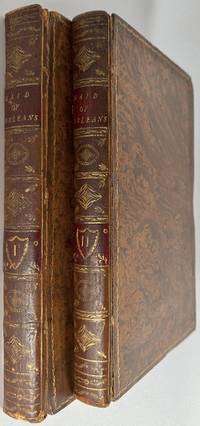
176882403Geneve 1768. First edition of one of Voltaire's best-known works of prose. Octavo original full period calf gilt titles to the spine red morocco spine label raised bands marbled endpapers. In good condition. Rare and desirable. “One of Voltaire’s finest romances†The Princess of Babylon relays the story of the beautiful Formosanta who travels the world in search of her lover Amazan Barron Fantasy Literature I:88. Subtle in its philosophy Voltaire breaks narrative conventions in this novella to foster Enlightenment values and in the process also “pokes fun at a number of literary traditions†Pearson Fables of Reason 196. The novella saw instant success upon publication and was in such demand that it was being illegally pirated in England and printed under a false imprint of ‘Geneva’ when it was actually printed in London. hardcover
176424563Londres: aux depens de la compagnie 1764. 8vo pp. xvi 384; engraved frontispiece and 20 engraved plates; 20th-century full crimson straight-grain morocco by Zaehnsdorf decorative gilt border on covers gilt-paneled spine and preserving the original blue printed wrappers which are bound in. First published without plates at Louvain in 1755. This is likely a 'variorum' edition probably Dutch based on the first authorized edition of 1762 Geneva with variant readings from earlier piracies. Bengesco 491. aux depens de la compagnie unknown
173446420<p>Basle i.e. London : by W. Bowyer 1734. First edition. Although an English translation had been published in London as "Letters Concerning the English Nation" in 1733 this is the first appearance of the original French text of the book now generally known as the "Lettres Philosophiques" and as "the first bomb thrown at the Ancien Régime". It has been said of Voltaire that "he came to England a poet and left it a philosopher": however that may be this book resulting from his stay in 1726-1728 is "one of the greatest and most influential works of the eighteenth century and beyond . the book that taught the whole of Europe how to think" Voltaire Foundation. The letters contrasting English and French thinking deal variously with religion in England - Quakers Anglicans Presbyterians and Socinians; politics parliament and Magna Carta; trade commerce and the businessman who "contributes to the felicity of the world"; English empiricism and Francis Bacon John Locke and Isaac Newton; and literature - Shakespeare above all Wycherley Congreve Swift and Pope etc. The London publishers' preface is interesting on the author's extreme reluctance to sanction a French-language edition - they had suppressed this edition for an entire year but others were now preparing illicit editions and they now had to displease the author to please the public. The furore which greeted the French editions when they appeared probably justified Voltaire's reluctance and the use here of a fake Basle imprint. Foolscap 8vo 171 x 103mm. viii228xxpp. Bound in a creditable modern rendition of early eighteenth-century full panelled calf; sprinkled edges; a few slight marks; Voltaire's name added to title-page in manuscript; faint fringe of very pale discolouration to fore-edge throughout text barely visible in most places; a few minor internal marks and tiny flaws but a good copy of one of the key books of the Enlightenment. Eighteenth-century 1768 ownership inscription now obscured.</p> Basle [i.e. London : by W. Bowyer], 1734. hardcover
1731231308Paris: Josse 1731. First. hardcover. very good. Slim 8vo pp. xxix 3. 110 3 approbation and errata. Decorative copper engraved head-pieces a few contemporary ink annotations full gilt brown calf covers lightly warped and rubbed with a bright gilt heraldic crest on front and back red edges. Paris: J.F. Josse 1731. First Edition. Scarce. Very good.<br/> <br/> Josse unknown
1785mon0003500177SociÔøΩtÔøΩ LittÔøΩraire-Typographique 1785-01-01. Leather Bound. Very Good. . Kehl Baden 1784 - 89. Complete 70 Volume Set. 8vo 7.75 - 9.75'' Famous first collected edition of Voltaire's works known as the 'Kehl Voltaire' Vols. 10 27 and 28 printed 1784 summary volume 70 printed 1789 all others printed 1785. Bound in Uniform 18th century full brown mottled calf leather. front and rear boards have floral chain decorated borders; gilt spiral design on foredges. Spines decorated in gold floral and trophy designs with gilt titles and vol numbers on red and black labels. Marbled end papers and page edges. Green silk reading ribbons are bound in. - Approx 400 pages per volume. Volume 1 frontispiece engraving of Voltaire by Moreau.; Vol 16 frontispiece portrait of Voltaire; Vol 24 engraved map. Vol 31 14 engraved plates. - All 70 Vols are well bound no cracked hinges no loose pages. Varying degrees of edge wear; a few volumes have chipping to spines or vol #s worn off. Browning or toning at times mostly end papers Otherwise A Very Good Set! SociÔøΩtÔøΩ LittÔøΩraire-Typographique hardcover
1759023043London: J. Scott and J. Gretton. Rebound in full new leather. Scholars have differed about whether this edition or the Nourse edition published in the same year was the First Edition in English. At the very least the First Edition of This Translation. One of the greatest works in all literature. According to PMM 204: The folly of philosophic and religious optimism is displayed with a vigor and wit that carries the reader away. Near Fine. . Near Fine. Hardcover. 1759. J. Scott and J. Gretton hardcover
1799ST17632cParis: de l'Imprimerie de Crapelet an VII 1799. 228 x 150 mm. 9 x 6". Two volumes. <br/> Very attractive 19th century red morocco by Capé stamp-signed in gilt on front turn-in French fillet border raised bands compartments with central quatrefoil surrounded by lacy gilt tooling gilt lettering gilt dentelles all edges gilt. Housed in a later marbled slipcase. WITH engraved frontispiece by Gaucher and 21 ENGRAVED PLATES after Marillier Monsiau and Ponce as called for AND EXTRA-ILLUSTRATED WITH 46 PLATES comprised of a suite of 20 small plates a suite of 21 large plates and five portraits. Verso of front free endpaper with the bookplate of Jacques Bastenet. Cohen-de Ricci 1035; Graesse VI 393. See also: Cohen-de Ricci 1047-48 for the plates by Moreau. ◆Two three-inch abrasions on one cover and a hint of wear to joints both very well disguised by refurbishment leather faintly soiled but the decorative bindings still lustrous and quite pleasing without any significant condition issues. Occasional mostly light foxing never serious and most of the plates clean but noticeable enough to be regrettable some of the smaller extra-illustrations slightly browned due to paper stock but still a book with considerable appeal inside and out with the engravings richly impressed.<br/> <br/> This printing of Voltaire's mock-heroic "Pucelle" a licentious burlesque based on the Joan of Arc story features the same beautiful engravings found in the Didot edition of 1795 but without the frames plus two additional suites of plates taken from other editions. The set of 20 small plates seem to be close copies of Gravelot's illustrations from the 1762 Geneva edition of "La Pucelle"; the set of 21 larger images are by Moreau all but two being before letters. The latter set probably comes from the suite of images for Voltaire's "Oeuvres" published by Renouard in 1802 of which there were just 40 copies before letters according to Cohen-de-Ricci. Capé was one of the most distinguished binders in France in the middle years of the 19th century being especially well known for the delicacy of his work as evidenced by our spines. He was the binder to the Empress Eugénie and Béraldi calls him "the Bozérian of the second Empire.". de l'Imprimerie de Crapelet unknown
17681591281768. First Edition. paperback. 182pp. half-title; woodcut title page vignette. sewn; unlettered buff wrappers. N.p. Geneva 1768.<br/> <br/> One of Voltaire's best known prose works it came out in many editions the same year. This is presumably the first and conforms to the copy in the Bibliotheque Imperiale.<br/> <br/> unknown
1764elala166Geneva: Cramer 1764. 1764. 8vo. pp. xvi 386 2. complete with half-title. woodcut title vignette. A fine copy in contemporary mottled calf gilt back. First Edition. Bengesco I 660. Cioranescu 63982. 1st Edition. Hardcover. [Geneva: Cramer], 1764. Hardcover
173871163Amsterdam 1738-1750. 8vo. Samtidige pergamentryggbind med tittelfelter i lysebrunt skinn og marmorerte dekler. Voltaires graverte portrett som frontispiece i bind I. Tittelbladene trykt i rødt og svart. 6 XXXII 1 1 blank 349 1 1 blank ; 4 366 1 1 blank ; 2 372 ; 4 377 1 blank 16 ; 6 v 1 135 1 blank XXII 102 24 112 ; 8 420 ; 16 415 1 blank ; 4 142 1 1 blank 152 1 1 blank XII 2 115 1 blank s. Med 21 kobberstikk utenom pagineringen. Tallrike kobberstukne vignetter. Chez Etienne Ledet & Compagnie Fransk. <br/><br/><em>Et flott sett. De fleste kobberstikkene er i bd. I som omfatter “La Henriadeâ€. </em> unknown
1785862N27Paris: De l'Impremerie de la Societe Litteraire Typographique 1785. Leather. Fair. 8" by 5". None. Forty three leather bound volumes from the Complete Works of Voltaire. 43 volumes from the complete works of Voltaire. Published in French. The present collection of the French philosopher's works includes volumes 2-10 12 14-17 20-23 25 27 32-35 37 45 51 60 63-69 70-77 and 89. With four plates to volumes two three and six. With three plates to volume four. With seven plates to volumes five and nine. With nine plates to volume eight. With ten plates to volume nine. With five plates to volume ten. The present collection opens with the theatrical works of Voltaire which is followed by his poetry including his epic poem the Henriade. In his Essay on the Universal History Manners and Spirit of Nations Voltaire discusses the history of Europe before Charlemagne until the age of Louis XIV. This is followed by his History of the Russian Empire Under Peter the Great his writings on politics and legislation some miscellaneous literary criticism and his commentary on the dramatic works of Pierre Corneille. The latter volumes are comprised of Voltaire's letter exchanges. Voltaire was a French Enlightenment writer philosopher and historian famed for his wit his criticism of Christianity and slavery and advocation of the separation of the church and state. The versatile and prolific writer produced works in many literary forms including plays novels essays but also scientific expositions. In a full contemporary calf binding. Externally sound. The rear board of volume 64 id disbound but present. The remaining volumes are lightly rubbed to the boards with some cracking to the leather along the spine. Volume 27 is missing some calf to the front extremity. Generally lightly rubbed to the head and tail of the spine although some volumes including 14 27 32-34 and the majority of the volumes in the 70s are missing a slither of calf to the head or tail of the spine or both. The front joints of volumes 10 16 20 33 and 45 are rather tender. Although the hinges are better to the latter volumes they are starting but firm to the majority of the earlier volumes.The front hinges are particularly tender to volumes 9 15 16 20 45 60 and 89 and the rear hinges are loose in volumes 10 and15. Internally firmly bound. Pages are generally bright and clean with some patches of light foxing. Fair De l'Impremerie de la Societe Litteraire Typographique hardcover
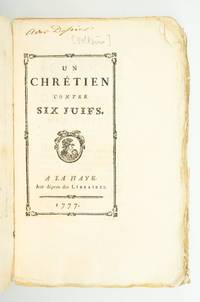
1777ST20535-04La Haye The Hague but Geneva: Aux dépens des Libraries 1777. FIRST EDITION. 215 x 140 mm. 8 1/2 x 5 1/2". 1 p.l. 303 3 pp. <br/> Publisher's marbled paper wrappers flat spine edges untrimmed. A Large Paper Copy. Benesco 1860. Andrew R. Morehouse "The Voltaire Collection in the Rare Book Room" The Yale Library Gazette 17 no. 4 1943 p. 75.<br /> Paper wrappers a bit faded as expected slightly defective at corners and a little curled otherwise and perhaps even so A VERY FINE COPY--the text within immense margins entirely clean fresh and bright.<br/> <br/> This is a remarkable survival in its original wrappers of a work related to one of the most resonating controversies of Voltaire's life and writings--the question of his anti-Semitism. A giant of the Enlightenment and one of the greatest of French writers and philosophers Voltaire real name François-Marie Arouet 1694-1778 writes here in response to "Lettres de quelques Juifs portugais allemands et polonais à M. de Voltaire" a 1776 critique by Antoine Guénée objecting to the anti-Semitism especially as expressed within a commercial context in our author's "Dictionnaire Philosophique." Deeply philosophical and leavened with satire the 120 chapters of the seminal "Dictionnaire" were widely read much condemned and not infrequently burned as they challenged religious authority advocated for toleration and dealt with many social and political issues from an uncomfortable Enlightenment perspective. And there can be no doubt that Voltaire's "Dictionnaire" does in fact contain critical remarks about the Jews; at the same time the author's criticism is extended with equal warmth to organized religion in other forms. In the present response to Guénée Voltaire is nothing if not scathing which in the end works against him. As Voltaire scholar Andrew R. Morehouse wryly puts it the text here expands upon Voltaire's previous points in such a way as to "justify the accusation that he is cruelly anti-Semitic." This work is not exactly rare but it is very unusual to find it in original wrappers as here particularly in such fine condition. Aux dépens des Libraries unknown
17687816<p>Glasgow: Printed for Robert Urie 1768 Three English-language editions were printed in 1768 one in London one in Dublin and one in Glasgow. All have different collations and none name a translator. The Urie edition is rare: ESTC lists seven copies three in North America Toronto North Carolina Huntington Library. . Contemporary speckled calf with red calf spine label. Octavo in fours. Binding extremities lightly worn occasional light marginal dampstaining. Old ink signature on title-page later ink signature and address on front free endpaper bookplate of a third owner on front pastedown. Overall a good clean copy with wide margins possibly a large paper copy.</p> Printed for Robert Urie,
179613479Privately Printed 1796. Hardcover. Very Good. Two volume set of English language translation of Voltaire's satiric poem is bound in brown tree calf with a gold border spines nicely decorated in gold and red. Corners and edges worn edges and head/tails of spine are rubbed rear of Vol I is scuffed. Armorial bookplates inside front covers endpapers toned. Not illustrated appears to be first English language translation. This satirical poem in 21 cantos by Voltaire first published in 1762 is a mock-epic that takes a humorous and often irreverent look at the life of Joan of Arc. The poem was controversial from the start and was banned and burned in many places. All orders packed with care most dust jackets protected by Brodart sleeve independent bookseller since 2011 Privately Printed hardcover
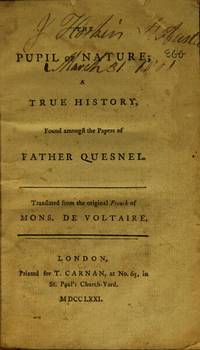
177124235London: T. Carnan 1771. First edition in English of his famous philosophical tale L'Ingénu first published in 1767; 12mo pp. 4 210; contemporary calf-backed marbled boards neatly rebacked black morocco label on spine; two short tears entering the top margin of the title 1 internal page stained else generally very good and sound. An edition was published in Philadelphia in 1778. L'Ingénu is a young man born in Canada of French parents but brought up for twenty years among the Hurons. "He then comes to France and is recognized as the lost nephew of an old French prior and his sister . L'Ingénu's simplicity frankness and good sense produce some comical situations . The story . is both a protest against abuses of power . and an exposure of some of the absurdities of our conventions" Ox. Comp. to French Literature. T. Carnan unknown
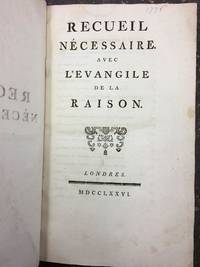
17761316353Londres 1776. Hardcover. Octavo 280 pages; VG; bound in quarter red calf gilt lettering and tooling to paneled spine marbled boards marbled endpapers; half-title present verso of sfep has two early math equations; wide margins; scarce; shelved case 10. The imprint is false; probably printed in the Netherlands. Contrary to the title this edition does not contain "L'evangile de la raison" but does include "Dialogue du douteur & de l'adorateur". Signature marks include "Tome I" but no Vol. 2 is recorded; <br /> <br> <br /> <br> <br /> Preceeded by a second false imprint printed in Amsterdam by M. M. Rey in 1768;<br /> <br> <br /> <br> <br /> ESTC Citation No. N12875. 1316353. Shelved Dupont Bookstore. hardcover