619 résultats
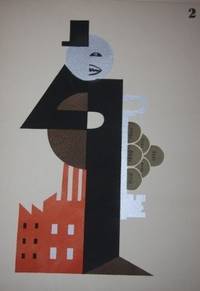
004645Bruxelles: Les Editions Socialistes. First Edition. Folder. Paper pastedown on a heavy card stock. . Very Good. Signed by the artist on the front cover and dated 1928. The album may have been issued in 1925 but bears no printed date. 317 by 243 mm. One leaf with playful carnivalesque preface by Barbusse on the recto and a key on the verso with the title or subject of the following 12 pochoir plates rendered in six languages French Dutch German English Russian Italian and Spanish with some power deriving from the repetitive similarities for the words in the different languages. Each plate an allegorical depiction of an enemy of the working class: militarism property philanthropy social democracy "justice" colonialism fascism "police spy" parliamentarism "middle-spirit" religion and patriotism. The artwork a heady mix of Cubist Constructivist Futurist and Dada-ist styles has a sculptural quality which is no accident given that Deltor eventually gained renown for his monumental public works. Deltor was a refugee from Fascist Italy. He first settled in Paris in 1922 where he was expelled six years later for his political activism. From there he went to Brussels and eventually settled for good in the Netherlands where he won wider recognition. Also heightening the visual excitement are the muscularity of the coloration with metallic silvers and golds and even blues brash reds unusual yellows greens and other colors. And whatever one's politics or for that matter view of Modernism one is likely to succumb to the wit and zest of the imagery. The subtitle of the set "12 Personages in Search of One" would seem a play on the Pirandello play title "Six Characters in Search of an Author" which premiered in 1921. Foxing on the folder which has slight chipping to its spine. Minor rubbing and wear by edges. Along the spine or joint edge appears the shadow remnants of tape that might have once run along it as a makeshift repair. Marginal toning to the plates. <br /><br /> Les Editions Socialistes books
004645Bruxelles: Les Editions Socialistes. First Edition. Folder. Paper pastedown on a heavy card stock. Very Good. Signed by the artist on the front cover and dated 1928. The album may have been issued in 1925 but bears no printed date. 317 by 243 mm. One leaf with playful carnivalesque preface by Barbusse on the recto and a key on the verso with the title or subject of the following 12 pochoir plates rendered in six languages French Dutch German English Russian Italian and Spanish with some power deriving from the repetitive similarities for the words in the different languages. Each plate an allegorical depiction of an enemy of the working class: militarism property philanthropy social democracy "justice" colonialism fascism "police spy" parliamentarism "middle-spirit" religion and patriotism. The artwork a heady mix of Cubist Constructivist Futurist and Dada-ist styles has a sculptural quality which is no accident given that Deltor eventually gained renown for his monumental public works. Deltor was a refugee from Fascist Italy. He first settled in Paris in 1922 where he was expelled six years later for his political activism. From there he went to Brussels and eventually settled for good in the Netherlands where he won wider recognition. Also heightening the visual excitement are the muscularity of the coloration with metallic silvers and golds and even blues brash reds unusual yellows greens and other colors. And whatever one's politics or for that matter view of Modernism one is likely to succumb to the wit and zest of the imagery. The subtitle of the set "12 Personages in Search of One" would seem a play on the Pirandello play title "Six Characters in Search of an Author" which premiered in 1921. Foxing on the folder which has slight chipping to its spine. Minor rubbing and wear by edges. Along the spine or joint edge appears the shadow remnants of tape that might have once run along it as a makeshift repair. Marginal toning to the plates. Les Editions Socialistes unknown
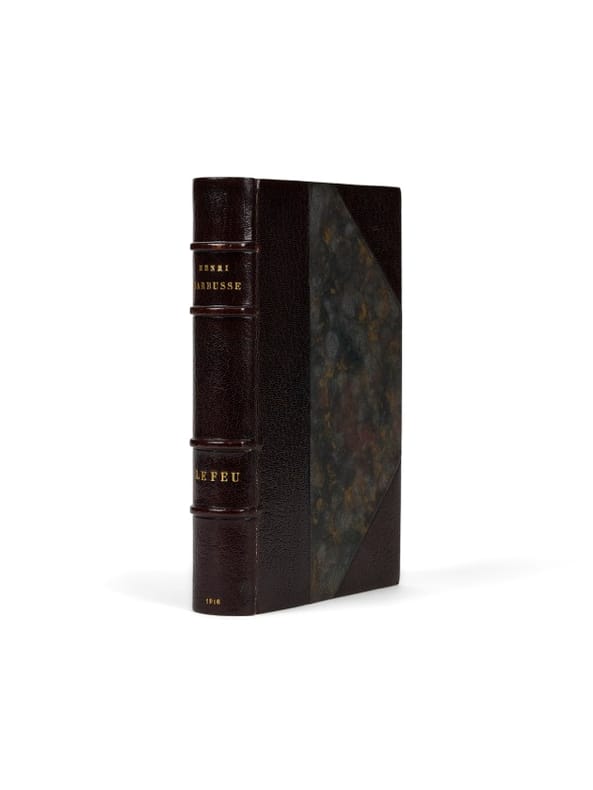
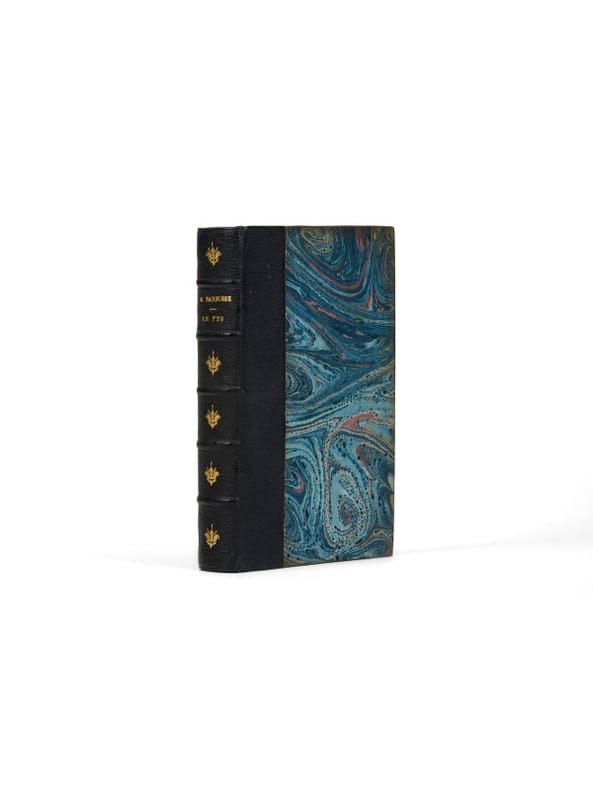
191629566Tirage spécial pour « Les XX», signé par l'auteur : le n° 1 Paris, Flammarion, (décembre) 1916. 1 vol. (126 x 175 mm) de 378 p. et [1] f. Demi-maroquin brun à coins, dos à nerfs, titre doré, date en pied, tête dorée, double couverture et dos conservés (reliure signée de Semet & Plumelle). Tirage spécial à vingt exemplaires réimposés sur Arches et réservés pour « Les XX», signés par l'auteur (n° 1). Montée en tête : lettre autographe signée, adressée au président de la Société des XX, datée du 6 octobre 1917 « […] je vous suis très obligé d'avoir compris Le Feu dans votre belle et précieuse collection des XX, et c'est très volontiers que je signerai les pages de gardes que vous voudrez bien me faire parvenir…».
29566Paris Flammarion décembre 1916. 1 vol. 126 x 175 mm de 378 p. et 1 f. Demi-maroquin brun à coins dos à nerfs titre doré date en pied tête dorée double couverture et dos conservés reliure signée de Semet & Plumelle. . Tirage spécial à vingt exemplaires réimposés sur Arches et réservés pour « Les XX » signés par l'auteur n° 1. Montée en tête : lettre autographe signée adressée au président de la Société des XX datée du 6 octobre 1917 « … je vous suis très obligé d'avoir compris Le Feu dans votre belle et précieuse collection des XX et c'est très volontiers que je signerai les pages de gardes que vous voudrez bien me faire parvenir… ». . Henri Barbusse avait connu le feu des tranchées dès 1915 d'abord comme soldat puis comme brancardier. C'est principalement des hôpitaux que Barbusse en vingt-quatre chapitres témoigne de son quotidien et de la « fatigue épouvantable surnaturelle et l'eau jusqu'au ventre et la boue et l'odeur et l'infâme saleté surnageant sur la terre vorace » écrivant depuis un carnet de guerre où il avait noté ses expériences vécues. Le roman est prêt à la toute fin de l'été et l'idée du Goncourt est déjà en germe pour ses éditeurs avant même la signature du contrat. La parution des premiers chapitres sous forme de feuilleton dans le quotidien L'OEuvre débute le 3 août : les frères Fischer directeurs littéraires de Flammarion flairent la bonne affaire et contactent l'auteur pour acheter les droits du Feu. Le 26 octobre à la veille d'une réunion préparatoire de l'Académie ils lui écrivent : « Nous avons parlé de la possibilité que nous entrevoyions relativement au Goncourt. Certaines conversations que nous avons eues ces jours-ci notamment avec Paul Margueritte nous font croire que nous ne nous étions pas tout à fait trompés. Mais il faudrait aller bigrement vite pour cela. » Barbusse hésite lié à d'autres éditeurs mais la perspective du Goncourt le décide. Une semaine plus tard le contrat est signé - six jours avant la fin de la parution en feuilleton 93 livraisons. Le 15 novembre le texte part à l'impression et paraît in extremis chez Flammarion début décembre dans un tirage initial de 1 000 exemplaires. Barbusse obtient le Goncourt au premier tour de scrutin le 15 décembre avec huit voix sans celle de Léon Daudet ni d'Elémir Bourges comme il l'avait anticipé. Le présent exemplaire appartient au rare tirage des XX limité à 20 exemplaires hors commerce tous signés par l'auteur. Il s'agit du n° 1 réservé à Henri Lenseigne président de la Société des XX. Une lettre autographe en tête signée de Barbusse permet de documenter précisément la publication : ce tirage est postérieur à l'édition originale et ce n'est qu'en octobre 1917 que Barbusse accepte de signer les feuillets justifiés. L'enveloppe d'envoi conservée oblitérée à cette date le confirme. Très bel exemplaire. Des bibliothèques Henri Lenseigne lettre autographe Jules Exbrayat et José Fabbiani Ruiz ex-libris. Jean Norton Cru Témoins p. 555 à 565 ; Talvart I 239 n'indique pas ce tirage Paris, Flammarion, (décembre) 1916. 1 vol. (126 x 175 mm) de 378 p. et [1] f. Demi-maroquin brun à coins, dos à nerfs, titre unknown
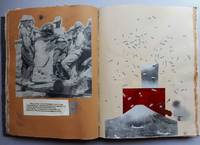
201711365East Hampton NY 2017. Unique artist's book on three different St. Armand papers in tan / brown signed and dated by the artist Barry McCallion on the colophon page. Page size: 9.5 x 12 inches; 63pp. plus colophon and titlepage. Bound: hand sewn by Joelle Webber at Mermaid Bindery into tan St. Armand paper wrappers laid into grey felt portfolio by Barry McCallion with title stenciled in red outlined in silver gilt with two pieces of barbed wire separating under and fire and underlining "fire" with black mesh screening in three pieces on spine housed in tan cloth over boards clamshell box with title lettered in black on tan paper insets on spine and front panel. The book is a selection of texts from the novel by Henri Barbusse. The artist has selected sentences and paragraphs from the text copied them enlarged some printed on various papers and collaged to the pages of this book. They are surrounded by photographs from various conflicts with painting handwritten words in India ink printing ink metal foil and acrylic paint. The whole reflects on the brutality that is war - each and every war. Barry McCallion notes in his colophon "The hundred years between then publication of UNDER FIRE and now have seen a recurring and uncanny sameness of bloodied fields and trenches mountains and beaches mud and wire snow and sand.A book in protest his and this." He has used images from the First and Second World Wars Korea Viet Nam Iraq and Afghanistan. He adds in the colophon "I have attempted to heave up a century's weight of agony and loss in one book grouping images from different times to create a single immediate and simultaneous present." <br/>Henri Barbusse wrote UNDER FIRE in 1916 after serving in the French army for fifteen months in the trenches in World War I when wounds lifted him from the French front line. Considered the first of the modern anti-war novels and was awarded the Prix Goncourt. The author's harrowing details of trench warfare have lost none of their power to appall. Mr. McCallion's book succeeds in calling to mind the terrible tragedies and loss when people go to war. unknown books
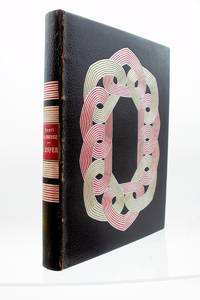
192152163Sous étui bordé. Reliure plein maroquin noir. Plats décorés d'un motif art-déco d'entrelacs bleus, rouges et palladium inspiré de l'enluminure irlandaise. Dos lisse orné de filets horizontaux rouges, jaunes et palladium, pièce de titre en maroquin jaune. Tête dorée, filets intérieurs argentés. Couverture et dos conservés. Reliure signée KIEFFER. Quelques rares piqures. Illustré de 24 eaux-fortes originales d'Edouard CHIMOT.
38819New York: Frederick A. Stokes. As New. Hardcover. FREE UPGRADE to Courier/Priority Shipping Upon Request IN STOCK AND IMMEDIATELY AVAILABLE FOR SHIPMENT - TEXT PRISTINE - ND. 79 pages. Large print. -- with a bonus offer-- . Frederick A. Stokes hardcover
190451117Bruxelles Belgium: Imprimerie Scientifique. As New. 1904. Paperback. FREE UPGRADE to Courier/Priority Shipping Upon Request IN STOCK AND IMMEDIATELY AVAILABLE FOR SHIPMENT - Text block pristine - text in French. The catalogue is divided into 3 parts. Part 1 consists of essays by various experts and men of letters on 18th Century French tapestries art & music women in the pictures of Watteau and Fragonard the 18th Centry French woman and dramatic art and literature in 18th Century France. Part 2 catalogues the 108 paintings works on paper & engravings the 23 sculptures and 23 tapestries included in the exposition with a number of these items illustrated in black and white. Part 3 catalogues the books at glass musical instruments furnishings and other items in the expositions and also includes a number of illustrations. Among the artists represented: Greuze DuPlessis Boucher Tournieres A. Watteau and others. -- with a bonus offer-- . Imprimerie Scientifique paperback
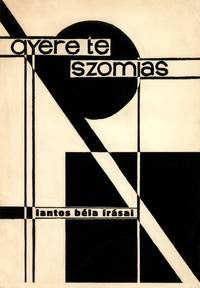
19283569Budapest 1928. First edition. Inscribed. In original paper. Mint condition. First edition. Inscribed. In original paper. 471 p.1 t. Béla Lantos 1904-1958 was an ironworker turned poet and belonged to Kassák's Munka Circle. The volume includes his best-known poem Aunt Kassák which he wrote to Kassák's mother.<br /> The typographic cover was designed by Lajos Lengyel engraved by Ferenc Sallmayer. unknown
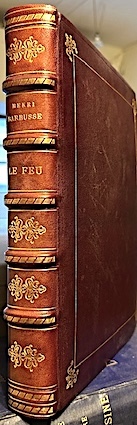
20619Paris, Ernest Flammarion, 1916. In-8, 378 pp., demi-maroquin à bandes brun de René Kieffer, plats de basane noire ornés de frises dorées, dos long orné de frises dorées, pièce de titre noire, bordure intérieure ornée de filets dorés, tête dorée sur témoins, couverture conservée, étui bordé.
192155888BBGenève, Editions du Sablier. 1921. Gross-8°. 193 S., 3 n.n. Bl. Roter Maroquinband mit goldgeprägtem Rückentitel und eingebundenem Originalbroschur-Umschlag.
192175346Paris: Albin Michel 1921. Fine. Albin Michel Paris 1921 25.50 x 33 cm relié sous étui Definitive edition illustrated with 24 original etchings by Edouard Chimot one of 355 numbered copies on Arches vellum. Full black morocco binding smooth spine decorated with horizontal palladium bands heightened with horizontal lines of red and brown mosaic morocco cold-stamped roulettes on headcaps traces of rubbing on one weakened joint covers decorated with a large interlacing design in palladium set with pieces of red and green mosaic morocco endpapers and pastedowns of moiré-effect paper frame of palladium fillet and palladium fleurons in corner-pieces of pastedowns covers and spine preserved cold fillet on edges top edge gilt slipcase bordered with black morocco marbled paper boards beige felt interior contemporary binding signed René Kieffer. Handsome copy in a spectacular Art Deco binding in full mosaic morocco signed René Kieffer. Albin Michel hardcover
19213883Paris, Albin Michel, 1921. 1 volume (254 x 321) de 198-[2] pages, 24 planches. Demi-vélin blanc à coins orné d’un filet doré, dos lisse, pièce de titre de maroquin vert, tête dorée, couverture et dos conservés. Parfaite condition.
191815826Gaston Boutitie Paris 1918 1 vol. In-4 de 3 ff.n.ch. 339 pp. 2 ff.n.ch., plein chagrin milieu XXème, dos à nerfs orné, filet doré en encadrement sur les plats avec fleurons aux angles, tête dorée, couverture et dos conservés (reliure de R. Menager).
P6002Tbilisi: Sakhelgami 1930. Octavo 17.6 à 12.5 cm. Original pictorial wrappers signed "O. Bur" in Cyrillic; 278 3 pp. Wrappers professionally restored preserving part of spine strip; light overall wear; stain to front wrapper; internally very good. First and only edition of the Georgian translation of Henri Barbusse's account of post-revolutionary Georgia published shortly after the French original appeared. "In his 1928 book Voici ce qu'on a fait de la Géorgie Barbusse praised post-sovietization political social and economic conditions in Georgia triggering a critical response from the Georgian émigré Dathico Charachidze who published in 1929 Barbusse les Soviets et la Géorgie with a sympathetic preface by Karl Kautsky" Wikipedia. One of 2000 copies printed. Chepyzhov 83 "Although Barbusse's work can be viewed as a great example of Socialist Realism. the cover of the book tells a different story. The Constructivist style of the design by O. Bur reveals that art was in a transitional period and this works sits between fading Constructivism and emerging Socialist Realism mixing elements of the two". As of November 2019 not in KVK or OCLC. We can only trace the copy at the Georgian National Parliamentary Library. unknown books
191631034Le Feu : exemplaire Maurice Genevoix Paris, Ernest Flammarion, (décembre) 1916. 1 vol. (115 x 180 mm) de 378 p. et [1] f. Demi-chagrin marine, dos à nerfs orné, titre doré, tête dorée, couvertures et dos conservés. Édition originale. Rare premier tirage, imprimé sur un papier légèrement glacé caractéristique des exemplaires imprimés avant l'obtention du prix Goncourt. Exemplaire de Maurice Genevoix, avec son ex-libris autographe à la page de titre.
31034Paris Ernest Flammarion décembre 1916. 1 vol. 115 x 180 mm de 378 p. et 1 f. Demi-chagrin marine dos à nerfs orné titre doré tête dorée couvertures et dos conservés. . Édition originale. Rare premier tirage imprimé sur un papier légèrement glacé caractéristique des exemplaires imprimés avant l'obtention du prix Goncourt. Exemplaire de Maurice Genevoix avec son ex-libris autographe à la page de titre. . Henri Barbusse avait connu le feu des tranchées dès 1915 d'abord comme soldat puis comme brancardier. C'est principalement des hôpitaux que Barbusse en vingt-quatre chapitres témoigne de son quotidien au front : « . fatigue épouvantable surnaturelle et l'eau jusqu'au ventre et la boue et l'odeur et l'infâme saleté surnageant sur la terre vorace » écrivant à partir du carnet de guerre où il avait noté ses expériences vécues. Le roman est prêt dès le printemps et l'idée du Goncourt est déjà en germe pour ses éditeurs avant même la signature du contrat. La parution des premiers chapitres sous forme de feuilleton dans le quotidien L'OEuvre débute le 3 août : les frères Fischer directeurs littéraires de Flammarion flairent la bonne affaire et contactent l'auteur pour acheter les droits du Feu. Le 26 octobre à la veille d'une réunion préparatoire de l'Académie ils lui écrivent : « Nous avons parlé de la possibilité que nous entrevoyions relativement au Goncourt. Certaines conversations que nous avons eues ces jours-ci notamment avec Paul Margueritte nous font croire que nous ne nous étions pas tout à fait trompés. Mais il faudrait aller bigrement vite pour cela. » Barbusse hésite lié à d'autres éditeurs mais la perspective du Goncourt le décide. Une semaine plus tard le contrat est signé - six jours avant la fin de la parution en feuilleton 93 livraisons. Le 15 novembre le texte part à l'impression et paraît in extremis chez Flammarion début décembre dans un tirage initial de 1 000 exemplaires imprimés sur un papier légèrement glacé. Barbusse obtient le Goncourt au premier tour de scrutin le 15 décembre avec huit voix sans celle de Léon Daudet ni d'Elémir Bourges comme il l'avait anticipé. Il est élu - alors que l'ouvrage de Maurice Genevoix Sous Verdun paru plusieurs mois plus tôt faisait figure de favori. Deux romans deux styles et deux façons d'appréhender un conflit qui jusque-là n'avait été abordé que par des ouvrages de propagande ou à tout le moins des ouvrages qui n'étaient pas écrits par des témoins directs et encore moins des poilus. Barbusse n'est pas Céline et Le Feu n'a pas la violence géniale des premières pages du Voyage au bout de la nuit ni même la force brute du témoignage de Genevoix. C'est entendu. Mais le roman vaut d'abord pour sa valeur documentaire et pour la dénonciation qui y est faite : la duperie de la propagande patriotique qui fut à l'époque le discours officiel et qui entraînera par exemple que Ceux de Verdun soit copieusement censuré. Barbusse ira un peu moins loin que Genevoix sur le sujet et le jury Goncourt décida d'honorer le sacrifice des centaines de milliers de poilus déjà tombés pour la France. Il est à noter que les deux titres ne rentreront pas directement en concurrence : le jury Goncourt décide cette année-là de récompenser deux lauréats l'un pour l'année en cours l'autre pour rattraper le prix non décerné en 1914. Afin sans doute de ménager une opposition frontale Genevoix sera mis en balance pour le choix final à Adrien Bertrand et son Appel du sol lequel obtiendra le Goncourt 1914. L'historien Jean-Yves Le Naour indique combien « Genevoix a voulu raconter la vérité et éviter la fiction . Politiquement Genevoix et Barbusse sont encore plus éloignés. Le Ligérien est un modéré qui fera preuve dans sa littérature d'une défiance permanente envers la ville et la modernité censées détruire la nature. Lecteur de Barrès c'est un patriote convaincu. De toute façon la politique ne l'intéresse guère. Quand les normaliens de gauche s'affrontent avec les camelots du roi de l'Action française l'étudiant préfère monter sur le toit de l'établissement et arroser tout le monde avec une lance à incendie ! Barbusse lui est un socialiste dreyfusard dont le premier engagement public vient justement avec la guerre. Lui qui âgé de 41 ans et doté d'une santé fragile devrait être réformé fait le choix de signer un engagement volontaire. Il s'en explique le 3 août 1914 avec le ton du socialisme patriotique à la façon d'un Péguy qui confiait partir 'pour le désarmement général et la dernière des guerres'. . Sous Verdun de Genevoix et Le Feu de Barbusse bouleversent. Voilà pour la première fois des récits qui ne cachent ni la misère des poilus ni l'horreur de la guerre. L'héroïsme guerrier en prend un coup fatal. » Bel exemplaire d'une provenance parfaite qui réunit les deux titres emblématiques de la période. Jean Norton Cru Témoins p. 555 à 565 ; Talvart I 239 « il existe des exemplaires de la première édition tirés sur papier glacé avant l'attribution du prix Goncourt. Les autres exemplaires de l'édition originale sont tirés sur papier de qualité inférieure ». Paris, Ernest Flammarion, (décembre) 1916. 1 vol. (115 x 180 mm) de 378 p. et [1] f. Demi-chagrin marine, dos à nerfs orné, t unknown
51931Flammarion.1916.In-8 en plein maroquin signé Creuzevault.Ex.132 sur Hollande.Edition originale.Couvs.et dos conservés. Tête dorée.TBE.
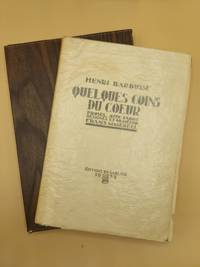
192162129Geneva: Éditions du Sablier 1921. Limited Edition. Paperback. Very good. 92pp. Octavo 23 cm Printed wraps. With the publisher's glassine wrapper title written in faint pen on spine of wrapper. In the slipcase decorated with paper imitating wood grain. Slipcase has just a tiny chip near the foot of the spine and a previous owner has neatly mounted cutout letters spelling the names of both Barbusse and Masereel on the spine. The text is in French. Ritter C a Nr. 19. Six cents exemplaires sur Hollande van Gelder a la cuve numérotés de 86 a 686. Number 285. Éditions du Sablier paperback
192126521Paris Albin Michel 1921 In-4, broch, couverture imprime.24 eaux-fortes originales par Edouard Chimot, dont un frontispice, 11 hors-texte et 12 in-texte. Tirage limit 432 exemplaires numrots. Un des 355 exemplaires sur vlin d'Arches.
1916100073Paris, Ernest Flammarion, éditeur, 1916, in-8, [14]-378-[9] pp, Demi maroquin rouge à coins, dos à nerfs et titre doré, Reliure signée Semet & Plumelle. Edition originale . Bel exemplaire Couverture rigide
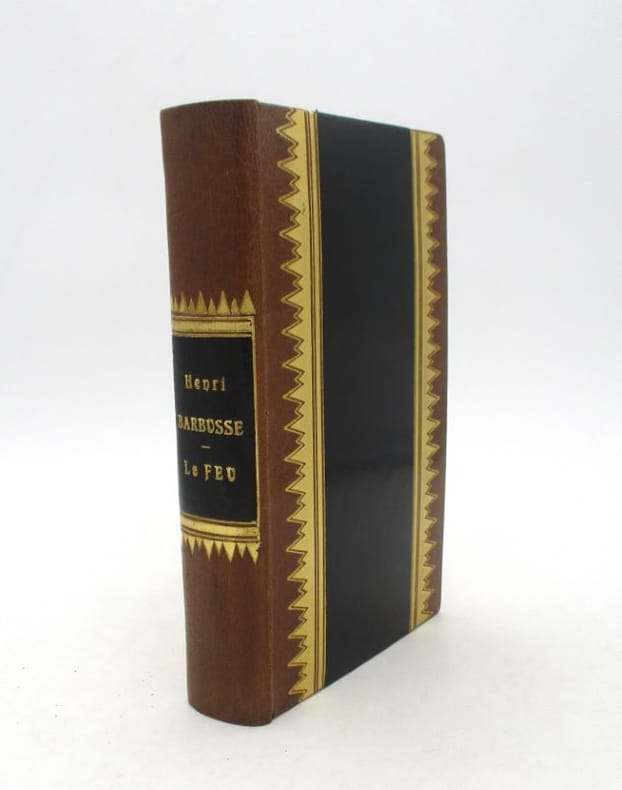
191637733Flammarion Paris 1916. 8vo. First Edition thus text in French; handsomely bound in full burgundy crushed morocco sides with gilt frame border back with raised bands second and fourth compartments ruled and lettered in gilt all other compartments tooled in gilt gilt top hand-made endpapers ribbon marker custom-made slip-case a most attractive copy ideal as a gift or for presentation. With the index at end as is proper. First edition of the greatest French novel of the Great War and winner of the Prix Goncourt. 'No war book in any language with the exception of 'All Quiet on the Western Front' has had the sale of 'Le Feu'' Falls 'War Books'.'Under Fire' is the spirit of the infantry war in France the letter and the spirit of reality' Henry Williamson referring to the title of the English edition. It was published simultaneously in three states: two private limited issues 33 copies on Japon and 165 copies in holland and the trade edition as here. The fact that the trade edition was issued as a flimsy paperback means that it is scarcely ever found in really good condition. Here it is complete and preserved in an elegant binding. VERY SCARCE IN THIS CONDITION. Falls p.263. Flammarion, Paris, paperback
192157573BBGenève, Editions du Sablier. 1921. Gross-8°. 193 S., 3 n.n. Bl. Bordeauxroter Halbmaroquinband mit Ecken auf 5 Bünden mit goldgeprägtem Rückentitel, Kopfgoldschnitt und miteingebundenem Broschurumschlag. (sign. Semet & Plumelle).
192127220Albin Michel Couverture souple Paris 1921 Ed. numérotée
8vo., First Edition, text in French; handsomely bound in full burgundy crushed morocco, sides with gilt frame border, back with raised bands, second and fourth compartments ruled and lettered in gilt, all other compartments tooled in gilt, gilt top, ORIGINAL WRAPPERS PRESERVED, a most attractive copy ideal as a gift or for presentation. With the index at end as is proper. First edition of the greatest French novel of the Great War and winner of the Prix Goncourt. 'No war book in any language, with the exception of 'All Quiet on the Western Front', has had the sale of 'Le Feu'' (Falls, 'War Books').'Under Fire' is the spirit of the infantry war in France, the letter and the spirit of reality' (Henry Williamson, referring to the title of the English edition). It was published simultaneously in three states: two private limited issues (33 copies on Japon and 165 copies in holland) and the trade edition as here. The fact that the trade edition was issued as a flimsy paperback means that it is scarcely ever found in really good condition. Here it is complete and preserved in an elegant binding. VERY SCARCE IN THIS CONDITION. Falls, p.263.