1 088 résultats
17931092202 vols. London: John Stockdale 1793. 2 vols. in one royal 8vo xi 225; vii 1871 advertisement pp. Engraved title to each part frontispiece to vol. I and 70 plates including 12 by Blake. Old calf rebacked lower cover rehinged scuffed and untidy internally very good without the usual browning and offsetting. § First edition with Blake’s plates. “The plates in this famous edition are free adaptations from the designs of Kent Wootton and Gravelot who illustrated the earlier printings of Gay's Fables. William Blake completely redesigned and redrew the 12 images for which he is responsible and is listed among the subscribers to the edition as are the other engravers who worked on this project. Blake engraved the plates opposite pp. 1 29 59 73 99 109 125 133 and 181 in volume one; and those opposite pp. 1 105 and 145 in volume two.†Sotheran’s. The first issue is easily identified because it uses the long “s†throughout and the second does not. Bentley Blake Books 460A. Essick William Blake’s Commercial Book Illustrations XXVI. Ray The Illustrator and the Book in England 1. John Stockdale unknown books
1828107872Single plate by William Blake. London: for the author and sold by Longman 1828. Single plate by William Blake cleaned by Court Benson. § From the first and only edition of this elusive Blake item. Includes Blake's figure of the constellation 'Cancer' which may be a caricature self-portrait of Blake himself. Keynes 248: 'extremely rare'. Bentley Blake Books 501. for the author and sold by Longman unknown books
1957123810Folio. London: Trianon Press 1957. Folio with 9 color plates and 156 illustrations. Original quarter morocco a superb copy virtually mint preserved in a quarter blue morocco box lettered in gilt § Limited to 460 copies this is #219. A very scarce book in good let alone fine condition as the size of the book and the fact that it was not issued with a box or a slipcase eve means most copies are more or less worn. This was the first time that Blake’s Biblical illustrations had been brought together. The catalogue raisonné was compiled by Sir Geoffrey Keynes and comprises virtually every Biblical painting by Blake in existence. Bentley Blake Books 681. Trianon Press unknown books
197428867London: Trianon Press 1974. Limited edition Letter R of 26 lettered copies of a total edition of 558 copies. 1 vols. Folio. Original marbled boards brown morocco spine fine in original matching slipcase. Blake William. Limited edition Letter R of 26 lettered copies of a total edition of 558 copies. 1 vols. Folio. The Trianon Press Facsimile of Blake's Jerusalem One of 26 Copies. The illuminated pages were brilliantly reproduced by Daniel Jacomet; the text was composed by hand in 16 point Garamond and printed by Aulard & Cie master printers in Paris. Trianon Press unknown books
1988140941162London: Jonathan Cape 1988. First Edition. Near Fine. Advance uncorrected proof of the first edition. Bound in publisher's red wraps printed in black. Near Fine with general shelf wear and light crease to bottom corner of the front cover. A scarce format of the of the Dahl's best-known works. Jonathan Cape unknown books
1935237391New York: The Pierpont Morgan Library 1935. 105 black and white and color facsimile engraved plates pencil drawings and watercolors by William Blake in six fascicles. Folio. Original cloth-backed gray wrappers printed labels on front cover in cloth box with some wear. 105 black and white and color facsimile engraved plates pencil drawings and watercolors by William Blake in six fascicles. Folio. Illustrations of the Book of Job being all the water-color designs pencil drawings and engravings beautifully reproduced in facsimile. The Pierpont Morgan Library unknown books
1886302951London: Kegan Paul Trench and Co 1886. Folding facsimile of the Blake broadside by William Muir. With explanatory note by Herbert Gilchrist at pp. 159-60. 1 vols. 4to. Blake plate folded fine. Volume bound in contmporary quarter brown morocco and cloth marbled endsheets t.e.g. Minor rubbing to joints. Very good. Folding facsimile of the Blake broadside by William Muir. With explanatory note by Herbert Gilchrist at pp. 159-60. 1 vols. 4to. First volume of the Hobby Horse publication of the influential Century Guild. Notable for the fine facsimile of the rare Blake broadside Little Tom the Sailor. The ballad is by William Hayley and in the autumn of 1800 Blake engraved the two images on pewter. The broadside was "Printed for & Sold by the Widow Spicer of Folkstone for the benefit of her orphans". The facsimile is uncredited but is by William Muir. Bentley 407b Kegan, Paul, Trench and Co unknown books
1793259455London: Printed for John Stockdale 1793. First Stockdale edition and first with the Blake plates first issue with the long 's' throughout. 2 engraved title-pages with vignette "Gay Monument" frontispiece and 68 illustrations including 12 etchings by William Blake. ii xii 225; ii vii 188 pp. 2 vols. 8vo 10-3/8 x 6-3/4 inches. Contemporary full straight-grained red morocco covers stamped in gilt with outer roll border flat spines divided into 6 compartments 2 with title and volume number the rest gilt with small tool a.e.g. marbled endpapers. Light wear to extremities some foxing to title-pages. Bookplate of Frasier W. McCann. First Stockdale edition and first with the Blake plates first issue with the long 's' throughout. 2 engraved title-pages with vignette "Gay Monument" frontispiece and 68 illustrations including 12 etchings by William Blake. ii xii 225; ii vii 188 pp. 2 vols. 8vo 10-3/8 x 6-3/4 inches. With 12 Plates by Blake. A tall copy in contemporary binding of the Stockdale edition of Gay's Fables with 12 engravings by Blake who freely adapted his source material. Ray considers this one of the best examples of Blake's work as a reproductive engraver. Bentley & Nurmi 371A; Ray England 1; Essick William Blake's Commercial Book Illustrations XXVI Printed for John Stockdale unknown books
19751052184to. London: Trianon Press 1975. 4to 8 plates 8 pp. commentary by Keynes with another plate plus 22 additional progressive proof plates and with a metal pochoir stencil mounted at the end. Full brown morocco prospectus inserted a fine copy in slipcase. As new. § #28 of 32 de luxe copies with the extra plates showing the progressive stages of the collotype and hand-stencil process. The total edition was limited to 458 copies. One of the richest and most elaborate Trianons. Bentley Blake Books A137. “The Song of Los completes the cycle of the four continents. the complete work tells the story of mankind from Adam to the Last Judgment the triumph of death and the general resurrection caused by the revolution.†Damon Blake Dictionary. Trianon Press unknown books
198710811222 separate plates. Paris: Trianon Press for the Blake Trust 1987. 22 separate plates approx. 15.75 x 12.25 inches 30 x 31 cm each printed in color on Arches housed in a tri-fold paper folder. Very good condition. § The New Zealand Set are careful watercolor copies of the central designs of the original engravings produced by the circle of John Linnell presented here in faithful facsimile. Butlin noted in the Blake Quarterly: “The long list of color facsimiles produced by the Trianon Press under Arnold Fawcus for the William Blake Trust were above all objects of beauty recreating as near to perfection as possible Blake’s original achievements.†Trianon Press for the Blake Trust unknown books
19681075944 vols. London: Trianon Press 1968. 4 vols. 8vo and 12mo Vol. I 8vo i-vii-viii 50 4 pp. Vol. II 12mo 2 pp. 22 plates Vol. III 4 pp. 31 plates Vol. IV 12mo 2 pp. 10 plates negative and copper plate. Original tan morocco volume 4 in brown cloth as issued cloth slipcase gilt lettering to backstrips of all three volumes. Backstrips slightly rubbed. § From an edition of 726 total copies this is the de luxe advance publisher’s copy including 700 numbered 1 to 700 of which the first 50 have additional material and are in a special binding. Volume I is an introductory volume followed by three volumes of plates. Bentley Blake Books 48. Trianon Press hardcover books
19681075954 vols. London: Trianon Press 1968. 4 vols. 8vo and 12mo Vol. I 8vo i-vii-viii 50 4 pp. Vol. II 12mo 2 pp. 22 plates Vol. III 4 pp. 31 plates Vol. IV 12mo 2 pp. 10 plates negative and copper plate. Original tan morocco volume 4 in brown cloth as issued cloth slipcase gilt lettering to backstrips of all three volumes. Backstrips slightly rubbed. § From an edition of 726 total copies this de luxe copy unnumbered out of series including 700 numbered 1 to 700 of which the first 50 have additional material and are in a special binding. Volume I is an introductory volume followed by three volumes of plates. Bentley Blake Books 48. Trianon Press hardcover books
1972110461Folio. London: Trianon Press 1972. Folio with 116 color facsimile leaves reproduced by collotype and hand-stencil color the text of the poems reproduced from copper-plate with 3 additional printings to reproduce Blake’s pencillings and the tone of the paper. Original sheets marbled boards morocco backstrip lettered in giltquarter brown morocco box. § Edition limited to 518 copies in all including 100 copies for Paul Mellon personally of which 12 copies were a super de luxe issue in three volumes with extra material 36 copies were a de luxe issue also with extra material but in sheets unbound18 copies were hors commerce contents unrecorded and 352 copies either bound in 3 volumes in slipcases or as a single set of the loose sheets in a box. This is #370.The 116 water-color illustrations to Thomas Gray's poems are among Blake's major achievements as an illustrator. They were commissioned in 1797 by Blake's friend the sculptor John Flaxman as a gift for his wife Ann to whom Blake addressed the poem that ends the series. The commission may have been inspired by the Flaxmans' seeing Blake's water-color designs to Edward Young's Night Thoughts begun in 1795. The Gray illustrations follow the same basic format. Blake cut windows in large sheets of the same type of Whatman paper used for the Night Thoughts illustrations and mounted in these windows the texts of Gray's poems from a 1790 octavo edition published by John Murray leaving out some prefatory materials fly-titles the notes and the 7 engraved illustrations. Blake then drew and colored his designs surrounding the letterpress texts. On blank versos near the beginning of each poem and in one case on a separate piece of paper pasted over letterpress text Blake inscribed with pen and ink either titles for each design or quotations from the poem to indicate the passage illustrated. On most text pages Blake also drew a pencil cross left of the first line of the illustrated passage. He numbered most leaves consecutively in pen and ink beginning a new sequence for each of the 13 poems.Blake conceived of his work as an illustrated book rather than a series of unbound designs as indicated by his offsetting Gray's texts above and to the right left on versos from the middle of each leaf—then the convention for all letterpress books. Although listed by William Michael Rossetti in his catalogue of Blake's drawings and paintings published in the 1863 and 1880 editions of Alexander Gilchrist's Life of William Blake the Gray illustrations were virtually unknown until their rediscovery by Herbert Grierson in 1919.The Trianon Press reproductions are recognized as the finest examples of the art of facsimile reproduction; working from the originals in Paul Mellon’s collection each leaf is faithfully hand-colored through stencils to achieve an astonishing exactitude. The Times Literary Supplement stated that nothing like these books had ever been printed before and that it was highly unlikely that they could be printed again. Bentley Blake Books 385. Trianon Press hardcover books
1893WRCLIT73714London: Bernard Quaritch 1893. Three volumes. Large thick octavo. Original green cloth spines and upper covers elaborately decorated in pictorial gilt after designs by Blake t.e.g. others untrimmed. Portrait facsimiles and plates. Spines somewhat rubbed and dull some shelfwear to joints and lower edges and bumps and wear to fore-tips endsheets a bit foxed and cloth a bit handsoiled some cracking and subtle repairs to inner hinges; still not a wholly disagreeable set of a work particularly susceptible to such issues. First edition. One of five hundred sets comprising the regular paper issue. Controversial in its interpretation of Blake's texts this work nonetheless remains in this issue and binding something of a landmark of 1890s book production. "The enthusiasm and comprehensiveness of this work are of considerable historical importance" - Bentley. Wade quotes Yeats's inscription in his own copy about the nature of this collaboration: "The writing of this book is mainly Ellis's the thinking is as much mine as his. The biography is by him. He re-wrote and trebled in size a biography of mine. The greater part of the 'symbolic system' is my writing; the rest of the book was written by Ellis working over short accounts of the books by me except in the case of the 'literary period' the account of the minor poems & the account of Blake's art theories which are all his own except in so far as we discussed everything together." WADE 218. BENTLEY 369. Bernard Quaritch hardcover books
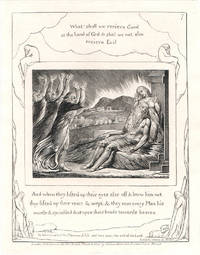
1828107781e 1825 but published 1826. London: March 8 1828 i.e 1825 but published 1826. Single leaf recently cleaned. § First edition one of 100 sets printed directly onto Whatman wove with the word “proof†removed. Blake had a long pictorial engagement with the biblical story of Job. This a single leaf from a series of 21 engravings commissioned by John Linnell in 1823 that are generally considered to be Blake's masterpiece as an intaglio printmaker. "Rather than using the customary "mixed method" of preliminary etching followed by engraving Blake used pure line engraving in the Job plates. Perhaps one of his motivations was to evoke the art of the master engravers of the Renaissance whom Blake greatly admired such as Albrecht Dürer." The William Blake Archive.In the Book of Job Job and his old friends argue at length over the divine purpose of Job's afflictions. This plate illustrates the moment the youthful Elihu overcomes his respect for his elders and bursts into the conversation to explain why he thinks both sides are wrong Job 32:6. In Blake's elaborate borders the figure of Job's Humanity sleeps while soaring angels try to awaken him.Bentley Blake Books 421A. Bindman Complete Graphic Works of Blake 625–641C. March 8 unknown books
1828107776e 1825 but published 1826. London: March 8 1828 i.e 1825 but published 1826. Single leaf recently cleaned. § First edition one of 100 sets printed directly onto Whatman wove with the word “proof†removed. Bentley Blake Books 421A. Bindman Complete Graphic Works of Blake 625–641C. March 8 unknown books
1828107778e 1825 but published 1826. London: March 8 1828 i.e 1825 but published 1826. Single leaf recently cleaned. § First edition one of 100 sets printed directly onto Whatman wove with the word “proof†removed. Bentley Blake Books 421A. Bindman Complete Graphic Works of Blake 625–641C. March 8 unknown books
1828107779e 1825 but published 1826. London: March 8 1828 i.e 1825 but published 1826. Single leaf recently cleaned. § First edition one of 100 sets printed directly onto Whatman wove with the word “proof†removed. Bentley Blake Books 421A. Bindman Complete Graphic Works of Blake 625–641C. March 8 unknown books
19261107072 vols. London: The Nonesuch Press 1926. 2 vols. in 1 8vo viii 283; xii 359 pp. Title pages in sepia and black 27 black-and-white plates. Full stiff vellum gilt-lettered backstrip covers slightly bowed and spotted in the vellum. Two gift inscriptions at front. § De luxe edition limited to 95 copies on India paper copies. One of the finest of the Nonesuch Press books with excellent reproductions of the watercolors and extensive notes on them by Geoffrey Keynes. Bentley Blake Books 394. The Nonesuch Press hardcover books
197291063 volumes. London: Trianon Press 1972. 3 volumes folio with 116 color facsimile leaves reproduced by collo-type and hand-stencil color the text of the poems reproduced from copper-plate with 3 additional printings to reproduce Blake's pencillings and the tone of the paper. Marbled boards morocco backstrips slipcases a very good set as issued. § Limited to 220 copies thus; 100 copies were issued unbound in Port-folio and 36 de luxe copies with extra material. The 116 water-color illustrations to Thomas Gray's poems are among Blake's major achievements as an illustrator. They were commissioned in 1797 by Blake's friend the sculptor John Flaxman as a gift for his wife Ann to whom Blake addressed the poem that ends the series. The commission may have been inspired by the Flaxmans' seeing Blake's water-color designs to Edward Young's Night Thoughts begun in 1795. The Gray illustrations follow the same basic format. Blake cut windows in large sheets of the same type of Whatman paper used for the Night Thoughts illustrations and mounted in these windows the texts of Gray's poems from a 1790 octavo edition published by John Murray leaving out some prefatory materials fly-titles the notes and the 7 engraved illustrations. Blake then drew and colored his designs surrounding the letterpress texts. On blank versos near the beginning of each poem and in one case on a separate piece of paper pasted over letterpress text Blake inscribed with pen and ink either titles for each design or quotations from the poem to indicate the passage illustrated. On most text pages Blake also drew a pencil cross left of the first line of the illustrated passage. He numbered most leaves consecutively in pen and ink beginning a new sequence for each of the 13 poems.Blake conceived of his work as an illustrated book rather than a series of unbound designs as indicated by his offsetting Gray's texts above and to the right left on versos from the middle of each leaf—then the convention for all letterpress books. Although listed by William Michael Rossetti in his catalogue of Blake's drawings and paintings published in the 1863 and 1880 editions of Alexander Gilchrist's Life of William Blake the Gray illustrations were virtually unknown until their rediscovery by Herbert Grierson in 1919.The Trianon Press reproductions are recognized as the finest examples of the art of facsimile reproduction; working from the originals in Paul Mellon’s collection each leaf is faithfully hand-colored through stencils to achieve an astonishing exactitude. The Times Literary Supplement stated that nothing like these books had ever been printed before and that it was highly unlikely that they could be printed again. Bentley Blake Books 385. Trianon Press hardcover books
19571231793 vols. London: The Nonesuch Press; New York: Random House 1957. 3 vols. in one roy. 8vo 364 397 and 429 pp. Illustrated with 58 plates. Original full brown morocco extra a very good copy with the bookplate of Scott Cunningham at the front. § From a limited edition of 1500 copies on Vidalon handmade paper this is #L of 75 copies on Oxford India paper numbered I to LXXV. Bentley Blake Books 370 A. The Nonesuch Press; New York Random House unknown books
1973263500London: Trianon Press 1973. Copy #1 of 32 special copies. Color facsimile accompanied with a set of paltes showing progressive stages of the collotype and hand stencil process together with a guide sheet and stencil Only in Roman numeral copies and unique to COPY ONE the etched copper plate for the title-page tipped in at back and etched in "Copy 1". 1 vols. 4to 11 x 9 inches ; 22.5 x28 cm. Bound in publisher's full black morocco as new in original slipcase. Blake William. Copy #1 of 32 special copies. Color facsimile accompanied with a set of paltes showing progressive stages of the collotype and hand stencil process together with a guide sheet and stencil Only in Roman numeral copies and unique to COPY ONE the etched copper plate for the title-page tipped in at back and etched in "Copy 1". 1 vols. 4to 11 x 9 inches ; 22.5 x28 cm. COPY NUMBER ONE WITH COPPER PLATE. Trianon Press unknown books
19511088124to. London: Trianon Press for The William Blake Trust 1951. 4to 6 ix 100 color plates. Very good in original dark blue buckram with protective acetate wrapper in a folding box with grey cloth spine and patterned paper covers slight fraying to cloth at top and bottom of front cloth spine for c 1/2" and tiny chip of loss to paper at top of rear of box. § Copy No. 393 of 516 issued. The first of the magnificent series of Blake Trust collotype and pochoir facsimiles by the Trianon Press of Blake’s illuminated books edited by Geoffrey Keynes. Bentley BB 78. Trianon Press for The William Blake Trust hardcover books
19511005614to. London: Trianon Press for the William Blake Trust 1951. 4to 6 ix text and 100 pochoir colorplates. Blue buckram gilt title. Very good copy in a worn folding box. § Limited to 516 copies. The definitive facsimile of one of Blake’s greatest works and the first of the magnificent series of facsimiles created by the Trianon Press of Blake’s illuminated books. The Preludium is by Joseph Wicksteed and the Bibliographical Statement by Geoffrey Keynes. Bentley 78. "Blake's etched copperplates giving the text of his poem and the basis of the designs were printed by him in a rich orange ink and were then illuminated by hand in water colours and gold. The etched base has now been reproduced by collotype in orange and the prints have then been coloured by hand by a stencilling process so that the final result bears the closest possible resemblance to Blake's original plates. An average of forty-four applications of water colours was required for each full page illustration of which there are four. Of the remainder fifty-one have some text with designs filling half the page or more and thirty-five have text with small marginal decorations.". Introduction Trianon Press for the William Blake Trust hardcover books
108281Printed for & sold by the Widow Spicer of Folkstone for the Benefit of her Orphans. n.d. 55.9 x 22.9 cm. single sheet folded once with some traces of mounting tape on the vertical margin some creases but very good. § The very fine William Muir facsimile often mistaken in the past as the original. The poem was composed by William Hayley. Originally etched in relief and white line by Blake on four plates printed in black ink uncolored; copies are also known hand colored or printed in brown ink. This is one of Blake’s rarest works; it is also amongst the rarest of Muir’s facsimiles; some were issued in The Hobby Horse and some separately - this is one of the separate issues and the only copy I have ever seen. They can be distinguished from the Hobby Horse examples since the latter were cut into two pieces to fit in the magazine always with slight loss of text at the cut or folded twice. Bentley Blake Books 470B or D. Bindman Complete Graphic Works of Blake 384. See also Keynes Blake Studies 2nd ed. who reports that the Muir facsimile was exhibited for some years as the original at the Pierpont Morgan Library.Essick notes: Muir “Little Tom†copies from my collection handlist. Gives the full watermark of the example bound in the Hobby Horse and Muir’s statement see first entry that his facsimile is based on an original owned by H. H. Gilchrist.Little Tom the Sailor. Datable to 1886. Laid paper leaf 56.8 x 23.1 cm. with watermark "POUNCY." On the printed front wrapper of his 1887 Europe facsimile Muir notes that his facsimile of Little Tom is "from Mr. Gilchrist's copy" now untraced. The facsimile is attributed to Emery Walker Ltd. rather than Muir in Keynes Blake Studies 2nd ed. page 109; this paper listed by Keynes as no. iii on page 110. Matted. Acquired July 1971 from Charles Sessler Books $200. BB#249i 470C or D. Idem. Laid paper leaf 61.8 x 21.3 cm. with watermark “JOHN DICKINSON & Co†this paper listed in Keynes Blake Studies 2nd ed. page 110 no. i. Folded twice and bound in The Century Guild Hobby Horse vol. 1 no. 4 Oct. 1886 which see under Biography and Criticism Periodicals through 1900. BB#249i 470B 1683. Idem. With the headpiece and tailpiece hand color in imitation of the original in the British Museum very probably hand colored by Blake or his wife Catherine. Inscribed in pen and brown ink “No 3 Wm Muir†upper left leaf of wove paper without watermark 60.3 x 23.0 cm. Quaritch records the delivery from Muir of a “coloured†copy of Little Tom on 11 May 1925 no copy number recorded. Quaritch’s catalogue 401 of May 1926 offers as item 243 a Muir facsimile of Little Tom with “two illustrations coloured by hand from the copy in the British Museum†for £1.1s. This catalogue dates the work to “1925†apparently the date of coloring possibly of printing but not of original execution as a lithograph. The same entry appears in Quaritch’s Dec. 1926 catalogue 405 item 256 1926 catalogue 427 item 248 and 1930 catalogue 434 item 2065. Acquired Nov. 2012 on $1316.99. BB#249i 470C or D hand colored copies not listed. Muir “Little Tom†copies from my collection handlist. Gives the full watermark of the example bound in the Hobby Horse and M unknown books