354 résultats
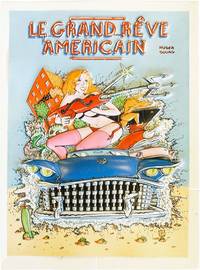
198838570Paris: Souvenirs du Futur 1988. First Edition. Oversize folio 46cm.; white paper-covered clamshell box embossed thermoformed plastic plate mounted to upper cover six leaves laid in as issued to which are mounted thermoformed plates on rectos and versos with the exception of the last leaf on whose verso is printed the colophon. In original cardboard mailing box adorned with the Souvenirs du Futur imprint. Clamshell box a bit dust-soiled cardboard box shows signs of light though not postal use else Very Good to Near Fine. Quite possibly the only comic book in its class Le Grand Rêve Americain The Great American Dream adapts technology developed by Philippe Schléret and Véronique Hauss using molded plastic to create brilliantly colored 3D images. The work exuberantly lampoons Pop Art American culture and early underground comic books and of all who have ever encountered the work and written of it seemingly none have failed to mention the heavy use of oversized female breasts that jut out from nearly every panel. Indeed OCLC record no. 712159856 lists "Large-breasted women" as one of the subjects. Other tropes not to be ignored include fancy sports cars gangsters and fastfood joints. Souvenirs du Futur unknown books
1969132781Los Angeles: Twentieth Century-Fox 1969. Original title card maquette hand lettered by Harold Adler for the 1969 film. Based on the "Alexandria Quartet" by Lawrence Durrell. <br/><br/>Harold Adler was a calligrapher who created hand lettered titles on over 100 films worked frequently with Alfred Hitchcock and was a favorite of legendary title sequence designers Saul Bass and Pablo Ferro. In addition to "Justine" his credits include "Comanche!" 1956 "The Man with the Golden Arm" 1955 "The Seven Year Itch" 1955 "Carmen Jones" 1954 "Psycho" 1960 "The Birds" 1963 "In the Heat of the Night" 1967 and "Finian's Rainbow" 1969. In 2012 an exhibition of Adler's work was organized by noted typographer and design historian Jill Bell at the American Advertising Federation Kansas City. <br/><br/>A young British schoolmaster and poet travels to Alexandria where he meets Justine the mysterious wife of a banker whom he discovers is involved in a plot to arm the Jewish underground in Palestine. Shot in part on location in Tunisia. <br/><br/>17.25 x 11.5 inches. Black ink on white card stock with tissue paper overlay. Near Fine with light toning to the card edges. Holograph annotations one noting "original" to the tissue overlay and card. Twentieth Century-Fox unknown books
1920165270Paris: Au Sans Pareil 1920. 1 of 9 copies on Japon Imperial paper Copy No. IV. Softcover. VG or better glassine jacket with minor chipping few tiny tears no significant loss microscopic at best. Printed oversize wraps with glassine jacket. Half-title. Title-page with woodcut vignette and 4 woodcut illustrations by Marc Chagall. 48 pp. Among Marc Chagall's earliest book illustrations preceded only by appearances in 1914 and 1918. With Andre Breton Soupault was one of the founders of the Surrealist movement: "Soupault's earliest verse collection 'Aquarium' 1917 was published with the help of Guillaume Apollinaire who introduced Soupault to André Breton. In 1919 Soupault Breton and Louis Aragon cofounded the review 'Littérature'. Originally drawn to the antirationalism of the Dada movement Soupault soon rejected its nihilism and he and Breton experimented with other revolutionary techniques. One result of their experimentation was the "automatic writing" of the jointly authored 'Les Champs magnétiques' 1920; 'The Magnetic Fields' known as the first major Surrealist work. Soupault soon abandoned automatic writing to produce carefully crafted verses such as those in 'Westwego' 1922 and 'Georgia' 1926. As the Surrealist movement became increasingly dogmatic and political Soupault grew dissatisfied with it and eventually broke with it and Breton" Encyclopedia Britannica online. Exceptionally rare one of 9 such copies. Au Sans Pareil unknown books
19472187Princeton NJ: Halsman 1947. Photograph. Fine. ONE OF THE MOST FAMOUS IMAGES OF EINSTEIN. Philippe Halsman's now iconic 1947 photograph of Einstein has become not only one of the most celebrated images of Einstein but one of the most recognizable images of the twentieth century. It was used to a 1966 US postage stamp of Einstein and was featured on the cover of Time Magazine honoring Einstein as the "Person of the Century".

 The photographer Halsman in his book Philippe Halsman: A Retrospective explained the circumstances of the photo: I admired Albert Einstein more than anyone I ever photographed not only as the genius who single-handedly had changed the foundation of modern physics but even more as a rare and idealistic human being.
 Personally I owed him an immense debt of gratitude. After the fall of France it was through his personal intervention that my name was added to the list of artists and scientists who in danger of being captured by the Nazis were given emergency visas to the United States.
 After my miraculous rescue I went to Princeton to thank Einstein and I remember vividly my first impression. Instead of a frail scientist I saw a deep-chested man with a resonant voice and a hearty laugh.
 The question of how to capture the essence of such a man in a portrait filled me with apprehension. Finally in 1947 I had the courage to bring on one of my visits my Halsman camera and a few floodlights. After tea I asked for permission to set up my lights in Einstein's study. The professor sat down and started peacefully working on his mathematical calculations. I took a few pictures. Ordinarily Einstein did not like photographers whom he called Lichtaffen light monkeys. But he cooperated because I was his guest and after all he had helped save me.
 Suddenly looking into my camera he started talking. He spoke about his despair that his formula E=mc2 and his letter to President Roosevelt had made the atomic bomb possible that his scientific search had resulted in the death of so many human beings. "Have you read" he asked "that powerful voices in the United States are demanding that the bomb be dropped on Russia now before the Russians have time to perfect their own" With my entire being I felt how much this infinitely good and compassionate man was suffering from the knowledge that he had helped to put in the hands of politicians a monstrous weapon of devastation and death.
 He grew silent. His eyes had a look of immense sadness. There was a question and a reproach in them.
 The spell of this moment almost paralyzed me. Then with an effort I released the shutter of my camera. Einstein looked up and I asked him "So you don't believe that there will ever be peace"
 "No" he answered. "As long as there will be man there will be wars." Silver prints of this photograph have been printed in different sizes over the years. This photograph is an official Halsman silver print with his copyright hand-stamp on the verso measuring approximately 10x13 inches. Princeton NJ. Silver print. Taken 1947; printed 1970s. Image: 13x10 inches 33x25.4 cm. Archivally matted and framed under UV-protecting museum glass to an overall size of 18.5x22 inches. A stunning piece in fine condition. Halsman unknown books