82 résultats
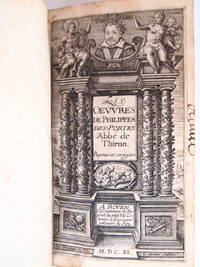
160412541Paris: Chez. Abel Langelier 1604. First edition. Full Calf. Very Good. First edition. Full Calf. The CL. Psalms of David set in French verse some Meditations and Prayers Christian Poems. Philippe Desportes 1546-1606 considered by his contemporaries as the greatest living poet ensured the literary transition between Ronsard and Malherbe. Desportes' design was to give the Catholics of France a translation which was the equivalent of that of Marot and Théodore de Bèze for the Reformed. Published for the first time in 1591 numbering sixty the psalms were increased to one hundred in 1598 and finally to one hundred and fifty in 1603. Title-frontispiece signed Thomas de Leu. With bookplate of Charles Carroll Alberton a Methodist Episcopal minister. Chipping gently bumped corners showing boards evenly toned slight loss to upper right text block normal aging else tight bright and unmarred. 12mo 2-287; 23; 27pp. illus 3 parts in 1 vol. Contemporary binding in mottled calf with gilt framing restorations on the hinges some rubbing on the covers. Ex-libris pasted on fep. Chez. Abel Langelier unknown
160369413à Paris: Par la veuve Mamert Patisson 1603. Fine. Par la veuve Mamert Patisson à Paris 1603 8 x 13 cm relié First edition. The title page of the Poesies chrestiennes is dated 1601. Publisher's devices on title pages. Half wine-colored glazed calf binding ca 1830 in the style of Thouvenin. Spine with raised bands decorated with 3 blind tools and roulettes. Gilt title labels on calf. Marbled edges. Philippe Desportes 1546-1606 considered by his contemporaries as the greatest living poet provides the literary transition between Ronsard and Malherbe. Desportes' design was to give French Catholics a translation that would be the equivalent of that of Marot and Theodore de Bèze for the reformed. First published in 1591 numbering sixty the psalms were increased to one hundred in 1598 and finally to one hundred fifty in 1603. Par la veuve Mamert Patisson hardcover

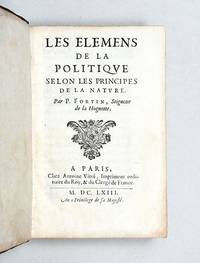
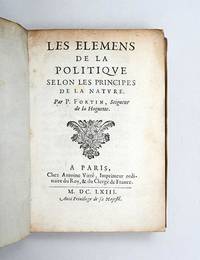
1663144254Paris: Chez Antoine Vitré 1663. Government and society in the reign of Louis XIV First edition of the final major work by the soldier and philosopher. Fortin's work of political theory yokes together the public and the private relating the development of government to the control of four essential vices: murder theft false witness and adultery. The book mirrors contemporary attitudes towards marriage and sexuality and it has been read as by Leslie Tuttle as reflecting the social imperialism imposed on France's new North American colonies in the 1660s p.79. Philippe Fortin de la Hoguette 1585-1668 fought in the French Wars of Religion and was present at the siege of La Rochelle in 1627. In his spare time he wrote several works of Catholic fideism corresponded extensively with the Dupuy brothers and smuggled many of Francis Bacon's manuscripts out of England after his death in 1626. Octavo 172 x 112 mm. Woodcut vignette to title page headpiece and initial. Contemporary mottled calf spine lettered panelled and decorated in gilt raised bands edges sprinkled red and brown. Ink manuscript "Elem: Pol:" to upper edge. Remnants of shelf label to lower spine end. Light wear loss to lower spine end front joint cracked but holding firm minor browning and foxing to endpapers and contents: a very good copy. Leslie Tuttle Conceiving the Old Regime: Pronatalism and the Politics of Reproduction in Early Modern France 2010. hardcover
1663144980Paris: Chez Antoine Vitré 1663. Government and society in the reign of Louis XIV First edition of the final major work by the soldier and philosopher. Fortin's work of political theory yokes together the public and the private relating the development of government to the control of four essential vices: murder theft false witness and adultery. The book mirrors contemporary attitudes towards marriage and sexuality and it has been read as by Leslie Tuttle as reflecting the social imperialism imposed on France's new North American colonies in the 1660s p.79. As a soldier Philippe Fortin de la Hoguette 1585-1668 fought in the French Wars of Religion and was present at the siege of La Rochelle in 1627. As a philosopher he wrote several works of Catholic fideism corresponded extensively with the Dupuy brothers and smuggled many of Francis Bacon's manuscripts out of England after his death in 1626. Octavo 166 x 113 mm Contemporary vellum spine lettered in manuscript edges sprinkled in red and green. Woodcut vignette to title page headpiece and initial. Lightly toned and with some natural creasing front pastedown free rear pastedown starting to free minor browning to endpapers and content margins occasional small mark: a very good copy in an attractive contemporary binding. Leslie Tuttle Conceiving the Old Regime: Pronatalism and the Politics of Reproduction in Early Modern France 2010. hardcover
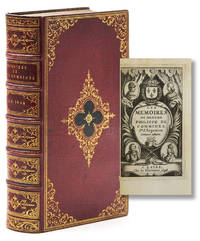
1648311279A Leide: chez les Elzevirs 1648. First Elzevier edition. Engraved title 2476519pp. 1 vols. 12mo 13.3 x 7.5 cm. Beautifully bound in 19th century polished claret red crushed levant with spine and corners richly tooled in gilt with a intricately gilt center ornament of inlaid black morocco gilt inner dentelles a.e.g. by Duru dated 1850. Three bookseller's descriptions tipped to binders blank some minor foxing but a very near fine copy. With the bookplate of Thomas Westwood and of Ex Musaeo PIN Elzéar-Stern. First Elzevier edition. Engraved title 2476519pp. 1 vols. 12mo 13.3 x 7.5 cm. The celebrated memoirs of the foremost French Renaissance historian 1445-1509 notable as an important analysis of 15th century culture politics and personality. ".The graphic style of his narrative and above all the keenness of his insight into the motives of his contemporaries an insight undimmed by undue regard for principles of right and wrong make this work one of the great classics of history" - ENCYC. BRITANNICA. <br /> "Authoritative and rare.printed in Paris probably by Le Gras" - Rostenberg & Stern THE HOUSE OF ELZEVIR 27 referencing this edition in their offering of the 1661 edition. "Jolie édition dont les exemplaires grands de marge et bien conservés sont fort recherchés" - Brunet. Rahir 630; Brunet II:191. Willems 634 chez les Elzevirs unknown
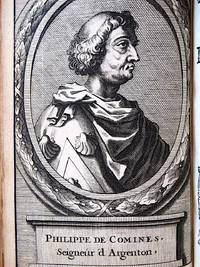
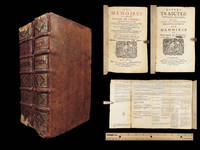
1649QQ0485Imprimerie Royale 1649. Original full speckled calf. Raised bands ornate gilt decor and gilt lettering to spine. Gilt decor to board edges. Small loss to base and top of spine. Small stain to rear board c. 5.5 x 4cm. Starting at base of spine over hinges to front 18cm and rear 8cm board but hinges holding firm. Wear to board corners. Folio 38.4 x 27.5cm. All edges speckled brown. A few tiny ink spots to fore-edges. Original marbled endpapers uncracked at gutters. Half-title. Large vignette printer's device to title page. Elaborate engraved head- and tail-pieces and decorated initials. Two double-page genealogical tables. A little light scattered foxing throughout. Philippe de Commines also Commynes or Comines; 1447-1511 humanist writer and diplomat first in service to the Burgundian duke Charles the Bold and then to Charles' great rival Louis XI of France and his successors Charles VIII and Louis XII. Commines' Memoires written between 1488 and 1501 and first published in 1524 cover in their first part the events from the start of Commines' career to the death of Louis XI and in their second the Italian wars under Charles VIII. The Memoires have never been out of print; they remain foundational not just as historical sources on 15th century France but as a work that shaped the practice of history itself. In their psychological insight and attention to motives as well as events the Memoires 'bear witness to a watershed moment for modern conceptions of both historiography and the individual subject' essentially inventing 'a new literary genre one defined by its first-person vision of history' Kleiman 2013 Philippe de Commynes: Memory Betrayal Text pp. 3 8. This important new 1649 edition edited by the jurist Denis Godefroy 1549-1622 replaced the previous standard version of the text the 1552 Denis Sauvage edition. Beautifully produced by Sebastien Cramoisy at the Imprimerie Royal then based in the Louvre this edition drew on two manuscript copies as well as the Sauvage version and included considerable additional contextual material. Brunet II 191; 'belle edition'. Robust packaging. Tracking is always added to USA orders. It can be added to other overseas orders on request. Used books are exempt from USA tariffs. 1st edition thus. Hardcover. Good. 56 572 12pp. Imprimerie Royale Hardcover
164821108371648. Leiden: Chez les Elzeviers. 1648. 12mo. Late 19th-century full vellum with yapp edges red morocco lettering-piece to spine gilt edges; pp. xxiv 765 19 with engraved title-page woodcut initials head- and tailpieces; light spotting to vellum overall an attractive clean copy; early ownership inscription cancelled and later ""Jean Paul Fesnim"" to title; modern bookplate to front pastedown.First Elzevir edition of Commines's celebrated contemporary account of the reign and military campaigns of Louis XI and Charles VIII of France.Philippe de Commines 1447-1511 was a humanist chronicler and diplomat in the courts of Burgundy and France. His Memoires was first published between 1524 and 1528 achieving immediate success with numerous reprints and earning the unique distinction among French-language texts of never having gone out of print. The first part written in the 1480s focuses on the reign of Louis XI particularly his rivalry with Charles the Bold while the second part composed in the 1490s examines Charles VIII's Italian campaign. Commines who served in a diplomatic capacity under both French monarchs devotes particular attention to the rise and fall of the Florentine preacher Girolamo Savonarola and the ultimate failure of French military and political ambitions in Italy.Commines's ""graphic style . and above all the keenness of his insight into the motives of his contemporaries an insight undimmed by undue regard for principles of right and wrong make this work one of the great classics of history"" Britannica. Often referred to as the ""French Machiavelli"" he shares affinities with the Italian political thinker particularly in his pragmatic and unsentimental approach to power.Willems 634; Tchemerzine III p. 468 ""jolie edition elzevirienne tres recherchee"". hardcover
1648227751Leide: Elzeviers 1648. hardcover. very good. Beautifully engraved title page with a small stamped crown monogram in the lower margin. 24 765 19 pages. Thick 12mo full contemporary vellum. Leide: Ezeviers. 1648. Le Dernier Edition. A very good copy of this rare edition.<br/> <br/> First Elzevir edition of these famous memoirs of the renowned French Renaissance historian 1445- 1509. A great classics of history. - Brunet II 191.<br/> <br/> Elzeviers unknown
164828716Leiden: Chez les Elzeviers 1648. First Elzevier edition. 24 765 19 pp complete with final blank leaf; old calf gilt a.e.g. rebacked preserving original backstrip corners and edges worn corner dampstain through p. 48. Bookplate of Nils Gyldenstolpe. Chez les Elzeviers unknown
168248605à La Haye The Hague: Ches Arnout Leers 1682. Fine. Ches Arnout Leers à La Haye The Hague 1682 9.50 x 16 cm relié New edition edited by Denys Godefroy the first of which appeared in 1649. It is illustrated with 3 portraits of Louis XI the Duke of Burgundy and Philippe de Commines as well as a folding plate. Full vellum binding from the mid-19th century. Smooth spine with blind title. Joint cracked at foot for 6 cm. A brown stain in the outer margin of leaves 435 to 445. An essential work that gave birth to modern history Commynes' work which also establishes a rule of political conduct for the Grandes of the kingdom forms the greatest source for this period. From 1472 to 1483 after having been advisor to the Duke of Burgundy Charles the Bold Commynes entered the service of Louis XI then Charles VIII and Louis XII. He distinguished himself through his diplomatic talents notably in Italy; consequently the Memoirs are also a history of Europe. We too often forget that his exemplary career experienced an interlude of disgrace: opposing young Charles VIII through his liberal ideas he rallied to the cause of the future Louis XII plot aimed at kidnapping Charles VIII. He was consequently arrested and imprisoned in an iron cage at Loches for five months in 1488. To this day the work still being studied Commynes' Memoirs have never failed in success and interest. Denys Godefroy's critical edition replaced the one that had served as reference until then Savage's version. Red sheep ex-libris of Jules Janin. A second ex-libris bearing a monogram on blue background P.B. Ches Arnout Leers hardcover
16611310250030Gras 1661-01-01. Hardcover. Good. Thick 12mo. Contemporary mottled calf spine gilt in 5 compartments. Chiped spine. 20 765 p. 16; 16 cm. Brunet II p. 191. Book plate on verso. Gras hardcover
168228968<p>Philippe de Commynes's memoirs document court and state affairs under French kings Louis XI and Charles VIII. This 1682 printing issued at The Hague by Arnout Leers and edited by Denys Godefroy presents Commynes's full narrative across two compact leather-bound volumes. The author served Louis XI yet his notes reveal numerous policy flaws and internal rivalries. The work also comments on Charles VIII's campaigns in Italy. This is considered a reliable primary narrative for the late 15th century. Good condition. Both bindings are leather with wear to corners. Hinges secure. Several leaves are loose but present and placed inside. Four engravings including 3 portraits and a folding chart. Format: duodecimo two volumes. Collation: 600pp / 401pp. No illustrations. Edition: Dernière édition. Publisher: A La Haye: Arnout Leers 1682. #28968. PHOTOS AVAILABLE UPON REQUEST.</p> Arnout Leers hardcover
161155315à Rouen: De l'imprimerie de Raphael Du Petit Val 1611. Fine. De l'imprimerie de Raphael Du Petit Val à Rouen 1611 8 x 14.50 cm relié New edition ornamented with an engraved title-frontispiece drawn by Léonard Gautier. Contemporary full brown sheep binding. Richly ornamented spine with raised bands. Red morocco title label. Top headcap torn with lacks to joints. Joints cracked at foot. 2 wormholes at foot and 2 others along the upper joint at foot. Corners slightly bumped. Yellowed paper. Desportes' poetry was durably influenced and shaped by Italian literature. The author indeed returns to France after a journey to Italy where he fell under the influence of Petrarch - his first poems were moreover criticized as neo-Petrarchism. His first book appeared in a collective volume and gathered his poems imitated from Ariosto. His clear frank mannerist and refined poetry a court poetry eclipsed that of Ronsard at the court of Henri III. It was in turn criticized and replaced by that of Malherbe. Desportes' literature nonetheless forms an important aspect of Renaissance poetry. This edition contains the loves of Diane the loves of Hyppolite Cleonice the elegies the poems imitated from Ariosto the new loves the epitaphs and various pieces. De l'imprimerie de Raphael Du Petit Val hardcover
1697284706Paris: Chez Jean Baptiste Coignard 1697. Third Edition. Full Leather. A third edition copy of a bilingual Cicero reader Les Offices de Ciceron translated from Graevius’ Latin edition by Philippe DuBois. Text in Latin and French in two columns. Printer’s device on the title page; woodcut engraved headpieces; index at the rear. Collates complete; 28 484 38 pp. Worming to the bottom of the first twenty-five leaves affecting the publication on the title page only. Loss to the top and bottom of the spine; shellacking to the front and rear boards. Full calf with a red leather label and gilt tooling in compartments on the spine. Chez Jean Baptiste Coignard unknown
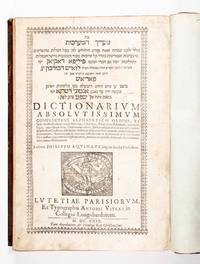
162948838Paris: Antoine Vitré 1629. First edition. Hardcover. Good. Folio. Signed: a4 e2 A-3B6 3C4 = 298 leaves. 12 584pp. Paginated from right to left. Full title and imprint in both Hebrew and Latin with woodcut printer's device; title within decorative letterpress border; woodcut lettrines and head-pieces; printed marginalia. Text in two columns. Eighteenth-century calf scuffed especially at front cover; spine with raised bands and gilt morocco morocco labels; edges stained red; green silk ribbon marker. Title leaf skilfully mounted on eighteenth-century paper. Text crisp and clean with ample borders.<br /> <br /> Only edition of this rare and highly unusual Hebrew and Aramaic dictionary composed by the formerly Jewish convert to Catholicism Mordechai Cresque of Carpentras who derived his new name Philippus d’Aquin or Aquinas; 1578-1650 from the place of his baptism in Aquino Italy. Printed almost entirely in the fine bold rashi characters "grosse glose hebraicque" cut by Guillaume I Le Bé in 1592 only the vocalised quotations and the lemmata are in Le Bé's square Hebrew script. Apart from the Latin title dedication approbations a poetic encomium and the alpha-numeric leaf signatures the work is printed entirely in Hebrew characters. It ends with a short notice in Latin and Hebrew on the printing errors which are corrected on the last three pages. The author announces at the title that all Hebrew biblical and rabbinic-talmudic and Aramaic terms are to be found in Ma'arikh ha-Ma'arakhot including many that do not appear in any existing lexicons among Jews or Christians. D'Aquin notes in particular that rare and difficult terms in rabbinic and cabalistic literature along with obscure abbreviations are all clearly explained. <br /> <br /> "The work is called in Hebrew Maarik ha-maarikot i. e. “Survey of the orders†a term which in the plural is also applied to "battle-lines" Wolf 140 translates Disponens ordines sive acies. One cannot help wonder if there is not a connection with the political situation at the time when the Huguenot town of La Rochelle had to submit to the French Crown in 1628. The privilege for our book has "Données au Camp devant la Rochelle le 19. Septembre 1628" and the work is dedicated to Cardinal Richelieu whose conquest of La Rochelle is also extolled in a Hebrew poem by the author. But the types are also reminiscent of war: did not Le Bé cut them "après le siège de Paris pour passer l'ennui" see Carter & Vervliet p. 15. They were prominently displayed afterwards in Vitray's type-specimen of 1636" Smitskamp. Among the eleven scholars whose approbations grace the present volume are Gabriel Sionita 1577-1645; professor of Arabic and Syriac at the College de France; Gilbert Gaulmin 1585-1665; Orientalist; Denis Petau 1583-1652; Jesuit theologian; and Jean Morin 1591-1659; theologian and Orientalist. Morin offers quite extravagent praise: "nihil hactenus in eo studii genere comparandum vidit Europa." <br /> <br /> Provenance: A morocco label on the spine reads Me-izabin. Hirsch. Wolf Kola i. e. From the legacy of Hirsch. References: Baillet Jugement de Scavans 3 1685: 729. Fürst 1:47-48. Gesenius Geschichte 113: “umfasst auch das Chadaïsche und Rabbinische†Hebrew title incorrectly transcribed without the definite article and indication of plural. Smitskamp Cat. no. 611 but notably not in Philologia Orientalis. Steinschneider Handbuch 129: “Früher sehr gesucht und selten. Heidenheim wollte se zuerst wieder ediren s. Catal. p. 739.†Wolf Historia lexicorum 140. For the interest of Richelieu in typographical matters and his foundation of the Imprimerie Royale in 1640 see Updike 1:238-40. Not in Goldsmith<br /> <br /> Hebrew title: מעריך המערכות. Antoine Vitré hardcover
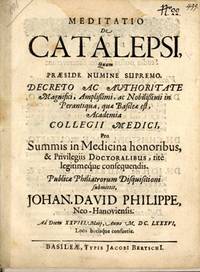
1686445491686. Baslilae: Typis Jaqcobi Bertsch 1686 Kl.4° 12 pp. Pappband. Husner: Verzeichnis bas. med. Univ.Schriften Nr. 1211 unknown
16521710030055Amsterdam: Louys Elzevier 1652. Hardcover. Good. Bound in full contemporary calf. Spine hinges cracked but solid at ties. Thick 4to 24 cm. Volume 1 only: 8 1207 i.e. 1197 15 p. p. 389 misnumbered 189; p. numbers 1070-1079 omitted in sequence. No pages are missing but the pagination is in error for all copies. <br> Suite des lettres et memoires de Messire Philippe de Mornay. Philippe de Mornay was a French Protestant writer and member of the anti-monarchist Monarchomaques. Mornay was instrumental in the drafting of the Edict of Nantes and an important figure in France's internal struggle between Huguenot and Catholic forces ca. 1562-1598. A continuation of the 2 previous volumes compiled from the memoirs of Charlotte Arbaleste wife of Philippe de Mornay by David de Liques and Valentin Conrart; edited by Jean Daille and printed by Jean Bureau at La Foret in 1624 and 1625. This edition by Elzevier continues the work of Jean Bureau's 1624 La Foret printing. <br> Refs: Copinger H.B. Elzevier Press 3243; Willems A. Elzevier 1149; Rahir E. Elzevier 1171; Hauser H. XVIe s. III 1612. <br> This is an oversized or heavy book that requires additional postage for international delivery outside the US. Louys Elzevier hardcover
16691407030014La Haye Steucker 1669-01-01. Hardcover. Good. 16mo. Bound in contemporary full vellum. Contemporary pen spine label. Good binding and cover. Shelfwear. Chipping and loss to bottom edge of vellum to boards. Clean unmarked pages with tanning. Owner's stamp on 2nd blank page. Ships daily. La Haye Steucker hardcover
1649138960Paris: Imprimerie Royale Sébastien Cramoisy 1649. full calfskin-covered boards seven raised bands gilt ornamentation on spine title in second compartment. folio 265 x 375 mm. full calfskin-covered boards seven raised bands gilt ornamentation on spine title in second compartment. 56-572 11 pages with two large genealogical tables printed on double-pages. Revues & corrigez sur divers manuscrits & anciennes impressions. Augmentez de plusieurs traistez contracts testaments autres actes & de diverses observations. Par Denys Godefroy Conseiller et Historiographe ordinaire du Roy. The Denys Godefroy edition with this copy being a somewhat larger paper copy 375 mm tall as opposed to the commonly found 350 mm tall. Small bookplate on front pastedown. Ownership name in ink on recto front free endpaper and ownership notes in ink on the verso of the front free endpaper. Front hinge cracked but firm. Loss of the leather spine in third compartment. Spine age-darkened. Rubbing to extremities. Minor foxing throughout. Dampstaining to title page. Philipe de Comines was a Statesman and one of the most interesting of the old French historians of the Middle Ages. Dibdin says that "no English Historical Collection can be complete without P. de Comines."<BR> <br /> <BR> <br /> A great visionary Comines 1447 - 1511 noticed and regretted the permanent antagonism between the European nations and aspired to a Europe united by Christianity. He advocated free trade the reform of the currency and the system of weights and measures as well as the consultation of the States General in order to avoid any despotism. After the first edition was produced by Denis Sauvage in 1552 which marked a notable progress this edition of 1649 produced by Théodore and Denis Godefroy was a great step forward. They printed at the prestigious Imprimerie Royale installed in the Louvre. In addition to the beautiful typographical quality it was established on two manuscripts and on the Sauvage edition. Many new lessons appear here for the first time and the editors attach to the text a valuable compendium of supporting material. this edition of 1649. Imprimerie Royale (Sébastien Cramoisy) unknown
1626elala975cLe Forest-sur-Sèvre: 1626-28. 1626. 2 Volumes. 4to. pp. 4 p.l. 978 16contents & index; 2 p.l. 640. woodcut ornaments & initials. contemporary mottled calf spines partly restored spine labels wanting scattered light foxing & browning some marginal dampstaining scattered stains small hole in last leaf costing several letters. Second Edition of the memoirs of one of the most eminent members of the French protestant party at the end of the sixteenth century. These memoirs begin with his narrow escape from the Massacre of St. Bartholomew in 1572 and his taking up arms for the Huguenots in 1575. Shortly thereafter he entered the service of Henri of Navarre who employed him in important negotiations. One of his most significant achievements was the role which he played in the reconciliation of Henri III and the King of Navarre in 1589 for which he was rewarded with the government of Saumur. He became a member of Henri IV's council and retained the monarch's favour after the latter had abjured his religion. Two further volumes of memoirs covering the period 1600-1623 were published by Elzevier at Amsterdam in 1651-52. Brunet III 1912. cfGoldsmith BM STC French M1495. [cLe Forest-sur-Sèvre]: 1626-28. unknown
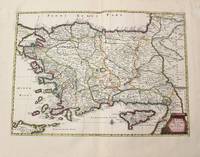
1700M10229Amsterdam: Jean Covens & Corneille Mortier 1700. Very Good. Notes: Detailed map of Turkey showing Cyprus. Size : 381x530 mm 15.00x20.87 Inches Coloring: Original Hand Coloring Category: Maps Asia Near East Turkey; Maps Mediterranean Islands; Jean Covens & Corneille Mortier unknown
1700B7152Nuremberg: Jean Zieger & George Lehmann. 1700. Some leaves with repairs otherwise text and plates are clean and crisp. . Binding: Original vellum boards rebacked. Spine with red morocco label. Top and front edges speckled red. Notes: Dual Language Edition; text in German and French Size: Folio 340 x 220mm Illustration: Near fine example of this important work on horsemanship. Illustrated with 73 large fine copperplates including engraved title and the armorial plate on the verso of the French title all double-page and/or folding. Translation of the original English edition. Text printed in two columns German in Gothic font on the left French on the right. Some inconsistencies in plate numbering; includes one duplicate plate. Pagination jumps from 290 to 293 text continuous. Lacking the German title in red and black. <br><br> Provenance: Ex-Libris; ownership stamp plus bookplate of Dodgson Hamilton Madden on front pastedown. References: Brunet I 1700; Graesse II 93; Huth 23; Lowndes 1663; Mennessier de la Lance II p. 250; Nissen ZBI 848 Pages: P Double-page engraved title. 4 double-page plates. Dedication. Blank. French Title. Large armorial engraving. German dedication. Publisher’s preface 3. Solleysel’s advertisement 5. Notice to the reader 5. Table of names 3. Contents 7. Pp. 1-301. Category: Book Natural History; Jean Zieger & George Lehmann. hardcover
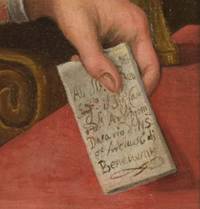
1613773Venice: Domenico Usci 1613. Softcover. Fair. This early 17th century edition of Commines important work on the inner-workings of the French government includes one of the more interesting provenance marks I've researched not for the person but for the unique way it's likely verified: ""Pompeo Arrigoni"" signed the flyleaf and title page twice. Searching this name quickly brought me to the Italian Roman Catholic Cardinal and Archbishop Pompeo Arrigoni. At his Italian Wikipedia page is a 1596 painting of him. I zoomed in on a note he's holding and there is his last name written in what appears to me the same hand as the one that inscribed my book. The painting is ""commons"" which means I'm free to use the photo so I've attached a copy of the note. I have to say most times I have to infer that someone signed a book context time period etc.; this is the first time I've ever found a picture of my subject holding their written name as though saying ""Yeah it was me that wrote in that book"". About the Author and Work - Philippe de Commines 1447 1511 was a writer and diplomat in the courts of Burgundy and France. He has been called ""the first truly modern writer"" Charles Augustin Sainte-Beuve and ""the first critical and philosophical historian since classical times"" Oxford Companion to English Literature. The Mémoires are divided into ""books"" the first six of which were written between 1488 and 1494 and relate the course of events from the beginning of Commines' career 1464 up to the death of King Louis. The remaining two books were written between 1497 and 1501 printed in 1528 and deal with the Italian wars ending in the death of King Charles VIII of France. Commines' scepticism is summed up in his own words: Car ceux qui gagnent en ont toujours l'honneur ""For the honours always go to the winners"". Bibliographic Details - Universal Short Title Catalogue number 4026765; 14 copies in the world's libraries. Only two copies outside Italy none in the Americas. Physical Attributes - Measures approx. 16.5 x 10.5 x 3.5 cm. Gatherings of eight 8vo. Vellum binding over pasteboard boards. Title in old hand on spine. Printers mark on title page. Several headers and decorated initials. Pages xxiv 1-683 1 Collation a8 b4 A-Z8 Aa-Tt8 Vv4 Someone fat-fingered the USTC entry because my gatherings are correct but they wrote ""11"" as the post-numbering number of pages. I can verify it is 1 since my gatherings are correct. Condition - See pictures. Some nibbling around edges and joints of vellum binding. Boards with some rust marks. Turn-ins lifted Im sure to check for manuscript there isnt. Text block edges a little darkened from dust. Ex libris and bookseller marks to pastedown and flyleaf. Pompeo wrote his name on the title page several times bottom one has bled through. Text block with a little toning and occasional thumbing dog-eared pages fox spot page-edge/corner chip etc. a2 with a 1 cm hole in the fore-edge margin. Bottom margin moisture mark intermittent. Bottom corner E5 chipped away no text affected. I5 torn at gutter from top 3 just barely touches start of text. L3 with a tear in bottom margin. V to Z gatherings with a moisture mark at top corner. Candle ember mark to Aa6. Oo7 bottom corner chipped. Two small wormholes in bottom margin of last gathering Vv. Domenico Usci
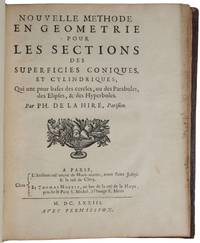
16766349Paris; Paris: chez l'autheur et Thomas Moette; n.p. 1676. First edition. <p>First edition extremely rare of these two works of which the Nouvelle Méthode is the first substantial treatment of projective geometry explicating the Brouillon Projet of Girard Desargues 1591-1661. "The BrouillonProjet 1639 was published in an edition of only 50 copies and won very little support . Projective geometry secured a place in mathematics only with the publication of a book by Philippe de Hire 1673" Stillwell Mathematics and its History.</p>. PROJECTIVE GEOMETRY SECURES A PLACE IN MATHEMATICS. <p>First edition extremely rare of these two works of which the Nouvelle Méthode is the first substantial treatment of projective geometry explicating the Brouillon Projet of Girard Desargues 1591-1661. "The BrouillonProjet 1639 was published in an edition of only 50 copies and won very little support. In fact its reception was generally hostile and Desargues was engaged in a pamphleteering battle for years with his detractors. At first his only supporters were Pascal most of whose work on projective geometry is also lost and the engraver Abraham Bosse. Desargues became discouraged by the attacks on his work and left the dissemination of his ideas up to Bosse who was not really mathematically equipped for the task. Projective geometry secured a place in mathematics only with the publication of a book by Philippe de Hire 1673. It seems quite likely that La Hire's book influenced Newton see below" Stillwell p. 153. Michel Chasles writing in 1837 noted that La Hire's work is "extrêmement rare" Chasles p. 128. "The treatise of 1673 is where De La Hire shows himself to be truly original and innovative and which leads us to regard him as one of the founders of modern geometry" translated from ibid. "La Hire certainly read the Rough Draft on Conics Brouillon Projet thoroughly; for a long time the only known copy of the work was one made by La Hire himself in 1679. Possibly he made his own handwritten copy of the Rough Draft on Conics from a printed copy belonging to his father the painter Laurent de la Hire 1606-1656 a pupil of Desargues and a friend and colleague of Abraham Bosse at the Académie. Philippe de la Hire had by then written his first book on geometry his Nouvelle Méthode en Géométrie . It too has become extremely rare and he was later to write that his new method had been found difficult because it involved planes and solids" Field & Gray p. 37. La Hire's point of view in his Nouvelle Methode was entirely projective. He regarded all conics as projections of circles and used the harmonic division of four points which he showed was projectively invariant to obtain theorems about poles and polars. The work is in two parts. In the first pp. 1-72 La Hire treats conics as sections of the cone which are then projected onto the plane of the base of the cone; this approach was later expanded in his Sectiones conicae 1685. In the second Les Planiconiques pp. 73-94 he treats conics by entirely planar methods; Chasles notes that this part which Chasles regards as the more original "offered the first sufficiently general method for transforming figures of one kind into other figures of the same kind". The Planiconiques was published one year after the Nouvelle Méthode and was not added to all copies the Lyon and Marburg copies of the Nouvelle Méthode end at p. 72. The second work in the present volume De Cycloid Lemma is even rarer than the Nouvelle Méthode. It presents a geometrical construction of the tangent at any point of the cycloid - the method was discovered by Descartes and Fermat but they did not publish it. OCLC lists 12 copies of the Nouvelle Méthode worldwide Columbia only in US and 6 copies of De Cycloide Lemma of which three are bound with the Nouvelle Méthode including Columbia and three are bound separately BL Erfurt & Lyon the first two of which hold the Nouvelle Méthode. It is unclear how many of the copies of the cycloid pamphlet are complete as several lack the plate e.g. the BNF copy. RBH lists only the Macclesfield copy of the Nouvelle Méthode since 1961 bound with De Cycloide Lemma but lacking its plate and no other copy of the cycloid pamphlet.</p> <br /> <p>"When Desargues circulated fifty copies of his Brouillon Project d'une Atteinte aux Événemens des Rencontres du Cone avec un Plan Rough Draft of an Essay on the results of taking plane sections of a cone in 1639 he was contributing to a lively contemporary study of geometry. Descartes's novel algebraic methods had been published two years before and in 1639 Mydorge published a more classical treatment of the conic sections. The classical authors themselves were increasingly well studied. Desargues had available Commandino's Latin edition of Euclid's Elements published in 1572 as well as his Latin edition of the first four books of Apollonius' Conics published in 1566 with extensive commentaries by Eutocius Pappus and Commandino himself. The last four books of the Conics were unknown in Desargues' time" Field & Gray p. 1.</p> <br /> <p>"The Brouillon Projet on conics of which he published fifty copies in 1639 is a daring projective presentation of the theory of conic sections; although considered at first in three-dimensional space as plane sections of a cone of revolution these curves are in fact studied as plane perspective figures by means of involution a transformation that holds a place of distinction in the series of demonstrations. But the use of an original vocabulary and the refusal to resort to Cartesian symbolism make the reading of this essay rather difficult and partially explain its meager success.</p> <br /> <p>"Although he praised the unitary conception that inspired Desargues Descartes doubted that the use of geometry alone could yield results as good as those that a recourse to algebra would provide. As for Fermat he reserved his judgment and the only geometer who really comprehended the originality and breadth of Desargues's views was the young Blaise Pascal who in 1640 published the brief Essay pour les Coniques inspired directly by the Brouillon Projet. But since the great Traité des Coniques that Pascal later wrote has been lost Desargues's example survived only in certain of the youthful works of Philippe de La Hire and perhaps in a few essays of the young Newton" DSB.</p> <br /> <p>"Philippe de la Hire 1640-1718 published three treatises on conics in 1673 in 1679 and in 1685. From the point of view of modern geometry the treatise of 1673 is by far the most original. Unfortunately because of its rarity it did not have a very wide circulation and today too many historians of science pass over it in silence concentrating instead on the Latin treatise of 1685 which is merely a development of the first part of the treatise of 1673. Although La Hire in a note attached to his copy of the Brouillon Projet of Desargues claims not to have known the treatise of Desargues until after 1673 and not to have been inspired by it it seems to us on the contrary that this inspiration is manifest. A first reason is that La Hire's father the king's painter was a diligent student of Desargues's oral lectures so it would be very surprising if he were unaware of the existence of this treatise and were unable to make its content known to his son. The second and most important reason is drawn from the study of the text. It seems that La Hire knowing at least the spirit of Desargues's treatise has tried to derive from it a work using the same principles but avoiding the faults that were the source of the violent criticisms by Desargues's adversaries.</p> <br /> <p>"Indeed La Hire seems to want to make a synthesis of the theories of Desargues while giving them a classical gloss . His method . amounts to deducing the projective properties of an arbitrary conic in space situated on a cone with a horizontal circular base from the properties of the base circle via the intermediary of the projection of the conic section onto the plane of the base. He uses in fact the properties of cylindrical projection for the passage from the curve in space to its projection and of homology for the passage from the conic to the projection of the base circle.</p> <br /> <p>"The method for studying the properties of conic sections 'in the cone' led quite logically to another procedure for studying them which consists in deducing directly - in the plane - every conic from a circle by a homology. This is the object of the second part of La Hire's small treatise titled Les Planiconiques. This very ingenious method is applied with the aid of several lemmas on the elementary properties of homology. So here apparently we have a treatise which although inspired by the ideas of Desargues is not afraid to develop them further" translated from Taton pp. 204-205.</p> <br /> <p>Chasles pp. 128-9 describes the method of the Planiconiques as follows. "Suppose that we have in a plane two straight lines parallel to each other which the author calls the formatrice and directrice and a point called the pole.Through each point M of a given curve in the plane one draws in an arbitrary direction a transversal; it meets the directrix at a point which one joins to the pole by a line;and the former at a second point through which we draw a parallel to this line.This parallel meets the straight line which goes from the point M to the pole in a point M' which is said to be formed by the point M.Each point of the proposed curve will thus form a corresponding point of a second curve. The points of a straight line form points belonging to a second straight line and these two straight lines will intersect on the formatrice.Finally the points of a circle will form the points of a conic section. Such is the method by which De La Hire studied in the plane without the need for any solid nor any other plane than that of the figure the sections of a cone.This is what he called reducing the cone and its sections to a plane."</p> <br /> <p>"Whiteside has pointed out Mathematical Papers of Isaac Newton VI 271 n.70 that the Nouvelle Méthode received a favourable review probably from CoIlins in 1676 and that Newton may have read it for Hooke wrote to him mentioning it in 1679. There are certainly similarities between ingenious projective transformations described by both men . In Book I of his Principia Newton showed how to solve all of the six different problems of the form: find the conic through k points and tangent to m lines k m = 5. In the course of accomplishing this feat he introduced a projective transformation capable as he remarked of transforming any conic to a circle . It is strikingly similar to the one given by La Hire in his Planiconiques which was printed in the same volume as his Nouvelle Méthode" Field & Gray p. 37. The Nouvelle Méthode also influenced Leibniz. "The ideas of Desargues and Pascal led Leibniz to a 'dynamical' vision of geometry. In the years 1672-76 Leibniz was in Paris where he greatly increased his mathematical knowledge. In 1673 he was informed on Desargues' perspective through La Hire's Nouvelle Méthodeen Géométrie ." Del Centini & Fiocca.</p> <br /> <p>Determining the properties of the cycloid the curve traced out by a point on the circumference of a circle as it rolls along a straight line served as a test bed for the techniques of seventeenth century mathematics. The earliest significant work on the cycloid is due to Gilles Personne de Roberval 1602-75 who obtained many of its properties before 1636 although he kept his results secret and they remained unpublished until 1693. Roberval in particular gave a construction of the tangent at a point on the cycloid using his method of 'composition of movements' a precursor of the differential calculus. This problem was also solved by Pierre de Fermat and René Descartes although they also did not publish their work. It was instead first published by La Hire in the first part of his De Cycloide Lemma pp. 1-4. The remainder of this little pamphlet is devoted to a problem relating to conics which is perhaps why it is often although not always found bound together with the Nouvelle Méthode.</p> <br /> <p>Chasles AperVu historique des Méthodes en Géométrie 1837. Del Centini & Fiocca 'Boscovich's geometrical principle of continuity and the 'msyteies of infinity' Historia Mathematica 45 2018 pp. 131-175. Field & Gray The Geometrical Work of Girard Desargues 1987. Stillwell Mathematics and its History 3rd edition 2010. Taton Le Prehistoire de la 'Geometrie moderne' Revue d'Histoire des Sciences et de leurs Applications 2 1949 pp. 197-224.</p> <br/> <br/> 4to 201 x 162 mm. Nouvelle Méthode: pp. viii 94 with 25 folding engraved plates 10 bound before title page 15 at end of volume the last 2 referring to Les Planiconiques woodcut vignette on title woodcut initials head- and tail-pieces. De Cycloide Lemma: pp. 6 with 13 figures on one plate cut up with each figure tipped in at the appropriate place in the text. chez l'autheur et Thomas Moette; [n.p.] unknown
16766181Paris; Paris: chez l'autheur et Thomas Moette; np 1676. First edition. <p>First edition extremely rare of these two works of which the Nouvelle Méthode is the first substantial treatment of projective geometry explicating the Brouillon Projet of Girard Desargues 1591-1661. "The BrouillonProjet 1639 was published in an edition of only 50 copies and won very little support . Projective geometry secured a place in mathematics only with the publication of a book by Philippe de Hire 1673" Stillwell Mathematics and its History.</p>. PROJECTIVE GEOMETRY SECURES A PLACE IN MATHEMATICS. <p>First edition extremely rare of these two works of which the Nouvelle Méthode is the first substantial treatment of projective geometry explicating the Brouillon Projet of Girard Desargues 1591-1661. "The BrouillonProjet 1639 was published in an edition of only 50 copies and won very little support. In fact its reception was generally hostile and Desargues was engaged in a pamphleteering battle for years with his detractors. At first his only supporters were Pascal most of whose work on projective geometry is also lost and the engraver Abraham Bosse. Desargues became discouraged by the attacks on his work and left the dissemination of his ideas up to Bosse who was not really mathematically equipped for the task. Projective geometry secured a place in mathematics only with the publication of a book by Philippe de Hire 1673. It seems quite likely that La Hire's book influenced Newton see below" Stillwell p. 153. Michel Chasles writing in 1837 noted that La Hire's work is "extrêmement rare" Chasles p. 128. "The treatise of 1673 is where De La Hire shows himself to be truly original and innovative and which leads us to regard him as one of the founders of modern geometry" translated from ibid. "La Hire certainly read the Rough Draft on Conics Brouillon Projet thoroughly; for a long time the only known copy of the work was one made by La Hire himself in 1679. Possibly he made his own handwritten copy of the Rough Draft on Conics from a printed copy belonging to his father the painter Laurent de la Hire 1606-1656 a pupil of Desargues and a friend and colleague of Abraham Bosse at the Académie. Philippe de la Hire had by then written his first book on geometry his Nouvelle Méthode en Géométrie . It too has become extremely rare and he was later to write that his new method had been found difficult because it involved planes and solids" Field & Gray p. 37. La Hire's point of view in his Nouvelle Methode was entirely projective. He regarded all conics as projections of circles and used the harmonic division of four points which he showed was projectively invariant to obtain theorems about poles and polars. The work is in two parts. In the first pp. 1-72 La Hire treats conics as sections of the cone which are then projected onto the plane of the base of the cone; this approach was later expanded in his Sectiones conicae 1685. In the second Les Planiconiques pp. 73-94 he treats conics by entirely planar methods; Chasles notes that this part which Chasles regards as the more original "offered the first sufficiently general method for transforming figures of one kind into other figures of the same kind". The Planiconiques was published one year after the Nouvelle Méthode and was not added to all copies the Lyon and Marburg copies of the Nouvelle Méthode end at p. 72. The second work in the present volume De Cycloid Lemma is even rarer than the Nouvelle Méthode. It presents a geometrical construction of the tangent at any point of the cycloid - the method was discovered by Descartes and Fermat but they did not publish it. OCLC list 12 copies of the Nouvelle Méthode worldwide Columbia only in US and 6 copies of De Cycloide Lemma of which three are bound with the Nouvelle Méthode including Columbia and three are bound separately BL Erfurt & Lyon the first two of which hold the Nouvelle Méthode. It is unclear how many of the copies of the cycloid pamphlet are complete as several lack the plate e.g. the BNF copy. RBH lists only the Macclesfield copy of the Nouvelle Méthode since 1961 bound with De Cycloide Lemma but lacking its plate and no other copy of the cycloid pamphlet.</p> <br /> <p>"When Desargues circulated fifty copies of his Brouillon Project d'une Atteinte aux Événemens des Rencontres du Cone avec un Plan Rough Draft of an Essay on the results of taking plane sections of a cone in 1639 he was contributing to a lively contemporary study of geometry. Descartes's novel algebraic methods had been published two years before and in 1639 Mydorge published a more classical treatment of the conic sections. The classical authors themselves were increasingly well studied. Desargues had available Commandino's Latin edition of Euclid's Elements published in 1572 as well as his Latin edition of the first four books of Apollonius' Conics published in 1566 with extensive commentaries by Eutocius Pappus and Commandino himself. The last four books of the Conics were unknown in Desargues' time" Field & Gray p. 1.</p> <br /> <p>"The Brouillon Projet on conics of which he published fifty copies in 1639 is a daring projective presentation of the theory of conic sections; although considered at first in three-dimensional space as plane sections of a cone of revolution these curves are in fact studied as plane perspective figures by means of involution a transformation that holds a place of distinction in the series of demonstrations. But the use of an original vocabulary and the refusal to resort to Cartesian symbolism make the reading of this essay rather difficult and partially explain its meager success.</p> <br /> <p>"Although he praised the unitary conception that inspired Desargues Descartes doubted that the use of geometry alone could yield results as good as those that a recourse to algebra would provide. As for Fermat he reserved his judgment and the only geometer who really comprehended the originality and breadth of Desargues's views was the young Blaise Pascal who in 1640 published the brief Essay pour les Coniques inspired directly by the Brouillon Projet. But since the great Traité des Coniques that Pascal later wrote has been lost Desargues's example survived only in certain of the youthful works of Philippe de La Hire and perhaps in a few essays of the young Newton" DSB.</p> <br /> <p>"Philippe de la Hire 1640-1718 published three treatises on conics in 1673 in 1679 and in 1685. From the point of view of modern geometry the treatise of 1673 is by far the most original. Unfortunately because of its rarity it did not have a very wide circulation and today too many historians of science pass over it in silence concentrating instead on the Latin treatise of 1685 which is merely a development of the first part of the treatise of 1673. Although La Hire in a note attached to his copy of the Brouillon Projet of Desargues claims not to have known the treatise of Desargues until after 1673 and not to have been inspired by it it seems to us on the contrary that this inspiration is manifest. A first reason is that La Hire's father the king's painter was a diligent student of Desargues's oral lectures so it would be very surprising if he were unaware of the existence of this treatise and were unable to make its content known to his son. The second and most important reason is drawn from the study of the text. It seems that La Hire knowing at least the spirit of Desargues's treatise has tried to derive from it a work using the same principles but avoiding the faults that were the source of the violent criticisms by Desargues's adversaries.</p> <br /> <p>"Indeed La Hire seems to want to make a synthesis of the theories of Desargues while giving them a classical gloss . His method . amounts to deducing the projective properties of an arbitrary conic in space situated on a cone with a horizontal circular base from the properties of the base circle via the intermediary of the projection of the conic section onto the plane of the base. He uses in fact the properties of cylindrical projection for the passage from the curve in space to its projection and of homology for the passage from the conic to the projection of the base circle.</p> <br /> <p>"The method for studying the properties of conic sections 'in the cone' led quite logically to another procedure for studying them which consists in deducing directly - in the plane - every conic from a circle by a homology. This is the object of the second part of La Hire's small treatise titled Les Planiconiques. This very ingenious method is applied with the aid of several lemmas on the elementary properties of homology. So here apparently we have a treatise which although inspired by the ideas of Desargues is not afraid to develop them further" translated from Taton pp. 204-205.</p> <br /> <p>Chasles pp. 128-9 describes the method of the Planiconiques as follows. "Suppose that we have in a plane two straight lines parallel to each other which the author calls the formatrice and directrice and a point called the pole.Through each point M of a given curve in the plane one draws in an arbitrary direction a transversal; it meets the directrix at a point which one joins to the pole by a line;and the former at a second point through which we draw a parallel to this line.This parallel meets the straight line which goes from the point M to the pole in a point M' which is said to be formed by the point M.Each point of the proposed curve will thus form a corresponding point of a second curve. The points of a straight line form points belonging to a second straight line and these two straight lines will intersect on the formatrice.Finally the points of a circle will form the points of a conic section. Such is the method by which De La Hire studied in the plane without the need for any solid nor any other plane than that of the figure the sections of a cone.This is what he called reducing the cone and its sections to a plane."</p> <br /> <p>"Whiteside has pointed out Mathematical Papers of Isaac Newton VI 271 n.70 that the Nouvelle Méthode received a favourable review probably from CoIlins in 1676 and that Newton may have read it for Hooke wrote to him mentioning it in 1679. There are certainly similarities between ingenious projective transformations described by both men . In Book I of his Principia Newton showed how to solve all of the six different problems of the form: find the conic through k points and tangent to m lines k m = 5. In the course of accomplishing this feat he introduced a projective transformation capable as he remarked of transforming any conic to a circle . It is strikingly similar to the one given by La Hire in his Planiconiques which was printed in the same volume as his Nouvelle Méthode" Field & Gray p. 37. The Nouvelle Méthode also influenced Leibniz. "The ideas of Desargues and Pascal led Leibniz to a 'dynamical' vision of geometry. In the years 1672-76 Leibniz was in Paris where he greatly increased his mathematical knowledge. In 1673 he was informed on Desargues' perspective through La Hire's Nouvelle Méthodeen Géométrie ." Del Centini & Fiocca.</p> <br /> <p>Determining the properties of the cycloid the curve traced out by a point on the circumference of a circle as it rolls along a straight line served as a test bed for the techniques of seventeenth century mathematics. The earliest significant work on the cycloid is due to Gilles Personne de Roberval 1602-75 who obtained many of its properties before 1636 although he kept his results secret and they remained unpublished until 1693. Roberval in particular gave a construction of the tangent at a point on the cycloid using his method of 'composition of movements' a precursor of the differential calculus. This problem was also solved by Pierre de Fermat and René Descartes although they also did not publish their work. It was instead first published by La Hire in the first part of his De Cycloide Lemma pp. 1-4. The remainder of this little pamphlet is devoted to a problem relating to conics which is perhaps why it is often although not always found bound together with the Nouvelle Méthode.</p> <br /> <p>Chasles AperVu historique des Méthodes en Géométrie 1837. Del Centini & Fiocca 'Boscovich's geometrical principle of continuity and the 'msyteies of infinity' Historia Mathematica 45 2018 pp. 131-175. Field & Gray The Geometrical Work of Girard Desargues 1987. Stillwell Mathematics and its History 3rd edition 2010. Taton Le Prehistoire de la 'Geometrie moderne' Revue d'Histoire des Sciences et de leurs Applications 2 1949 pp. 197-224.</p> <br/> <br/> 4to 201 x 162 mm. Nouvelle Méthode: pp. viii 94 with 25 folding engraved plates 10 bound before title page 15 at end of volume the last 2 referring to Les Planiconiques woodcut vignette on title woodcut initials head- and tail-pieces. De Cycloide Lemma: pp. 6 with 13 figures on one plate cut up with each figure tipped in at the appropriate place in the text. chez l'autheur et Thomas Moette; [np] unknown