(Philippe Avril)Biblio.com
82 résultats
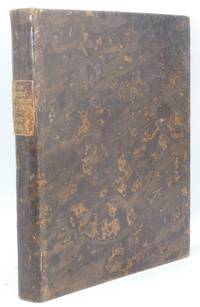
169368094Paris: Jean Boudot 1693. Later hardcover. Engraved title page 263422 pp. and 8 engraved plates. Text in French new binding low margins sometimes a little loss see pictures pages 283/284 misbound paper browned Although still very good very rare see pictures Jean Boudot hardcover
1692BS44GLTBN504Paris: Claude Barbin 1692. Hardback later mottled calf gilt title to spine label. 24.5cm x 19cm. Engraved portrait of Stanislaus Jablonowski by Picart one folding map 3 engraved plates engraved headpieces all by Vallet historiated initials. 1st edition 1692. Binding is slightly rubbed and worn with a few very small worm holes not going all the way through. Some dampstaining to front free end-paper and to inner lower margin of last few pages of the Table at rear but otherwise contents is generally clean. Scarce. bs44. 1st Edition. Hard Cover. Good. Claude Barbin Hardcover
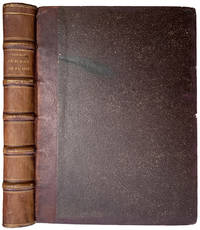
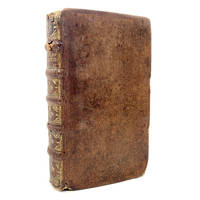
1692E0527titlepictorial platexviifolding map406xxiv pages with engraved initials and vignettes and three additional plates and index. Royal octavo 9 3/4" x 7 1/2" bound in full leather with five raised bands and lettering in gilt and decorative vignettes. First edition.<br /><br />Philippe Avril was a Jesuit explorer of the Far East and professor of philosophy and mathematics at Paris when he was dispatched to the Jesuit missions of China. He was summoned by the Jesuit missions and sent as a Jesuit to the missions in China. Following the instructions of Ferdinand Verbiest another Jesuit then at Peking suggested that he attempted an overland journey which he ended up traveling for six years through Kurdistan Armenia Astrakhan Persia and other countries of eastern Asia arriving at Moscow. He now traveled to Grodno in Poland where he renewed an acquaintance with Count de Syri who had formerly befriended him at Astrakham. The count at the suggestion of Avril applied ot the French government for the appointment of ambassador from the King of France to the Emperor of China. He succeed in obtaining the appointment and it was arranged that Avril should accompany him. They set out to Moscow together. An accident detained Avril and the count arrived at Moscow days before his companion. On the arrival of Avril he received the intelligence that the Russian authorities and compelled the count to proceed and was refused permission to over take him. Avril proceeded to Warsaw and through the assistance of Prince Jablonowksi to reach Constantinople by way of Moldavia. Here he was seized with spitting of blood and he found himself compelled to relinquish his mission and returned to France. He landed at Toulon in 1690 and published an account of his travels. Avril's journal and writings provide a significant amount of useful material for modern historians and demographers.<br /><br /><b>Condition:</b><br /><br />Corners bumped and rubbed lacking 3E4 blank leaf between the end of the main text and start of the Table de Metiers occasional toning ink inscription to title spine ends and raised spine rubbed some spotting to leather else a good to very good copy. Claude Barbin, Jean Boudot, George & Louis Josse hardcover
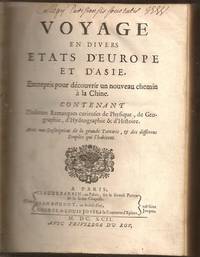
1692LV1992Paris:: Chez Claude Barbin Jean Boudot George & Louis Josse avec privilege du Roy 1692. 1692. Sm. 4to. xx 406 xxiv pp. 6 chapter vignettes engraved by Vallet pp. aii 1 71 165 231 323 large engraved portrait of General Stanislas Jablonowski by Picart large folding map of Siberia 3 engraved plates: engr. pl. of transport sled of Moscow facing p.150 engr. pl. of a Calmouc Tartar facing p. 195 "Esquiss des Cosaques" facing p. 356. Nineteenth century quarter maroon morocco maroon paper over boards; rubbed. Rubber-stamp of Abbe E. Emile Longin Beaujeu fl.1904; receipt of sale of this copy to Armand Pushman 1932 NYC. First edition. This work was first translated into English in 1693. "At this time a major preoccupation of the Catholic Church and its China mission was to discover a safe land route from Europe to Peking through central Asia. This was due to the large numbers of out-going clergy who perished tragically every year at sea." Ames & Love p. 202. "The last decade of the century saw the publication of the accounts of several overland travelers to China and their destinations of China's inner-Asian neighbors. The story of the Jesuit Philippe Avril's attempt to establish a route across Russia for the safe passage of missionaries to China appeared in 1692 and includes descriptions of both the routes from Moscow to China and the peoples on China's frontiers. Avril himself however did not travel beyond Moscow and his descriptions therefore are not the result of his own observations." Lach & Kley pp. 1685-1686. The same for Nicolaas Witsen. Avril Philippe a Jesuit born in France explored extensively throughout Asia and the Far East. He was a professor of mathematics and philosophy in Paris before he began his overland journey. He traveled for six years through Kurdistan Armenia Astrakhan Persia and other parts of the southeast. At one point he came to Moscow and was refused entry to Tatary. He was sent by the government to Poland via Istanbul and back to France. Apparently affected by exhaustion and disease he still undertook another voyage his last for the ship was lost at sea circa 1698. – Love Ronald S. "A Passage to China: A French Jesuit's Perceptions of Siberia in the 1680s." French Colonial History 3: p. 94 2003. Ames & Love offer: "Though obliged to leave Moscow Avril did not return to France with Louis Barnabe . . . Remaining instead at Warsaw the two Jesuits had entered in early March 1688 Avril attempted twice more to achieve his objective or reaching China by land – if not through Siberia then via Persia and Central Asia. Aided in part by the Polish monarch John Sobieski r.1674-1696 and his ambassador to Russia the French priest once again traveled to Moscow in late spring. Just two days after his arrival in the Muscovite capital however Avril was ordered summarily out of the country. Once again he appealed the command in vain. 'Russia intended to keep her trade with China a secret.' Nor did he have better luck later the same year 1688 when he and a fellow Jesuit Pere de Beauvillier tried going south to Constantinople instead and thence through Persia to Bokhara Samarkland and the Chinese frontier. Crossing secretly into Ottoman territory the two men were arrested as spies. After several weeks they secured their release and resumed their trek. But Avril whose health had been waning as a result of relentless exertions suddenly developed a hemorrhage. Ordered to abandon the search and return home by his superiors he reached France in autumn 1689." Ames & Love p. 219. For Abbe Emile Longin provenance: see Bulletin de la Societe des sciences et arts du Beaujolais 1904 p.92. There is a Maggs Bros. London booksellers receipt of sale of this copy to Armand Pushman 10 Nov. 1932. Armand was one of two sons of Hovsep Pushman 1877-1966 an American artist of Armenian descent. He had studied art at the Imperial School of Fine Arts Istanbul. For a time Pushman lived at the famous Mission Inn Riverside California. He was also involved in the founding of the Laguna Beach Art Association. Armand Pushman d.1999 lived to 98 years and had been throughout his career a partner with his brother in their carpet business Pushman & Company. See: NYT Obituary January 11 1999. See: Henri Cordier Bibliotheca Sinica Dictionnaire Bibliographique des ouvrages relatifs a l'Empire chinois t. III 2088; De Backer Augustin & Carlos S.J. Sommervogel Bibliotheque de la Compagnie de Jesus. Bibliographie tome I p.706; Donald F. Lach Edwin J. Van Kley Asia in the Making of Europe Volume III: A Century of Advance book 4: East Asia. University of Chicago Press 1998; Glenn Joseph Ames Ronald S. Love Distant Lands and Diverse Cultures: The French Experience in Asia 1600-1700. Praeger 2003 – pp. 202 219; Howgego A142; Salmaslian Armenag Bibliographie de l'Armenie 1946 p. 238; Walravens Hartmut China illustrata. Das europaische Chinaverstandnis im Spiegel des 16. bis 18. Jahrhunderts. Mit einem Beitrag von David E. Mungello. Ausstellung im Zeughaus der Herzog August Bibliothek Wolfenbuttel vom 21. Marz bis 23. August 1987. Ausstellungskataloge der Herzog-August-Bibliothek Nr. 55 Wolfenbuttel: Herzog August Bibliothek 1987 55. 1691. Chez, Claude Barbin, Jean Boudot, George & Louis Josse, avec privilege du Roy, 1692. hardcover
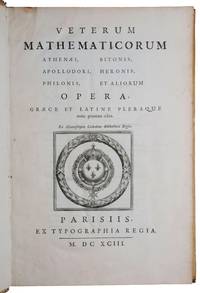
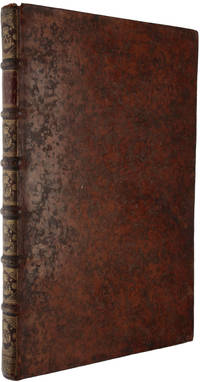
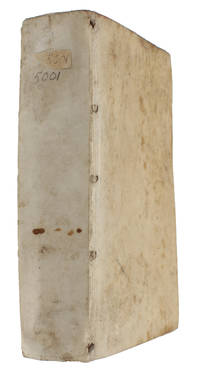
16936467Paris: Typographia Regia 1693. First edition. <p>First edition a very fine copy of this collection of early Greek writings on technology especially military technology and hydrostatics. It contains several treatises on the mechanics and siege operations or poliorcetica of the Hellenistic period the period between Alexander and Augustus including the construction and management of projectile engines.</p>. DIBNER 84: ANCIENT GREEK TECHNOLOGY. <p>First edition of this collection of early Greek writings on technology especially military technology and hydrostatics. It contains several treatises on the mechanics and siege operations or poliorcetica used in the Hellenistic period the period between Alexander and Augustus including the construction and management of their projectile engines. The first six works in the volume comprise the writings on the subject of military engines that were compiled by Athenaeus Apollodorus Biton Heron and Philon. These works include the first edition in both Greek and Latin of Biton's Construction of War Machines and Artillery of extant part of the Mechanike Syntaxis attributed to Philon of Byzantium and of the Poliorcetica of Apollodorus of Damascus. These are followed by the Greek and Latin texts of Hero of Alexandria's works on hydrostatics the Pneumatica and Automata which include what some regard as the first description of a steam-engine; this is the first printing of the Greek text of these works. Thévenot the King's librarian to Louis XIV prepared the present work from a rather defective secondary manuscript Codex Parisinus 2435. After Thévenot's death in 1692 it was revised by the mathematician La Hire with insightful annotations by Boivin an official in the King's library. It is one of three early publications of the French Academy of Sciences grouped together as Dibner 84. "Printed at the royal press in small editions they were intended as gifts for the King and Academy. In size binding and beauty of the plates they are among the most sumptuous books in science" Dibner. This is a rare book on the market only eight copies having appeared at auction in the last 40 years. The Evelyn copy was sold at Christie's in 1977.</p> <br /> <p>To gain access to the walls of a site under siege a siege tower or ram was brought into position and used to launch an attack onto the walkway aided by missile fire from the higher levels of the tower. Simultaneous attacks with scaling ladders took place. A siege tower is a specialized siege engine constructed to protect assailants and the ladders used when approaching the defensive walls of a fortification. The tower was usually rectangular with four wheels and a height roughly equal to that of the wall; it was sometimes higher to allow archers to stand on the top and fire into the fortification. The tower was made chiefly of wood but sometimes there were metal components as well. They were unwieldy to manoeuvre and slow to assemble and consequently were usually constructed at the siege site. Sometimes siege towers themselves incorporated other devices including artillery rams and dropbridges. Two main types of artillery equipment were used in this period: bolt-throwers ballistae: used for picking off prominent individuals and stone-throwers scorpiones onagri. Stone throwers could cause structural damage but were generally confined to firing at towers gates or siege machinery. Artillery might use incendiary ammunition when firing at gates or equipment.</p> <br /> <p>In common with much Byzantine literature poliorcetica draw heavily on earlier classical material. Since these were composed before the development of heavy artillery the poliorcetica are not so much concerned with large machines but rather with describing techniques for bringing men close to fortifications and then ways of undermining them. They also suggest various psychological tricks which might be used to outwit the enemy. Such ancient works on military machines were a source of fascination to the Italians of the late 15th and 16th centuries not only because of their historic interest but also as a source for modern inventions to be used in contemporary warfare and several of these works were first published in Renaissance Italy.</p> <br /> <p>The present volume begins with the De Machinis of Athenaeus a Cilician ex-statesman living in Rome in the 20s B.C. and a contemporary of the architect-engineer Vitruvius who like Vitruvius worked under the patronage of the Emperor Augustus Vitruvius devoted Book 10 of his De Architectura to machines. In addition to describing individual siege engines and theorizing on tactics Athenaeus draws on actual instances from history of the use of these machines in order to make various points and elucidate his text.</p> <br /> <p>The author of the next text is Apollodorus of Damascus who was a Roman architect and engineer of the late 1st to early 2nd century A.D. As Emperor Trajan's architect and military engineer he was responsible for Trajan's forum and possibly Trajan's column and produced designs for new siege machines. In his treatise Poliorcetica he describes a system of banks and ditches and also sheds that would be needed to protect the legionaries during undermining work or to carry battering rams against a tower gate or wall. Next he describes the construction of a siege tower followed by a system of interlocking ladders. He concludes his treatise with a description of a battlemented raft for river assaults. Although some of the elaborations are considered somewhat unrealistic − for example the addition of a torsion-powered truncheon to the end of a battering ram − and some of these are believed to have been added by a later editor the core of Apollodorus' text is believed to be authentic and to accurately describe highly effective machinery. Apollodorus dedicated Poliorcetica to the Emperor Hadrian perhaps an attempt to gain forgiveness for an earlier insult. On that occasion Trajan was discussing with Apollodorus the buildings which the great architect had built in Rome. Hadrian's assessment only demonstrated his ignorance which was bluntly pointed out by Apollodorus. Hadrian never forgot the insult and when he came to power banished Apollodorus accused him of several crimes and had him put to death.</p> <br /> <p>The third text in the volume is the Mechanike Syntaxis attributed to Philon of Byzantium who is believed to have been born about 280 B.C. in Byzantium and to have died around 220 B.C. Only the fourth and fifth books of this work have come down to us. Although there are few references to him in literature he is mentioned by Vitruvius. Amongst other weapons of siegecraft he describes the catapult recently invented by Ctesibius fl. 285-222 BC a Greek or Egyptian inventor and mathematician and probably the first head of the Museum at Alexandria. From this Philon's treatise can be dated fairly accurately to around 250 B.C. He describes journeys he made to Rhodes and to Alexandria to study catapults and it seems he may have earned his living advising military rulers.</p> <br /> <p>"The fourth book is headed κ τν Φιλνο βελοποιικν and the general subject is the manufacture of missiles. He mentions in it an invention of his own which he denominates ξυβλη p. 56. In the fifth book we are shocked to find that while recommending a besieging army to devastate the open country on the approach of an enemy he advises them to poison the springs and the grain which they cannot dispose of p. 103; and what renders this the worse he mentions his having treated of poisons in his book on the preparations that should be made for a war. What principally attracted attention to this work in modern times is his notice of the invention of Ctesibius p. 77. &c. The instrument described by him named εÏτονο acted on the property of air when condensed and is evidently in principle the same with the modern air-gun" A Dictionary of Greek and Roman Biography and Mythology<br /> William Smith ed. </p> <br /> <p>Philon's work is followed by the brief treatise of Biton of Pergamon 3rd or 2nd century B.C. about whom little is known; it is the only extant work to give a full description of advanced tension catapults. Biton's handbook describes four tension bow catapults a helepolis city-taker = siege tower and a sambuca mechanical scaling ladder. The bow catapults consisted of two stone throwers small and large and two bolt shooters a medium "belly bow" and mountain "belly bow". The latter took their name from the concave rest at their rear end against which the archer braced his stomach while drawing the bow. The work is dedicated to a King Attalus and was therefore composed between about 230 BC when Attalus I assumed the title of King and 133 BC death of Attalus III. As Biton mentions older types of catapults but not the torsion catapult that was otherwise well attested from the end of the 4th cent. BC the work probably belongs to the early years of the reign of Attalus I King of Pergamum 241-197 B.C. We do not know if Attalus employed the devices Biton described but they were definitely used in numerous later sieges and naval battles.</p> <br /> <p>The final two texts of siegecraft in the volume the Belopoeica and the Cheiroballistra are both attributed to Heron of Alexandria ca. 10-75 AD. Heron possibly taught at the Museum at Alexandria since many of his writings have the appearance of student lecture notes. The Belopoeica "On arrow making" describes the hand-held "belly bow" also discussed by Biton. The Cheiroballistra describes a small hand-held catapult. Some of Heron's designs derived from the works of Ctesibius none of whose works survive although they are mentioned by Vitruvius Athenaeus and Philo of Byzantium as well as Heron. In 1616 Bernardino Baldi 1553-1617 published a Latin translation of Heron's Belopoeica along with Heron's Greek text and a biography of Heron also written in Latin. Some of Baldi's commentary is appended to the present work.</p> <br /> <p>The volume concludes with the Pneumatica and Automata of Hero or Heron of Alexandria fl. 62 CE. "The Pneumatica in two books describes a menagerie of mechanical devices or "toys": singing birds puppets coin-operated machines a fire engine a water organ and his most famous invention the aeolipile the first steam-powered engine. This last device consists of a sphere mounted on a boiler by an axial shaft with two canted nozzles that produce a rotary motion as steam escapes" Britannica. "The introduction treats the occurrence of a vacuum in nature and the pressure of air and water . Some of the theory is right some is wrong for instance the horror vacui of nature but it was the best theoretical explanation to be had at the time . The first chapters most of them taken from Philo's Pneumatics describe experiments to show that air is a body and that it will keep water out of a vessel unless it can find an outlet and will keep water in if it cannot enter. Hero goes on to siphons . With very few exceptions it is evident that the chapters were written by Hero himself and without exception they are very clear: each instrument can be reconstructed from the description and the figure. While there is no order at all in the general arrangement of the chapters we find here and there a short series of related chapters in which it is clear that Hero is searching for a better solution to a mechanical problem. This shows unmistakably that he was an inventor; it is therefore probable that he himself invented the dioptra the screw-cutter and the odometer as well as several pneumatic apparatuses" DSB. The first appearance in print of Pneumatica was a Latin paraphrase in Giorgio Valla's De expetendis et fugiendis rebus 1501; the complete text was first published in Latin by Federico Commandino 1509-75 in 1575. The excellence of Commandino's translation persuaded the editors that it was unnecessary to include a further Latin translation in the present work and therefore only the Greek text of Pneumatica appears. Some of the commentary on Pneumatica from the 1589 Italian translation by Giovanni Battista Aleotti 1546-1636 is appended to the present work.</p> <br /> <p>"The Automata or Automatic Theater describes two sorts of puppet shows one moving and the other stationary; both of them perform without being touched by human hands. The former moves before the audience by itself and shows a temple in which a fire is lit on an altar and the god Dionysus pours out a libation while bacchantes dance about him to the sound of trumpets and drums. After the performance the theater withdraws. The stationary theater opens and shuts its doors on the performance of the myth of Nauplius. The shipwrights work; the ships are launched and cross a sea in which dolphins leap; Nauplius lights the false beacon to lead them astray; the ship is wrecked; and Athena destroys the defiant Ajax with thunder and lightning. The driving power in both cases was a heavy lead weight resting on a heap of millet grains which escaped through a hole. The weight was attached by a rope to an axle and the turning of this axle brought about all the movements by means of strings and drums. Strings and drums constituted practically all the machinery; no springs or cogwheels were used. It represents a marvel of ingenuity with very scant mechanical means" DSB. The Automata was first published in Italian by Baldi in 1589.</p> <br /> <p>"The design of this collection was formed by Thévenot 1620-92 deputy librarian of the Royal library in the reign of Louis XIV and after his death it was carried out by De la Hire 1640-1718. Thévenot's plan was to publish an accurate transcript of the MSS. of the several authors. The inevitable obscurity arising from the numerous corruptions which had crept into the manuscripts was to be remedied by an appendix of notes and a Latin translation. But for the Pneumatics of Hero it seemed sufficient to adopt the already well-known translation of Commandine; and in consequence of the eight MSS. of this treatise existing in the Royal Library that one was chosen which most nearly agreed with the Latin version" The Pneumatics of Hero of Alexandria translated and edited by Bennet Woodcroft 1851 preface.</p> <br /> <p>Brunet V 1163; Dibner Heralds 84; Norman 2148; Schweiger I 358. For a detailed account of the works contained in the present volume see Marsden Greek and Roman Artillery: Historical Development 1969.</p> <br/> <br/> Folio 432 x 288 mm pp. xvi including half-title 279 290-365 9 index & colophon occasional mostly light browning. Text in double columns Greek or parallel Greek and Latin many engraved diagrams and illustrations in text engraved head- and tail-pieces. Contemporary blind-stamped vellum. A very fine copy. Typographia Regia unknown
16934930Paris: Typographia Regia 1693. First edition. <p>First edition the Stanhope copy of this collection of early Greek writings on technology especially military technology and hydrostatics. It contains several treatises on the mechanics and siege operations or poliorcetica of the Hellenistic period the period between Alexander and Augustus including the construction and management of projectile engines.</p>. DIBNER 84: ANCIENT GREEK TECHNOLOGY. <p>First edition the Stanhope copy of this collection of early Greek writings on technology especially military technology and hydrostatics. It contains several treatises on the mechanics and siege operations or poliorcetica used in the Hellenistic period the period between Alexander and Augustus including the construction and management of their projectile engines. The first six works in the volume comprise the writings on the subject of military engines that were compiled by Athenaeus Apollodorus Biton Heron and Philon. These works include the first edition in both Greek and Latin of Biton's Construction of War Machines and Artillery of extant part of the Mechanike Syntaxis attributed to Philon of Byzantium and of the Poliorcetica of Apollodorus of Damascus. These are followed by the Greek and Latin texts of Hero of Alexandria's works on hydrostatics the Pneumatica and Automata which include what some regard as the first description of a steam-engine; this is the first printing of the Greek text of these works. Thévenot the King's librarian to Louis XIV prepared the present work from a rather defective secondary manuscript Codex Parisinus 2435. After Thévenot's death in 1692 it was revised by the mathematician La Hire with insightful annotations by Boivin an official in the King's library. It is one of three early publications of the French Academy of Sciences grouped together as Dibner 84. "Printed at the royal press in small editions they were intended as gifts for the King and Academy. In size binding and beauty of the plates they are among the most sumptuous books in science" Dibner. This is a rare book on the market only eight copies having appeared at auction in the last 40 years. The Evelyn copy was sold at Christie's in 1977.</p> <br /> <p>Provenance: Philip Stanhope 2nd Earl Stanhope 1714-86 bookplate on front paste-down. Stanhope was a Fellow of the Royal Society from 1735 and had a lifelong interest in mathematics. A student of Abraham de Moivre Stanhope made significant contributions to probability theory. He was also a patron of various mathematicians notably Thomas Bayes; Stanhope was responsible for Bayes's election to the Royal Society and probably also for Bayes taking up the study of probability Bellhouse pp. 190 & 201. </p> <br /> <p>To gain access to the walls of a site under siege a siege tower or ram was brought into position and used to launch an attack onto the walkway aided by missile fire from the higher levels of the tower. Simultaneous attacks with scaling ladders took place. A siege tower is a specialized siege engine constructed to protect assailants and the ladders used when approaching the defensive walls of a fortification. The tower was usually rectangular with four wheels and a height roughly equal to that of the wall; it was sometimes higher to allow archers to stand on the top and fire into the fortification. The tower was made chiefly of wood but sometimes there were metal components as well. They were unwieldy to manoeuvre and slow to assemble and consequently were usually constructed at the siege site. Sometimes siege towers themselves incorporated other devices including artillery rams and dropbridges. Two main types of artillery equipment were used in this period: bolt-throwers ballistae: used for picking off prominent individuals and stone-throwers scorpiones onagri. Stone throwers could cause structural damage but were generally confined to firing at towers gates or siege machinery. Artillery might use incendiary ammunition when firing at gates or equipment.</p> <br /> <p>In common with much Byzantine literature poliorcetica draw heavily on earlier classical material. Since these were composed before the development of heavy artillery the poliorcetica are not so much concerned with large machines but rather with describing techniques for bringing men close to fortifications and then ways of undermining them. They also suggest various psychological tricks which might be used to outwit the enemy. Such ancient works on military machines were a source of fascination to the Italians of the late 15th and 16th centuries not only because of their historic interest but also as a source for modern inventions to be used in contemporary warfare and several of these works were first published in Renaissance Italy.</p> <br /> <p>The present volume begins with the De Machinis of Athenaeus a Cilician ex-statesman living in Rome in the 20s B.C. and a contemporary of the architect-engineer Vitruvius who like Vitruvius worked under the patronage of the Emperor Augustus Vitruvius devoted Book 10 of his De Architectura to machines. In addition to describing individual siege engines and theorizing on tactics Athenaeus draws on actual instances from history of the use of these machines in order to make various points and elucidate his text.</p> <br /> <p>The author of the next text is Apollodorus of Damascus who was a Roman architect and engineer of the late 1st to early 2nd century A.D. As Emperor Trajan's architect and military engineer he was responsible for Trajan's forum and possibly Trajan's column and produced designs for new siege machines. In his treatise Poliorcetica he describes a system of banks and ditches and also sheds that would be needed to protect the legionaries during undermining work or to carry battering rams against a tower gate or wall. Next he describes the construction of a siege tower followed by a system of interlocking ladders. He concludes his treatise with a description of a battlemented raft for river assaults. Although some of the elaborations are considered somewhat unrealistic − for example the addition of a torsion-powered truncheon to the end of a battering ram − and some of these are believed to have been added by a later editor the core of Apollodorus' text is believed to be authentic and to accurately describe highly effective machinery. Apollodorus dedicated Poliorcetica to the Emperor Hadrian perhaps an attempt to gain forgiveness for an earlier insult. On that occasion Trajan was discussing with Apollodorus the buildings which the great architect had built in Rome. Hadrian's assessment only demonstrated his ignorance which was bluntly pointed out by Apollodorus. Hadrian never forgot the insult and when he came to power banished Apollodorus accused his of several crimes and had him put to death.</p> <br /> <p>The third text in the volume is the Mechanike Syntaxis attributed to Philon of Byzantium who is believed to have been born about 280 B.C. in Byzantium and to have died around 220 B.C. Only the fourth and fifth books of this work have come down to us. Although there are few references to him in literature he is mentioned by Vitruvius. Amongst other weapons of siegecraft he describes the catapult recently invented by Ctesibius fl. 285-222 BC a Greek or Egyptian inventor and mathematician and probably the first head of the Museum at Alexandria. From this Philon's treatise can be dated fairly accurately to around 250 B.C. He describes journeys he made to Rhodes and to Alexandria to study catapults and it seems he may have earned his living advising military rulers.</p> <br /> <p>"The fourth book is headed κ τν Φιλνο βελοποιικν and the general subject is the manufacture of missiles. He mentions in it an invention of his own which he denominates ξυβλη p. 56. In the fifth book we are shocked to find that while recommending a besieging army to devastate the open country on the approach of an enemy he advises them to poison the springs and the grain which they cannot dispose of p. 103; and what renders this the worse he mentions his having treated of poisons in his book on the preparations that should be made for a war. What principally attracted attention to this work in modern times is his notice of the invention of Ctesibius p. 77. &c. The instrument described by him named εÏτονο acted on the property of air when condensed and is evidently in principle the same with the modern air-gun" A Dictionary of Greek and Roman Biography and Mythology<br /> William Smith ed. </p> <br /> <p>Philon's work is followed by the brief treatise of Biton of Pergamon 3rd or 2nd century B.C. about whom little is known; it is the only extant work to give a full description of advanced tension catapults. Biton's handbook describes four tension bow catapults a helepolis city-taker = siege tower and a sambuca mechanical scaling ladder. The bow catapults consisted of two stone throwers small and large and two bolt shooters a medium "belly bow" and mountain "belly bow". The latter took their name from the concave rest at their rear end against which the archer braced his stomach while drawing the bow. The work is dedicated to a King Attalus and was therefore composed between about 230 BC when Attalus I assumed the title of King and 133 BC death of Attalus III. As Biton mentions older types of catapults but not the torsion catapult that was otherwise well attested from the end of the 4th cent. BC the work probably belongs to the early years of the reign of Attalus I King of Pergamum 241-197 B.C. We do not know if Attalus employed the devices Biton described but they were definitely used in numerous later sieges and naval battles.</p> <br /> <p>The final two texts of siegecraft in the volume the Belopoeica and the Cheiroballistra are both attributed to Heron of Alexandria ca. 10-75 AD. Heron possibly taught at the Museum at Alexandria since many of his writings have the appearance of student lecture notes. The Belopoeica "On arrow making" describes the hand-held "belly bow" also discussed by Biton. The Cheiroballistra describes a small hand-held catapult. Some of Heron's designs derived from the works of Ctesibius none of whose works survive although they are mentioned by Vitruvius Athenaeus and Philo of Byzantium as well as Heron. In 1616 Bernardino Baldi 1553-1617 published a Latin translation of Heron's Belopoeica along with Heron's Greek text and a biography of Heron also written in Latin. Some of Baldi's commentary is appended to the present work.</p> <br /> <p>The volume concludes with the Pneumatica and Automata of Hero or Heron of Alexandria fl. 62 CE. "The Pneumatica in two books describes a menagerie of mechanical devices or "toys": singing birds puppets coin-operated machines a fire engine a water organ and his most famous invention the aeolipile the first steam-powered engine. This last device consists of a sphere mounted on a boiler by an axial shaft with two canted nozzles that produce a rotary motion as steam escapes" Britannica. "The introduction treats the occurrence of a vacuum in nature and the pressure of air and water . Some of the theory is right some is wrong for instance the horror vacui of nature but it was the best theoretical explanation to be had at the time . The first chapters most of them taken from Philo's Pneumatics describe experiments to show that air is a body and that it will keep water out of a vessel unless it can find an outlet and will keep water in if it cannot enter. Hero goes on to siphons . With very few exceptions it is evident that the chapters were written by Hero himself and without exception they are very clear: each instrument can be reconstructed from the description and the figure. While there is no order at all in the general arrangement of the chapters we find here and there a short series of related chapters in which it is clear that Hero is searching for a better solution to a mechanical problem. This shows unmistakably that he was an inventor; it is therefore probable that he himself invented the dioptra the screw-cutter and the odometer as well as several pneumatic apparatuses" DSB. The first appearance in print of Pneumatica was a Latin paraphrase in Giorgio Valla's De expetendis et fugiendis rebus 1501; the complete text was first published in Latin by Federico Commandino 1509-75 in 1575. The excellence of Commandino's translation persuaded the editors that it was unnecessary to include a further Latin translation in the present work and therefore only the Greek text of Pneumatica appears. Some of the commentary on Pneumatica from the 1589 Italian translation by Giovanni Battista Aleotti 1546-1636 is appended to the present work.</p> <br /> <p>"The Automata or Automatic Theater describes two sorts of puppet shows one moving and the other stationary; both of them perform without being touched by human hands. The former moves before the audience by itself and shows a temple in which a fire is lit on an altar and the god Dionysus pours out a libation while bacchantes dance about him to the sound of trumpets and drums. After the performance the theater withdraws. The stationary theater opens and shuts its doors on the performance of the myth of Nauplius. The shipwrights work; the ships are launched and cross a sea in which dolphins leap; Nauplius lights the false beacon to lead them astray; the ship is wrecked; and Athena destroys the defiant Ajax with thunder and lightning. The driving power in both cases was a heavy lead weight resting on a heap of millet grains which escaped through a hole. The weight was attached by a rope to an axle and the turning of this axle brought about all the movements by means of strings and drums. Strings and drums constituted practically all the machinery; no springs or cogwheels were used. It represents a marvel of ingenuity with very scant mechanical means" DSB. The Automata was first published in Italian by Baldi in 1589.</p> <br /> <p>"The design of this collection was formed by Thévenot 1620-92 deputy librarian of the Royal library in the reign of Louis XIV and after his death it was carried out by De la Hire 1640-1718. Thévenot's plan was to publish an accurate transcript of the MSS. of the several authors. The inevitable obscurity arising from the numerous corruptions which had crept into the manuscripts was to be remedied by an appendix of notes and a Latin translation. But for the Pneumatics of Hero it seemed sufficient to adopt the already well-known translation of Commandine; and in consequence of the eight MSS. of this treatise existing in the Royal Library that one was chosen which most nearly agreed with the Latin version" The Pneumatics of Hero of Alexandria translated and edited by Bennet Woodcroft 1851 preface.</p> <br /> <p>Brunet V 1163; Dibner Heralds 84; Norman 2148; Schweiger I 358. For a detailed account of the works contained in the present volume see Marsden Greek and Roman Artillery: Historical Development 1969.</p> <br/> <br/> Folio 432 x 284mm pp. xvi including half-title 279 290-365 9 index & colophon occasional mostly light browning. Text in double columns Greek or parallel Greek and Latin many engraved diagrams and illustrations in text engraved head- and tail-pieces. Eighteenth-century mottled calf spine richly gilt in compartments with red lettering-piece. Bookplate of Philip Earl Stanhope on front paste-down. This is a very large copy 10mm taller than the Norman copy. Typographia Regia unknown
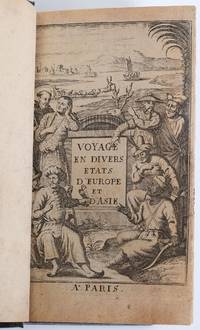
169314946<p><b>1693 CHINA 1ed Avril Travels Asia Arabia Voyages Syria Iraq Iran Russia Poland</b></p><p>Philippe Avril was a 17th-century Jesuit French explorer who spent numerous years in China Tartary and the Middle East. While on his voyages Avril wrote an incredible historical account of his discoveries and experiences. '<i>Travels in the Divers Parts of Europe and Asia'</i> covers the entirety of his voyages giving attention to each country he visited including Syria Kurdistan Iraq and Iran Armenia Persia Russia Moldovia Poland and of course China.</p><p><b>This 1693 first English edition</b> like the original French has regular anti-Catholic and anti-Jewish undertones throughout highlighting cultural superstitions and marking the differences between Christianity and other religious views.</p><p>Item number: #14946</p><p>Price: $1500</p><p>AVRIL Philippe</p><p><b><i>Travels into divers parts of Europe and Asia: undertaken by the French King's order to discover a new way by land into China. Containing many curious remarks in natural philosophy geography hydrography and history. Together with a description of Great Tartary and of th different people who inhabit there</i></b></p><p>London : printed for Tim. Goodwin at the Maidenhead over-against St. Dunstan's-Church in Fleetstreet MDCXCIII. 1693. <b>First English edition.</b></p><p><br /></p><p><u>Details</u>: </p><p>· Collation: Complete with all pages</p><p>o 10 191 1; 178 2</p><p>· References: Wing A 4275; ESTC R 16481; De Backer/Sommervogel I 706; Löwendahl 207</p><p>· Language: English</p><p>· Binding: Leather; tight & secure</p><p>· Size: ~6.5in X 4in 16.5cm x 10cm</p><p>· Very rare and desirable</p><p>Our Guarantee:</p><p>Very Fast. Very Safe. Free Shipping Worldwide.</p><p>Customer satisfaction is our priority! Notify us with 7 days of receiving and we will offer a full refund without reservation!</p><p>14946</p><p>Photos available upon request. </p> for Tim. Goodwin, at the Maidenhead over-against St. Dunstan's-Church in Fleetstreet hardcover
168457732à Paris: Chez Etienne Michalet 1684. Fine. Chez Etienne Michalet à Paris 1684 9 x 16 cm relié Rare first edition illustrated with several diagrams in the text and 3 plates of leveling instruments invented by Picard for the leveling of the château de Versailles. Edition produced by Philippe de la Hire after Jean Picard's death and from manuscripts found at his residence. Contemporary full speckled brown sheep binding. Decorated spine with raised bands. Brown calf title label. 3 corners slightly bumped. Rubbing. Good copy. The work is divided into distinct chapters the first being a theory of leveling in relation to the earth's surface those that follow being an application of this theory and practical examples of leveling. One finds there for example the way to bring water to Versailles through measurements despite differences in terrain. The last part concerns the measurement of the earth. Picard had been charged by the Académie des sciences to measure one degree of meridian. The result found by Picard was the most accurate found at that time and allowed science and notably Newton to pursue his work on universal gravitation whereas he had been hindered by imprecise and faulty measurements. Chez Etienne Michalet hardcover
168560607La Haye Moetjens 1685. 12mo. In contemporary full vellum. Light soiling to extremities. Worm-tract in margin of pp. 359-401 not affecting text otherwise a nice copy. 1-14 15-404 5 pp. 3 plates. <br/><br/><em>This third edition of one of the first works to deal with the gastronomic and healing qualities of coffee tea and chocolate and the first work in any language to describe the three new beverages of the seventeenth century. This is the only edition having the appendix consisting of a dialogue about the medical properties between a physician an Indian and a civilist. Vicaire p. 293-94. </em> hardcover
16855021242050<p>"Traitez Nouveaux & Curieux du Café du Thé et du Chocolat. Ouvrage Également Nécessaire aux Medecins & à Tous Ceux qui Aiment Leur Santé." by Philippe Sylvestre Dufour Jean Girin & B. Riviere 1685. First Edition. French language. 20 445 5 pp. Added engraved title page with 3 frontispiece engravings one each for treatise: on coffee tea and chocolate. 12mo 16x8.5 cm 6¼x3½" period calf raised bands spine lettered in gilt. Moderate binding wear with cracked joints and some worming; title page with several holes possibly burn marks engraved title with short tear to fore-edge affecting image throughout light foxing some toning overall still Very Good.</p><p>This book is one of the first comprehensive European treatises on coffee tea and chocolate detailing their origins preparation medicinal properties and cultural importance. It helped introduce and popularize these beverages in Europe during the late 17th century a time when they were still considered novelties.</p> Jean Girin & B. Riviere hardcover
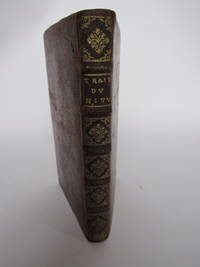
1685743Lyon: Jean Girin & Barthélemy Rivière 1685. First edition. <br /> <br /> A landmark in the cultural and scientific history of coffee tea and chocolate — the three “new beverages†of early modern Europe. Written by Philippe Sylvestre Dufour 1622–1687 a Lyon apothecary physician and merchant this 1685 first edition is among the earliest treatises devoted to the preparation medicinal properties and social virtues of these drinks. Dufour discusses the origin of coffee in the Ottoman Empire tea in China and cacao in the Americas blending pharmacological observation with moral reflection on their consumption. The work marks an important moment in the spread of global trade and early modern dietary theory illustrating how exotic imports became staples of European life and medicine.<br /> <br /> Illustrated with three full-page engravings and an engraved frontispiece including a striking depiction of an Ottoman coffee drinker a Chinese tea ceremony and a native American holding a chocolate vessel. These plates helped define the visual iconography of coffee and chocolate in the 17th century. Dufour’s Traitez became the foundational French-language reference on these drinks influencing subsequent European authors. This copy shows early marginal notes and the presence of all plates noted for the true first edition confirming its completeness and authenticity.<br /> <br /> Condition & Binding: Contemporary full mottled calf spine gilt in compartments with floral ornaments and gilt title “TRAITÉ DU CAFÉ.†Light rubbing and edge wear; some cracking along joints but binding remains solid and entirely original. Mild staining and toning to a few leaves; scattered foxing consistent with age. Engravings crisp and well-inked showing excellent impression quality. Early manuscript notes on title and endpaper likely from an 18th-century hand. Overall- good. Jean Girin & Barthélemy Rivière unknown
169328644A la Haye Adrian Moetjens 1693. 12mo. Cont. full calf. Gilt back and gilt titlelabels. Edges worn especially lacking outer part of backcover. Engraved title showing an Arab a Chinese and an Indian drinking their products and printed title. 1-1415-4044 pp. and 3 engraved plates depicting the appropriate plants together with their cultivators. Somewhat brownspotted. Plates shaved traces of use. <br/><br/><em>This third edition is the only edition having the appendix consisting in a dialogue about the medical properties between a physician an Indian and a civilist. - Vicaire p. 293-94. </em> unknown
1685262811Lyons: Girin 1685. hardcover. very good. 3 full page copperplate engravings and 4 engraved chapter headings. Thick 12mo 22 445 5 pages rubricated title and edges full calf gilt spine chipped and worn. Lyons: Jean Girin & B. Riviere 1685. Scarce. Very good .<br/> <br/> Sabin 21146; Wellcome II p. 494; Bitting 134.<br/> <br/> Girin unknown
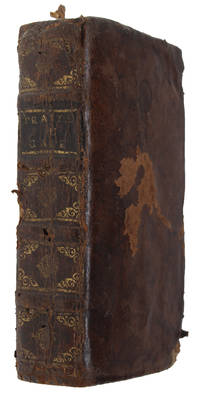
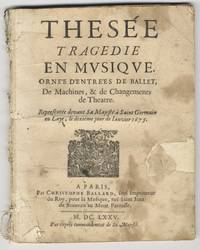
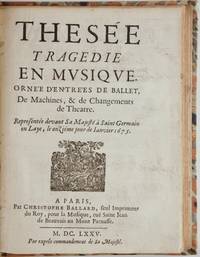
167539713Paris: Christophe Ballard seul Inprimeur du Roy pour la Musique ruë Saint Jean de Beauvais au Mont Parnasse . Par exprés commandement de Sa Majesté 1675. Quarto. Disbound. 1f. recto title verso blank 1f. "Acteurs du Prologue" 3ff. "Prologue" 1f. "Acteurs de la Tragedie" 70 pp. With woodcut device to title including Apollo with lyre figures in Greco-Roman dress with harp and lute and a pegasus; woodcut headpieces to each act; decorative woodcut initials and tailpieces throughout.<br /> <br /> Full named cast lists for the "Acteurs du Prologue" and the "Acteurs de la Tragedie."<br /> <br /> Somewhat worn browned foxed soiled and stained a bit heavier to title; some worming especially to lower inner margins; stub of front free endpaper and blank preliminary leaf preceding title; first signature detached; loss to blank outer margin of title repaired with contemporary paper; blank outer margin of all leaves of "Prologue" repaired with contemporary paper; numerous additional leaves with contemporary paper reinforcements to inner margins; other minor defects. Lacking first leaf of Prologue pp. 65-66 and pp. 71-76. First Edition first issue all other issues with a date of first performance as 11 January 1675. This issue not in Sonneck Librettos. Schmidt LLC3-1. <br /> <br /> Thesée a tragédie en musique in a prologue and five acts to a libretto by Quinault after Ovid's Metamorphoses was first performed at St Germain-en-Laye on 11 January 1675.<br /> <br /> "The orchestra and chorus are used with brilliant effect in several divertissements but especially in the evocation of battle throughout Act 1. Medea's role like that of Lully's final lovesick sorceress Armide is replete with expressive monologue airs: 'Doux repos' 'Dépit mortel' 'Sortez Ombres' and 'Ah! faut-il me venger'. Thésée was part of the standard repertory at the Paris Opéra from 1675 until 1767; in addition it was selected to represent Lully when in 1779 the Opéra presented an historical survey of French operatic styles. Lully's score was substantially modernized by editors for productions from 1754 onwards." Lois Rosow in Grove Music Online. Christophe Ballard, seul Inprimeur du Roy, pour la Musique, ruë Saint Jean de Beauvais au Mont Parnasse ... Par exprés command unknown
167539689Paris: Christophe Ballard seul Imprimeur du Roy pour la Musique ruë Saint Jean de Beauvais au Mont Parnasse . Par exprés commandement de Sa Majesté 1675. Small quarto. Modern marbled boards with paper title label to upper and spine. 1f. recto title verso blank 1f. "Acteurs du Prologue" 4ff. "Prologue" 1f. "Acteurs de la Tragedie" 76 pp. With woodcut device to title including Apollo with lyre figures in Greco-Roman dress with harp and lute and a pegasus; exceptionally fine woodcut headpiece to Prologue and additional headpieces to each act; decorative woodcut initials and tailpieces throughout.<br /> <br /> Full named cast lists for the "Acteurs du Prologue" and the "Acteurs de la Tragedie."<br /> <br /> Small holes to blank inner margins from previous sewing; slightly worn; very occasional minor foxing soiling and stains; minor loss to blank upper outer corner of pp. 31/32. First Edition fourth issue. Sonneck Librettos p. 1069. Schmidt LLC3-2.3. <br /> <br /> Thesée a tragédie en musique in a prologue and five acts to a libretto by Quinault after Ovid's Metamorphoses was first performed at St Germain-en-Laye on 11 January 1675.<br /> <br /> "The orchestra and chorus are used with brilliant effect in several divertissements but especially in the evocation of battle throughout Act 1. Medea's role like that of Lully's final lovesick sorceress Armide is replete with expressive monologue airs: 'Doux repos' 'Dépit mortel' 'Sortez Ombres' and 'Ah! faut-il me venger'. Thésée was part of the standard repertory at the Paris Opéra from 1675 until 1767; in addition it was selected to represent Lully when in 1779 the Opéra presented an historical survey of French operatic styles. Lully's score was substantially modernized by editors for productions from 1754 onwards." Lois Rosow in Grove Music Online. Christophe Ballard, seul Imprimeur du Roy, pour la Musique, ruë Saint Jean de Beauvais au Mont Parnasse ... Par exprés command unknown
166682624Parisiis: Simonem Benard 1666. First Edition . Hardcover. Good/No Jacket Issued. 8vo - over 7¾" - 9¾" tall. hardcover with original leather spine and rear cover and later leather front cover xvi 1-626 pp plus 44 index pages binding chipped and rubbed internally a very good clean and complete copy. scarce. <br/> <br/> Simonem Benard hardcover
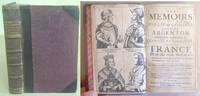
167448087for John Starkey at the Miter in Fleet Street within Temple Bar 1674. 1st edition thus. Hardback. Later half morocco VG. xxiv611pp4pp publishers catalogue engraved frontis stoutly rebound in mid Victorian half morocco the binder has shaved the top margin close with slight loss to the running title to some pages a nice copy. Popular memoirs of immense importance largely because of Comines' cynical and forthright attitude to the events and machinations he decribes. His writings reveal many of the less savory aspects of the reign of Louis XI and Commines related them without apology insisting that the late king's virtues outweighed his vices. He is regarded as a major primary source for 15th century European history. Philippe de Commines 1447 - 1511 writer and diplomat at the courts of Burgundy & France. Denis Godefroy 1615 - 1681 historian who specialised in the Hundred Years War and the reigns of Charles VII of France Charles VIII of France & Joan of Arc. STC C5543. for John Starkey at the Miter in Fleet Street within Temple Bar hardcover
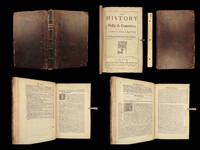
167426006<p><strong>1674 Philippe Commines ENGLISH Memoirs Kings Louis XI Charles VIII France FOLIO</strong></p><p>Philippe de Commines was a 15th-century Burgundian diplomat whose '<em>Memoires'</em> helped him become the first critical and philosophical historian of modern literature. This collection of essays and entries reveal many of the faults and scandals of the reign of Louis XI. Even though Commines supported the king the content of the '<em>Memoirs'</em> portrays Louis XI negatively. Commines and this work are considered one of the primary sources of 15th-century European history. In addition to the court of Louis XI Commines discusses Italian wars during the reign of Charles VIII of France.</p><p>This beautiful 1674 folio edition of Comines' "<em>Memoirs</em>" was published by Mearne and Martyn. </p><p>Item number: #26006</p><p>Price: $750</p><p>COMINES Philippe de</p><p><strong><em>The history of Philip de Commines knight Lord of Argenton</em></strong></p><p>London: Printed for Samuel Mearne John Martyn and Henry Herringman 1674.</p><p><u>Details</u>: </p><p><!-- if !supportLists-->· <!--endif-->Collation: Complete with all pages</p><p><!-- if !supportLists-->o <!--endif-->16 348</p><p><!-- if !supportLists-->· <!--endif-->Language: English</p><p><!-- if !supportLists-->· <!--endif-->Binding: Leather; tight and secure</p><p><!-- if !supportLists-->· <!--endif-->Size: ~11.75in X 7.75in 30cm x 20cm</p><p>Our Guarantee:</p><p>Very Fast. Very Safe. Free Shipping Worldwide.</p><p>Customer satisfaction is our priority! Notify us with 7 days of receiving and we will offer a full refund without reservation!</p><p>26006</p><p>Photos available upon request. </p> for Samuel Mearne, John Martyn, and Henry Herringman hardcover
160162363London: Imprinted at London by Ar. Hatfield for I. Norton 1601. Second edition in English. Title page within large historiated woodcut border bearing the royal arms and motto "Honi soit qui mal y pense" the crest of Burghley and the printer's beehive device; several large inital woodcut capitals throughout and genealogical table in rear. 16 364 pp. 1 vols. Small folio. Bound in contemporary paneled calf central gilt lozenge last nine leaves of genealogical tables have contemporary manuscript notes. Upper covers split and pulling away from boards which are nevertheless firmly attached by cords; front free endpaper missing; internally very good. Second edition in English. Title page within large historiated woodcut border bearing the royal arms and motto "Honi soit qui mal y pense" the crest of Burghley and the printer's beehive device; several large inital woodcut capitals throughout and genealogical table in rear. 16 364 pp. 1 vols. Small folio. Second edition in English of a primary source for 15th century European history. Commines has been called "the first critical and philosophical historian since classical times" Oxford Companion to English Literature principally for his shrewd and practical insight into the political realities of his day his psychological insight and his forthright account of the machinations of the politicians he described. His history is divided into 8 books the first six of which deal with the reign of Louis XI; the last two deal with the Italian wars of Charles VIII ending with his death<br /> <br /> Thomas Danett's English translation was first published in 1596. In his dedication to Lord Burghley dated 1 Nov. 1596 Danett states that thirty years before he presented Lord Burghley and "the late Earle of Leicester my Lord" his 'historie of Commines rudely translated into our vulgar toong' and that he later revised and enlarged his translation at the request of Sir Christopher Hatton. According to the DNB Danett fl. 1566-1601 was also the author of the following works: "1. The Description of the Low Countreys and of the Prouinces thereof gathered into an Epitome out of the Historie of Lodouico Guicchardini' London 1593 dedicated to Lord Burghley. 2. A Continuation of the Historie of France from the death of Charles the Eight where Comines endeth till the death of Henry the Second 1559 collected by Thomas Danett gentleman' London 1600 dedicated to Lord Buckhurst. ." STC 5603 Imprinted at London by Ar. Hatfield for I. Norton unknown
16141230372London: Imprinted for John Brill 1614. Third Edition. Hardcover. Hardcover. 4to - over 9¾ - 12" tall. Very good condition. xvi 366 pages of text. Newly rebound in hardcover charcoal linen with a maroon leather spine label. New endpapers added with original endpapers retained. Illustrated title page and numerous woodcut initials in-text. Early marginalia on the title page preface and final endpaper including the name Leo Agbirowz. The page edges are slightly trimmed and there is minor to moderate soiling and staining scattered here and there. This is the third edition in English the first being in 1596. Philippe de Comines 1447-1511 was a French diplomat in the courts of Kings Louis XI and Charles VIII. His work is famed as a realistic view of the Machiavellian intrigue at the French court. The latter section of the work is an important contemporary account of the Italian Wars of the late 15th century which ended with Charles VIII's death in 1498. Imprinted for John Brill hardcover
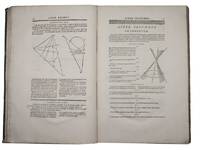
16854671Paris: Etienne Michallet 1685. 19th-century boards ca. 1820 covered with blue paste-paper sewn on 4 cords with gold-tooled red vellum spine-label. Large folio 38 x 26 cm. With a charming woodcut headpiece at the beginning of the main text with a perspective drawing of sliced cones and double cones in a decorative border hundreds of woodcut diagrams in the text woodcut tailpieces one repeated on the title-page 2 woodcut decorated initials 2 series and numerous decorations built up from cast fleurons. First and only early edition in Latin of a comprehensive and influential text book on conic sections discussing the standard classical Greek work of Apollonius the projective methods of Desargues and the application of Cartesian analytical geometry by the artist mathematician and astronomer Philippe de La Hire "among the best of the followers of Desargues and Descartes" DSB. It "seemed to be the last word on the subject" and La Hire's "pre-eminence in this field" was still acknowledged in 1738 Kemp p. 121. La Hire here provides the clearest and most fully developed presentation of the projective principles pioneered by Desargues whose work became generally known through La Hire's further development and improved presentation of his ideas. With a few leaves slightly browned 2 severely or foxed the last leaf extensively but otherwise in very good condition and largely untrimmed with many deckles intact and large margins. Binding rubbed and spine damaged.l Honeyman coll. 1886; Kemp The science of art pp. 221-222 & passim; for La Hire: DSB VII pp. 576-579. Etienne Michallet, hardcover
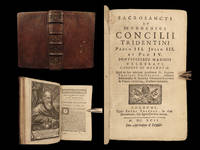
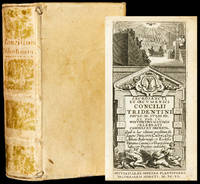
169224445<p><strong>1696 Council of Trent Catholic Chifflet Papacy Popes Forbidden Book Inquisition</strong></p><p>In the century following the Council of Trent numerous important treatises on the famed ecumenical council were regularly published and reprinted. These works especially that by Philippe Chifflet were written to bring clarity and understanding to Europe's attempts at Protestant reforms and many of these books were placed on the Prohibited Books Index by the Catholic Church. </p><p>This 1696 edition of Chifflet's "<em>Council of Trent</em>" was published in Lyon. </p><p>Item number: #24445</p><p>Price: $499</p><p>CHIFFLET Philippe</p><p><strong><em>Sacrosancti et oecumenici Concilii Tridentini Paulo III. Julio III. et Pio IV. Pontificus Maximis celebrati canones et decretal</em></strong></p><p>Lugduni: typis Petri Valfray 1692.</p><p><u>Details</u>: </p><p><!-- if !supportLists-->· <!--endif-->Collation: Complete with all pages </p><p><!-- if !supportLists-->o <!--endif-->24 342 2 LXVIII 100</p><p><!-- if !supportLists-->· <!--endif-->Provenance: Handwritten – <em>Petri Joannis Durand</em></p><p><!-- if !supportLists-->· <!--endif-->Language: Latin</p><p><!-- if !supportLists-->· <!--endif-->Binding: Leather; tight and secure</p><p><!-- if !supportLists-->· <!--endif-->Size: ~5.5in X 3in 14cm x 7.5cm</p><p>Our Guarantee:</p><p>Very Fast. Very Safe. Free Shipping Worldwide.</p><p>Customer satisfaction is our priority! Notify us with 7 days of receiving and we will offer a full refund without reservation!</p><p>24445</p><p>Photos available upon request. </p> Petri Valfray hardcover
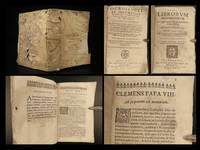
165720576<p><b>1657 Council Trent Catholic Chifflet Popes Banned Book Index Inquisition RARE</b></p><p>Philippe Chifflet wrote one of the most famous and important treaties on the Council of Trent in 1640. It saw reprints in various languages for over 100 years after its inception. Chifflet sought to bring clarity and understanding to Europe's attempts at Protestant reforms consequently Chifflet's books were placed on the Prohibited Books Index by the Catholic Church. This late 17th-century printing was published by Ferrand in Rouen France who included a printing of the Prohibited Books Index at the end.</p><p>Item number: #20576</p><p>Price: $599</p><p>CHIFFLET Philippe</p><p><b><i>Sacrosancti et oecumenici concilii tridentini sub Paulo III. Iulio. III. et Pio IV. Pont. Max. celebrati canones et decreta</i></b></p><p>Rothomagi Rouen: Apud Antonium Ferrand in gradibus Palatii 1657.</p><p><br /></p><p><u>Details</u>:</p><p>· Collation: Complete with all pages</p><p>o Council of Trent – 32 365 3 </p><p>o <b>Prohibited Books Index – 109 1</b></p><p>· Language: Latin</p><p>· Binding: Vellum; secure</p><p>· Size: ~6.25in X 4.25in 16cm x 10.5cm</p><p>· Quite scarce</p><p>Our Guarantee:</p><p>Very Fast. Very Safe. Free Shipping Worldwide.</p><p>Customer satisfaction is our priority! Notify us with 7 days of receiving and we will offer a full refund without reservation!</p><p>20576</p><p>Photos available upon request. </p> Antonium Ferrand, in gradibus Palatii hardcover
16407546CB1640. Antwerpen Balthasar Moretus 1640. 12°. 24 Bl. 358 S. 1 Bl. LXXII S. 31 Bl. Mit ganzs. Kupfertitel und 3 Holzschnittporträts im Text. Pergamentband der Zeit mit handschr. Rückentitel. Häufig aufgelegter Text mit der Beschreibung des Tridentinischen Konzils dies fand von 1545 bis 1563 in drei Tagungsperioden Sessio I bis XXV statt. Hauptanlass war die Notwendigkeit auf die Forderungen und Lehren der Reformation zu reagieren. Der Schnitt etwas angestaubt und das Papier vereinzelt stockfleckig. unknown
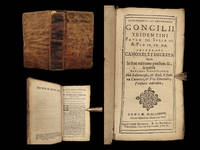
167822742<p><strong>1678 Council of Trent Catholic Chifflet Papacy Popes Forbidden Book Inquisition</strong></p><p>In the century following the Council of Trent numerous important treatises on the famed ecumenical council were regularly published and reprinted. These works especially that by Philippe Chifflet were written to bring clarity and understanding to Europe's attempts at Protestant reforms and unfortunately many of these books were placed on the Prohibited Books Index by the Catholic Church. </p><p>This 1678 edition of Chifflet's "<em>Council of Trent</em>" was published in Genoa. </p><p>Item number: #22742</p><p>Price: $499</p><p>CHIFFLET Philippe</p><p><strong><em>Sacrosancti et oecumenici Concilii Tridentini Paulo III. Iulio III & Pio IV. PP. MM. celebrati Canones et decretal</em></strong></p><p>Genoa: Iuxta copiam Io. Dominici Peri apud Ioseph Bottarum & Io. Baptistam Tiboldum 1678.</p><p><u>Details</u>: </p><p><!-- if !supportLists-->· <!--endif-->Collation: Complete with all pages </p><p><!-- if !supportLists-->o <!--endif-->24 302 lix 83</p><p><!-- if !supportLists-->· <!--endif-->Language: Latin</p><p><!-- if !supportLists-->· <!--endif-->Binding: Vellum; tight and secure</p><p><!-- if !supportLists-->· <!--endif-->Size: ~5.5in X 3in 14cm x 7.5cm</p><p>Our Guarantee:</p><p>Very Fast. Very Safe. Free Shipping Worldwide.</p><p>Customer satisfaction is our priority! Notify us with 7 days of receiving and we will offer a full refund without reservation!</p><p>22742</p><p>Photos available upon request. </p> Iuxta copiam Io. Dominici Peri apud Ioseph Bottarum, & Io. Baptistam Tiboldum hardcover