Boulle PierreBiblio.com
126 résultats
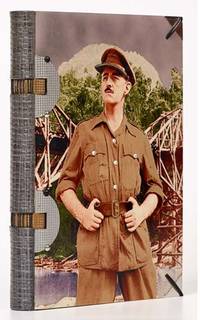
195240<p>Pierre Boulle</p><p>Le Pont de la rivière Kwaï</p><p>Paris René Julliard 1952. 12mo. 236 pp. and 1 leaf of colophon. Binding signed by Jean de Gonet dated 2018. Rigid boards in MDF with corners in stainless steel and ebony with the application of a digital photograph—a film still portrait of Alec Guinness. On the front board the photograph has been reworked: the belt buckle has been reconstructed in brass; all the buttons of his shirt replaced with ivory buttons; and the visor of his cap recreated in ebony highlighted with a brass rod in slight relief. Sewing on two beige straps with strap pieces in silvered calf riveted with ebony. Spine in silvered calf. Doublures in black nubuck endpapers in green nubuck. Dimensions: 185 × 125 mm. Original wrappers and spine preserved. First edition. One of 25 copies on "Corvol l'orgueilleux" paper the only large-paper issue no. 18. <strong>A stunning binding by Jean de Gonet.</strong> <em>The Bridge over the River Kwai</em> is along with <em>Planet of the Apes</em> Pierre Boulle's most famous novel. The author drew on his own experience: an agent of the Free French in Southeast Asia he was sentenced to life at hard labor and escaped only after two years. Popularized by the film <em>The Bridge on the River Kwai</em> directed by David Lean and accompanied by its famous score it remains one of the most widely translated French works in the world. Notable differences exist between the novel and the film however since in the book the bridge is not destroyed at the end. Jean de Gonet is undoubtedly the greatest bookbinder of our time and this binding renders obsolete the faltering attempts of so-called "contemporary binding." He has created a montage based on images from David Lean's film showing Alec Guinness standing out against the bridge. The portrait of the actor is particularly well chosen expressing both the uprightness and determination of the character as well as his somewhat blinkered rigidity. At first glance one does not immediately perceive the subtle and playful additions introduced by Jean de Gonet: the cap visor in relief made of a gilded brass wire the buttons of the uniform in ivory inlays and the belt buckle reconstructed in brass. Beyond their technical virtuosity these additions carry meaning. Colonel Nicholson thus appears as a puppet the binder conveying his blind obedience to hierarchy and rules. This is the most recent binding produced by Jean de Gonet who in recent years has worked only according to his own inspiration offering some of his most free and striking creations.</p> René Julliard