CAMUS AlbertABAA

99 résultats
1948636891948. PRASSINOS Mario. CAMUS Albert. L' ETAT DE SIEGE: spectacle en trois parties. Paris: Gallimard 1948. Limited edition: From an edition of 1050 numbered copies on alfa Navarre bound in decorated paper-covered boards after a maquette by Mario Prassinos this is one of 60 specially numbered copies that were not offered for sale; this copy is number LV. Small 8vo.: 237 pp. Publisher's artist-style binding; bound in white paper boards decorated in gold and black with patterned endpapers. Light dust-soiling to top-edge of book block but internally fresh. Some sunning to top-edge of boards and spine with some occasional light soiling and joints are just starting at the top-edge. Very good plus. unknown books
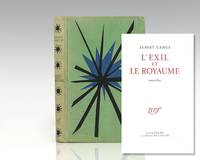
194795102Paris: Gallimard 1947. First edition of Camus' short story collection exploring themes of existentialism and absurdism. Octavo original cloth. One of only 950 numbered copies this is number 783. In near fine condition. Rare and desirable. This collection of six short stories covers the whole variety of existentialism or absurdism as Camus himself insisted his philosophical ideas be called. The six works collected in this volume include: The Adulterous Woman The Renegade of a Confused Spirit The Silent Man The Guest Jonas or the Artist at Work and The Growing Stone. The final story most clearly manifests Camus' existential ideals with a protagonist who actively shapes his life in spite of receiving a deep insight into the absurdity of the world and acting morally nevertheless. Gallimard hardcover books
1818599921818. Paris 1805. 2 vols. Fourth edition. Paris 1805. 2 vols. Fourth edition. Handsomely Bound Copy of an Important French Legal Reference Camus Armand Gaston 1740-1804. Dupin Andre-Marie-Jean-Jacques 1783-1865 Editor. Lettres Sur La Profession D'Avocat; Bibliotheque Choisie des Livres de Droit Qu'il est le Plus Utile d'Acquerir et de Connaitre. Quatrieme Edition. Augmentee de Plusieurs Lettres et Autres Pieces Interessantes sur la Profession d'Avocat Telles que le Celebre "Dialogue des Avocats" de Loisel; Deux "Discours" de M. d'Aguesseau et l'Histoire de l'Ordre des Avocats" Par M. Boucher d'Argis; La Bibliographie Revue Corrigee et Augmentee d'un Grand Nombre d'Articles Nouveaux. Paris: Chez B. Waree 1818. 2 volumes. xlviii 535; xii 690 pp. Octavo 8-3/4" x 5". Contemporary mottled sheep gilt ornaments and lettering pieces to spines marbled endpapers. Some rubbing to extremities corners bumped hinges starting chipping to head of Volume II rear joint of that volume starting at foot. Light toning to text somewhat darker in places light foxing to a few leaves. Early owner signature to title page of Volume I interiors otherwise clean. $300. Fourth edition. Sweet and Maxwell include this in its list of major bibliographies and notes: "the second volume is a descriptive bibliography of French English foreign and Roman law well indexed. The bibliography lists 2348 books and provides historical critical and bibliographical notes on several remarkable books of French jurisprudence." Sweet & Maxwell A Legal Bibliography of the British Commonwealth 1:1-2 7. unknown books
195457507NY: Knopf 1954. First US Edition. 8vo pp. 273. A VG tight copy in some scuffed and chipped dj.The scarce first edition. "By one of the most profoundly influential thinkers of our century 'The Rebel' is a classic essay on revolution. Knopf unknown books
195580077NY:: Knopf. Very Good in Very Good dust jacket. 1955. Hardcover. Translated from the French by Justin O'Brien. Stated first American edition. Previous owner's name and date on front free endpaper else very good in a very good minor edge wear with two short closed edge tears age toning along the spine and on rear panel price clipped dust jacket.; 212 pages . Knopf, hardcover books
199873894New York: Everyman's Library 1998. First Everyman's library edition of Camus' first novel and masterpiece which was translated as The Stranger in the United States. Octavo bound in full morocco by the Chelsea Bindery gilt titles to the spine raised bands top edge gilt. Introduction by Peter Dunwoodie. Translated by from the French by Joseph Laredo. In fine condition. Through the story of an ordinary man unwittingly drawn into a senseless murder on an Algerian beach Camus explored what he termed "the nakedness of man faced with the absurd." With the publication of this first novel L'Etranger Camus introduced his lifelong attempt to reconcile a philosophy of heroic nihilism with "the ideal of human fraternity" Encyclopedia of Philosophy. It remains one of the classic works of the twentieth century and Le Monde ranks it as number one on its 100 Books of the Century. Everyman's Library hardcover books
1946192354Alfred Knopf: New York 1946. First American Edition. Hardcover. Good. First American Edition. Beige cloth boards have minor wear with light dust soiling. Clean has a good binding old name and address Asheville NC is written inside on the front pastedown- no other marks or notations. 154 pages. Foxed endpapers. Alfred Knopf: New York hardcover books
197130087Paris: Gallimard 1971. First edition. Wrappers fine. Copy 22 of 106 on Holland van Gelder paper tirage de tête. <br/><br/> Gallimard unknown books
196130080Liège: Editions Dynamo 1961. First separate edition. Copy 3 of 11 printed on Hollande paper from a total edition of 51 copies published on the first anniversary of Camus's death. Fine. <br/><br/> Editions Dynamo unknown books
197894698Paris: Editions Andre Sauret 1978. The Sauret deluxe illustrated edition of the works of Albert Camus. Quartos 8 volumes bound in full brown morocco with gilt titles to the spine elaborately illustrated throughout. In near fine condition. Each volume housed in the original custom slipcase. Focusing most of his philosophy around existential questions Albert Camus addressed the absurdity and inevitable ending of life in his several novels short stories plays and essays. Rejecting nihilism Camus devoted his life to embracing the meaninglessness of man's existence delving deeply into the concept of individual freedom. He won the Nobel Prize in Literature at the age of 44 in 1957 the second youngest recipient in history. Editions Andre Sauret unknown books
1940149802N.p.: N.p. 1940. Draft English language script of Camus' 1944 play. Ribbon copy typescript on onionskin circa 1940s largely faithful to the 1947 Stuart Gilbert English translation "Caligula and Cross Purpose" but with modifications made apparently for a smaller production. The adaptation includes the removal of incidental characters patricians knights poets guards and servants with their dialogue frequently merged with that of secondary characters the creation of an added "porch" set piece utilized to retain some dialogue otherwise lost the the simplification or removal of more elaborate set pieces and other minor editorial changes. <br/><br/>No information regarding the date or location of the production or intended production nor the translator or editor of this typescript is known.<br/><br/>Begun in 1938 and subject to numerous revisions "Caligula" was finally published in 1944 by Editions Gallimard first jointly with "The Misunderstanding" then alone later the same year. Part of Camus' "Cycle of the Absurd" with the 1942 novel "The Stranger" and the 1942 essay "The Myth of Sisyphus." The play premiered at the Theatre-Hebertot Paris September 9 1945 directed by Paul Oettly starring Gerard Philipe Michel Bouquet and Margo Lion.<br/><br/>Caligula third Roman Emperor Gaius Julius Germanicus after having been missing for three days following the death of his sister and lover Drusilla returns with a belief in 'absolute logic' which incurs the humiliation torture and murder of as many men and women as he can seeking 'total freedom' and leading to his own assassination. <br/><br/>Set in 41 AD Rome. <br/><br/>Beige title wrappers. Title page present with credits for playwright Albert Camus. 80 leaves with last page of text numbered IV--19. Ribbon copy typescript on onionskin rectos only. Pages 5.5 x 8.5 inches Near Fine with light wrinkling on first two leaves wrapper 6.5 x 9.5 inches Very Good plus with splitting on bottom half of spine bound internally with three gold brads. N.p. unknown books
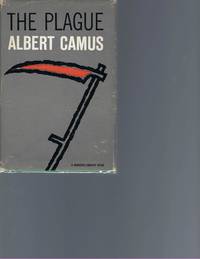
16911CAMUS Albert. The Plague. First Edition. Originally published in France as "La Peste "in 1947 our First English Edition was published by Knopf in New York in 1948. Publisher's scarce original blindstamped green cloth covers gilt lettering to spine. In original unclipped dustjacket. 278 numbered pages measures approximately 5" x 7.25" inches. In very good to near fine condition. Textblock firm pages clean. Original ownership signature on half-title. Dustjacket has some rubbing. <br/><br/> The Plague which tells the story of a plague sweeping the French Algerian city of Oran is considered an existentialist classic. The novel stresses the powerlessness of the individual characters to affect their destinies. Along with the novel's existentialist themes The Plague has also been read as an allegorical treatment of the French resistance to Nazi occupation during World War II. The novel became a bestseller during the worldwide COVID-19 pandemic. unknown books
1948140941024London: Hamish Hamilton 1948. First British Edition. Very Good/Good. First British edition first printing. Bound in publisher's original blue cloth with red spine titles blocked in silver. Very Good. Lean to binding and uneven sunning to cloth through dust jacket. Former owner names to front free endpaper and pages toned. In a Good unclipped dust jacket with losses at the spine ends toning and edge wear with heavy-handed tape repairs made to the blindside resulting in some active stickiness to the ends of the flap folds where the tape protrudes slightly over the paper. Hamish Hamilton unknown books
1955140941430London: Hamish Hamilton 1955. First British Edition. Near Fine/Near Fine. First British edition and the first English language edition. Bound in publisher's original blue cloth with spine lettered in silver. Near Fine with pages a little toned and a small split started at the rear inner hinge else a fantastic copy in a Near Fine unclipped dust jacket which is spine and edge-toned has several tiny stains and some trivial edge wear. A beautiful copy. Hamish Hamilton unknown books
15233Albert Camus. French author famous for his critique of bourgeouis sentimentality. Later edition in French of his most popular novel L'Etranger which follows the main character's murder trial following the death of his mother. Considered both an important social commentary on the bourgeouis as well as a critical contribution to existentialist literature. Clear and dark signature in pen on the free front end paper. Original paper cover. 12x19cm. Some toning and a handwritten drawing from a previous owner on the verso of the signature page but otherwise in very good condition. unknown books
196594697Paris: Imprimierie Nationale 1965. The Louis XIV national deluxe illustrated edition of the works of Albert Camus with over 90 original lithographs in color by Carzou. Quartos 7 volumes pages loosely bound within black vellum backed wrappers housed in glassine elaborately illustrated throughout with additional suites of lithographs to the rear of each volume. In near fine condition. Each volume housed in the original custom slipcase. Exquisitely illustrated. Focusing most of his philosophy around existential questions Albert Camus addressed the absurdity and inevitable ending of life in his several novels short stories plays and essays. Rejecting nihilism Camus devoted his life to embracing the meaninglessness of man's existence delving deeply into the concept of individual freedom. He won the Nobel Prize in Literature at the age of 44 in 1957 the second youngest recipient in history. Imprimierie Nationale hardcover books
1959173205New York: Reynal & Company 1959. Hardcover. Vg-/VG light tanning and foxing to interior and exterior. foxing to text blocks. moderate corner and edge wear to dust jacket including small edge tears. scuffing to dj. White and color-illustrated boards with black lettering. Red and black dust jacket with black and white lettering. 153 pp. 32 page pamphlet included in separate front pocket. 29 original lithographs 17 in color including 5 double-page. 12 illuminations.61 color illustrations. 77 BW illustrations. Articles: Improvisations by Pierre Reverdy Henri Laurens by Alberto Giacometti May 1920 by Alberto Giacometti Perhaps by Albert Camus Rembrandt Hokusai Van Gogh by W. Sandberg Water Lilies of a Summer Dawn by Gaston Bachelard Monet the Innovator by Andre Masson Reflections of Georges Braque Venice From My Window by Jean-Paul Sartre Spanish Still Life by Jean Cassou Footnote to Reality by Jean Wahl Portraits of the Fayoum by Jean Grenier The Advantages of Ignorance by Louis Guilloux The Dukes' Terence The Renaut of Montauban and the Master of the Flowers by Frantz Calot. 1 of 1000 copies. Reynal & Company hardcover books
194600008149London: Hamish Hamilton 1946 1946. First English language edition. Hardcover. Near Fine/Near Fine. Slim 8vo. 4 3-103 3 pp. Bound in grey-green cloth with gold lettering on the spine. Price of 6s. net on front flap of jacket. First edition in English and Camus' first English publication. Translated by Stuart Gilbert. Introduction by Cyril Connolly. Ahearn Collected Books 157 4th ed. Published in France as L'Étranger in 1942 this novel was number one on Le Monde's 100 Books of the Century. Widely regarded as a classic of twentieth-century literature Camus' novel is the first of several novels he wrote that explore the notion of the absurd within a fictional context in contrast to the more direct and thorough examination of this notion in his philosophical essays. Camus won the Nobel Prize in Literature in 1957. A beautiful copy of this important book Camus' best-known and most acclaimed novel. Near Fine book with a name on the free front endpaper and a faint wrinkle to the last three leaves in a Near Fine dust jacket with a touch of edge wear. Hamish Hamilton (1946) hardcover books
1948119263Paris: Gallimard 1948. First edition of this classic play by the Nobel Prize-winning author. Octavo original wrappers. Presentation copy inscribed by the author on the half-title page "A. M. Antomin <span class="match">en</span> cordial hommage Albert Camus." In near fine condition. Housed in a custom half morocco clamshell box. Written in 1948 The State of Siege--the original sense is closer to state of emergency--is a play in three acts presenting the arrival of plague personified by a young opportunist in sleepy Cadiz and the subsequent creation of a totalitarian regime through the manipulation of fear. In a piece written in 1948 in reply to criticisms from Gabriel Marcel Camus defended his decision to set the play in Spain and not in Eastern Europe citing the ongoing oppression in Spain France's collusion in it and the Catholic Church's abandonment of Spanish Christians. The piece was first performed in October 1948 and was initially received poorly by critics and public who had eagerly awaited the work but expected a dramatization of Camus's novel The Plague. While the two share a common background the treatments are entirely different in tone. Although Camus himself was pleased with the work critics remained unimpressed. The State of Siege has remained constantly in print in French and since 1958 in an English translation by Stuart Gilbert--in Caligula and Three Other Plays. Gallimard unknown books
1946140940653New York: Alfred A. Knopf 1946. First American Edition. Near Fine/Near Fine. First American edition first printing. Bound in publisher's original tan cloth with maroon spine lettering red topstain. Near Fine with light softening to spine ends and light toning to pages in a Near Fine unclipped dust jacket with light edge wear and soiling. A nice copy of the classic existential novel. Alfred A. Knopf unknown books
5222ALBERT CAMUS 1913-1960. Camus was a Nobel Prize-winning French author best known for his absurdism and works like The Stranger and The Plague. TMS. 5pgs. 1945. N.p. A lengthy typescript in French by Albert Camus. It concerns the Spanish Civil War 1936 to 1939. This manuscript was Camus’s preface to the book L’Espagne Libre Paris: Calman-Lévy 1946. Writing just after World War II in which he took an active role in the resistance against the Nazis Camus muses back on the Spanish Civil War often called a “dress rehearsal for World War IIâ€. Camus felt personally connected to the Spanish Civil War since his mother was Spanish. The English translation of his writing is as follows: “It has been nine years now that the men of my generation have carried Spain in their thoughts. Nine years that they carry like a serious wound. That experience has given them their first taste of defeat and the insight really a surprise from which they have barely recovered that you could be in the right and yet be beaten that force could suppress the spirit and that there were times where courage was not rewarded. No doubt that explains why to so many men all over the world the Spanish drama felt like a personal tragedy some realizing that this was the first battle in a war for which neither qualities nor flaws had prepared us. But those very same ones who did not don the mantle of prophecy came to feel with anguish that this war was theirs to the degree that it was a war of liberty. For it was in fact that a war of liberty. We found out about it in the papers even if it was a badly intentioned paper. There are things that today one doesn’t speak about anymore but that back then were fresh and bloody history. And we at least have not forgotten that the Spanish Civil War started out as a general’s rebellion against the democratic institutions that a people had just given themselves liberally. We have not forgotten that this general sent Moorish troops against the people of his country in the name of Christ and German-Italian legions invoking the Holy Spain. In the indignation that overcame us in 1931 despite the warning signs there was the feeling that an injustice had just been committed that had to disappear as quickly as possible if one didn’t want it to remain on Europe’s flank like a sore that was going to fester and grow wider. But the injustice still was to receive its reward that this world always reserves for it. Agencies published the Italian legions’ victorious communiques at the same time as the non-intervention ones. The Spanish Republic firm in its rightfulness teetered in its power and at first with rage then with pain that filled us all started to give birth to anguished amazement that has not left us all these years at the spectacle of an injustice that gradually took on an immense scale of history and that found itself sanctioned both by the defeat of a people and by the cowardice of the world. This world nevertheless perseveres in calling legal what has been established while we continue in vain to call legal what has been given consent. Of all the reasons that the Spanish war has continued to haunt us many undoubtedly have vanished today. The cruelty of that struggle seems to us almost natural after five years of indescribable violence. But you can see what remains: the passion of a people and the spectacle of injustice that was never repaired. The hostilities have been suspended the darkness of the dictatorship has dissipated and so we continue to carry Spain in our thoughts. At the other end of the continent a patch of night yet reminds us of the reasons for this war and of the fact that we were wrong believing it to be finished just as we were wrong nine years ago not believing that it had started. But vanquished courage and injustice consecrated by history are commonplace in this world. And maybe as far as Spain is concerned our indignation would be less strong if we had a better conscience. How would it be when we cannot forget that France is not the only one to respond to some of the assassinations that shook what was left of the European conscience. The death of Frederic Garcia Lopez thus seems to us less tolerable than others. We had entered a period where every free man could reasonably expect that he would one day stand facing guns of execution. We are still in that period and it is natural that a free man justifiably prepares himself or at least takes this likelihood into account when he calculates his chances and his convictions. Lorca’s death was in the order of things in the dirty order in which we have since lived. And the Granada execution put men on alert that they had entered serious times meaning times where poets could be shot by those whom their existence contradicted. At least some of us have seen it that way and are preparing ourselves instead of complaining. But we have to believe that we were not yet prepared enough. For we needed to go further yet do our part of the assassinations and see Antonio Machade die as he was leaving a democratic concentration camp. Some years later and Companys was liberated by a French Marechal to be executed at leisure. How will we be able to forget All of this has colored in red and in black a face that of Spain that we already carry in ourselves but that we can no longer heal. That is why since Barcelona was taken there is an absence in us an emptiness a sense of waiting. In this world that we call liberated there is a country from which we obstinately avert our gaze for it speaks to us of injustice and remorse. We would like peace but it won’t let us have it. Yet would our heart be as anxious if this subjugated land was not at the same time the land of great passion and grandeur No doubt I have my personal reasons of choice. Based on blood Spain is my second home. And in this greedy Europe in this mechanized world where passion is met with derision half my blood has been pondering its exile for seven years and wants to find the only land again where I feel at ease the only land where people know how to unite to a higher degree of necessity the love of living and the desperation of living. But it is not just a personal reaction that rules the hope for a free Spain. All of Europe’s intelligent minds also turn to Spain as if they felt that this sad country held some of the royal secrets that Europe is desperately trying to figure out right through a long list of wars revolutions eras of mechanics and spiritual adventures. In fact what would prestigious Europe be without poor Spain What more staggering has it invented than this powerful and magnificent Spanish summer light where extremes are wed where passion can be indulgent as well as ascetic where death is a reason to live where you bring seriousness to dance and lightheartedness to sacrifice where nobody can tell the border between life and dreams between comedy and truth. While the Western world tears itself up to discover syntheses and formulas Spain offers them up freely. But it can only furnish them in the effort of insurrections the terrible breathing of its liberty. Homeland of revolutionaries the only country where anarchy has been able to establish itself as a powerful organized party its greatest works are calls toward the impossible. In each one the world is accused yet at the same time glorified. Europe and the world for what they now need to find can really no longer do without Spain. But Europe and the world do and in such a natural way that it is hard to believe. But that is the way it is and nothing apparently is of any use but the testimony of the free man. The indignation will last through the ages we know that now. For the last twelve years many Ubu Fathers rose up and we at first laughed about them but they put irresistible mechanisms in the service of their mediocre follies. And these Ubu Fathers were masters long enough that at their defeat men were still blind. You have to believe it at least since we let the latter continue their parade in what was the country of Cervantes. For the past seven years the grotesque has been the only Spanish product to manifest itself there. And we who know the value of the grotesque when it has a police we support that it continue gagging the people of the revolution and that above Spain the windmills of stupidity and cruelty keep turning. And not only do we support the grotesque but we also sign treatise with them. The democrats are hungry and honor does noy count for much when you can have some oranges. The lasting smell of those oranges will mingle with the memory of Machade and Companys. Too bad if in the end we have a change of heart. Why get upset The realists say that this does not concern us that you have to leave people to take care of their own business and that finally we didn’t fight for Spain but against Germany. Democracy from all it seemed means not to worry about others. But we learned that democracy means no borders. Misunderstood in one place it is threatened altogether. And we know better than the realists why we fought. We fought so that free men could look at each other without shame and so that each man would be in charge of his own happiness and would judge himself without carrying the constricting weight of others’ humiliation. That man today can feel himself or actually be free as long as this land of liberty stays entrusted to an arbiter. Every time a man somewhere in the world is weighed down with chains we are at the same time bound. Freedom must be for all or for no one. That is the only formula of democracy that is worth the sacrifice. Here at least in the following pages the testimony of some men who feel they are still not quite free. It is the work of those who have not signed commercial treatise and who will continue to make do without oranges. And there is no doubt their testimony is symbolic. It has to be. But in this world without memory it is good that some believe in faithfulness. They perhaps will help one day to forgive what in the rage in their hearts they could not prevent. Albert Camus 1945â€. This weighty and heartfelt piece was published as Camus’s preface to the book L’Espagne Libre Paris: Calman-Lévy 1946 which also included contributions by Jean Cassou Jean Camp and others. It has been much quoted over the years even inspiring the title of a recent book on the Spanish Civil War. One page is yellowed and there are corrections and cross-outs one quite large throughout in Camus’s handwriting. unknown books
1946116373New York: Alfred A. Knopf 1946. First American edition of Camus' first novel and masterpiece. Octavo original beige cloth. Presentation copy inscribed by the author on the half-title page "A Muriel Sutman nous ne sommes pas des etrangers <span class="match">Albert</span> <span class="match">Camus.</span>" Near fine in a near fine dust jacket. Jacket design by Warren Chappell. Translated by Stuart Gilbert. Housed in a custom half morocco clamshell box. Presentation copies of The Stranger are rare with only one appearing at auction in the past 70 years. Through the story of an ordinary man unwittingly drawn into a senseless murder on an Algerian beach Camus explored what he termed "the nakedness of man faced with the absurd." With the publication of this first novel L'Etranger The Stranger Camus introduced his lifelong attempt to reconcile a philosophy of heroic nihilism with "the ideal of human fraternity" Encyclopedia of Philosophy. It remains one of the classic works of the twentieth century. Alfred A. Knopf hardcover books
5221ALBERT CAMUS 1913-1960. Camus was a Nobel Prize-winning French author best known for his absurdism and works like The Stranger and The Plague. AM. 5pgs. N.d. 1946. N.p. An autograph manuscript draft of Albert Camus’s famous “The Crisis of Man†or “The Human Crisis†speech. Camus delivered this landmark speech at Columbia University on March 28 1946 during his only trip to the United States. Asked to talk about the French sensibility Camus delivered a compelling meditation about the Second World War and the crisis facing all humanity. The tone is both stirring and thought-provoking. Camus had been a resistance fighter during the war and his experiences obviously color his speech particularly in his descriptions of atrocities committed during the war. In 2016 Columbia held an event to commemorate the 70th anniversary of Camus’s speech. There actor Viggo Mortensen read Camus’s speech to a sold-out crowd in the Miller Theatre – the same venue where Camus had spoken. Even three-quarters of a century after its debut “The Crisis of Man†remains relevant and timely and people continue to reflect on it today. This manuscript is Camus’s draft of the speech. As such it differs in some places from the version he actually delivered. The manuscript is written in French. The English translation is as follows: “When it was suggested to me to do lectures at the EUDA the United States I felt scruples and hesitated. I am not of the age to give lectures and It was in the reflex as well as the categorical affirmation since I don’t show myself in person at what is generally held to be the truth. Having taken notice of my scruples they gave the very polite response that the important thing was not that I have a personal opinion. What was important was that I would in a way bring to France the various elements of information that would permit my audience to form an opinion. As to what about it was proposed that I tell my listeners about the current state of French theater literature and even philosophy. I responded that it might be at least as interesting to speak about the extraordinarily hard work of the French railroad workers and the…of which the miners from the North seem to work. I was told patiently that you should never force your talent and that it was good that the specialists were treated by those who were suspicious of them and that since I had been interested in literary questions for a long time and thus certainly knew nothing about railroad switches it was only natural that I would be asked to speak about literature rather than the railroad. I understood right away. And I agreed in short to speak of what I knew and to give an idea of France. That is precisely why I chose to speak neither of literature nor of the theater. Because literature theater philosophy and maybe even the hard work of railroad workers and mail carriers intellectual research and the hard work of an entire people are only the reflections of a fundamental questioning of a struggle for life and for man reflections that for us make up the entire problem of the time. The French feel that man is quite threatened and that he cannot go on believing a certain idea of man who is not…And that is why out of loyalty to my country I chose to speak of my…And even if it were a matter of speaking about what I knew I did not believe I could do better than retrace as clearly as possible the spiritual experience of people of my generation because that experience has had the whole…of the world crisis and because it may bring a faint shimmer and faith to the destiny of the railroad workers and an aspect of today’s French sensibility. How did that happen In this world that is deprived of value in this desert of the heart where we live what did this revolt mean It made men who say no out of us. But at the same time we were men who say yes. We said no to this world to its essential absurdity to the abstractions that threatened us to the culture of death that was being prepared for us. By saying no we affirmed that things had been like that for long enough that there was a limit that could not be passed. But at the same time we affirmed everything that was beyond that limit; we affirmed that there was something in us that defended the scandal and that was impossible to humiliate too long. And of course that was a contradiction but one that had to make us reflect. We thought that this world was and would continue to be without any real value. But then again there we were fighting against Germany. The men of the Resistance whom I met and who read Montaigne on the trains where they carried their tracts showed at least to us that one could not understand the skeptics while having a notion of honor. But consequently through the simple fact of living of hoping and of fighting we affirmed something. But some thing had a general value – did it extend beyond the thoughts of the individual – did it seem to serve as a rule of conduct The answer is simple. The men I am talking about accepted their death at the start of their revolt. And that death proved that they were sacrificing themselves for the good of a pay-off that went beyond their personal existence and thus their individual destiny. What these revolutionaries defended against an enemy destine was a value that is shared by all men. – When the men were tortured in front of their concierge when the nights were purposefully chopped up when mothers saw themselves forced to condemn their children to death and when the just were buried like hogs these revolutionaries decided that something inside of them was being denied to them that did not belong to them alone but was a common bond where the men found their solidarity all ready. Yes that was the big lesson of these terrible years when the wrong done to a student in Prague would touch a blue-collar worker in a suburb of Paris and when the blood spilled on the banks of a central-European river would bring a Texas farmer to spill his on the soil of the Ardennes that he had never seen before. And that in itself was absurd and crazy impossible almost anyway to imagine. But that absurdity at the same time carried in it the lesson that we were all in a collective tragedy and what was at stake was our common dignity a feeling of communion with each other that was crucial to defend and to maintain. Aside from that we knew how to act and we learned how the individual in the most absolute moral denouement again can find enough values to rule his conduct. For if that communication between individuals in the mutual recognition of their dignity was the truth then it was that communication that had to be helped. And in order to maintain that communication it meant people had to be free because there is nothing in common between a master and a slave and you cannot talk and communicate with someone who is subservient. Yes servitude is a form of silence the most terrible of all. And in order to maintain that communication we had to make sure that injustice would disappear because there is no contact between one who is oppressed and one who profits from it. Envy too is in the domain of silence. And in order to maintain that communication we had to banish lying and violence for someone who lies closes himself off from other people and someone who tortures and uses force imposes the ultimate silence. Aside from the negation of the simple movement of our revolt we also drew moral strength from liberty and sincerity. 2 This crisis then is based on the impossibility of persuasion. People live and can do so only because of the notion that they have something in common where they can always meet. You always believe that by speaking humanely to a person you can get a humane reaction. Yet we have also discovered this: there are people you cannot persuade. It was impossible for a victim in concentration camps to even begin to explain to the SS who were beating her that they shouldn’t do it. The Greek mother whom I have mentioned could not persuade the German officer that the terrible choice he put her in was just impossible. It’s because the SS or the German officer didn’t represent a person anymore or persons but an instinct that had been elevated to an idea or a theory. Passion even if murderous would have been preferable. Because passion has an end and another passion another scream from the heart or flesh can convince it. But a person who is capable of caring sincerely about the ears that he himself has previously torn that man is not impassioned he is mathematical and no one can stop or convince him. 3This crisis is also about the replacement of natural objects with print that is to say the increase of bureaucracy. Contemporary man more and more puts an abstract and complicated machine between himself and nature which throws him back into solitude. When there is no more bread tickets appear. The French have only 1200 calories of nutrition a day but they have at least six different pieces of paper all stamped a hundred times. And it is like that all over the world where bureaucracy has not ceased to multiply. To come to America from France I used a lot of paper in both countries. So much paper that I suspect I could have printed this lecture on some of it and have it copied here without even having to show up. With the help of paper offices and functionaries we are creating a world where human warmth disappears where nobody can touch anybody else unless it is through the maze of what is called formalities. The German officer who flattered my comrade about his wounded ears thought he could do so because he had torn them and it was part of his job as a functionary so consequently that couldn’t be bad. To summarize one only dies or loves or kills anymore by permit. That is what you call at least I think so a good organization. 4 The crisis is also about the replacement of the real person with the political person. Individual passions are no longer possible only collective passions meaning abstract passions. We are all introduced to politics by agreeing or by force. What counts is not that you respect or spare the suffering of a mother but that a doctrine triumphs. And human pain is no longer a scandal but only a numeral in an addition whose terrible sum total cannot be calculated yet. 5 It is clear that all these symptoms are replicated in one single one which is at once the cult of effectiveness and that of abstraction. This is why today’s European knows only solitude and silence. And that is because he cannot join others with their values that they have in common. Since he is no longer defended by human respect based on his values the only alternative open to him from now on is to be victim or else executioner.†This highly-significant manuscript is in fine condition overall. It has some crossouts red pencil underlining light toning a couple of folded corners horizontal folds on every page and a small stain on the third page. unknown books
194697850New York: Alfred A. Knopf 1946. First American edition of Camus' first novel and masterpiece. Octavo original beige cloth. Presentation copy inscribed by the author on the half-title page "A Vincent Sheean pour le remercier de savoir si bien parler de Stendhal Sympathiquement Albert Camus." The recipient Vincent Sheean was an American journalist and novelist. Sheean's most famous work was Personal History which won one of the inaugural National Book Awards: the Most Distinguished Biography of 1935. Film producer Walter Wanger acquired the political memoir and made it the basis for his 1940 film production Foreign Correspondent directed by Alfred Hitchcock. Sheean wrote the narration for the feature-length documentary Crisis 1939 directed by Alexander Hammid and Herbert Kline. He translated Eve Curie's biography of her mother Madame Curie 1939 into English. Sheean wrote Oscar Hammerstein I: Life and Exploits of an Impresario 1955 as well as a controversial biography of Dorothy Thompson and Sinclair Lewis Dorothy and Red 1963. He studied at the University of Chicago becoming part of a literary circle which included Glenway Wescott Yvor Winters Elizabeth Madox Roberts and Janet Lewis while he was there. Near fine in a near fine dust jacket. Jacket design by Warren Chappell. Translated by Stuart Gilbert. Housed in a custom half morocco clamshell box. Presentation copies of The Stranger are rare with only one appearing at auction in the past 70 years. Exceedingly scarce and desirable. Through the story of an ordinary man unwittingly drawn into a senseless murder on an Algerian beach Camus explored what he termed "the nakedness of man faced with the absurd." With the publication of this first novel L'Etranger The Stranger Camus introduced his lifelong attempt to reconcile a philosophy of heroic nihilism with "the ideal of human fraternity" Encyclopedia of Philosophy. It remains one of the classic works of the twentieth century. Alfred A. Knopf hardcover books