7 résultats
1767at076.056GB: James Dickson Edinburgh 1767. DISBOUND PAPMPHLET of 48 pages. Clean unspotted copy but some corner creasing. . VG-. James Dickson (Edinburgh) unknown
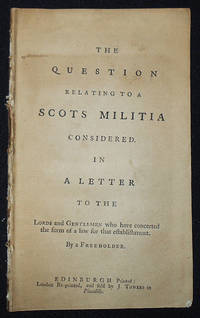
1760010353London: J. Towers 1760. Paperback. Good. 48 p.; 20 cm. Disbound. The anonymous author was Scottish minister Alexander Carlyle 1722-1805. Scarce. In Good Condition: title page is brown and lightly soiled; p. 48 somewhat browned; pages 43-48 are detached but present; p. 5 has 2 ink corrections to the text; otherwise clean and solid. J. Towers paperback
175923900London: printed for M. Cooper 1759. Octavo. 8 5/8 x 5 1/2 inches. 51 1pp. Uncut. Stitched.<br/> <br/> Scarce.<br/> <br/> Carlyle charges the Prime Minister William Pitt the Elder with being too favourable towards France. The discontent amongst army officers in America and the various failed expeditions were all blamed on Pitt's perceived failure to support the military.<br/> <br/> Sabin 42915; ESTC T93350. printed for M. Cooper unknown
175923900London: printed for M. Cooper 1759. Octavo. 8 5/8 x 5 1/2 inches. 51 1pp. Uncut. Stitched.<br/> <br/>Scarce.<br/> <br/>Carlyle charges the Prime Minister William Pitt the Elder with being too favourable towards France. The discontent amongst army officers in America and the various failed expeditions were all blamed on Pitt's perceived failure to support the military.<br/> <br/>Sabin 42915; ESTC T93350. printed for M. Cooper unknown books
179370147Edinburgh: William Creech 1793. First Edition. A Presentation Copy from the Author to Robert Chalmers Esq. 8vo original wraps bound into antique paper covered card binding. 2 45 pp. A fine clean and crisp copy of this rare work. Some wear and age to the card binding the text-block in excellent condition. VERY RARE PRESENTATION COPY OF THE FIRST EDITION. ".with his mind expanded to explore the works of God our pupil may venture to look within himself; to study the science of mind or spirit; to investigate the intellectual the active and moral powers of man the most mysterious and difficult of all the sciences; tha with faculties enlarged and more infallible sagacity he may be able to search to the bottom the principles of ethics and politics as they are displayed with such boundless diversity in the history of man either as an individual or in society." This erudite sermon represents an important contribution to the literature of the age as it pertains to the usefulness of a rich education and deep reading and study by the clergy. William Creech paperback
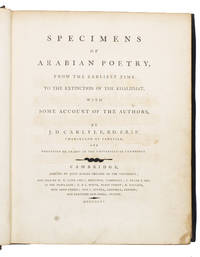
1796ABC_48589Cambridge: Printed by John Burges printer to the university 1796. Contemporary brown calf with a later spine a dark red morocco title-label on the spine with the title and author lettered in gold marbled endpapers. 4to. With an engraved sheet with musical notation. 2 parts in 1 volume. First edition of this beautiful example of Orientalist scholarship presenting sixty early Arabic poems in their original language with English translations. This work by Orientalist Joseph Dacre Carlyle 1758-1804 enabled the English to discover the beauty of Arabic literature. The poems which cover a wide range of topics offer a glimpse into the rich cultural heritage of the Arab world. Carlyle was the first to translate these poems into English. His translations became quite well-known and continued to be used in other works until at least the late 19th century.The work is a collection of poems from the Arabian peninsula between the 6th and 13th century. It includes a poem written on the tomb of Sayid by Abd Almalec Alharithy dates unknown a poem on avarice by Hatim al-Tai -578 and a poem about a thunder storm by Ibrahim Ben Khiret Abou Isaac dates unknown. In addition to the poems themselves the work also provides some biographical information about the poets offering readers a deeper understanding of the historical and cultural context in which the poems were written. The work consists of two parts the first contains the poems in English and the second in Arabic.Carlyle was professor of Arabic at the University of Cambridge. He was appointed chaplain by Thomas Bruce Lord Elgin 1766-1841 to the embassy at Constantinople in 1799 and pursued his researches in Eastern literature in a tour through Asia Minor Palestine Greece and Italy. During his travels he collected several valuable Greek and Syriac manuscripts.The work has been rebacked the leather on the boards is dried and cracked the flyleaf in the back has been replaced by a different marbled paper. The work is somewhat browned throughout with mild foxing on the first few leaves annotations in pencil on page 12 and 80. Otherwise in good condition.l BMC 4 1258.1197; Graesse II p. 49. Printed by John Burges printer to the university, unknown
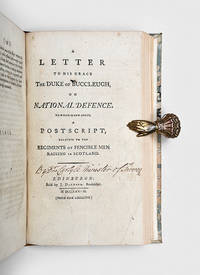
1778152780Edinburgh: J. Dickson 1778. First edition second issue "a re-issue of the London edition of the same year with a cancel title page and the addition of a postscript dated: Lincoln's Inn July 20th 1778" ESTC this copy also retaining the London title page. "This discussion of the bill for extending the militia law of Scotland introduced in 1776 contains a number of passing references to the war in America" Adams. The postscript comments on Burgoyne's defeat. Carlyle is identified as author in a contemporary hand on the Edinburgh title. After studies at Edinburgh Glasgow and Leiden where his classmates included William Robertson Adam Ferguson and John Home Carlyle was licensed to preach in 1746 and was introduced to the parish of Inveresk some five miles south-east of Edinburgh by the duke of Buccleuch the following year receiving his ordination in 1748. A moderate in his support for ecclesiastical patronage and politically conservative issues as well as in his endorsement of Enlightenment cultural principles including liberal education polite learning and religious toleration Carlyle was a familiar figure in the cultural life of what has come to be known as the Scottish Enlightenment. Strong and outspoken in his support for the Scots militia cause having written in 1760 The Question relating to a Scots Militia Considered the present pamphlet attacks Smith's apparent opposition to militias in the Wealth of Nations citing passages from Smith's book and also referring to the opinions of the Encyclopedistes. The other pamphlets included in this volume are: DOUGLAS John William Pulteney and Junius attributed authors. A Letter addressed to two Great Men on the prospect of peace; and on the terms necessary to be insisted upon in the negotiation. London: Millar and A. Kincaid & J. Bell Edinburgh 1760. Howes 6095. DALRYMPLE Sir John. The Rights of Great Britain asserted against the Claims of America: being an answer to the declaration of the General Congress. The third edition with additions. London: T. Cadell 1776. Howes 2564. LIND John. An Answer to the Declaration of the American Congress. The fourth edition. London: T. Cadell J. Walter and T. Sewell 1776. Howes 6167. TOWNSHEND Charles. Remarks on the Letter addressed to two Great Men. I a Letter to the author of that piece. London: printed in the year 1760. Howes 10372. Manuscript attribution to Henry Lord Holland on title. Octavo 209 x 122 mm. Bound fourth with four other pamphlets related to American affairs in contemporary quarter sheep and marbled boards vellum tips spine ruled gilt in compartments red morocco label lettered "Pamphlets" and numbered 2 direct sprinkled edges. Ownership inscription "Binning" to front pastedown dated 1779 with a manuscript list of the volume's contents to front free endpaper. Short tear to head of front joint; a very good copy. Adams The American Controversy 78-56b variant; ESTC T179898 locating copies at the National Library of Scotland and Harvard Business School only. The London imprint ESTC T107064 is slightly more common with copies located at British Library Columbia Harvard JCB and the New York Historical Society only; Vanderblue p. 50. hardcover