2 239 résultats
192865144Au sans pareil | Paris 1928 | 14 x 19.50 cm | broché
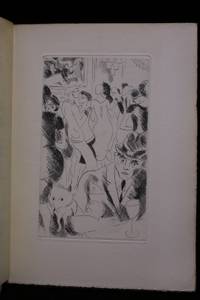
192865144Paris: Au sans pareil 1928. Fine. Au sans pareil Paris 1928 14 x 19.50 cm broché First edition one of the numbered copies on Montgolfier laid paper. Spine and covers marginally sunned and faded as generally. Work illustrated with 6 etchings by Pierre Falké. Au sans pareil unknown
192846705Paris: Au sans pareil 1928. Fine. Au sans pareil Paris 1928 14.50 x 19.50 cm broché First edition one of 1200 numbered copies on Montgolfier laid paper. Work illustrated with 6 original etchings by Pierre Falké. Spine and boards sunned a light stain at head of front board interior in pleasant condition. Au sans pareil hardcover
194923244Edimarton Paris 1949
195027331Editions Points et Contrepoints 1947. In-8 broché de 186 pages au format 18,5 x 24 cm. Couverture rempliée avec titre imprimé en noir et petite vignette illustrée. Dos carré, légèrement insolé, avec de minuscules taches brunes. Plats et intérieur frais, malgré des mors insolés, de minuscules rousseurs au 4ème plat, et un papier jaunissant. Superbe préface de Francis Carco. Recueil de poèmes, dont quelques inédits. Très bel état général. Edition originale, enrichie d'une double dédicace autographe, signée, de l'auteur, à André Cardinaud.
1998Q-0814403875AMACOM 1998-01-27. Hardcover. New. New. In shrink wrap. Looks like an interesting title! AMACOM hardcover
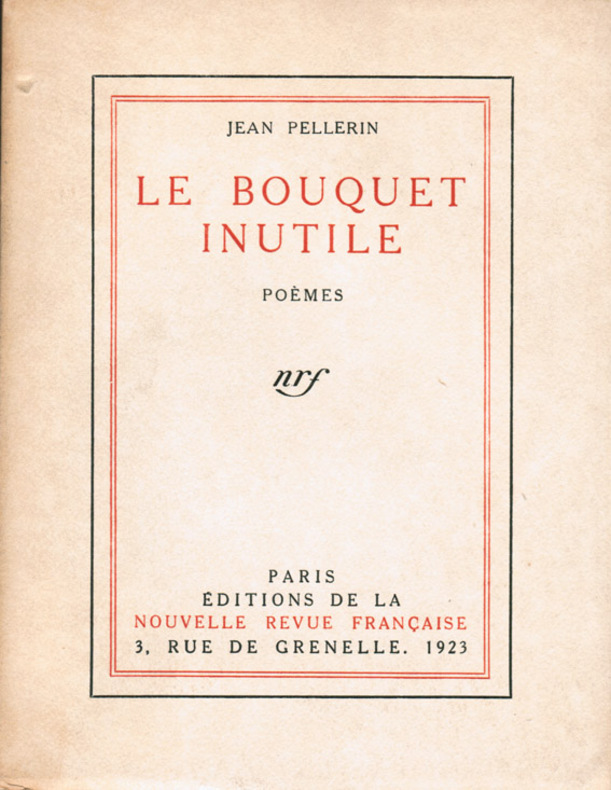
192318591923 Paris, Editions de la Nouvelle Revue Française (Gallimard), 1923. In-4 tellière, 193 pp., broché.
534Edouard Champion, éditeur. 1923. In-12 broché. Couverture rempliée. 72 pages. E.O.
191838244L'éventail | Genève 15 Novembre 1918 | 19 x 23.50 cm | broché
191838244Genève Geneva: L'éventail 1918. Fine. L'éventail Genève Geneva 15 Novembre 1918 19 x 23.50 cm broché First edition. Contributions by Paul-Jean Toulet ""Quatrains et distiques"" then ""Contrerimes"" Francis Carco ""Les veillées du Lapin Agile"" Louis Thomas. Issue illustrated with drawings by Félix Appenzeller and William Muller and reproductions of works by Raoul Dufy Maurice de Vlaminck Ossip Zadkine Henry de Waroquier. Handsome copy. L'éventail unknown
200239254Villerville: Nanga 2002. Paul Collomb. Two volumes complete. A livre d'artiste with 52 full-page loose high-quality color reproductions of watercolors executed by Paul Collomb 1921-2010 in 1952. From a total edition of 100 numbered copies printed on extremely fine wove paper and signed by the artist below the justification / colophon this is ONE OF ONLY 20 COPIES WITH A SIGNED ETCHING AN ORIGINAL FULL-PAGE SIGNED WATERCOLOR BY COLLOMB ON JAPANESE PAPER and all 52 reproductions the other 80 copies include only 20. Enhanced with a warm signed dedication inscription by Collomb. Large 4to. Loose as issued in the original wraps cloth chemises and slipcase. FINE AND BRIGHT with no defects. <br/><br/> Nanga paperback
19355007Baetz Pierre 1935
1952AUB-3911Paris, éd. Gallimard 1952. Bon exemplaire broché, couverture ornée d'éd., in-8, 291 pages + 16 planches.
20484Paris, Albin Michel, 1953 1 volume In-8° (12 x 19cm) Broché. 252p., 2 feuillets; 8 planches hors texte. Bon état.
195030534Avignon Pour F.M. et ses Amis 1950-1961 1 vol. broché 14 volumes in-16, brochés, couvertures rempliées imprimées en fac-similé, non coupés. Collection complète en parfait état, établie par le bibliophile avignonnais Florentin Mouret, ami de Claude Aveline auquel il consacra une bibliographie. Chaque volume en édition originale est tiré seulement à 150 exemplaires numérotés sur vélin pur fil d'Annonay. Détail des titres : C. Aveline : Extrait du Livre de Vie (1950) - J. Cassou : La Folie d'Amadis et autres poèmes (1950) - F. Carco : Rêverie dans Amsterdam (1951) - L.-P. Fargue : Textes. Présentés par Marcel Abraham (1951) - L. Martin-Chauffier : L'Écrivain et la liberté (1951) - G. Duhamel : Dialogue dans la ville délivrée (1952) - L. Guilloux (Louis) : Le Muet mélodieux (1952) - A. France : Ma Suzon chérie. Avec des souvenirs de Lucien Psichari (1952) - P. Albert-Birot : Dix poèmes à la mer (1953) - C. Vildrac : Jérôme le voyageur (1956) - P. Boulle : Un étrange événement (1957) - P. Gilson : Les Voix en peine (1957) - J. Bergamin : Aphorismes. Traduits de l'espagnol par Claude Aveline - J. Lescure : Noires compagnes de mes murs (1961).
1924IRCblCAR12Paris: Éditions De La Nouvelle Revue Française 1924. 1924. 8vo. pp. 2 p.l. vii1blank 9-122 1 leaf. with half-title. 12 original tinted lithographed plates of women by Luc Albert Moreau. Uncut & partly unopened in original printed wrs. One of 315 copies on 'vélin pur fil Lafuma-Navarre' 15 hors commerce of a total edition of 335. Bénézit refers to Moreau's output as relatively limited but important and notes that his work relating to women had been described by some critics as revealing a certain baudelairian spirit. Paris: Éditions De La Nouvelle Revue Française, [1924]. unknown
1925Y25870Paris, Flammarion 1925 xi + 270pp., 5e mille, bel état, Y25870
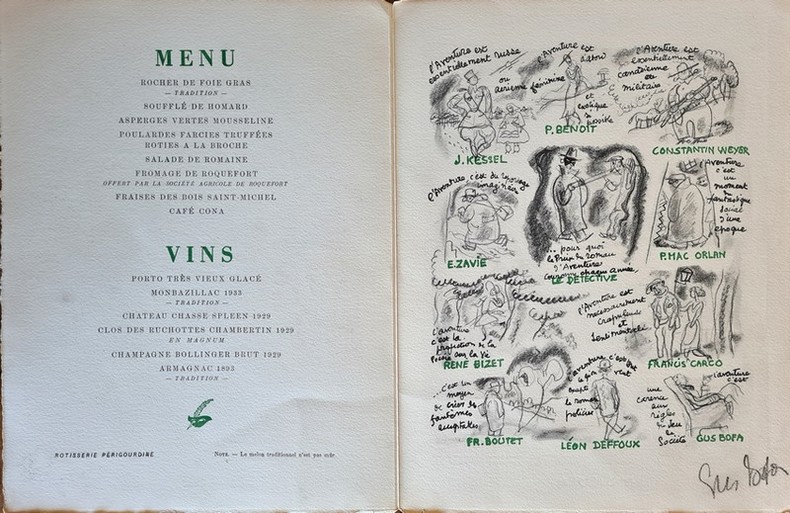
21189Menu du Déjeuner du Prix du Roman d'Aventures, donné à Paris le 30 mai 1938. In-4 de 4 pages au format 25,5 x 33 cm. Tirage unique à 50 exemplaires tous nominatifs ( celui-ci à été imprimé au nom de Georges Jadelot ). Couverture avec titre, ornée de 7 dédicaces autographes signées d'Albert Pigasse, Pierre Nord, Pierre Boileau, Maurice Constantin Weyer, Jean Bernard avec très beau dessin au crayon représentant un poisson lisant un manuel intitulé " Le Moulinet à Tambour Fixe ", signature de Francis Carco et une dédicace dont je n'ai pas identifié l'auteur. Au verso de la couverture on trouve le menu en lui-même, avec en regard une pages de dessins de Gus Bofa, caricaturant les membres du Jury : Albert Pigasse ( Le Détective ), Pierre Benoit, René Bizet, Frédéric Boutet, Gus Bofa, Joseph Kessel, Pierre Mac-Orlan, Emile Zavie. Francis Carco, Maurice Constantin Weyer et Léon Deffoux. En bas de page signature autographe de Gus Bofa. Quatrième plat avec dessin de Gus Bofa et justificatif de tirage.Textes des dédicaces :Albert Pigasse - Depuis le Meurtre de Roger Ackroyd, nous collaborons. Jusqu’où ? Nous en reparlerons dans vingt ans, Ma fidèle amitié.Pierre Nord - Au plus fidèle ami.Francis Carco ( signature ).Pierre Boileau - Toute ma sympathie.Jean Bernard - Avec ça mon instruction est complète, en souvenir de la Sauldre, Pâques 1938 et superbe dessin au crayon représentant un poisson lisant un manuel intitulé " Le Moulinet à Tambour Fixe " .Maurice Constantin Weyer, répondant au dessin de Jean Bernard - Avec lequel nous ne prendrons rien.Auteur non reconnu - Très cordial souvenir du plus charmant...?Gus Bofa ( signature ).
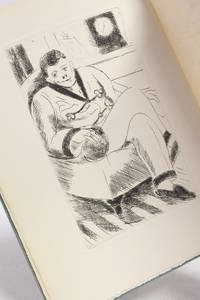
22120Menu du Déjeuner du Prix du Roman d'Aventures, donné à Paris le 13 juin 1951. In-4 de 4 pages au format 25,5 x 33 cm. Tirage unique à 50 exemplaires tous nominatifs ( celui-ci à été imprimé au nom de Pierre Lagarde. Couverture avec titre, ornée d'une dédicaces autographes ou signatures de Francis Carco, Dignimont ( avec petit dessin ), superbe dessin de Maurice Féaudierre dit " Serge ", 2 signatures non identifiés. Au verso de la couverture on trouve le menu en lui-même, avec en regard un dessin pleine page de Fontanarosa. 4ème plat avec belles dédicaces autographes de Pierre Boileau, Henri Filipacchi, Pierre Nord, une dédicace non identifiée et justificatif de tirage. Textes des dédicaces : Pierre Boileau - Toute mon amitié, Cher Pierre Lagarde... Et à l'année prochaine !Francis Carco (signature).Pierre Nord - Au très charmant, très gentil, très fidèle ami, de son ami aussi fidèle.Henri Filipacchi - A Pierre Lagarde, en souvenir du bon vieux temps, de Rachilde et de SachaDignimont ( signature + dessin )Maurice Féaudierre dit " Serge " Dessins signé, intitulé " Clinique "Non identifié : Au conteur, bien cordialement.Signature non identifiée.Non identifié : Avec cette plume que Dignimont vient de tenir, sauf ses doigts, mon amitié, si vous la voulez
003197Paris. Limited First Edition. Wraps. Very Good Plus. Scarce collection of watercolors from a now forgotten or unjustly overlooked artist who incomparably captures in her paintings the l'esprit of Colette. No copies found on OCLC notwithstanding this was a limited edition of 500 copies. This copy is numbered 500. Also no information on the publisher suggesting this might have been privately printed. N.d. circa 1925. 33 by 25 cm. 2 pp. preface by Carco a novelist regarded as the "Last Bohemian" followed by sixteen watercolors each preceded by a tissue guard containing the title of the painting. Whether or not May Wanda herself felt a connection to Colette is immaterial; in her subject matter her treatment of her subjects the economy of line in her portraits her bold application of color and finally her straightforward unblinking honesty the comparison of the two is inevitable. There are a few men appearing in these paintings but this is artwork about women by a woman from a woman's point-of-view. That point-of-view is both inscrutable and acerbic in its traversal of the frivolous and gaudy aspects of urban life and there is somehow created a bond between the women living in comfort and luxury and those of meaner circumstance. Here are depicted a woman sitting alone with a glass of wine a young ingenue on a fashionable boulevard a flapper behind the wheel of a car a woman at a pool sisters in an opera box smartly dressed women shopping a woman at a "Bal Musette" etc. Carco likens May Wanda to Toulouse-Lautrec and that is also an apt comparison in many ways particularly in the weary enigmatic expressions of many of the women. unknown
003197Paris. Limited First Edition. Wraps. Very Good Plus. Scarce collection of watercolors from a now forgotten or unjustly overlooked artist who incomparably captures in her paintings the l'esprit of Colette. No copies found on OCLC notwithstanding this was a limited edition of 500 copies. This copy is numbered 500. Also no information on the publisher suggesting this might have been privately printed. N.d. circa 1925. 33 by 25 cm. 2 pp. preface by Carco a novelist regarded as the "Last Bohemian" followed by sixteen watercolors each preceded by a tissue guard containing the title of the painting. Whether or not May Wanda herself felt a connection to Colette is immaterial; in her subject matter her treatment of her subjects the economy of line in her portraits her bold application of color and finally her straightforward unblinking honesty the comparison of the two is inevitable. There are a few men appearing in these paintings but this is artwork about women by a woman from a woman's point-of-view. That point-of-view is both inscrutable and acerbic in its traversal of the frivolous and gaudy aspects of urban life and there is somehow created a bond between the women living in comfort and luxury and those of meaner circumstance. Here are depicted a woman sitting alone with a glass of wine a young ingenue on a fashionable boulevard a flapper behind the wheel of a car a woman at a pool sisters in an opera box smartly dressed women shopping a woman at a "Bal Musette" etc. Carco likens May Wanda to Toulouse-Lautrec and that is also an apt comparison in many ways particularly in the weary enigmatic expressions of many of the women. <br/><br/> paperback books
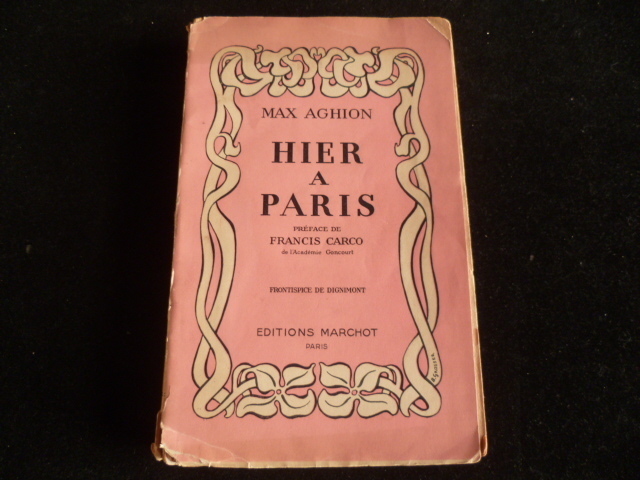
19478336Paris, Ed. Marchot, 1947, in-8, Broché, 268 pages. Bon état.
194774125Editions Pétridès | Paris 1947 | 28 x 38 cm | relié
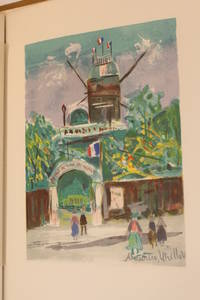
194774125Paris: Editions Pétridès 1947. Fine. Editions Pétridès Paris 1947 28 x 38 cm relié First edition one of 240 numbered copies on vélin d'Arches with 22 color lithographs after gouaches including 12 full-page plates by Maurice Utrillo printed in the ateliers of Fernand Mourlot and Lucien Détruit. White aniline calf with gilt titanium joints ink-painted boards in green and grey decoration continuing edge-to-edge on the liners loose endpapers on papier japon dyed with Kakishibu by the binder title lengthwise on the spine decorated chemise titled on the spine and matching custom slipcase. Original wrappers and spine preserved. Binding signed by Julie Auzillon gilt title by Geneviève Quarré de Boiry and gilt top edge by Jean-Luc Bongrain 2022. This book presenting every style of the famed artist from Montmartre was published on the occasion of his exhibition in 1947 at the Paul Pétridès gallery. This book presenting every aesthetic period of Montmartre artist Maurice Utrillo was published for his 1947 exhibition at the Paul Pétridès gallery. Mounted at the front of the book an autograph sonnet entitled ""L'Art pictural"" signed by Maurice Utrillo and addressed to Francisque Poulbot; two quatrains and two tercets written in black ink on lined paper. Before the poem Utrillo specified: ""Sonnet par Maurice Utrillo V < dédié à son ami et confrère < Georges Kars."" Sonnet by Maurice Utrillo V < dedicated to his friend and colleague < Georges Kars Signed and inscribed by Utrillo a second time at the top of the sheet: ""Amicalement à Francisque Poulbot"". A few stains to the margins not affecting reading. The sonnet was published in ART vol. 2 October 1934-July 1935 p. 9. This beautiful poem a true poetic manifest of pictorial independence twice signed by Utrillo is dedicated to cartoonist Francisque Poulbot a key figure in Montmartre society. It brings together iconic figures of the Butte famous for their bohemian life and eternal drunkenness: Utrillo Poulbot and Georges Kars a Cubist artist of Czech origin living in Montmartre whose paintings are celebrated by Utrillo in the sonnet. Utrillo wrote this manuscript in 1928 to Francisque Poulbot former classmate of the Lycée Rollin who had become a renowned draughtsman goguettier and founder of the République de Montmartre. Poulbot sketched the painter many times in his beloved Montmartre streets brush in one hand and bottle in the other the silhouette of the Sacré-Coeur church looming in the distance. Utrillo and Poulbot both stayed at some point in their lives at 12 rue Cortot where the Musée de Montmartre is now located. The year he wrote this poem Utrillo painted a superb gouache of Poulbot's house on avenue Junot. Although known for his paintings Utrillo also found in poetry a form of redemption for his bouts of alcohol-induced hysteria. Considered by his friends as a ""builder of sonnets or dithyrambic quatrains"" his verses were praised by famed critic Félix Fénéon. Utrillo also used poetry to celebrate his Montmartre artist neighbors. He wrote this poem in honor of Czech painter Georges Kars thanking him for a striking portrait of him exhibited at the Berthe Weill gallery: « Qu'il me soit donc ici permis en compagnon Sincère et noble et pur en non troubleur en rond Sur cet Art pictural d'émettre un trait austère Georges Kars en ce lieu de digne réunion Rue Laffitte chez Weill de l'art porte-fanion S'affirme en ses tableaux inventif et sincère. » Kars had settled in Montmartre in 1908 and spent many summers in Cadaquès with his wife Utrillo and his mother Suzanne Valadon. In these verses dedicated to the lines of ""his friend and colleague"" Kars Utrillo celebrates the independence and aesthetic personality emancipated from any artistic movement which also characterized Utrillo's own style. Utrillo being a self-taught painter he states his difference from academism and even the avant-gardes of yesteryear citing the Impressionist revolution embodied by the Cormon s Editions Pétridès hardcover