Niedersächsisches Innenministerium (Hrsg.)Antiquariat.de

1 566 résultats
1996V42646Hameln ( Niemeyer-Druck) 1996 (= Erste Ausgabe). 8°, illustrierte Originalbroschur (Paperback) 240 S., Abbildungen 1
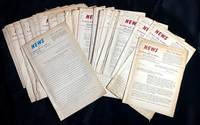
195142943New York American Council for Judaism 1951. 1st edition. Original stapled pages. "News" is 8.5"x11" and generally 4 single sided leaves. Press releases are legal size 8.5"x14" 2-4 single sided leaves each. Approximately 160 leaves total. <br> News is subtitled "Highlights of the Yiddish and Hebrew Press. A weekly Digest prepared by the Publicity and Research Departments American Council for Judaism." Maurice Spector is listed as Publicity Directory though the OCLC listing indicates Bill Gottlieb as editor perhaps for earlier or later issues <br> Each issue of the NEWS is headed with the warning "This is not for release - for your information only." <br> <br> Some headlines from the NEWS often quoting the Zionist press when it shines poorly on Zionism include: <br> -Nationalist-Zionist Education Endangers Judaism<br> - To the Rescue of Yiddish<br> - The Sin of the Histadrut<br> - Treatment of the Arab Minority in Israel<br> - And Now it is Israel's Turn to Use the Hostage Weapon.<br> - The Religious Bloc is Powerful for Reasons that aren't Religious<br> - We Want Peace Unity Discipline-But on our Own Terms.<br> - Israel's Election Campaign Opens.Here in America<br> <br> Some headlines from the press releases include: American council for Judaism Calls NCRAC Action Partisan: <br> -Declares Zionism and Jewish Nationalism Responsible for Creating 'Dual Loyalties' Issue<br> - Carroll Binder Warns Minority Pressure Blocs Endanger U.S. National Interests<br> - President Truman Say American Council for Judaism Deeply Rooted in U.S. Traditions of Individual Rights<br> - Zionist Pressure Seek Change of Judaism Values from Universal Religion to Status of Tribal Cult Rabbi Charges<br> - Dorothy Thompson Warns Zionism's Viewing All Jews as Members of a Jewish Nation" Seeking Privileged Minority Status in U.S. Gives Aid to Antisemitism<br> - Cause of DP's Pleaded at American Council for Judaism's Annual Meeting: Leading Social Workers Charges Pro-Israel Pressures Deprived Many Thousands of Sanctuary<br> - U. S. Culture Infiltration Seen as world Zionism Aim<br> - Israel has No Rights Authority Over Lives of U.S. Jews Rosenwald Says: Assumptions in Ben-Gurion's Knesset Speech Rejected by Head of American Council for Judaism<br> <br> "The American Council for Judaism ACJ is an organization of American Jews committed to the proposition that Jews are not a national but a religious group adhering to the original stated principles of Reform Judaism as articulated in the 1885 Pittsburgh Platform. In particular it is notable for its historical opposition to Zionism. Although it has since moderated its stance on the issue it still advocates that American Jews distance themselves from Israel politically and does not view Israel as a universal Jewish homeland.<br> The rabbis of Reform Judaism had opposed Zionism prior to World War I supporting freedom democracy and equal rights for Jews in the countries where they lived. The influential American Jewish Committee was also anti-Zionist until 1918 when it shifted to a non-Zionist platform until the 1967 Six-Day War. The Central Conference of American Rabbis of the Reform movement declared itself officially neutral on Zionism in 1937.<br> In 1942 a split within the Reform movement occurred due to the passage of a resolution by some rabbis endorsing the raising of a 'Jewish Army' in Palestine to fight alongside the Allies of World War II. The American and British general staffs opposed placing Jews in segregated armed forces.The founders of the American Council for Judaism regarded the potential segregation of Jews to be a highly regressive and harmful measure.<br> The ACJ was founded in June 1942 by a group of leading Reform rabbis including six former presidents of the Central Conference of American Rabbis and the president of the Hebrew Union College as well as laymen who opposed the creation of a religiously segregated Jewish Army to fight alongside the Allies and the new political direction of some in their movement including but not limited to on the issue of Zionism as redefined by the Biltmore Program in May 1942.The leading rabbis included Louis Wolsey Morris Lazaron Abraham Cronbach David Philipson and Henry Cohen but their most vocal representative for a time became Elmer Berger who became the council's Executive Director.<br> The ACJ described itself as anti-nationalist and followed a universalist interpretation of Jewish history and destiny. According to its statement of principles the ACJ supported the 'rehabilitation' of Palestine and did not support political Zionism. It also declared that 'Jewish nationalism tends to confuse our fellowmen about our place and function in society and diverts our own attention from our historic role to live as a religious community wherever we may dwell.' The ACJ's leaders felt that they represented the views of a majority of American Jews and began a large membership drive. By 1946 it had numerous local chapters throughout the United States and regional offices in Richmond Chicago Dallas and San Francisco.<br> During World War II the council was active in opposing Zionism. In 1944 it protested the formation of the Jewish Brigade by the British Army which was composed of Palestinian Jews led by British-Jewish officers.it stated that.'Americans of the Jewish faith are and always have been in the American armed forces. The flag of Americans of the Jewish faith is the Stars and Stripes.'<br> While protesting the White Paper of 1939 which imposed strict limits on Jewish immigration to Palestine and land purchases in the country it also opposed 'Zionist nationalism' and urged American Jews to 'organize in strength out of deep concern for oppressed Jews everywhere behind a non-nationalistic program to deal with the total Jewish problem.' <br> It declared that 'Beyond the abrogation of the White Paper lies the need for a basic solution. That solution we believe can come only when there is world wide recognition of the rights of Jews to full equality. It can come in Palestine only when the pretensions to Jewish Statehood are abandoned and we seek instead freedom of migration opportunity based on incontestable rights and not on special privilege.<br> We look forward to the ultimate establishment of a democratic autonomous government in Palestine wherein Jews Moslems and Christians shall be justly represented; every man enjoying equal rights and sharing equal responsibilities; a democratic government in which our fellow Jews shall be free Palestinians whose religion is Judaism even as we are Americans whose religion is Judaism.'<br> Following World War II with the question of Palestine's future being considered the ACJ continued to support a joint Jewish-Arab state rather than a Jewish state in Palestine and opposed dispossessing the Arabs who were then living in Palestine.<br> The presidency of the ACJ was accepted by the well-known philanthropist Lessing J. Rosenwald who took the lead in urging the creation of a unitary democratic state in Mandatory Palestine in American policy-making circles. Rosenwald testified before the Anglo-American Committee of Inquiry in 1946 urged the creation of a unitary Jewish-Arab state in Palestine and allowing Jewish immigration to Palestine to continue only upon 'renunciation of the claim that Jews possess unlimited national right to the land and that the country shall take the form of a racial or theocratic state' and said that the United States and other UN member states should allow more Jewish immigration to solve the European-Jewish refugee problem.<br> It later endorsed the Committee of Inquiry's recommendations including that Palestine become neither a Jewish or Arab state and the admittance of 100000 Jewish refugees into Palestine. In addition it opposed the establishment of a Jewish state anywhere else in the world not just in Palestine. The ACJ's official position was that European Jews should be rehabilitated by restoring their civil political and economic security. <br> During the Jewish insurgency in Palestine a campaign against the British by Jewish underground groups in Palestine the Haganah Irgun and Lehi the ACJ opposed what it viewed as Jewish terrorism. Following the King David Hotel bombing it issued a statement calling for American Jews to 'repudiate the perpetrators of those outrages and those leaders of Jews in and out of Palestine whose incitement is equally responsible.' In a statement Lessing Rosenwald called for the American Jewish community to condition any further assistance to the Yishuv Palestinian Jewry on the end of violence.<br> After the State of Israel declared independence in 1948 the ACJ continued its anti-Zionist campaign.<br> Its position was that to American Jews Israel was not the state or homeland of the Jewish people but merely a foreign country. In December 1948 Lessing Rosenwald urged that the US condition friendship with Israel on Israel building an inclusive Israeli nationalism confined to its own borders and inclusive of its Muslim and Christian citizens rather than Jewish nationalism.<br> The ACJ switched its focus to battling what it viewed as its primary foe-the political influence of Zionism upon American Jewry. In addition to supporting a network of religious schools committed to Classical Reform Judaism the Council fought American-Jewish fundraising for Israel and agitated against the merging of Zionist fund-raising organizations with local Jewish community boards provided financial aid to Jews emigrating from Israel and to Palestinian refugees and enjoyed friendly relations with the Eisenhower State Department under John Foster Dulles. <br> The ACJ also vocally supported the efforts of William Fulbright to have the lobbyists for Israel in the United States legally registered as foreign agents. In 1955 the ACJ's head Elmer Berger advocated the complete assimilation of Jews into American life by switching the Jewish Sabbath from Saturday to Sunday creating a new menorah to 'reflect the appreciation of American Jews of the freedom of life in the United States' and for the interpretation of the holiday of Sukkot 'to be broadened to take on meaning to all citizens of an industrial society.'<br> In 1957 the Union of American Hebrew Congregations now known as the Union for Reform Judaism denounced the American Council for Judaism. In a statement the UAHC alleged that the ACJ misrepresented classical Reform Judaism undermined the unity of the Reform movement questioned the national loyalty of Jews who supported Zionism aided antisemites and 'played directly into the hands of Arab propagandists'.<br> Jewish intellectuals who at one time or another passed through the Council included David Riesman Hans Kohn Erich Fromm Hannah Arendt Will Herberg Morrie Ryskind Frank Chodorov and Murray Rothbard. Among the notable gentile friends of the council were Dorothy Thompson Norman Thomas Freda Utley Arnold J. Toynbee and Dwight Macdonald. The ACJ was particularly influential in San Francisco Philadelphia Houston Chicago Baltimore Washington D.C. Atlanta and Dallas" Wikipedia.<br> SUBJECTS: Zionism and Judaism -- Periodicals. Jews -- United States -- Sionisme -- Aspect religieux -- Judai¨sme -- Pe´riodiques. Juifs -- E´tats-Unis. OCLC: 12373966. OCLC lists only 3 holdings worldwide HUC UTexas Wisc Hist all in the midwest and none at any Ivy League institution.<br> Toning to edges pencilled institutional numbers to cover corner margins some original corner staples removed paper strong Good Condition solid. Rare and important especially as much of Liberal Progressive and Secular American Jewry rethinks its relationship to Israel and Zionism in light of the present Israel-Gaza war. B Zion2-3-5-'l. New York, American Council for Judaism unknown
1915113745München, 1915. 40 S. (BAdW. Sitz.-Ber. d. Phil.-hist. Kl. 1915/12).
200023843Göttingen, Wallstein, 2000. 184 S. mit einigen s/w-Abb. 8°. OKart.
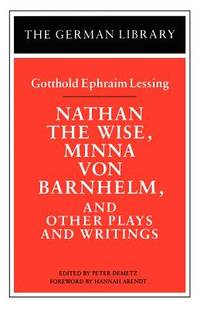
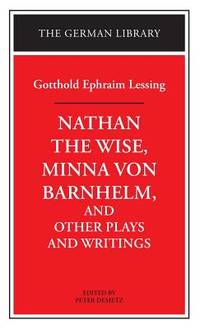
1991x-0826407072Continuum Intl Pub Group 1991. Paperback. New. 1st edition. 370 pages. 8.50x5.50x1.00 inches. Continuum Intl Pub Group paperback
1991G0826407064I5N00Continuum Intl Pub Group 1991. Hardcover. Acceptable. Readable copy. Pages may have considerable notes/highlighting. ~ ThriftBooks: Read More Spend Less.Dust jacket quality is not guaranteed. Continuum Intl Pub Group hardcover
19672iiiAd0055fNew York: Frederick Ungar Publishing Co. 1967. Book. Like New. Mass Market Paperback. 5th Printing 1967. 12mo or 12° Duodecimo: 6¾" x 7¾" tall. 150 pp. Clean fresh copy with very light shelf wear crisp pages and clean text. Frederick Ungar Publishing Co. Paperback
1997RO30370030Actest sud. 1997. In-8. Broché. Etat passable, Coins frottés, Dos satisfaisant, Papier jauni. 120 pages. Ex-libris à l'encre en page de garde. Rares rousseurs. Couverture fanée.. . . . Classification Dewey : 792-Théâtre
1997R150190420ACTES SUD- SACD. 1997. In-8. Broché. Bon état, Couv. convenable, Dos satisfaisant, Intérieur frais. 120 pages- une petite illustration en couleurs sur le 1er plat. . . . Classification Dewey : 792-Théâtre
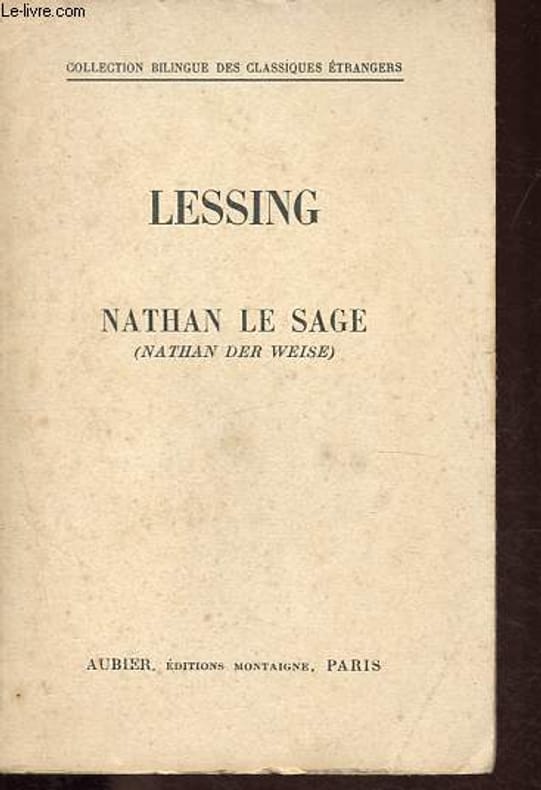
1939R200034859AUBIER. 1939. In-12. Broché. Bon état, Couv. convenable, Dos satisfaisant, Intérieur acceptable. 307 pages. Texte en regard allemand/français.. . . . Classification Dewey : 410-Linguistique
1953R320179251Aubier éditions Montaigne. 1953. In-12. Broché. Etat d'usage, Couv. convenable, Dos satisfaisant, Papier jauni. LXXII + 307 pages - ouvrage en allemand avec la traduction française en regard - quelques annotations et quelques phrases soulignées au crayon à papier à l'intérieur du livre sans conséquence sur la lecture.. . . . Classification Dewey : 830-Littératures des langues germaniques
1953R200140044Aubier. 1953. In-12. Broché. Etat d'usage, Tâchée, Dos plié, Quelques rousseurs. 307 pages - texte en allemand avec la traduction française en regard - papier jauni, pliure sur le 1er plat, coins frottés, coiffes abimées, annotations au crayon papier et à l'encre en page de faux-titre.. . . . Classification Dewey : 830-Littératures des langues germaniques
1956feb12475ESPLA 1956. Used. 1956; Romanian Edition of Nathan Inteleptul ESPLA BPT ; For more details please contact me ESPLA unknown
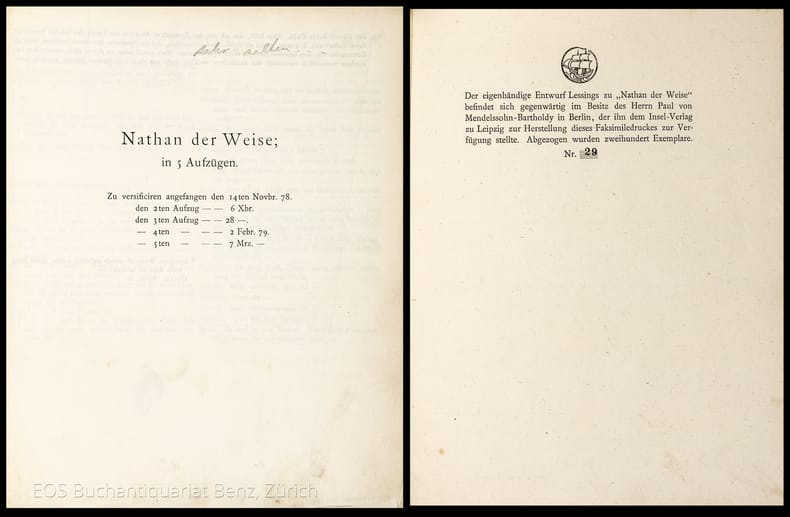
19104785DBLeipzig, Insel, (1910). 22 x 17,5 cm. (40) S. (Faksimile), (40) S. (Umschrift). Orig.-Lederband mit Aussenkantenvergoldung.
1940R200050263EUGENE BELIN. 1940. In-12. Broché. Bon état, Couv. convenable, Dos satisfaisant, Intérieur frais. 188 pages. . . . Classification Dewey : 430-Langues germaniques. Allemand
1968RO60084265Philipp Reclam Jun.. 1968. In-16. Broché. Bon état, Couv. légèrement passée, Dos satisfaisant, Intérieur acceptable. 142 pages.. . . . Classification Dewey : 430-Langues germaniques. Allemand
1940R320179349Eugène Belin. 1940. In-12. Broché. Etat d'usage, Tâchée, Coiffe en pied abîmée, Papier jauni. 188 pages - frontispice en noir et blanc - ouvrage en allemand avec introduction et notes en français - tampon sur le 1er plat - coiffes légèrement abîmées.. . . . Classification Dewey : 430-Langues germaniques. Allemand
19839569Stuttgart: Philipp Reclam jun., 1983. Universal-Bibliothek Nr. 3, 36. Auflage 153 Seiten , 15 cm, kart.,
19769227Stuttgart: Philipp Reclam jun., 1976. Universal-Bibliothek Nr. 3 154 Seiten , 15 cm, kart.,
197732951Leipzig, Verlag Philipp Reclam jun., 1977. 154, 56, 157, 101 Seiten , 18 cm, kartoniert
1990RO60149615Reclam. 1990. In-18. Broché. Bon état, Couv. convenable, Dos satisfaisant, Papier jauni. 160 pages. Texte en allemand.. . . . Classification Dewey : 430-Langues germaniques. Allemand
197824613AB1978. Leipzig Insel 1978. Folio. 152 Seiten. Hardcover/ Gebundene Ausgabe mit originalem Schutzumschlag in Brodart / Mylar Spezielle Sammler - Schutzfolie für Schutzumschläge. Leinen mit illustriertem Schutzumschlag. Sehr guter Zustand mit nur absolut geringen rein äußerlichen Gebrauchsspuren. Rücken des Umschlags etwas vergilbt. Nathan the Wise original German title: "Nathan der Weise" is a play by Gotthold Ephraim Lessing in 1779. It is a fervent plea for religious tolerance. It was never performed during Lessing's lifetime and was first performed in 1783 at the Döbbelinsches Theater in Berlin. Set in Jerusalem during the Third Crusade it describes how the wise Jewish merchant Nathan the enlightened sultan Saladin and the initially anonymous Templar bridge their gaps between Judaism Islam and Christianity. Its major themes are friendship tolerance relativism of God a rejection of miracles and a need for communication. Wikipedia Anatoli Tankhum Lvovich Kaplan December 26 1902 in Rahachow Belarus- July 3 1980 in Leningrad was a Jewish-Russian painter sculptor and printmaker whose works often reflect his Jewish origins. Kaplan one was one of six children; his father was a butcher in Rahachow which was at that time within the Jewish Pale of Settlement in Russia. His background was therefore not dissimilar to that of Marc Chagall born a generation earlier in 1887 and although their lives were very different their art has much in common. The shtetl figures in many of Kaplan's paintings - autobiographical references are very clear in The Butcher's Shop 1972 and Tailor's Shops 1975 and in the many illustrations which he was to create to the works of Sholem Aleichem. Around 1922 Kaplan came to Leningrad then named Petrograd where he was to base his career for the rest of his life although he often revisited the towns of his childhood. He graduated in 1927 from the Russian Academy of Arts there. In the 1930s he became associated with a group of artists and lithographers in Leningrad which had been instructed to prepare a series of works dedicated to the remote Jewish Autonomous Oblast being created by Stalin in the hope of resettling Russia's Jewish population in a remote area in the Far East of the country. Here Kaplan learnt and took to the skills of printmaking developing many individual techniques. His first cycle of prints 1937-1940 was entitled Kasrilevka the name of the village invented by Sholem Aleichem. During the war Kaplan was at first evacuated to the Urals but returned to Leningrad in 1944. His lithograph cycle of Landscapes of Leningrad during the Days of the Blockade 1948 was widely acclaimed in Russia and was purchased by eighteen State galleries. At one time Kaplan was supervisor of design in a glassware factory and this gave him an interest in the third dimension which was later to blossom in his ceramics and sculptures. From the 1950s onwards Kaplan's artworks concentrated on Jewish themes despite constant and often serious opposition and obstruction from the Soviet cultural authorities. Amongst these works should be mentioned his cover and illustrations to the Jewish Folksongs of Dmitri Shostakovich 1977 illustrations to Aleichem's Tevye the Milkman 3 series 1957-1966 The Enchanted Tailor 1954-57 and Song of Songs 1962 and a magnificent series of coloured lithographs printed in London in 1961 on the old Jewish Passover song Chad Gadya One Kid Goat. Throughout this time Kaplan was also producing paintings though in view of their subject matter they were rarely displayed in the Russia of his time. From 1967 onward he began also to produce ceramics and sculptures including a remarkable set based on the characters of Gogol's Dead Souls. Wikipedia Anatoli Lwowitsch Kaplan 28. Dezember 1902 in Rahatschou Weißrussland; 3. Juli 1980 in Leningrad war ein russisch-jüdischer Maler Bildhauer und Grafiker. Kaplans Umfeld in der Kindheit war nicht unähnlich dem von Marc Chagall der eine Generation früher 1887 geboren wurde. Auch wenn das Leben der beiden Künstler sehr unterschiedlich verlief so haben sie in ihrem Werk doch viel gemeinsam. Vor allem die Stetl-Gestalten und Szenen spielen bei beiden eine große Rolle. Ebenso die autobiographischen Bezüge wie sie in Kaplans Gemälden Metzgerladen 1972 und Schneiderladen 1975 ganz offensichtlich sind ebenso in vielen Illustrationen zu Werken des Schriftstellers Scholem Alejchem. Auf der Akademie wurde Kaplan in erster Linie als Maler ausgebildet. Weil er damit in den Jahren danach sein Brot nicht verdienen konnte musste er alle möglichen Aufgaben übernehmen. Dadurch erwarb er sich Routine auch in dekorativen und plakativen Arbeiten sowie in unterschiedlichsten Techniken samt dem Umgang mit Schrift und Ornamenten. Im Jahr 1937 erhielt er den Auftrag des Leningrader Ethnographischen Museums für die jüdische Sektion eine Serie von Lithographien zu schaffen. Jetzt erst in der Experimentierwerkstatt des Leningrader Künstlerverbandes erlernte Kaplan systematisch die Techniken der Druckgrafik. Er entwickelte auch eigene Verfahren. Seinen ersten Lithographie-Zyklus 19371940 nannte er Kasrilewke nach einem Dorf in einer Erzählung von Scholem Alejchem. Der Krieg brachte einen harten Einschnitt in Kaplans künstlerisches Wirken. Erst 1944 nach der Rückkehr aus der Evakuierung im Ural konnte er seine Arbeit wieder aufnehmen. Er begann sofort mit einem Lithographien-Zyklus über die Leiden seiner Stadt. 1946 erschien die Mappe Leningrad in den Tagen der Blockade. Kaplan führte die Bildfolge bis zum Ende der fünfziger Jahre weiter und bezog den Wiederaufbau ein. Ab 1953 konzentrierte sich Kaplan wieder ganz auf jüdische Themen. Damit eckte er ständig und ernsthaft bei den sowjetischen Kulturbehörden an. Unter den Werken dieser Epoche sind besonders bemerkenswert die Illustrationen zu Jüdische Volkslieder von Dmitri Schostakowitsch zu Scholem Alejchems Tewje der Milchmann Der behexte Schneider und Stempenju und zu Mendele Moicher Sforims Fischke der Lahme. Ab 1967 schuf Kaplan vor allem Keramiken und Skulpturen darunter einen bemerkenswerten Satz von Gestalten aus Gogols Roman Die toten Seelen. In Formen und Farben beweist er einen phantastisch-spielerischen Umgang mit dem Material. Wikipedia hardcover
1998Q-3140222874Schöningh im Westermann 1998-12-01. Paperback. New. In shrink wrap. Looks like an interesting title! Schöningh im Westermann paperback
19104785DB1910. Leipzig Insel 1910. 22 x 175 cm. 40 S. Faksimile 40 S. Umschrift. Orig.-Lederband mit Aussenkantenvergoldung. Sarkowski 1024 VA. Nr. 29 von 200. Mit Faksimile des handschriftlichen Entwurfs des Nathan von 1779. Lose beigegeben die Umschrift. Der Einbandrücken und die Kanten berieben mit kleiner Fehlstelle am oberen Kapital. Die Vorsätze gebräunt. unknown
19108460AB1910. Leipzig Insel-Verlag 1910. 165 : 10 cm. 2 Blatt 276 Seiten 1 Blatt Original-Lederband mit reicher Rücken- und Deckelvergoldung signiert Enders Leipzig. Eines von 400 numerierten Exemplaren der einmaligen Auflage. - Einband gering berieben. - Sarkowski 1024. unknown