12 résultats
1828101698Au bureau du journal / chez dondey dupré père et fils 1828 150 pages in8. 1828. broché. 150 pages.
1833101700Au bureau du journal / chez dondey dupré père et fils 1833 200 pages in8. 1833. broché. 200 pages.
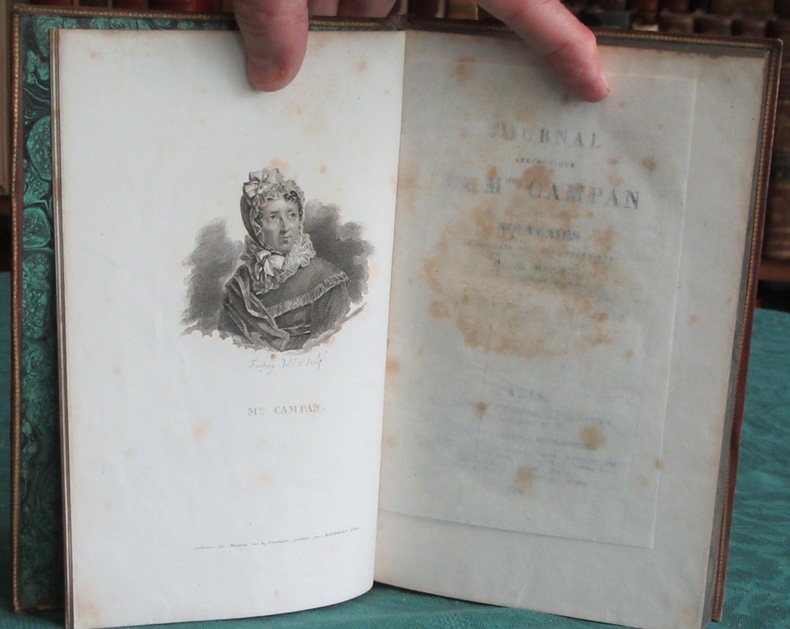
182340225P., Baudouin Frères, 1823, in-8°, xlvii-382 pp, troisième édition, un portrait gravé en frontispice, notice par F. Barrière (47 pp), éclaircissements historiques et pièces officielles in fine (97 pp), reliure demi-chagrin vert, dos lisse avec titres et filets dorés (rel. de l'époque), bon état
1828357361Washington: Printed by Duff Green 1828. Softcover. Very Good. Disbound pamphlet. 224pp. plus 5 plates and 1 table. Foxed slight erosion on title-leaf still tight and very good. A manual compiled by Genet including a translation from a German treatise on dying silk by George William Helterhoff published at Erfurt 1809. This copy belonged to Mitchell King with his signature on title page a lawyer principal of Charleston College South Carolina and a founder of the Philosophical Society in 1809. Shaw & Shoemaker 36504. Printed by Duff Green unknown
187912414Lyon, Imprimerie typographique H. Albert, 1879 ; petit in-8 carré, broché ; 242, (6) pp., couverture gris-bleu imprimée.
182694538Paris, Baudoin Frères, coll. « Mémoires relatifs à la Révolution française » 1826 2 volumes. In-8 21 x 14 cm. Reliures modernes pleine toile vert foncé, pièce de titre cuir vert émeraude, couvertures et dos conservés, XLVII-382-400 pp. Bon exemplaire.
182418590Par M. Maigne, suivi d'une correspondance inédite de Mme Campan (1752-1822) avec son fils.Edition originale. Paris, Baudouin frères 1824. 250 pages.Belle reliure plein veau cerise l'époque. Dos à nerf avec avec auteur et pièce de tomaison noirs. Dos frotté. Filet doré bordant les plats. Quelques rousseurs. Bon état. Format in-8° (22x14).
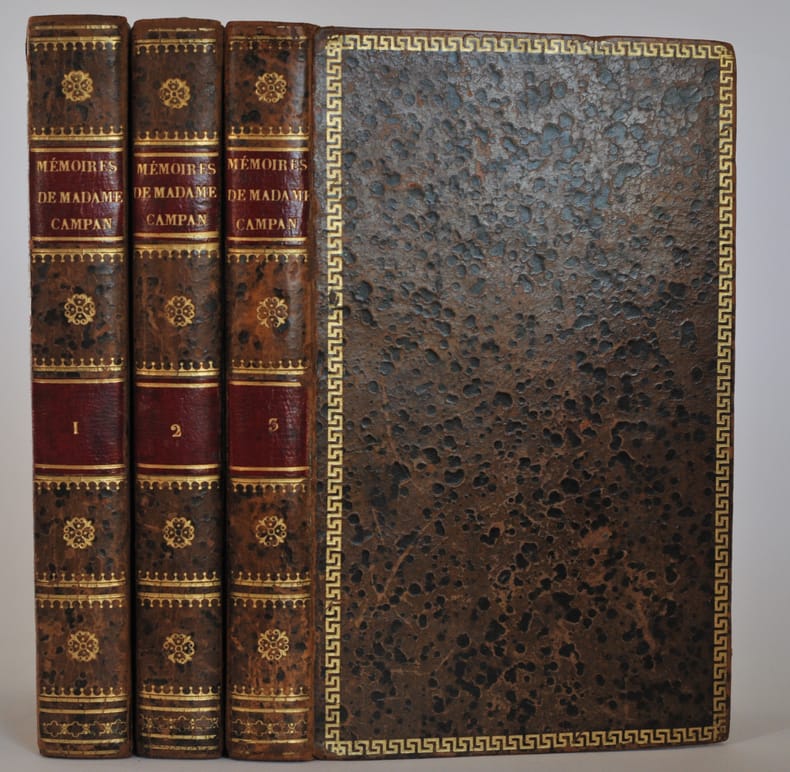
182346405723Paris, Baudouin, 1823 ; 3 volumes in-8, plein veau granit, encadrement grecques dor., dos ornés de frises et fleurons dorés, pièces de titre en maroq. rouge, tr. marbrées. 2 ff., XLVIII pp., 382 pp. - 2 ff., 399 pp. - 2 ff., 382 pp.Portrait de Mad. Campan gravé par Dien au 1er tome.L’édition originale a paru chez le même éditeur en 1822, peu après la mort de l’auteur. Ces mémoires appartiennent à la Collection des Mémoires relatifs à la Révolution française. La notice sur Madame Campan (48 pp. au début du tome 1) est signée F. Barrière. Exemplaire bien relié à l’époque, rousseurs éparses.
189375430Eagle Printing 1893-01-01. Acceptable. Fair; Front cover is lose but still present; Soft Cover; Eagle Printing; 1893; 0 Eagle Printing paperback
1831717Prospect Hill 1831. 4to. 260 x200 mm. 10 ¼ x 8 inches.  1 page plus small portions of two other pages folio sheet folded approximately 150 words. Written in ink Moderate brown stain toward center obscuring a number of words. Letter laid down into marginal paper supports. This letter discusses Genet's enclose Christmas gift for President Andrew Jackson which the verso of the letter indicates to be a medallion bearing the head of Julius Caesar. Genet begs the recipient thought to be William L. Marcy U.S. Senator and former Secretary of State to give Jackson the gift because: "no one I believe at Washington being better than you acquainted with my humble history in this country as an unchangeable Republican and a zealous friend of General Jackson." Genet wished to deliver the gift to Jackson personally but Jackson's proposed visit to Albany never materialized. The letter is significant for several reasons. It demonstrates Genet's continued involvement with the highest political men in America as well as his commitment to democratic ideals now translated for the Jacksonian age. A Governor of New York Senator and Secretary of State Marcy was influential on American foreign policy and the letter demonstrates Genet's intimacy with him. ".be then My dear Sir my Interpreter near him and add to my letter with your usual eloquence what my rusticated style has not been able to express." The contact between Genet and Jackson came at an important moment of U.S.-French relations a subject of continuous interest to Genet the first minister of the French Republic to the United States. President Jackson had sent William Rives as representative to France to try to negotiate a settlement of the "Beaumarchais claim" a claim by the family for repayment for services rendered by their ancestor to the American Revolution. Rives was also seeking reparations against the French for their role in the commercial crisis that preceded the War of 1812. In 1830 the U.S. had manipulated wine tariffs as a weapon in the negotiations but by 1831 both sides were finally agreeing to settlements which favored American claims. Genet's "small hommage" to Jackson cannot have failed to figure in the President's perception of France at this crucial time in the diplomatic relationship of the two countries. Jackson and Genet did occasionally correspond and two letters dated 1831 are held by the James Monroe Museum and Memorial Library. unknown books
1831717Prospect Hill 1831. 4to. 260 x200 mm. 10 ¼ x 8 inches. 1 page plus small portions of two other pages folio sheet folded approximately 150 words. Written in ink Moderate brown stain toward center obscuring a number of words. Letter laid down into marginal paper supports. This letter discusses Genet's enclose Christmas gift for President Andrew Jackson which the verso of the letter indicates to be a medallion bearing the head of Julius Caesar. Genet begs the recipient thought to be William L. Marcy U.S. Senator and former Secretary of State to give Jackson the gift because: "no one I believe at Washington being better than you acquainted with my humble history in this country as an unchangeable Republican and a zealous friend of General Jackson." Genet wished to deliver the gift to Jackson personally but Jackson's proposed visit to Albany never materialized. The letter is significant for several reasons. It demonstrates Genet's continued involvement with the highest political men in America as well as his commitment to democratic ideals now translated for the Jacksonian age. A Governor of New York Senator and Secretary of State Marcy was influential on American foreign policy and the letter demonstrates Genet's intimacy with him. ".be then My dear Sir my Interpreter near him and add to my letter with your usual eloquence what my rusticated style has not been able to express." The contact between Genet and Jackson came at an important moment of U.S.-French relations a subject of continuous interest to Genet the first minister of the French Republic to the United States. President Jackson had sent William Rives as representative to France to try to negotiate a settlement of the "Beaumarchais claim" a claim by the family for repayment for services rendered by their ancestor to the American Revolution. Rives was also seeking reparations against the French for their role in the commercial crisis that preceded the War of 1812. In 1830 the U.S. had manipulated wine tariffs as a weapon in the negotiations but by 1831 both sides were finally agreeing to settlements which favored American claims. Genet's "small hommage" to Jackson cannot have failed to figure in the President's perception of France at this crucial time in the diplomatic relationship of the two countries. Jackson and Genet did occasionally correspond and two letters dated 1831 are held by the James Monroe Museum and Memorial Library. unknown
18251528Albany: Packard & Van Benthuysen 1825. About very good. 112pp. plus five engraved plates and folding table. Original printed boards sympathetically rebacked. Light dampstaining and wear to boards. Some foxing and toning internally heavier to initial leaves. A rare and pioneering if evidently fanciful work on air travel by Edmund Charles Genet the infamous ambassador of the French Republic to the United States who from his position in America sought to outfit privateering expeditions against British and Spanish interests in the Caribbean during the 1790s. Following the failure of his schemes and removal from his office at the request of President Washington Genet managed to remain in the United States:<br/><br/>"In February 1794 the new minister Joseph Fauchet arrived with a warrant for Genet's arrest. Had the ex-minister returned to France the Jacobins now in power might have executed him. Granted asylum in the United States he married Cornelia Clinton daughter of New York governor George Clinton 1739-1812 settled near Albany and eventually became a U.S. citizen. He avoided politics and busied himself with publishing unworkable schemes for powered balloons and for using hydraulic power to haul barges over hills" - ANB.<br/><br/>Despite its title which suggests hydraulics the present work largely deals with aviation and is regarded as the first printed suggestion of the theory of a heavier-than-air machine taking flight. The marvelous plates contain detailed diagrams and illustrations of Genet's proposed horse-powered aerostatic airship and the text discusses his designs and his theoretical proofs for the possibility of mechanical flight in exuberant detail. <br/><br/>"This pamphlet by the former Ambassador from France contains a proposal for a large airship and other suggestions for the use of the aerostatic principle. The project attracted much attention. but never materialized" - Aeronautic Americana. "Extremely rare and important the first book printed in the United States on practical aeronautics and on the first patent for an aeronautical invention" - Streeter.<br/> ANB online. Aeronautical Americana 9. Honeyman Sale 1475. Howes G100 "b." Rink 610. Streeter Sale 3974. Packard & Van Benthuysen unknown books