38 résultats
163867902London: Printed by T. Cotes for William Cooke 1638. First edition in English. Leather Bound. Good. 327 numbered pages. Twentyfourmo 14.5 cm Full brown leather with a red leather spine label decorative gilt tooling to the spine and double blind-ruled borders on the boards. Later endpapers circa 18th-19th century. Lacking the frontispiece portrait. Extremities rubbed. Cracks to the head of the spine along the joints the longer crack along the front joint measures 1 inch. Leather boards darkened at the edges. Ownership inscription "C Humphreys 1746" on front flyleaf. Two contemporary notations on the title page. A single manuscript notation within the text. One gathering hanging by a thread. Text block cracked at p. 317 and pp. 317-322 are partially detached. Small stains in the top margins of pp. 40-162 of "The Epistle." P. 286 is numbered as p. 287 and vice versa. <br /> <br /> Ex-libris English antiquary verse-writer and politician Hudson Gurney of Norwich 1775-1864 with his armorial bookplate on the front pastedown. Hudson a highly acclaimed intellectual and bibliophile avowed to have read all 15000 volumes in his library and was a fellow of the Royal Society and the vice president of the Society of Antiquaries. His own verse works include the free translations of "Cupid and Psyche" 1798 and "The Orlando Furiosa" 1808 and his chronicle of major events in ancient history "Heads of Ancient History" 1814. His "Observations on the Bayeux Tapestry" 1817 presented an argument for the authenticity of its subject. He made numerous contributions in Parliament where he was viewed as an independent who tended to see both sides of every question. The book opens with a note on the translation which is followed by an unpaginated section titled "To the Inhabitants of the Island of great Britaine Unitie and Felicity."<br /> <br /> Gildas was a 6th century British monk and historian who lived for many years as an ascetic hermit on Flatholm Island in the Bristol Channel and was known for his piety and good education. He founded a monastery in Brittany known as St. Gildas de Rhuys. His "De excidio et conquestu Britanniae" "The Overthrow and Conquest of Britain" is one of a handful of sources for the country's post-Roman history. This work "The Epistle of Gildas" is a longer work which is a series of sermons on the moral failures of rulers and of the clergy.<br /> <br /> A work by one of the most influential figures of the early English Church. Printed by T. Cotes, for William Cooke unknown
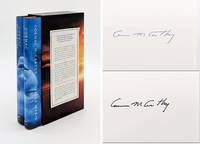
71342Hopewell NJ: The Ecco Press 1994. First edition first printing. Hardcover. Near Fine/Near Fine. Signed by Cormac McCarthy in blue ink on the half-title page. <br /> <br /> 133 pp. Octavo 22 cm. Publisher's black cloth and grey paper-covered boards with blind-stamped design on the front and silver titles on the spine. First edition clearly stated on the copyright page. In the original dust jacket designed by Chip Kidd with the "$19.95" price and "9404" code intact on the front flap.<br /> <br /> A Near Fine unread and clean copy. The rear board is bound slightly askew a minor binder's aberration. The dust jacket is likewise Near Fine showing only very light surface rubbing. A nice copy. Signed by the notoriously reclusive author. From the library of the late Santa Fe bookseller Nicholas Potter. Throughout a friendship spanning forty years Potter’s bookstore served as a frequent destination for McCarthy where the two shared a rapport rooted in their mutual appreciation of literature art music and history. This volume represents a vital fragment of that connection.<br /> <br /> Written in the mid-1970s The Stonemason remained unpublished for nearly twenty years until its release by Ecco Press in 1994. The professional relationship began when Ecco founder Daniel Halpern reached out to McCarthy via a letter to his Tennessee home. This collaboration eventually established Ecco as a primary publisher for McCarthy’s dramatic and poetic work.<br /> <br /> Set in Louisville Kentucky the work meditates on craft and heritage. McCarthy’s rhythmic dialogue reflects the precision of masonry elevating manual labor to a spiritual discipline. Prioritizing thematic architecture over narrative the play measures the permanence of stone against the fragility of family structures. The Ecco Press hardcover
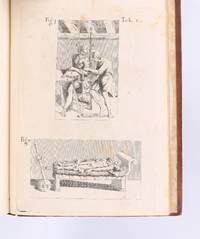
177691216Romae Rome: Apud Benedictum Francesium 1776. Fine. A copy uniting two illustrious surgeons of the 18th and 19th centuries Apud Benedictum Francesium Romae Rome 1776 20.5 x 27.8 cm Relié Illustrated first edition lacking the frontispiece portrait of Hippocrates but complete with its five plates fine decorative initials and large tailpieces. Contemporary full tree calf smooth spine richly gilt with among other decorations a palmette roll tan morocco lettering piece gilt roll on board edges. Ink ownership inscription on the front pastedown: ""J. E. Petrequin lyon nov. 1856"" in the hand of Joseph Pierre Eléonor Pétrequin chief surgeon at the Hôtel-Dieu de Lyon who received the distinction of Chevalier de la Légion d'Honneur in 1855. Scattered foxing marginal tear to p. xi. A fine copy. Upon its publication in 1776 this text commenting on the Hippocratic treatise on fractures won the admiration of scholars at the Royal Academy of Surgery in Paris on the other side of the Alps. Joseph Pierre Eléonor Pétrequin would thus own in the following century a copy of this work recognized in France the one offered here. His main book published posthumously in 1878 would also deal with the medicine of Hippocrates. Pietro Pericoli would write in 1879 that Andrea Massimini was the last at that date to have worked on the doctrines of the ""Father of Medicine"" this Italian politician had certainly not yet heard of Pétrequin's 1200 pages on the subject. A fine illustrated work associating two renowned surgeons in line with the Hippocratic legacy. Provenance: ownership inscription of Joseph Pierre Eléonor Pétrequin. Apud Benedictum Francesium unknown
71333New York: Alfred A. Knopf 2022. First editions first printings in publisher's slipcase. Hardcover. Near Fine/Near Fine. From the library of the late Santa Fe bookseller Nicholas Potter a long-time friend of Cormac McCarthy. Both volumes are signed by the author on publisher’s tipped-in pages: The Passenger in blue ink and Stella Maris in black ink. Laid into the first volume are two small memo notes in Potter’s hand providing a record of the set's rarity: "This is one of the two copies of the boxed signed edition that Dorothy Massey proprietor of Santa Fe’s Collected Works Bookstore got in the "lottery" for them. Collected Works was one of hundreds of bookstores that tried to order them. Probably fewer than 500 were signed. Dorothy gave it to me."<br /> <br /> 383; 189 pp. Two octavo volumes 24 cm. Publisher’s blue and red paper-covered boards respectively; titles gilt-stamped to spines. First edition clearly stated on the copyright pages. In the original illustrated dust jackets with prices and date codes intact. Housed in the publisher's decorative pictorial paper-covered slipcase with the original paper label tipped-on the rear panel. All elements are Near Fine; bright square clean copies showing only the faintest hints of shelfwear or handling. This set documents a direct connection within the Santa Fe book trade having been gifted from Dorothy Massey to Nicholas Potter. The signatures are provided on the publisher’s tipped-in pages with provenance established by a laid-in note in Potter’s hand. This note identifies the volumes as a gift from Massey proprietor of Collected Works establishing a professional association that distinguishes this set from typical signed issues. It stands as a physical record of the professional network and relationships that supported McCarthy’s work in New Mexico for four decades.<br /> <br /> Alfred A. Knopf published The Passenger on October 25 2022 followed by Stella Maris on December 6 2022. This slipcased boxed set was released concurrently with the second volume and contains both first-edition hardcovers. These signed sets were distributed via a highly restricted "lottery" to select bookstores; it is estimated that only 500 such sets were produced. As McCarthy declined public appearances for these final titles these tipped-in pages represent rare "officially" signed copies of his final works. McCarthy passed away in June 2023—scarcely six months after the final volume's release—marking these as the last works published during his lifetime.<br /> <br /> Conceived as a profound late-career diptych The Passenger and Stella Maris constitute Cormac McCarthy’s final novels. The first volume follows Bobby Western a salvage diver contending with his father’s legacy on the Manhattan Project and the suicide of his sister Alicia. Its companion Stella Maris is a psychiatric transcript recording Alicia’s own struggle with mathematics and hallucination. Eschewing conventional linear plotting the pairing serves as a rigorous inquiry into the "unshareable" nature of reality and the constraints of human knowledge. Alfred A. Knopf hardcover
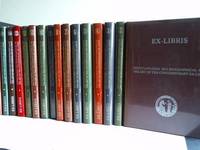
9a629A.M.da Mota Miranda Celorico de Basto 1995. Zusammen ca.3.500 S. mit zahlreichen Illustrationen und aufgezogenen teils signierten Originalen in verschiedenen Techniken Kunstleder. Quart. - Die Bände sind viersprachig. Neben Deutsch ebenso Italienisch: "Enciclopedia Bio-Bibliografica da Arte do Ex-Libris contemporaneo"/französich:"Envyclopèdie Bio-Bibliographique de L`Art de L`Ex-Libris contemporain"/englisch: "Encyclopaedia Bio-Bibliographical of the Art of the Contemporary Ex-Libris" - unknown
71330London: Picador 2006. First U.K. edition first printing. Hardcover. Fine/Fine. One of only 200 copies issued with a bookplate signed in black ink by Cormac McCarthy mounted to the title page. These bookplates were signed specifically for this first Picador edition and distributed via the British retailer Waterstones. From the library of the late Santa Fe bookseller and McCarthy associate Nicholas Potter. Laid in is Potter's original invoice and purchase receipt from Nicholas & Helen Burrows booksellers Surrey/London UK dated 20-Nov-06.<br /> <br /> 241 pp. Octavo 24 cm. Publisher’s black paper-covered boards with silver stamping to the spine. Original pictorial dust jacket with the "£16.99" price intact. A bright square and clean copy. The inclusion of the signed bookplate at the title page is notably scarce. A short note in Potter's hand is also laid in: "w/signed Bookplate tipped in. October 2006. Cormac told me he would not sign this book title so it is rare signed even if it is on a bookplate." Throughout a friendship spanning forty years Nicholas Potter’s Santa Fe bookstore served as a frequent destination for McCarthy where the two shared a rapport rooted in their mutual appreciation of literature art music and history. This volume represents a vital fragment of that connection.<br /> <br /> Pulitzer Prize-winning and austere The Road is a harrowing odyssey and a testament to paternal devotion. Set in an ash-covered wasteland the narrative depicts a father and son navigating a landscape of predatory cannibals among the ruins of civilization. Refining the sparse prose of his late career into minimalist parable McCarthy captures the endurance of hope in the face of total environmental collapse. The work was adapted into a film directed by John Hillcoat and starring Viggo Mortensen. Picador hardcover
176088881Paris: S. n. 1760. Fine. A contemporary full red morocco binding S. n. Paris 1760 22.5 x 29.3 cm trois volumes reliés New edition adorned with a portrait of the author by Daullé three headpieces by de Sève engraved by Juste Chevillet twelve plates engraved by Jacques Aliamet Jean-Jacques Flipart Noël Le Mire Louis-Simon Lempereur Dominique Sornique and Jacques-Nicolas Tardieu and thirteen vignettes and sixty tail-pieces all by de Sève engraved by Jean-Charles Baquoy Jean-Jacques Flipart and Louis Legrand. A superb copy of the first luxury edition of Racine among the most sought-after bound in the most sumptuous red morocco. Contemporary full red morocco spine with five raised bands and gilt compartments triple gilt fillet border corner fleurons yellow morocco lettering pieces and volume numbers double gilt fillets on the boards marbled endpapers double gilt fillet on the edges gilt dentelle turn-ins gilt edges. Occasional light foxing mostly on the early leaves of the volumes; some browned pages; skilfully restored corners and joints; a few scratches. Provenance: Library of Jean Fürstenberg his red morocco bookplate pasted to the verso of a free endpaper of vol. I others in paper in vols. II and III. From a family of Berlin bankers and a banker himself Hans Fürstenberg took refuge in France in 1938 and francised his name. It was then that he presented to the Bibliothèque nationale his collection of original editions of German works from the pre-classical and classical periods. From his youth Jean Fürstenberg also collected illustrated books rare French eighteenth-century works incunabula and bindings maintaining his interest in these fields throughout his life and publishing several works on the subjects. In 1959 together with Julien Cain he founded the International Association of Bibliophily. Comité dhistoire de la Bibliothèque nationale de France S. n. hardcover
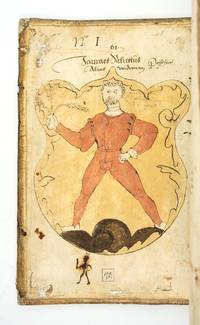
1558ST20936Mainz: druckts Franz Behem Arnold Birckmann I heirs of 1558 1559. FIRST EDITION. 320 x 205 mm. 12 5/8 x 8". 6 p.l. CCCCCI 501 leaves; 4 p.l. CCLXII 162 leaves. <br/> Contemporary blind-stamped pigskin over bevelled wooden boards covers with concentric frames containing a palmette roll and roll featuring half-length portraits of King David signed K D St. Paul Christ the Savior and St. John the Baptist dated 1549 each of these with abbreviated Latin mottos beneath the figures central panel with botanical tooling raised bands inked shelfmark G 73 in bottom panel brass catchplates and remnants of straps corners of boards and head and tail of joints repaired with pigskin some decades ago. Title pages with printer's device 6 with woodcut of the Crucifixion verso of title page of second work with woodcut arms of the archbishop of Mainz. Front pastedown with FULL-PAGE HAND-PAINTED EX-LIBRIS OF JOHANNES SALICETUS WIDENER: his ink inscription at head of page above a shield painted yellow with curling ink leaves around the perimeter dominated by a bearded young man in red shirt and tights standing astride three brown hillocks one hand on his hip the other holding three stalks of wheat a ink-drawn homunculus at the foot of the page his head sprouting what appear to be two antennae the later blue ink stamp of F T E beside this. First work: USTC 694128; VD16 694130. Second work: 694130; VD16 For the binding: EBDB workshop w002792; EBDB roll r001326 similar to saints roll but dated 1547 and with slightly different Latin mottos. Pigskin somewhat soiled and rubbed title page of first work tipped onto 2 leaves lightly browned due to paper quality with intermittent foxing and occasional mostly trivial stains and smudges final leaf with a two-inch to half-inch triangular piece torn away from the upper half of the fore edge affecting a total of perhaps 80 or 100 words. Still a copy featuring a binding with antique appeal and considerable interest in terms of provenance see below.<br/> <br/> Offered in its original blind-stamped pigskin binding this imposing collection of Counter-Reformation sermons by an influential preacher is of special interest because of the impressively large hand-painted ex-libris at the front. The two groups of sermons bound together here were written by Johann Wild 1497-1554 a Franciscan who was educated at Cologne and who served as the Domprediger official cathedral preacher at Mainz Cathedral. Wild's sermons were very popular and it has been suggested that they played a significant role in keeping Mainz Catholic at a time when many surrounding cities were converting to Lutheranism. Despite his being a Catholic hero for a time Wild later became a controversial figure in the Church: many of his works eventually faced posthumous censure even being placed on the Vatican's Index Librorum Prohibitorum on the grounds that they might invite scriptural misinterpretation. Our copy was owned by a second German Counter-Reformation figure Johannes Salicetus i.e. Johann Wideman whose exuberantly large hand-painted ex-libris takes up nearly the entire front pastedown. Salicetus was rector at the University of Ingolstadt which had become a bastion of Catholic thought in Southern Germany under the leadership of theologian Johann Eck 1486-1543 an outspoken Luther opponent. A relative and very close friend of Eck Salicetus composed Eck's eulogy USTC 698476 as well as a marital poem for his son Oswald USTC 2213477. The enormous bookplate is apparently a coat of arms and features a particularly proud central figure posing staunchly in a very red suit with a prominent codpiece and holding three stalks of wheat. While this peculiarly emphatic expression of ownership is surely not unprecedented we have never owned a book with provenance shown in quite such a dramatic fashion. druckts Franz Behem, [Arnold Birckmann (I) (heirs of)] unknown
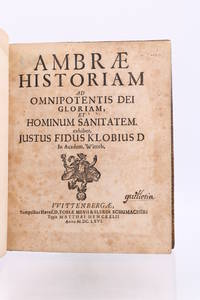
166689746Wittenberg: Héritiers de D. Tobias Mevius et E. SchumacherImpr. de Matthaeus Henckel 1666. Fine. A copy ""uncut at the head"" Héritiers de D. Tobias Mevius et E. Schumacher Impr. de Matthaeus Henckel Wittenberg 1666 16.3 x 20.2 cm Relié First edition illustrated with four plates including a folding world map cf. Sinkankas 3466; Agassiz III 370.Full fawn calf spine with five slender raised bands gilt-tooled compartments with occasionally softened floral tools rubbed gilt headcaps brown morocco lettering-piece marbled endpapers and pastedowns gilt dentelle framing the pastedowns gilt fillets to board edges marbled edges contemporary binding.Repairs to the spine one joint split at head and foot browning along the board margins with surface scratches scattered foxing a waterstain at the head of all leaves.A noteworthy treatise devoted to yellow amber and above all to ambergris the fragrant substance derived from the intestinal concretions of sperm whales which once expelled float on the surface of the sea and yield a highly prized perfume.The plates depict a frog and a lizard embedded in amber a world map Africa Europe Asia and part of the Southern Lands figures collecting bird droppings and various animals.""This book commonly appears in bibliographies on amber when in fact it is about ambergris but Klobius examines both substances and notes their differences on p. 26-9. One of the plates shows a frog and a lizard imbedded in amber both of which are fakes"" Sinkankas.On the title-page a distinguished manuscript ex-libris in black ink Héritiers de D. Tobias Mevius et E. SchumacherImpr. de Matthaeus Henckel hardcover
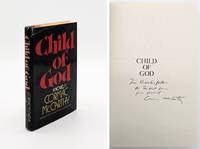
71269New York: Random House 1973. First edition first printing. Hardcover. Near Fine/Very Good. Inscribed by Cormac McCarthy in black ink on the half-title page to Santa Fe bookseller Nicholas Potter: "For Nicholas Potter All the best from your friend Cormac McCarthy."<br /> <br /> 197 pp. Octavo 21.5 cm. Publisher's black cloth and red paper-covered boards stamped in red and gold. Black dust jacket with red white and olive green typography designed by Muriel Nasser. First edition clearly stated on the copyright page. Dust jacket with "$5.95" price intact at top-front flap and "1/74" code at the rear flap's bottom-left.<br /> <br /> A Near Fine unread copy with occasional light surface soil or toning. The text block is solid and square. The top edges of the boards are gently sunfaded. The front free endpaper has a previous ownership inscription written neatly in blue ink: "Dane Meyers Hugh Prather Collection." The dust jacket is in Very Good condition showing the spine-fading common to this title along with some general surface rubbing and scratching. The jacket edges are lightly toned with a few minor creases and short closed tears measuring less than 2cm. An attractive copy with an intimate association. A significant association copy warmly inscribed by the notoriously reclusive author to his long-time friend the late Santa Fe bookseller Nicholas Potter. A short note in Potter's hand is laid in: ".This copy inscribed to me in the mid 90's." Throughout a friendship spanning forty years Potter’s bookstore served as a frequent destination for McCarthy where the two shared a rapport rooted in their mutual appreciation of literature art music and history. This volume represents a vital fragment of that connection; McCarthy who famously avoided public life inscribed most of his published works to Potter.<br /> <br /> The first printing of Child of God consisted of a run of 7500 copies and was the only printing of the first edition of this work. The book was a commercial failure upon its release selling less than 2500 copies. The book sparked controversy over its subject matter with some reviewers objecting to it on moral grounds.<br /> <br /> The narrative chronicles the progressive isolation and depravity of Lester Ballard—a dispossessed outcast who pushes the boundaries of abhorrent human behavior. Set in the rugged hill country of mid-century Tennessee the story is told in a detached clinical manner. McCarthy’s third novel Child of God intensified the visceral Southern Gothic vision of his previous works and solidified his reputation for writing spare biblical prose that depicts harrowing and macabre scenes with unflinching clarity. Random House hardcover
196571251New York: Random House 1965. Second printing of the first edition in the first issue dust jacket. Hardcover. Near Fine/Very Good. Inscribed by Cormac McCarthy in black ink on the half-title page to Santa Fe bookseller Nicholas Potter: "For Nicholas All the very best Cormac." <br /> <br /> 246 pp. Octavo 21 cm. Publisher's green cloth and light burgundy paper-covered boards stamped in gilt red and blind. Publisher's green topstain. White dust jacket with red and black typography designed by Muriel Nasser. Second printing clearly stated on the copyright page. First issue dust jacket with "$4.95" price intact at top-front flap and "5/65" code at the bottom-right. <br /> <br /> A Near Fine copy the text block is clean square and seemingly unread throughout. The green topstain is lightly faded and the paper at the fore-edges of the boards show bits of abrasion. The dust jacket is Very Good gently sunned at the spine and showing light overall surface soiling and minor edgewear including a short split beginning at the top-front flap fold and tiny chips at the spine head and the top-right corner of the front panel. An attractive copy with an intimate association. A significant association copy warmly inscribed by the notoriously reclusive author to his long-time friend the late Santa Fe bookseller Nicholas Potter. Throughout a friendship spanning forty years Potter’s bookstore served as a frequent destination for McCarthy where the two shared a rapport rooted in their mutual appreciation of literature art music and history. This volume represents a vital fragment of that connection; McCarthy who famously avoided public life inscribed most of his published works to Potter.<br /> <br /> The second printing of The Orchard Keeper consisted of a small run of only 750 copies. It has been noted that surplus first-issue dust jackets were used for this printing; these were frequently price-clipped to accommodate the second printing’s increased $6.95 price. The present example is notably not price-clipped retaining the original $4.95 price.<br /> <br /> Set in a remote rural Tennessee community between the World Wars The Orchard Keeper is McCarthy’s debut novel inaugurating a cycle of four Southern Gothic works with Outer Dark Child of God and Suttree to follow. The narrative explores the forces of modern civilization as they encroach upon older more rugged ways of living. Upon its release the novel earned McCarthy immediate critical acclaim and comparisons to the likes of William Faulkner. Random House hardcover
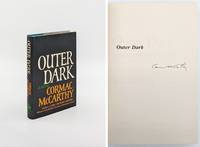
196871258New York: Random House 1968. First edition first printing. Hardcover. Near Fine/Very Good. Signed by Cormac McCarthy in black ink on the half-title page.<br /> <br /> 242 pp. Octavo 21 cm. Publisher's turquoise cloth and grey paper-covered boards stamped in black silver blue. Publisher's black topstain. Black dust jacket with white green and orange typography designed by Muriel Nasser. First printing statement on the copyright page. Dust jacket is price-clipped and has the "9/68" code at the front flap’s bottom-right.<br /> <br /> A Near Fine unread copy clean and square. The black topstain is lightly faded. The price-clipped dust jacket is Very Good with just a tiny closed tear measuring less than 1cm at the bottom edge of the front panel and one very small dark stain on the spine. A nice copy. Signed by the notoriously reclusive author. From the library of the late Santa Fe bookseller Nicholas Potter. Throughout a friendship spanning forty years Potter’s bookstore served as a frequent destination for McCarthy where the two shared a rapport rooted in their mutual appreciation of literature art music and history. This volume represents a vital fragment of that connection.<br /> <br /> The first printing of Outer Dark consisted of a run of 5000 copies and was the only printing of the first edition of this work. The book was a commercial failure upon its release selling less than 3500 copies.<br /> <br /> Set in purgatorial turn-of-the-century Appalachia Outer Dark is McCarthy’s second novel distilling his Southern Gothic style which he would continue to explore in his two subsequent novels Child of God and Suttree. The narrative utilizes an archaic rhythmic prose to deliver a wandering tale—a harrowing meditation on nihilism. Its publication cemented McCarthy as a singular prophetic stylist distinguished from many of his more experimental postmodernist contemporaries through a mastery of the macabre and the mythic. Random House hardcover
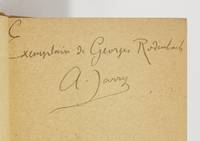
189669650Paris: Mercure de France 1896. Fine. Mercure de France Paris 1896 9.50 x 15.50 cm relié The first edition with two portraits of Père Ubu drawn by Alfred Jarry. Half brown morocco over marbled paper boards by G. Gauché spine in five compartments raised bands with blind ruled fillet gilt date to foot of spine marbled endpapers and pastedowns covers and spine repaired preserved top edge gilt. A rare handsome autograph inscription signed by Alfred Jarry: Georges Rodenbach's copy. Alfred Jarry. Provenance: from the personal collection of President Georges Pompidou with his ex-libris to endpaper. He showed that he could at the same time love Racine and Soulages. Poussin and Max Ernst. Virgil and René Char and from that point of view he was outstanding. Alain Peyrefitte. From behind a desk in the école Normale and high up in the government administration in the bank and finally as a politician Georges Pompidou put together in the heart of his personal collection an anthology of French literature. This handsome copy of Ubu Roi reveals his identity as a man of letters between classicism and the avant-garde. Pompidou whose literary training would imbue both his thinking and political speeches showed a taste cultivated alongside his wife Claude for modern art cinema and the theatre: we know that he was well acquainted with Jules Romains read Beckett and was a great admirer of Louis Jouvet. The arts among other things owe him a debt for the unfailing support he showed the Théâtre National Populaire of Jean Vilar who presented a new staging of Ubu Roi in 1958 at Chaillot. This copy of Jarry's masterpiece also bears witness to its famous first owner the Belgian Symbolist Georges Rodenbach one of the most perfect writers in Flanders who received this work with a signed inscription from the author his fellow contributor to the Revue blanche. They were both disciples of Stéphane Mallarmé meeting every Tuesday with their master at his salon in the rue de Rome. Also a member of the circle of the Hydropathes in which Jarry was an active participant Rodenbach published in the same year as Ubu one of his most important collections of poems Les vies encloses inspired by the occultism of Novalis and the German Romantics. With Jarry claiming to be a follower of Pantagruel as Rodenbach did of Baudelaire one of them struggled with the incomprehension of the public while the other revelled in it: they developed at the two extremes of the Mallarmé spectrum. An admirable witness of the Parisian literary and bohemian microcosm this work with its prestigious provenance brings together two great names of the avant-garde theatre and fin-de-siecle poetry: Jarry the ultimate mystifier and Rodenbach the nostalgic poet of cloistered lives. Mercure de France hardcover