4 résultats
1587ABC_48453Antwerp: Christoffel Plantin 1587. Contemporary elaborately blind-tooled pigskin over bevelled wooden boards sewn on 4 double supports with the corresponding raised bands on the spine the manuscript title in the first compartment and the original manuscript shelf mark label "H.36" of the Monastery of Buxheim in the fifth compartment both boards with an ornamental roll and a roll with the portraits of Salvater sic! Maria S. Bruno and S. Johannes in a panel design two original brass clasps and catches ornamented with a small star leather tabs and six original bookmarkers plaited into a big knot. 8vo. With a woodcut vignette with Peter and Paul by Peeter van der Borcht on the title page 6 full-page woodcuts ca. 112 x 75 mm by Antoon van Leest after Peeter van der Borcht 6 half-page square woodcuts 55 x 55 mm in border one signed by Antoon van Leest one woodcut 90 x 76 mm by Antoon van Leest after Peeter van der Borcht and 2 smaller oval woodcuts. The work is printed in red and black. Plantin edition of the revised Roman Missal following the directives of the Council of Trent first published in Rome in 1570 by order of pope Pius V 1504-1572 and later approved by Clemens VIII 1536-1605 and Urbanus VIII 1568-1644. The work was quite popular as Plantin published a new missal nearly every year from 1571 onwards. All editions were printed in different sizes and in two issues one with woodcut illustrations and one with engravings. The present copy is the octavo edition with woodcut illustrations and comes from the library of the famous Carthusian monastery of Buxheim Maria Saal near Memmingen Bavaria.The monstery of Buxheim was founded in 1402 and dissolved after the secularisation in 1803. The rich library was auctioned in 1883 by Förster and in 1884 by Ludwig Rosenthal in Munich. The Museum of the Charterhouse Buxheim today is actively studying the history of the library and the present location of its books and manuscripts. The present copy is bound in contemporary pigskin which was likely bound for the monastery itself as the rolls depict Saint Bruno who was the founder of the Carthusian order. The Missal is therefore probably bound in a South-German bindery in the surroundings of the monastery.With an ownership annotation on the title page "Cartusiae Buxheim". The binding is somewhat rubbed and soiled. The leaves are lightly browned some of the leaves are slightly stained especially around the leather tabs. Otherwise in good condition.l Belg. Typ. 6335; Imhof Plantins 1574 Missale Romanum in octavo in: De Gulden Passer 73 1995 pp. 67-82; Nagler I 1459; USTC 406791; Voet 1701 A; Weale-Bohatta no. 1269; not in Haebler. Christoffel Plantin, hardcover
16002945Paris: the Associated Booksellers to the Church 1600. <p>Folio 362 x 245 mm. Collation: ã6 ê6 î4 i4 blank õ6 Å©6 ãã6 êê4; A-Z Aa-Yy6. 38 228 42 leaves. Double column printed in red and black double rule page-borders throughout. 57 pages with printed music staves red-printed. Woodcut title illustration of Saints Peter and Paul seven full-page woodcuts the first in two blocks: a woodcut border and small Annunciation cut five small woodcut vignettes including two repeats and approximately 368 historiated initials in various sizes and from various series. Small tear to corner of title-leaf occasional foxing very occasional offsetting of red ink small stains in gutters in quire O finger-soiling in Canon quire X small rust-hole in f. 212 NN2 affecting 3 letters last few leaves with narrow marginal dampstain and slight creasing to upper fore-corners. Bound in contemporary French gold-tooled and -stamped light brown goatskin covers paneled with double fillets inner panel with fleurons at outer corners inner corners with large stamp of leafy branches emerging from a small medallion with winged cherub’s head large central oval medallion of the Crucifixion on upper cover and Annunciation on lower cover smooth spine with recessed cords decorated with overall double fillet panel with tiny fleurons at corners gilt edges plain endpapers remains of numerous fore-edge tabs in paper pale green or pink silk and black silk for the Mass for the Dead. Corners bumped slight wear front cover slightly rubbed a few small holes to lower cover foxing to endpapers. Provenance: contemporary inscription in French on front flyleaf listing “Messes pour tous les iours de la sepmaine†Masses for every day of the week; loosely inserted armorial papercut unidentified arms lion rampant on a chief three roses.<br /> <br /> Unrecorded issue of an imposing post-Tridentine Missal in a fine Parisian gold-tooled binding. The woodcut illustrations of this copy differ from the other known copies of this edition which are illustrated with engravings. The binding tools appear on other books published by the same publishing consortium and have been associated with religious lay confraternities founded by Henri III in the 1580s.<br /> <br /> This exceptional copy is of interest for the history of publishing printing illustration and binding; it raises questions about the very concept of an edition about the transmission of images and about the relations between printer-publishers bookbinders and book buyers in the hand-press period. <br /> <br /> In 1570 with the papal bull “Quo primum†Pope Pius V imposed uniformity on the rites of Mass previously a hodge-podge of different local traditions. That bull was printed in all subsequent missals; it is accompanied here by papal and royal privileges which supply crucial information concerning the publishing history of this edition. Jacques Kerver was the first French libraire to obtain a privilege for the publication of liturgical works. When he died in 1583 the privilege passed to his widow who ceded it to a consortium of booksellers: Sebastian Nivelle Guillaume Chaudière Guillaume de la Noue Michel Sonnius and Thomas Brumen cf. Renouard Imprimeurs et libraires parisiens du XVIe siècle IV 22. That privilege expired on 22 December 1595. This edition includes Papal and Royal renewals of the Kerver privilege for the printing of “sacred books†Missals Breviaries and Offices of the Virgin granted respectively by Clement VIII and Henri IV both on 4 April 1596. For Thomas Brumen who had died in 1588 the Royal privilege substitutes his son-in-law and heir Jean Corbon II and adds the names of Claude Chapelet identified as bookseller to the Academy and Jamet Mettayer and Pierre L’Huillier respectively Royal printer and Royal bookseller Mettayer was also the official printer for the Royal confraternities.<br /> <br /> The preliminary matter further includes the reformed Gregorian Paschal calendar for the years 1582 to 1700 a table of moveable feasts for 1589 to 1621 the Rubricae generalis missae the Ritus servandus in celebratione Missae and an index of Saints’ names. The second part of the Missal separately paginated contains the Commune Sanctorum. The subjects of the full-page illustrations are: the Annunciation: a small cut within an historiated woodcut border in twelve compartments showing four scenes from the life of the Virgin alternating with angels and the four Evangelists fol. êê4v; the Nativity B4v Crucifixion T6v opening the Canon Resurrection X4v Pentecost AA1v Last Supper BB3r and Last Judgment PP2v. These monumental woodcuts influenced by Italian and Flemish mannerism derive from various engraved sources including at least one engraving the Resurrection used by Jamet Mettayer in an Office of the Virgin published in 1586.<br /> <br /> The five smaller woodcuts printed from three blocks include a Crucifixion showing Longinus piercing the side of Jesus repeated twice the Last Supper and a smaller primitive Crucifixion cut. Noteworthy are the many historiated initials. Ruth Mortimer describing an edition by Kerver from 1574 noted that the elaborate historiated initials containing “figures of the saints the Evangelists and . New Testament scenes may be attributed to the same artists who worked on the illustrations. The blocks are so detailed as to give the impression of additional illustrations rather than initials.†As in previous editions the initials were chosen carefully here to match the text: for example the four Rs opening the word Requiem in the Mass for the Dead incorporate a skeleton and funeral scenes.<br /> <br /> The full-page woodcuts had appeared previously in the Kerver-consortium’s 1588 edition cf. an illuminated copy offered by Breslauer in 1981 cat. 104/II no. 192. Only a few copies of these repeatedly printed Paris post-Tridentine Missals survive in public collections and precise descriptions are few. The most thorough description is that by Ruth Mortimer of the Harvard copy of the 1574 Kerver edition. Both that edition and the 1583 edition of which there is a copy at the Newberry Library are illustrated with only two full-page woodcuts including the canon cut of the Crucifixion used here and numerous smaller woodcuts. The title of the 1574 edition bears the same Peter and Paul cut while the 1583 edition has Kerver’s device.<br /> <br /> The present copy represents a previously unrecorded variant issue of the 1600 edition. I have located two other copies of the edition at the Austrian National Library digitized and with Sokol Books catalogue 65/64; they are illustrated with engravings instead of woodcuts all but one of which differ iconographically from the woodcuts in our copy. The exception is the aforementioned Resurrection woodcut which is copied in reverse from the engraving. The typesetting other than the title appears to be identical but rather than a letterpress title-page and seven woodcut full-page illustrations the other copies have an engraved title and seven full-page engravings. Another variant setting occurs in quires M and N: both issues have the small Longinus woodcut on M1v but the spaces here filled by 3 small woodcuts one used twice are left blank in those copies.<br /> <br /> The existence of multiple editions of these post-Tridentine Paris Missals has been documented; Mortimer for example noted that in 1574 Kerver printed two folio editions as well as quarto and octavo editions. From the early 1570s to the end of the century these liturgical books now rare were churned off the presses to meet the needs of priests and clerics throughout France and beyond several copies of the Kerver or Kerver-consortium editions survive in Spanish and Italian libraries. Under these circumstances the existence of multiple editions and variant issues is not surprising though the outright replacement of engravings with woodcuts or vice-versa seems unusual.  <br /> <br /> The attractive Parisian binding shows signs of hasty finishing: the cornerpieces using a popular cherub’s head and leafy branch motif are single stamps and those on the upper cover are unevenly placed so that three of them overlap the double fillet panel. It is however a luxury binding of high-quality goatskin and its decoration is charged with meaning which remains to be completely teased out. Several variants of the Crucifixion and Annunciation medallions were used on the bindings of a number of devotional books published by the present publishing consortium or by its individual members. A few of those bindings bear a motto Spes mea Deus used by members of the Confraternity of Penitents of the Annunciation founded by Henri III in 1583. Possibly by extension the Crucifixion stamp itself has been associated with the confraternity and with the three other “congregations†established by that devout monarch in 1583-85. The same large Crucifixion and Annunciation medallion stamps were used in a similar center- and cornerpiece design on the aforementioned Breslauer copy of the 1588 edition of this Missal and in a dated binding from 1599 covering a 1508 Verard book of hours in the British Library shelfmark c29f16 reproduced in the BL Database of Bookbindings. In both cases the corner feuillage stamps are different but the central medallions appear to be identical to those on this binding.<br /> <br /> Similar but not identical stamps besides those cited in the sources below are found on: a copy of Mettayer’s 1586 Pseaultier de David recently offered by the Paris booksellers Laurent Coulet and Ariane Adeline in their catalogue “1586: Jamet Mettayer et les Confréries de Pénitentsâ€; an Officium beatae Mariae Virginis Paris: apud Societatem Typographicum 1586 using both the Annunciation and Crucifixion medallions set within a fanfare design Bibliothèque Sainte Geneviève Réserve 8 Z 6685 INV 9940; and an Office de La Vierge published by Mettayer in 1586 BnF Réserve B. 1654 Lacombe 486. A book of hours for the use of Amiens Paris: for Guillaume de La Noue 1589 bound with several devotional tracts BnF Réserve B-27949; Lacombe 492 has a different Annunciation stamp but apparently the same Crucifixion stamp. Coulet and Adeline established a typology of 9 different Crucifixion stamps or 8 stamps and one variant the one used here being no. 8. <br /> <br /> Given these facts the possibility cannot be excluded that the publishers were involved in commissioning the bindings of this copy and of the other “Crucifixion medallion†bindings found on their imprints.<br /> <br /> USTC 137500 Austrian National Library only variant issue - not in their OPAC. Cf. Harvard/Mortimer French 378 8 June 1574 edition. Not in Weale-Bohatta or Amiet. On the binding cf. Hobson & Culot Italian and French 16th-century Bookbindings 1991 62; Claude La Charité “Henri III Le miroir des religieux 1585 de Louis de Blois et `la troisiesme couronne à frere Henri de Valois’†Revue de Bibliothèques et Archives du Québec no. 2 2010 online; Needham Twelve Centuries of Bookbindings 1979 82.</p> the Associated Booksellers to the Church unknown
16002945Paris: the Associated Booksellers to the Church apud Societatem Typographicam Librorum Officii Ecclesiastici 1600. Folio 362 x 245 mm. Collation: ã6 ê6 î4 i4 blank õ6 ũ6 ãã6 êê4; A-Z Aa-Yy6. 38 228 42 leaves. Double column printed in red and black double rule page-borders throughout. 57 pages with printed music staves red-printed. Woodcut title illustration of Saints Peter and Paul seven full-page woodcuts the first in two blocks: a woodcut border and small Annunciation cut five small woodcut vignettes including two repeats and approximately 368 historiated initials in various sizes and from various series. Small tear to corner of title-leaf occasional foxing very occasional offsetting of red ink small stains in gutters in quire O finger-soiling in Canon quire X small rust-hole in f. 212 NN2 affecting 3 letters last few leaves with narrow marginal dampstain and slight creasing to upper fore-corners. Bound in contemporary French gold-tooled and -stamped light brown goatskin covers paneled with double fillets inner panel with fleurons at outer corners inner corners with large stamp of leafy branches emerging from a small medallion with winged cherub's head large central oval medallion of the Crucifixion on upper cover and Annunciation on lower cover smooth spine with recessed cords decorated with overall double fillet panel with tiny fleurons at corners gilt edges plain endpapers remains of numerous fore-edge tabs in paper pale green or pink silk and black silk for the Mass for the Dead. Corners bumped slight wear front cover slightly rubbed a few small holes to lower cover foxing to endpapers. Provenance: contemporary inscription in French on front flyleaf listing "Messes pour tous les iours de la sepmaine" Masses for every day of the week; loosely inserted armorial papercut unidentified arms lion rampant on a chief three roses.An imposing post-Tridentine Missal an unrecorded issue in a fine Parisian gold-tooled binding. The illustrations of this copy differ from the other known copies of this edition. The binding tools appear on other books published by the same publishing consortium and have been associated with religious lay confraternities founded by Henri III in the 1580s.In 1570 with the papal bull "Quo primum" Pope Pius V imposed uniformity on the rites of Mass previously a hodge-podge of different local traditions. That bull was printed in all subsequent missals; it is accompanied here by papal and royal privileges which supply crucial information concerning the publishing history of this edition. Jacques Kerver was the first French libraire to obtain a privilege for the publication of liturgical works. When he died in 1583 the privilege passed to his widow who ceded it to a consortium of booksellers: Sebastian Nivelle Guillaume Chaudière Guillaume de la Noue Michel Sonnius and Thomas Brumen cf. Renouard Imprimeurs et libraires parisiens du XVIe siècle IV 22. That privilege expired on 22 December 1595. This edition includes Papal and Royal renewals of the Kerver privilege for the printing of "sacred books" Missals Breviaries and Offices of the Virgin granted respectively by Clement VIII and Henri IV both on 4 April 1596. For Thomas Brumen who had died in 1588 the Royal privilege substitutes his son-in-law and heir Jean Corbon II and adds the names of Claude Chapelet identified as bookseller to the Academy and Jamet Mettayer and Pierre L'Huillier respectively Royal printer and Royal bookseller Mettayer was also the official printer for the Royal confraternities.The preliminary matter further includes the reformed Gregorian Paschal calendar for the years 1582 to 1700 a table of moveable feasts for 1589 to 1621 the Rubricae generalis missae the Ritus servandus in celebratione Missae and an index of Saints' names. The second part of the Missal separately paginated contains the Commune Sanctorum. The subjects of the full-page illustrations are: the Annunciation: a small cut within an historiated woodcut border in twelve compartments showing four scenes from the life of the Virgin alternating with angels and the four Evangelists fol. êê4v; the Nativity B4v Crucifixion T6v opening the Canon Resurrection X4v Pentecost AA1v Last Supper BB3r and Last Judgment PP2v. These monumental woodcuts influenced by Italian and Flemish mannerism derive from various engraved sources including at least one engraving the Resurrection used by Jamet Mettayer in an Office of the Virgin published in 1586.The five smaller woodcuts printed from three blocks include a Crucifixion showing Longinus piercing the side of Jesus repeated twice the Last Supper and a smaller primitive Crucifixion cut. Noteworthy are the many historiated initials. Ruth Mortimer describing an edition by Kerver from 1574 noted that the elaborate historiated initials containing "figures of the saints the Evangelists and . New Testament scenes may be attributed to the same artists who worked on the illustrations. The blocks are so detailed as to give the impression of additional illustrations rather than initials." As in previous editions the initials were chosen carefully here to match the text: for example the four Rs opening the word Requiem in the Mass for the Dead ff. XX5 ff. incorporate a skeleton and funeral scenes.The full-page woodcuts had appeared previously in the Kerver-consortium's 1588 edition cf. an illuminated copy offered by Breslauer in 1981 cat. 104/II no. 192. Only a few copies of these repeatedly printed Paris post-Tridentine Missals survive in public collections and precise descriptions are few. The most thorough description is that by Ruth Mortimer of the Harvard copy of the 1574 Kerver edition. Both that edition and the 1583 edition of which there is a copy at the Newberry Library are illustrated with only two full-page woodcuts including the canon cut of the Crucifixion used here and numerous smaller woodcuts. The title of the 1574 edition bears the same Peter and Paul cut while the 1583 edition has Kerver's device.The present copy represents a previously unrecorded variant issue of the 1600 edition of which the two other copies located at the Austrian National Library digitized and with Sokol Books catalogue 65/64 are illustrated with engravings all but one of which differ iconographically from the present woodcuts. The exception is the aforementioned Resurrection woodcut which is copied in reverse from the engraving. The typesetting other than the title appears to be identical but rather than a letterpress title-page and woodcut full-page illustrations the other copies have an engraved title and seven full-page engravings. Another variant setting occurs in quires M and N: both issues have the small Longinus woodcut on M1v but the spaces here filled by 3 small woodcuts one used twice are left blank in the cited copies.The existence of multiple editions of these post-Tridentine Paris Missals has been documented; Mortimer for example noted that in 1574 Kerver printed two folio editions as well as quarto and octavo editions. From the early 1570s to the end of the century these liturgical books now rare were churned off the presses to meet the needs of priests and clerics throughout France and beyond several copies of the Kerver or Kerver-consortium editions survive in Spanish and Italian libraries. Under these circumstances the existence of multiple editions and variant issues is not surprising.The attractive Parisian binding shows signs of hasty finishing: the cornerpieces using a popular cherub's head and leafy branch motif are single stamps and those on the upper cover are unevenly placed so that three of them overlap the double fillet panel. It is however a luxury binding of high-quality goatskin and its decoration is charged with meaning which remains to be completely teased out. Several variants of the Crucifixion and Annunciation medallions were used on the bindings of a number of devotional books published by the present publishing consortium or by its individual members. A few of those bindings bear a motto Spes mea Deus used by members of the Confraternity of Penitents of the Annunciation founded by Henri III in 1583. Possibly by extension the Crucifixion stamp itself has been associated with the confraternity and with the three other "congregations" established by that devout monarch in 1583-85. The same large Crucifixion and Annunciation medallion stamps were used in a similar center- and cornerpiece design on the aforementioned Breslauer copy of the 1588 edition of this Missal and in a dated binding from 1599 covering a 1508 Verard book of hours in the British Library shelfmark c29f16 reproduced in the BL Database of Bookbindings. In both cases the corner feuillage stamps are different but the central medallions appear to be identical to those on this binding.Similar but not identical stamps besides those cited in the sources below are found on: a copy of Mettayer's 1586 Pseaultier de David recently offered by the Paris booksellers Laurent Coulet and Ariane Adeline in their catalogue "1586: Jamet Mettayer et les Confréries de Pénitents"; an Officium beatae Mariae Virginis Paris: apud Societatem Typographicum 1586 using both the Annunciation and Crucifixion medallions set within a fanfare design Bibliothèque Sainte Geneviève Réserve 8 Z 6685 INV 9940; and an Office de La Vierge published by Mettayer in 1586 BnF Réserve B. 1654 Lacombe 486. A book of hours for the use of Amiens Paris: for Guillaume de La Noue 1589 bound with several devotional tracts BnF Réserve B-27949; Lacombe 492 has a different Annunciation stamp but apparently the same Crucifixion stamp. Coulet and Adeline established a typology of 9 different Crucifixion stamps or 8 stamps and one variant the one used here being no. 8. Given these facts the possibility cannot be excluded that the publishers were involved in commissioning the bindings of this copy and of the other "Crucifixion medallion" bindings found on their imprints.This exceptional copy is of interest for the history of publishing printing illustration and binding; it raises questions about the very concept of an edition about the transmission of images and about the relations between printer-publishers bookbinders and book buyers in the hand-press period. USTC 137500 Austrian National Library only variant issue - not in their OPAC. Cf. Harvard/Mortimer French 378 8 June 1574 edition. Not in Weale-Bohatta or Amiet. On the binding cf. Hobson & Culot Italian and French 16th-century Bookbindings 1991 62; Claude La Charité "Henri III Le miroir des religieux 1585 de Louis de Blois et `la troisiesme couronne à frere Henri de Valois'" Revue de Bibliothèques et Archives du Québec no. 2 2010 online; Needham Twelve Centuries of Bookbindings 1979 82. the Associated Booksellers to the Church (apud Societatem Typographicam Librorum Officii Ecclesiastici) unknown books
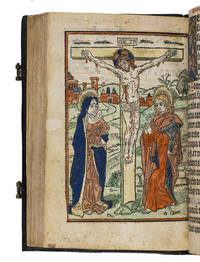
1506ABC_47741Paris: Thielman Kerver 1506. Gold- and blind-tooled black goatskin morocco 1st half of the 18th century sewn on 4 supports each board with a frame of blind triple fillets the front board also with the date ANNODOMINI1506 in gold in a gold-tooled frame with a saw-tooth edge and a flower in each corner: to make lining numerals the finisher used a J for 1 and an O for 0 and the spine-title MISSALEROMANUM in gold in the 2nd of 5 compartments gilt edges 2 brass hook fastenings with pin catch-plates marbled endpapers so-called Dutch combed pattern - teeth about 6.5 mm apart in red blue orange white and green more subtly curled than Wolfe 34 & 35 and the remains of a tab on the fore-edge of n2 marking the beginning of the Canon. 8vo. Printed in red and black throughout in 2 columns except for the preliminaries and Canon in 1 column with on the title page the first 1497 version of Kervers finely executed armorial device Renouard 499: a shield with T K above a mark with a cross supported by unicorns the shield hanging on a tree surrounded by many flowers 103 x 73 mm with a criblée background and with THIELMAN KERVER in a scroll in the foot; a crucifixion woodcut 120 x 82 mm; hundreds of impressions of at least 28 finely executed lombardic initials 4 series with decorations on a criblée background a 39 mm T with a crucifixion scene; two 28 mm: an R with a heron standing on one leg with an eel or snake in its mouth and an S with floral decorations; three 21 mm with floral and vine decoration; and at least twenty-two 13 mm with floral and vine decoration forming a complete 23-letter alphabet except for K X Y and Z plus alternate blocks for at least C O and S and a couple simple woodcut lombardic initials; as well as dozens of at least mostly 4-line spaces left for manuscript initials about half with printed guide letters filled in with manuscript lombardic initials in blue some with white or white and red decoration except for 3 lombardic initials in red; 3 sizes of cast lombardic initials 11 6 and 3 mm printed in red; a two-impression plainchant music type 10 mm 4-line staff in red with square-head notes and c-clef in black and two small typographic ornaments apparently designed for printing in red and black. The maltese crosses pilcros paragraph marks and Vx and Rx signs are printed in red and the capitals are rubricated throughout. The main text is set in a rotunda gothic type 66 mm/20 lines and the Canon n5r-o2v and the first line of the title in a textura gothic 112 mm/20 lines. The woodcut crucifixion on n4v facing the opening of the Canon Kervers device and the criblée initials are all coloured by a contemporary hand. The rare first missal for the Roman rite to be printed or published by the great Paris printing and publishing family Kerver best known for their luxurious liturgical and devotional printing especially their books of hours. There appears to be no copy in any French library. Kervers first missal in 1501 was made for the Paris rite. Kervers early missals including the present one are extremely rare the USTC recording no more than five copies of any edition printed before 1520. Caerr p. 73 notes that Kervers present first publishers device is universally recognised as a master-piece. It has been suggested that Kervers criblée blocks were metal cuts rather than woodcuts. The crucifixion scene facing the opening of the Canon is a more traditional woodcut. Caerr p. 51 suggests Kerver reached the pinnacle of his success in his stylistic evolution in or around 1506 fully incorporating Renaissance tastes in the period 1505-1514 and perfecting the criblée technique used for his present publishers device and initials. The present edition is also a very early example of the use of abstract typographic ornaments. The preliminaries include a calendar of feast days and most of its less common Saints days printed in red suggest a Franciscan connection.Thielman Kerver Koblenz ca. 1460/70-Paris 1522 appears in Paris imprints as a bookseller and publisher working with various printers and co-publishers from 1497 beginning with books of hours which always remained his greatest speciality. He added his own printing office in 1498 though he continued to work with others and expanded into a wide variety of genres. He also added other kinds of liturgical books including breviaries from 1499 a psalter in 1500/01 and missals from 1501 apparently publishing about 16 missals to his death in 1522 first using the present form of the title in the present edition. He was sworn in as official bookseller to the University in Paris in 1501 and soon after also printer hence the In alma Parisiorum Academia in the present title and colophon. Kervers widow continued the firm from 1522 to her death in 1557 their son Jacques continued it to his death in 1583 and its materials were sold in 1586.The fact that both the wording of the title and the exact date differ between the title page and the colophon the latter is 40 days later has led nearly every reference work from Weale in 1886 to the present USTC to turn one 1506 edition into two most describing a folio edition by Kerver a ghost and an anonymous 8vo edition supposedly with no copy known. David Shaw provided an accurate description on-line based on the British Library copy.With an inscription in the head margin of the title page partly shaved and difficult to read; the engraved publishers device of the Antwerp printer and publisher Jean Baptiste III Verdussen 1698-1773 on the front and back pastedown serving as his bookplate see above. Also with an 1831 owners inscription of S. De Ram on a free endleaf facing the title page. The rubricator or an early owner has added several notes in red in the calendar. Further with an occasional early marginal manuscript note some shaved. Four words in the Canon have been deliberately erased as an editorial revision. With an 8 cm tear into one leaf the running heads of a few others shaved the title-page slightly soiled a 3 mm hole in leaf 232 E4 affecting 2 or 3 words some tiny marginal wormholes in a few leaves and some water stains in the endpapers otherwise in very good condition. The binding shows a few small defects one slightly affecting the gold lettering on the front board but is also generally very good. A rare and beautifully produced missal and the second major display of Kervers stunning criblée initials all coloured by a contemporary hand as are the woodcut and Kerver's device.l Thierry Caerr Imprimerie et réussite sociale à Paris .: Thielman Kerver . 2000 2 vols. www.enssib.fr/bibliotheque-numerique 117 4 copies erroneously described as a folio; Catalogue . bibliothèque de feu . Jean de Meyer Ghent 2-5 November 1869 lot 33 8vo 23 March 1506 not mentioning Kerver but with alma Parisiorum Academia; Pettegree French books 68270 not noting Kervers name & 68271 erroneously described as a folio 1 of the same 4 copies; Frank Isaac reworked by David Shaw frenchpostincunables.djshaw.co.uk IS000343; USTC 68270 not noting Kervers name & 180236 erroneously described as a folio same copy as Pettegree; Catalogue . de la bibliothèque de M. Jean François van de Velde Ghent 1831 lot 1360 with an extra woodcut inserted facing leaf 58; Catalogus librorum Joannis Baptistae Verdussen Antwerp widow of Hieronymous Verdussen 15 July 1776 liturgy lot 45 the present copy; Weale & Bohatta Bibliographia liturgica 1928 982 23 March 1506 2 copies & 985 11 February 1506 not noting Kervers name no copy located both on p. 147 in the 1886 ed.; WorldCat 152428895 315474570 843131050 843131052 906577964 1063178422 5 copies plus 2 ghosts; not in Adams no Kerver missal before 1515; Davis Fairfax Murray French no Kerver missal; Mortimer Harvard French no Kerver missal before 1574; SUDOC; catalogue.bnf.fr. Thielman Kerver, unknown