Livre Rare Book
16 résultats
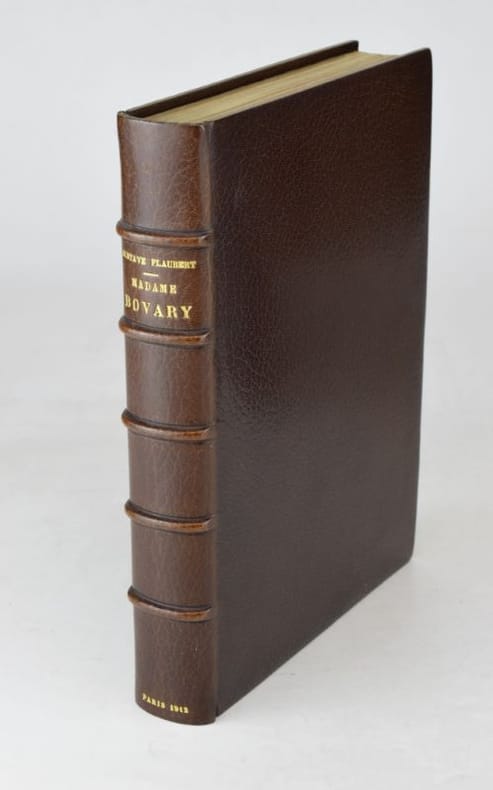
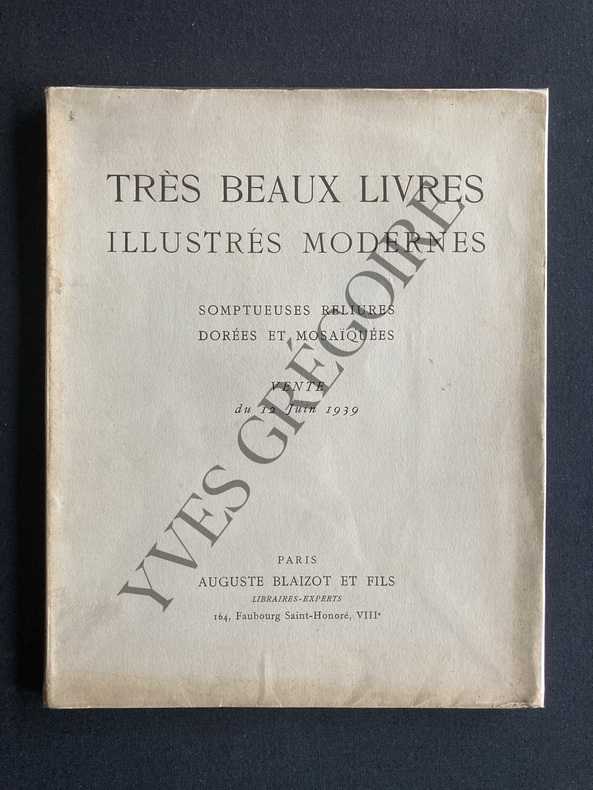
1939ABE-151499204914256 PAGES-23 CM X 28,3 CM-CONQUET-LAUNETTE-PELLETAN-ROMAGNOL-TESTARD-BLAIZOT-FERROUD-KIEFFER-MEYNIAL-PIAZZA-"TRES RICHES RELIURES DOREES ET MOSAIQUEES PAR CARAYON, LORTIC, MARIUS MICHEL, NOULHAC, CANAPE, MAYLANDER, MEUNIER,.-PREFACE 4 PAGES PAR HENRI CLOUZOT-PLANCHE COULEURS PLEINE PAGE (GRUEL)-18 PLANCHES NOIR ET BLANC PLEINE PAGE (7 GRUEL, CANAPE, 5 CARAYON, 2 LORTIC, MARIUS-MICHEL, 3 NOULHAC)-RESULTATS EN MARGE-(PRCV4)
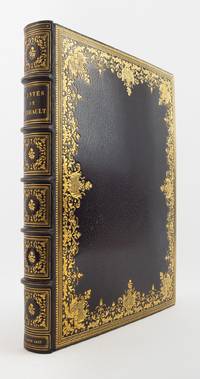
1886ST20745Asnières sur Seine: Boussod Valadon et Cie 1886-87. 390 x 305 mm. 15 1/4 x 12". 34 leaves; 42 leaves. Printed on rectos only. <br/> MAJESTIC DARK BROWN MOROCCO RICHLY GILT BY NOULHAC stamp-signed and dated 1912 on front dentelle covers with elegant frame in the Romantic style with acanthus leaves and myriad blossoms enclosed by multiple plain rules dotted and dogtooth rolls raised bands spine compartments with central rose sprig framed by a spray of leaves erupting from each corner inner dentelles with ornate frame featuring an entwined floral vine and ribbon roll lovely jacquard endleaves of floral baskets woven in pink green and blue marbled flyleaves all edges gilt. WITH 74 ILLUSTRATIONS BY DE BEAUMONT 33 in the first work 41 in the second "reproduced in facsimile and printed in color by the Publishers." Printed on rectos only on thick wove paper. Lonchamp Manuel du Bibliophile Français 1470-1920 II 361; Vicaire Manuel de l'Amateur de Livres du XIXe siècle VI 550. Joints a little worn though nicely refurbished a four-inch superficial scratch on rear board but A VERY FINE COPY--the striking binding with lustrous leather and glittering gilt; the contents entirely clean fresh and bright; and the margins vast.<br/> <br/> This grandly proportioned bibliophile's edition of Perrault's fairy tales is sumptuous to the last detail with lush facsimile watercolor illustrations and a binding by a leading French artisan. Charles Perrault 1628-1703 reworked traditional folklore into sophisticated fairy tales for the denizens of the intellectual salons of Paris ending each story with a usually cynical moral in couplets. He is credited with inventing the fairy tale genre and the Brothers Grimm--not to mention Walt Disney--profited greatly from his oeuvre. These two publications include three of his best-known tales--Cinderella Bluebeard and Sleeping Beauty--alongside the lesser-known "Les Fées.†Literally translated as “The Fairies†but generally called "Diamonds and Toads" in English this fourth tale features a pair of sisters who meet a fairy in disguise and are rewarded or punished based on their behavior toward her. The son of a sculptor our illustrator Charles-Édouard de Beaumont 1812-88 had initially trained to follow in his father's footsteps but instead became a painter illustrator and lithographer working across genres and media through his career. He is best known for his watercolors and for his work to encourage the popularity of the medium; in 1879 he co-founded the Society of French Watercolorists with Jehan Georges Vibert. Benezit tells us that "as a watercolourist . . . his style is highly individual and personal and it may be claimed that his work broke new ground." This is evident in the present artworks where the characters--charming comical and terrifying--are depicted with graceful linework and gentle washes of color. Beaumont's artwork interacts physically with the text which is sometimes obscured behind a painted curl of smoke or pushed out of the way by the feet of the optimistic suitors of Cinderella's prince. Beaumont had a love for historical weaponry his collection was donated to the Museum of Cluny after his death and he depicted the knives and swords in the famous tale of the murderer Bluebeard with an almost gleeful accuracy of detail that clearly demonstrates his interest. The imposing binding with lacy detail calling to mind the decorations of the era in which Perrault first published these stories is the work of Henri Noulhac. Described as "a superlative craftsman" by Duncan & De Bartha who reproduce four of his bindings in their "Art Nouveau and Art Deco Bookbinding" Noulhac 1866-1931 was born in Chateauroux where he served his apprenticeship. He afterwards moved in 1894 to Paris where he established his atelier at 10 rue de Buci and gained a reputation as one of the foremost binders and gilders of his generation. In addition to the binding and the illustrations here the condition of this volume needs to be highlighted--the book seems to be fresh from the binder's atelier untouched by any reader. Boussod Valadon et Cie unknown
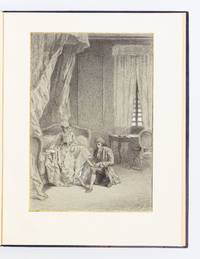
1875ST19376Paris: D. Jouast for Librairie des Bibliophiles 1875. No. 21 OF 200 LARGE PAPER COPIES this one of 15 on Whatman paper with plates in two states. 225 x 145 mm. 9 x 5 3/4"; 338 x 265 mm. 13 1/4 x 10 1/2". 2 p.l. XLV 3 pp. Two volumes. Translated and with an introductory essay by Alfred Hédouin. <br/> TASTEFUL MIDNIGHT BLUE CRUSHED MOROCCO GILT BY NOULHAC FOR HENRI BERALDI front doublure stamp-signed in gilt with the binder's name and "Ex-Libris Henri Beraldi" covers framed by eight gilt fillets raised bands spine compartments similarly framed gilt lettering CITRON MOROCCO DOUBLURES free endleaves of floral jacquard silk marbled flyleaves all edges gilt. Original printed paper wrappers bound in. Plate volume in dark blue morocco with covers and smooth spine bordered by gilt fillet crimson watered silk endleaves all edges gilt. Text volume with six etchings portrait of the author and five scenes by Edmond Hédouin each in two states one before letters; the second volume WITH THE FIVE ORIGINAL BLACK CHALK DRAWINGS each SIGNED BY THE ARTIST. Plate volume with ex-libris of Suzanne Courtois. Text volume with just the slightest hint of rubbing to front joint at the top perhaps pale offsetting from some of the plates but fresh and bright and very fine inside and out. Plate volume with a touch of fraying to silk endleaves otherwise with no signs of use.<br/> <br/> This is a very special copy of a newly-translated deluxe bibliophile edition of Sterne's "Sentimental Journey in France and Italy" beautifully bound for the most distinguished expert on French bindings of the 19th century and accompanied by the original drawings for the illustrations. Forced by poor health to leave England for warmer climes on the continent Sterne 1713-68 produced this perennially popular travelogue which was translated into French multiple times. Upon his return to London in 1766 he had the gratifying experience of being treated like a literary lion and he was greeted in the same way when he later revisited Paris. Ours is a new translation by Alfred Hédouin 1819-98 illustrated by Edmond Hédouin 1820-89 a painter and engraver unrelated to Alfred whose etchings graced a wide range of books. Described as "a superlative craftsman" by Duncan & De Bartha who reproduce four of his bindings in their "Art Nouveau and Art Deco Bookbinding" Henri Noulhac 1866-1931 was born in Chateauroux where he served his apprenticeship then moved in 1894 to Paris where he established his atelier at 10 rue de Buci and gained a reputation as one of the foremost binders and gilders of his generation. His work attracted several eminent clients including the celebrated collector and binding historian--and our former owner--Henri Béraldi who became his main patron. In the 1920s Noulhac was a sought-after binding instructor numbering Rose Adler among his students. Beraldi 1849-1931 was perhaps the most renowned and knowledgeable writer on French bindings of the 19th century. His collection of French illustrated books and French bindings was considered to be among the very best in the world and the outstanding condition here is typical of volumes from Beraldi's library. Our copy was later owned by Bordeaux bibliophile Suzanne Courtois a prominent female collector of the 1920s and 1930s who was also noted for the quality of the books in her library. [D. Jouast for] Librairie des Bibliophiles unknown
1924116541924 P., Auguste Blaizot, 1924, 1 vol. in-4° (310 x 220) relié plein maroquin chocolat, dos à 5 nerfs, plaque de cuir ciselée et peinte incrustée au plat supérieur, double filet doré sur les coupes, tranches dorées, doublure de moire verte encadrée de maroquin chocolat, jeu de 7 filets dorés dont 1 gras et 1 filet à froid, double garde de moire verte et de papier marbré, étui bordé, couv. et dos cons., (Rel. de NOULHAC, plaque de G. GUÉTANT), de (3) ff. - XI (préface de Louis Barthou) - 198 pp. - (2) ff.Petit accroc sur un nerf, légère décharge des eaux-fortes, superbe exemplaire par ailleurs.
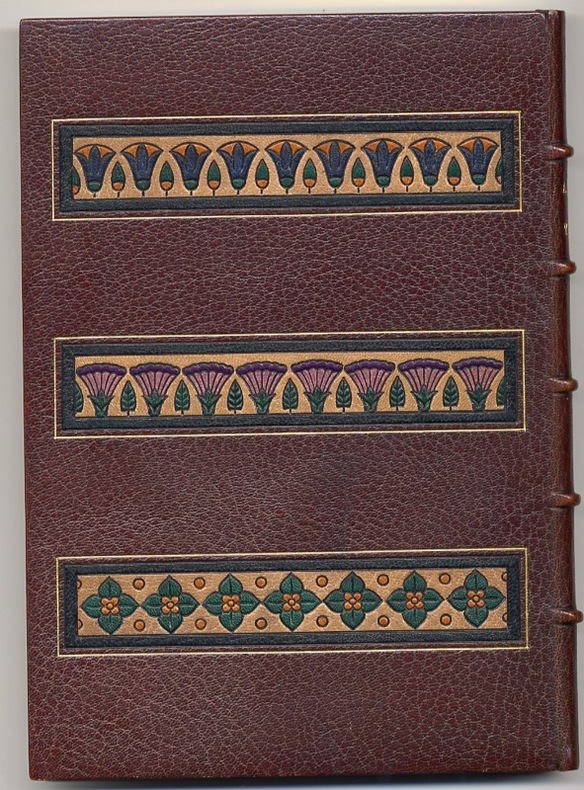
19248546Paris, Les Cent Bibliophiles, 1924 ; in-4 ; plein maroquin aubergine, dos à cinq nerfs, plats décorés et mosaïqués de trois larges compositions horizontales de fleurs stylisées "à l'égyptienne" : celle du haut, sur fond de maroquin mastic, succession de petites et grandes fleurs de maroquin mandarine, bleu-nuit et vert-sapin encadrée d'un listel vert foncé et d'un filet doré ; celle du milieu, alternance de fleurs et feuilles de couleurs violet, parme et vert-sapin, interrompue en son centre par un grand cercle de maroquin mastic dans lequel sont mosaïquées les lettres du titre en vert foncé, qui se chevauchent, le tout entouré d'un listel vert foncé et filet doré ; enfin, celle du bas présente une série de fleurs et feuilles à plat, soulignée d'une double rangée de points mandarine, toujours sur le même fond mastic et encadrée du même listel vert foncé et filet doré.Le décor du second plat, à l'identique mais sans le cercle-titre ; double filet doré sur les coupes, tranches ébarbées et dorées ; contreplats doublés de maroquin havane orné, en encadrement, d'un listel de maroquin aubergine entrecoupé de carrés dorés, triple filet doré, gardes de brocard de soie pourpre, couverture et dos conservés, étui bordé (reliure de Noulhac d'après une maquette de Madeleine Noulhac) ; (8) ff. (3 blancs, justification du tirage, faux-titre au verso frontispice, titre, faux-titre au verso, gravure hors-texte, gravure hors-texte), 215 pp., (8) ff. (table, achevé d'imprimer, Les Cent Bibliophiles, 2 bl.). ; 147 bois dessinés et gravés en couleurs de Louis Jou dont 9 hors-texte et 3 lettrines.
10958P., Société de Propagation des Livres d'Art, 1901, 1 vol. in-4° (285 x 190) relié maroquin vert à coins, dos à 4 nerfs richement orné, date en queue, filet dor bordant les plats, tête dorée, couvertures vertes conservées, (Noulhac), de (3) ff. (faux-titre, titre, et dédicace) - 148 pp. - (1) f. (achevé d'imprimer. Coin bas du plat inférieur très légèrement choqué, papiers de garde incurvés (du à un rétrécissement du papier contrecollé), très bel exemplaire par ailleurs.
1907GITk289Bruxelles Edmond Deman 1907. Grand in-8 2 feuillets non chiffrés 1-66pp 2 feuillets non chiffrés (fin du texte et achevé d'imprimer) 1 feuillet blanc 2 feuillets non chiffrés (prospectus pour cette édition reprenant un extrait du texte et 2 illustrations). Plein maroquin acajou, dos à 4 nerfs orné en long de filets dorés à bande mosaïquée noire; sur les plats, double encadrement à motif d'angles dorés portant au centre une grande bande mosaïquée noire percée de jours rectangulaires à filet doré; double filet doré sur sur les coupes; non rogné, plats et dos de la couverture illustrée conservés; grande bordure intérieure de maroquin acajou soulignée d'un double filet doré et de fleurons d'angles finement dorés; contreplats de soie ébène doublés de papier fort marbré brun, tranches dorées sur témoin, reliure légèrement postérieure (Noulhac rel 1920); étui doublé de feutrine, bordé d'un liséré de maroquin acajou. Orné de 15 eaux fortes de Armand Rassenfosse tirées en couleurs: vignette sur le titre, 2 têtes de chapitre, 12 hors texte dont le frontispice. Première édition séparée du recueil des Diaboliques; tirage unique à 125 exemplaires, tous imprimés sur papier de Rives spécialement fabriqué pour cette édition, celui-ci portant le numéro 18. Publication de qualité, très bien illustrée par Armand Rassenfosse, appréciée des amateurs. Carteret IV page 57. Monod 948. Talvart et Place I, colonne 220. TRES BEL EXEMPLAIRE FRAIS dans une reliure au luxe raffiné signée par Henri Noulhac (1866-1931), réputé pour la maîtrise de son Art et la perfection de ses oeuvres. (Fléty page 136).
950Léopold Carteret, Paris, et Emile Raoust-Leleu, Lille, 1925.
4327Paris, Me Ader et L. Lefèvre & C. Guérin,, 1960. In-4, non paginé, décrivant 338 lots, 16 pl. h. t., couv. et dos cons., tête dorée, plein maroquin rouge, dos à nerfs, 1er plat frappé de la devise de Daniel Zierer himself, puisqu’il s’agit de l’exemplaire du propriétaire des livres de cette vente. Relié par Georges Cretté, rien que ça! Et avec son étui, bordé de maroquin rouge et doublé de box framboise of course. Exemplaire justifié 1 imprimé sur Arches.
19128760Paris, Imprimé pour la Société du Livre d'Art par l'Imprimerie Nationale, 1912. In-4, (8)-375-(5) pp., illustré de 51 eaux-fortes originales en couleurs d'Henri Jourdain. Édition tirée à 150 exemplaires numérotés, l'un des 100 (n° 7) réservés aux membres de la Société. Reliure de l'époque en maroquin havane janséniste, dos à nerfs, titre doré, doublure en maroquin bordeaux, contre garde en tissu et double garde en papier caillouté doré, double filet doré sur les coupes, tranches dorées sur témoins, couvertures et dos conservés, étui bordé. Reliure signée de Noulhac.(Cartert, IV-159, "L'un des meilleurs ouvrages de l'artiste ; il est très coté").Claires décharges des eaux-fortes sur les feuillets en vis-à-vis, page de faux titre et dernière page blanche brunies par décharge des couvertures, très bel exemplaire en parfait état.
Paris, Calmann-Lévy, Editeurs. 31 mars 1905. Un volume in-4, (21 x 28;5 cm), 186 pp-3 ff. Demi-maroquin à coins lie-de-vin, dos à 4 nerfs, auteur et titre or, tête dorée, couvertures et dos conservés. Reliure signée NOULHAC. 28 eaux-fortes en bistre dans le texte d'Edouard CHAHINE. Tirage limité à 300 exemplaires numérotés. Un des 200 exemplaires numérotés sur papier à la cuve Blanchet et Kléber fabriqué spécialement avec le titre du livre en filigrane (n° 108). Prospectus relié in-fine. Bel exemplaire.
24193Paris, Calmann-Lévy, Editeurs. 31 mars 1905. Un volume in-4, (21 x 28;5 cm), 186 pp-3 ff. Demi-maroquin à coins lie-de-vin, dos à 4 nerfs, auteur et titre or, tête dorée, couvertures et dos conservés. Reliure signée NOULHAC.
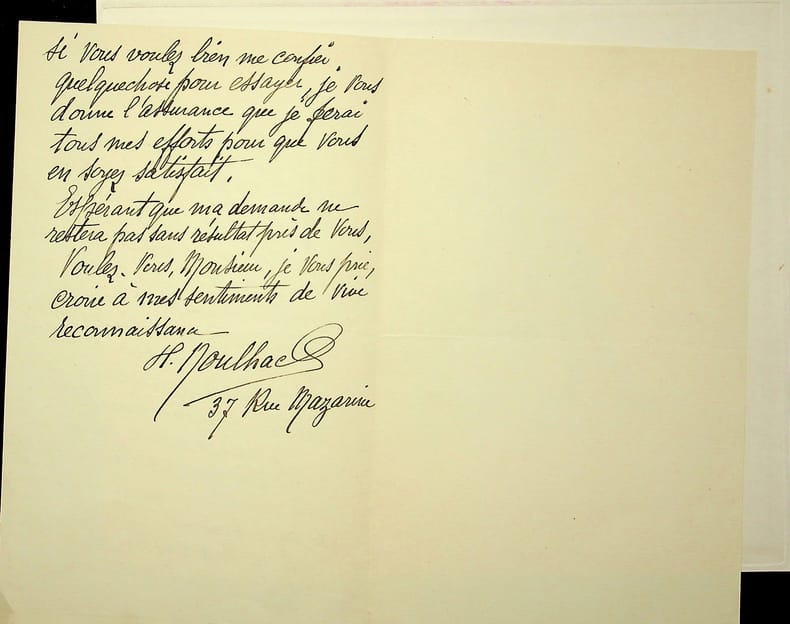
015145Henri Noulhac (1866-1931), relieur. L.A.S., Paris, 6 février 1901, 1p 1/2 in-8. Au bibliophile Edouard Pelay (1842-1921). Sympathique lettre pour proposer ses services, lui proposant notamment un essai de reliure. On joint une belle gravure en couleurs, signée L Le Riverend, représentant une devanture fictive du relieur Noulhac. Peu commun. [371]
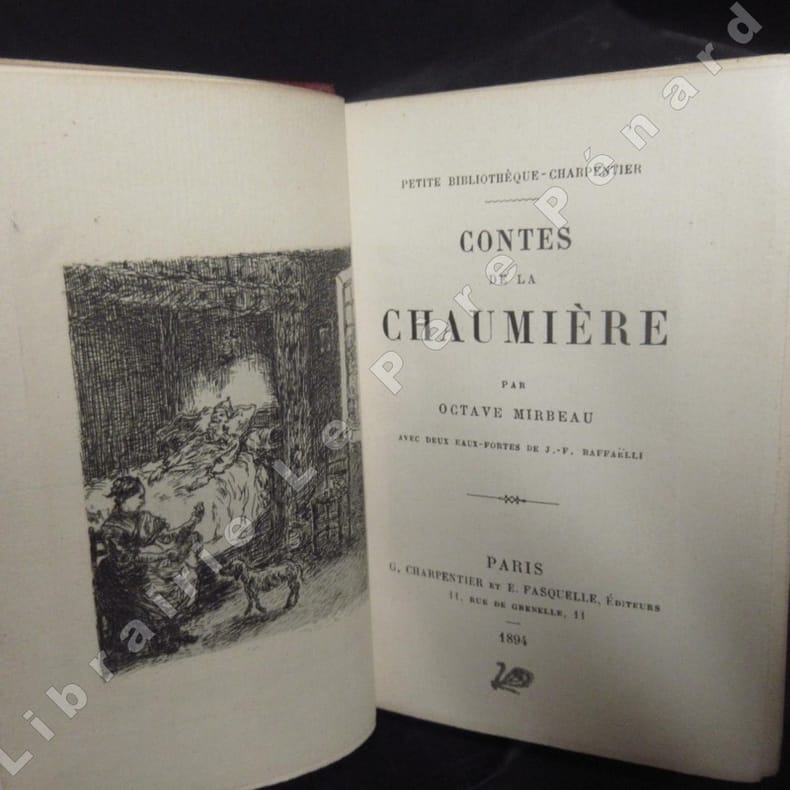
18941182301894 A Paris, G. Charpentier et E. Fasquelle, éditeurs - 1894 - Petit in-16, demi-maroquin à coins rouge; dos à 5 nerfs avec titre, nom de l'auteur et année d'édition en doré - Reliure signée Henri Noulhac - Couverture originale et dos conservés - 346 pp. - Deux eaux-fortes, dont un frontispice, de J.-F. Raffaëlli - Envoi en 1ère page de titre d'Octave Mirbeau à l'attention de Francis Maynard
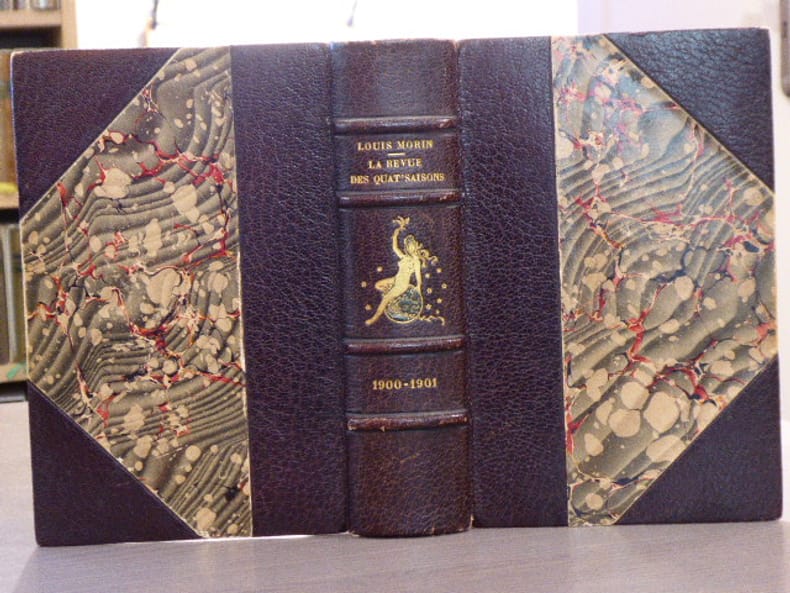
268468Société D Editions Littéraires Et Artistiques - Librairie Paul Ollendorff Paris 1900-1901 4 numéros reliés en 1 volume in-12 ( 195 X 125 mm ) de 319 pages, demi-maroquin chocolat à coins, dos à nerfs orné d'une jolie figure dorée, tête dorée, couvertures et dos conservés ( Reliure signée de NOULHAC ). " LA REVUE DES QUAT'SAISONS" était une revue-éphémère- trimestrielle illustrée de 400 dessins, dans et hors-texte en noir et en couleurs, dont de nombreuses planches dépliantes en couleurs par Louis MORIN. Série complète et rare de cette revue consacrée aux divertissements parisiens de la période 1900. "Sprituelle publication recherchée. Elle est consacrée aux Bal des Quat'Zars, Bal de l'Internat, Boeuf gras, aux fêtes, au Carnaval de Nice." ( Carteret IV-294 ). EDITION ORIGINALE, 1 des 150 exemplaires du tirage de tête ( N°81 ), 1 des 100 sur japon. Très bel exemplaire. ( Monod II-8482 ). - N°1-janvier-avril 1900.- N°2 avril-juillet 1900.- N°3 Juillet à octobre 1900.- N°4 octobre à janvier 1901.
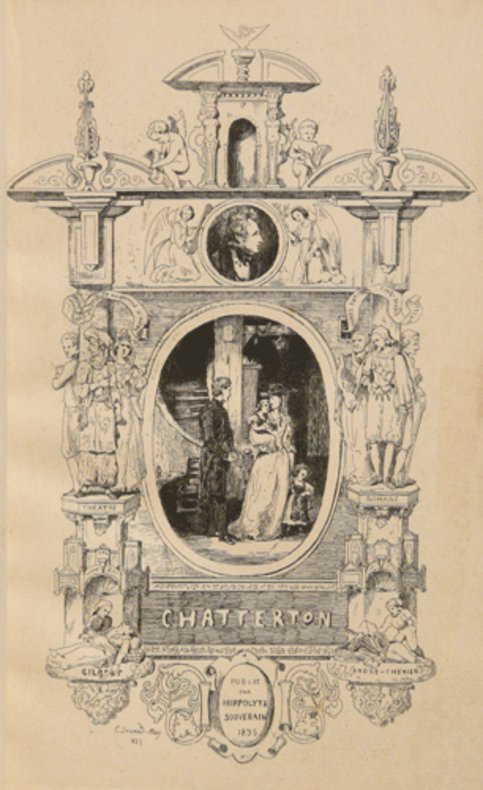
18350031121835 Paris, Hippolyte Souverain, 1835. In-8 (143 X 229 mm) demi-maroquin tête-de-nègre à long grain et à coins, dos lisse orné de deux caissons dorés composés de fleurons et filets en long, auteur et titre dorés, date en queue, plats de la couverture conservés (NOULHAC) ; faux-titre, frontispice gravé, titre, 229 pages, (1) f. de table.