Antiquariat.de

390 résultats
179419373Wien, Wappler, 1794. VIII, 195 S. 8°. Pp. des 19. Jahrhunderts mit Rückenschild (etw. bestoßen und berieben). [3 Warenabbildungen]
199794996Graz, Akademische Druck- u. Verlagsanstalt, ( 1997). 164 S. farb. Faksimile-Druck der Handschrift, 67 S. (= Glanzlichter der Buchkunst, Bd. 1). 20 cm. OLn. mit Kopffarbschnitt und SU. im bedruckten OSchuber.
Vol. quattro in-4° cm. 34 di pp. 4-XVI-426-480-IX-313-VIII-245 con 1 pianta di Gaeta a doppia pag. e 17 tav. f.t. Bross. edit. intonso. Come nuovo in cofanetto.
198725149Paris Club Du Livre 1987 2 Volumes Petits Folios 155 pp + repro en noir pour le commentaire , reliure basane d'éditeur, étuis, fac simile sur papier fort imitant le vélin d'origine comportant 108 ff collection musée du livre, bon exemplaire
094991Graz, Akademische Druck- und Verlagsanstalt. Vol. LXX/2 der Reihe Codices Selecti; (80 Bl.); Faksimileausgabe im Originalformat der Blätter 97 - 175 des Codex Vindobonesis 2759; auf 780 Expl. limitierte u. numerierte Ausgabe, hier # BBC 11, der 99 für die Bibliophila Buchclub GmbH reservierten Expl.; Ganzleder mit Rückentitel in Gold, im Original-Pappschuber Leder 54,5 cm Faksimile Tadellos [5 Warenabbildungen]
094992Graz, Akademische Druck- und Verlagsanstalt. Vol. LXX/2 der Reihe Codices Selecti; (80 Bl.); Faksimileausgabe im Originalformat der Blätter 97 - 175 des Codex Vindobonesis 2759; auf 780 Expl. limitierte u. numerierte Ausgabe, hier # BBC 21, der 99 für die Bibliophila Buchclub GmbH reservierten Expl.; Ganzleder mit Rückentitel in Gold, im Original-Pappschuber Leder 54,5 cm Faksimile Tadellos [6 Warenabbildungen]
1930LFA-126725193Un ouvrage de 899 pages, format 130 x 200 mm, relié cartonnage dos cuir à nerfs, publié en 1930, Typis Polyglottis Vaticanis, bon état
dola2068London: 1980. 8vo. pp. 175 4. illus. throughout in colour. bds. Fine copy. dola2068 London: 1980 unknown
193375426Glendale: Arthur H. Clark Company 1933. First edition. One of 250 copies printed for private distribution. Tall octavo. 10 pp. of text plus the 22-panel accordion fold facsimile of the Codex. Publisher's printed gray wrappers. Small split along top inch of spine not affecting integrity and hard to discern. A very good copy.The Paris Codex also known as the Codex Peresianus and Codex Perez is one of four surviving generally accepted pre-Columbian Maya books dating to the Postclassic Period of Mesoamerican chronology c. 900–1521 AD although recent scholarship points to it being of far greater antiquity. The content of the codex is mainly ritual in nature and one side of the codex contains the patron deities and associated rituals for a cycle of thirteen k atuns a 20-year Maya calendrical cycle. The reverse of the codex is more varied in nature and includes a section dedicated to a calendrical cycle ruled by Chaac the god of rain. It also includes information about the prognostication of rainfall and maize crop yields as well as information about spiritual forces. It was purchased by the Bibliotheque Royale of Paris in 1832 and remains there to today. Arthur H. Clark Company unknown
176280904Frankfort: Officina Fleischeriana 1762. hardcover. near fine. Folding frontispiece. 2 volumes in one. 134 37 pages. 18mo modern 1/2 tan letter; tiny dampstain on margins throughout. Francofurti: In Officina Fleischeriana 1762. Near fine.<br/> <br/> This is evidently the London Pharmacopeia of 1746 the most excellebt produced to that time and in most respects an improvement over previous ones. STC. See Monk vol III Appendix for a description. Cf. Osler 6089. Waller 7386. Blake p. 349.<br/> <br/> Officina Fleischeriana unknown
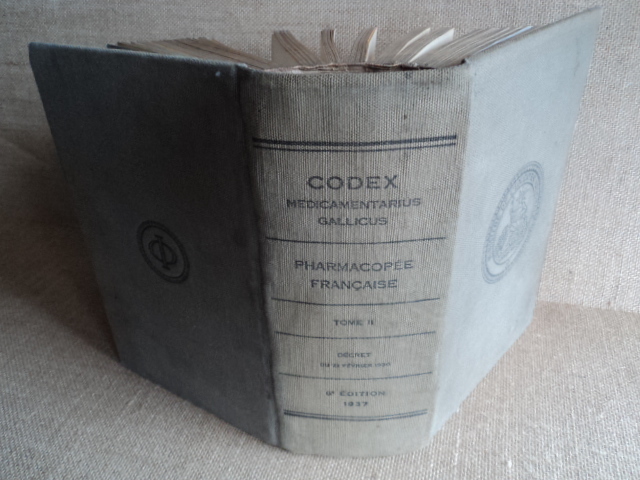
7614Rennes, Imprimerie Oberthur, 1937, in-8, reliure éditeur toile grise, 1192 pages + addenda 17 pages , 6ème édition sous la Direction de la Commission du CODEX, numéroté, 80 planches de plantes pleine page en couleurs
114835395X.Gpaperback. Good. Access codes and supplements are not guaranteed with used items. May be an ex-library book. paperback
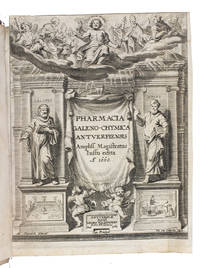
1661JC5F71XARFAUAntwerp 1661. 4to. Joris Willemsens I 18th-century vellum faded manuscript title on spine. With an integral engraved architectural title page by Petrus van Caukercken after Abraham van Diepenbeeck with the title on a drapery held by 2 putti in an arch and flanked by figures of Claudius Galenus and Masawaih al-Mardini views of a botanical garden and an apothecary's shop below and Jesus with numerous religious and allegorical figures above in a cloud letterpress title page with a woodcut decoration a divisional title for part 2 woodcut tailpieces woodcut decorated initials 5 series. Set in roman and italic with incidental Greek textura and pharmacological signs. 1 1 blank 46 285 = 281 32 1 blank pp. Rare first and only edition in Latin of the first and only official pharmacopoeia for Antwerp containing hundreds of medicinal recipes and throwing a great deal of light on 17th-century medical practice in the Low Countries. The work's separate part with the title "Selectiora chymica" shows the rising importance of chemistry in the production of medicines. Although Plantin published an important and influential 1568 Antwerp edition of Valerius Cordus's Dispensatorium first published posthumously at Nürnberg in 1546 it was not produced by order of any official municipal body. In 1624 the magistrates of Antwerp set up a Collegium Medicum which did declare that medicines were to be prepared following Cordus until further notice. In 1659 the Antwerp Collegium Medicum decided to produce their own pharmacopoeia primarily at the impetus of their secretary and future director Michiel Boudewijns 1591-1681 best known as the father of modern medical ethics. Although his name does not appear on the title-page the book does attribute the 18-page preface to him and he was probably the principal compiler of the book. The decision to compile it makes explicit reference to those published at Augsburg 1564 Rome 1583 Amsterdam 1636 and Brussels 1641 but Valerius may have remained the most important source. No apothecaries were officially consulted in the compilation of the pharmacopoeia reflecting the growing status of physicians and declining status of apothecaries.Although the letterpress title-page is dated 1660 the engraved title-page when present is apparently always dated 1661 and in some copies the 1660 has been corrected to 1661. The work has extensive preliminaries with dedications notes to the reader laudatory verses etc. but some copies include an unsigned bifolium inserted after a2 containing an additional dedication not present here. The present copy does have the rarer addendum leaf at the end and an addendum slip on Q3r supplying the omitted last line of that page with the quire signature and catchword below it. The addendum leaf has three blind impressions of the type for this addendum slip in its head margin.With minimal wear at the edges. With a brown spot in the outer margin of the first two gatherings; a very good copy.l Anet 6 copies; Daems & Vandewiele pp. 62-63 5 copies; STCV 12879911 5 copies incl. 1 defective; not in Krivatsy; Wellcome. hardcover
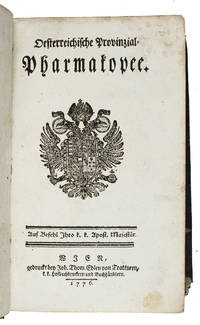
1776I14AUD0VK13VVienna 1776. 8vo. Johan Thomas Edlen von Trattnern Contemporary calf light brown morocco spine label with title in gold red sprinkled edges. With a woodcut coat-of-arms on the title-page and typographical head- and tailpieces. 10 384 18 pp. First edition of the German version of the Pharmacopoeia Austriaco-Provincialis first published in 1774. Many editions of both the original Latin and German translation followed. Based on a thorough analysis it can be determined that pharmaceutical care was on a high level in the area of South-Eastern Europe and that it followed the scholarly pharmacy in the Habsburg monarchy.The necessity to publish the pharmacopoeia in German was because it was used by minor medical professions without knowledge of Latin such as surgeons. A Dutch translation of the pharmacopoeia entitled Apotheek der Oostenrijksche Staaten which was based on the edition of 1775 was published in Rotterdam in 1780. The content and the format of the new pharmacopoeia had changed dramatically compared to the former one. While the Viennese Dispensatory represented a Baroque pharmacopoeia in size and in its abundance of recipes the new Pharmacopoeia Austriaco-Provincialis was a rather small booklet with a drastically reduced number of formulations.Two sections built up the body of the pharmacopoeia. The first one cited the Materia Pharmaceutica minerals crude drugs of plant and animal origin in separate chapters mentioning the Latin name the scientific identification and the Austrian local name of all items. Another chapter listed the chemical characters some of them still representing alchemical signs. The second part consisted of formulated preparations in alphabetical order followed by an index. The pharmacopoeia had a new concept and for the first time specified the medicinal ingredients alphabetically and listed the formulations in alphabetical order according to the recipes names.Corners slightly bumped otherwise in very good condition.l Christa Kletter The civil Pharmacopoeias of Austria Paper Austrian International Society for the history of Pharmacy 2015 pp. 7-8. unknown
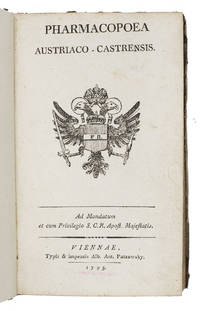
1795I17BBOP2JSB6Vienna 1795. 8vo. Albert Anton Patzowsky Half calf spine label lettered in gold red sprinkled edges. 4 102 pp. First edition in Latin of the first military pharmacopoeia for Habsburg Austria with the privilege for 10 years in German dated 29 September 1795 and granted to the publisher Albert Anton Patzowsky on behalf of the last Holy Roman Emperor Franz II Joseph 1768-1835 who was to become Franz I the first Emperor of the Austrian Empire in 1804.Until 1794 the Austrian army met its pharmaceutical needs with help from civilian pharmacists. Problems with the quality of the services provided led to the establishment of a professional military pharmaceutical service in 1794. To provide the medical support that the army needed garrison hospital pharmacies were built. Patzowsky published a German edition of the present pharmacopoeia in the same year: Oestrreichischen Militär-Pharmacopoea zum Gebrauche der Oestrreichischen Fieldärzte Vienna A.A. Patzowsky 1795. In spite of the privilege a pirated edition appeared in the same year in Pavia.Spine slightly worn otherwise in good condition.l Blake p. 347; cf. Wellcome IV p. 356 1795 edition Pavia. unknown
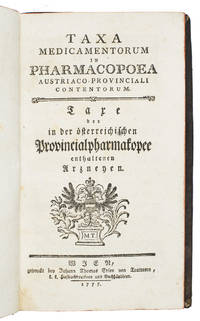
1777I14F46A1C75MVienna: Johann Thomas Edlen von Trattner 1777. Mottled calf gold-tooled spine brown morocco spine label marbled endpapers red edges. 8vo. Medical ordinances and a list of the new taxes on nearly 2000 named medicinal components. As the Habsburgs in the 1770s attempted to strengthen their control over the professional standards and business activity of pharmacists and medical personnel in their realms the authorities imposed new taxes on behalf of Empress Maria Theresa covering all components of medicaments described and prescribed in the Pharmacopoea Austriaco-Provinciali the official book of pharmacological recipes for the entire Habsburg empire with editions published almost every year from 1776 to ca. 1822. The ordinance on the subject was promulgated on 25 November 1775 and took affect on 1 January 1776 so the 1776 edition was clearly the first but the 1790 edition calls itself the second. It is therefore not certain whether the present copy is the true second edition or a reissue of the first. The ordinance pp. 3-8 of the preliminaries is signed by Christian August Graf von Seilern Statthalter and Thomas Ignaz Freiherr von Pöct Kanzler and contains seven points including sanctions and criminal procedures in case of fraud. Trattner was printer and bookseller to the Imperial Court.Foot of spine damaged otherwise in good condition.l Cf. Blake p. 24 1776 ed. Johann Thomas Edlen von Trattner, unknown
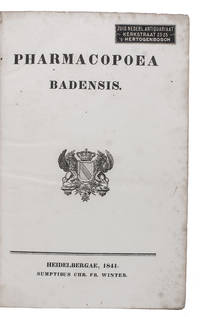
1841I14BP0GYACIHHeidelberg 1841. Large 8vo 23.5 x 15.5 cm. Christian Friedrich Winter Near contemporary half calf gold-tooled spine. With the wood engraved arms of Baden on title-page. VIII 353 1 pp. First edition of the official pharmacopoeia of the Duchy of Baden in southwest Germany which replaced the Preußischen Pharmakopöe used there previously. It contains a total of 822 medicines and recipes of which 345 "Simplicia" simple medicines and 477 "Praeparata" compound medicines. The book is entirely interleaved.With bookseller's ticket on title-page. Slightly foxed throughout primarily in the margins. Binding cracked at front hinge otherwise a good copy.l R. Schmitz et al. Geschichte der Parmazie 2005 pp. 577-578. unknown
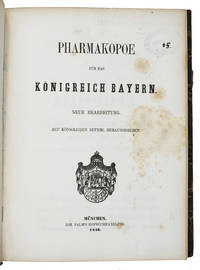
1856I14FWQ4I6CYWMünchen: Johann Palm 1856. Half light brown buckram marbled boards gilt-lettered title on spine. Large 8vo. With the royal coat-of-arms of Bavaria on the title-page. First edition of a new Pharmacopeia for the Kingdom of Bavaria ordered by the liberal King Maximilian II 1811-1864 who succeeded his father in the revolutionary year 1848 to replace the obsolete Bavarian Pharmacopeia of 1822. The compilers of the new work were a.o. Prof. Max Pettenkofer Hofapotheker and first German Hygienist 1818-1901 and Dr. Ernst Aug. Buchner. Library stamp on title. Some stains especially on the first leaves otherwise in good condition.l The afterword by Wolgang Schneider in the reprint of the Pharmakopoe of 1988; Neues Repertorium für die Pharmacie vol. 9 1859 3. Abschnitt pp. 39-43. Johann Palm, hardcover
1775JBS8N69TDKIEAmsterdam: Johannes van Seggeren 1775. Contemporary wrappers rebacked. 8vo. With an engraved title page showing an apothecary shop the preparation of medicines and a botanical garden and 2 folding engravings identifying alchemical symbols and measurements. Rare second edition of the Dutch translation of the Brussels pharmacopoeia. Like the first Dutch edition of 1742 the translation was based on the second Latin edition originally published in 1671. Interestingly when this edition was published in 1775 the Viennese pharmacopoeia had been the official pharmacopoeia of Brussels since 1747.With the bookplate of the Gouda pharmacist Elize Grendel 1899-1986. Binding somewhat worn and crudely rebacked. Dog-eared and some spots; a good copy.l Anet 1 copy; Daems & Vandewiele pp. 82-83 1 copy; STCN 2 copies including 1 incomplete; WorldCat 3 copies; not in Wellcome; NLM. Johannes van Seggeren, unknown
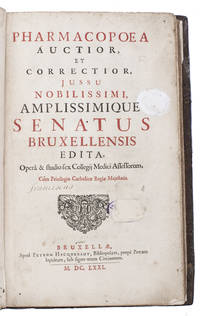
1671I17E1NCA7M49Brussels 1671. Folio. Pierre Hacquebaud Contemporary calf; rebacked with part of the original gold-tooled backstrip laid down. 1 1 blank 8 237 15 pp. Second revised and enlarged edition of the Brussels pharmacopoeia. Brussels had begun discussing plans to establish a Collegium Medicum ca. 1605 but failed to do so. A 1636 plague however incited city magistrates to compile a pharmacopoeia and they commissioned four leading city physicians Joannes Jocquet Paulus de Hullegarde Ludovicus Fabri and Joannes De Lau not mentioned on the title-page but acknowledged by name in the preliminaries to compile the present Brussels pharmacopoeia which appeared in 1641. No apothecaries were officially consulted in the compilation of the Brussels pharmacopoeia reflecting the growing status of physicians and declining status of apothecaries. Amsterdam had produced the first official pharmacopoeia in the Low Countries in 1636 based in part on Valerius but the Brussels physicians chose to take the 1638 Paris Codex medicamentarius Parisiensis as their principal model.With an ownership inscription by "Franciscus" dated 1716 on the paste-down and title-page and a another inscription below the colophon possibly in a different hand noting that the book was a gift from Louis Riqueur ca. 1655-1737 apothecary of King Philip V of Spain. Binding damaged at the sides and heavily restored at the spine and extremities. With a few spots and many wormholes throughout; lacking the engraved title-page; a fair copy.l Anet 1 copy; Daems & Vandewiele pp. 71-72 5 copies plus 1 manuscript version; Krivatsy 8908; STCV 2 copies; Wellcome IV p. 357. unknown
19745663Akademische Druck- u. Verlagsanstalt (ADEVA), 1974. 1974 1 vol. de texte et 1 vol. datlas en paravent, tous deux in-folio au format carré (400 x 400 mm) de: vol. de texte. 39 pp. (dont faux titre, titre, sommaire et table) ; vol. datlas. [34] pp. dillustrations fac-similé en accordéon dont certaines sur double-page. Vol. de texte sous couverture cartonnée beige titrée sur le premier plat, vol. datlas imitant la couverture dorigine avec ses défauts et accidents.
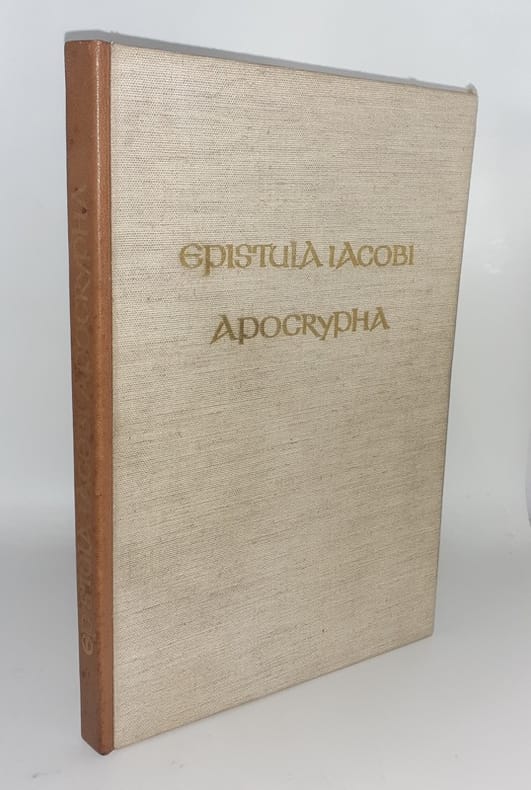
604647Zürich und Stuttgart, Rascher, 1968. In-4, rel. éd. demi-basane fauve, plat de toile beige, titre doré au dos et sur le 1er plat, XXXI pp., 16 pl. de reprod. en n/b., 139 pp., texte en français, copte, allemand, anglais, index des mots grecs, des noms propres, des mots coptes.
2006844112006 Paris, Flammarion, 2006, in 8° broché, 223 pages ; couverture illustrée ; ex-libris.
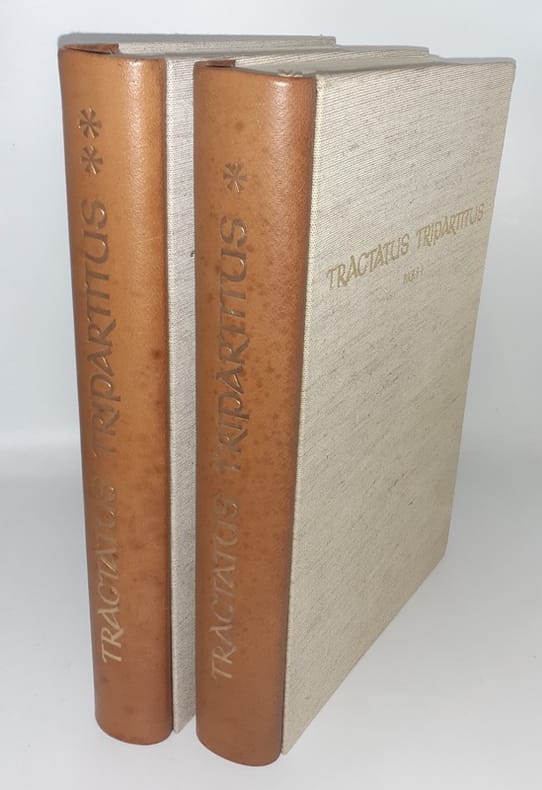
604648Bern, Francke Verlag, 1973-1975. 3 parties en 2 forts vol. in-4, rel. de l'éd. demi-basane fauve, plat de toile beige, titre doré au dos et sur le 1er plat ; 390 et 348 pp., 53 et 37 planches de fac-similés en n/b., texte copte avec traduction française en regard, texte en allemand, en anglais, notes philologiques, notes critiques, index, sigles et abréviation.
177751944Wien (bzw. Leipzig), Voigt; Trattner bzw. Eisfeld, 1704-1777. Fol. Blindgepr. Schweinsldr.-Bd. d. Zt. a. 5 Bünden m. goldgepr. bischöflichem Wappensupralibros mit den Initialen ?E.P.P.C.?, goldgepr. Rückenschildern, dreiseitigem Farbschnitt u. einer (statt 2) Schließe (Bde. 1 u. 2 in einem Band) bzw. Pgmt.-Bde. d. Zt. m. goldgepr. Rückenschild (Bde. 3-6).