Antiquariat.de
22 résultats
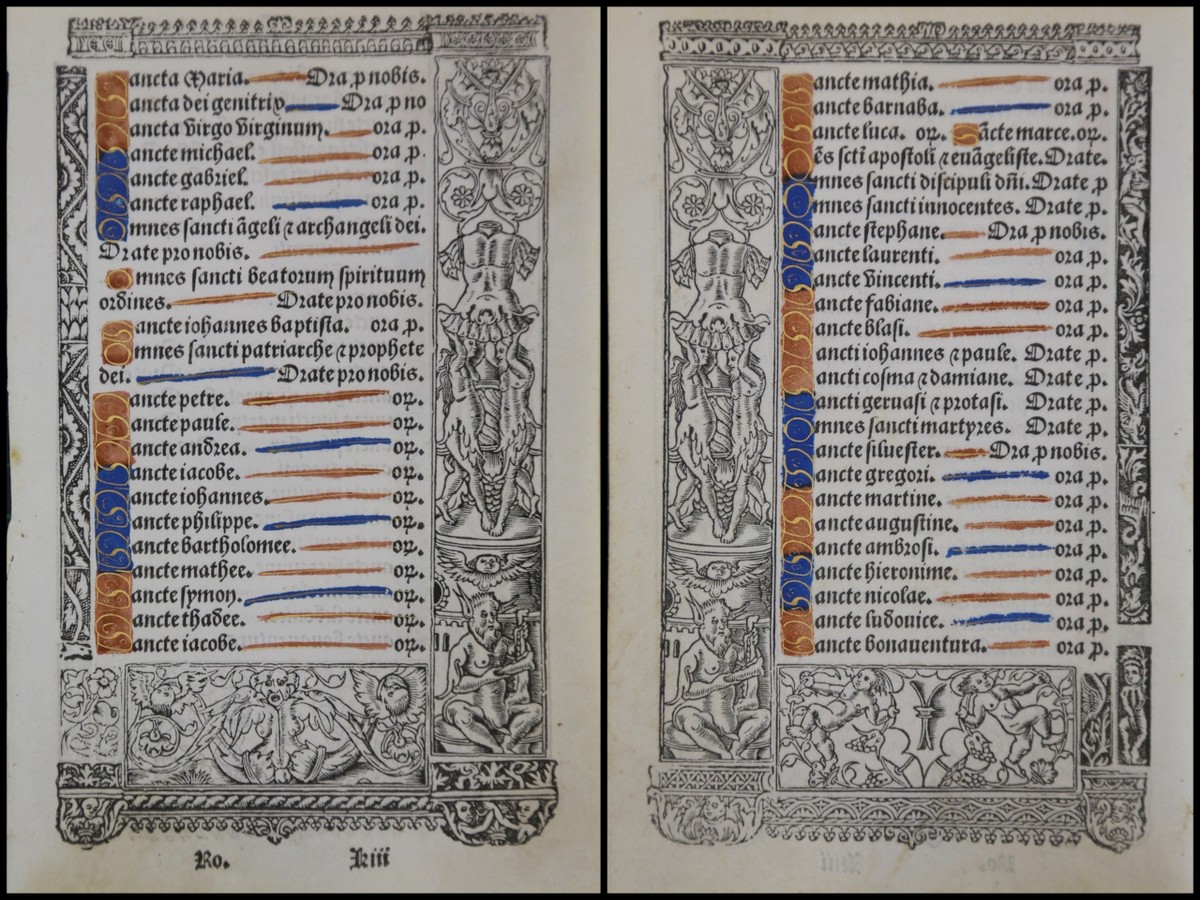
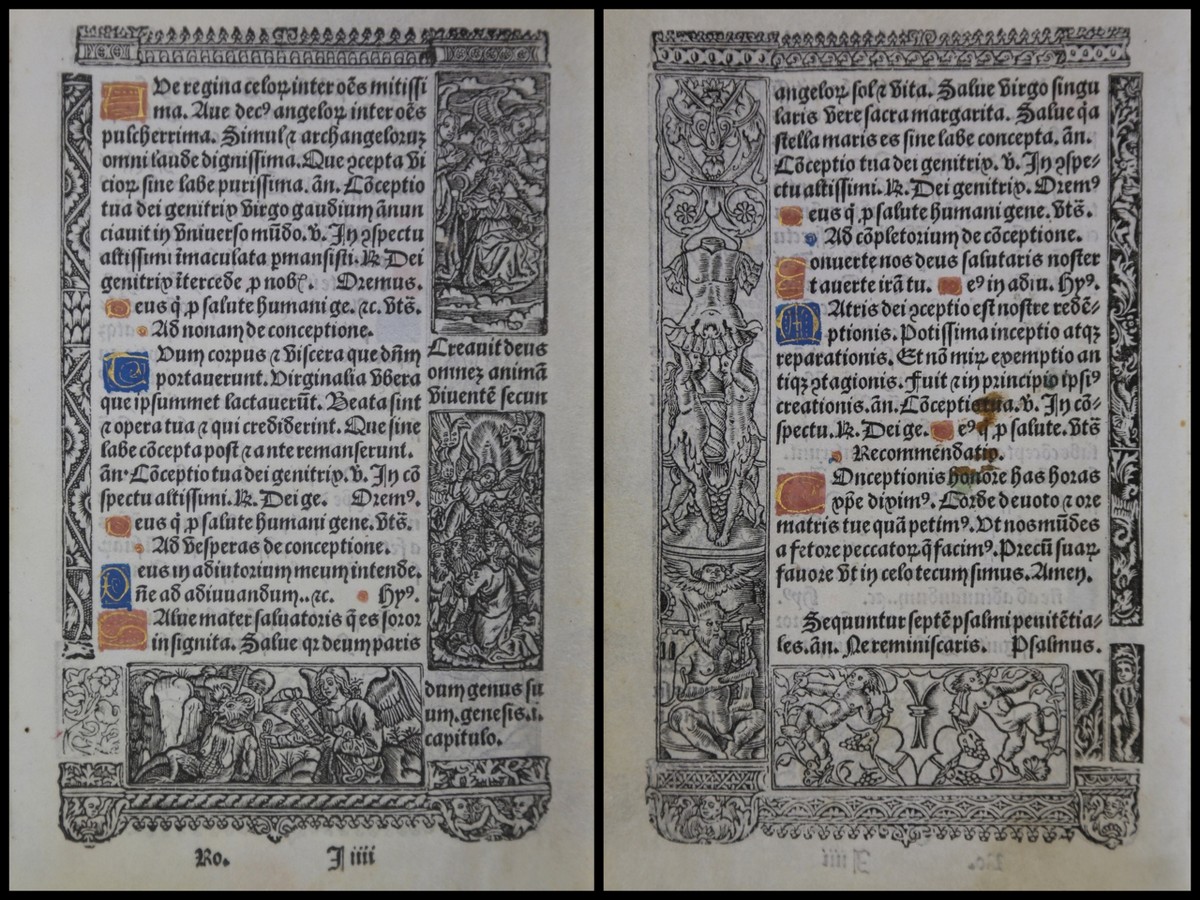
1510151128(Paris, um 1510). Blattgröße: 17,5 x 11,5 cm. Schriftspiegel: 16 x 9,5 cm.
1510151127(Paris, um 1510). Blattgröße: 17,5 x 11,5 cm. Schriftspiegel: 16 x 9,5 cm.
15991125181599 [Heidelberg], Ex Bibliopolio Commeliniano, 1599, 1 volume petit in-8 de 110 x 170 mm environ, (32) ff. (Titre gravé, Epistola dedicatoria, Index), 327 pages. Plein vélin souple d'époque au dos muet (titre inscrit à l'encre partiellement effacé), traces de lien. Exemplaire de bibliothèque portant une étiquette papier sur le plat supérieur et des tampons. Vélin griffé et marqué par endroits, galeries de vers, quelques rousseurs, il manque 2 feuillets (p.147-148 et 219-220).
1510151129(Paris, um 1510). Blattgröße: 17,5 x 11,5 cm. Schriftspiegel: 16 x 9,5 cm.
156014605[Genève], Henri Estienne, Huldrich Fugger (Huldrici Fuggeri), 1560 ; in-8 ; plein vélin ivoire ; 100 pp. (A-F 8, G 2).
160097208[Heidelberg], Commelinus [Hieronymus Commelinus Erben], 1600. [7] Bll., 274 S.; 1 Vakatbl., 291 S. Mit Druckermarke aT, einig. Holzschnitt-Vignetten u. -Initialen. 17 cm. Geflecktes Pergament d. Zt. m. eingeschlagenen Vorderkanten, und hs. Rückentitel.
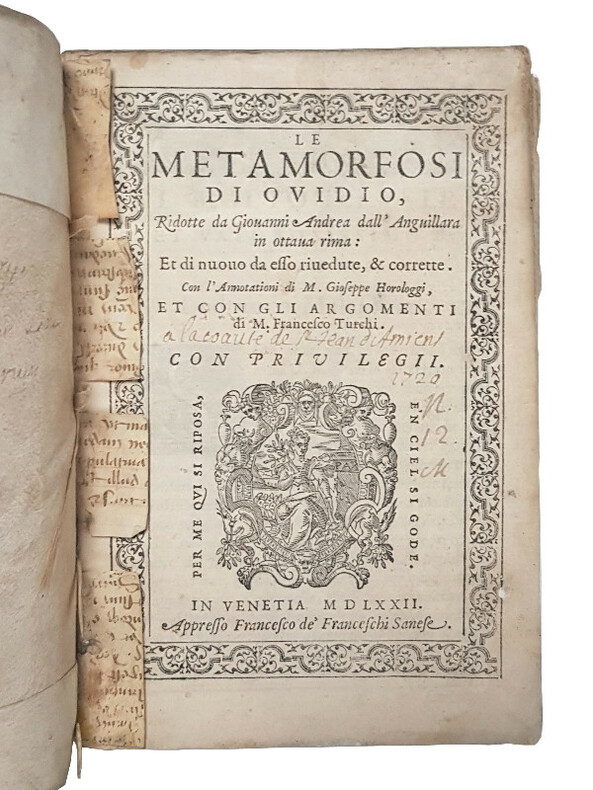
1572LCPCLIT-0037(Une très rare édition de poche des Métamorphoses d'Ovide en italien, conservée dans sa toute première reliure en vélin souple de l'époque) OVIDE (Publius Ovidius Naso). (Sulmona, 43 a.J.-C. - Tomis, 17-18 ap. J.-C.) "LE METAMORFOSI DI OVIDIO, RIDOTTE DA GIOVANNI ANDREA DELL'ANGUILLARA IN OTTAVA RIMA...". 1572, Venetia, F. de Franceschi Senese. 1 volume in-12° (155x112 mm) (dimensions pages 154x106 mm) 209, (1) pp. (y compris titre et dédicace), (2) ff. (table), (1) f. b., 15 gravures sur bois dans le texte. (A-Z8, Aa-Cc8, Dd4) Reliure en vélin souple strictement de l'époque. Très rare édition de poche. Quelques rares et infimes brunissures marginales, sinon très bel et séduisant exemplaire, conservé dans sa toute première reliure en vélin souple du temps. Composées au tout début du Ier siècle, sous le règne de l'Empereur Auguste, les Métamorphoses sont un long poème dont la composition débute probablement en l'an 1. L'oeuvre comprend quinz elivres (près de douze mille vers) écrits en hexamètres dactyliques et regroupe plusieurs centaines de récits courts sur le thème des métamorphoses issus de la mythologie grecque et de la mythologie romaine, organisés selon une structure complexe et souvent imbriqués les uns dans les autres. La structure générale du poème suit une progression chronologique, depuis la création du monde jusqu'à l'époque où vit l'auteur. Aucun exemplaire dans les collections publiques françaises. Un seul exemplaire dans les collections publiques italiennes (Verona). Provenance : Ex dono ms. "a lacoaule (sic! école?) de St Jean d'Amiens 1720". (LCPCLIT-0037)
15551186Lyon, Jean de Tournes et Guillaume Gazeau, 1555, in-16 ; plein vélin ivoire, titre manuscrit (reliure de l'époque) ; (24) feuillets (titre, dédicace, index des plantes en grec, latin, français, italien), 976 pages, (8) feuillets d’explications.
159214640Lyon, Q. Hug. A Porta, Fratres de Gabiano (Excudebat Guichardus Jullieron anno 1592), 1592 ; in-8 (164), plein vélin ivoire à recouvrements de l'époque ; (8), 312, (7) index, (1 bl.) ; 34 pp., (1) p., (1 bl.), 2 ff. blancs.
160088394Frankfurt a. M. Johannes Saur, 1600. [8], 791, [25] Seiten (Index), 1 Blatt. - /// Zusammen mit: [2.] Opera quae extant omnia Plutarchi Chaeronei: Ethica sive moralia complectentia interprete Herm Cruserio denuo recognita ... Ebda. 1605. 742; [32] Seiten (Index). - // Beide Werke mit Titelholzschnitten, Holzschnitten von Jost Amman (1539-1591) im Text u. geschnitt. Zierinitialen. 4to. 34 x 24 x 10 cm. Blindgeprägtes Pgt. d. Zt. auf 5 Bünden.
15491199Bâle, Jean Herwagen, 1549, in-folio ; plein vélin ivoire, dos à cinq nerfs soulignés de filets décoratifs à froid (reliure de l’époque) ; (6) feuillets (titre, préface, mensurae), 829 pages, (95) pages (annotations par L. Flori, Sigismond Gelenius et Beati Rhenani), (26) feuillets de chronologie par Glaeranum, (43) pages d’index, (1) page d’achevé d’imprimer, (2) feuillets (marque d’imprimeur, un blanc).Coiffe supérieure arrachée recollée, quelques lacunes sur les coupes, absence des lacets, milieu du volume légèrement déboîté mais l’ensemble reste solide et parfaitement manipulable.
15741124921574 Genevae (Genève), Apud Eustathium Vignon (Eustache Vignon), 1574, 1 volume in-4 de 180 x 250 mm environ, (12) ff. (page de titre, Epistola, Praefatio), 440 pages, écrit en latin avec un sens de lecture de la gauche vers la droite mais texte imprimé et paginé de la droite vers la gauche. Plein vélin souple d'époque au dos muet, traces de lien. Reliure en état d'usage (quelques taches sur les plats et une étiquette papier collée sur le plat supérieur, un coin plié), tampon de bibliothèque répété, annotations à l'encre pages 40-41-57-59, légères traces de mouillures aux coins d'une dizaine de feuillets, plus importantes sur 7 feuillets (p.195 à 208), discrets trous de vers, déchirure marginale sans atteinte au texte p. 304. Bel état pour cet ouvrage d'érudition rare.
158414506Francfort, Héritiers de André Wechel, 1584 ; in-4 ; plein vélin ivoire de l'époque, titre manuscrit au dos ; 341 pp., (1) p. corrigenda, (1) f. blanc. Texte grec jusqu'à la page 258 puis Annotations en latin sur deux colonnes et Index.
154611249Venise, Hieronymus Scotas, 1546 ; in-folio ; plein vélin ivoire en partie manuscrit (reliure de l'époque) ; (6) ff., 142 ff. recto-verso, (3) ff. le dernier, blanc, a été découpé.
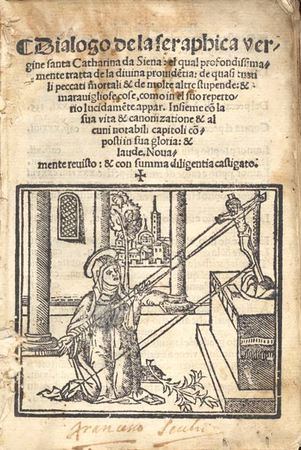
15406505Venetia (Venezia), Marchia Sessa, 1540 ; in-8 ; plein vélin vieil ivoire (reliure de l'époque) ; (32) ff., 224 ff., le dernier verso blanc ; grand bois gravé (88 x 78 mm) en page de titre représentant Sainte Catherine recevant les stigmates et marque d'imprimeur à la suite du collophon, achevé d'imprimer du 29 avril 1540, date anniversaire de la mort de la Sainte (29 avril 1380).
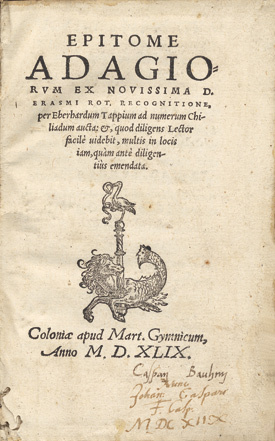
15499472Cologne, Mart. Gymnicus, 1549 ; in-8 ; plein vélin estampé sur ais de bois, dos à trois gros nerfs, fermoirs de cuivre (reliure de l'époque) ; (16) y compris le titre, 632, [634], (76) pp. index, (1) f. blanc (*, AZ, Aa-Xx - 8, Yy - 4).
1509Pharsale-Lucain-1509Édition rare et authentique de la Pharsale de Lucain, en format in folio, reliée en plein vélin blanc d’époque. Dos à 5 nerfs, reliure Janséniste, titré à la main au dos. Toutes tranches mouchetées, très frais. Petit trou d'envol au mors du plat supérieur arrière, trois dernières pages fendues en bas de marge, ainsi qu'un petit trou dans la marge. Rousseurs en marge sur le dernier cahier. Texte sur deux colonnes, lettrines.
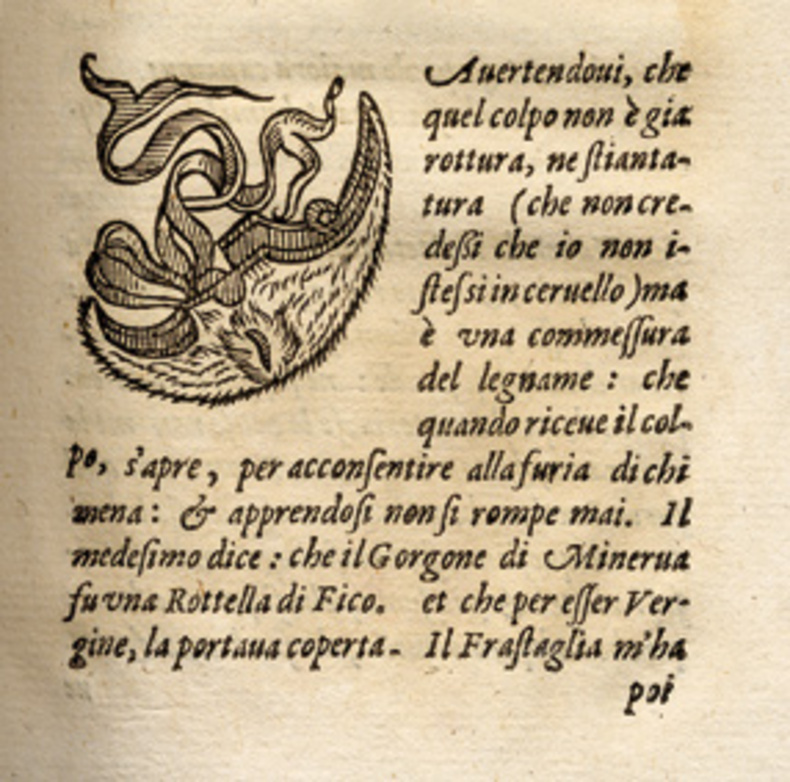
158414460Bengodi (fictive), s.n., 1584 (21 octobre) ; 3 tomes en un petit volume in-8 (157 x 100 mm) ; plein vélin ivoire à recouvrements de l'époque ; (12), 228 pp. (A-P 8) ; (8), le premier feuillet blanc, 401 pp., (1 bl.), (2) ff. blancs (A-Z 8, Aa-Cc 8) ; 142 pp. (Dd-Mm 8), (1) f. blanc et figure de la figue à fourrure p.107 de la 3e partie.
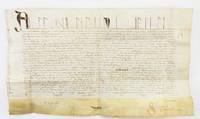
1502ST17895Rome 10 August 1502. 305 x 513 mm. 12 x 20 1/4". Single column 29 lines in a papal documentary script plus signatures at bottom. <br/> First line of text much larger and with elongated letters and calligraphic flourishes. WITH THE ORIGINAL LEAD SEAL AND HEMP TIES ATTACHED. Verso with several ink notations in different contemporary and later hands recto with a long ink line in one margin and the letter "A" in the other both by a later hand. Several folds to vellum as usual one-inch tear near where the hemp tie is attached a couple of small holes in the large "A" at the top of the document seal a little worn around edges and to the contours of the faces but overall in excellent condition with no major issues the vellum especially clean and bright.<br/> <br/> Issued to the overseer of a church in Frilingen probably modern Freilingen in Germany this bull orders the return of the vacated ecclesiastical seat and benefices of the church of St. James in Hergelzhausen in the diocese of Frilingen to two people. The church's rector Andrew Kuefuelz is to receive the position and things that once belonged to Leonard Walter the procurator while George Maltzel of Erding a priest of the same church is to receive the provisions and annual rents pertaining to the church. A member of the powerful Borgia family Rodrigo Borgia 1431-1503 served as vice-chancellor to five successive popes before being elected to the papacy in 1492 taking the name Alexander VI. One of two Borgias to ascend to the papacy the other was Callixtus III who died after just three years as pope Alexander held his own among a notorious family known for scandal. He led a sordid personal life--he was accused of participating in an orgy when he was a cardinal and openly admitted to fathering several children by his mistresses--and his reign was characterized by acts of nepotism and promoting his own family's interests above all else--especially with matters related to foreign policy. However he was also known as a patron of the arts having commissioned work by Raphael Michelangelo and Pinturicchio adopted a rather tolerant attitude toward Jews during this period and succeeded in cracking down on crime in Rome. The Papal Bull takes its name from the lead seals called "bullae" that were issued with official documents of the papacy as a way of ensuring their authenticity. Apart from the rare Solemn Privilege like Innocent III's famous granting of England in 1214 to his involuntary vassal King John there are three other categories of Papal Bulls: Simple Privileges also called Solemn Letters Letters of Grace which confirm privileges and rights and Mandates. The present item is of this final type differentiated by its use of hemp ties as opposed to silk. unknown
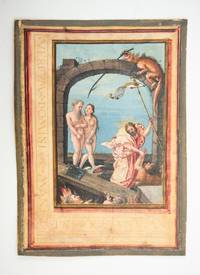
1540ST20622Germany ca. 1540. 183 x 133 mm. 7 1/8 x 5 1/4". <br/> WITH A FULL-PAGE MINIATURE DEPICTING THE HARROWING OF HELL featuring a naked Adam and Eve on the left and on the right Christ bending down to rescue John the Baptist the figures framed by a stone archway supporting a hairy creature who aims the point of a spear directly at Adam and Eve the miniature in a thin brown frame with gilt lines surrounded on two sides by the words "VERBUM DOMINI MANET IN ETERNUM" in gilt all framed in gray and red washes with double rules of black and gilt. Light soiling to frame a little flaking to the gray border and a couple of small scuffs and smudges elsewhere verso with spotting but the miniature vibrant and well preserved with only very trivial imperfections.<br/> <br/> A close copy of an early 16th century engraving by Albrecht Dürer this powerful miniature depicting the Harrowing of Hell is an intriguing artifact that ties together manuscript art print culture and the Reformation. The image depicts an apocryphal tale in the Gospel of Nicodemus in which Christ following his death but before his Resurrection descends into Limbo in order to save righteous souls who had passed away before him particularly figures from the Old Testament. Christ appears here in pale pink robes carrying a long staff with a cross and banner adorning the top. Having just brought down the gates of Hell he stoops to rescue John the Baptist here dressed in furs from its depths. A naked Adam and Eve covering their loins stand at the left of the composition--Adam now a gray-bearded old man as a reflection of sin and mortality but Eve still as she was at the Expulsion in keeping with the period's inclination to retain the classically idealized youthful feminine form. Above them is a stone arch upon which a dog-like demon perches stealthily aiming a spear directly at the oblivious couple. Another demon snaps its jaws at the feet of Christ and we can see a lick of flames below the broken gate as more captive souls clamor to escape. The painting is skillfully done showing the artist's facility with anatomy proportion and foreshortening. The bodies of Adam and Eve are particularly excellent with lovely skin tones and convincing molding. The composition is clearly based on an engraving by Dürer published in 1513 as part of a major series of 16 images known as the "Engraved Passion." In translating a black & white print into a full-color painting the artist here dispensed with a few details seen in Dürer's work such as the shadowy figure behind Adam and Eve and the stigmata on Christ's hand; however the overall composition deviates little from the original suggesting that the artist may have been working from an actual engraving. Although this leaf contains just a few words in the form of a border inscription--"Verbum Domini manet eternum" "the Word of the Lord endures forever"--they are monumentally important. This line from Isaiah 40:8 and 1 Peter 1:25 became the motto of the Lutheran Reformation appearing on art clothing coins and even armor of the 16th century. The Schmalkaldic League an influential group of allied Lutheran principalities in the Holy Roman Empire at the time also adopted it as their motto. Given the dominance of print materials during the Reformation period our hand-painted miniature--possibly produced as a frontispiece--must have been a very special commission. It is also an object that is prime for further study touching on aspects of book production religious art and the transmission of images and ideas in the early modern period. unknown
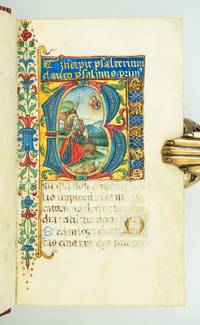
1536ST20557Italy Florence completed in 1536. 155 x 96 mm. 6 1/8 x 3 3/4". Single column 17 lines in a rounded gothic hand. 225 leaves first leaf and last three leaves blank. One signature bound upside-down the calendar bound at end but COMPLETE. With modern foliation in pencil i 225 leaves f. 222 omitted in numbering. <br/> Attractive 19th century red straight-grain morocco covers with lacy gilt border raised bands compartments with floral a scrolling tools with small stars and bezants green morocco label with gilt lettering gilt floral turn-ins all edges gilt and gauffered. In a fine modern pebble-grained red morocco folding box by A. Lobstein gilt lettering on spine lined with velvet. Rubrics in red numerous one-line initials and paragraph marks in red or blue many two-line gilt initials on ground of two colors red blue green or purple with small gold embellishments three-line "KL" initials for each calendar month in gilt TWO LARGE HISTORIATED INITIALS the first measuring approximately 11 lines 65 mm. and featuring King David in prayer the initial painted blue and embellished with green and pink acanthus on gold ground surrounded on two sides by bars of gilt lettering on blue and pink ground inner margin decorated with colorful floral motifs decorated with gilt bezants the second initial measuring six lines 35 mm. and featuring the Holy Trinity the initial painted pink with colorful acanthus on gilt ground and with a similar floral border in the outer margin and extending over the initial along the top. See: Alexander "The Painted Page" nos. 1 3 & 4; and Salmi "Italian Miniatures" frontispiece and pp. 52-53. Text rather faded in places though sense always recoverable isolated insignificant rubbing or chipping to the gilt a handful of trivial stains and instances of soiling or foxing but a nevertheless lovely manuscript--very clean and fresh with wide margins and the historiated initials especially well preserved. Just the slightest signs of use to the lustrous binding.<br/> <br/> This is a fine example of Florentine manuscript production from the early 16th century with a beautiful rounded gothic script sparkling initials and historiation that suggests a link to some of the most important miniaturists of the period. The decoration is composed of rich jewel tones and includes a half-page initial opening "Beatus vir" depicting King David in prayer and a smaller "D" opening Psalm 109 "Dixit Dominus Domino meo: a sede adextris meis" depicting the Holy Trinity. Each initial is embellished by a lovely partial border of floral motifs and many gilt bezants in a typical Florentine style. The large "Beatus vir" initial is particularly well done with excellent molding and shading and careful attention to even the smallest hair on David's beard. Into a relatively small space the artist manages to fit an entire outdoor scene complete with foreground middle ground and background including rolling hills a river and a distinctive rock formation that adds dimension scale and a sense of realism to the painting. Although whoever had the box made for this work attributed the manuscript to Giovanni Boccardi known as Boccardino il Vecchio 1460-1529 the figures and border decoration are stylistically closer to the work of two other contemporary workshops: that of Attavante degli Attavanti 1452-1525 and brothers Gherardo 1445-97 and Monte 1448-1532 di Giovanni del Fora. Of Attavante Salmi notes that he was "At one time the most celebrated miniaturist of the Renaissance" and Alexander says that he "was one of the most successful entrepreneurs in the Florentine book trade in obtaining commissions from patrons outside Florence." He counted European royalty among his patrons and executed celebrated manuscripts for Mattias Corvinus King of Hungary and Manuel I King of Portugal as well as high ranking members of the church including Pope Leo X. Among the many hands employed by Attavante were those of Gherardo and Monte di Giovanni del Fora which explains the closely related styles of the two workshops. Salmi notes that "As expert miniaturists Gherardo and Monte composed magnificent interiors evoking historical events and landscapes of great depth and drama abounding in descriptive details and precious minutiae worthy of the Books of Hours of Flemish and French Masters." In addition to stylistic similarities we have been able to find two other examples of miniatures with compositions that are very close to the "Beatus vir" initial in the present work both of which are attributed to Gherardo and Monte Giovanni del Fora or their workshop. These are: an "S" initial in a Choirbook at the Museo dell'Opera di S. Maria del Fiore we found a black & white reproduction only; and a full-page miniature in the Biblioteca Medicea Laurenziana MS Plut. 15.17. Like our opening initial these miniatures both depict King David kneeling in prayer dressed in similarly draped and shaped garments in the miniature with color reproductions available the garments are identically colored red and blue with an unusual lobed harp on the ground and a rocky outcropping in the background. Most notably in the latter miniature as well as our initial this rock formation includes a natural archway that has formed over a river. If we are to believe the final rubricated lines indicating that the manuscript was completed on 25 October 1536 then the historiated initials were probably painted by an artist who was at the very least quite familiar with the work of the aforementioned miniaturists if not directly employed by one of their workshops. The most likely workshop would be that of Monte Giovanni del Fora who died in 1532--four years before this work was supposedly completed. It is perhaps even conceivable that the production of the Psalter took long enough that the initials might have been executed during Monte's lifetime. It is unfortunate that three lines in the colophon have been erased as they may have provided additional information about the making of this manuscript. Whatever the case may be this is a lovely object with tasteful decoration that clearly echoes the work of some of Florence's finest workshops. Italian prayer books such as this are increasingly difficult to come by and the present item being complete and in excellent condition would be a fine addition to any private or institutional collection. unknown
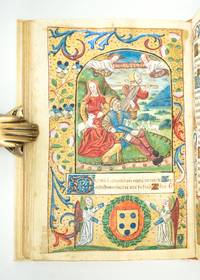
1516ST20620Northern France late 15th or early 16th century. 176 x 128 mm. 7 x 5". Single column 23 lines in a neat batârde hand. i blank 101 ii blank leaves. Lacking one leaf after f. 87 possibly containing a miniature otherwise complete. Contents: Calendar f. 1r; Gospel Lessons f. 7r; Passion according to John f. 10v; Hours of the Virgin f. 15v; Penitential Psalms and Litany f. 45r; Office of the Dead f. 54v; Hours of the Cross f. 68v; Hours of the Holy Spirit f. 70v; Prayers to the Trinity St. Veronica "Obsecro Te" "O Intemerata" and "Stabat Mater" f. 72v; Suffrages f. 79r; Prayers in French to be said on various occasions f. 86v; verse prayer in French beginning "Royne des cieulx glorieuse" f. 90r; additional prayers in French and Latin f. 93v. <br/> Attractive 19th century vellum with lacy gilt border raised bands ruled in gilt gilt lettering tan silk endleaves all edges gilt. Housed in a felt-lined reddish-brown pebbled morocco clamshell box with gilt lettering on spine. Rubrics in red numerous one- and two-line initials in painted gold on burgundy or blue ground WITH 27 SMALL MINIATURES one miniature of Christ Carrying the Cross measuring 60 x 68 mm. the rest depicting saints and measuring between eight and nine lines each surrounded by a full border of acanthus flowers and small dots on bare or painted vellum and 14 LARGE MINIATURES EACH OPENING WITH A FULL BORDER either with acanthus and flowers as before or architectural some borders embellished with figures animals or hybrids two with a small scene in the lower margin and about a dozen with the added coats of arms and/or mottos of Jean Boutin. The subjects of the large miniatures include the following: St. John of Patmos f. 7r; Annunciation f. 15v; Visitation f. 23r; Nativity f. 27v; Annunciation to the Shepherds f. 29v; Adoration of the Magi f. 31v; Presentation in the Temple f. 33v; Flight into Egypt f. 35v; Death of the Virgin f. 38v; Bathsheba bathing f. 45r; Funeral Mass f. 54v; Crucifixion f. 68v; Pentecost f .70v; Trinity f. 72v. See: Fairfax-Murray "French" p. 265-266. Vellum binding soiled but perfectly sound. Small portions of some border figures and perhaps three or four miniatures touched up in the 16th century see below occasional chipping to white paint small hole in the border of ff. 11 & 29 light scattered spotting fading thumb soiling and other minor issues but an attractive and substantially complete manuscript the illumination extensive and mostly well preserved.<br/> <br/> This heavily illustrated Book of Hours is a lovely example of provincial illumination; it calls attention in an interesting way to the influence of printed books on manuscript art; and it contains intriguing traces of an early prominent owner. Our manuscript contains a total of 41 large and small miniatures by a skilled artist who clearly had some training and familiarity with the prevailing styles of the time. The overall appearance of the work suggests the artist or workshop was located in Northern France and although the figures and backgrounds are indicative of a provincial hand the rich colors profuse use of liquid gold and sumptuous borders are unmistakable marks of luxury. The image of the Trinity is particularly lovely demanding the viewer's attention with God the Father's piercing gaze and conveying the majesty of the subject with a patterned throne set against a starry sky. Of special interest here are the compositions of the large miniatures many of which seem to have been copied from printed Books of Hours of the period. When we talk about the transition from manuscripts to print culture in the late-15th and 16th centuries the discussion often focuses on how the art of manuscripts influenced the appearance of printed works. There is no better example than Books of Hours which in printed editions often mimic the look of their manuscript predecessors in appearance and the way many were finished by hand. However as the present example demonstrates the opposite was also true as printed works inevitably made their way into the hands of manuscript artists. Some even worked simultaneously both as illustrators for publishers working with metal- and woodcuts and as manuscript painters. As a reflection of this point in the present work we find distinct similarities between our miniatures and a series of metalcuts used by Philippe Pigouchet for the publisher Simon Vostre beginning in 1496 Fairfax-Murray's set 2. According to Fairfax-Murray "These cuts . . . were evidently very favourably received by Pigouchet's rivals and imitators for one finds several close copies and adaptations in the various productions of other presses" including a very close imitation of woodcut images commissioned by the publisher Antoine Vérard. Evidently the popularity of these plates extended to manuscript artists and it is fascinating to see the adaptation of each composition to suit the painter's own style and the patron's needs. Most of the compositions in our manuscript are essentially simplified versions of the printed miniatures retaining the central figures their gestures garments and props but with complex backgrounds eschewed as are extra figures deemed unnecessary to fulfill the narrative. The resulting miniatures are far less busy than their printed counterparts allowing the viewer to focus on the central story. In a few instances the artist has added small scenes beneath the large miniatures. An example on f. 35 depicts the so-called "Miracle of the Wheat" featuring harvesters misleading Herod's soldiers by truthfully saying that the fleeing Holy Family passed by when their now miraculously matured crop was just being sown. This kind of inclusion may have been influenced by the copious small metalcut scenes that decorate the borders of numerous printed Books of Hours of this period. The text here follows a fairly typical structure but includes prayers in French to be said for each day of the week and on various occasions such as when one awakens or when one leaves a house. Also in French are additional verses to the Virgin--one of which is credited to the Franciscan preacher Jean Tisserand d. 1497 who founded an order for repentant women. Another accessory prayer included here f. 98 appeared in both prayer books and conjuring manuals of the period straddling the line between religion and popular magic. Based on an apocryphal encounter between Pope Leo III and Charlemagne during the Battle of Roncevaux this prayer was often used as a protective amulet against all manner of evil; here it is said to "conquer demons and one's enemies." Although we do not know for whom this manuscript was originally made the book shows a number of marginal customizations in the form of different coats of arms the motto "Soit avenu" "Let it come to pass" and the name of Jean Boutin written on ff. 23 and 35. This owner could have been Jean Boutin Sieur de la Court et de Chamballan and Mayor of Nantes from 1575-76. In addition to the marginal customizations the manuscript may possibly have some very neat replenishing of white facial paint in a handful of marginal figures and perhaps in a very small number of the miniatures. Using magnification and strong light we are unable to find convincing evidence that this retouching took place at least in the miniatures and if it was we think it was done quite early perhaps in the 16th century. Worst case it would necessarily be termed subtle and skillful enough to cause uncertainty now and whatever the verdict is in this respect the manuscript remains very fresh and attractive features attractively executed paintings is complete but for one leaf and would provide ample room for additional research. unknown